Why Most of Your Non-Human Identities Are Now AI Agents and Not Service Accounts

Share via:
blog-cms-banner-bg
Little-Known Negotiation Hacks to Get the Best Deal on Slack
cta-bg-blogDownload Your Copy

HIPAA Compliance Checklist for 2025

Download PDF

An IAM team begins an NHI discovery exercise expecting to find service accounts, scheduled jobs, and API keys. Instead, they uncover a Copilot Studio agent built by marketing, an n8n workflow connected to Salesforce, and several Claude-powered automations created by engineering. None of them went through IT.

This is the shift most IGA programs haven't caught up to. AI adoption is happening from the bottom up, with employees building AI agents in low-code platforms outside traditional provisioning and approval workflows. Each agent creates a non-human identity that behaves very differently from the service accounts identity teams are used to governing.

Governing AI agents still requires ownership, access reviews, and lifecycle management. But it also requires visibility into how these agents are created, what systems they access, and how their permissions evolve over time.

TL;DR

  • AI agents are NHIs, but they are not service accounts. 
  • The three AI agent scenarios most likely to create a security incident: the abandoned agent, the over-permissioned agent, and the externally shared agent. All three are invisible to traditional NHI discovery
  • Traditional NHI discovery relies on Active Directory and secrets management tools. AI agents created in Copilot Studio, n8n, and Zapier appear in neither
  • CloudEagle delivers continuous lifecycle management for applications, user identities, and non-human identities, including AI agents created in low-code platforms that never touched IT's provisioning workflow
  • Governing AI agents requires discovery across creation platforms, ownership assignment at creation, and review cadence that matches the rate of change

1. How AI Agents Differ From Service Accounts as NHIs

IAM teams know service accounts. The distinction that matters here is not what AI agents are in general. It is specifically how they differ from service accounts in the three dimensions that governance programs depend on.

  • Who creates them: Service accounts are created by IT or DevOps through a provisioning process. There is a ticket, a requester, and an approval. AI agents are created by business users in Copilot Studio, n8n, Zapier, Make, and LangChain, with no ticket required, no IT review, and no provisioning workflow. The identity exists the moment the user clicks deploy, regardless of whether any governance process has been triggered.
  • What they connect to: Service accounts typically connect to defined infrastructure endpoints with permissions scoped to their specific function. AI agents connect to whatever data sources the business user had access to when they built the agent: SharePoint libraries, Salesforce orgs, customer email inboxes, financial systems. Those connections carry the full permission scope of the user who created them, not a least-privilege scope designed for the agent's actual task.
  • How their permissions drift: Service account permissions are relatively static. They are set at creation and changed through a change management process. AI agent permissions drift as the agent is modified, as connected data sources change, and as the agent is shared with additional users who run it under their own credentials. A Copilot Studio agent shared across a team now runs with the permission scope of every user who has executed it, accumulated over time, with no review trigger for any of those changes.

Service accounts are infrastructure. AI agents are business logic running with standing access to your most sensitive systems, and most of them were never reviewed by security.

AI Agents Need Governance Too.

See the identity risks that emerge when AI agents operate outside IT oversight.
See the Risks

2. How CloudEagle.ai Governs AI Agents Alongside Traditional NHIs

AI agents are becoming a new class of non-human identity, but most identity governance programs still treat them separately from service accounts, managed identities, and API tokens. CloudEagle.ai brings them together in one governance platform, giving security teams continuous visibility into every NHI, regardless of how it was created.

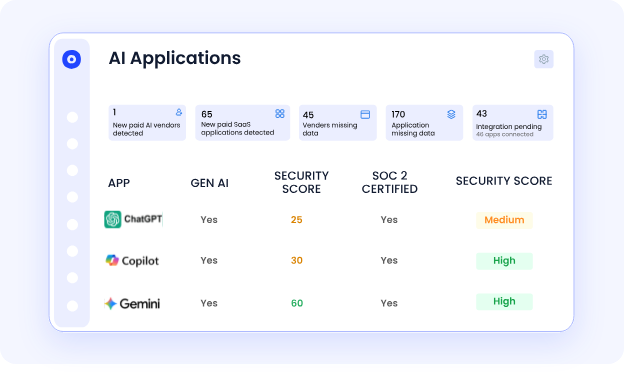
Discover AI Agents Across Every Creation Channel

AI agents can be created in Microsoft Copilot Studio, n8n, Zapier, and other low-code platforms without ever passing through an IT provisioning workflow.
How it helps

  • Discovers AI agents, service accounts, managed identities, and API tokens in one inventory
  • Correlates browser, endpoint, network, SSO, HR, and finance signals to identify AI agents running across the enterprise
  • Detects AI agents created through business-led or shadow AI initiatives
  • Surfaces new AI agents automatically without relying on manual registration

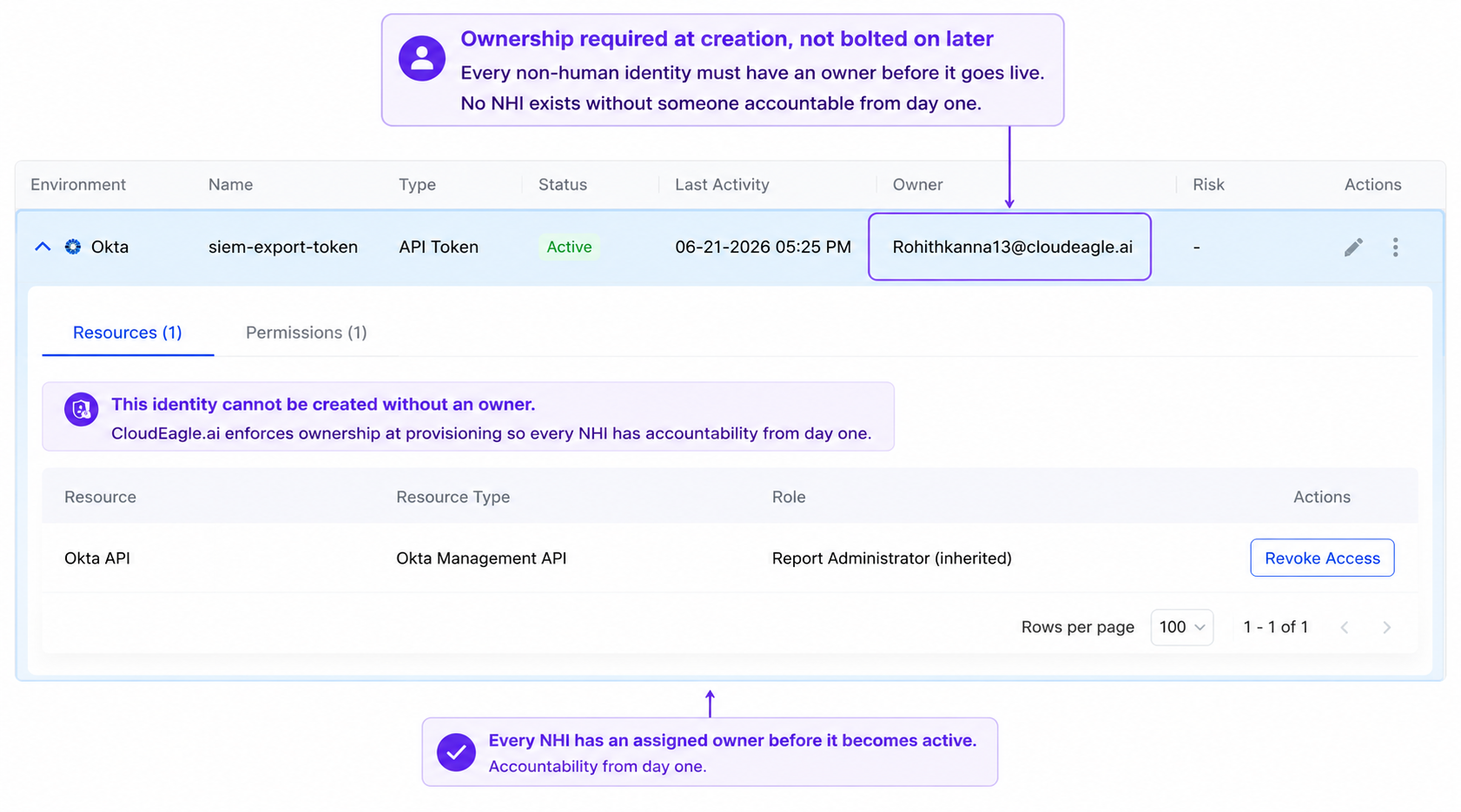
Assign Ownership and Eliminate Ownerless Agents

Every AI agent should have a clearly accountable human owner.
How it helps

  • Maps each AI agent to its creator, business owner, and department
  • Flags ownerless agents when employees leave or contractor engagements end
  • Maintains a complete ownership history for every AI agent
  • Creates an audit trail for ownership changes and governance actions

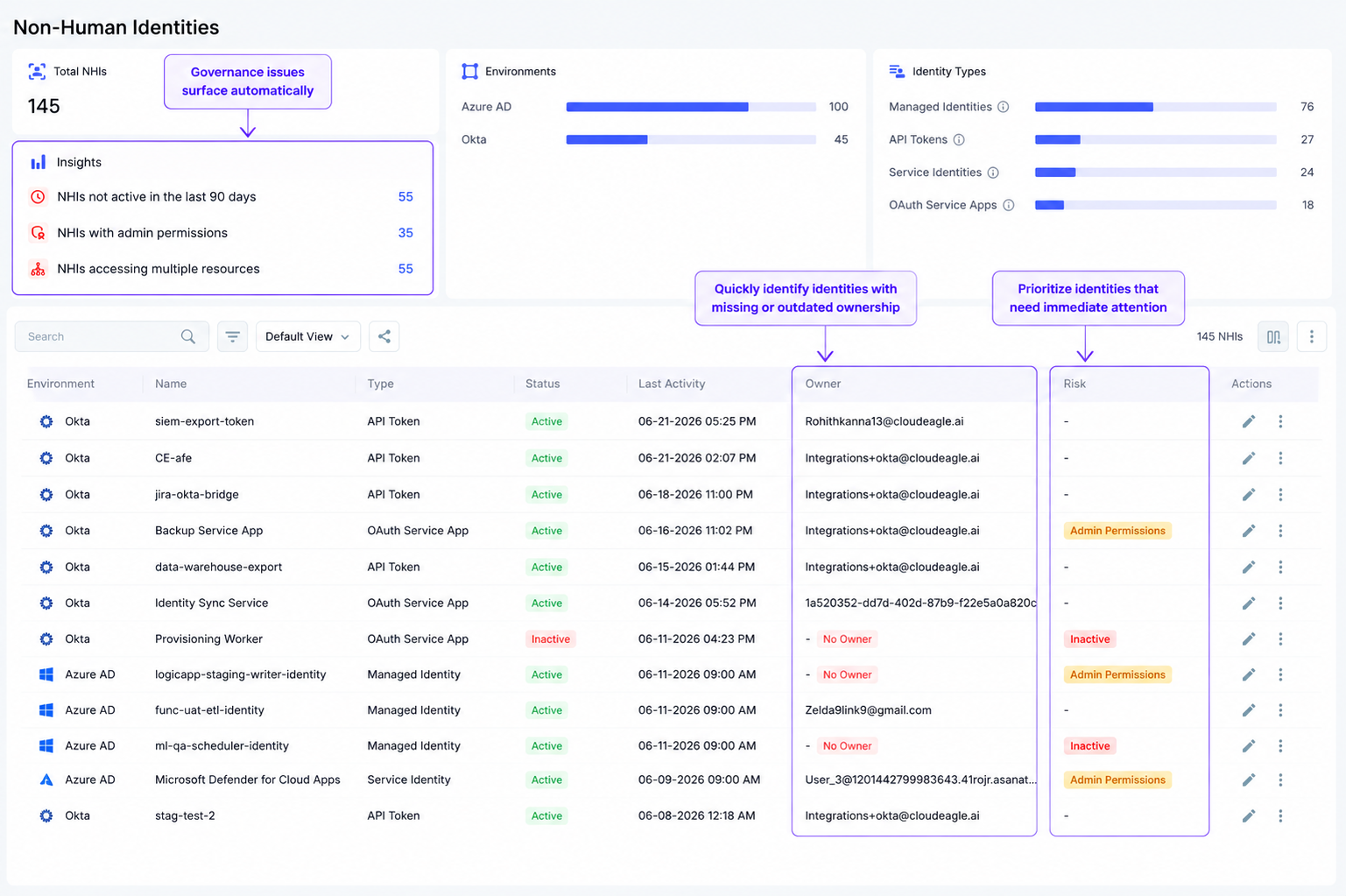
Understand What Every AI Agent Can Access

Knowing an AI agent exists is only half the problem. Security teams also need to understand what it can reach.
How it helps

  • Maps OAuth permissions, API connections, and connected enterprise systems
  • Shows access to CRM platforms, SharePoint, email, HR, finance, cloud storage, and other business applications
  • Highlights AI agents whose permissions exceed their intended business purpose
  • Surfaces excessive privileges before they become security incidents

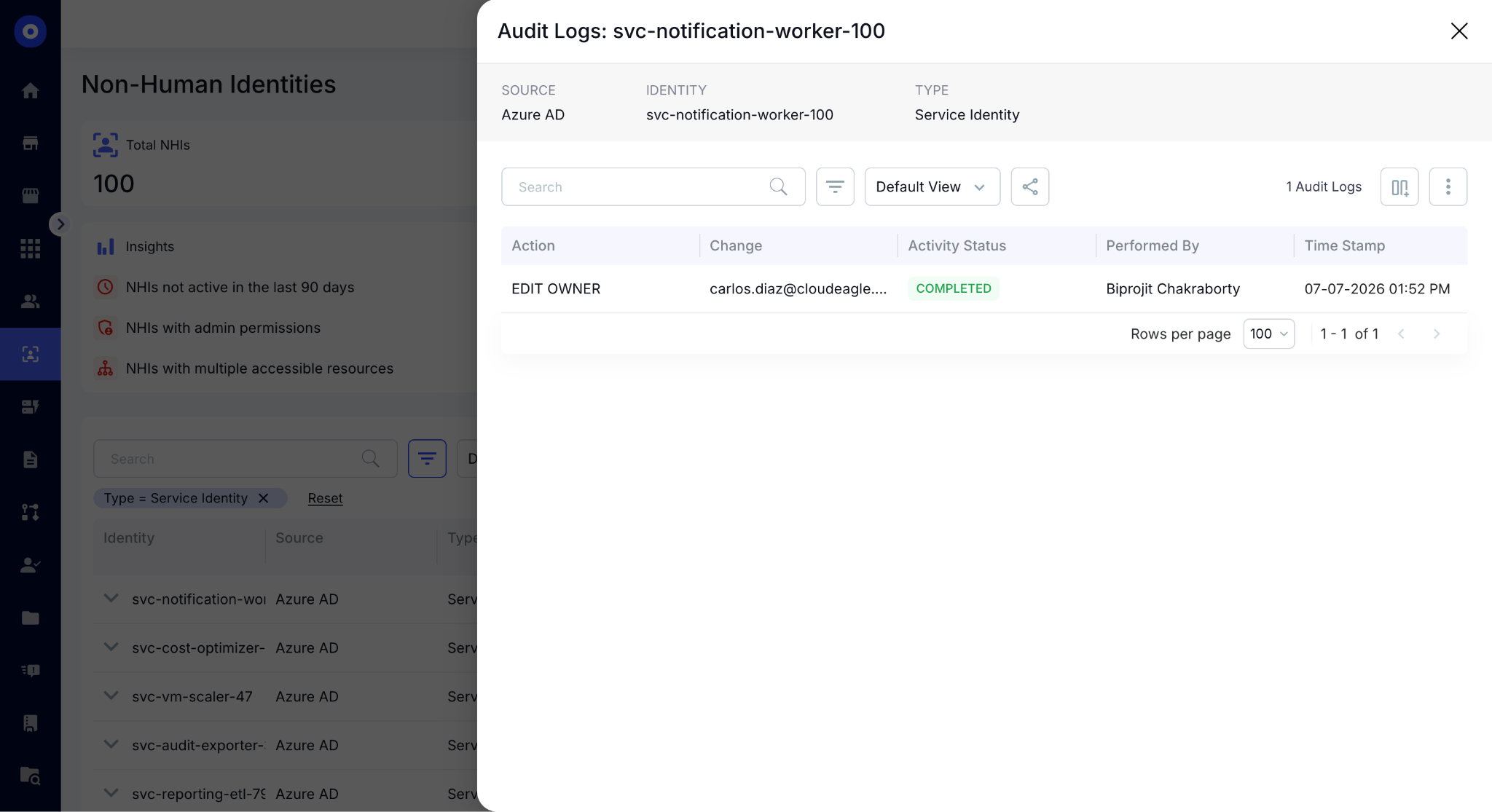
Continuously Review and Govern AI Agents

AI agents should be reviewed with the same rigor as human identities and traditional NHIs.
How it helps

  • Includes AI agents in continuous NHI and access certification campaigns
  • Automatically assigns reviews to business owners
  • Revokes access for agents that fail certification or no longer have an owner
  • Generates audit-ready evidence for every review, approval, and remediation action

Take Action Without Leaving the Platform

Visibility alone doesn't reduce risk. Security teams need to remediate AI identity risks quickly.

How it helps

  • Revoke access to connected resources directly from the governance console
  • Remove excessive permissions while keeping legitimate automations running
  • Rotate API keys and credentials for compromised or high-risk identities
  • Govern AI agents alongside service accounts, managed identities, and API tokens through a single workflow

3. The Three AI Agent Scenarios Most Likely to Create a Security Incident

These aren't hypothetical examples. They are common patterns organizations discover once they start identifying and governing AI agents across the enterprise.

Scenario 1: The Abandoned Agent

A business analyst builds a Copilot Studio agent connected to SharePoint and Salesforce for a project. When the project ends, the analyst moves to another team, but the agent keeps running.

It still has access to both systems, yet no one owns it, no access review is scheduled, and no revocation process is triggered.

The employee's SSO account was deprovisioned, but the agent's OAuth connections remained active because the offboarding process didn't include AI agents.

What goes wrong

  • No active owner for the AI agent
  • Standing access to enterprise applications
  • No scheduled access reviews
  • Orphaned AI agent continues running indefinitely

CloudEagle surfaces the agent as an ownerless non-human identity (NHI) and automatically flags it for review when the creator leaves the organization.

Scenario 2: The Over-Permissioned Agent

A developer creates an AI coding assistant connected to GitHub using their own OAuth credentials. Those credentials include administrator privileges from an earlier project, and the permissions were never reduced.

The AI agent inherits those admin privileges. When the developer shares the agent with the rest of the engineering team, multiple users begin using an agent with privileged GitHub access that was never reviewed.

What goes wrong

  • AI agent inherits excessive OAuth permissions
  • Privileged access isn't aligned with the agent's purpose
  • Shared agent expands the security impact
  • No approval or governance before deployment

CloudEagle compares an agent's intended function with its actual permissions and flags excessive access as a policy deviation.

Scenario 3: The Externally Shared Agent

A Copilot Studio agent built for internal document search is accidentally published to a public URL. The creator assumes "Publish" only makes the agent available internally.

The agent still has access to internal SharePoint content, but its exposure expands from employees to anyone with the link.

Traditional security tools often miss this because the permissions themselves haven't changed.

What goes wrong

  • Internal AI agent becomes externally accessible
  • Enterprise data remains connected
  • No review is triggered when exposure changes
  • Increased risk of unauthorized data access

CloudEagle combines an agent's accessibility with its connected data sources, helping security teams identify externally exposed AI agents before they become an incident.

📖 Worth a Read 👉 The 4 Types of AI Risk That Traditional Security Tools Weren't Designed to Handle

4. Why Your Existing NHI Governance Process Doesn't Cover AI Agents

The gap is structural, not a process failure. Existing NHI governance was designed around a specific discovery and review pattern that AI agents simply do not fit.

The Discovery Gap

Traditional NHI discovery relies on IT-managed provisioning systems. Service accounts appear in Active Directory, while API keys live in secrets management tools. AI agents created in Copilot Studio, n8n, or Zapier appear in neither. They exist inside the platforms where they were built, with data access established through OAuth grants across connected applications.

As a result, AI agents remain invisible to the governance systems IT already relies on.

The Review Gap

Traditional NHI reviews assume identities have a fixed purpose, owner, and permission set. AI agents don't. Business users can update prompts, connect new data sources, expand permissions, or share agents without triggering change management.

Quarterly or annual reviews were designed for infrastructure that changes slowly. AI agents evolve continuously and require governance that keeps pace with those changes.

5. What AI Agent Governance Needs to Look Like Going Forward

Three principles distinguish AI agent governance from traditional NHI governance:

  • Discovery must extend beyond IT provisioning systems: AI agents created in Copilot Studio, n8n, Zapier, and similar platforms won't appear in Active Directory or secrets management tools. Governance must explicitly discover identities across these low-code platforms.
  • Ownership should be assigned as soon as an AI agent is discovered: Unlike service accounts, AI agents are often created without a provisioning workflow. Assigning an owner early prevents unmanaged identities from accumulating access over time.
  • Reviews should be event-driven, not calendar-driven: AI agents change far more frequently than traditional NHIs. Governance should trigger reviews when permissions, integrations, or ownership change instead of relying solely on quarterly or annual review cycles.

CloudEagle.ai enables enterprises to govern AI agents with the same lifecycle management that governs service accounts, extended across the discovery channels, ownership models, and review cadences that AI agents actually require before the agent inventory becomes unmanageable.

Conclusion

The NHIs multiplying fastest in your environment are not the ones your IGA program was built for. Service accounts follow a provisioning process. AI agents do not. Service accounts are discovered through IT-managed systems. AI agents are not. Service account permissions change through change management. AI agent permissions drift through business user activity with no review trigger.

Governing AI agents requires discovery across the creation platforms where they actually live, ownership assignment at the moment of discovery, and a review cadence that matches how frequently these identities change. 

CloudEagle.ai provides all three alongside traditional NHI governance, in a unified inventory that gives IAM teams a complete picture of every non-human identity in the environment, regardless of how it was created.

See CloudEagle's NHI Governance in Action → Book a Demo

Frequently Asked Questions

1. What is the difference between an AI agent and a service account?
Service accounts are provisioned and governed by IT. AI agents are often created by business users in low-code platforms, inherit OAuth permissions, and can change over time, making them harder to discover and govern.

2. Why doesn't traditional NHI discovery detect AI agents?
Traditional NHI discovery focuses on Active Directory, IAM, and secrets managers. AI agents created in Copilot Studio, n8n, or Zapier exist outside those systems and require dedicated discovery across AI platforms and OAuth connections.

3. Why are abandoned AI agents a security risk?
When an employee leaves, their SSO account may be removed, but AI agents they created can continue running with active OAuth permissions. Without an owner or review, they can retain unnecessary access to enterprise data.

4. How should enterprises govern AI agents as non-human identities?
Organizations should continuously discover AI agents, assign ownership when they're created, and trigger reviews whenever permissions, integrations, or configurations change instead of relying only on periodic access reviews.

5. Can AI agents become over-permissioned?
Yes. AI agents often inherit the OAuth permissions of the user who created them. If those permissions are broader than the agent's purpose, the agent may gain unnecessary access to sensitive systems and data unless governance policies enforce least privilege.

Advertisement for a SaaS Subscription Tracking Template with a call-to-action button to download and a partial graphic of a tablet showing charts.Banner promoting a SaaS Agreement Checklist to streamline SaaS management and avoid budget waste with a call-to-action button labeled Download checklist.Blue banner with text 'The Ultimate Employee Offboarding Checklist!' and a black button labeled 'Download checklist' alongside partial views of checklist documents from cloudeagle.ai.Digital ad for download checklist titled 'The Ultimate Checklist for IT Leaders to Optimize SaaS Operations' by cloudeagle.ai, showing checklist pages.Slack Buyer's Guide offer with text 'Unlock insider insights to get the best deal on Slack!' and a button labeled 'Get Your Copy', accompanied by a preview of the guide featuring Slack's logo.Monday Pricing Guide by cloudeagle.ai offering exclusive pricing secrets to maximize investment with a call-to-action button labeled Get Your Copy and an image of the guide's cover.Blue banner for Canva Pricing Guide by cloudeagle.ai offering a guide to Canva costs, features, and alternatives with a call-to-action button saying Get Your Copy.Blue banner with white text reading 'Little-Known Negotiation Hacks to Get the Best Deal on Slack' and a white button labeled 'Get Your Copy'.Blue banner with text 'Little-Known Negotiation Hacks to Get the Best Deal on Monday.com' and a white button labeled 'Get Your Copy'.Blue banner with text 'Little-Known Negotiation Hacks to Get the Best Deal on Canva' and a white button labeled 'Get Your Copy'.Banner with text 'Slack Buyer's Guide' and a 'Download Now' button next to images of a guide titled 'Slack Buyer’s Guide: Features, Pricing & Best Practices'.Digital cover of Monday Pricing Guide with a button labeled Get Your Copy on a blue background.Canva Pricing Guide cover with a button labeled Get Your Copy on a blue gradient background.

Enter your email to
unlock the report

Oops! Something went wrong while submitting the form.
License Count
Benchmark
Per User/Per Year

Enter your email to
unlock the report

Oops! Something went wrong while submitting the form.
License Count
Benchmark
Per User/Per Year

Enter your email to
unlock the report

Oops! Something went wrong while submitting the form.
Notion Plus
License Count
Benchmark
Per User/Per Year
100-500
$67.20 - $78.72
500-1000
$59.52 - $72.00
1000+
$51.84 - $57.60
Canva Pro
License Count
Benchmark
Per User/Per Year
100-500
$74.33-$88.71
500-1000
$64.74-$80.32
1000+
$55.14-$62.34

Enter your email to
unlock the report

Oops! Something went wrong while submitting the form.

Enter your email to
unlock the report

Oops! Something went wrong while submitting the form.
Zoom Business
License Count
Benchmark
Per User/Per Year
100-500
$216.00 - $264.00
500-1000
$180.00 - $216.00
1000+
$156.00 - $180.00

Enter your email to
unlock the report

Oops! Something went wrong while submitting the form.

Get the Right Security Platform To Secure Your Cloud Infrastructure

Please enter a business email
Thank you!
The 2023 SaaS report has been sent to your email. Check your promotional or spam folder.
Oops! Something went wrong while submitting the form.

Access full report

Please enter a business email
Thank you!
The 2023 SaaS report has been sent to your email. Check your promotional or spam folder.
Oops! Something went wrong while submitting the form.

An IAM team begins an NHI discovery exercise expecting to find service accounts, scheduled jobs, and API keys. Instead, they uncover a Copilot Studio agent built by marketing, an n8n workflow connected to Salesforce, and several Claude-powered automations created by engineering. None of them went through IT.

This is the shift most IGA programs haven't caught up to. AI adoption is happening from the bottom up, with employees building AI agents in low-code platforms outside traditional provisioning and approval workflows. Each agent creates a non-human identity that behaves very differently from the service accounts identity teams are used to governing.

Governing AI agents still requires ownership, access reviews, and lifecycle management. But it also requires visibility into how these agents are created, what systems they access, and how their permissions evolve over time.

TL;DR

  • AI agents are NHIs, but they are not service accounts. 
  • The three AI agent scenarios most likely to create a security incident: the abandoned agent, the over-permissioned agent, and the externally shared agent. All three are invisible to traditional NHI discovery
  • Traditional NHI discovery relies on Active Directory and secrets management tools. AI agents created in Copilot Studio, n8n, and Zapier appear in neither
  • CloudEagle delivers continuous lifecycle management for applications, user identities, and non-human identities, including AI agents created in low-code platforms that never touched IT's provisioning workflow
  • Governing AI agents requires discovery across creation platforms, ownership assignment at creation, and review cadence that matches the rate of change

1. How AI Agents Differ From Service Accounts as NHIs

IAM teams know service accounts. The distinction that matters here is not what AI agents are in general. It is specifically how they differ from service accounts in the three dimensions that governance programs depend on.

  • Who creates them: Service accounts are created by IT or DevOps through a provisioning process. There is a ticket, a requester, and an approval. AI agents are created by business users in Copilot Studio, n8n, Zapier, Make, and LangChain, with no ticket required, no IT review, and no provisioning workflow. The identity exists the moment the user clicks deploy, regardless of whether any governance process has been triggered.
  • What they connect to: Service accounts typically connect to defined infrastructure endpoints with permissions scoped to their specific function. AI agents connect to whatever data sources the business user had access to when they built the agent: SharePoint libraries, Salesforce orgs, customer email inboxes, financial systems. Those connections carry the full permission scope of the user who created them, not a least-privilege scope designed for the agent's actual task.
  • How their permissions drift: Service account permissions are relatively static. They are set at creation and changed through a change management process. AI agent permissions drift as the agent is modified, as connected data sources change, and as the agent is shared with additional users who run it under their own credentials. A Copilot Studio agent shared across a team now runs with the permission scope of every user who has executed it, accumulated over time, with no review trigger for any of those changes.

Service accounts are infrastructure. AI agents are business logic running with standing access to your most sensitive systems, and most of them were never reviewed by security.

AI Agents Need Governance Too.

See the identity risks that emerge when AI agents operate outside IT oversight.
See the Risks

2. How CloudEagle.ai Governs AI Agents Alongside Traditional NHIs

AI agents are becoming a new class of non-human identity, but most identity governance programs still treat them separately from service accounts, managed identities, and API tokens. CloudEagle.ai brings them together in one governance platform, giving security teams continuous visibility into every NHI, regardless of how it was created.

Discover AI Agents Across Every Creation Channel

AI agents can be created in Microsoft Copilot Studio, n8n, Zapier, and other low-code platforms without ever passing through an IT provisioning workflow.

How it helps

  • Discovers AI agents, service accounts, managed identities, and API tokens in one inventory
  • Correlates browser, endpoint, network, SSO, HR, and finance signals to identify AI agents running across the enterprise
  • Detects AI agents created through business-led or shadow AI initiatives
  • Surfaces new AI agents automatically without relying on manual registration

Assign Ownership and Eliminate Ownerless Agents

Every AI agent should have a clearly accountable human owner.

How it helps

  • Maps each AI agent to its creator, business owner, and department
  • Flags ownerless agents when employees leave or contractor engagements end
  • Maintains a complete ownership history for every AI agent
  • Creates an audit trail for ownership changes and governance actions

Understand What Every AI Agent Can Access

Knowing an AI agent exists is only half the problem. Security teams also need to understand what it can reach.

How it helps

  • Maps OAuth permissions, API connections, and connected enterprise systems
  • Shows access to CRM platforms, SharePoint, email, HR, finance, cloud storage, and other business applications
  • Highlights AI agents whose permissions exceed their intended business purpose
  • Surfaces excessive privileges before they become security incidents

Continuously Review and Govern AI Agents

AI agents should be reviewed with the same rigor as human identities and traditional NHIs.

How it helps

  • Includes AI agents in continuous NHI and access certification campaigns
  • Automatically assigns reviews to business owners
  • Revokes access for agents that fail certification or no longer have an owner
  • Generates audit-ready evidence for every review, approval, and remediation action

Take Action Without Leaving the Platform

Visibility alone doesn't reduce risk. Security teams need to remediate AI identity risks quickly.

How it helps

  • Revoke access to connected resources directly from the governance console
  • Remove excessive permissions while keeping legitimate automations running
  • Rotate API keys and credentials for compromised or high-risk identities
  • Govern AI agents alongside service accounts, managed identities, and API tokens through a single workflow

3. The Three AI Agent Scenarios Most Likely to Create a Security Incident

These aren't hypothetical examples. They are common patterns organizations discover once they start identifying and governing AI agents across the enterprise.

Scenario 1: The Abandoned Agent

A business analyst builds a Copilot Studio agent connected to SharePoint and Salesforce for a project. When the project ends, the analyst moves to another team, but the agent keeps running.

It still has access to both systems, yet no one owns it, no access review is scheduled, and no revocation process is triggered.

The employee's SSO account was deprovisioned, but the agent's OAuth connections remained active because the offboarding process didn't include AI agents.

What goes wrong

  • No active owner for the AI agent
  • Standing access to enterprise applications
  • No scheduled access reviews
  • Orphaned AI agent continues running indefinitely

CloudEagle surfaces the agent as an ownerless non-human identity (NHI) and automatically flags it for review when the creator leaves the organization.

Scenario 2: The Over-Permissioned Agent

A developer creates an AI coding assistant connected to GitHub using their own OAuth credentials. Those credentials include administrator privileges from an earlier project, and the permissions were never reduced.

The AI agent inherits those admin privileges. When the developer shares the agent with the rest of the engineering team, multiple users begin using an agent with privileged GitHub access that was never reviewed.

What goes wrong

  • AI agent inherits excessive OAuth permissions
  • Privileged access isn't aligned with the agent's purpose
  • Shared agent expands the security impact
  • No approval or governance before deployment

CloudEagle compares an agent's intended function with its actual permissions and flags excessive access as a policy deviation.

Scenario 3: The Externally Shared Agent

A Copilot Studio agent built for internal document search is accidentally published to a public URL. The creator assumes "Publish" only makes the agent available internally.

The agent still has access to internal SharePoint content, but its exposure expands from employees to anyone with the link.

Traditional security tools often miss this because the permissions themselves haven't changed.

What goes wrong

  • Internal AI agent becomes externally accessible
  • Enterprise data remains connected
  • No review is triggered when exposure changes
  • Increased risk of unauthorized data access

CloudEagle combines an agent's accessibility with its connected data sources, helping security teams identify externally exposed AI agents before they become an incident.

📖 Worth a Read 👉 The 4 Types of AI Risk That Traditional Security Tools Weren't Designed to Handle

4. Why Your Existing NHI Governance Process Doesn't Cover AI Agents

The gap is structural, not a process failure. Existing NHI governance was designed around a specific discovery and review pattern that AI agents simply do not fit.

The Discovery Gap

Traditional NHI discovery relies on IT-managed provisioning systems. Service accounts appear in Active Directory, while API keys live in secrets management tools. AI agents created in Copilot Studio, n8n, or Zapier appear in neither. They exist inside the platforms where they were built, with data access established through OAuth grants across connected applications.

As a result, AI agents remain invisible to the governance systems IT already relies on.

The Review Gap

Traditional NHI reviews assume identities have a fixed purpose, owner, and permission set. AI agents don't. Business users can update prompts, connect new data sources, expand permissions, or share agents without triggering change management.

Quarterly or annual reviews were designed for infrastructure that changes slowly. AI agents evolve continuously and require governance that keeps pace with those changes.

5. What AI Agent Governance Needs to Look Like Going Forward

Three principles distinguish AI agent governance from traditional NHI governance:

  • Discovery must extend beyond IT provisioning systems: AI agents created in Copilot Studio, n8n, Zapier, and similar platforms won't appear in Active Directory or secrets management tools. Governance must explicitly discover identities across these low-code platforms.
  • Ownership should be assigned as soon as an AI agent is discovered: Unlike service accounts, AI agents are often created without a provisioning workflow. Assigning an owner early prevents unmanaged identities from accumulating access over time.
  • Reviews should be event-driven, not calendar-driven: AI agents change far more frequently than traditional NHIs. Governance should trigger reviews when permissions, integrations, or ownership change instead of relying solely on quarterly or annual review cycles.

CloudEagle.ai enables enterprises to govern AI agents with the same lifecycle management that governs service accounts, extended across the discovery channels, ownership models, and review cadences that AI agents actually require before the agent inventory becomes unmanageable.

Conclusion

The NHIs multiplying fastest in your environment are not the ones your IGA program was built for. Service accounts follow a provisioning process. AI agents do not. Service accounts are discovered through IT-managed systems. AI agents are not. Service account permissions change through change management. AI agent permissions drift through business user activity with no review trigger.

Governing AI agents requires discovery across the creation platforms where they actually live, ownership assignment at the moment of discovery, and a review cadence that matches how frequently these identities change. 

CloudEagle.ai provides all three alongside traditional NHI governance, in a unified inventory that gives IAM teams a complete picture of every non-human identity in the environment, regardless of how it was created.

See CloudEagle's NHI Governance in Action → Book a Demo

Frequently Asked Questions

1. What is the difference between an AI agent and a service account?
Service accounts are provisioned and governed by IT. AI agents are often created by business users in low-code platforms, inherit OAuth permissions, and can change over time, making them harder to discover and govern.

2. Why doesn't traditional NHI discovery detect AI agents?
Traditional NHI discovery focuses on Active Directory, IAM, and secrets managers. AI agents created in Copilot Studio, n8n, or Zapier exist outside those systems and require dedicated discovery across AI platforms and OAuth connections.

3. Why are abandoned AI agents a security risk?
When an employee leaves, their SSO account may be removed, but AI agents they created can continue running with active OAuth permissions. Without an owner or review, they can retain unnecessary access to enterprise data.

4. How should enterprises govern AI agents as non-human identities?
Organizations should continuously discover AI agents, assign ownership when they're created, and trigger reviews whenever permissions, integrations, or configurations change instead of relying only on periodic access reviews.

5. Can AI agents become over-permissioned?
Yes. AI agents often inherit the OAuth permissions of the user who created them. If those permissions are broader than the agent's purpose, the agent may gain unnecessary access to sensitive systems and data unless governance policies enforce least privilege.

CloudEagle.ai recognized in the 2025 Gartner® Magic Quadrant™ for SaaS Management Platforms
Download now
gartner chart
5x
Faster employee
onboarding
80%
Reduction in time for
user access reviews
30k
Workflows
automated
$15Bn
Analyzed in
contract spend
$2Bn
Saved in
SaaS spend

Streamline SaaS governance and save 10-30%

Book a Demo with Expert
CTA image