
%201.svg)


HIPAA Compliance Checklist for 2025

For years, non-human identities lived outside the SaaS management conversation. Security teams managed service accounts. IAM teams focused on employee access. SaaS teams tracked applications & licenses.
These problems rarely overlapped because the systems they controlled were separate. That's no longer true. Service accounts authenticate into Salesforce. API keys connect your HR platform. AI agents use OAuth tokens to access documents.
Now, non-human identity governance has become a SaaS management challenge because the identities creating risk now live inside the same applications your business runs every day.
CloudEagle.ai is built for exactly this convergence, governing the full access population, human and non-human, from the same platform where you already manage your SaaS stack.
In this article, we'll show you how NHI governance fits into a SaaS management program and why it has to.
TL;DR
- Non-human identities like API keys, OAuth tokens, service accounts, and AI agents have become a core SaaS governance challenge.
- Traditional IAM and PAM tools often miss SaaS-based non-human identities created through integrations and AI workflows.
- CloudEagle.ai discovers, inventories, and reviews human and non-human identities from a unified SaaS management platform.
- Ownership attribution, risk scoring, and automated actions help eliminate stale, over-permissioned, and ownerless identities.
- CloudEagle.ai enables continuous governance of service accounts, API keys, OAuth tokens, and AI agents across 500+ SaaS applications
1. What Non-Human Identities Actually Are in a SaaS Context
A non-human identity is any credential assigned to something that needs access to a system but isn't a person, API keys, OAuth tokens, service accounts, and machine credentials used by applications, integrations, and automated workflows.
These aren't infrastructure credentials living in a Vault or an Active Directory. They're SaaS credentials, issued by vendors through consent flows and API key generation, and they accumulate with every integration.
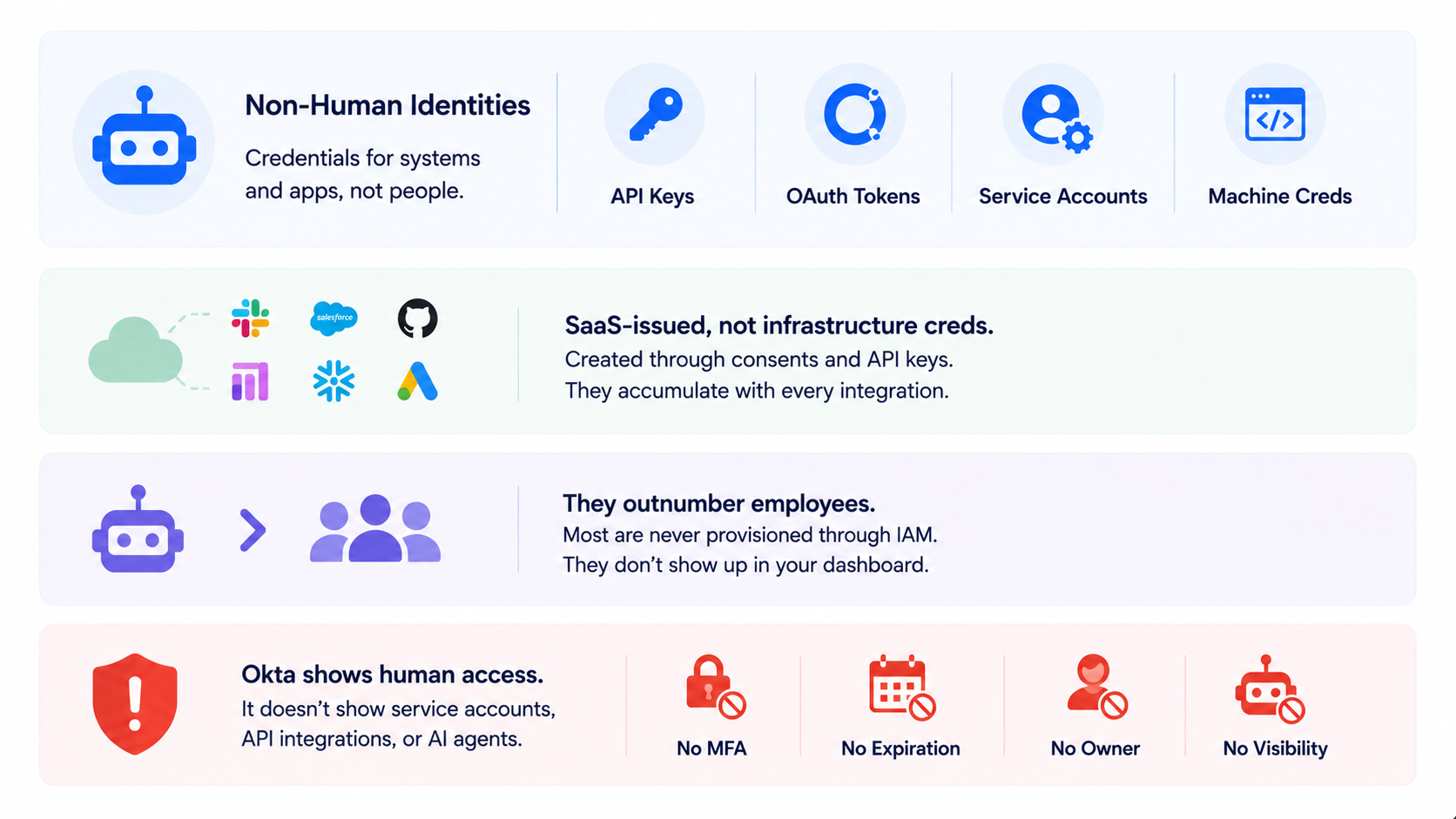
In organizations running hundreds of SaaS applications, non-human identities typically outnumber employees. Most were never provisioned through a standard identity workflow, which means they never appear in your IAM dashboard.
Your Okta dashboard shows you every human who has access to Salesforce. It doesn't show you the eight service accounts, four API integrations, and two AI agents that also have access without any MFA, expiration, and owner.

2. How NHI Governance Fits Inside a SaaS Management Program
Managing non-human identities follows the same principle as managing SaaS applications: you can't secure what you can't see.
As more AI agents connect to business applications, NHI governance fits inside SaaS management. The integration layer surfacing licenses and spend also surfaces the service accounts and API keys of each application.
A. One Inventory for Apps and the Identities That Access Them
SaaS management starts with discovering every application in your environment. NHI governance extends that inventory to the credentials operating inside those applications.
The same integrations used to track licenses, usage, and spend can also surface:
- Service accounts: Automated credentials running workflows inside applications that were never provisioned through standard identity processes
- OAuth tokens: Third-party app connections granted through consent flows that persist long after the original use case ends
- API keys: Direct application-to-application connections that carry standing access with no expiration unless someone actively revokes them
- Connected applications: Third-party integrations with broad permission scopes that no longer have an active owner or business purpose
Instead of creating a separate discovery process, NHI visibility becomes part of your existing SaaS inventory.
B. NHI Reviews Run Alongside Human Access Reviews
Traditional access reviews verify whether employees still need access to specific applications. NHI reviews apply the same process to non-human access:
- Does this identity still have an owner?
- Is it still being used?
- Are the permissions appropriate?
Reviewing both together gives security teams a complete picture of who and what has access in a single review cycle, against a single audit record.
C. NHI Risk Scores in the Same Posture Dashboard as App Risk
SaaS security reviews usually focus on application-level risks like MFA support, compliance status, and user permissions. NHI governance adds the credential layer:
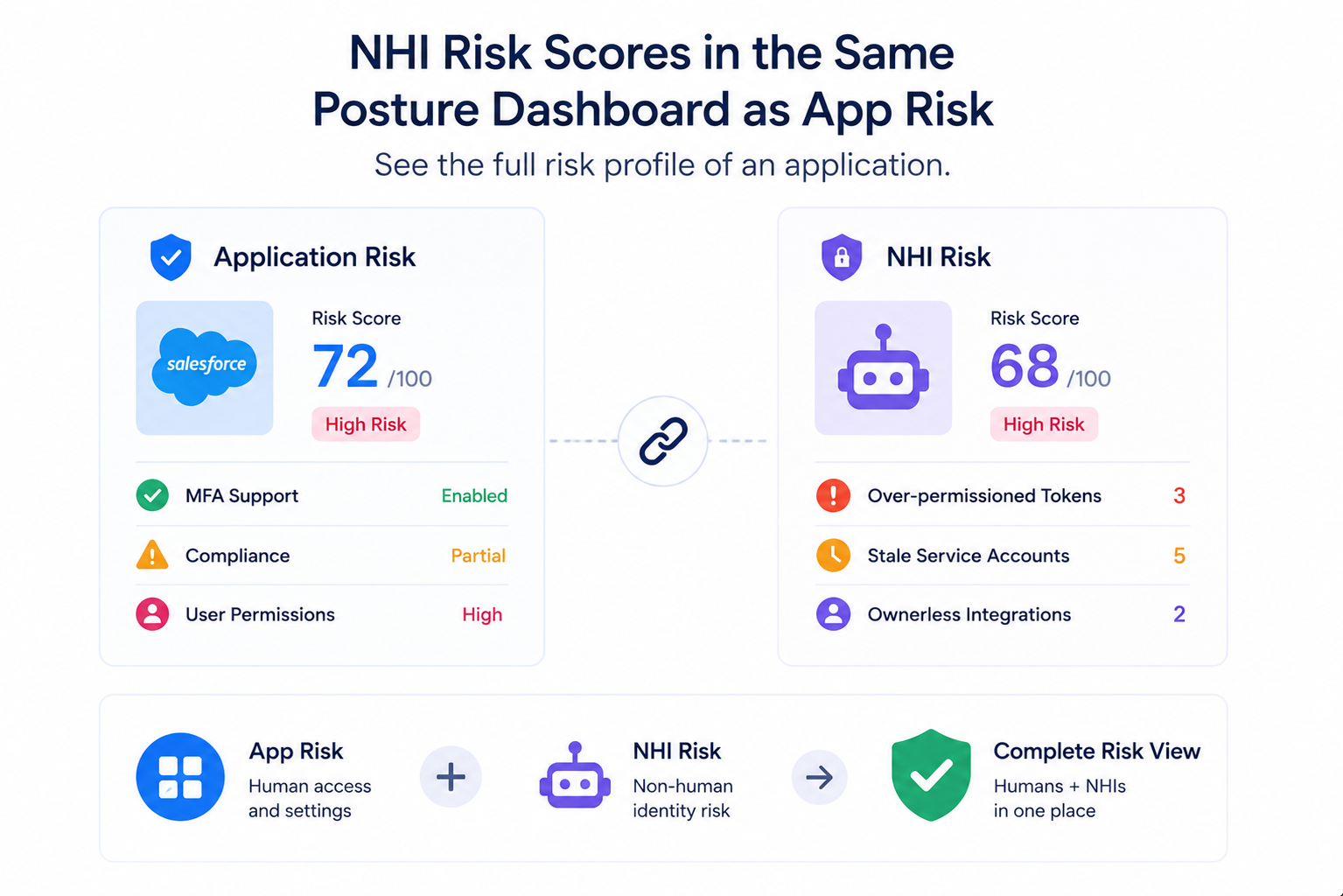
- Over-permissioned tokens: OAuth connections granted with broad scopes that exceed what the integration actually requires
- Stale service accounts: Credentials still active on applications where the underlying workflow stopped running months ago
- Ownerless integrations: Connected applications where the human who created the integration has since left the organization
Combining both views shows the full risk profile of an application, not just the humans accessing it, but the non-human identities operating inside it.
3. How CloudEagle.ai's NHI Module Fits Into SaaS Management
CloudEagle governs non-human identities through the same platform where you already manage licenses, access reviews, and spend.
It surfaces service accounts, managed identities, and AI agents in a dedicated NHI tab, with owner attribution and direct actions like revoke access, remove permissions, and rotate API keys.
A. NHI Dashboard: Immediate Risk Visibility Before You Open a Single Record
In CloudEagle's NHI dashboard, the overview surfaces what matters the moment you log in.
You get total NHIs across all connected environments, identity type breakdown between Managed Identities and Service Identities, and three risk-prioritized insights that tell your security team where to look first.
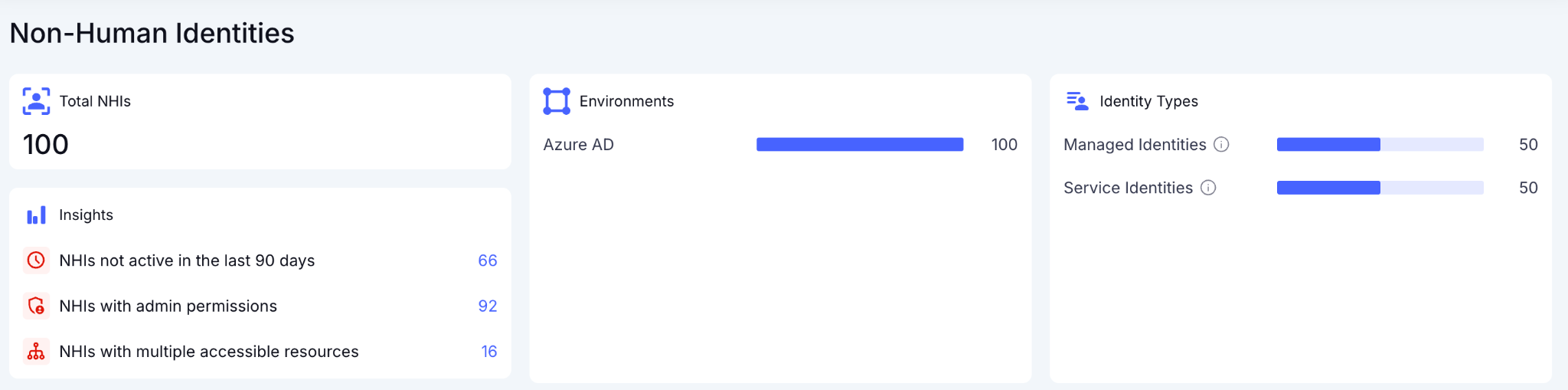
In this environment: 66 of 100 NHIs haven't been active in 90 days. 92 carry admin permissions. 16 have access to multiple resources simultaneously.
These aren't hypothetical risks, they're the exact numbers a security team can act on immediately, without a spreadsheet export or a manual audit.
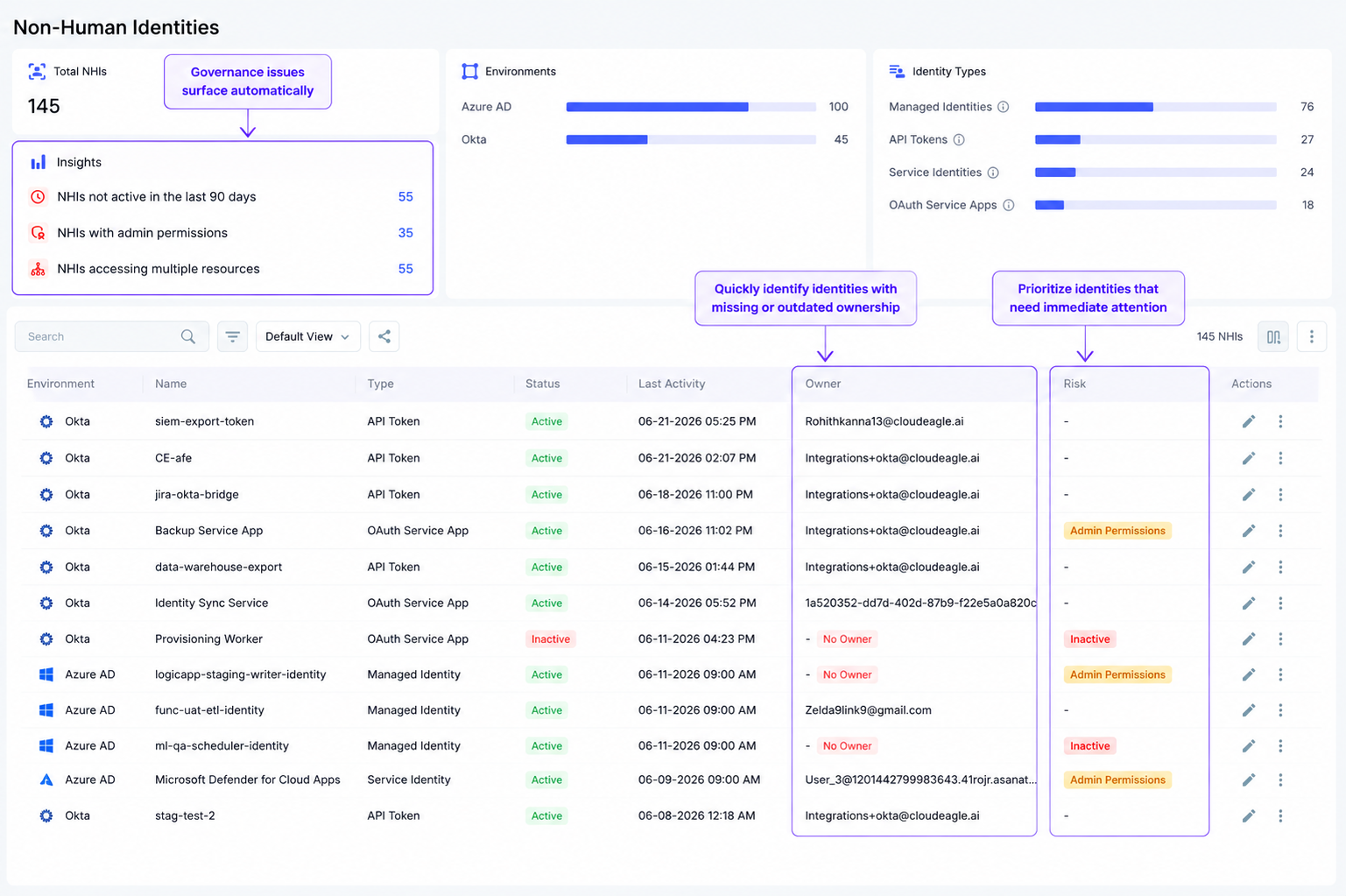
B. NHI Inventory: Every Identity, Credential Type, and Owner in One View
When CloudEagle connects to your systems, it brings in both human and non-human identities like service accounts, managed identities, and API tokens.
CloudEagle surfaces them in their own dedicated NHI tab alongside the source environment, credential type, last activity date, and assigned owner.
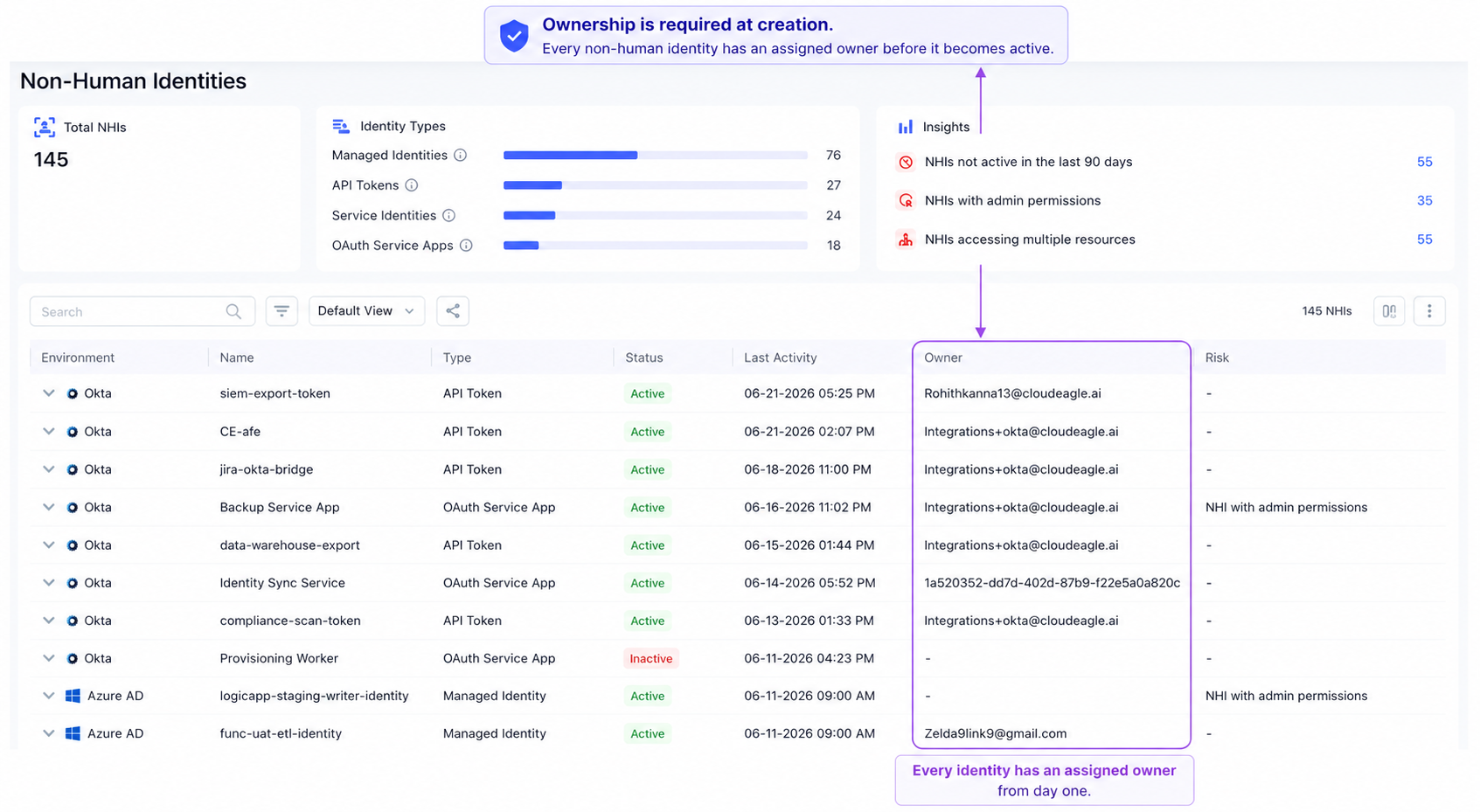
Every NHI with a missing owner is immediately visible. Every credential type ( PRIVATE_KEY_JWT, Secret, and others) is surfaced without requiring a separate query.
This is where over-permissioned identities become actionable. A service account carrying Contributor access on a resource group, Key Vault access on a SQL database, and Owner-level access on a subscription is visible in one expanded row.
As Roy Illsley, Chief Analyst at Omdia, noted when reviewing this capability: there is not much on the market that shows access for non-humans at this level, and as organizations scale autonomous agents, it is about to become a rapidly urgent topic.
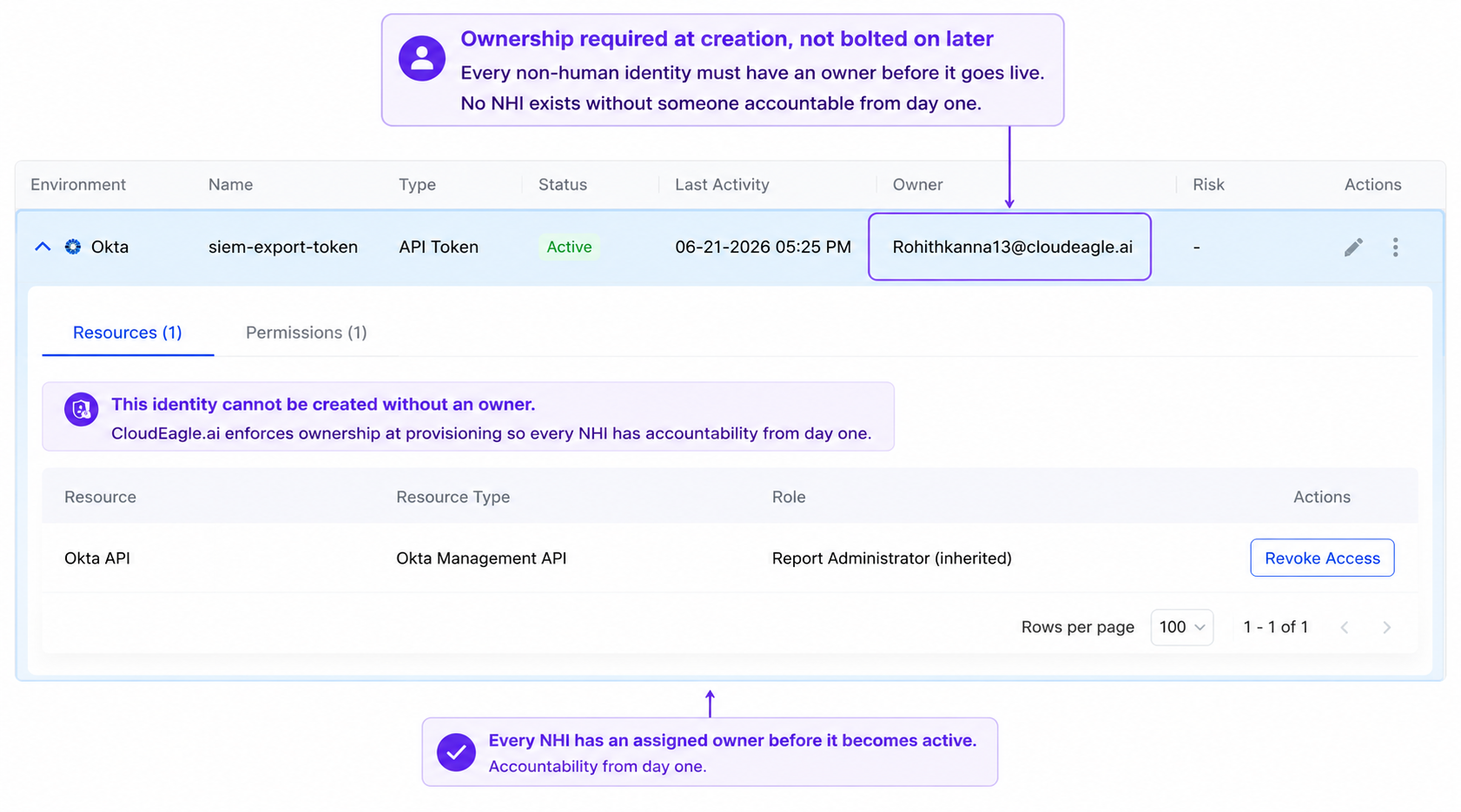
C. Ownership Attribution: Every NHI Needs an Accountable Human
CloudEagle lets you assert an owner to any NHI directly from the inventory view. When an owner is found, they're attributed. When no owner can be identified, the NHI is flagged for access removal.
For NHIs that originated from a specific system like Microsoft Copilot, Salesforce, Azure AD, CloudEagle knows the source and can often identify the human who created the identity.
So, security teams get a starting point for ownership assignment even when none was documented at creation. Every ownership action is logged automatically in a per-NHI audit trail.
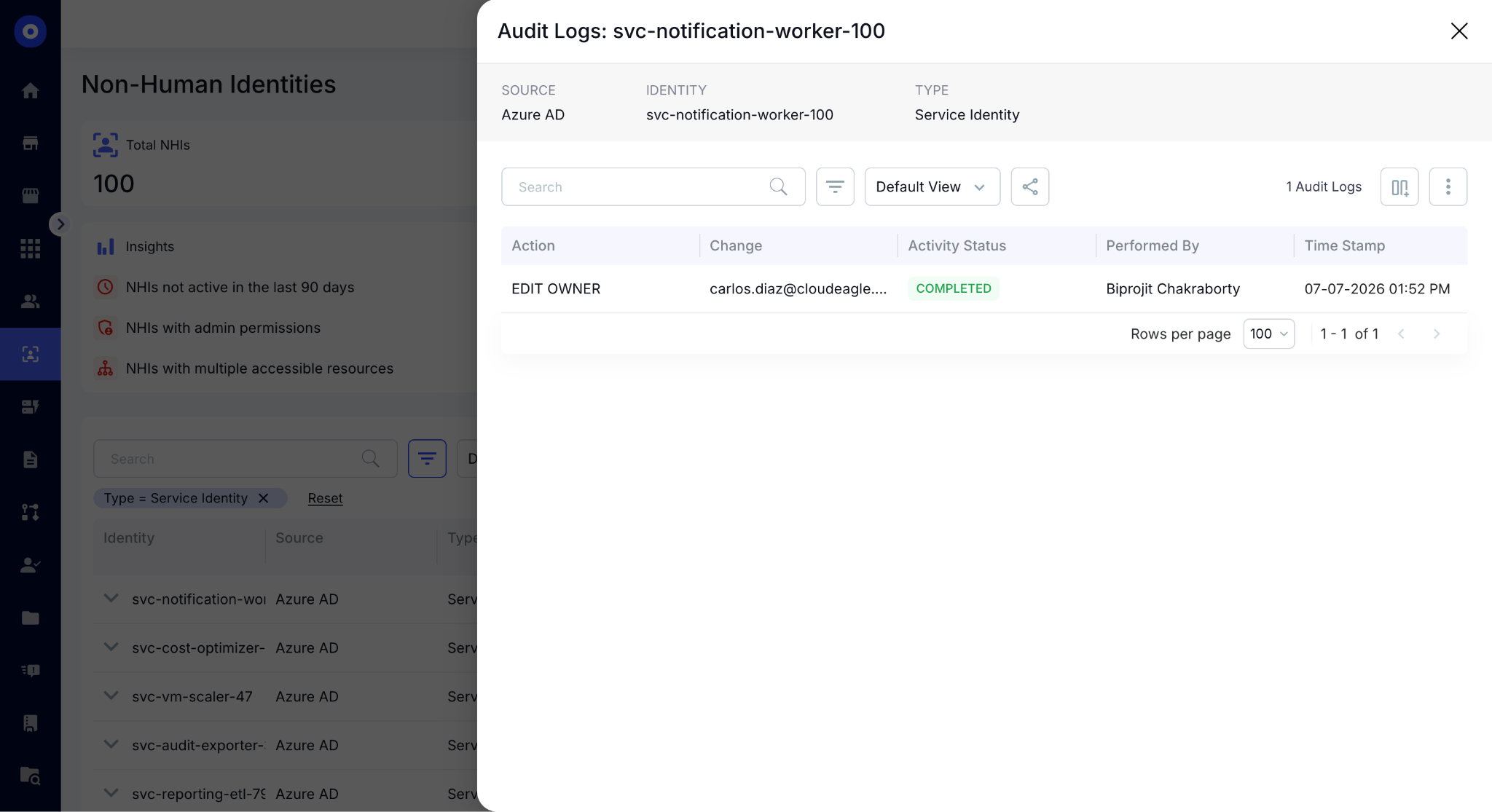
When an auditor asks who owns a specific service account and when that ownership was assigned, the answer is already in CloudEagle, not assembled from Jira tickets and email threads the night before the review.
D. Actions: Revoke, Remove, and Rotate Without Leaving the Platform
Visibility without action isn't governance. For every NHI surfaced, whether inactive, over-permissioned, or ownerless, CloudEagle provides three direct actions from the inventory view.
- Revoke Access: Remove the NHI's access to a specific resource or role immediately, without logging into the source system
- Remove Permissions: Strip elevated or unnecessary permissions from an identity that should remain active but with reduced scope
- Rotate API Key: Force credential rotation for NHIs carrying static keys, reducing the blast radius of any compromise without deprovisioning the identity entirely
When an employee leaves and their AI access, including tokens and personal-account logins, needs to be revoked, it happens alongside the standard offboarding flow. NHIs don't outlive their human owners.
Not Every Identity Is Human


4. Why NHI Is Now a SaaS Management Problem, Not Just a PAM Problem
PAM tools still play an important role. But SaaS platforms now issue their own credentials like OAuth tokens, API keys, and service accounts outside the governance layer PAM was designed to cover.
A. PAM Tools Were Built for Infrastructure, Not SaaS Integrations
Traditional PAM platforms manage privileged credentials across servers, databases, cloud environments, and DevOps workflows.
But SaaS-based NHIs work differently. OAuth tokens, API keys, and connected apps are often created directly inside SaaS platforms and persist independently of a PAM vault.
The distinction is clearest in practice:
- A GitHub service account supporting a CI/CD pipeline fits the traditional PAM model. It was provisioned deliberately, lives in a controlled environment, and is likely inventoried somewhere
- A HubSpot and Slack OAuth integration created by a marketing team creates a SaaS governance challenge. It was created through a consent flow and almost certainly never touched your PAM tool
B. AI Agents Introduced a New Governance Gap
AI agents add another layer of unmanaged access. Agents created in MS Studio, Salesforce Agentforce, or custom AI workflows carry permissions to access SaaS data and perform actions without behaving like normal users.
As one IT Security Manager at a mid-size financial institution put it:
"We are seeing a large number of personal agents and AI agents being created. I want to almost claw that back so we can have a more refined governance around that."
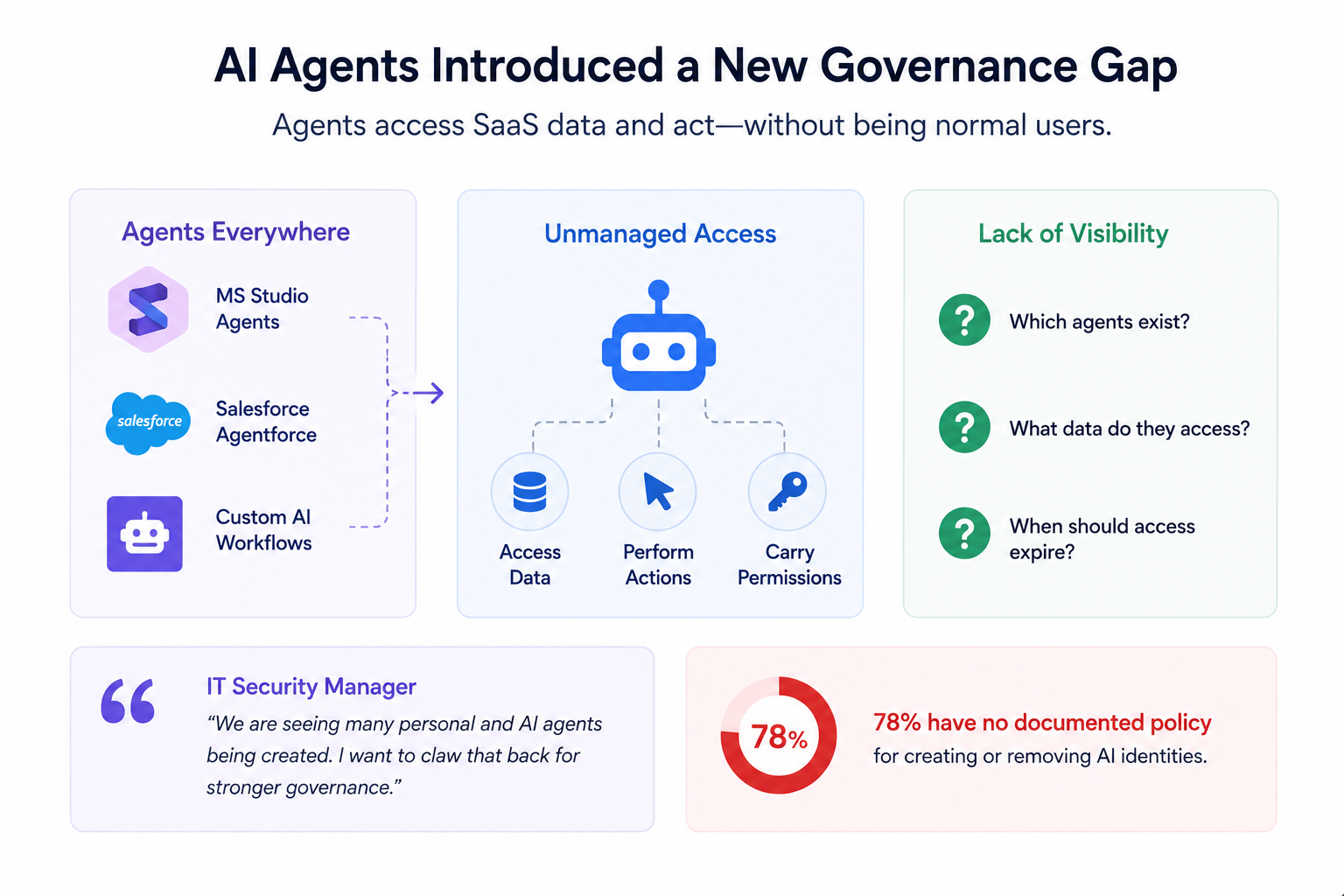
The problem is that most organizations don't know which agents exist, what data they access, or when that access should expire. 78% have no documented policy for creating or removing AI identities.
C. SaaS Vendors Don't Govern What Connects to Them
SaaS vendors manage authentication, not governance. Salesforce, GitHub, Google Workspace, and Microsoft 365 all allow integrations through OAuth tokens and API keys, but none of them manage the full lifecycle:
- Who owns this integration?
- Is it still being used?
- Does it still need the same permissions?
When nobody can answer those questions, integrations persist indefinitely, carrying standing access long after the use case that created them has ended.
Every SaaS vendor assumes a governance layer exists above them. The challenge is that most organizations don't have one that spans every application.
5. Conclusion
Every SaaS integration, automation workflow, and AI agent your organization runs creates a non-human identity with persistent access.
Most were never provisioned through a standard workflow, don't appear in your IAM dashboard, and won't get deprovisioned when the human who created them leaves.
That's not a PAM gap. It's a SaaS management gap and it belongs in the same platform where you already govern licenses, access reviews, and spend.
CloudEagle.ai governs human and non-human identities together, surfacing service accounts, OAuth tokens, API keys, and AI agents across Salesforce, GitHub, Microsoft Copilot, and 500+ other applications.
6. FAQs
1. How are non-human identities created in SaaS environments without IT approval?
Most SaaS NHIs are created through OAuth consent flows, API key generation, or direct vendor integrations, none of which trigger a provisioning workflow in the identity provider. The credential is issued by the SaaS vendor and persists independently of anything in Okta or Entra.
2. What happens to a non-human identity when the employee who created it leaves?
Without an automated offboarding trigger, nothing. The credential persists with the same permissions and no active owner, creating a standing access risk that most organizations only discover during an audit or a security incident.
3. What is the difference between NHI governance and secrets management?
Secrets management securely stores and rotates credentials. NHI governance covers the full lifecycle like discovery, ownership, access reviews, permission scoping, and decommissioning. A credential can be stored securely while the identity using it is still over-permissioned or ownerless.
4. Why are AI agents harder to govern than traditional service accounts?
Traditional service accounts perform predictable tasks. AI agents decide at runtime what actions to take, chain multiple tool calls, and often inherit the broad OAuth permissions of their creator, making the blast radius of a compromised agent significantly larger.
5. How often should non-human identity access reviews be conducted?
Quarterly at minimum, with continuous monitoring for high-risk credentials. NHIs that are inactive for 90 days or more should surface automatically rather than waiting for a scheduled review cycle.
Every Identity Deserves Governance


.avif)


.avif)
.avif)




.png)





.avif)
.avif)
.avif)


