.avif)
%201.svg)


HIPAA Compliance Checklist for 2025

Somewhere in your environment right now, a service account is running with standing admin access. Nobody filed a ticket for it, and nobody will notice when it's compromised.
The fix: every non-human identity needs a named owner, assigned at creation, reviewed on the same cadence as human access. Skip that step, and the identity can't be reviewed, renewed, or retired, so risk just accumulates.
CloudEagle's IGA Report found that machine identities, service accounts, API keys, and bots already vastly outnumber human ones inside most enterprises. That gap keeps widening as automation and AI agents multiply.
TL;DR
- An NHI with no owner cannot be reviewed, renewed, or safely retired. It just accumulates risk.
- Non-human identity ownership works when it's assigned at creation, tied to the team with the most context, and reviewed on the same cadence as human access.
- CloudEagle.ai supports NHI ownership assignment and tracking as part of a broader identity security posture: surfacing every service account and API key, flagging ownerless ones, and keeping ownership records current.
- Ownership models vary by identity type: creator-owned, system-owner-owned, or centrally owned as a last resort.
- Retroactive NHI ownership assignment for identities that predate any governance program follows a discover, triage, and assign sequence.
1. Why Ownership Is What Makes an NHI Governable
Review, renewal, and retirement are all human decisions.
A system can flag a stale credential or an unused account, but it cannot decide whether that account is still needed, authorize a rotation, or approve decommissioning.
Only a named owner can make that call. That is the actual case for non-human identity ownership: it's the accountability mechanism that makes every other governance action possible.
"Every" is the operative word, not just the obviously risky ones, for two reasons:
- No default accountable party: A human account inherits one automatically: a manager, HR, or a fixed offboarding process. An NHI inherits none of that, so there's no fallback owner if you skip assignment.
- Risk isn't fixed at creation: A low-privilege integration today can get re-scoped, connected to a sensitive system, or inherit broader access through a role change tomorrow, with no owner in place to notice. Sorting NHIs into "needs an owner" and "safe to skip" assumes today's risk profile holds. It usually doesn't.
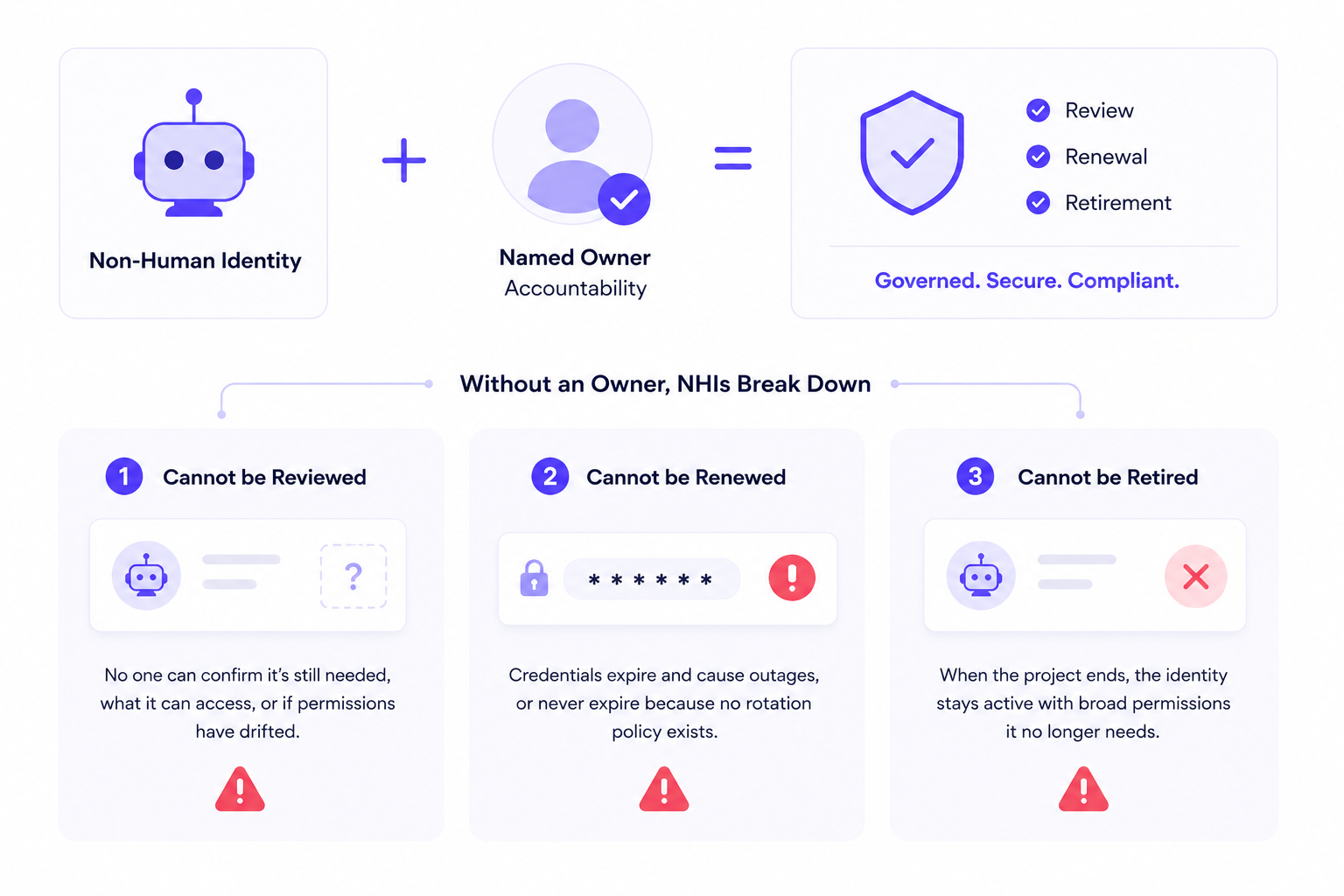
An ownerless NHI breaks down in three specific ways as a result:
- Cannot be reviewed: nobody can confirm it still needs to exist, what systems it can reach, or whether its permissions have drifted since the day it was created.
- Cannot be renewed: credentials expire silently and cause outages nobody anticipated, or they never expire because no one thought to set a rotation policy.
- Cannot be retired: when the project it was built for ends, the identity stays active with whatever permissions it had on day one, almost always broader than the job required.
That failure compounds into real cost:
An identity with no owner is not just ungoverned. It is ungovernable. There is no one to ask, no one to certify it, and no one accountable when it goes wrong.
If you want the fuller picture of why machine identities are structurally harder to manage than human accounts, this breakdown of non-human identity management is worth the ten minutes.

2. How to Assign NHI Ownership: What Good Looks Like
Assigning an owner to an NHI is the core mechanic behind non-human identity ownership, and it breaks down into five steps.
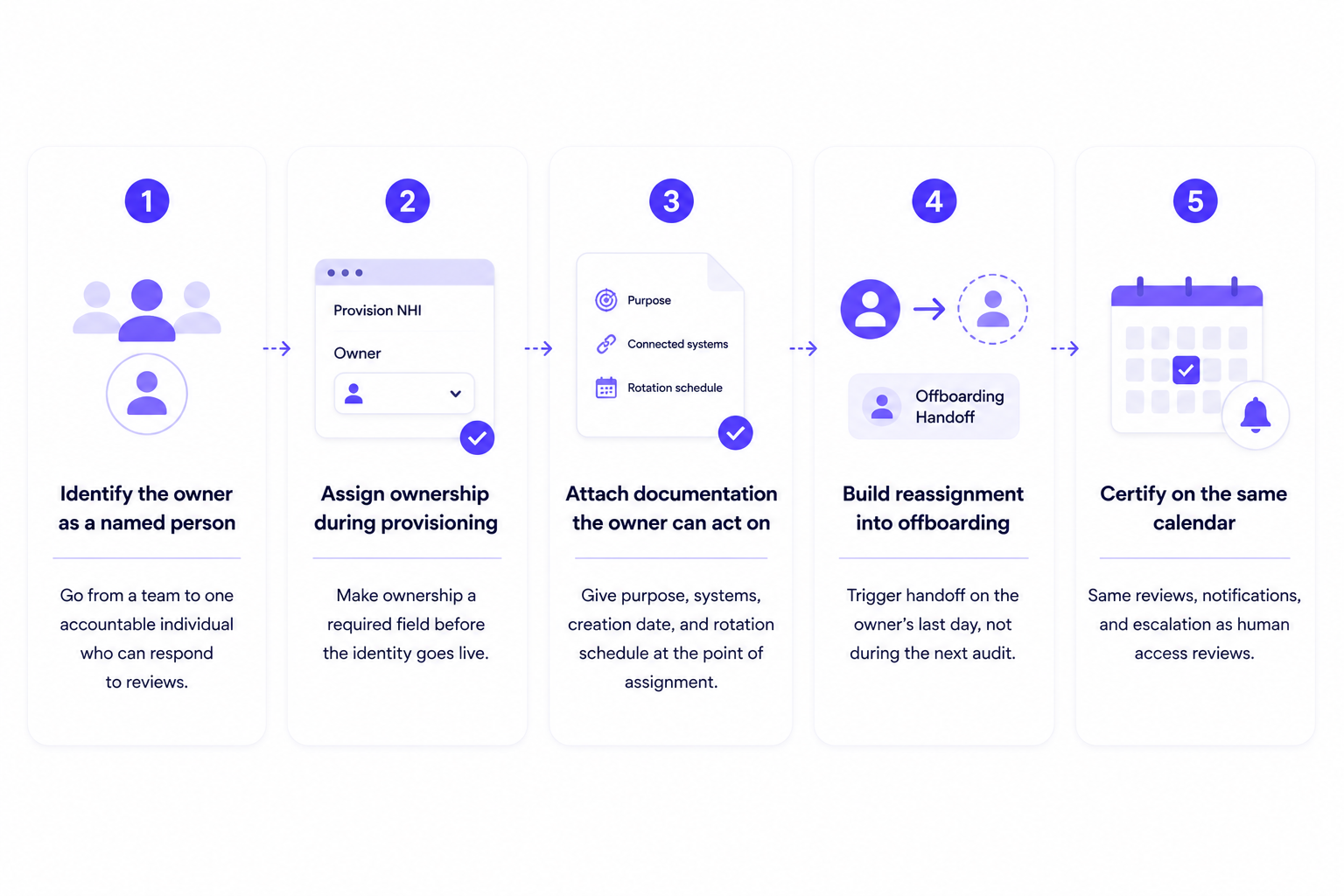
Skip any one step and ownership drifts back into a name in a spreadsheet nobody actually checks.
1. Identify the owner as a named person:
Start with the team that created the identity, "payments" or "platform engineering," then land on one accountable individual within it.
A team can't answer a review notification. A person can.
2. Assign that person inside the provisioning step itself:
Whether the NHI comes from a service account request form, a Terraform module, or an IGA workflow, ownership should be a required field in that same step, filled in before the identity goes live.
3. Attach documentation the owner can act on:
Purpose, connected systems, creation date, rotation schedule, entered at the point of assignment.
Without this, the named owner has a title but no basis for an actual certify-or-retire decision later.
4. Build reassignment into offboarding, not into a future audit:
When the owner leaves the company, their NHIs get flagged for handoff on their last day as part of the standard offboarding checklist.
Waiting for the next access review means the identity sits ownerless for months.
5. Put certification on the same calendar as human access reviews:
Same cadence, same notification flow, same escalation path if the owner doesn't respond, in line with broader access management trends.
A separate schedule for machine identities is how they quietly fall out of scope.
This works cleanly for the first few hundred NHIs. Past that, running steps 1 through 5 by hand for every new identity becomes its own job, and the same ownership gaps from the last section start reappearing at scale.
3. How CloudEagle.ai Helps with NHI Ownership Assignment and Tracking
The five steps above hold up fine at a small scale. Past a few hundred NHIs, they break down for a specific reason: every step becomes manual work competing with everything else on an IT or security team's plate.
- The assignment gets skipped because nobody enforces it at the provisioning step.
- Documentation gets thin because nobody's tracking it consistently.
- Offboarding handoffs get missed because NHI cleanup isn't part of the standard checklist.
- Certification cadence slips because nobody's chasing owners for a response.
CloudEagle.ai closes that gap. It doesn't replace the five-step process; it runs it continuously so each step happens by default instead of by memory.
a) Full inventory before ownership even starts
Assigning non-human identity ownership starts with knowing what exists.
CloudEagle.ai surfaces every service account, API key, and OAuth token across your SaaS and AI environment, including the ones that never went through IT and would otherwise sit invisible until an audit or an incident surfaces them. This is the foundation of a working identity governance framework.
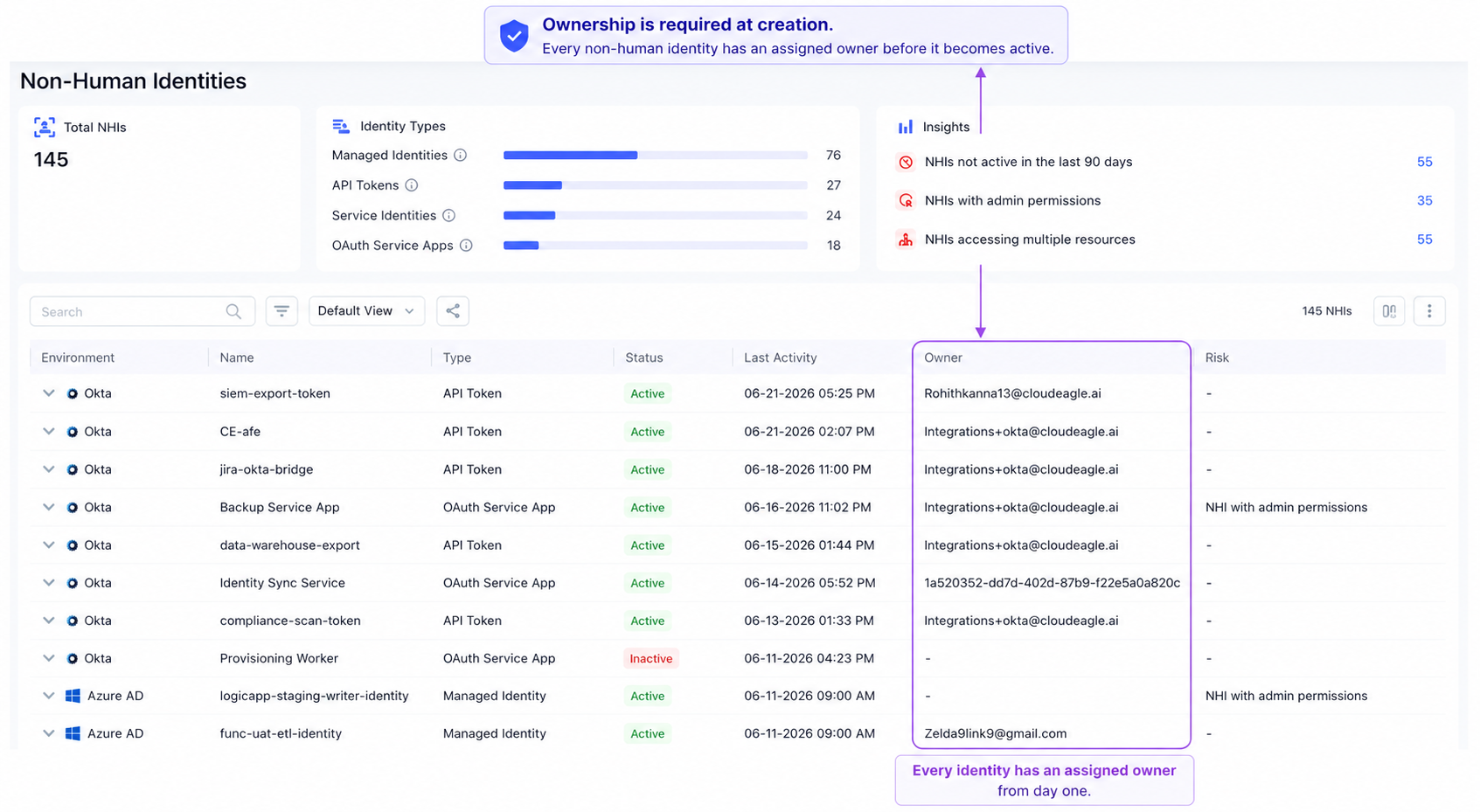
b) Ownership required at creation, not bolted on later
Most teams try to assign ownership after the fact, once thousands of NHIs already exist with no record of who they belong to.
CloudEagle.ai makes ownership a required field at provisioning, so no identity goes live without someone accountable for it from day one.
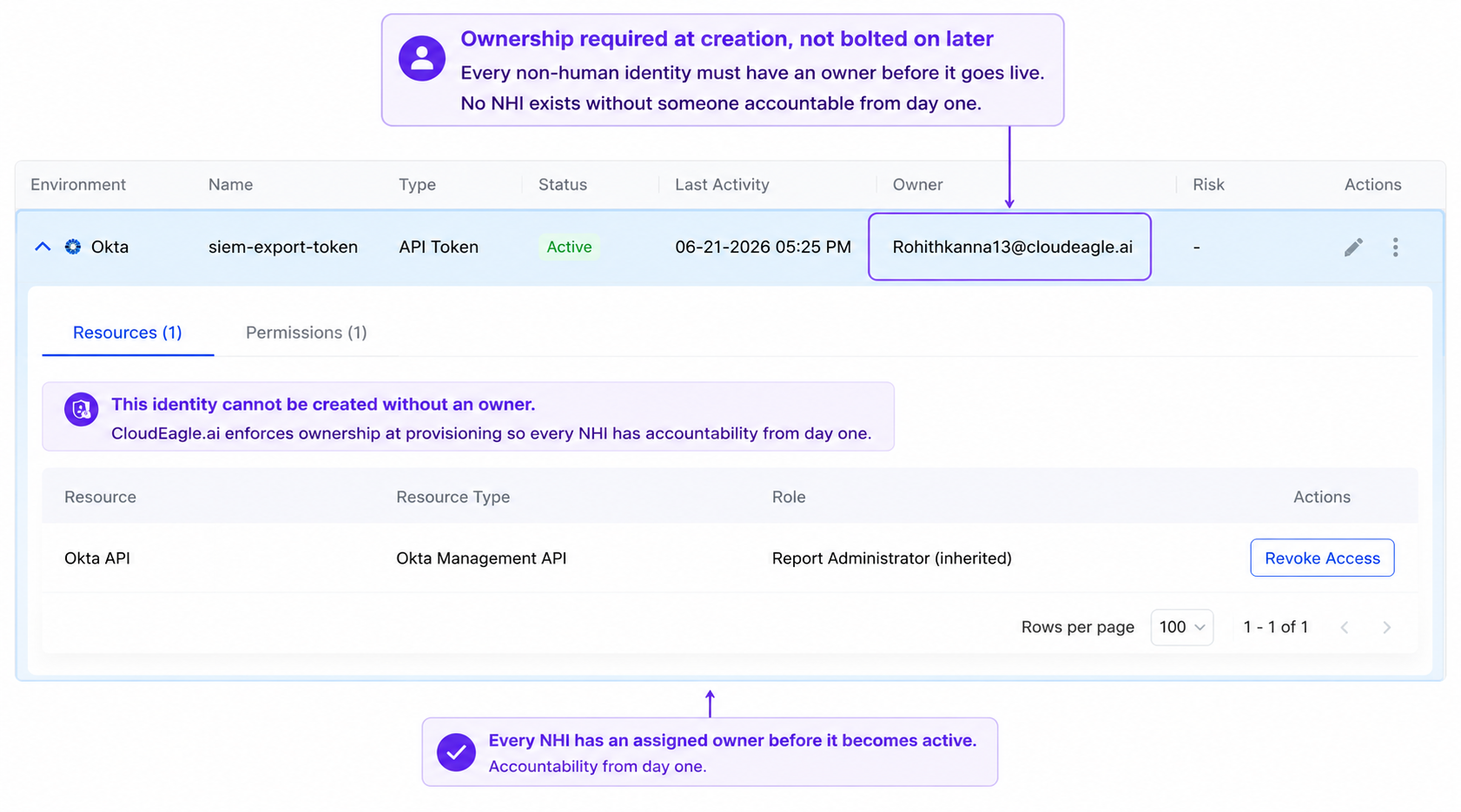
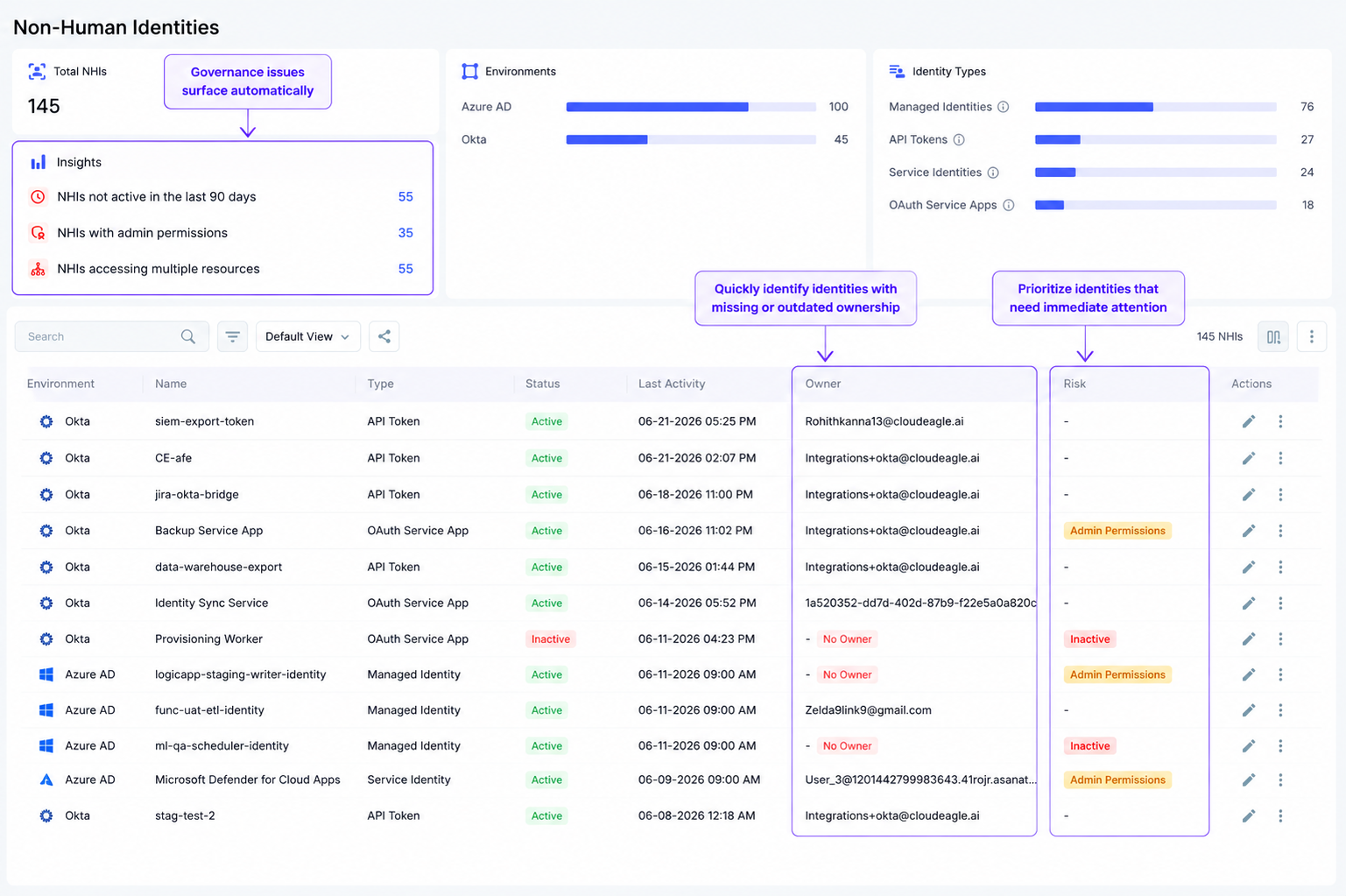
c) Ownerless and orphaned identities flagged automatically
Manually cross-checking owner lists against HR records doesn't scale past a few dozen identities.
CloudEagle.ai continuously flags NHIs with no assigned owner, credentials that haven't been reviewed, and identities whose owner has since left the organization.
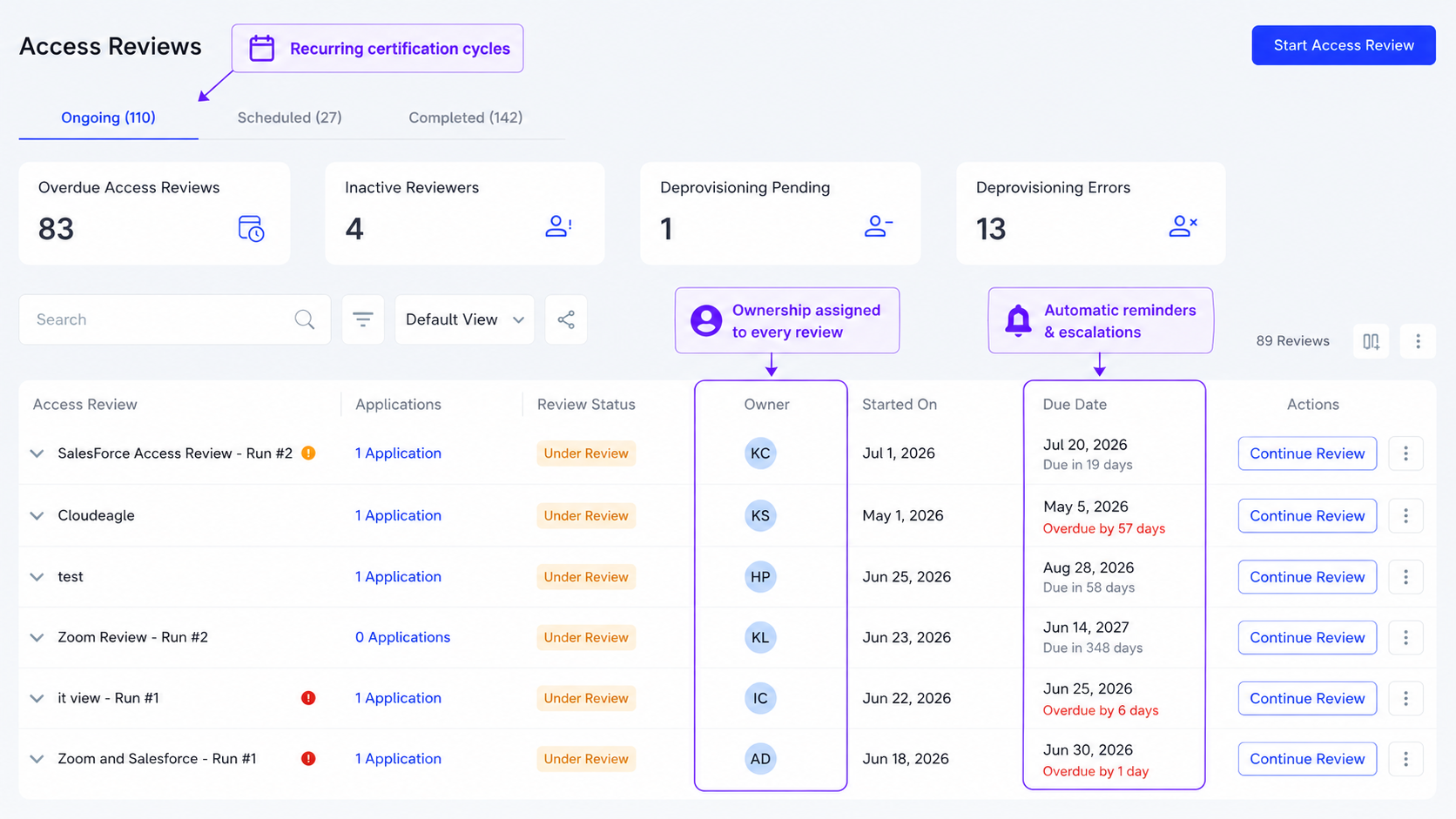
d) Ownership certification on the same cadence as human access reviews
Running NHI reviews on a separate, ad hoc schedule is how ownership gaps go unnoticed for months. CloudEagle.ai runs certifications on the same cycle as human access reviews, notifying owners, prompting certification, and escalating automatically if they don't respond.
ICEYE used this approach to cut manual access reviews by 90% and reclaim over 1,500 hours a year.
"We went from spreadsheet-driven access reviews that took months to a fully automated, structured process," said Michal Lipinski, Director of IT & Security at ICEYE.
"CloudEagle.ai gave us complete visibility into users, roles, and permissions, while eliminating delays and reducing risk."
See how automated access reviews work.
CloudEagle.ai keeps NHI ownership assigned and current, not as a one-time cleanup project but as an ongoing governance layer.
The scope here is deliberately narrow: assignment and tracking, not rotation enforcement or secrets management, so your existing tooling for those functions stays untouched.
Machine Identities Outnumber Humans in Your Stack. Who Owns Them?


4. Non-Human Identity Ownership: Who Should Own What
Ownership should follow accountability, not convenience. The team with the most context about why an identity exists is almost always the right owner, and IAM's job is to enforce the framework rather than personally own every service account.
CloudEagle.ai supports all three: ownership is assignable to any individual, team, or role already in your directory, so the model doesn't have to change to fit the tool.
For the wider risk picture on why these identities go unmonitored in the first place, this look at non-human identities as a silent SaaS risk fills in the context.
5. How to Assign Ownership to NHIs You Didn't Know Existed
Most organizations carry thousands of non-human identities that predate any governance program. Assigning ownership to accounts nobody documented is the hardest part of any NHI ownership initiative, and it follows the same three steps every time:
- Discover first: Build a full inventory using multi-source discovery rather than relying on what's already registered with your identity provider.
- Triage by risk: Prioritize ownerless identities with admin privileges, broad data access, or expired rotation schedules over lower-risk accounts.
- Assign by proximity: Use creation logs, connected systems, and ticket history to find the team most likely to know what the identity actually does.
CloudEagle's discovery layer surfaces NHIs across browser, endpoint, network, and finance signals, including identities created entirely outside IT's visibility, and flags the ownerless ones with enough context to start the assignment conversation instead of starting from zero.
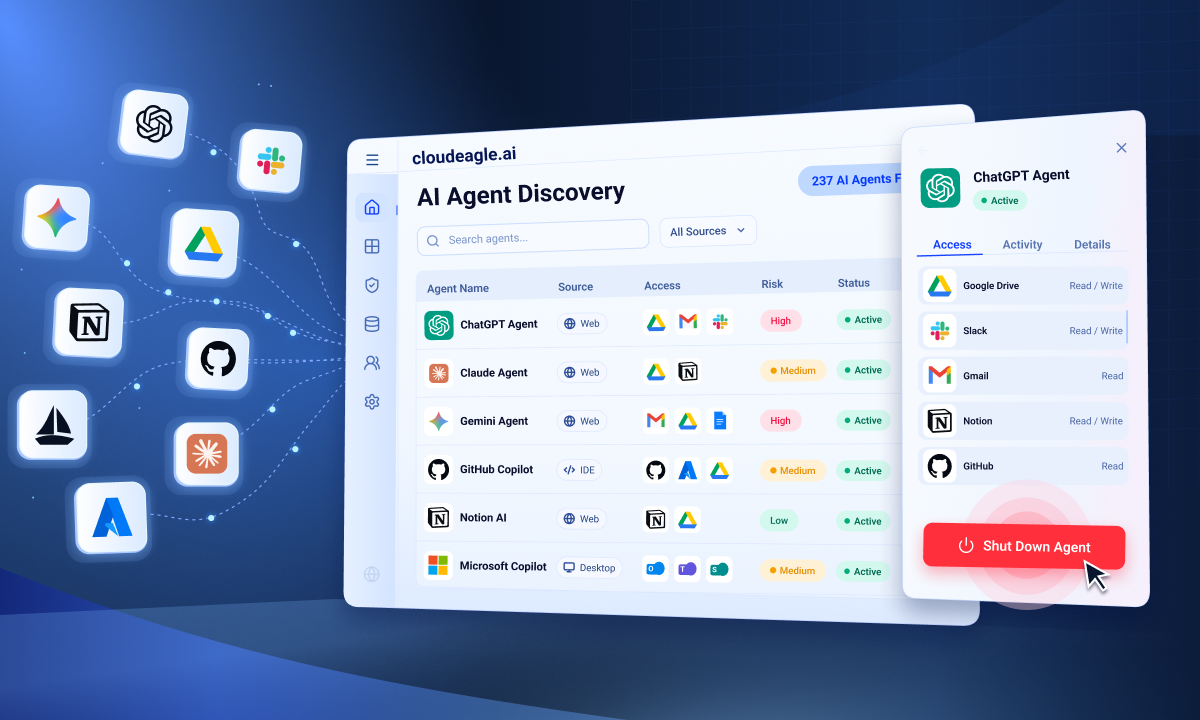
Agentic AI tools are accelerating this exact problem. This CIO's AI governance checklist covers what to ask before your next AI rollout spawns identities nobody reviews.
6. FAQs
1. What does it mean for a non-human identity to have an owner?
An owner certifies that the NHI still needs to exist, ensures credential rotation, and initiates decommissioning when its use case ends.
2. Who should own a service account?
The team that created it, since they have the most context. IAM should own only identities with no clear business owner.
3. How often should NHI ownership be reviewed?
On the same cadence as human access reviews, so ownership gaps surface on schedule instead of during an incident.
4. Can non-human identity ownership be assigned retroactively?
Yes, through discovery, risk-based triage, and assignment by proximity, using creation logs and connected systems to find the likely owner.
5. What happens if an NHI's owner leaves the company?
The identity becomes ownerless until reassigned. Continuous monitoring should flag this automatically rather than waiting for the next audit.
Non-human identity ownership isn't optional anymore.
Every NHI in your environment either has an owner who can govern it or is a risk nobody is managing. There's no middle ground.
See how CloudEagle.ai surfaces and assigns non-human identity ownership → Book a demo
Every Ownerless NHI Is a Risk Nobody Is Accountable For


.avif)


.avif)
.avif)




.png)






.avif)
.avif)
.avif)


