Why Most AI Governance Frameworks Ignore Autonomous Agents and What Singapore Did About It

Share via:
blog-cms-banner-bg
Little-Known Negotiation Hacks to Get the Best Deal on Slack
cta-bg-blogDownload Your Copy

HIPAA Compliance Checklist for 2025

Download PDF

TL;DR

  • Every major AI governance framework was written to govern what a model produces. An agent is judged by what it does, and that difference is why the frameworks you already run do not cover the agents your teams are shipping.
  • A 2026 survey of generative AI security found that frontier safety policies, the NIST AI RMF, ISO/IEC 42001 and the EU AI Act contain no references to agents or agentic systems at all.
  • Singapore moved first. IMDA released the Model AI Governance Framework for Agentic AI on 22 January 2026 and published version 1.5 on 20 May 2026 after feedback from more than 60 organizations.
  • The United States is early. NIST's Center for AI Standards and Innovation launched its AI Agent Standards Initiative on 17 February 2026, and finalized agent guidance is unlikely before 2027 while adoption accelerates through this year.
  • The gap has a name your security team already understands. The NCCoE concept paper frames it directly: agents are commonly treated as generic service accounts, with no dedicated identity, authorization or accountability controls.
  • Until the standards land, govern agents the way you govern any other login that is not a person. CloudEagle.ai discovers every AI app, agent and MCP server across your stack, attaches an owner and an expiry to the credentials behind them, and puts them in the same review cycle as your employees.

Pick up any AI governance framework in circulation today and you will find it asks a consistent question: is this model's output fair, accurate, explainable and safe. That question was the right one in 2023.

It is the wrong one for a system that books the refund, merges the pull request, or queries the customer database at three in the morning without anyone watching.

What Do Today's AI Governance Frameworks Actually Govern, and Where Do They Stop?

Today's frameworks govern models and the uses people put them to. They ask how a system was trained, what it outputs, who it might harm, and how a human reviews that output.

They stop at the point where the system stops answering and starts acting.

The Model and Use Assumption Behind NIST AI RMF, ISO 42001, and the EU AI Act

All three were built on the same picture of AI: a model produces something, a person decides what to do with it. Each is good at what it was drafted for, and none was drafted for a system that holds credentials and calls other systems on its own.

Framework What it governs How it is structured Where it stops
NIST AI RMF The model and its risks in context Four functions: Govern, Map, Measure, Manage No agent-specific controls. SP 800-53 overlays for single and multi-agent systems are still in development.
ISO/IEC 42001 The management system your organization runs around AI Plan-Do-Check-Act, certifiable Certifies the process around AI, not the actions an agent takes at runtime.
EU AI Act The use case and its risk tier Prohibited practices plus obligations on listed high-risk systems Does not regulate agentic AI as a distinct category.

The Missing Vocabulary in Existing Framework Text

The clearest evidence is what the documents do not say. Search the text of the three frameworks most enterprises have standardized on and the word "agent" is absent.

That is not a drafting oversight, it is a timestamp. The frameworks predate the products:

  • Anthropic launched Computer Use in October 2024
  • OpenAI released Operator in January 2025
  • Claude Code reached general availability in May 2025
  • None of them shipped under a binding agent-specific governance standard

The practical consequence for you is narrow and specific. Your framework tells you how to assess a model you licensed.

It tells you nothing about the agent your engineering team built on top of that model last quarter, or the credential that agent is using right now.

Catch the AI Agents Your Framework Never Named

A practical guide to finding shadow AI and governing it before the standards land.
Get The Guide

Why Autonomous Agents Break the Assumptions Behind Existing AI Frameworks

Agents break four assumptions at once. Each one is load-bearing for how a model-era framework works, and each one fails differently when the system acts on its own.

Assumption in a model-era framework Why it holds for a model Why it fails for an agent
AI produces output that a person reviews Review happens at the point of reading. The action lands before anyone reads anything.
Risk is bounded by a single interaction One prompt, one response, one decision. Multi-step plans compound an early error down the chain.
A human sits between the system and the consequence The human executes. The agent executes, using its own credential.
The acting party is identifiable A named employee acted. A shared key or service account acted, and nobody knows which agent held it.

Agents Take Actions in Live Systems, Not Just Produce Outputs

A model that writes a bad summary has produced a bad summary. An agent that misreads the same input sends the email, closes the ticket, or pushes the change.

Output-centered review has no equivalent checkpoint for the second case, because by the time anyone reads anything, the action has already happened.

Tool Access, Memory, and Multi-Step Plans as a New Risk Surface

Agents differ from models on properties that governance frameworks never had to account for:

  • They act on external systems and reach tools dynamically, so the risk surface changes at runtime
  • They execute multi-step plans, so a small early error compounds instead of stopping
  • They carry persistent memory, which can be manipulated
  • They hand work to other agents, which splits accountability across boundaries

That last one is what hurts during an incident. When three agents pass a task between them and something goes wrong, "which system did this" has no clean answer.

Agent Credentials Treated as Generic Service Accounts

This failure shows up in real environments long before any regulator gets involved. Agents get whatever credential was easiest to issue, which is usually a shared API key or a service account built for software that does not make its own decisions.

The mental model is already out of date. In most environments the majority of logins that are not people are now agents rather than service accounts, created in low-code platforms that never touched an IT provisioning workflow.

The federal standards work says so plainly:

  • Enterprise deployments commonly rely on manually managed access lists, shared API keys and service account credentials designed for software systems rather than autonomous agents
  • The result is an authorization chain that nobody can follow after the fact
  • Agents end up without dedicated identity, authorization or accountability controls

Which points at the fix, and it is not a new framework. If the problem is that agents are unmanaged logins, manage them as logins: inventory them, give each one an owner, scope it, expire it, and review it on a cycle.

What Singapore Did About Autonomous Agents

Singapore wrote a framework for actors instead of outputs. The IMDA framework, unveiled in January 2026, is the first governance model in the world specific to agentic AI, and it covers organizations that build agents internally as well as those taking them from a third party.

The IMDA Model AI Governance Framework for Agentic AI and Its Four Dimensions

The framework is organized around four dimensions rather than model lifecycle stages. Read them against a model-era framework and the shift is obvious: these are questions about authority and scope, not about output quality.

Dimension The question it asks What it means in practice
Assess and bound the risks upfront How far is this agent allowed to go Define the actions, systems and data inside the agent's reach before it runs.
Ensure meaningful human accountability Who answers for what this agent does Name an owner and set checkpoints where a human approves.
Implement technical controls and processes What stops it structurally, not by instruction Access scoping, guardrails and approvals built into the system rather than the prompt.
Enable end-user responsibility Does the person working alongside it know what it is Transparency about when an agent is acting and where its judgment ends.

What Version 1.5 Added on Multi-Agent Risk and Automation Bias

The January release was not the end of it. Version 1.5, published on 20 May 2026, kept the four-pillar structure and added guidance on multi-agent systemic risk, more granular technical controls, and case studies showing how organizations applied the framework in practice.

Two additions deserve your attention:

  • The update addresses multi-agent systems, third-party agents and automation bias
  • It raises what happens to your own team's competence when agents absorb entry-level work, including skill degradation and the loss of knowledge needed to run critical processes manually when agents fail or become unavailable

That second point is one almost nobody else in this conversation is making, and it is an operational risk, not an ethics footnote.

Agent Identity and Authorization Trails as a Stated Requirement

The part that matters most for security and IT is that Singapore made identity explicit.

The framework recommends that each agent have a unique identity tied to the supervising agent or user it acts for, so accountability can be traced, supported by an audit trail of which agent acted under whose authorization.

You can act on that this quarter without waiting for anyone to finalize anything.

The framework is voluntary, but the control it describes is concrete, and it reduces to three things: know which agents exist, know who each one answers to, and be able to reconstruct what each one did.

How NIST and the EU Are Catching Up to the Agent Gap

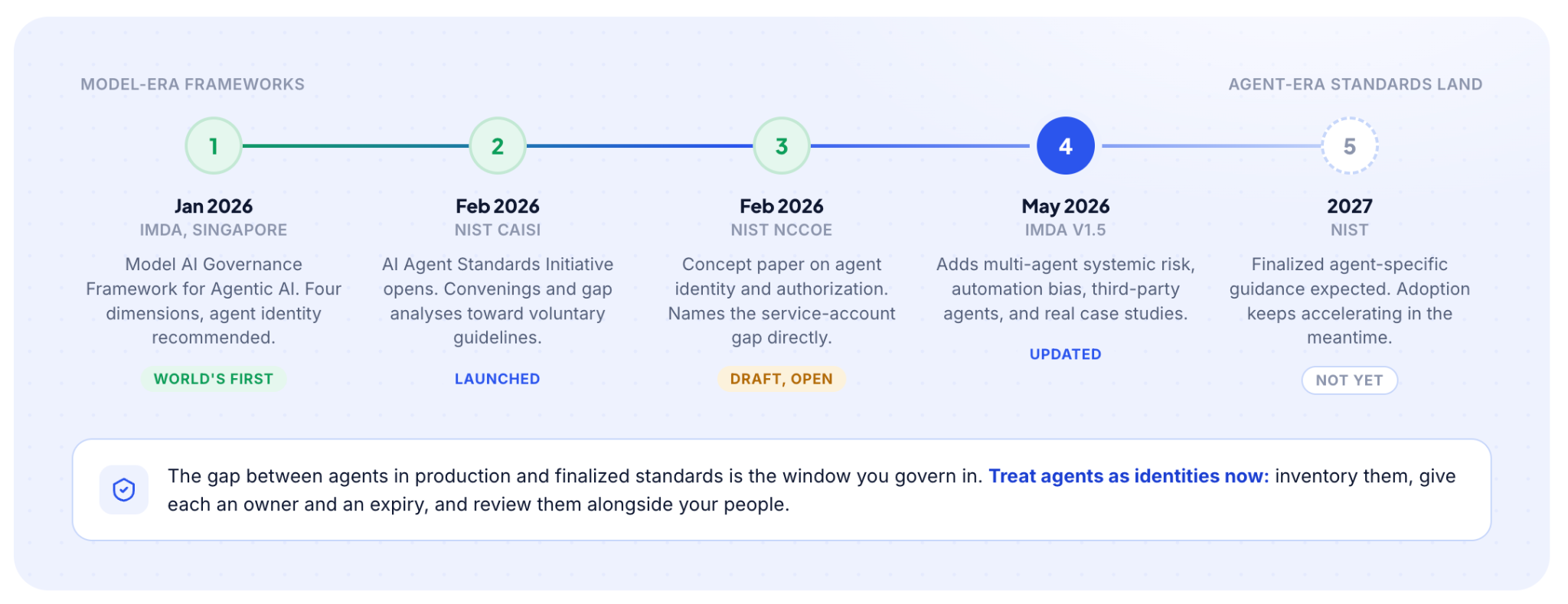
Both are moving, and neither has arrived. NIST has opened a dedicated standards workstream and named the identity problem precisely. The EU applies existing obligations to agents without treating them as a category of their own.
Body Instrument Date Where it stands on agents
IMDA, Singapore Model AI Governance Framework for Agentic AI 22 January 2026, v1.5 on 20 May 2026 Purpose-built for agents. Four dimensions, unique agent identity and audit trail recommended. Voluntary.
NIST CAISI AI Agent Standards Initiative 17 February 2026 Convenings and gap analyses producing voluntary guidelines. Finalized guidance unlikely before 2027.
NIST NCCoE Concept paper on software and AI agent identity and authorization February 2026 Proposes adapting existing identity and authorization frameworks for agents.
European Commission EU AI Act In force since August 2024 Articles 14 and 15 apply to agents in high-risk domains. No agent-specific guidance yet.

The NIST AI Agent Standards Initiative and the NCCoE Agent Identity Concept Paper

The initiative exists because the current stack was found wanting.

Community feedback held that NIST AI RMF, NIST SP 800-53 and ISO/IEC 42001 do not adequately address the risk surface created by agents taking autonomous, real-world actions.

Note what the NCCoE paper implies about the direction of travel.

The federal answer to agent governance is being built out of identity infrastructure, not out of model risk assessment, which is the same conclusion the previous section reached from the operational side.

EU AI Act Coverage of Agents Under Articles 14 and 15

Europe covers agents by extension rather than by design. The Act's definition of an AI system refers to varying levels of autonomy, which pulls agents in, and the high-risk obligations then apply.

Coverage is not the same as guidance:

  • As of early 2026 the AI Office had published nothing specifically addressing AI agents, autonomous tool use or runtime behavioral change
  • The AI Act Service Desk described regulatory considerations on agents as preliminary
  • Harmonized technical standards for high-risk systems have been delayed to late 2026 and are not yet final

The Timing Gap Between Agent Deployment and Finalized Standards

Here is the number to plan around. Finalized NIST agent guidance is unlikely to arrive before 2027, while enterprise agent adoption accelerates substantially through 2026.

  • Waiting for completed standards leaves you reactive, with real technical debt to unwind later
  • Nothing stops you applying the controls the draft work already agrees on, and the recommended interim move is mapping current deployments to the AI RMF functions you already run
  • The organizations that come out of this well treat the next eighteen months as a design window rather than a waiting room

How Do You Approach AI Agent Governance Before the Standards Are Final?

You govern agents as identities. Every draft that has looked hard at this problem, in Singapore and at NIST, arrives at the same place: an agent is an actor holding credentials, and the controls that work are the ones you already apply to accounts.

Four of them are available to you now.

Building an Inventory of Agents and the Credentials They Hold

Start with the count, because most organizations cannot produce one. The inventory has to cover more than the agents your platform team registered, and it has to be continuous rather than a quarterly audit, because agents appear between review cycles.

  • Agents built in-house on Azure AI Foundry, Bedrock or an open framework, then exposed over an API
  • Agents that arrived inside a SaaS tool you already pay for, switched on by a product team
  • Third-party and vendor agents acting on your data under a contract nobody read for autonomy language
  • MCP servers connecting agents to enterprise systems, along with who authorized each one and what it can reach
  • The API keys, service accounts and tokens each of those holds, and what each key can reach

The last line is the one that matters. An agent inventory without the credential attached tells you what exists but not what it can do.

Assigning an Owner and an Expiry Date to Every Agent Identity

An agent with no named owner is an agent nobody will retire. Ownership is what converts an inventory into something you can act on, and expiry is what stops the inventory growing forever.

  • Name a human accountable for each agent, matching the meaningful human accountability dimension Singapore set out
  • Scope the credential to what the agent's job actually needs, not what was convenient at creation
  • Set an expiry date at the moment of creation rather than promising a cleanup later
  • Record what the agent is for, so the next reviewer is not guessing

Extending Access Reviews to Logins That Are Not People

Most access review programs certify employees and quietly skip everything else. That is the single largest gap between how mature your identity governance looks on paper and how much of your actual attack surface it covers.

Agents belong in the same cycle as your people: the same cadence, the same reviewer routing, the same evidence capture.

Reviewing employees quarterly while service accounts and agent tokens go unreviewed for years leaves you certifying the smaller half of the problem, and the mechanics of extending certification to logins that are not people are well understood at this point.

This is the part of AI agent governance CloudEagle.ai handles for you.

We discover the AI applications, agents and MCP servers running across your stack, surface the service accounts and API keys behind them with owner, scope and last activity attached.

Additionally bring them into continuous access reviews alongside your employees, with expiry dates applied at creation.
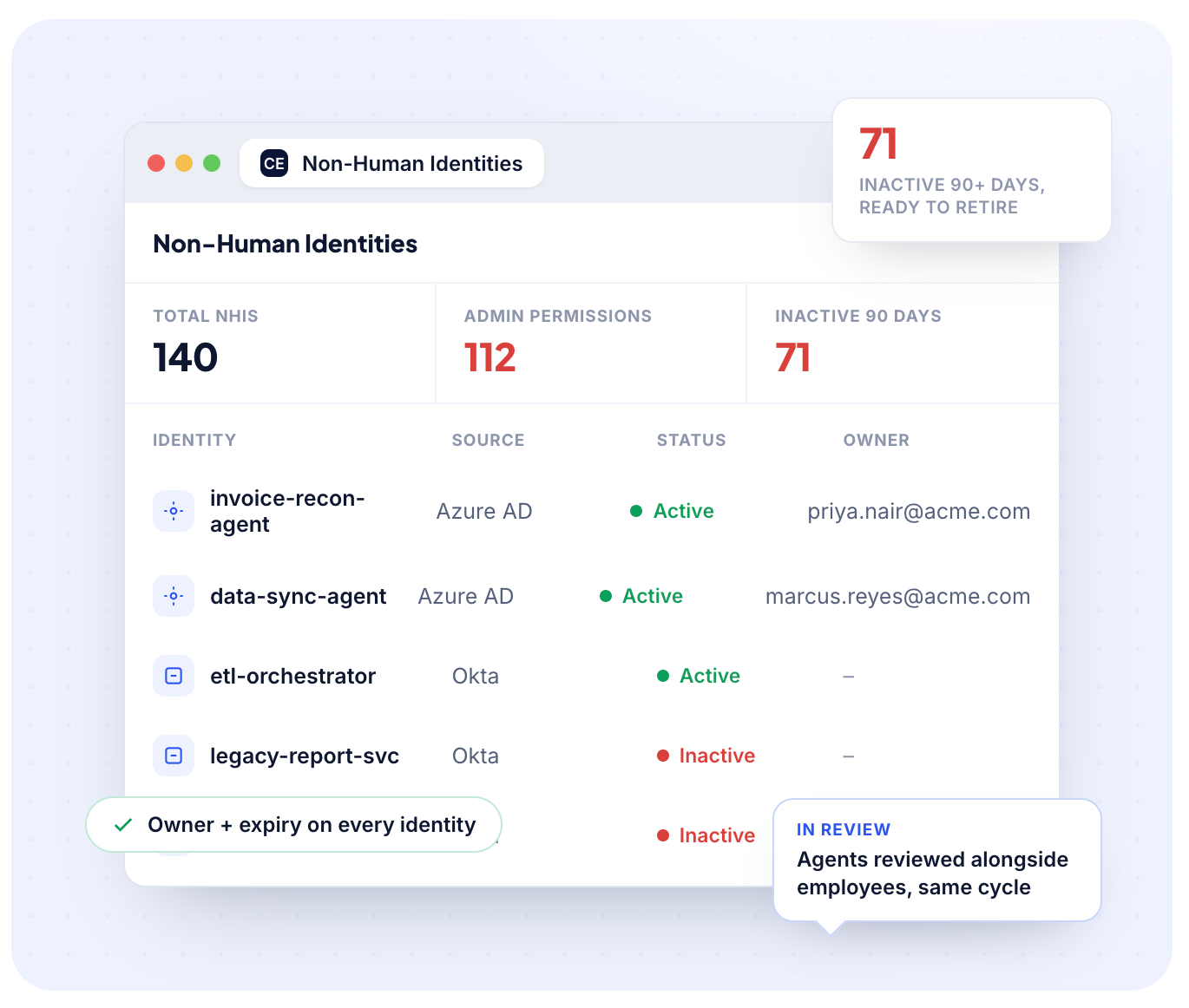
The result is a governance record you can hand to an auditor without a spreadsheet exercise.

Armorcode did exactly this with us, taking visibility across their logins that are not people from 40 percent to 95 percent, remediating 480 unmanaged accounts and scoping down more than 220 that carried more access than their function required.

Where Visibility Ends and Enforcement Begins

Be honest with yourself about what this class of control does and does not do, because the distinction shapes what else you need.

Discovery, ownership, scoping, expiry and review govern what an agent is permitted to hold. They do not intercept an agent mid-action and stop a specific decision as it happens.

Runtime interception is a different control layer, usually a proxy or a gateway sitting in the traffic path.

Treat that as a sequencing principle rather than a disclaimer. You cannot enforce policy on an agent you cannot see, and most organizations are still short of the inventory.

Get the identity layer right first, then decide whether usage enforcement at the point of behavior or full runtime interception is worth what it costs you in latency and complexity.

What Should Security and IT Leaders Do About AI Governance Frameworks Now?

Do not start over. The framework you already run stays useful, it just has to be extended to cover actions and access rather than only outputs.

Mapping Existing Agent Deployments to a Framework You Already Run

If you have adopted the NIST AI RMF, the functions still hold. What changes is their scope.

Function What it covered for models What it has to cover for agents
Govern Policy, roles, accountability for AI use Named owner per agent, approval path for granting an agent new access
Map Model context, training data, intended use Tool integration surface, authorization scope, which agents talk to which
Measure Output quality, bias, accuracy Actions taken, credentials used, deviation from the bounded scope
Manage Mitigation and monitoring of model risk Credential expiry, scope reduction, retirement of dormant agents

The Singapore framework is worth reading alongside it even if you never adopt it formally. It is currently the most detailed public description of what bounding an agent actually involves.

Choosing an AI Governance Framework When Agents Are in Scope

If you are selecting an AI governance framework now rather than extending one, judge candidates on four questions rather than on certification value alone.

  • Does it treat the AI system as something that acts, or only as something that outputs
  • Does it require an identifiable owner for each autonomous system
  • Does it say anything about agent identity, credentials and authorization trails
  • Does it address what happens when agents delegate to other agents

Most frameworks in circulation answer the first question and stop.

Singapore's answers all four, which is why it is the reference point in this conversation even for organizations with no Singapore footprint. NIST is heading the same way, and the shape of what lands in 2027 is already visible in the NCCoE identity work.

Whichever framework you land on, the controls underneath it are the same set, and the practical challenges of governing autonomous agents are worth working through before you commit to a certification path.

The organizations that will pass that audit comfortably are the ones that spent the interim building the agent inventory, not the ones that spent it reading drafts.

Advertisement for a SaaS Subscription Tracking Template with a call-to-action button to download and a partial graphic of a tablet showing charts.Banner promoting a SaaS Agreement Checklist to streamline SaaS management and avoid budget waste with a call-to-action button labeled Download checklist.Blue banner with text 'The Ultimate Employee Offboarding Checklist!' and a black button labeled 'Download checklist' alongside partial views of checklist documents from cloudeagle.ai.Digital ad for download checklist titled 'The Ultimate Checklist for IT Leaders to Optimize SaaS Operations' by cloudeagle.ai, showing checklist pages.Slack Buyer's Guide offer with text 'Unlock insider insights to get the best deal on Slack!' and a button labeled 'Get Your Copy', accompanied by a preview of the guide featuring Slack's logo.Monday Pricing Guide by cloudeagle.ai offering exclusive pricing secrets to maximize investment with a call-to-action button labeled Get Your Copy and an image of the guide's cover.Blue banner for Canva Pricing Guide by cloudeagle.ai offering a guide to Canva costs, features, and alternatives with a call-to-action button saying Get Your Copy.Blue banner with white text reading 'Little-Known Negotiation Hacks to Get the Best Deal on Slack' and a white button labeled 'Get Your Copy'.Blue banner with text 'Little-Known Negotiation Hacks to Get the Best Deal on Monday.com' and a white button labeled 'Get Your Copy'.Blue banner with text 'Little-Known Negotiation Hacks to Get the Best Deal on Canva' and a white button labeled 'Get Your Copy'.Banner with text 'Slack Buyer's Guide' and a 'Download Now' button next to images of a guide titled 'Slack Buyer’s Guide: Features, Pricing & Best Practices'.Digital cover of Monday Pricing Guide with a button labeled Get Your Copy on a blue background.Canva Pricing Guide cover with a button labeled Get Your Copy on a blue gradient background.

Enter your email to
unlock the report

Oops! Something went wrong while submitting the form.
License Count
Benchmark
Per User/Per Year

Enter your email to
unlock the report

Oops! Something went wrong while submitting the form.
License Count
Benchmark
Per User/Per Year

Enter your email to
unlock the report

Oops! Something went wrong while submitting the form.
Notion Plus
License Count
Benchmark
Per User/Per Year
100-500
$67.20 - $78.72
500-1000
$59.52 - $72.00
1000+
$51.84 - $57.60
Canva Pro
License Count
Benchmark
Per User/Per Year
100-500
$74.33-$88.71
500-1000
$64.74-$80.32
1000+
$55.14-$62.34

Enter your email to
unlock the report

Oops! Something went wrong while submitting the form.

Enter your email to
unlock the report

Oops! Something went wrong while submitting the form.
Zoom Business
License Count
Benchmark
Per User/Per Year
100-500
$216.00 - $264.00
500-1000
$180.00 - $216.00
1000+
$156.00 - $180.00

Enter your email to
unlock the report

Oops! Something went wrong while submitting the form.

Get the Right Security Platform To Secure Your Cloud Infrastructure

Please enter a business email
Thank you!
The 2023 SaaS report has been sent to your email. Check your promotional or spam folder.
Oops! Something went wrong while submitting the form.

Access full report

Please enter a business email
Thank you!
The 2023 SaaS report has been sent to your email. Check your promotional or spam folder.
Oops! Something went wrong while submitting the form.

TL;DR

  • Every major AI governance framework was written to govern what a model produces. An agent is judged by what it does, and that difference is why the frameworks you already run do not cover the agents your teams are shipping.
  • A 2026 survey of generative AI security found that frontier safety policies, the NIST AI RMF, ISO/IEC 42001 and the EU AI Act contain no references to agents or agentic systems at all.
  • Singapore moved first. IMDA released the Model AI Governance Framework for Agentic AI on 22 January 2026 and published version 1.5 on 20 May 2026 after feedback from more than 60 organizations.
  • The United States is early. NIST's Center for AI Standards and Innovation launched its AI Agent Standards Initiative on 17 February 2026, and finalized agent guidance is unlikely before 2027 while adoption accelerates through this year.
  • The gap has a name your security team already understands. The NCCoE concept paper frames it directly: agents are commonly treated as generic service accounts, with no dedicated identity, authorization or accountability controls.
  • Until the standards land, govern agents the way you govern any other login that is not a person. CloudEagle.ai discovers every AI app, agent and MCP server across your stack, attaches an owner and an expiry to the credentials behind them, and puts them in the same review cycle as your employees.

Pick up any AI governance framework in circulation today and you will find it asks a consistent question: is this model's output fair, accurate, explainable and safe. That question was the right one in 2023.

It is the wrong one for a system that books the refund, merges the pull request, or queries the customer database at three in the morning without anyone watching.

What Do Today's AI Governance Frameworks Actually Govern, and Where Do They Stop?

Today's frameworks govern models and the uses people put them to. They ask how a system was trained, what it outputs, who it might harm, and how a human reviews that output.

They stop at the point where the system stops answering and starts acting.

The Model and Use Assumption Behind NIST AI RMF, ISO 42001, and the EU AI Act

All three were built on the same picture of AI: a model produces something, a person decides what to do with it. Each is good at what it was drafted for, and none was drafted for a system that holds credentials and calls other systems on its own.

Framework What it governs How it is structured Where it stops
NIST AI RMF The model and its risks in context Four functions: Govern, Map, Measure, Manage No agent-specific controls. SP 800-53 overlays for single and multi-agent systems are still in development.
ISO/IEC 42001 The management system your organization runs around AI Plan-Do-Check-Act, certifiable Certifies the process around AI, not the actions an agent takes at runtime.
EU AI Act The use case and its risk tier Prohibited practices plus obligations on listed high-risk systems Does not regulate agentic AI as a distinct category.

The Missing Vocabulary in Existing Framework Text

The clearest evidence is what the documents do not say. Search the text of the three frameworks most enterprises have standardized on and the word "agent" is absent.

That is not a drafting oversight, it is a timestamp. The frameworks predate the products:

  • Anthropic launched Computer Use in October 2024
  • OpenAI released Operator in January 2025
  • Claude Code reached general availability in May 2025
  • None of them shipped under a binding agent-specific governance standard

The practical consequence for you is narrow and specific. Your framework tells you how to assess a model you licensed.

It tells you nothing about the agent your engineering team built on top of that model last quarter, or the credential that agent is using right now.

Catch the AI Agents Your Framework Never Named

A practical guide to finding shadow AI and governing it before the standards land.
Get The Guide

Why Autonomous Agents Break the Assumptions Behind Existing AI Frameworks

Agents break four assumptions at once. Each one is load-bearing for how a model-era framework works, and each one fails differently when the system acts on its own.

Assumption in a model-era framework Why it holds for a model Why it fails for an agent
AI produces output that a person reviews Review happens at the point of reading. The action lands before anyone reads anything.
Risk is bounded by a single interaction One prompt, one response, one decision. Multi-step plans compound an early error down the chain.
A human sits between the system and the consequence The human executes. The agent executes, using its own credential.
The acting party is identifiable A named employee acted. A shared key or service account acted, and nobody knows which agent held it.

Agents Take Actions in Live Systems, Not Just Produce Outputs

A model that writes a bad summary has produced a bad summary. An agent that misreads the same input sends the email, closes the ticket, or pushes the change.

Output-centered review has no equivalent checkpoint for the second case, because by the time anyone reads anything, the action has already happened.

Tool Access, Memory, and Multi-Step Plans as a New Risk Surface

Agents differ from models on properties that governance frameworks never had to account for:

  • They act on external systems and reach tools dynamically, so the risk surface changes at runtime
  • They execute multi-step plans, so a small early error compounds instead of stopping
  • They carry persistent memory, which can be manipulated
  • They hand work to other agents, which splits accountability across boundaries

That last one is what hurts during an incident. When three agents pass a task between them and something goes wrong, "which system did this" has no clean answer.

Agent Credentials Treated as Generic Service Accounts

This failure shows up in real environments long before any regulator gets involved. Agents get whatever credential was easiest to issue, which is usually a shared API key or a service account built for software that does not make its own decisions.

The mental model is already out of date. In most environments the majority of logins that are not people are now agents rather than service accounts, created in low-code platforms that never touched an IT provisioning workflow.

The federal standards work says so plainly:

  • Enterprise deployments commonly rely on manually managed access lists, shared API keys and service account credentials designed for software systems rather than autonomous agents
  • The result is an authorization chain that nobody can follow after the fact
  • Agents end up without dedicated identity, authorization or accountability controls

Which points at the fix, and it is not a new framework. If the problem is that agents are unmanaged logins, manage them as logins: inventory them, give each one an owner, scope it, expire it, and review it on a cycle.

What Singapore Did About Autonomous Agents

Singapore wrote a framework for actors instead of outputs. The IMDA framework, unveiled in January 2026, is the first governance model in the world specific to agentic AI, and it covers organizations that build agents internally as well as those taking them from a third party.

The IMDA Model AI Governance Framework for Agentic AI and Its Four Dimensions

The framework is organized around four dimensions rather than model lifecycle stages. Read them against a model-era framework and the shift is obvious: these are questions about authority and scope, not about output quality.

Dimension The question it asks What it means in practice
Assess and bound the risks upfront How far is this agent allowed to go Define the actions, systems and data inside the agent's reach before it runs.
Ensure meaningful human accountability Who answers for what this agent does Name an owner and set checkpoints where a human approves.
Implement technical controls and processes What stops it structurally, not by instruction Access scoping, guardrails and approvals built into the system rather than the prompt.
Enable end-user responsibility Does the person working alongside it know what it is Transparency about when an agent is acting and where its judgment ends.

What Version 1.5 Added on Multi-Agent Risk and Automation Bias

The January release was not the end of it. Version 1.5, published on 20 May 2026, kept the four-pillar structure and added guidance on multi-agent systemic risk, more granular technical controls, and case studies showing how organizations applied the framework in practice.

Two additions deserve your attention:

  • The update addresses multi-agent systems, third-party agents and automation bias
  • It raises what happens to your own team's competence when agents absorb entry-level work, including skill degradation and the loss of knowledge needed to run critical processes manually when agents fail or become unavailable

That second point is one almost nobody else in this conversation is making, and it is an operational risk, not an ethics footnote.

Agent Identity and Authorization Trails as a Stated Requirement

The part that matters most for security and IT is that Singapore made identity explicit.

The framework recommends that each agent have a unique identity tied to the supervising agent or user it acts for, so accountability can be traced, supported by an audit trail of which agent acted under whose authorization.

You can act on that this quarter without waiting for anyone to finalize anything.

The framework is voluntary, but the control it describes is concrete, and it reduces to three things: know which agents exist, know who each one answers to, and be able to reconstruct what each one did.

How NIST and the EU Are Catching Up to the Agent Gap

Both are moving, and neither has arrived. NIST has opened a dedicated standards workstream and named the identity problem precisely. The EU applies existing obligations to agents without treating them as a category of their own.

Body Instrument Date Where it stands on agents
IMDA, Singapore Model AI Governance Framework for Agentic AI 22 January 2026, v1.5 on 20 May 2026 Purpose-built for agents. Four dimensions, unique agent identity and audit trail recommended. Voluntary.
NIST CAISI AI Agent Standards Initiative 17 February 2026 Convenings and gap analyses producing voluntary guidelines. Finalized guidance unlikely before 2027.
NIST NCCoE Concept paper on software and AI agent identity and authorization February 2026 Proposes adapting existing identity and authorization frameworks for agents.
European Commission EU AI Act In force since August 2024 Articles 14 and 15 apply to agents in high-risk domains. No agent-specific guidance yet.

The NIST AI Agent Standards Initiative and the NCCoE Agent Identity Concept Paper

The initiative exists because the current stack was found wanting.

Community feedback held that NIST AI RMF, NIST SP 800-53 and ISO/IEC 42001 do not adequately address the risk surface created by agents taking autonomous, real-world actions.

Note what the NCCoE paper implies about the direction of travel.

The federal answer to agent governance is being built out of identity infrastructure, not out of model risk assessment, which is the same conclusion the previous section reached from the operational side.

EU AI Act Coverage of Agents Under Articles 14 and 15

Europe covers agents by extension rather than by design. The Act's definition of an AI system refers to varying levels of autonomy, which pulls agents in, and the high-risk obligations then apply.

Coverage is not the same as guidance:

  • As of early 2026 the AI Office had published nothing specifically addressing AI agents, autonomous tool use or runtime behavioral change
  • The AI Act Service Desk described regulatory considerations on agents as preliminary
  • Harmonized technical standards for high-risk systems have been delayed to late 2026 and are not yet final

The Timing Gap Between Agent Deployment and Finalized Standards

Here is the number to plan around. Finalized NIST agent guidance is unlikely to arrive before 2027, while enterprise agent adoption accelerates substantially through 2026.

  • Waiting for completed standards leaves you reactive, with real technical debt to unwind later
  • Nothing stops you applying the controls the draft work already agrees on, and the recommended interim move is mapping current deployments to the AI RMF functions you already run
  • The organizations that come out of this well treat the next eighteen months as a design window rather than a waiting room

How Do You Approach AI Agent Governance Before the Standards Are Final?

You govern agents as identities. Every draft that has looked hard at this problem, in Singapore and at NIST, arrives at the same place: an agent is an actor holding credentials, and the controls that work are the ones you already apply to accounts.

Four of them are available to you now.

Building an Inventory of Agents and the Credentials They Hold

Start with the count, because most organizations cannot produce one. The inventory has to cover more than the agents your platform team registered, and it has to be continuous rather than a quarterly audit, because agents appear between review cycles.

  • Agents built in-house on Azure AI Foundry, Bedrock or an open framework, then exposed over an API
  • Agents that arrived inside a SaaS tool you already pay for, switched on by a product team
  • Third-party and vendor agents acting on your data under a contract nobody read for autonomy language
  • MCP servers connecting agents to enterprise systems, along with who authorized each one and what it can reach
  • The API keys, service accounts and tokens each of those holds, and what each key can reach

The last line is the one that matters. An agent inventory without the credential attached tells you what exists but not what it can do.

Assigning an Owner and an Expiry Date to Every Agent Identity

An agent with no named owner is an agent nobody will retire. Ownership is what converts an inventory into something you can act on, and expiry is what stops the inventory growing forever.

  • Name a human accountable for each agent, matching the meaningful human accountability dimension Singapore set out
  • Scope the credential to what the agent's job actually needs, not what was convenient at creation
  • Set an expiry date at the moment of creation rather than promising a cleanup later
  • Record what the agent is for, so the next reviewer is not guessing

Extending Access Reviews to Logins That Are Not People

Most access review programs certify employees and quietly skip everything else. That is the single largest gap between how mature your identity governance looks on paper and how much of your actual attack surface it covers.

Agents belong in the same cycle as your people: the same cadence, the same reviewer routing, the same evidence capture.

Reviewing employees quarterly while service accounts and agent tokens go unreviewed for years leaves you certifying the smaller half of the problem, and the mechanics of extending certification to logins that are not people are well understood at this point.

This is the part of AI agent governance CloudEagle.ai handles for you.

We discover the AI applications, agents and MCP servers running across your stack, surface the service accounts and API keys behind them with owner, scope and last activity attached.

Additionally bring them into continuous access reviews alongside your employees, with expiry dates applied at creation.

The result is a governance record you can hand to an auditor without a spreadsheet exercise.

Armorcode did exactly this with us, taking visibility across their logins that are not people from 40 percent to 95 percent, remediating 480 unmanaged accounts and scoping down more than 220 that carried more access than their function required.

Where Visibility Ends and Enforcement Begins

Be honest with yourself about what this class of control does and does not do, because the distinction shapes what else you need.

Discovery, ownership, scoping, expiry and review govern what an agent is permitted to hold. They do not intercept an agent mid-action and stop a specific decision as it happens.

Runtime interception is a different control layer, usually a proxy or a gateway sitting in the traffic path.

Treat that as a sequencing principle rather than a disclaimer. You cannot enforce policy on an agent you cannot see, and most organizations are still short of the inventory.

Get the identity layer right first, then decide whether usage enforcement at the point of behavior or full runtime interception is worth what it costs you in latency and complexity.

What Should Security and IT Leaders Do About AI Governance Frameworks Now?

Do not start over. The framework you already run stays useful, it just has to be extended to cover actions and access rather than only outputs.

Mapping Existing Agent Deployments to a Framework You Already Run

If you have adopted the NIST AI RMF, the functions still hold. What changes is their scope.

Function What it covered for models What it has to cover for agents
Govern Policy, roles, accountability for AI use Named owner per agent, approval path for granting an agent new access
Map Model context, training data, intended use Tool integration surface, authorization scope, which agents talk to which
Measure Output quality, bias, accuracy Actions taken, credentials used, deviation from the bounded scope
Manage Mitigation and monitoring of model risk Credential expiry, scope reduction, retirement of dormant agents

The Singapore framework is worth reading alongside it even if you never adopt it formally. It is currently the most detailed public description of what bounding an agent actually involves.

Choosing an AI Governance Framework When Agents Are in Scope

If you are selecting an AI governance framework now rather than extending one, judge candidates on four questions rather than on certification value alone.

  • Does it treat the AI system as something that acts, or only as something that outputs
  • Does it require an identifiable owner for each autonomous system
  • Does it say anything about agent identity, credentials and authorization trails
  • Does it address what happens when agents delegate to other agents

Most frameworks in circulation answer the first question and stop.

Singapore's answers all four, which is why it is the reference point in this conversation even for organizations with no Singapore footprint. NIST is heading the same way, and the shape of what lands in 2027 is already visible in the NCCoE identity work.

Whichever framework you land on, the controls underneath it are the same set, and the practical challenges of governing autonomous agents are worth working through before you commit to a certification path.

The organizations that will pass that audit comfortably are the ones that spent the interim building the agent inventory, not the ones that spent it reading drafts.

CloudEagle.ai recognized in the 2025 Gartner® Magic Quadrant™ for SaaS Management Platforms
Download now
gartner chart
5x
Faster employee
onboarding
80%
Reduction in time for
user access reviews
30k
Workflows
automated
$15Bn
Analyzed in
contract spend
$2Bn
Saved in
SaaS spend

Streamline SaaS governance and save 10-30%

Book a Demo with Expert
CTA image