
%201.svg)


HIPAA Compliance Checklist for 2025

Agentic AI is changing how enterprises work. Unlike traditional AI that only answers prompts, agentic AI can take actions on its own, complete multi-step tasks, interact with systems, and make decisions without human supervision.
This creates huge opportunities, but it also introduces new risks. Without the right controls, autonomous AI agents can access the wrong data, trigger unintended workflows, create compliance issues, or operate without proper oversight.
That's why agentic AI governance is now essential.
Let's explore what agentic AI governance is, why enterprises need it, the challenges involved, and best practices for managing autonomous AI safely.
TL;DR
- Agentic AI governance makes sure autonomous AI systems act safely, ethically, and only within approved limits.
- Traditional AI controls aren't enough; agentic AI can take multi-step actions on its own, so it needs real-time monitoring, identity controls, and strict oversight.
- The biggest risks include low visibility, unpredictable actions, shadow AI agents, too many permissions, risky API activity, and unclear accountability.
- Best practices: least-privilege access, regular reviews, guardrails, risk scoring, audit logs, kill switches, sandbox testing, real-time monitoring and mapping controls to NIST AI RMF, ISO 42001 and the EU AI Act.
- CloudEagle.ai helps enterprises securely manage AI with automated controls, monitoring, and compliance.
What Is Agentic AI Governance?
Agentic AI governance, often shortened to agentic governance, is the framework of policies, controls, guardrails, and oversight mechanisms used to manage access to AI systems that can act autonomously, not just make predictions. Building an effective AI governance program requires policies, controls, and real-time monitoring.
Unlike traditional AI models that only generate outputs, agentic AI can take real actions, often across multiple applications and data environments.
Agentic AI systems are capable of:
- Planning and executing multi-step tasks
- Making decisions dynamically based on real-time inputs
- Triggering workflows across SaaS tools and internal systems
- Modifying data, files, or system settings
- Interacting with APIs, services, and external agents
- Acting independently without human prompts
Because these systems behave less like software and more like autonomous digital workers, they require stronger access governance to ensure they remain safe, compliant, and controllable.
Effective agentic AI governance ensures that:
- AI agents operate within clearly defined boundaries
- Their permissions follow least-privilege principles
- All actions are tracked, explainable, and auditable
- They cannot escalate privileges or access sensitive data
- High-risk workflows require human approval or intervention
- Every autonomous decision complies with internal and external regulations
At its core, an agentic AI governance framework focuses on visibility, access control, accountability, and safety—so enterprises can leverage autonomous AI without introducing operational, security, or compliance risks.
What Are the Key Agentic AI Governance Challenges?
These are the agentic AI governance challenges enterprises run into most:
1. Autonomy Risks: Agentic AI systems can make decisions without human intervention, which may lead to unexpected or harmful outcomes if not carefully controlled.
2. Accountability Gaps: When AI agents act independently, it becomes difficult to assign responsibility for errors, damages, or regulatory violations, creating legal and operational challenges.
3. Privacy & Compliance: Autonomous agents often require access to sensitive information, increasing the risk of violating privacy laws and regulatory frameworks such as GDPR, HIPAA, or CCPA.
4. Transparency Issues: Many autonomous AI models operate as "black boxes," making it hard to understand or explain the reasoning behind their decisions, which complicates audits and stakeholder trust.
5. Data Quality & Bias: AI decisions are only as reliable as the data they are trained on. Biased, incomplete, or outdated data can result in unfair or inaccurate outcomes.
6. Security Threats: Elevated permissions for AI agents can be exploited by insiders or external attackers, potentially causing data breaches, system disruptions, or unintended actions.
7. Regulatory Uncertainty: AI laws and guidelines are evolving rapidly and vary across regions, making it challenging to ensure agentic AI systems remain fully compliant globally.

Why Agentic AI Requires a New Governance Approach?
Agentic AI fundamentally reshapes an enterprise's risk landscape. While traditional AI models only generate outputs, agentic AI can act, decide, and trigger workflows across multiple systems—often without human supervision.
These systems can:
- Execute tasks inside SaaS applications
- Modify configurations or system settings
- Interact with finance, HR, IT, or operational systems
- Request, generate, or misuse credentials
- Trigger chained automations or external APIs
- Communicate and collaborate with other agents
- Use tools or resources without human approval
This level of autonomy introduces risks that traditional AI governance cannot manage.
Agentic AI Needs a New Governance Layer For:
1. Autonomous Decision-Making Creates Unpredictability: Unlike rule-based automation, agentic AI selects different actions each time based on its internal reasoning. Understanding how agentic AI differs from RPA which follows fixed rules, clarifies why governance approaches must adapt for autonomous decision-making.
2. AI Agents Operate Across Multiple Systems Without Central Oversight: Continuous visibility across AI systems is essential to track autonomous agent behavior and prevent misconfigurations or malicious actions. Agents span SaaS apps, APIs, internal tools, and cloud environments. This creates cross-system risks that no single team or platform traditionally monitors.
3. Agents Often Require Elevated Access to Do Their Jobs: Without strict controls, they can over-privilege themselves or access sensitive data. One misconfigured permission can open a massive attack surface.
4. Speed Amplifies the Blast Radius of Mistakes: Learning from agentic AI failures where autonomous agents caused unintended consequences or compliance violations helps teams avoid similar mistakes. Agents can execute hundreds or thousands of actions in minutes. A small error, wrong file, wrong workflow, or wrong API can cause instant, large-scale damage.
5. Accountability Becomes Ambiguous: If an AI agent makes a harmful decision, who is responsible? Legal, compliance, and security teams need clear ownership and auditability.
6. Shadow AI Becomes Significantly Harder to Detect: Employees can deploy open-source agents or connect AI tools directly to SaaS apps. These agents run autonomously, outside the visibility of IT or security.
7. Compliance Requirements Are Evolving to Cover Autonomous Systems
New regulations and frameworks (EU AI Act, SOC 2, ISO 27001, NIST AI RMF) now expect:
- Clear documentation of AI decisions
- Access governance for agents
- Continuous monitoring of autonomous behavior
- Explainability and auditability
Traditional governance models built for static ML models cannot meet these demands.
Agentic AI Governance Frameworks: How They Work and Why They Matter?
An agentic AI governance framework is the structured set of policies, processes, and controls that ensures autonomous AI systems operate safely and within enterprise boundaries.
A modern framework generally includes:
1. Purpose & Policies: Defines where agentic AI can operate, data sensitivity limits, ethical/compliance rules, risk tolerance, and approval workflows. Sets clear boundaries to align autonomous agents with business goals and prevent misuse.
2. Permissioning & Access Controls: Uses RBAC, ABAC, JIT access, PAM, scoped APIs, and least privilege to ensure agents access only necessary resources. Context-aware permissions adapt dynamically to tasks or risks, preventing unauthorized actions.
3. Monitoring & Guardrails: Provides real-time logging, anomaly detection, policy enforcement, risk scoring, and kill-switches. Tracks agent behavior across planning/action/reflection loops to catch deviations early.
4. Data Governance & Privacy Controls: Classifies sensitive data, applies masking/anonymization, blocks PII/PHI, and logs all flows. Ensures GDPR/HIPAA compliance in autonomous data handling.
5. Operational Controls: Manages lifecycle with sandbox testing, deployment standards, incident response, change controls, and versioning. Prevents cascading failures through fail-safes.
6. Accountability Framework: Assigns RACI roles: owner, reviewer, approver, monitor, escalation paths. Eliminates responsibility gaps in multi-agent systems.
How CloudEagle.ai Helps With Agentic AI Governance at Scale?
CloudEagle.ai delivers a unified identity and AI-governance control plane, enabling safe agentic AI use across enterprises. Employees activate AI agents only under controlled, compliant, least-privilege conditions. Real-time monitoring tracks agent behavior, system interactions, and permissions for responsible governance.
CloudEagle.ai's AI Governance module covers four areas that map directly to agent risk.
a. AI Agent Management
AI agents get created across provider consoles and workflows, then keep running with no clear owner or lifecycle. CloudEagle.ai discovers and inventories them in one view, showing each agent's status, last activity, owner, credential usage and the roles it holds or inherits.
- One inventory across providers, at both global and application level
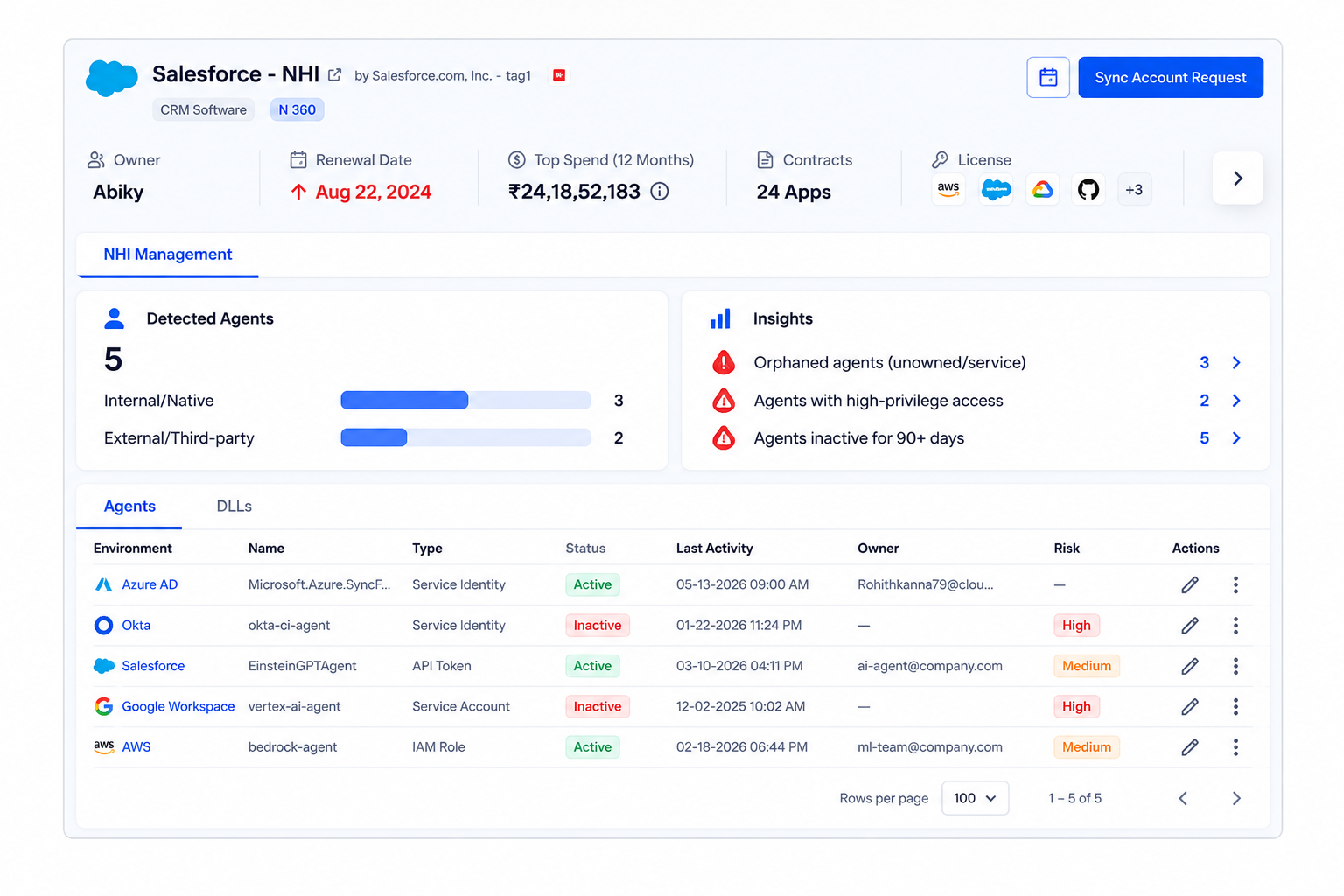
- Inherited credentials, roles and permissions mapped to each agent
- Inactive, unowned or over-permissioned agents flagged for remediation
b. Non-Human Identity Governance
Service accounts, API tokens and AI agents often outlive the project they were built for, carrying admin-level access nobody reviews. CloudEagle.ai's non-human identity management discovers them through SSO, IdP and direct app integrations and runs them through the same access reviews and lifecycle as employees.
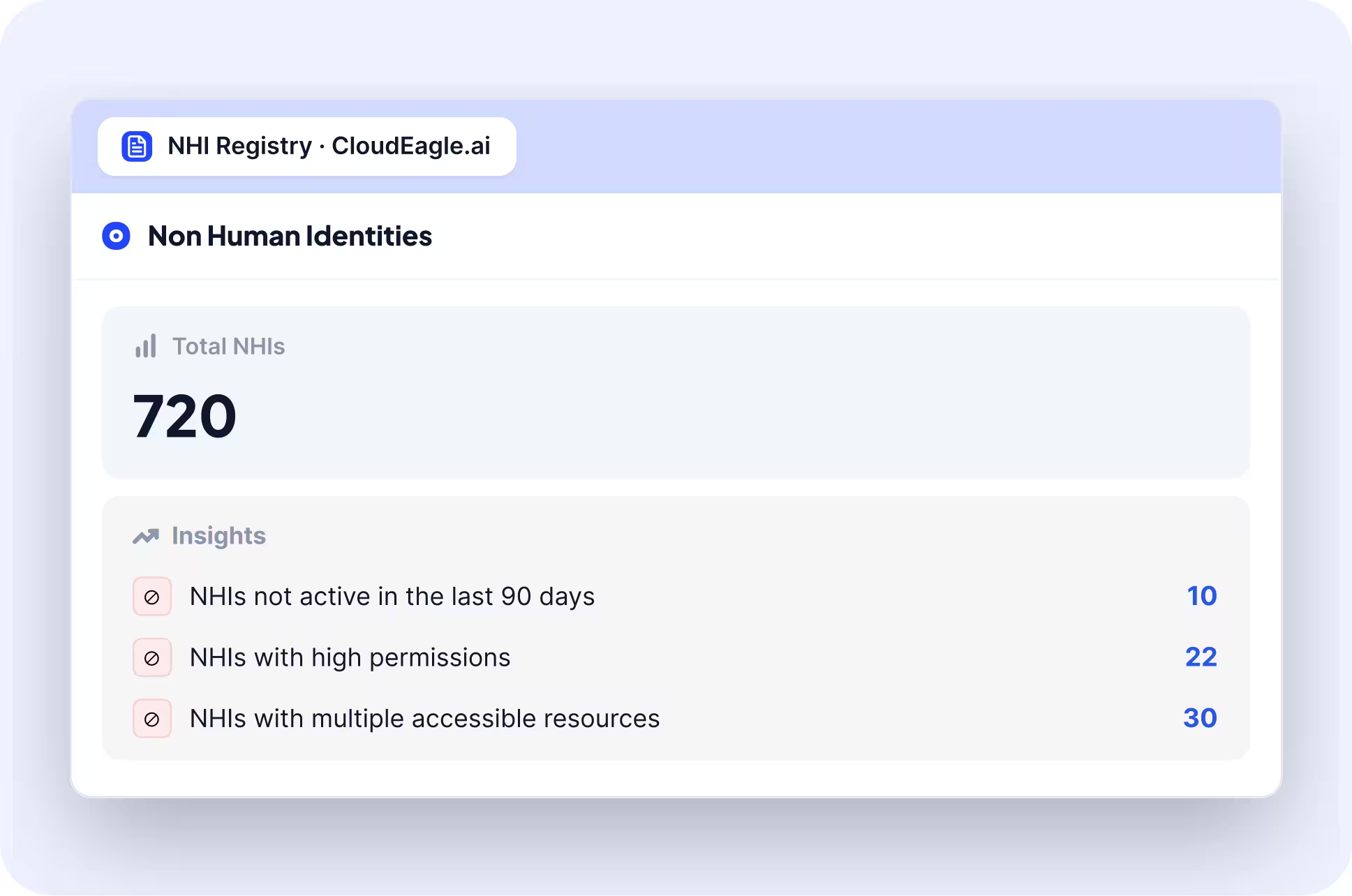
- Owner, scope, activity and creation date for every machine identity
- User access reviews extended to machine identities on the same cadence as people
- Dormant, high-privilege credentials surfaced first through risk correlation
- AI access, including tokens, removed during AI agent offboarding
ArmorCode raised machine identity visibility from 40% to 95% with CloudEagle.ai, remediating 480 unmanaged identities and scoping down 220+ over-privileged ones.
c. AI Usage Control
For approved AI tools, CloudEagle.ai breaks down token usage and spend by user, team and project, so leadership can see which projects return value. Admins set spend limits and route increase requests through a structured approval process.
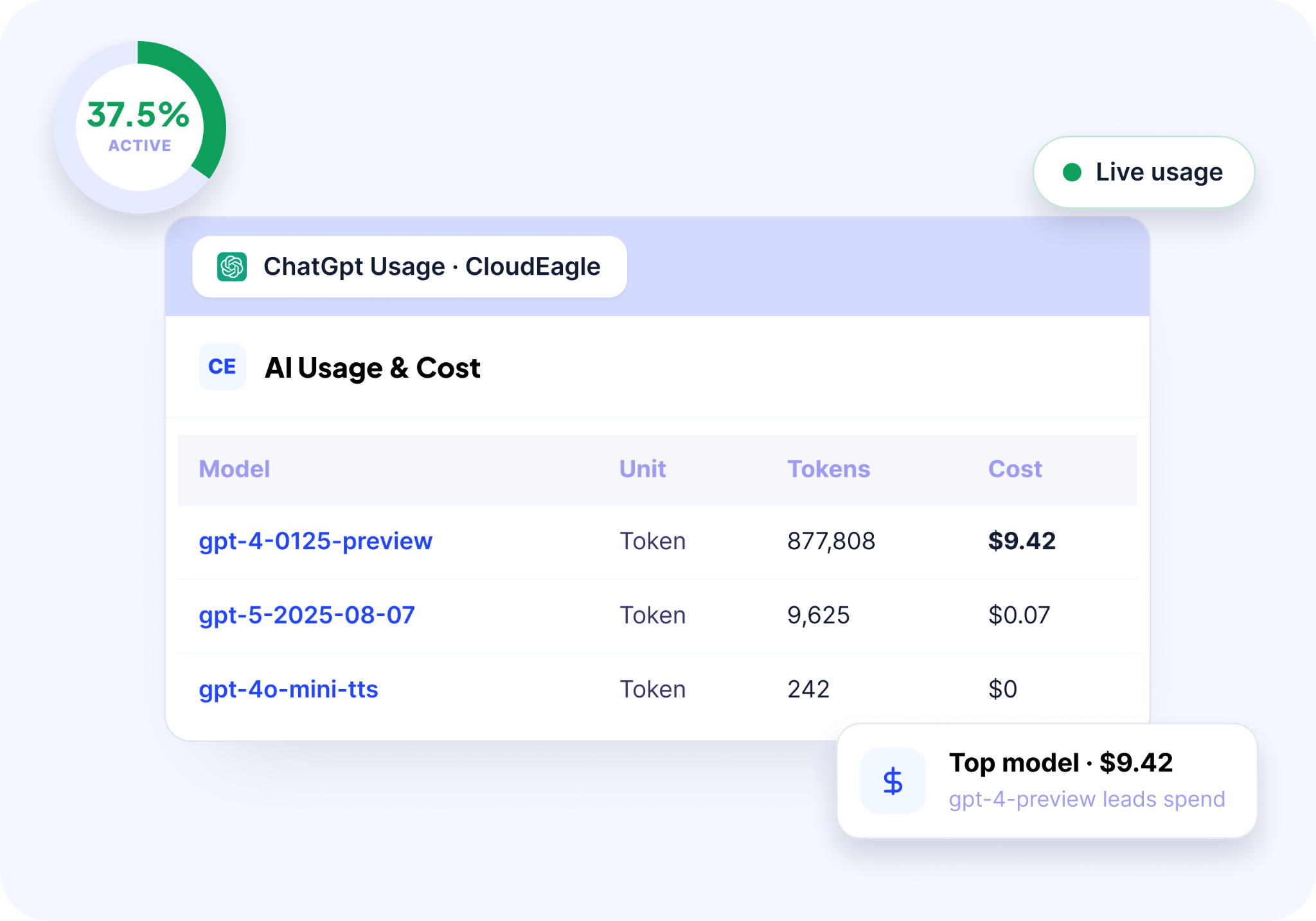
- Invoices matched against tracked usage before finance approves them
- Chargeback reports built on existing SSO and org data
- Unused AI licenses flagged for harvesting through approval workflows
- Prompt intent classified by a browser plugin without storing prompt text, with sensitive prompts flagged before submission
- Model nudges that steer users toward the right model for each task
d. AI Policy Enforcement
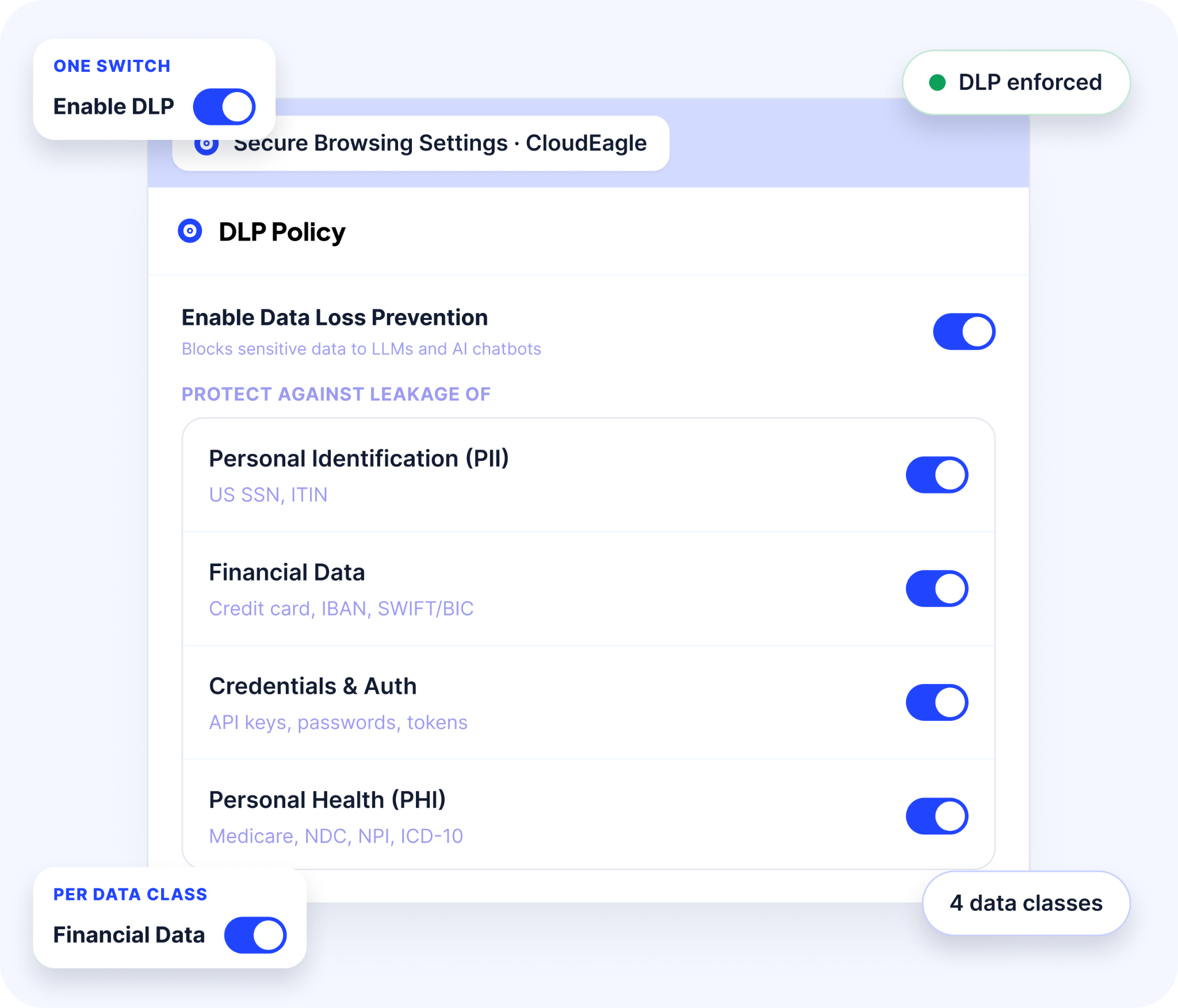
When an employee opens an unapproved AI tool, CloudEagle.ai's AI policy enforcement intercepts the session with a flash page and redirects them to an approved alternative. That keeps shadow AI in check, while sensitive data shared with AI tools is monitored and blocked at the browser layer.
- Usage checked against your approved AI tool list
- Every AI access event logged for audits
e. Identity and Access Controls That Extend to Agents
The same identity governance layer that covers employees also applies to AI agents:
- Automated provisioning and deprovisioning: access management that grants and removes AI tool access as roles change.
- Just-in-time access: just-in-time access for high-risk AI actions, revoked when the task ends.
- Least privilege: permissions held to the "least privilege" principle for users and agents alike.
- RBAC: access assigned by role, so agents only reach the tools their function needs.
- PAM: Privileged Access Management with logged, time-bound control over sensitive actions.
- Real-time monitoring: alerts on unusual activity before it turns into security risks.
- Automated access reviews: periodic access reviews that flag outdated permissions. See how Dezerv automated its app access review process.
- Audit reporting: a record of who did what, when and why, ready for compliance reviews.
One Control Plane for Every Agent


Agentic AI Governance Best Practices for Enterprises
Managing autonomous AI agents requires a governance model far more rigorous than traditional AI oversight. Below are the essential agentic AI governance best practices every enterprise should implement to ensure safety, compliance, and controlled automation.
1. Enforce Strict Least-Privilege Access
Agentic AI must never receive broad or persistent access. Limit permissions using:
- RBAC (Role-Based Access Control)
- JIT (Just-In-Time) access for temporary privileges
- Scoped API credentials with minimal permissions
- Context-aware restrictions for sensitive actions
- Deny-by-default policies as the baseline
This reduces the risk of unauthorized actions, privilege escalation, or unintended data exposure.
2. Continuously Monitor All Agent Activity
Real-time visibility is a core requirement of AI agent governance. Monitor:
- Actions, triggers, and workflows
- Input and output patterns
- Agent intent and reasoning chains
- Privilege usage and abnormal behavior
- Sudden spikes in API calls or agent autonomy
Continuous monitoring ensures you can detect and stop risks before they scale.
3. Automate Access Reviews for Every AI Agent
AI agents require the same (or stricter) access validation as human identities.
Recommended cadence:
- Monthly reviews for high-risk or high-autonomy agents
- Quarterly reviews for all other agents
Automated access reviews help prevent privilege creep and stale credentials.
4. Require Sandbox Validation Before Deployment
Never deploy an agent directly into production. All autonomous systems must pass:
- Safety and alignment testing
- Scenario and failure-mode simulations
- Stress testing under varied conditions
- Compliance verification against internal and regulatory standards
This ensures agents behave predictably before they touch real systems.
5. Maintain Agentic Identity Governance for All Agents
Agent identities must be managed like human identities. Centralize:
- Provisioning & deprovisioning
- Credential rotation
- Agent lifecycle management
- Usage and access reconciliation
- Cross-app activity tracking
This prevents shadow AI agents and unmanaged credentials.
6. Enforce Kill-Switches for Immediate Shutdown
Every agent must be stoppable instantly. Kill-switch controls include:
- Immediate access removal
- Workflow termination
- Session destruction
- Action rollback or revocation
Kill-switches ensure rapid containment of harmful or runaway behavior.
7. Apply Strong Agentic AI Data Governance Controls
Define strict data boundaries for all agent interactions:
- What data may an agent access?
- Where can data be stored or processed?
- What data can be generated, shared, or transformed?
- PII masking and redaction
- Context-level data filtering
This prevents data leakage, compliance violations, and model misuse.
8. Establish Human-in-the-Loop (HITL) Oversight
High-risk workflows must require human intervention. Human checkpoints include:
- Approval steps
- Confirmation of sensitive actions
- Escalation routing
- Final authority over irreversible operations
This keeps autonomous AI aligned with business and compliance requirements.
9. Maintain Complete Audit Trails
Every agent interaction must be fully traceable. Log:
- Timestamps and session IDs
- System and data accesses
- Workflow steps taken
- Privilege elevation attempts
- API calls and model outputs
Auditability is essential for compliance, security, and forensic analysis.
10. Align Policies With Global Compliance Frameworks
[IMAGE: Align Policies With Global Compliance Frameworks]
Agentic AI governance must map to established frameworks, including:
- SOC 2 (security & access controls)
- ISO 27001 (information security management)
- GDPR (data privacy & lawful processing)
- HIPAA (health data protection)
- EU AI Act (risk-tiered AI governance)
- NIST AI RMF (risk management framework)
Aligning policies ensures agent behavior meets legal and regulatory obligations.
Agentic AI Compliance: How Do You Map Controls to NIST AI RMF, ISO 42001 and the EU AI Act?
Agentic AI compliance works when every agent control you run points to a named requirement in the framework your auditors use. NIST AI RMF sorts that work into four functions, while the ISO 42001 requirements call for proof that each control actually operates. The EU AI Act layers logging and human oversight duties on top for high-risk systems.
Mapping matters because Gartner expects over 40% of agentic AI projects to be canceled by the end of 2027, with inadequate risk controls among the causes. For where these frameworks still fall short on autonomous agents, read our breakdown of the AI agent governance gap.
AI Agent Governance Best Practices for High-Autonomy Systems
Agentic AI can automate complex work, but it also introduces new risks. The following risk mitigation strategies help enterprises keep autonomous agents safe, controlled, and aligned with business rules.
1. Role-Based & Task-Based Privilege Segmentation: Give each agent only the permissions it needs for a specific job. Create narrow, task-focused roles so an agent can't access systems or data beyond its purpose. This reduces the risk of accidental or harmful actions.
2. Real-Time Identity-Aware Governance: Tie every agent action back to a clear identity and authorization rule. This ensures you always know which user, which system, or which integration triggered the agent's actions. It increases accountability and stops unauthorized behavior instantly.
3. Data Minimization: Limit the data an agent can access. Only provide the information required for each task; nothing more. This prevents unnecessary exposure of sensitive data and reduces the impact if something goes wrong.
4. Continuous Compliance Validation: Use automated checks to ensure agents always follow security and compliance rules. These checks look for incorrect permissions, policy violations, or agents that have more access than they should. This keeps your environment safe day-to-day, not just during audits.
5. Automated Alerting & Action Revocation: Set up automated alerts so that the moment an agent behaves suspiciously, the system can pause it or remove its access. This stops potential incidents before they spread and protects sensitive information.
6. Strict Vendor & SaaS Integration Governance: Apply your governance rules to external AI vendors and SaaS tools as well. Make sure third-party agents follow your identity, data, and access control policies. This prevents outside tools from becoming a security gap.
7. Multi-Layer Guardrails: Use multiple layers of protection such as input filtering, output checks, and workflow limits. These guardrails help keep agents on track and prevent unintended actions, even when tasks are complex.
Hear from Jeremy Boerger, founder of Boerger Consulting and creator of the Pragmatic ITAM Method. He shares 20+ years of experience on SaaS governance, breaking down silos, and building IT organizations that are resilient, collaborative, and data-driven.
Conclusion
Agentic AI can unlock massive productivity and innovation, but without the right governance, it also amplifies risk. When AI agents can make decisions, trigger workflows, and touch sensitive data on their own, enterprises need more than traditional AI controls.
The only scalable way to manage agentic AI safely is to bring policy, identity, and continuous monitoring together under one governance layer.
CloudEagle.ai helps enterprises do exactly that by centralizing identity governance, enforcing least-privilege and JIT access, continuously monitoring agent activity across SaaS apps, and automating access reviews and approvals.
If your organization is planning to adopt or scale agentic AI, now is the time to build the governance foundations that protect your data, keep you compliant, and maintain trust.
Ready to govern agentic AI with confidence?
Schedule a demo with CloudEagle.ai and see how you can gain full visibility and control over AI agents across your SaaS stack.
FAQs
1. What is a major governance challenge for agentic AI?
Ownership. In agentic governance, agents act through their own API keys and service accounts, so they keep running after the person who built them leaves, holding permissions nobody reviews.
2. Our agents run under an employee's account. Do they still need identity governance?
Yes. Inherited access gives an agent everything that employee can reach, and it drops out of view when they leave. Agentic identity governance gives each agent its own owner, scope and review cycle.
3. If an agent only reads data, do we still need agentic AI data governance?
Yes. Read access is enough to pull customer or regulated data into a prompt, a log or a third-party tool. Data governance decides which sources an agent can read and where its output can go.
4. Can we rely on agentic AI for data governance?
For the repetitive parts, yes, such as classifying data and flagging policy violations. Those agents touch sensitive data themselves, so they still need scoped access, audit trails and a human owner.
5. Is aligning with NIST AI RMF or ISO 42001 enough for agentic AI compliance?
Those frameworks describe outcomes and leave agent-level controls to you. Compliance holds when each control, such as agent inventory, scoped access and action logs, maps to a named requirement.
6. Does CloudEagle.ai govern AI agents, or do we need a separate tool next to Okta?
CloudEagle.ai works alongside Okta, Entra and 500+ other integrations to discover AI agents and MCP servers, then tracks each agent's owner, permissions and token usage in one place.
Agentic AI Without Governance Is a Liability


.avif)


.avif)
.avif)




.png)




.avif)
.avif)
.avif)


