
%201.svg)


HIPAA Compliance Checklist for 2025

Compliance failures rarely happen because an organization deliberately ignores the rules. They happen when regulations change, controls fall out of sync, or teams fail to spot a risk.
That is where compliance risk management comes in. It is the process of identifying, assessing, monitoring, and addressing risks that could cause an organization to violate laws, regulations, industry standards, or internal policies.
Enterprises need a way to continuously understand where compliance risks exist and take action before they lead to penalties, financial losses, operational disruption, or reputational damage.
This guide explains what is compliance risk management, how it works, the risks organizations need to monitor to maintain stronger controls as their business changes
1. What is Compliance Risk?
Compliance risk is the possibility that an organization may face legal, financial, or reputational consequences when its activities fail to meet applicable laws, regulations, industry standards, or internal policies.
Risk compliance management can arise from gaps in processes, employee actions, security practices, financial controls, or data handling.
Depending on the nature of the failure, the consequences can include regulatory penalties, legal disputes, financial losses, operational disruption, or damage to the organization's reputation.
Here are the types of compliance risks you need to know:
- Data Privacy Risk: Failing to handle, protect, or process personal information according to applicable privacy requirements, such as GDPR.
- Financial Compliance Risk: Failing to meet Risk compliance management, anti-money laundering, tax, or other financial control requirements.
- Workplace Compliance Risk: Violations involving employee rights, workplace safety, discrimination, harassment, or employment regulations.
- Operational and Human Error Risk: Compliance failures caused by incorrect processes, inadequate training, configuration mistakes, or employee actions.
2. What is Compliance Risk Management?
Compliance risk management is the process of ensuring an organization follows applicable laws, regulations, standards, and internal policies while identifying and addressing risks that could harm the business.
risk management and compliance brings compliance and risk management together through policies, controls, monitoring, and corrective actions.
The objective is broader than avoiding regulatory penalties. Effective compliance risk management helps protect an organization’s finances, reputation, operations, and ability to meet its legal and business obligations.
3. How to Build a Compliance Risk Management Framework
A compliance risk management framework provides a structured way to identify regulatory obligations, assess potential exposure, implement controls, and monitor compliance over time.
A practical Risk compliance management framework should define its scope, assign ownership, prioritize risks, establish controls, and continuously review their effectiveness.
A. Define the Scope and Assign Ownership
Start by identifying the business units, locations, systems, processes, and regulations covered by the framework.
Assign clear owners to compliance obligations and define who is responsible for monitoring risks, maintaining controls, and addressing gaps.
B. Identify Compliance Obligations and Risks
Create an inventory of applicable laws, regulations, contractual requirements, and internal policies.
Map these requirements to relevant business processes and identify risks that could result from non-compliance, weak controls, or process failures.
C. Assess and Prioritize Compliance Risks
Evaluate each risk based on its likelihood and potential impact. Consider possible financial, legal, operational, and reputational consequences.
Prioritize higher-risk areas so teams can direct resources toward the compliance gaps that require the most attention.
D. Implement Policies and Controls
Develop regulatory compliance risk management policies and controls that address the identified risks. Define control owners, testing procedures, review frequencies, and evidence requirements.
Provide relevant training so employees understand the compliance responsibilities associated with their roles.
E. Monitor, Report, and Review Continuously
Track compliance controls, open issues, remediation activities, and changes in regulatory requirements. Review the regulatory compliance risk management register regularly and update controls when business processes, technologies, or compliance obligations change.
A strong risk management and compliance framework is not a one-time exercise. It creates a continuous cycle of identifying risks, assessing exposure, applying controls, monitoring results, and improving compliance processes.
4. Why Compliance Risk Management Matters
Compliance risk management helps organizations prevent and address failures that could result in legal penalties, financial losses, or reputational damage.
By identifying compliance risks early and maintaining effective controls, organizations can reduce exposure to regulatory violations and protect critical business operations.
The regulatory landscape is becoming increasingly complex. New laws and standards are constantly emerging, existing regulations are tightening, and enforcement actions are growing more aggressive and punitive.
5. Key Elements of an Effective Compliance Risk Strategy
A. Risk Identification and Assessment
The foundation of effective compliance risk management starts with comprehensive risk identification and assessment.
Organizations must:
- Identify applicable regulations across all jurisdictions and functions
- Evaluate current compliance posture
- Assess both internal vulnerabilities and external regulatory threats
This involves continuous monitoring of legal updates, industry trends, and internal changes. Risk management and compliance Assessment models should include:
- Quantitative factors (e.g., financial exposure, risk ratings)
- Qualitative insights (e.g., reputational risk, stakeholder impact)
- Interdependencies among compliance domains
Regular risk reviews help ensure that the organization focuses on the most critical and evolving threats.
B. Policy Development and Enforcement
Effective policies are the backbone of compliance. They should:
- Clearly define compliance requirements
- Assign roles and responsibilities
- Establish control mechanisms and decision-making protocols
Policies must be living documents, updated as regulations and business conditions evolve.
Regulatory risk management is just as critical:
- Monitoring systems must detect violations early
- Escalation procedures should be clear and swift
- Non-compliance must lead to defined, appropriate consequences
Key structures include segregation of duties, approval workflows, and independent reviews, all vital for reducing risk.
C. Employee Training and Awareness
People are the frontline of compliance. Human error remains one of the top sources of risk.
That’s why organizations need:
- Role-specific training
- Ongoing awareness campaigns
- Practical scenarios and escalation simulations
Training must be dynamic, updated frequently and delivered in engaging, context-relevant formats. Additional best practices include:
- Competency checks
- Refresher courses
- Special focus for high-risk departments
A culture of regulatory risk management starts with leadership visibility, recognition of good practices, and accountability for failures.
D. Continuous Monitoring and Auditing
Compliance risk monitoring is a critical component of any modern compliance program. It involves continuous evaluation of systems, user behavior, and third-party activities to detect violations or emerging threats in real-time.
Without visibility, compliance gaps go unnoticed until it’s too late. Continuous monitoring is essential to stay ahead.
Organizations should deploy:
- Automated systems for real-time alerts
- Manual audits to uncover nuanced or systemic issues
A risk-based audit approach ensures focus on high-exposure areas, without neglecting broader compliance needs.
Audit findings must:
- Be tracked to resolution
- Feed into process improvements
- Inform future risk assessments
Ongoing monitoring helps organizations stay agile, responsive, and aligned with changing regulatory expectations.
6. What are the Common Compliance Risks
As regulations grow more complex and enforcement becomes stricter, organizations must stay vigilant about the most critical areas of compliance risk.
Below are four high-impact regulatory risk management compliance categories that demand proactive attention.
A. Data Privacy Violations (e.g., GDPR, HIPAA)
Data privacy regulations are among the most dynamic and challenging compliance areas.
With frameworks like the General Data Protection Regulation (GDPR) and the California Consumer Privacy Act (CCPA), companies operating across multiple jurisdictions face increasing complexity.
- GDPR violations can result in fines of up to €20 million or 4% of global turnover, whichever is higher.
- CCPA adds additional obligations around consumer data rights for companies operating in or serving California residents.
In the healthcare sector, the Health Insurance Portability and Accountability Act (HIPAA) imposes strict data handling rules, with fines reaching up to $1.5 million per incident.
The risks are compounded by:
- The technical intricacies of modern data systems
- Global data flows and storage
- Evolving legal interpretations of data ownership and consent
B. Anti-Money Laundering (AML) and Financial Fraud
Financial institutions and fintechs are under intense scrutiny when it comes to AML, fraud prevention, and know-your-customer (KYC) compliance.
Recent enforcement cases have shown penalties reaching over $1 billion for violations.
Key AML compliance challenges include:
- Monitoring complex, real-time digital transactions
- Handling cryptocurrency flows and cross-border payments
- Managing beneficial ownership transparency, sanctions screening, and PEP (politically exposed person) checks
To improve regulatory risk management, firms must invest in:
- Advanced transaction monitoring systems
- Robust customer due diligence (CDD) frameworks
- Comprehensive suspicious activity reporting mechanisms
C. Licensing and Contractual Obligations
In many industries, failing to secure or maintain proper regulatory compliance risk management can halt operations instantly.
This is especially true for:
- Financial services
- Healthcare providers
- Technology vendors
- Professional service firms
Jurisdiction-specific licensing rules and changing regulatory conditions make compliance particularly challenging.
In parallel, contractual compliance risks arise when organizations fail to meet obligations in agreements with:
- Clients
- Vendors
- Partners
- Lenders
Consequences include:
- Breach of contract lawsuits
- Financial penalties
- Terminated business relationships
- Reputational harm
A strong contract lifecycle management (CLM) process is essential to monitor deadlines, deliverables, and renewal conditions.
D. Third-Party and Vendor Compliance Risks
Outsourcing has introduced new layers of compliance risk. Despite delegating operations, organizations are still accountable for the actions of third-party vendors and partners.
Common issues include:
- Vendors mishandling sensitive data
- Poor adherence to regulatory standards
- Lack of transparency in subcontracting chains
To mitigate these risks, organizations must:
- Conduct thorough due diligence during vendor onboarding
- Monitor vendor performance regularly
- Include compliance clauses and compliance audit rights in contracts
- Maintain incident reporting protocols
A risk-based approach helps tailor oversight based on vendor criticality, ensuring high-risk vendors get more scrutiny while maintaining efficiency with low-risk relationships.
7. Why Ignoring Compliance Risk is a Big Mistake
Failing to address compliance risks isn't just risky, it’s potentially catastrophic. The consequences extend well beyond financial penalties and can threaten the very survival of a business.
There’s no single ISO for compliance risk, but ISO 37301 (Compliance Management Systems) and ISO 31000 Risk Management frameworks.
A. Escalating Financial Penalties
Regulatory bodies are increasingly aggressive with enforcement. In 2023, the Consumer Financial Protection Bureau (CFPB) issued over $4.2 billion in penalties.
Other agencies continue to impose maximum fines for serious or repeated violations. These fines often escalate quickly based on the severity and scope of non-compliance.
B. Long-Term Remediation Costs
Even after penalties are paid, organizations must invest in system and infrastructure upgrades, enhanced monitoring and controls, and third-party audits and independent oversight.
These remediation efforts often outlast the original issue draining time, resources, and leadership attention for years.
C. Reputational Damage
Compliance failures erode public trust and weaken brand equity. Consequences include loss of customers and contracts, declining investor confidence, difficulty forming partnerships or securing funding, and reduced ability to recruit and retain top talent.
Rebuilding a damaged reputation can take years, with no guaranteed return to pre-incident standing.
D. Criminal Liability for Executives
In the most severe cases, compliance failures can lead to criminal charges against individuals. The U.S. Department of Justice is increasingly focused on executive accountability.
Violations can result in personal fines, loss of professional licenses, and even prison sentences. This underscores the need for executive-level ownership of compliance risk, not just delegation to legal or risk teams.
8. How CloudEagle.ai Can Help Enterprises Stay Compliant
We built SaaS security posture management to start where the compliance risk starts, with discovery, then keep posture and access current on every app without a manual audit.
CloudEagle.ai correlates identity, finance, browser, and CASB signals into one per-app view, so the whole estate and its posture sit in the same place.
Discovering the Full Estate Before Scoring Its Posture
We find the apps your identity provider cannot.
By correlating SSO, finance and card spend, browser signals, and CASB logs against our proprietary app catalog, we surface shadow SaaS and shadow AI.
Post which we then risk-score each one so your team knows what to bring under governance first instead of treating every unknown app as an equal fire drill.
Continuous Posture and Compliance Tracking Per App
For every app, we track posture continuously and roll it into a security score and a per-signal view:
- A per-app security score summarizing how the app measures up.
- MFA and SSO support, pulled from the vendor and your identity provider.
- Compliance certifications tracked per vendor, including HIPAA, HITRUST, NIST / SP800-53, SOC 2, and ISO 27001.
- Data center standards and AI signals: whether the vendor uses GenAI, whether it can be disabled, and whether it trains on your data.
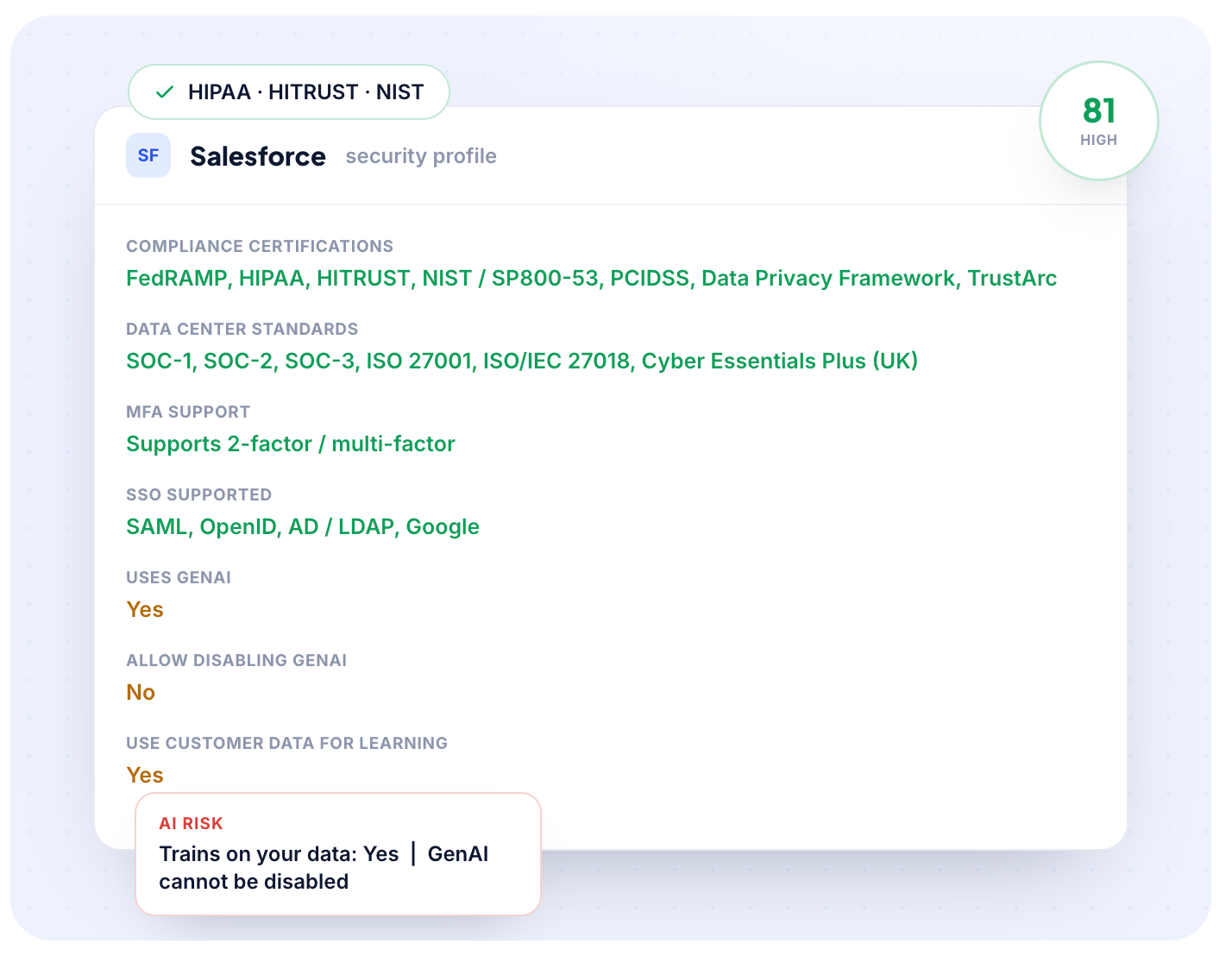
One boundary is that we give you the visibility and the per-app posture across your SaaS security and compliance stack.
Inline blocking of data in transit stays with your CASB. We tell you where the exposure is and keep it in view; your enforcement layer acts on it.
Access Reviews and Offboarding That Produce Audit Evidence
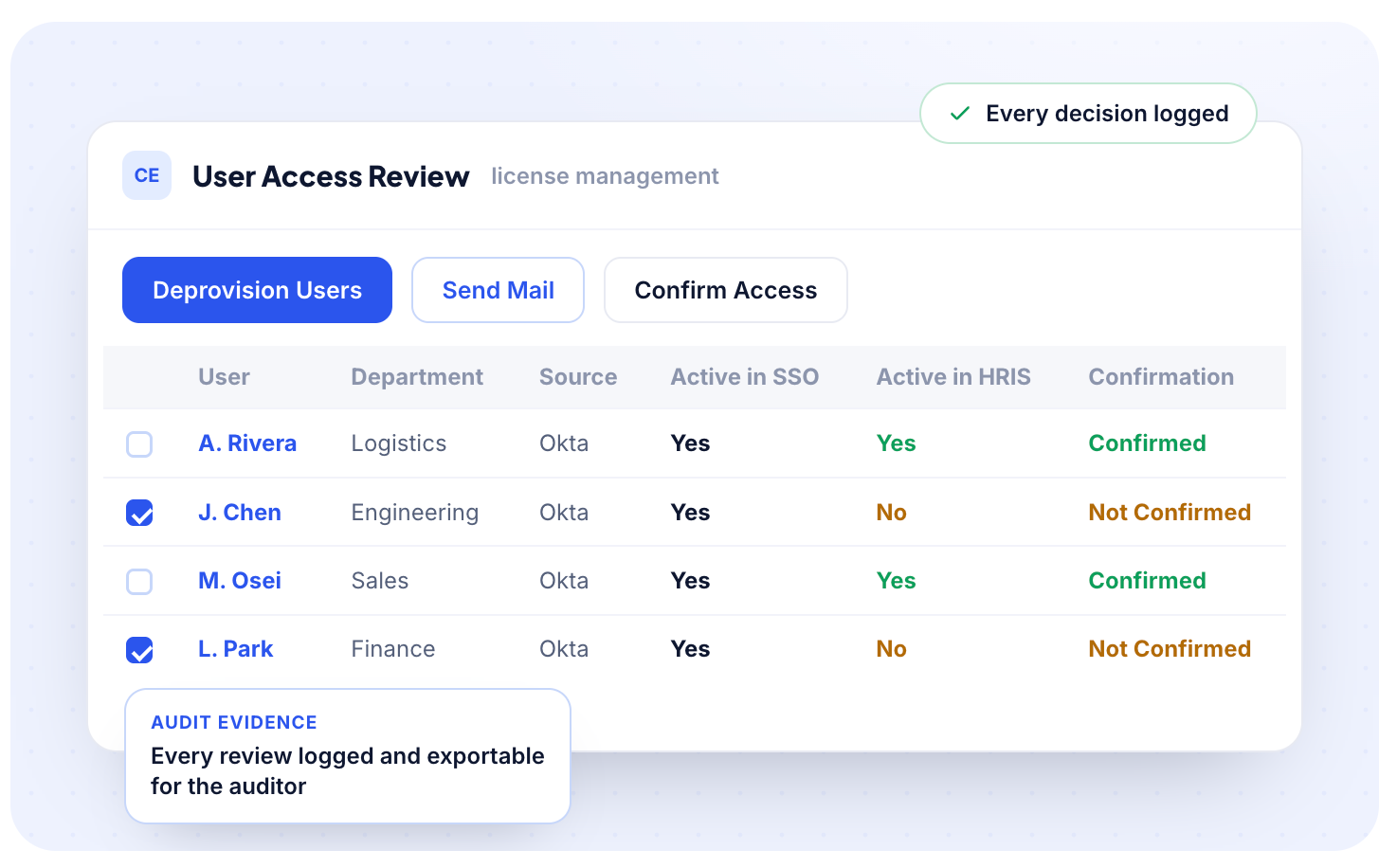
We turn access reviews and offboarding into a continuous process that generates evidence as it runs:
- Reviews route to the right manager from HRIS data, with reminders.
- Rejected access triggers deprovisioning automatically.
- Every decision is logged and exportable in the format auditors expect.
The evidence is a byproduct of the work, not a separate project bolted on before the audit.
Conclusion
Effective compliance risk management helps organizations identify risks, maintain controls, and respond to regulatory requirements before compliance gaps become costly problems.
It protects the business from legal, financial, operational, and reputational consequences while supporting more consistent compliance practices.
CloudEagle.ai helps enterprises manage this process with real-time monitoring, automated compliance workflows, and centralized visibility across SaaS applications and vendors.
By connecting compliance, security, and SaaS management, CloudEagle.ai helps teams identify risks, strengthen controls, and maintain compliance as their environment evolves.
FAQs
1. What is compliance risk?
Compliance risk is the potential for legal penalties, financial loss, or reputational harm due to violations of laws, regulations, or internal policies.
2. What’s the difference between compliance and risk management?
Compliance ensures an organization follows rules and standards. Risk management identifies and minimizes potential threats. While compliance is rule-driven, risk management is about anticipating and preparing for various uncertainties, both functions often overlap and complement each other.
3. What is meant by compliance issues?
Compliance issues refer to any breaches, gaps, or failures in following regulatory or policy requirements. They can involve data privacy violations, licensing lapses, reporting errors, or ethical misconduct.
4. What does a risk and compliance manager do?
This professional oversees compliance programs, identifies and mitigates risks, ensures adherence to policies, and liaises with regulators and auditors.
5.How do you mitigate compliance risks?
To mitigate compliance risks, organizations should adopt a risk-based approach, automate controls, implement ongoing employee training, regularly review policies, and utilize monitoring tools like CloudEagle.ai for real-time visibility and alerts.
6. What is the compliance risk management process?
The compliance risk management process involves identifying compliance obligations, assessing risks associated with those obligations, designing and implementing controls, training employees, and monitoring systems to ensure continued compliance.


.avif)


.avif)
.avif)




.png)




.png)

.avif)
.avif)
.avif)


