AI Governance

Why AI Governance Can't Be an Afterthought: Lessons from Early Adopters

Share via:
Written by:
CloudEagle.ai Team
Reviewed by
Nidhi Jain
Last Updated:
September 9, 2026
blog-cms-banner-bg
Little-Known Negotiation Hacks to Get the Best Deal on Slack
cta-bg-blogDownload Your Copy

HIPAA Compliance Checklist for 2025

Download PDF

AI governance is the set of controls that decide which AI tools, agents, and identities can operate inside an enterprise, what data they reach, and who is accountable when they act. The first wave of enterprise adopters treated it as documentation to be completed after deployment.

IBM's 2026 Cost of a Data Breach Report priced that sequencing decision. Among organizations that suffered an AI-related breach, 92% had no access controls on their AI models and data.

The more uncomfortable number sits one layer below. Of six AI governance controls IBM tracked year over year, five declined in adoption while AI deployment accelerated across the same population.

Governance is not lagging AI adoption. Relative to it, governance is moving backwards.

That is the real lesson from the early adopters, and it is not "write the policy sooner." It is that the four things you are forced to retrofit, namely inventory, ownership, access, and evidence, are precisely the four that get more expensive the longer you wait.

The Afterthought Tax Is Now Measurable

For two years, "govern AI later" was a defensible bet because the downside was theoretical. It stopped being theoretical in 2026.
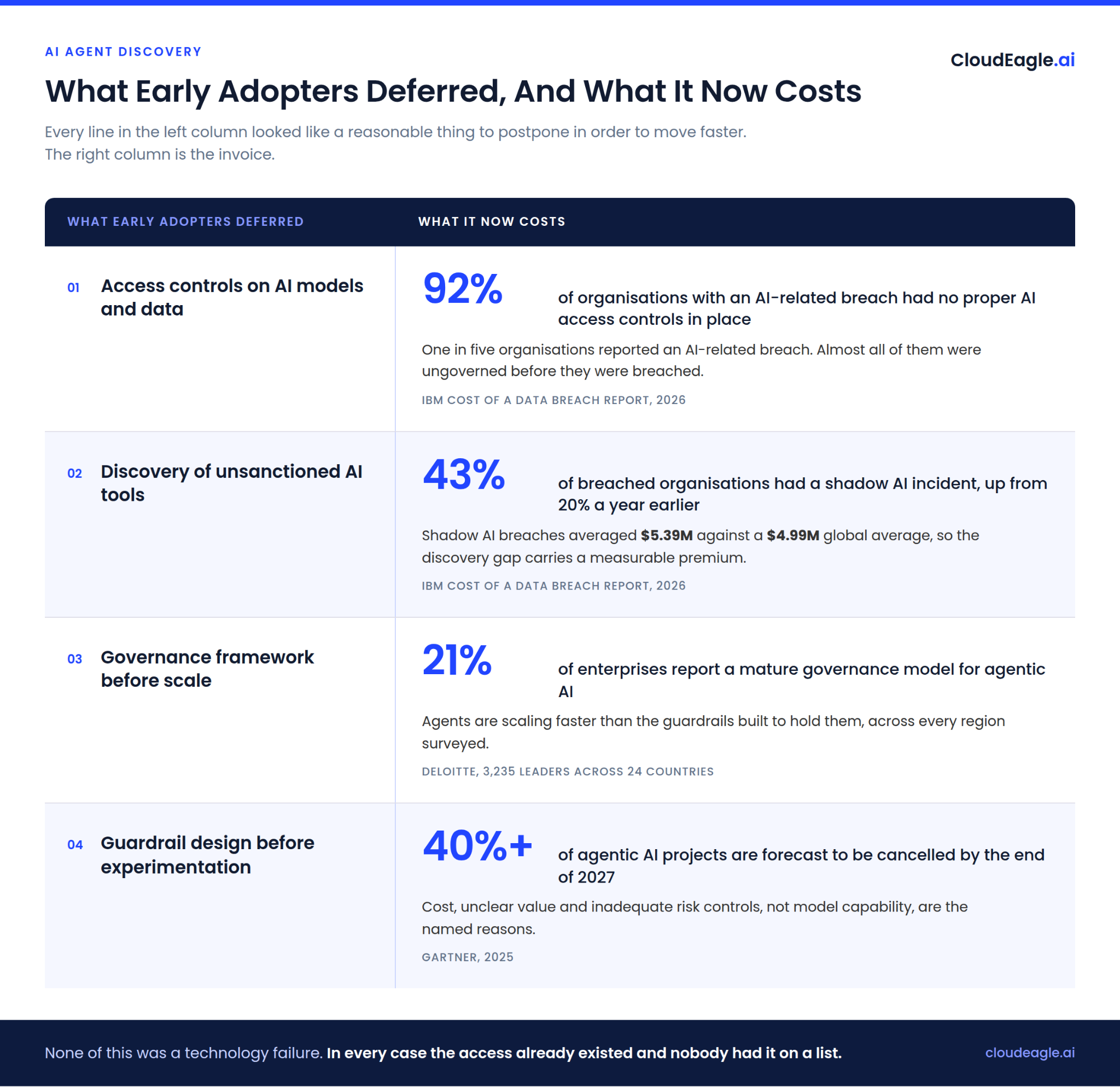
Table showing four AI governance practices early adopters deferred and the resulting costs, including gaps in AI access controls, unsanctioned AI discovery, governance maturity, and agentic AI guardrails.


Read the last row carefully, because it reframes the whole category. Gartner's cancellation forecast is not a prediction about model quality; it is a prediction about projects that cannot clear internal review.

Governance did not slow those projects down. Its absence killed them.

Governance Is Already Costing You

See what weak AI governance can cost before it hits your business.
Download Checklist

Why It Became an Afterthought in the First Place

This was not carelessness, and the diagnosis matters because it determines the fix.

Every governance control an enterprise built over the last decade assumed a procurement-mediated entry path. Software arrived through a purchase order, a security review, and a federation decision, which gave IT three natural checkpoints before anything touched company data.

AI did not arrive that way. It arrived through a browser tab, a free tier, and a personal email address, then through features switched on inside tools the organization already owned.

By the time a governance conversation started, the estate already existed. The program was not late by choice; it was late because the first checkpoint it could have used had been bypassed months earlier.

That is why "write a policy" was the instinctive response, and why it did not work. A policy is the only governance instrument that requires no checkpoint to produce.

The organizations getting this right now start from the opposite premise: assume the adoption already happened, and work backwards from what is actually running.

Lesson 1: A Policy Without an Enforcement Point Is a Preference

Most early adopters did produce a policy. IBM found 32% of breached organizations had one fully implemented, another 33% had one in development.

The policy was rarely the failure. The failure was that it lived in a governance function with no connection to a control plane, which is where AI policy enforcement actually happens.

Only 19% of organizations reported any coordination between their governance and security teams. The document existed; the mechanism that could act on it did not.

This is why the early adopters who are now redoing the work describe it the same way: they built a governance function before they built a governance surface. A function produces artifacts. A surface produces refusals.

The practical test for any AI policy is a single question. Name the system that would stop the behavior the policy prohibits, and name the person who gets the alert when it doesn't.

If neither has a name, you have a preference.

Lesson 2: Your Guardrails Are Assets, and Nobody Owns Them

The McKinsey Lilli breach is the clearest case study the category has produced, and the widely-quoted headline number is the least interesting part of it.

An autonomous offensive agent built by CodeWall probed the platform and, within roughly two hours, chained a set of failures: 22 API endpoints requiring no authentication, and a SQL injection reachable through unsanitized JSON field names. Exposure ran to 46.5 million chat messages, 728,000 files, and 57,000 user accounts.

The governance finding is the one that should reach a board. Ninety-five system prompts, the instructions defining how the AI behaves and where its guardrails sit, were stored in the same database with write access.

An attacker with that access does not need to exfiltrate anything. They can edit the guardrails and leave, and the platform continues serving tens of thousands of consultants under rules the organization never wrote.

Nothing in a traditional governance program covers this. System prompts are not code, so they escape code review; they are not documents, so they escape document control; they are not data, so they escape data classification.

They are the enforcement layer, held as an unversioned, unowned database row.

The same pattern appeared a month earlier at Sears Home Services, where researcher Jeremiah Fowler found three unprotected databases holding 3.7 million chat transcripts and 1.4 million audio recordings, over 4TB in plaintext. Both are AI-native asset classes that existing governance never assigned an owner.

Your Guardrails Are Assets, and Nobody Owns Them

Identify the AI assets and access controls hiding outside traditional governance.
Download Checklist

Lesson 3: The Identity Layer Broke Before the Model Layer Did

Almost every AI governance program built in the last two years assumed the governed entity was a person.

CyberArk's research puts machine identities at more than 82 for every human identity in enterprise environments. Every integration issues a token; every automation creates a service account; every agent can provision its own credentials without a ticket.

Access review cycles designed to have managers certify their direct reports quarterly cannot cover a population growing that way. The reviewers do not know the identities exist, and no manager is listed as owner.
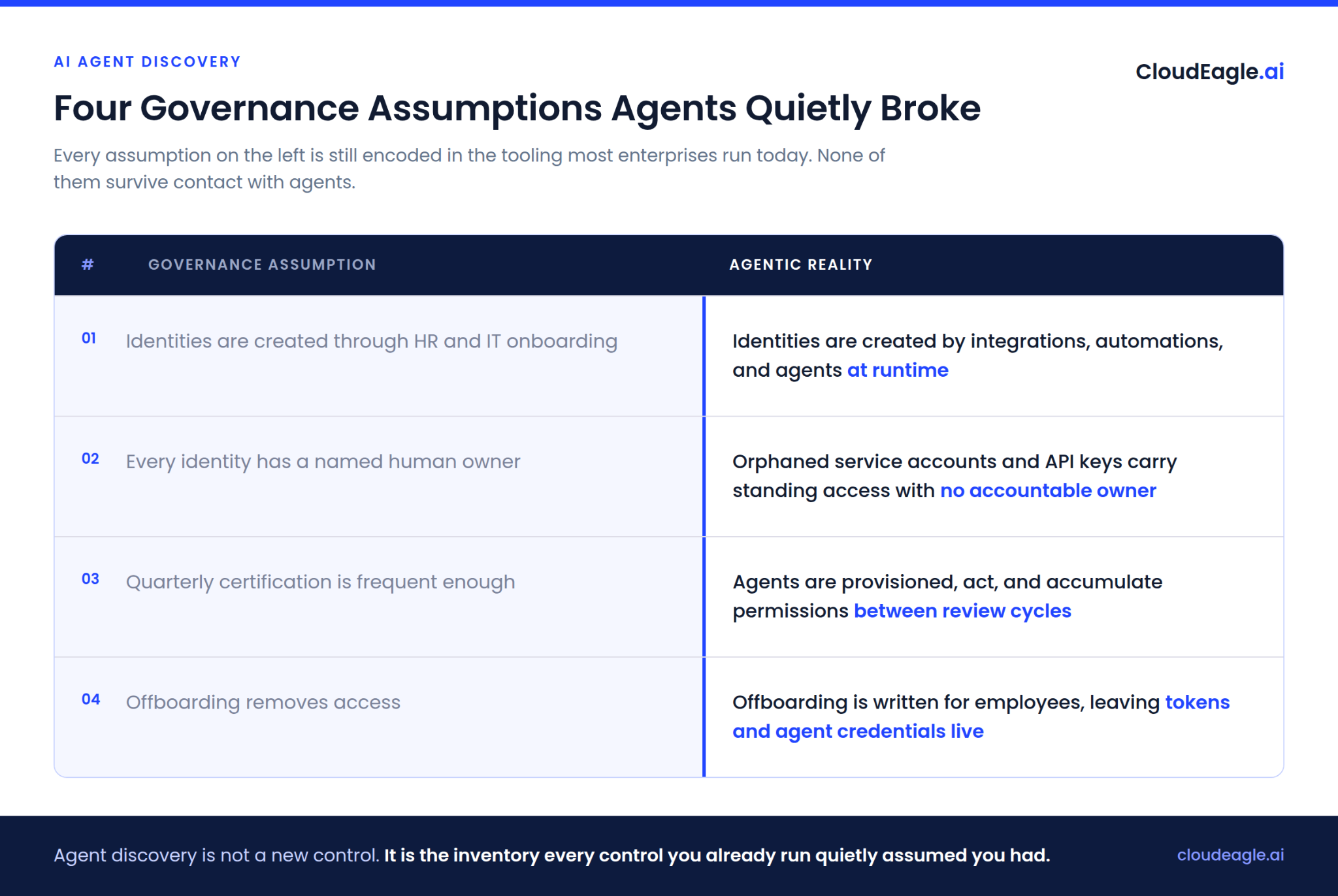
Table comparing four traditional identity governance assumptions with agentic AI realities, including runtime identity creation, orphaned service accounts, permissions between review cycles, and persistent agent credentials.

IBM found fewer than half of organizations actively secure their non-human identities. That is the specific gap the McKinsey attack ran through, and it is structural rather than negligent.

The correction the mature adopters made is unglamorous: bring service accounts, API keys, and agents into the same access review cycle as employees, with an owner, a permission set, and an expiry.

Lesson 4: The Meter Was Running Before Anyone Owned the Budget

Risk dominated the early governance conversation, which left the commercial exposure unmanaged for longer.

SaaS taught finance to govern a fixed unit: a seat, priced annually, consumed by a named person. AI replaced that unit with token consumption, which is variable, generated by systems rather than people, and billed in arrears.

An agent running in a loop can produce a five-figure line item without a single human logging in, and nothing in a seat-based governance model registers that as an event.

The early adopters found this at renewal, not in-quarter. Common patterns include duplicate copilots bought by three departments, pilots rolled out to 20% of employees with no mechanism to judge whether the other 80% should follow, and AI features silently bundled into existing SaaS contracts at uplift.

The governance question is not "how much are we spending on AI." It is "which team, using which tool, generated this consumption, and can we attribute it."

Attribution is the control. Without it, every AI renewal is negotiated blind, and the finance team's only lever is refusal.

This is also the fastest argument for governance a CFO will accept, because it produces a number in the current quarter rather than a risk reduction that has to be taken on faith.

Lesson 5: Compliance Dates Are a Poor Reason to Govern

A large share of first-wave AI governance work was scheduled against the EU AI Act's 2 August 2026 high-risk deadline. Then the deadline moved.

Under the finalized Digital Omnibus, stand-alone high-risk obligations under Annex III shift to 2 December 2027, and AI embedded in regulated products under Annex I shifts to 2 August 2028.

Obligation Original date Current date
Prohibited practices and AI literacy 2 February 2025 In force
Article 50 transparency and disclosure 2 August 2026 Unchanged, with a limited grace period for watermarking on systems already marketed
High-risk, Annex III stand-alone systems 2 August 2026 2 December 2027
High-risk, AI embedded in regulated products 2 August 2027 2 August 2028

Two things follow, and they point in opposite directions.

Programmes justified purely by the deadline lost their business case overnight and are now stalled inside organizations whose AI usage kept growing. Programmes justified by exposure did not blink.

The second point is the one most teams have missed: transparency obligations were not deferred. They still require you to know which systems are AI, where they are deployed, and what they disclose to users, which is an inventory problem, not a legal one.

Regulators moved the date for building the paperwork. Nobody moved the date for knowing what you run.

Lesson 6: Certification Is a Signal, Not a Programme

ISO/IEC 42001 became the default answer to "how do we prove we govern AI," and adoption tells you how early this market still is. BCG announced in January 2026 that it was among the first 100 organizations globally to certify.

A hundred organizations, worldwide, against a population of enterprises deploying AI in the hundreds of thousands.

Certification is worth pursuing, and it is not the thing that stops an incident. It attests to a management system; it does not enumerate the AI tools your marketing team signed up for last week on a corporate card.

Treat the standard as the audit target and continuous discovery as the operating layer underneath it, in that order.

What the Second Wave Is Doing Differently

The organizations rebuilding their programs are converging on the same sequence, and it inverts the order the first wave used.

  1. Discover before you draft, correlating SSO, finance and card spend, browser telemetry, and firewall logs into a live inventory of AI apps, agents, and MCP servers; a policy written against a stack you cannot see is a policy written against assumptions.
  1. Assign ownership at the point of creation, so every AI tool, model, prompt store, service account, and agent has a named owner when it appears rather than when an auditor asks; unowned assets are the common factor in every incident above.
  1. Move enforcement to where the decision happens, which means the browser, the identity provider, and the approval workflow, not a wiki page an employee read once during onboarding.
  1. Instrument for evidence continuously, capturing approvals, revocations, and access changes as they occur; reconstructing an audit trail after the fact is the single most expensive line item in retrofitted governance.
  1. Govern spend and risk in one view, since token consumption, license utilization, and access risk all describe the same estate; splitting them across finance and security tooling is what produces the 19% coordination figure.

Governance Is the Constraint That Makes AI Shippable

The framing that cost the first wave the most was treating governance as a tax on velocity.

Deloitte's data says the opposite. With 74% of organizations expecting at least moderate agentic AI use by 2027 and only 21% holding mature governance, the binding constraint on AI programs is no longer model capability or budget.

It is whether anyone can approve the deployment.

Governance is what converts a promising pilot into a system that survives a security review, an audit, and a renewal conversation. Absent it, capability accumulates and nothing ships.

How CloudEagle.ai Approaches AI Governance

CloudEagle.ai treats AI governance as a discovery and enforcement problem rather than a documentation one.

The platform correlates browser, firewall, finance, and identity provider signals against its EagleIQ inventory to surface every sanctioned and unsanctioned AI app, agent, and MCP server in use, then risk-scores each one so security teams can prioritize rather than triage everything at once.

From there, policy becomes operational: usage controls can monitor or block sensitive content moving into AI tools, redirect employees to approved alternatives, and track token consumption alongside license usage.

Non-human identities, including service accounts, API keys, and AI agents, are governed through the same lifecycle as human ones, with visible ownership, permissions, and revocation. Approvals and revocations are captured automatically as audit-ready evidence.

Onboarding takes about 30 minutes across 500+ integrations, which matters mainly because it removes the argument that discovery is a quarter-long project.

Frequently Asked Questions

Why do AI governance programs fail?

They fail when the policy has no enforcement point. IBM's 2026 research found only 19% of organizations report coordination between governance and security teams, and 92% of AI-related breaches occurred where no access controls existed on AI models and data. The document exists; the mechanism that can act on it does not.

What should an enterprise govern first when AI is already deployed?

Inventory, then ownership. You cannot enforce policy against tools you have not discovered, and unowned assets such as orphaned service accounts, unversioned system prompts, and retained chat logs are the common factor across the major 2026 AI incidents.

Did the EU AI Act delay remove the pressure to act?

No. High-risk obligations moved to December 2027 and August 2028, but prohibited practices and AI literacy requirements have applied since February 2025, and Article 50 transparency obligations were not deferred. Those still require a current inventory of AI systems and their disclosures.

Does CloudEagle.ai govern AI agents and non-human identities?

Yes. CloudEagle.ai discovers AI apps, agents, and MCP servers alongside SaaS, and governs service accounts, API keys, and AI agents with the same lifecycle controls, access reviews, and ownership tracking applied to employees.

Advertisement for a SaaS Subscription Tracking Template with a call-to-action button to download and a partial graphic of a tablet showing charts.Banner promoting a SaaS Agreement Checklist to streamline SaaS management and avoid budget waste with a call-to-action button labeled Download checklist.Blue banner with text 'The Ultimate Employee Offboarding Checklist!' and a black button labeled 'Download checklist' alongside partial views of checklist documents from cloudeagle.ai.Digital ad for download checklist titled 'The Ultimate Checklist for IT Leaders to Optimize SaaS Operations' by cloudeagle.ai, showing checklist pages.Slack Buyer's Guide offer with text 'Unlock insider insights to get the best deal on Slack!' and a button labeled 'Get Your Copy', accompanied by a preview of the guide featuring Slack's logo.Monday Pricing Guide by cloudeagle.ai offering exclusive pricing secrets to maximize investment with a call-to-action button labeled Get Your Copy and an image of the guide's cover.Blue banner for Canva Pricing Guide by cloudeagle.ai offering a guide to Canva costs, features, and alternatives with a call-to-action button saying Get Your Copy.Blue banner with white text reading 'Little-Known Negotiation Hacks to Get the Best Deal on Slack' and a white button labeled 'Get Your Copy'.Blue banner with text 'Little-Known Negotiation Hacks to Get the Best Deal on Monday.com' and a white button labeled 'Get Your Copy'.Blue banner with text 'Little-Known Negotiation Hacks to Get the Best Deal on Canva' and a white button labeled 'Get Your Copy'.Banner with text 'Slack Buyer's Guide' and a 'Download Now' button next to images of a guide titled 'Slack Buyer’s Guide: Features, Pricing & Best Practices'.Digital cover of Monday Pricing Guide with a button labeled Get Your Copy on a blue background.Canva Pricing Guide cover with a button labeled Get Your Copy on a blue gradient background.

Enter your email to
unlock the report

Oops! Something went wrong while submitting the form.
License Count
Benchmark
Per User/Per Year

Enter your email to
unlock the report

Oops! Something went wrong while submitting the form.
License Count
Benchmark
Per User/Per Year

Enter your email to
unlock the report

Oops! Something went wrong while submitting the form.
Notion Plus
License Count
Benchmark
Per User/Per Year
100-500
$67.20 - $78.72
500-1000
$59.52 - $72.00
1000+
$51.84 - $57.60
Canva Pro
License Count
Benchmark
Per User/Per Year
100-500
$74.33-$88.71
500-1000
$64.74-$80.32
1000+
$55.14-$62.34

Enter your email to
unlock the report

Oops! Something went wrong while submitting the form.

Enter your email to
unlock the report

Oops! Something went wrong while submitting the form.
Zoom Business
License Count
Benchmark
Per User/Per Year
100-500
$216.00 - $264.00
500-1000
$180.00 - $216.00
1000+
$156.00 - $180.00

Enter your email to
unlock the report

Oops! Something went wrong while submitting the form.

Get the Right Security Platform To Secure Your Cloud Infrastructure

Please enter a business email
Thank you!
The 2023 SaaS report has been sent to your email. Check your promotional or spam folder.
Oops! Something went wrong while submitting the form.

Access full report

Please enter a business email
Thank you!
The 2023 SaaS report has been sent to your email. Check your promotional or spam folder.
Oops! Something went wrong while submitting the form.

TL;DR

  • 92% of organizations that suffered an AI-related breach in 2026 had no access controls on their AI models and data, and only 19% report any coordination between governance and security teams (IBM)
  • Five of the six AI governance controls IBM tracks declined in adoption year over year, so governance is regressing relative to deployment rather than merely trailing it
  • The McKinsey Lilli breach exposed 95 writable system prompts, which means the guardrails themselves were an unversioned, unowned asset
  • Machine identities outnumber human ones by more than 82 to 1 (CyberArk), and access reviews built around quarterly manager certification cannot reach that population
  • The EU AI Act's high-risk deadline moved to December 2027, but transparency obligations did not move, and neither did the requirement to know what you are running
  • The fix sequence early adopters now recommend runs discover, own, enforce, then prove; the reverse order is what made retrofitting expensive

AI governance is the set of controls that decide which AI tools, agents, and identities can operate inside an enterprise, what data they reach, and who is accountable when they act. The first wave of enterprise adopters treated it as documentation to be completed after deployment.

IBM's 2026 Cost of a Data Breach Report priced that sequencing decision. Among organizations that suffered an AI-related breach, 92% had no access controls on their AI models and data.

The more uncomfortable number sits one layer below. Of six AI governance controls IBM tracked year over year, five declined in adoption while AI deployment accelerated across the same population.

Governance is not lagging AI adoption. Relative to it, governance is moving backwards.

That is the real lesson from the early adopters, and it is not "write the policy sooner." It is that the four things you are forced to retrofit, namely inventory, ownership, access, and evidence, are precisely the four that get more expensive the longer you wait.

The Afterthought Tax Is Now Measurable

For two years, "govern AI later" was a defensible bet because the downside was theoretical. It stopped being theoretical in 2026.

Table showing four AI governance practices early adopters deferred and the resulting costs, including gaps in AI access controls, unsanctioned AI discovery, governance maturity, and agentic AI guardrails.


Read the last row carefully, because it reframes the whole category. Gartner's cancellation forecast is not a prediction about model quality; it is a prediction about projects that cannot clear internal review.

Governance did not slow those projects down. Its absence killed them.

Governance Is Already Costing You

See what weak AI governance can cost before it hits your business.
Download Checklist

Why It Became an Afterthought in the First Place

This was not carelessness, and the diagnosis matters because it determines the fix.

Every governance control an enterprise built over the last decade assumed a procurement-mediated entry path. Software arrived through a purchase order, a security review, and a federation decision, which gave IT three natural checkpoints before anything touched company data.

AI did not arrive that way. It arrived through a browser tab, a free tier, and a personal email address, then through features switched on inside tools the organization already owned.

By the time a governance conversation started, the estate already existed. The program was not late by choice; it was late because the first checkpoint it could have used had been bypassed months earlier.

That is why "write a policy" was the instinctive response, and why it did not work. A policy is the only governance instrument that requires no checkpoint to produce.

The organizations getting this right now start from the opposite premise: assume the adoption already happened, and work backwards from what is actually running.

Lesson 1: A Policy Without an Enforcement Point Is a Preference

Most early adopters did produce a policy. IBM found 32% of breached organizations had one fully implemented, another 33% had one in development.

The policy was rarely the failure. The failure was that it lived in a governance function with no connection to a control plane, which is where AI policy enforcement actually happens.

Only 19% of organizations reported any coordination between their governance and security teams. The document existed; the mechanism that could act on it did not.

This is why the early adopters who are now redoing the work describe it the same way: they built a governance function before they built a governance surface. A function produces artifacts. A surface produces refusals.

The practical test for any AI policy is a single question. Name the system that would stop the behavior the policy prohibits, and name the person who gets the alert when it doesn't.

If neither has a name, you have a preference.

Lesson 2: Your Guardrails Are Assets, and Nobody Owns Them

The McKinsey Lilli breach is the clearest case study the category has produced, and the widely-quoted headline number is the least interesting part of it.

An autonomous offensive agent built by CodeWall probed the platform and, within roughly two hours, chained a set of failures: 22 API endpoints requiring no authentication, and a SQL injection reachable through unsanitized JSON field names. Exposure ran to 46.5 million chat messages, 728,000 files, and 57,000 user accounts.

The governance finding is the one that should reach a board. Ninety-five system prompts, the instructions defining how the AI behaves and where its guardrails sit, were stored in the same database with write access.

An attacker with that access does not need to exfiltrate anything. They can edit the guardrails and leave, and the platform continues serving tens of thousands of consultants under rules the organization never wrote.

Nothing in a traditional governance program covers this. System prompts are not code, so they escape code review; they are not documents, so they escape document control; they are not data, so they escape data classification.

They are the enforcement layer, held as an unversioned, unowned database row.

The same pattern appeared a month earlier at Sears Home Services, where researcher Jeremiah Fowler found three unprotected databases holding 3.7 million chat transcripts and 1.4 million audio recordings, over 4TB in plaintext. Both are AI-native asset classes that existing governance never assigned an owner.

Your Guardrails Are Assets, and Nobody Owns Them

Identify the AI assets and access controls hiding outside traditional governance.
Download Checklist

Lesson 3: The Identity Layer Broke Before the Model Layer Did

Almost every AI governance program built in the last two years assumed the governed entity was a person.

CyberArk's research puts machine identities at more than 82 for every human identity in enterprise environments. Every integration issues a token; every automation creates a service account; every agent can provision its own credentials without a ticket.

Access review cycles designed to have managers certify their direct reports quarterly cannot cover a population growing that way. The reviewers do not know the identities exist, and no manager is listed as owner.

Table comparing four traditional identity governance assumptions with agentic AI realities, including runtime identity creation, orphaned service accounts, permissions between review cycles, and persistent agent credentials.

IBM found fewer than half of organizations actively secure their non-human identities. That is the specific gap the McKinsey attack ran through, and it is structural rather than negligent.

The correction the mature adopters made is unglamorous: bring service accounts, API keys, and agents into the same access review cycle as employees, with an owner, a permission set, and an expiry.

Lesson 4: The Meter Was Running Before Anyone Owned the Budget

Risk dominated the early governance conversation, which left the commercial exposure unmanaged for longer.

SaaS taught finance to govern a fixed unit: a seat, priced annually, consumed by a named person. AI replaced that unit with token consumption, which is variable, generated by systems rather than people, and billed in arrears.

An agent running in a loop can produce a five-figure line item without a single human logging in, and nothing in a seat-based governance model registers that as an event.

The early adopters found this at renewal, not in-quarter. Common patterns include duplicate copilots bought by three departments, pilots rolled out to 20% of employees with no mechanism to judge whether the other 80% should follow, and AI features silently bundled into existing SaaS contracts at uplift.

The governance question is not "how much are we spending on AI." It is "which team, using which tool, generated this consumption, and can we attribute it."

Attribution is the control. Without it, every AI renewal is negotiated blind, and the finance team's only lever is refusal.

This is also the fastest argument for governance a CFO will accept, because it produces a number in the current quarter rather than a risk reduction that has to be taken on faith.

Lesson 5: Compliance Dates Are a Poor Reason to Govern

A large share of first-wave AI governance work was scheduled against the EU AI Act's 2 August 2026 high-risk deadline. Then the deadline moved.

Under the finalized Digital Omnibus, stand-alone high-risk obligations under Annex III shift to 2 December 2027, and AI embedded in regulated products under Annex I shifts to 2 August 2028.

Obligation Original date Current date
Prohibited practices and AI literacy 2 February 2025 In force
Article 50 transparency and disclosure 2 August 2026 Unchanged, with a limited grace period for watermarking on systems already marketed
High-risk, Annex III stand-alone systems 2 August 2026 2 December 2027
High-risk, AI embedded in regulated products 2 August 2027 2 August 2028

Two things follow, and they point in opposite directions.

Programmes justified purely by the deadline lost their business case overnight and are now stalled inside organizations whose AI usage kept growing. Programmes justified by exposure did not blink.

The second point is the one most teams have missed: transparency obligations were not deferred. They still require you to know which systems are AI, where they are deployed, and what they disclose to users, which is an inventory problem, not a legal one.

Regulators moved the date for building the paperwork. Nobody moved the date for knowing what you run.

Lesson 6: Certification Is a Signal, Not a Programme

ISO/IEC 42001 became the default answer to "how do we prove we govern AI," and adoption tells you how early this market still is. BCG announced in January 2026 that it was among the first 100 organizations globally to certify.

A hundred organizations, worldwide, against a population of enterprises deploying AI in the hundreds of thousands.

Certification is worth pursuing, and it is not the thing that stops an incident. It attests to a management system; it does not enumerate the AI tools your marketing team signed up for last week on a corporate card.

Treat the standard as the audit target and continuous discovery as the operating layer underneath it, in that order.

What the Second Wave Is Doing Differently

The organizations rebuilding their programs are converging on the same sequence, and it inverts the order the first wave used.

  1. Discover before you draft, correlating SSO, finance and card spend, browser telemetry, and firewall logs into a live inventory of AI apps, agents, and MCP servers; a policy written against a stack you cannot see is a policy written against assumptions.
  1. Assign ownership at the point of creation, so every AI tool, model, prompt store, service account, and agent has a named owner when it appears rather than when an auditor asks; unowned assets are the common factor in every incident above.
  1. Move enforcement to where the decision happens, which means the browser, the identity provider, and the approval workflow, not a wiki page an employee read once during onboarding.
  1. Instrument for evidence continuously, capturing approvals, revocations, and access changes as they occur; reconstructing an audit trail after the fact is the single most expensive line item in retrofitted governance.
  1. Govern spend and risk in one view, since token consumption, license utilization, and access risk all describe the same estate; splitting them across finance and security tooling is what produces the 19% coordination figure.

Governance Is the Constraint That Makes AI Shippable

The framing that cost the first wave the most was treating governance as a tax on velocity.

Deloitte's data says the opposite. With 74% of organizations expecting at least moderate agentic AI use by 2027 and only 21% holding mature governance, the binding constraint on AI programs is no longer model capability or budget.

It is whether anyone can approve the deployment.

Governance is what converts a promising pilot into a system that survives a security review, an audit, and a renewal conversation. Absent it, capability accumulates and nothing ships.

How CloudEagle.ai Approaches AI Governance

CloudEagle.ai treats AI governance as a discovery and enforcement problem rather than a documentation one.

The platform correlates browser, firewall, finance, and identity provider signals against its EagleIQ inventory to surface every sanctioned and unsanctioned AI app, agent, and MCP server in use, then risk-scores each one so security teams can prioritize rather than triage everything at once.

From there, policy becomes operational: usage controls can monitor or block sensitive content moving into AI tools, redirect employees to approved alternatives, and track token consumption alongside license usage.

Non-human identities, including service accounts, API keys, and AI agents, are governed through the same lifecycle as human ones, with visible ownership, permissions, and revocation. Approvals and revocations are captured automatically as audit-ready evidence.

Onboarding takes about 30 minutes across 500+ integrations, which matters mainly because it removes the argument that discovery is a quarter-long project.

Frequently Asked Questions

Why do AI governance programs fail?

They fail when the policy has no enforcement point. IBM's 2026 research found only 19% of organizations report coordination between governance and security teams, and 92% of AI-related breaches occurred where no access controls existed on AI models and data. The document exists; the mechanism that can act on it does not.

What should an enterprise govern first when AI is already deployed?

Inventory, then ownership. You cannot enforce policy against tools you have not discovered, and unowned assets such as orphaned service accounts, unversioned system prompts, and retained chat logs are the common factor across the major 2026 AI incidents.

Did the EU AI Act delay remove the pressure to act?

No. High-risk obligations moved to December 2027 and August 2028, but prohibited practices and AI literacy requirements have applied since February 2025, and Article 50 transparency obligations were not deferred. Those still require a current inventory of AI systems and their disclosures.

Does CloudEagle.ai govern AI agents and non-human identities?

Yes. CloudEagle.ai discovers AI apps, agents, and MCP servers alongside SaaS, and governs service accounts, API keys, and AI agents with the same lifecycle controls, access reviews, and ownership tracking applied to employees.

CloudEagle.ai recognized in the 2025 Gartner® Magic Quadrant™ for SaaS Management Platforms
Download now
gartner chart
5x
Faster employee
onboarding
80%
Reduction in time for
user access reviews
30k
Workflows
automated
$15Bn
Analyzed in
contract spend
$2Bn
Saved in
SaaS spend

Streamline SaaS governance and save 10-30%

Book a Demo with Expert
CTA image