
%201.svg)


HIPAA Compliance Checklist for 2025

You probably already have shadow IT.
Not because your team is reckless. Just because work moves fast, someone signs up for a tool to hit a deadline. Someone connects an AI assistant to speed up meetings. It feels productive. It feels harmless.
Until you realize half those apps never went through review. Some are duplicating tools you already pay for. Some are touching sensitive data. And now shadow AI is accelerating all of it.
If you’re trying to manage shadow AI and shadow IT, the real challenge isn’t stopping innovation. It’s getting visibility before experimentation turns into unmanaged risk.
Let’s break down how to do that without slowing the business down.
TL;DR
- 60% of AI and SaaS apps operate outside IT visibility, increasing risk and spend.
- Shadow AI management requires more than blocking tools; it needs continuous monitoring.
- Traditional IAM tools miss apps outside SSO and browser-based AI usage.
- A unified shadow IT management platform connects discovery, governance, and cost optimization.
- CloudEagle.ai helps enterprises reduce risk, eliminate waste, and regain full control over shadow AI and shadow IT.
Shadow AI vs. Shadow IT. They're Not the Same Problem, But They Need the Same Fix
Let’s clarify something first.
Shadow IT is not new. Shadow AI is.
Shadow IT refers to applications, SaaS tools, or software adopted without IT approval. Think employees signing up for Dropbox, Notion, or project management tools using company emails.
Shadow AI, however, deals specifically with generative AI tools like ChatGPT, Claude, Midjourney, or AI plugins embedded inside tools like Google Docs.
Here is the difference:
- Shadow IT = unapproved software adoption
- Shadow AI = unapproved AI usage that may process sensitive data
- Both create governance blind spots
- Both expand outside official procurement processes
Microsoft’s Work Trend Index found that 75 percent of knowledge workers use AI at work, and 78 percent bring their own AI tools.
So yes, they are different risks. But they require the same solution: unified shadow IT visibility tools with AI detection built in.
If you want to manage shadow AI and shadow IT effectively, you cannot treat them as separate programs.
What Happens When Shadow AI and Shadow IT Go Unmanaged for Too Long?
See, both shadow AI and shadow IT do not explode overnight.
It takes its sweet time.
First, it looks like experimentation. Then, productivity optimization. Then it becomes embedded into workflows. By that point you are dealing with AI tools running silently across teams, long past the moment anyone could have flagged them.
Here is what happens when you fail to implement shadow AI management and proper shadow IT visibility tools:
A. Data Exposure Increases
- Employees paste customer data into AI tools.
- Developers connect AI APIs to internal systems.
- Marketing teams upload proprietary documents for summarization.
IBM reports that the average data breach cost reached 4.45 million dollars in 2023.
Shadow AI increases that risk surface dramatically.
B. Compliance Gaps Multiply
Unapproved tools often lack:
- SOC 2 certification
- GDPR compliance
- Proper data retention policies
- Role-based access control
Without a shadow IT management platform, you cannot audit or govern these tools.
C. SaaS Spend Becomes Invisible
Shadow IT makes this worse. Finance does not see it. Procurement does not control it. IT cannot optimize it.
To eliminate shadow IT, enterprises must first detect it. And most teams do not even know what exists.
D. AI Usage Bypasses Policy
You may have AI policies. But are they enforced?
If your security team does not know who is using which AI model, policies are just documentation.
That is why managing shadow AI and shadow IT requires continuous monitoring, not annual audits.

How CloudEagle.ai Helps Enterprises Disover and Manage Shadow AI and Shadow IT?
CloudEagle’s 2025 IGA report found that 60 percent of AI and SaaS applications operate outside IT visibility. That means more than half your environment could be unmanaged.
Here’s how CloudEagle.ai helps:
1. EagleIQ correlates multiple discovery sources
We correlate SSO logs, finance records, network logs and corporate card data through EagleIQ, our context graph.
A charge with no matching login, or a login with no matching charge, gets flagged as an account operating outside approval.
For AI tools specifically, that's how we catch a personal ChatGPT Plus or Claude Pro subscription an employee pays for themselves, the kind of account that never touches an admin console at all.
2. Discovering paid shadow AI and shadow IT apps
Right on the main dashboard at login, a “Purchases With Credit Cards widget” shows every card transaction from the last 30 days, vendor, status, amount, credit card account, and source, confirmed and unconfirmed side by side.
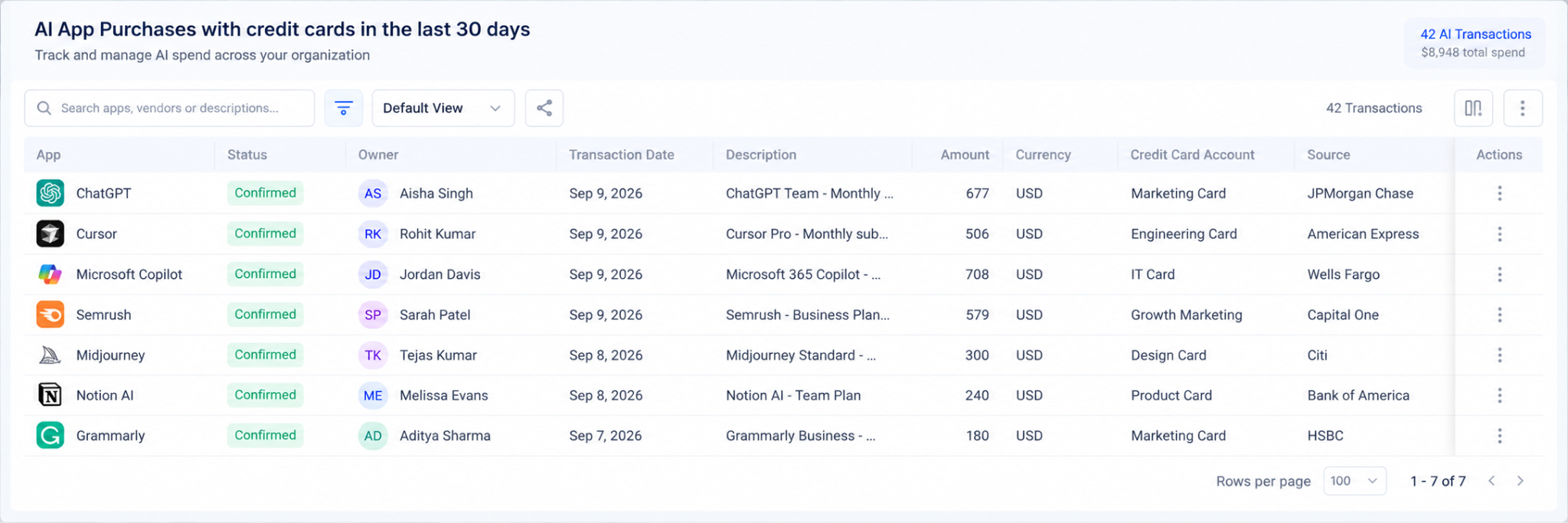
You can identify all your shadow purchases from this dashboard and contact the users and understand their intent and decide whether to remove or add the application to the sanctioned list.
3. Discovering free shadow AI and shadow IT apps
Credit card monitoring catches paid purchases, but a lot of shadow AI costs nothing to sign up for.
A separate widget, “Free Apps Users Are Logging Into in the Last 30 Days”, tracks exactly that: tools with active logins and zero dollars attached, still sitting unconfirmed.
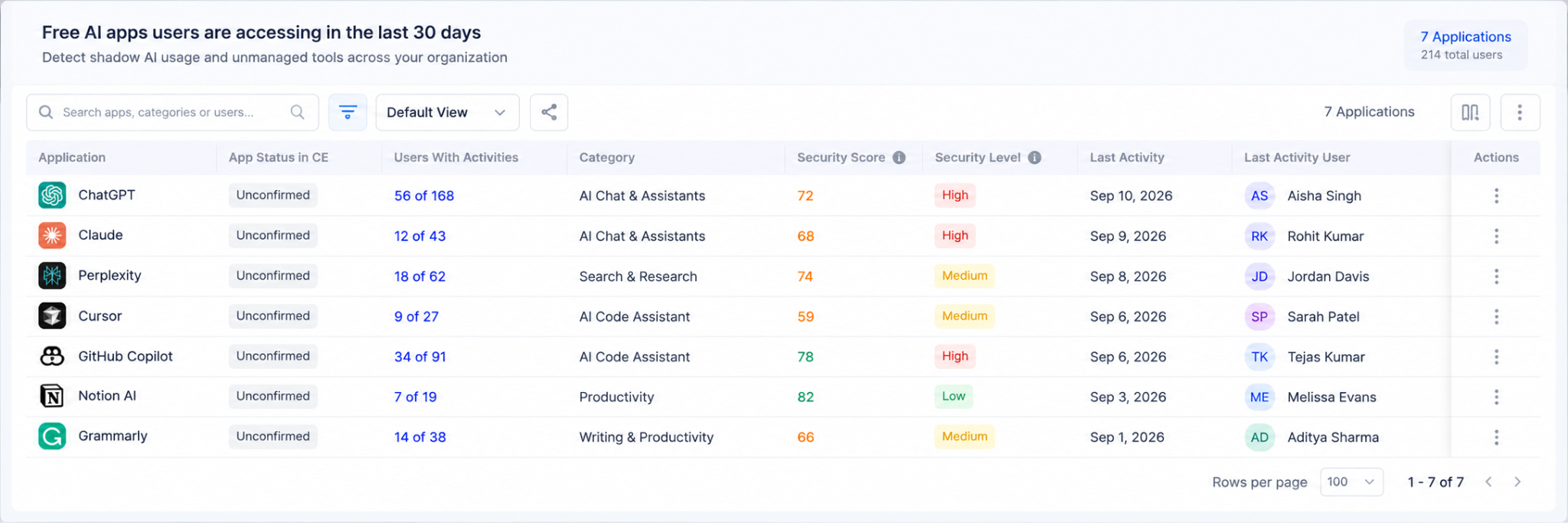
There is another easier way to identify shadow IT existing in your stack. No digging required.
The Managed Applications card is the first thing you see on login, broken down into paid apps, free apps, low-usage apps, duplicates, and AI-identified apps.
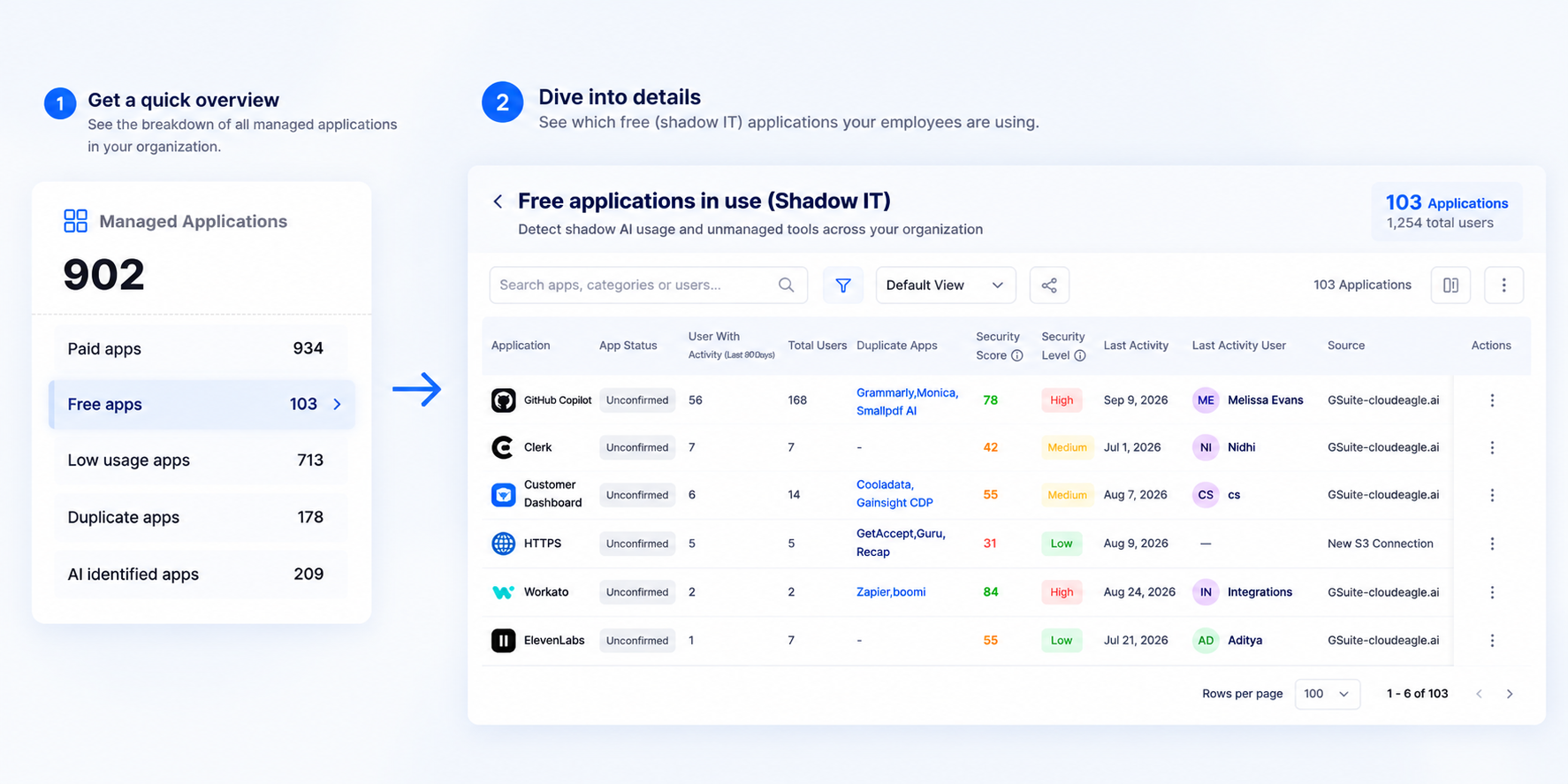
Click Free Apps, and it opens straight into the Free Applications in Use (Shadow IT) view.
Every unconfirmed free app, with users active in the last 90 days shown against total assigned users, so you can see adoption at a glance instead of just a list of app names.
4. Risk Scoring on Every App
Not every unconfirmed app carries the same risk, so each one gets a security score and a rating, powered by the Netskope Cloud Confidence Index.
That score is what turns a list of unknown apps into a decision. Pair it with the duplicate-app flags from the same dashboard, to decide which one to keep, and which ones to eliminate, without opening a single vendor security questionnaire.
5. Looking at Historical Shadow IT Data
The main dashboard widgets show the last 30 or 90 days.
For anything further back, go to Reports and in the Expenses and Credit Card Purchases (Shadow IT) tab, set the time period to Last 12 Months, or any custom range.
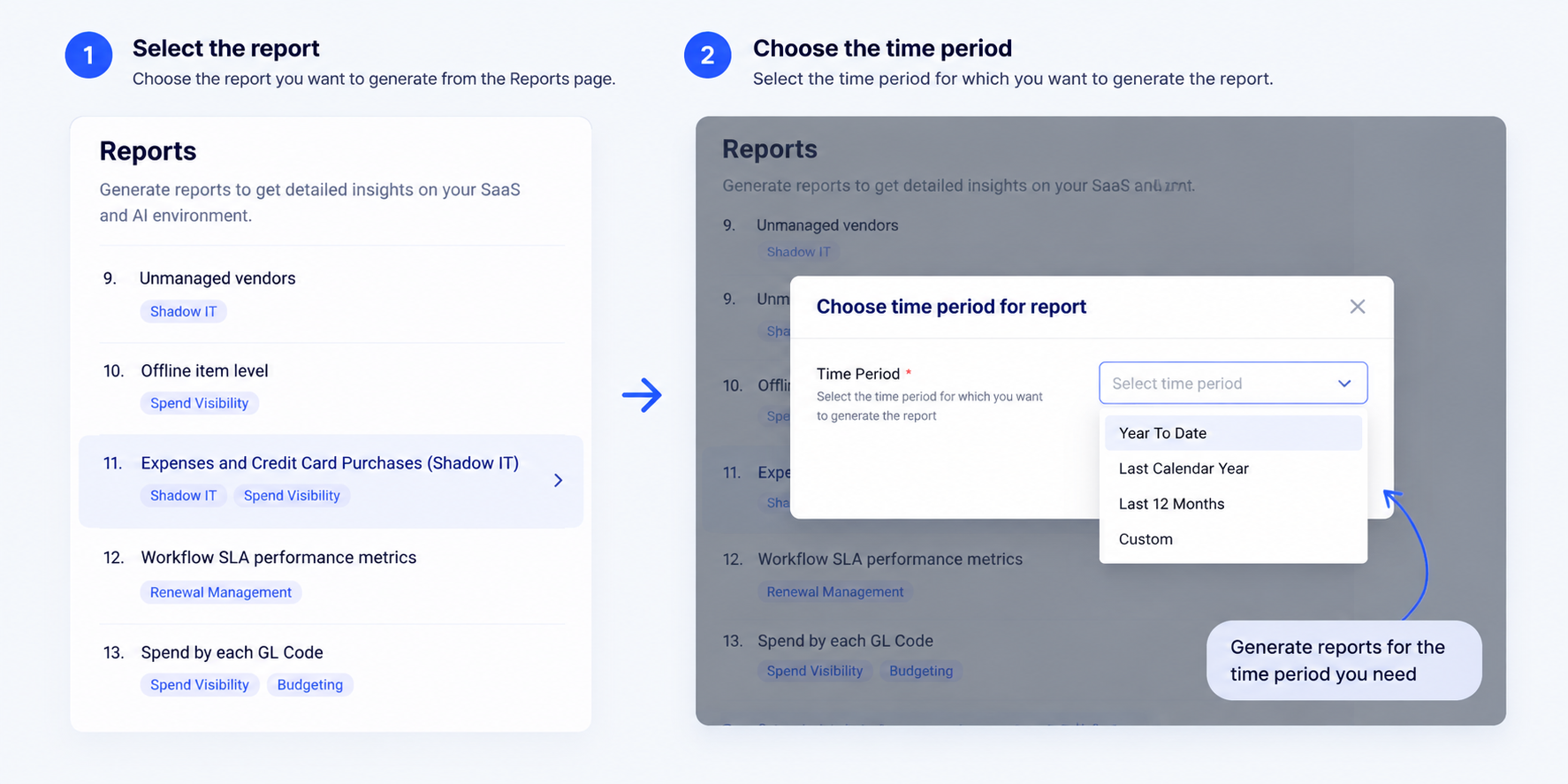
Every card transaction across the period you set: vendor, status, amount, and account. A vendor that keeps charging month after month, sometimes from a different account each time, shows up clearly once a year of transactions is sitting in one table.
Why this matters
A 30-day view catches what's happening right now. A 12-month view catches what's been quietly renewing the whole time.
A recurring charge, paid monthly from five separate accounts, is easy to miss month to month and hard to miss once a year if it is sitting in one table. That's the difference between reacting to shadow IT and actually budgeting around it.
Read more: Identifying shadow AI is one part of the picture. Once you know what's out there, the next question is what it's actually costing you every day. See how token-level usage tracking works →
AI Without Governance Is Risk.


Why Managing Shadow AI and Shadow IT Is Harder Than Most Enterprises Expect?
On paper, it sounds simple.
- Create policies.
- Block risky domains.
- Educate employees.
In reality, managing shadow AI and shadow IT is messy because the problem is not visibility alone. It is scale, speed, and behavior.
Let’s break down why this gets complicated fast.
A. You Can't Manage What You Haven't Found Yet
Most enterprises underestimate how many apps are already connected to their ecosystem.
Employees sign up using corporate emails, personal emails, shared team logins, and API keys. Some tools never even show up in expense reports. Closing that gap takes a deliberate way to discover shadow AI, not a one-time scan that misses everything bought on a personal card.
The visibility gap exists because:
- Apps connect through OAuth without procurement involvement
- AI browser extensions operate outside traditional SaaS tracking
- Department budgets bypass central IT
- Free tiers never trigger financial alerts
Turns out, what you don’t see really can hurt you. One CloudEagle.ai customer plugged into Workday and discovered far more apps than expected.
With real-time SaaS discovery and automated governance, CloudEagle.ai gave them complete visibility and control almost immediately.
B. Every Unapproved App Is a Compliance Gap Waiting to Be Discovered
Shadow AI management becomes critical the moment sensitive data enters the equation.
Many AI tools:
- Store prompts and conversation logs
- Use third-party subprocessors
- Lacks enterprise-grade compliance certifications
- Retain metadata longer than expected
Now layer that over frameworks like SOC 2, ISO 27001, HIPAA, or GDPR.
Each unmanaged tool becomes:
- An audit blind spot
- A data residency risk
- A vendor risk assessment waiting to fail
C. The Budget Leak No One Put in the Report
Shadow AI and shadow IT are not just security issues. They are financial ones.
When tools are adopted informally:
- Licenses overlap across teams
- Enterprise agreements are bypassed
- Inactive users remain assigned
- Redundant AI tools stack up quietly
IT believes spending is controlled. Finance believes procurement is centralized. In reality, subscriptions grow in parallel.
Without a shadow IT management platform, optimization is impossible.
D. Policies That Exist But Aren't Actually Enforced
Most enterprises already have AI and SaaS policies.
The problem is enforcement.
Policies fail when:
- Discovery is manual
- Access reviews happen annually
- Approvals rely on email threads
- No system links identity, spend, and usage
Shadow AI management requires automation, not documentation.
Because governance that depends on memory, spreadsheets, or one security analyst is not governance. It is hope.
Final Words
Shadow AI and Shadow IT are not temporary disruptions. They are now embedded in how teams work, experiment, and move fast inside modern enterprises.
Trying to block everything will fail. The real solution is visibility, continuous governance, and automation that scales with how employees actually adopt tools.
To truly manage shadow AI and shadow IT, enterprises need more than detection. They need a shadow IT management platform that connects discovery, access control, spend optimization, and enforcement in one system.
CloudEagle.ai helps organizations move from reactive cleanups to proactive control, giving IT, security, and finance a unified way to eliminate shadow IT enterprise-wide without slowing innovation.
Book a free demo with CloudEagle.ai and take control of your shadow AI and shadow IT before it scales beyond visibility.
Frequently Asked Questions
- What is shadow IT management?
Shadow IT management is the process of discovering, governing, and controlling unapproved software and SaaS tools used within an organization to reduce security, compliance, and financial risks.
- What tools can help manage shadow IT?
Shadow IT visibility tools and a shadow IT management platform like CloudEagle.ai help detect unsanctioned apps, automate access governance, and optimize SaaS spend across departments.
- What are the risks of shadow AI?
Shadow AI increases the risk of data leakage, compliance violations, uncontrolled API integrations, and insider threats when AI tools process sensitive enterprise information without oversight.
- How to detect shadow AI?
Shadow AI can be detected using SaaS discovery tools that monitor OAuth connections, browser activity, finance data, SSO logs, and AI integrations across enterprise environments.
- What is the value of shadow IT discovery?
Shadow IT discovery provides real-time visibility into unapproved tools, helping enterprises reduce risk, prevent compliance gaps, eliminate duplicate spend, and strengthen governance.
AI Without Governance Is Risk.


.avif)


.avif)
.avif)




.png)





.avif)
.avif)
.avif)


