You need to enable JavaScript in order to use the AI chatbot tool powered by ChatBot

The Real Cost of Shadow AI: How CloudEagle Can Prevent it

Share via:
blog-cms-banner-bg
Little-Known Negotiation Hacks to Get the Best Deal on Slack
cta-bg-blogDownload Your Copy

HIPAA Compliance Checklist for 2025

Download PDF

Shadow AI is becoming one of the fastest-growing risks inside enterprises and most IT, Security, and Procurement teams don’t even know it’s happening. As AI tools like ChatGPT, Gemini, Claude, Notion AI, and countless others become mainstream, employees are adopting them faster than governance teams can keep up.

The result?

Unapproved AI usage spreads across SaaS apps, browser-based tools, and embedded AI features - creating invisible risks, hidden spend, and compliance gaps. The cost of shadow AI is no longer theoretical; it’s already impacting security, budgets, and operational efficiency.

But the good news?

With the right visibility and controls, shadow AI can be identified, governed, and prevented before it causes damage. That’s where CloudEagle.ai comes in.

TL;DR

  • Shadow AI is rising rapidly due to unapproved, invisible AI usage inside SaaS tools and browsers.
  • It creates hidden financial losses, data exposure, and compliance failures.
  • Most companies underestimate how much AI usage is happening across departments.
  • CloudEagle.ai provides complete visibility into shadow AI, embedded AI, and AI browsing.
  • Automated alerts, risk scoring, and policy enforcement stop shadow AI before it becomes a threat.

1. What Is the Real Cost of Shadow AI?

Shadow AI refers to the use of unapproved or unmonitored AI tools across an organization. It silently develops employees experimenting with AI features inside tools like Notion or HubSpot, or using ChatGPT/Gemini without IT approval.

The costs accumulate quickly across financial, security, compliance, and operational areas.

Direct Financial Costs

Shadow AI drains budgets in ways most leaders never see:

  • Duplicate AI tools: Teams buy AI tools independently each with its own credits and subscriptions.
  • Unmonitored AI add-ons: SaaS products like Figma, Asana, and HubSpot now bundle paid AI features renewing automatically without IT’s knowledge.
  • Department-level AI purchases: Small teams swipe credit cards for premium AI plans, creating fragmented spend
  • Wasted licenses: AI features remain unused, but companies keep paying for them.

As SaaS spend has grown 30x in 10 years (CloudEagle slide data), invisible AI add-ons amplify spend leakage even more.

Data Privacy & Security Risks

This is the most damaging and most underestimated cost of shadow AI:

  • Sensitive data flowing into LLMs without approval
  • No audit trail of prompts, outputs, or usage
  • Unknown vendor security posture, many AI vendors lack enterprise controls
  • Risky models accessed directly from personal accounts
  • Data leakage and IP exposure through browser-based AI tools

Once sensitive data is entered into an external model, the exposure is irreversible.

Compliance & Legal Exposure

Shadow AI creates instant audit and regulatory vulnerabilities:

  • Violations under GDPR, CCPA, SOC 2, PCI
  • Gaps in EU AI Act readiness
  • Lack of documentation for audits
  • No record of who used which AI tools, when, or how
  • High regulatory fines for unauthorized data use

Enterprises can only meet upcoming AI regulations with full visibility and governance.

2. Why Shadow AI Is Hard to Detect

Most companies have shadow AI even when they believe their SSO, CASB, or IDP tools are enough. They’re not.

Here’s why it slips through:

Shadow AI Inside Approved SaaS Apps

SaaS apps now embed AI features overnight — every platform has its own AI brain:

  • Notion AI – your intelligent workspace co-pilot.
  • Salesforce Einstein – CRM’s predictive AI engine powering insights and automation.
  • HubSpot AI – smarter marketing, sales, and content creation built directly into your workflow.
  • Figma AI – design generation, layout suggestions, and instant asset creation.
  • Asana AI – auto-prioritizes tasks, predicts blockers, and accelerates project execution.
  • Miro AI – brainstorms, clusters ideas, and turns chaos into structured boards.
  • Fireflies’ “Fred” – an AI note-taker that transcribes, summarizes, and analyzes meetings.
  • CloudEagle’s “EagleEye” – your SaaS Intelligence engine for cost optimization, security, and automated workflows.

IT has no idea:

  • Which AI features are enabled
  • What data these features use
  • Who is using them
  • Whether prompts contain sensitive or regulated information

Because embedded AI usage doesn’t show up as a separate app, traditional tools can’t detect it.

Employees Using Browser-Based AI Tools

Employees log into:

  • ChatGPT
  • Gemini
  • Claude
  • Perplexity
  • Replit AI
  • Bard extensions
  • AI browser plugins

…all without IT visibility.

Lack of a Centralized AI Inventory

Companies track SaaS, but not AI.
They know “what apps are used,” but not “what AI is used inside each app.”

AI Adoption Is Faster Than Governance

AI features evolve weekly. Governance frameworks evolve yearly.
The gap creates uncontrolled risk.

Want to ensure robust SaaS contracts?

Our checklist guides you to review key terms like renewals and security for complete confidence.

Download Resource
CTA Thumbnail

3. How CloudEagle Prevents Shadow AI 

Shadow AI isn’t just a visibility problem, it’s a data, compliance, and spend problem that compounds quickly as AI features proliferate across SaaS apps. CloudEagle.ai prevents this by giving IT, Security, and Procurement a unified layer of AI governance built directly on top of your existing SaaS infrastructure.

This section expands the capabilities into deeper clarity and stronger benefits.

1. AI Feature Discovery Across All SaaS Apps 

Most AI risk hides inside the tools you already use - Notion AI, Salesforce Einstein, HubSpot AI, Figma AI, Asana Intelligence, and more. These AI features roll out silently and often without admin approval.

CloudEagle solves this by:

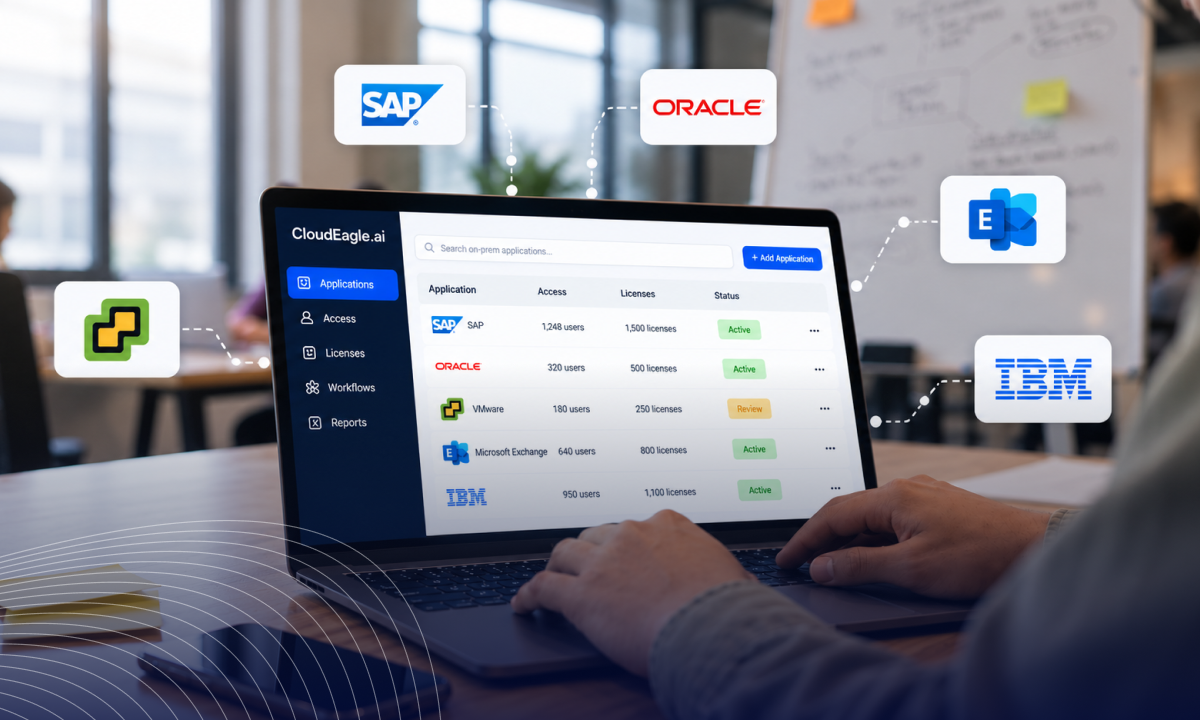
  • Detecting every AI-capable app in your stack using 500+ direct integrations.
  • Identifying which AI features are currently enabled, even if users bypass your IDP to log in directly
  • Tracking AI feature usage by user, team, and role (e.g., “Marketing used Notion AI 124 times last week”).
  • Correlating usage to actual license entitlements, revealing if teams are paying for AI features they aren’t using.
  • Mapping AI data flows, showing what activity is happening inside each AI-enabled tool.

Why it matters:

Hidden AI features are one of the biggest sources of accidental data leakage. With CloudEagle, enterprises get true, feature-level visibility, not just login data.

Result: You know exactly where AI is being used, who is using it, and whether it aligns with your policies.

2. Shadow AI Detection Through Network & Behavior Analysis 

Shadow AI often happens outside SaaS apps, through browsers, personal accounts, extensions, and external AI websites.

CloudEagle uses a combination of:

  • Browser and network activity analysis
  • Deep URL/session inspection
  • Cross-checking with SSO, HRIS, and finance systems
  • AI classification using a 150,000-vendor database

…to detect:

Unapproved AI access

Examples:

  • Users logging into ChatGPT with personal Gmail
  • Employees using Gemini to summarize internal documents
  • Developers using Replit AI to upload source code
  • Analysts pasting sensitive data into Claude

AI browser plugins & extensions

CloudEagle flags plugins such as:

  • GPT-based writing assistants
  • PDF analyzers using unknown AI backends
  • Translation tools powered by external LLMs

Risky prompts or data movement

High-level detection (non-invasive):

  • Unusual volume of text being pasted into AI sites
  • Sensitive URLs or IDs being fed into AI models
  • Users uploading files to unknown LLM providers

Why it matters: Traditional CASB or SSO tools can't detect this level of behavior. Shadow AI happens outside their perimeter.

Result: You gain continuous, real-time visibility into AI activity, even if it never touches an approved SaaS app.

3. Full AI Inventory Dashboard

Most organizations don’t have a centralized AI inventory. CloudEagle generates one automatically.

It categorizes your entire AI footprint into:

✔️ Shadow AI

Unapproved or unknown AI tools accessed by employees.

✔️ Embedded AI

AI features inside SaaS apps (e.g., Notion AI, Asana AI, HubSpot AI).

✔️ AI Browsing

External LLM tools accessed via browsers (e.g., ChatGPT, Claude, Perplexity).

Each category displays:

  • Users & departments involved
  • Frequency of use & risk score
  • Data types likely exposed
  • Whether apps are behind SSO
  • Whether AI features align with your corporate policies
  • License-level information (paid vs free AI features)

Why it matters: This becomes your single source of truth for enterprise AI usage.

Result: IT, Security, and Procurement finally align on a shared AI governance baseline.

4. Automated Approvals & Policy Enforcement 

AI governance cannot scale manually. CloudEagle turns governance policies into automated workflows.

Examples:

  • If a user tries to use ChatGPT, route their approval request to Security.
  • If a department enables Figma AI, notify IT and validate data safety.
  • If an employee accesses a risky AI tool, automatically message them inside Slack/Email.
  • If an AI feature violates your policy, automatically block or restrict access.
  • If AI activity exceeds department thresholds, trigger automated reviews.

Workflow capabilities include:

  • Custom approval workflows
  • Role- and department-based restrictions
  • AI usage caps
  • Auto-notifications to app admins
  • Blocking via ITSM/IDP integrations
  • Integration with JIRA, ServiceNow, Slack, Teams

Why it matters: IT teams can’t chase every AI request. CloudEagle enforces policies instantly and consistently.

Result: Governance becomes proactive, automated, and scalable.

Aiming to improve Identity & Access Management?

Our eBook outlines eight key areas and solutions to enhance access security and maintain compliance.

Download Resource
CTA Thumbnail

5. AI Vendor Risk & Compliance Check (Expanded)

Not all AI vendors are safe. CloudEagle evaluates each one with automated risk scoring:

CloudEagle assesses:

  • Data residency & storage
  • Access to training datasets
  • Model transparency
  • Encryption standards
  • SOC2 / ISO27001 compliance
  • GDPR/CCPA obligations
  • AI Act readiness
  • Whether the AI vendor stores prompts
  • Whether data can be used for retraining
  • Whether usage involves personal account

Plus:

Cross-validation against CloudEagle’s database of 150,000 SaaS & AI vendors ensures accuracy.

Why it matters: Most AI tools are new, unverified, and lack enterprise-grade governance.

Result: You adopt AI tools safely and avoid risky vendors before they enter your environment.

6. Continuous Monitoring & Alerts 

CloudEagle monitors AI activity 24/7 across:

  • APIs
  • Browser sessions
  • SSO data
  • Finance systems (AI add-on spend)
  • Direct SaaS usage logs

Then it sends proactive alerts for events like:

  • “User uploaded files to an unapproved AI tool.”
  • “Marketing turned on HubSpot AI features.”
  • “Finance purchased AI credits via credit card.”
  • “Developer used AI code assistants from a personal device.”
  • “Sales accessed Claude via a personal account.”

It also provides:

  • Audit-ready logs
  • Historical AI usage timeline
  • User-level risk profiles
  • Anomaly detection using the EagleEye AI engine

Why it matters: Shadow AI happens in seconds. You can’t wait for quarterly audits.

Result: You stay compliant and prevent AI risks in real time.

With CloudEagle, enterprises get:

  • 100% visibility into every AI feature, tool, plugin, and browsing activity
  • Automated governance with approval workflows and policy enforcement
  • Risk-aware AI adoption based on vendor scoring and usage context
  • Proactive risk detection across SaaS and browser patterns
  • Audit-ready logs for compliance and AI Act readiness

CloudEagle transforms AI chaos into an automated, orchestrated governance system that keeps your organization safe without slowing innovation.

7. Conclusion

Shadow AI is invisible, fast-growing, and extremely costly. Without visibility into how employees use A inside SaaS tools, through browsers, or via embedded features companies face hidden financial losses, data exposure risks, and compliance failures.

CloudEagle.ai eliminates these blind spots with real-time AI discovery, feature-level insights, risk detection, and automated governance. With a unified AI inventory and consistent policy enforcement, enterprises can prevent shadow AI before it becomes a threat.

Concerned about undetected SaaS security gaps?

Our checklist enables your team to identify vulnerabilities and implement measures to protect sensitive data effectively.

Download Resource
CTA Thumbnail

Frequently Asked Questions 

1. What is the cost of Shadow AI?

Shadow AI costs include hidden SaaS spend, duplicate AI tool purchases, paid AI add-ons, data leakage risks, and compliance penalties. The biggest cost is unmanaged data flowing into unapproved AI tools.

2. Why is Shadow AI dangerous for enterprises?

Shadow AI is dangerous because it exposes sensitive data, bypasses governance, violates regulations, and creates invisible financial waste. IT cannot control what it cannot see.

3. How can companies detect Shadow AI?

Companies can detect shadow AI by monitoring SaaS AI features, analyzing browser activity, tracking AI add-ons, and using tools like CloudEagle.ai that provide complete AI visibility.

4. What’s the difference between Shadow AI and Shadow IT?

Shadow IT refers to unapproved SaaS apps.
Shadow AI refers to unapproved or hidden AI usage inside those apps or through AI tools. Shadow AI is harder to detect because AI features don’t appear as standalone applications.

5. How does CloudEagle help prevent Shadow AI?

CloudEagle provides AI feature discovery, browser-based AI detection, a full AI inventory, automated approvals, vendor risk scoring, and real-time monitoring—stopping shadow AI before it escalates.

Advertisement for a SaaS Subscription Tracking Template with a call-to-action button to download and a partial graphic of a tablet showing charts.Banner promoting a SaaS Agreement Checklist to streamline SaaS management and avoid budget waste with a call-to-action button labeled Download checklist.Blue banner with text 'The Ultimate Employee Offboarding Checklist!' and a black button labeled 'Download checklist' alongside partial views of checklist documents from cloudeagle.ai.Digital ad for download checklist titled 'The Ultimate Checklist for IT Leaders to Optimize SaaS Operations' by cloudeagle.ai, showing checklist pages.Slack Buyer's Guide offer with text 'Unlock insider insights to get the best deal on Slack!' and a button labeled 'Get Your Copy', accompanied by a preview of the guide featuring Slack's logo.Monday Pricing Guide by cloudeagle.ai offering exclusive pricing secrets to maximize investment with a call-to-action button labeled Get Your Copy and an image of the guide's cover.Blue banner for Canva Pricing Guide by cloudeagle.ai offering a guide to Canva costs, features, and alternatives with a call-to-action button saying Get Your Copy.Blue banner with white text reading 'Little-Known Negotiation Hacks to Get the Best Deal on Slack' and a white button labeled 'Get Your Copy'.Blue banner with text 'Little-Known Negotiation Hacks to Get the Best Deal on Monday.com' and a white button labeled 'Get Your Copy'.Blue banner with text 'Little-Known Negotiation Hacks to Get the Best Deal on Canva' and a white button labeled 'Get Your Copy'.Banner with text 'Slack Buyer's Guide' and a 'Download Now' button next to images of a guide titled 'Slack Buyer’s Guide: Features, Pricing & Best Practices'.Digital cover of Monday Pricing Guide with a button labeled Get Your Copy on a blue background.Canva Pricing Guide cover with a button labeled Get Your Copy on a blue gradient background.

Enter your email to
unlock the report

Oops! Something went wrong while submitting the form.
License Count
Benchmark
Per User/Per Year

Enter your email to
unlock the report

Oops! Something went wrong while submitting the form.
License Count
Benchmark
Per User/Per Year

Enter your email to
unlock the report

Oops! Something went wrong while submitting the form.
Notion Plus
License Count
Benchmark
Per User/Per Year
100-500
$67.20 - $78.72
500-1000
$59.52 - $72.00
1000+
$51.84 - $57.60
Canva Pro
License Count
Benchmark
Per User/Per Year
100-500
$74.33-$88.71
500-1000
$64.74-$80.32
1000+
$55.14-$62.34

Enter your email to
unlock the report

Oops! Something went wrong while submitting the form.

Enter your email to
unlock the report

Oops! Something went wrong while submitting the form.
Zoom Business
License Count
Benchmark
Per User/Per Year
100-500
$216.00 - $264.00
500-1000
$180.00 - $216.00
1000+
$156.00 - $180.00

Enter your email to
unlock the report

Oops! Something went wrong while submitting the form.

Get the Right Security Platform To Secure Your Cloud Infrastructure

Please enter a business email
Thank you!
The 2023 SaaS report has been sent to your email. Check your promotional or spam folder.
Oops! Something went wrong while submitting the form.

Access full report

Please enter a business email
Thank you!
The 2023 SaaS report has been sent to your email. Check your promotional or spam folder.
Oops! Something went wrong while submitting the form.

Shadow AI is becoming one of the fastest-growing risks inside enterprises and most IT, Security, and Procurement teams don’t even know it’s happening. As AI tools like ChatGPT, Gemini, Claude, Notion AI, and countless others become mainstream, employees are adopting them faster than governance teams can keep up.

The result?

Unapproved AI usage spreads across SaaS apps, browser-based tools, and embedded AI features - creating invisible risks, hidden spend, and compliance gaps. The cost of shadow AI is no longer theoretical; it’s already impacting security, budgets, and operational efficiency.

But the good news?

With the right visibility and controls, shadow AI can be identified, governed, and prevented before it causes damage. That’s where CloudEagle.ai comes in.

TL;DR

  • Shadow AI is rising rapidly due to unapproved, invisible AI usage inside SaaS tools and browsers.
  • It creates hidden financial losses, data exposure, and compliance failures.
  • Most companies underestimate how much AI usage is happening across departments.
  • CloudEagle.ai provides complete visibility into shadow AI, embedded AI, and AI browsing.
  • Automated alerts, risk scoring, and policy enforcement stop shadow AI before it becomes a threat.

1. What Is the Real Cost of Shadow AI?

Shadow AI refers to the use of unapproved or unmonitored AI tools across an organization. It silently develops employees experimenting with AI features inside tools like Notion or HubSpot, or using ChatGPT/Gemini without IT approval.

The costs accumulate quickly across financial, security, compliance, and operational areas.

Direct Financial Costs

Shadow AI drains budgets in ways most leaders never see:

  • Duplicate AI tools: Teams buy AI tools independently each with its own credits and subscriptions.
  • Unmonitored AI add-ons: SaaS products like Figma, Asana, and HubSpot now bundle paid AI features renewing automatically without IT’s knowledge.
  • Department-level AI purchases: Small teams swipe credit cards for premium AI plans, creating fragmented spend
  • Wasted licenses: AI features remain unused, but companies keep paying for them.

As SaaS spend has grown 30x in 10 years (CloudEagle slide data), invisible AI add-ons amplify spend leakage even more.

Data Privacy & Security Risks

This is the most damaging and most underestimated cost of shadow AI:

  • Sensitive data flowing into LLMs without approval
  • No audit trail of prompts, outputs, or usage
  • Unknown vendor security posture, many AI vendors lack enterprise controls
  • Risky models accessed directly from personal accounts
  • Data leakage and IP exposure through browser-based AI tools

Once sensitive data is entered into an external model, the exposure is irreversible.

Compliance & Legal Exposure

Shadow AI creates instant audit and regulatory vulnerabilities:

  • Violations under GDPR, CCPA, SOC 2, PCI
  • Gaps in EU AI Act readiness
  • Lack of documentation for audits
  • No record of who used which AI tools, when, or how
  • High regulatory fines for unauthorized data use

Enterprises can only meet upcoming AI regulations with full visibility and governance.

2. Why Shadow AI Is Hard to Detect

Most companies have shadow AI even when they believe their SSO, CASB, or IDP tools are enough. They’re not.

Here’s why it slips through:

Shadow AI Inside Approved SaaS Apps

SaaS apps now embed AI features overnight — every platform has its own AI brain:

  • Notion AI – your intelligent workspace co-pilot.
  • Salesforce Einstein – CRM’s predictive AI engine powering insights and automation.
  • HubSpot AI – smarter marketing, sales, and content creation built directly into your workflow.
  • Figma AI – design generation, layout suggestions, and instant asset creation.
  • Asana AI – auto-prioritizes tasks, predicts blockers, and accelerates project execution.
  • Miro AI – brainstorms, clusters ideas, and turns chaos into structured boards.
  • Fireflies’ “Fred” – an AI note-taker that transcribes, summarizes, and analyzes meetings.
  • CloudEagle’s “EagleEye” – your SaaS Intelligence engine for cost optimization, security, and automated workflows.

IT has no idea:

  • Which AI features are enabled
  • What data these features use
  • Who is using them
  • Whether prompts contain sensitive or regulated information

Because embedded AI usage doesn’t show up as a separate app, traditional tools can’t detect it.

Employees Using Browser-Based AI Tools

Employees log into:

  • ChatGPT
  • Gemini
  • Claude
  • Perplexity
  • Replit AI
  • Bard extensions
  • AI browser plugins

…all without IT visibility.

Lack of a Centralized AI Inventory

Companies track SaaS, but not AI.
They know “what apps are used,” but not “what AI is used inside each app.”

AI Adoption Is Faster Than Governance

AI features evolve weekly. Governance frameworks evolve yearly.
The gap creates uncontrolled risk.

Want to ensure robust SaaS contracts?

Our checklist guides you to review key terms like renewals and security for complete confidence.

Download Resource
CTA Thumbnail

3. How CloudEagle Prevents Shadow AI 

Shadow AI isn’t just a visibility problem, it’s a data, compliance, and spend problem that compounds quickly as AI features proliferate across SaaS apps. CloudEagle.ai prevents this by giving IT, Security, and Procurement a unified layer of AI governance built directly on top of your existing SaaS infrastructure.

This section expands the capabilities into deeper clarity and stronger benefits.

1. AI Feature Discovery Across All SaaS Apps 

Most AI risk hides inside the tools you already use - Notion AI, Salesforce Einstein, HubSpot AI, Figma AI, Asana Intelligence, and more. These AI features roll out silently and often without admin approval.

CloudEagle solves this by:

  • Detecting every AI-capable app in your stack using 500+ direct integrations.
  • Identifying which AI features are currently enabled, even if users bypass your IDP to log in directly
  • Tracking AI feature usage by user, team, and role (e.g., “Marketing used Notion AI 124 times last week”).
  • Correlating usage to actual license entitlements, revealing if teams are paying for AI features they aren’t using.
  • Mapping AI data flows, showing what activity is happening inside each AI-enabled tool.

Why it matters:

Hidden AI features are one of the biggest sources of accidental data leakage. With CloudEagle, enterprises get true, feature-level visibility, not just login data.

Result: You know exactly where AI is being used, who is using it, and whether it aligns with your policies.

2. Shadow AI Detection Through Network & Behavior Analysis 

Shadow AI often happens outside SaaS apps, through browsers, personal accounts, extensions, and external AI websites.

CloudEagle uses a combination of:

  • Browser and network activity analysis
  • Deep URL/session inspection
  • Cross-checking with SSO, HRIS, and finance systems
  • AI classification using a 150,000-vendor database

…to detect:

Unapproved AI access

Examples:

  • Users logging into ChatGPT with personal Gmail
  • Employees using Gemini to summarize internal documents
  • Developers using Replit AI to upload source code
  • Analysts pasting sensitive data into Claude

AI browser plugins & extensions

CloudEagle flags plugins such as:

  • GPT-based writing assistants
  • PDF analyzers using unknown AI backends
  • Translation tools powered by external LLMs

Risky prompts or data movement

High-level detection (non-invasive):

  • Unusual volume of text being pasted into AI sites
  • Sensitive URLs or IDs being fed into AI models
  • Users uploading files to unknown LLM providers

Why it matters: Traditional CASB or SSO tools can't detect this level of behavior. Shadow AI happens outside their perimeter.

Result: You gain continuous, real-time visibility into AI activity, even if it never touches an approved SaaS app.

3. Full AI Inventory Dashboard

Most organizations don’t have a centralized AI inventory. CloudEagle generates one automatically.

It categorizes your entire AI footprint into:

✔️ Shadow AI

Unapproved or unknown AI tools accessed by employees.

✔️ Embedded AI

AI features inside SaaS apps (e.g., Notion AI, Asana AI, HubSpot AI).

✔️ AI Browsing

External LLM tools accessed via browsers (e.g., ChatGPT, Claude, Perplexity).

Each category displays:

  • Users & departments involved
  • Frequency of use & risk score
  • Data types likely exposed
  • Whether apps are behind SSO
  • Whether AI features align with your corporate policies
  • License-level information (paid vs free AI features)

Why it matters: This becomes your single source of truth for enterprise AI usage.

Result: IT, Security, and Procurement finally align on a shared AI governance baseline.

4. Automated Approvals & Policy Enforcement 

AI governance cannot scale manually. CloudEagle turns governance policies into automated workflows.

Examples:

  • If a user tries to use ChatGPT, route their approval request to Security.
  • If a department enables Figma AI, notify IT and validate data safety.
  • If an employee accesses a risky AI tool, automatically message them inside Slack/Email.
  • If an AI feature violates your policy, automatically block or restrict access.
  • If AI activity exceeds department thresholds, trigger automated reviews.

Workflow capabilities include:

  • Custom approval workflows
  • Role- and department-based restrictions
  • AI usage caps
  • Auto-notifications to app admins
  • Blocking via ITSM/IDP integrations
  • Integration with JIRA, ServiceNow, Slack, Teams

Why it matters: IT teams can’t chase every AI request. CloudEagle enforces policies instantly and consistently.

Result: Governance becomes proactive, automated, and scalable.

Aiming to improve Identity & Access Management?

Our eBook outlines eight key areas and solutions to enhance access security and maintain compliance.

Download Resource
CTA Thumbnail

5. AI Vendor Risk & Compliance Check (Expanded)

Not all AI vendors are safe. CloudEagle evaluates each one with automated risk scoring:

CloudEagle assesses:

  • Data residency & storage
  • Access to training datasets
  • Model transparency
  • Encryption standards
  • SOC2 / ISO27001 compliance
  • GDPR/CCPA obligations
  • AI Act readiness
  • Whether the AI vendor stores prompts
  • Whether data can be used for retraining
  • Whether usage involves personal account

Plus:

Cross-validation against CloudEagle’s database of 150,000 SaaS & AI vendors ensures accuracy.

Why it matters: Most AI tools are new, unverified, and lack enterprise-grade governance.

Result: You adopt AI tools safely and avoid risky vendors before they enter your environment.

6. Continuous Monitoring & Alerts 

CloudEagle monitors AI activity 24/7 across:

  • APIs
  • Browser sessions
  • SSO data
  • Finance systems (AI add-on spend)
  • Direct SaaS usage logs

Then it sends proactive alerts for events like:

  • “User uploaded files to an unapproved AI tool.”
  • “Marketing turned on HubSpot AI features.”
  • “Finance purchased AI credits via credit card.”
  • “Developer used AI code assistants from a personal device.”
  • “Sales accessed Claude via a personal account.”

It also provides:

  • Audit-ready logs
  • Historical AI usage timeline
  • User-level risk profiles
  • Anomaly detection using the EagleEye AI engine

Why it matters: Shadow AI happens in seconds. You can’t wait for quarterly audits.

Result: You stay compliant and prevent AI risks in real time.

With CloudEagle, enterprises get:

  • 100% visibility into every AI feature, tool, plugin, and browsing activity
  • Automated governance with approval workflows and policy enforcement
  • Risk-aware AI adoption based on vendor scoring and usage context
  • Proactive risk detection across SaaS and browser patterns
  • Audit-ready logs for compliance and AI Act readiness

CloudEagle transforms AI chaos into an automated, orchestrated governance system that keeps your organization safe without slowing innovation.

7. Conclusion

Shadow AI is invisible, fast-growing, and extremely costly. Without visibility into how employees use A inside SaaS tools, through browsers, or via embedded features companies face hidden financial losses, data exposure risks, and compliance failures.

CloudEagle.ai eliminates these blind spots with real-time AI discovery, feature-level insights, risk detection, and automated governance. With a unified AI inventory and consistent policy enforcement, enterprises can prevent shadow AI before it becomes a threat.

Concerned about undetected SaaS security gaps?

Our checklist enables your team to identify vulnerabilities and implement measures to protect sensitive data effectively.

Download Resource
CTA Thumbnail

Frequently Asked Questions 

1. What is the cost of Shadow AI?

Shadow AI costs include hidden SaaS spend, duplicate AI tool purchases, paid AI add-ons, data leakage risks, and compliance penalties. The biggest cost is unmanaged data flowing into unapproved AI tools.

2. Why is Shadow AI dangerous for enterprises?

Shadow AI is dangerous because it exposes sensitive data, bypasses governance, violates regulations, and creates invisible financial waste. IT cannot control what it cannot see.

3. How can companies detect Shadow AI?

Companies can detect shadow AI by monitoring SaaS AI features, analyzing browser activity, tracking AI add-ons, and using tools like CloudEagle.ai that provide complete AI visibility.

4. What’s the difference between Shadow AI and Shadow IT?

Shadow IT refers to unapproved SaaS apps.
Shadow AI refers to unapproved or hidden AI usage inside those apps or through AI tools. Shadow AI is harder to detect because AI features don’t appear as standalone applications.

5. How does CloudEagle help prevent Shadow AI?

CloudEagle provides AI feature discovery, browser-based AI detection, a full AI inventory, automated approvals, vendor risk scoring, and real-time monitoring—stopping shadow AI before it escalates.

CloudEagle.ai recognized in the 2025 Gartner® Magic Quadrant™ for SaaS Management Platforms
Download now
gartner chart
5x
Faster employee
onboarding
80%
Reduction in time for
user access reviews
30k
Workflows
automated
$15Bn
Analyzed in
contract spend
$2Bn
Saved in
SaaS spend

Recognized as an Industry leader for our AI

CloudEagle.ai is Recognized in the 2024 Gartner® Magic Quadrant™ for SaaS Management Platforms

Recognition highlights CloudEagle’s innovation and leadership in the rapidly evolving SaaS management and procurement space.
Read More
Gartner Magic Quadrant for SaaS Management Platforms showing a chart divided into Challengers and Leaders quadrants with various companies plotted as dots.

CloudEagle.ai Recognized in the GigaOm Radar for SaaS Management Platforms

CloudEagle named a Leader and Outperformer in GigaOm Radar Report, validating its impact in the SaaS management platform landscape.
Read More
gigaom

Everest Group Positions CloudEagle.ai as a Trailblazer in SaaS Management Platforms

CloudEagle recognized as a Trailblazer by Everest Group, showcasing its rapid growth and innovation in SaaS spend and operations management.
Read More
qks

CloudEagle.ai is Recognized in the 2024 Gartner® Magic Quadrant™ for SaaS Management Platforms

Recognition highlights CloudEagle’s innovation and leadership in the rapidly evolving SaaS management and procurement space.
Read More
gartner

Streamline SaaS governance and save 10-30%

Book a Demo with Expert
CTA image
One platform to Manage
all SaaS Products
Learn More