
%201.svg)


HIPAA Compliance Checklist for 2025

AI adoption is accelerating, but governance maturity is not keeping up. Understanding the benefits of effective AI governance, from risk reduction to regulatory alignment, motivates investment in mature practices
While enterprises are deploying generative AI, automated decision systems, and AI-powered SaaS tools at record speed, most organizations don’t know their true AI governance maturity level. Some have policies on paper, others rely on ad hoc controls, and many haven’t mapped their risks at all.
One 2025 report found that while 93% of organizations use AI in some capacity, only 7% have “fully embedded” AI governance frameworks.
This is where an AI Governance Maturity Model becomes essential. It helps teams benchmark their current stage, understand capability gaps, and move toward responsible AI at scale.
In this blog, we break down the four levels of the AI governance maturity model, explain their characteristics, and help you evaluate where your organization stands today.
What Is an AI Governance Maturity Model?
An AI Governance Maturity Model is a structured framework that evaluates how effectively an organization manages the risks, policies, and oversight required for responsible AI. It helps teams understand:
- How formalized their AI governance practices are
- Whether accountability and review processes exist
- How well risks are managed across AI systems and vendors
- What improvements are needed to move to the next maturity stage
It’s a valuable tool for CIOs, CISOs, legal, compliance, procurement, and AI teams trying to scale AI responsibly.
Why Maturity Matters in AI Governance
AI is being adopted faster than governance can keep up, creating gaps that expose organizations to risk. Maturity matters because:
- AI deployment is outpacing policy development - Teams adopt AI tools, even embedded ones inside SaaS platforms, before governance controls exist.
- AI creates new, unpredictable risks - Hallucinations, insecure prompts, data leakage, IP exposure, and biased outputs all require structured oversight.
- Regulators are tightening requirements - With frameworks like the EU AI Act, NIST RMF, and ISO AI standards, organizations without mature governance face compliance challenges.
- Leadership needs clarity - A maturity model helps executives understand where the organization stands and where investment is required.
Common Challenges Organizations Face Today
Supporting infrastructure is also lacking: only 4% of organizations said their data/infrastructure environment is “fully AI-ready”.
Most enterprises, regardless of industry or size, tend to experience the same early-stage hurdles when it comes to AI governance. The pattern is almost universal:
- Shadow AI quietly spreads before leadership even notices
Employees start experimenting with ChatGPT, embedded AI features, and automated workflows long before policies exist. What begins as productivity hacks turns into a patchwork of untracked AI usage that no one fully understands or controls.
- No central oversight means everyone evaluates AI differently
Marketing might review AI tools based on features, IT checks security, legal looks at compliance, but none of these evaluations talk to each other. AI approval becomes a fragmented, inconsistent process where risks slip through the cracks.
- Ownership is unclear and often debated internally
Is AI governance a responsibility of IT? Security? Compliance? Data teams? Procurement? In many organizations, each department assumes someone else is managing the risks, leaving AI oversight scattered and ineffective.
Clarifying where AI governance and AI security overlap and where they diverge prevents organizational confusion and ensures complete coverage.
- AI behaviors are rarely monitored once deployed
Tools are adopted, prompts are shared, automations are built, but ongoing monitoring is almost nonexistent.
No one tracks hallucination rates, drift, bias, or vendor model changes. Teams rely on “it seems to work” instead of verifiable performance.
- AI-driven decisions aren’t documented or auditable
Without proper documentation, organizations can’t explain:
- how an AI tool reached a decision
- whether a model changed
- what data was used
- who approved it
This creates compliance gaps and increases exposure during audits.
And the biggest issue?
Without a defined AI governance maturity framework, these challenges continue unchecked. Governance becomes reactive, addressing issues after something goes wrong rather than proactive, intentional, and measurable.
A robust AI governance platform enables organizations to move from reactive incident response to proactive, measurable governance at scale.
What are the Four Stages of AI Governance Maturity
Below is the structured, Gartner-inspired four-level model for assessing AI governance maturity.
A. Level 1 - Ad Hoc (Unmanaged)
Organizations at this level have no formal AI governance in place.
Characteristics include:
- No AI policy, no responsible AI guidelines
- Teams independently adopt generative AI and AI tools
- Risk exposure is high and largely unknown
- No documentation, audit trail, or approval workflows
- Issues are handled reactively, only after something goes wrong
Typical signs: Shadow AI everywhere, no inventory of AI systems, no awareness of risks.
To move up: build a complete AI inventory, including AI embedded in SaaS apps.
B. Level 2 - Developing (Basic Governance)
At this stage, organizations begin implementing basic structures.
Characteristics include:
- Early AI usage policies (often generic and high-level)
- Departments start logging AI tools, though inconsistently
- Introduction of basic risk classification or checklists
- No central governance body yet
- Oversight is partial, not organization-wide
Typical signs: Some awareness, but governance varies across teams and is not yet unified.
To move up: name an owner for AI governance and route every new AI tool through a standing approval workflow.
C. Level 3 - Defined (Structured Governance)
Organizations have formal, standardized governance processes.
Characteristics include:
- Governance committees, ethics boards, or review councils
- Documented approval workflows for new AI tools
- Vendor AI assessments and risk scoring
- Bias testing, security reviews, compliance alignment
- Clear ownership: legal, IT, security, procurement, and data teams collaborate
- Processes are measurable, repeatable, and auditable
Typical signs: Leadership visibility is high; vendors face structured evaluations; internal AI deployment follows policy.
To move up: add metrics and continuous monitoring so you can prove controls work between reviews.
D. Level 4 - Optimized (Advanced Governance)
This is the highest maturity stage, proactive, automated, and scalable.
Characteristics include:
- Continuous monitoring for drift, bias, and performance changes
- Clear accountability and audit trails
- Centralized AI inventory with automated enforcement
- Documentation for every high-risk model
- Training programs for employees on safe AI usage
- Integration of regulatory requirements into workflows
- AI governance is embedded into business and technical processes
Typical signs: Real-time monitoring, automated controls, advanced responsible AI programs, and enterprise-wide compliance readiness.
To move up: automate enforcement and feed every incident back into policy.

How to Identify Your Organization’s Maturity Level?
Before you can improve AI governance, you need to know where you truly stand. But here’s the reality: most organizations believe they’re more mature than they actually are.
Maybe you have an AI policy. Maybe IT “approves” tools. Maybe teams say they follow the rules.
But when you look closer, things often tell a different story.
Identifying your maturity level is like turning the lights on in a room you thought you knew well, suddenly, you see the hidden corners, the overlooked details, and the systems running behind the scenes.
Here’s how you uncover the truth.
A. Conduct an AI Inventory
Imagine walking through your organization with a flashlight. You peek into different departments and discover:
1. Marketing quietly uses five AI writing tools.
2. Sales adopted an AI assistant embedded inside their CRM.
3. Engineering is running its own LLM instance.
4. Finance relies on spreadsheets enhanced with AI formulas from tools no one approved.
5. And HR? They’ve plugged ChatGPT into onboarding workflows for “efficiency.”
This is normal.
Shadow AI is usually far bigger than leadership expects.
A proper AI inventory is not just a list, it’s a reality check.
It reveals:
- The AI tools employees use openly
- The AI hidden inside SaaS platforms
- The custom scripts or models built by engineering teams
- The vendor AI systems connected to sensitive data
- The unapproved AI apps employees experiment with
Once everything is visible, governance stops being theoretical and becomes actionable.
B. Review Existing Policies - Compare Intent vs. Reality
Next, it’s time to compare what’s written with what’s actually happening.
Many organizations proudly point to their “AI Use Policy” and believe governance is handled. But when you read it closely, it often looks like a generic template downloaded from the internet, barely enforced, and rarely understood by employees.
As you review policies, ask:
- Do teams know this policy exists?
- Does it spell out what’s allowed, not allowed, and high-risk?
- Are there approval workflows or do people just use whatever tool helps them get work done faster?
- Is risk classification defined or left to individual judgment?
- Is compliance involved, or are decisions made in silos?
You’ll often discover a gap between what leadership believes and what employees actually do.
That gap is your true maturity level.
C. Assess Risk Controls - Look for the “Seatbelts”
Think of AI use like driving a car. The car may be powerful, but without seatbelts, airbags, and speed limits, risk skyrockets.
Your assessment should uncover:
- Are there controls for sensitive data uploads?
- Do teams validate model outputs for accuracy or bias?
- Are vendors assessed for security and compliance?
- Are logs captured for AI activities?
- Is there any monitoring at all or only after incidents happen?
If risk controls feel “optional,” you’re still early in the maturity journey.
D. Evaluate Ownership and Accountability - Who’s Actually in Charge?
Ask any team, “Who owns AI governance here?”
The answer usually varies:
- IT says Security owns it
- Security says Compliance owns it
- Compliance says business units must own their tools
- And business units point back to IT
Clear ownership is the strongest predictor of governance maturity.
If accountability is blurred, maturity is low. If roles are documented, cross-functional, and active, maturity rises.
E. Analyze Monitoring & Auditing Capabilities - Are You Flying Blind?
Even if policies exist and tools are approved, maturity depends on visibility:
- Can you detect misuse?
- Do you track model drift?
- Is AI activity logged across tools?
- Can you produce an audit trail for regulators?
Organizations often think they have oversight, until they try to generate a report and realize nothing is centrally monitored.
Monitoring separates “we think we’re compliant” from “we can prove we’re compliant.”
Identifying your maturity level isn’t about passing or failing. It’s about understanding where you are today, so you can finally build a governance program that keeps pace with how quickly AI is transforming your organization.
This becomes even more important as businesses adopt ai staff augmentation strategies, where clear oversight and accountability are needed to ensure AI-supported workflows remain aligned with governance and compliance requirements.
For a quick baseline before the full review, the Shadow AI Risk Assessment Calculator takes 10 questions and flags your lowest-scoring areas. If your target is Level 3, our 30-day AI governance framework playbook sequences the work week by week.
How Do Executives Assess AI Governance Maturity Before a Board Review?
Executives assess AI governance maturity before a board review by bringing a level for each area of the program along with the evidence behind it. Pair that with a dated plan for reaching the next level.
Board-level oversight is still uncommon: in McKinsey's 2025 State of AI report, 17% of respondents said their board oversees AI governance. The same research found CEO oversight of AI governance was among the factors most tied to bottom-line impact from generative AI.
A. What Will the Board Ask?
- Who owns AI risk? Show a named executive and a documented decision path.
- What AI touches company data? Show your inventory count, including embedded AI and agents.
- Where do we stand on regulation? Show your exposure under the EU AI Act and new US state AI laws.
- What happens when something goes wrong? Show your incident process. McKinsey found that almost 60% of organizations that had AI incidents rated their response as only satisfactory or worse.
B. Which Evidence Holds Up?
Records generated by systems hold up better than answers gathered by survey.
- Live AI inventory: a current count of AI tools and their users.
- Enforcement logs: records of blocked uploads, approvals, and exceptions.
- Access review results: proof that access to AI apps was reviewed on schedule.
Present each gap as a move from your current level to a target level within two quarters, with an owner for each move.
Which Frameworks Pair With the AI Governance Maturity Model?
NIST AI RMF defines the risk functions you build as you mature, and ISO 42001 defines the auditable management system expected from Level 3 onward. Neither includes maturity levels, which is why teams pair them with an AI governance maturity model to track progress.
A. NIST AI RMF
NIST organizes AI risk work into four functions in AI RMF 1.0, and each becomes central at a different stage.
- Govern: policies, roles, and accountability. NIST treats it as cross-cutting, and closing its gaps is most of the work between Level 1 and Level 3.
- Map: context for each AI system, which depends on the inventory built at Levels 2 and 3.
- Measure: ongoing risk assessment and tracking, the core of Level 4.
- Manage: acting on measured risk and responding to incidents, which Level 5 automates.
Our NIST AI RMF implementation checklist breaks each function into actions.
B. ISO 42001
ISO 42001 is the international standard for AI management systems, and its requirements line up most closely with Level 3 and Level 4.
- Where it fits: documented policies and approvals are Level 3 work, while the evidence auditors request depends on Level 4 monitoring.
- Why buyers care: enterprise customers now raise it during vendor due diligence, as covered in our breakdown of what ISO 42001 requires.
What Does Governance Maturity for Generative AI Require?
Governance maturity for generative AI requires control over what employees type and upload into AI tools, on top of the inventory and approval work every level needs. Prompts and file uploads can move sensitive data out of the company in seconds, which a quarterly review will not catch.
- Input controls: monitoring and blocking sensitive data before it reaches unmanaged AI tools.
- Embedded AI: tracking AI features switched on inside approved SaaS apps, which rarely appear in a standalone inventory.
- Risk guidance: NIST's Generative AI Profile extends the AI RMF to risks specific to generative AI.
- Domain-level scoring: the GenAI Governance Framework, hosted at genai.global and published in Accounting Horizons, sets out 69 control considerations across five governance domains. It includes a maturity model for rating readiness on each one, so teams that need control-level detail can score against it alongside the five levels above.
How Does CloudEagle.ai Help Enterprises Move Up the AI Governance Maturity Model?
CloudEagle.ai, the AI-powered SaaS Management, AI Governance, and SaaS Security platform, produces the evidence each level of the AI governance maturity model asks for. It has processed $50B+ in spend and saved customers $3B+, with 500+ integrations and 30-minute onboarding.
- Complete AI inventory: correlates SSO, browser, firewall, and finance data to find AI tools, including AI embedded in SaaS apps, free trials, and personal accounts.
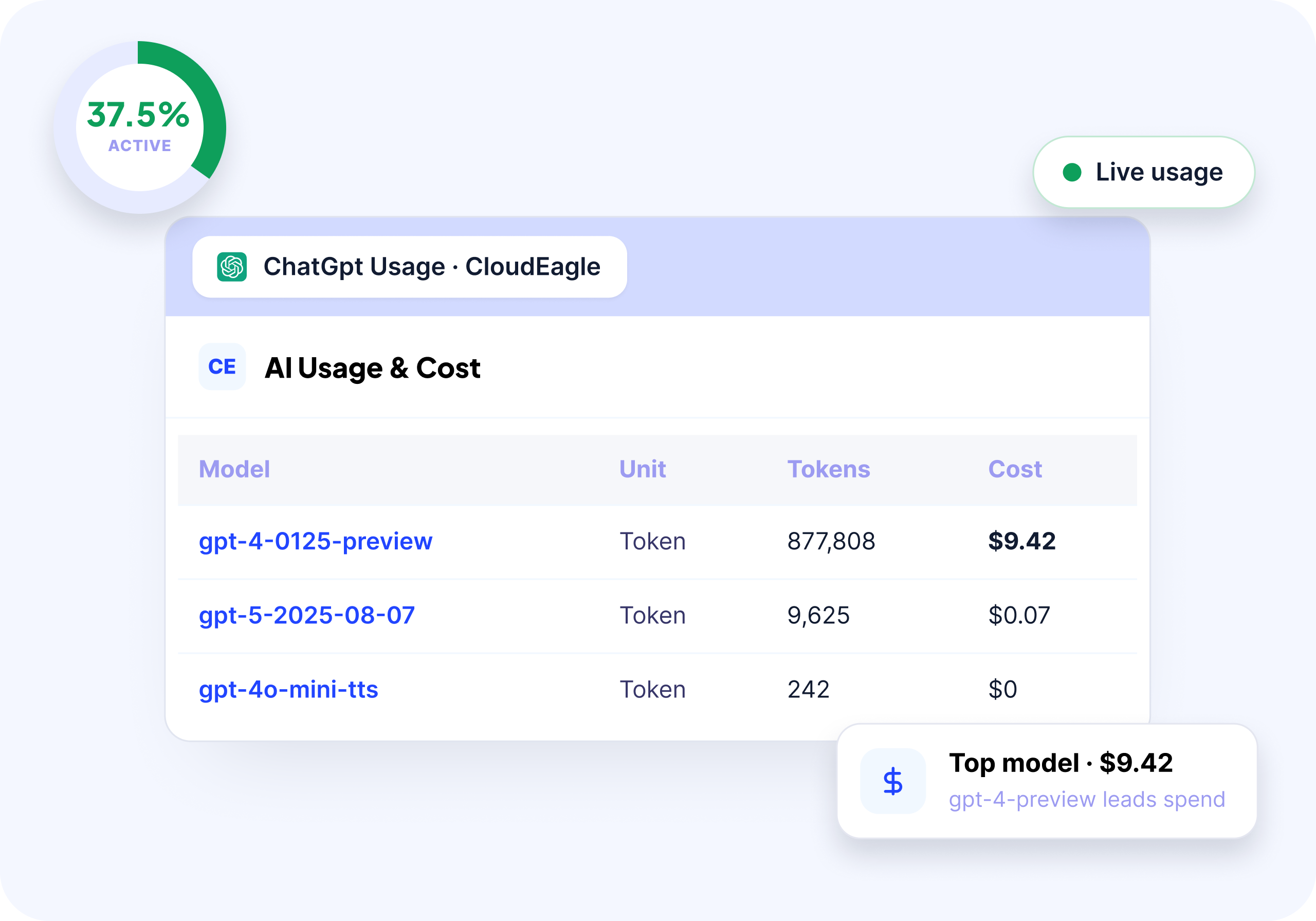
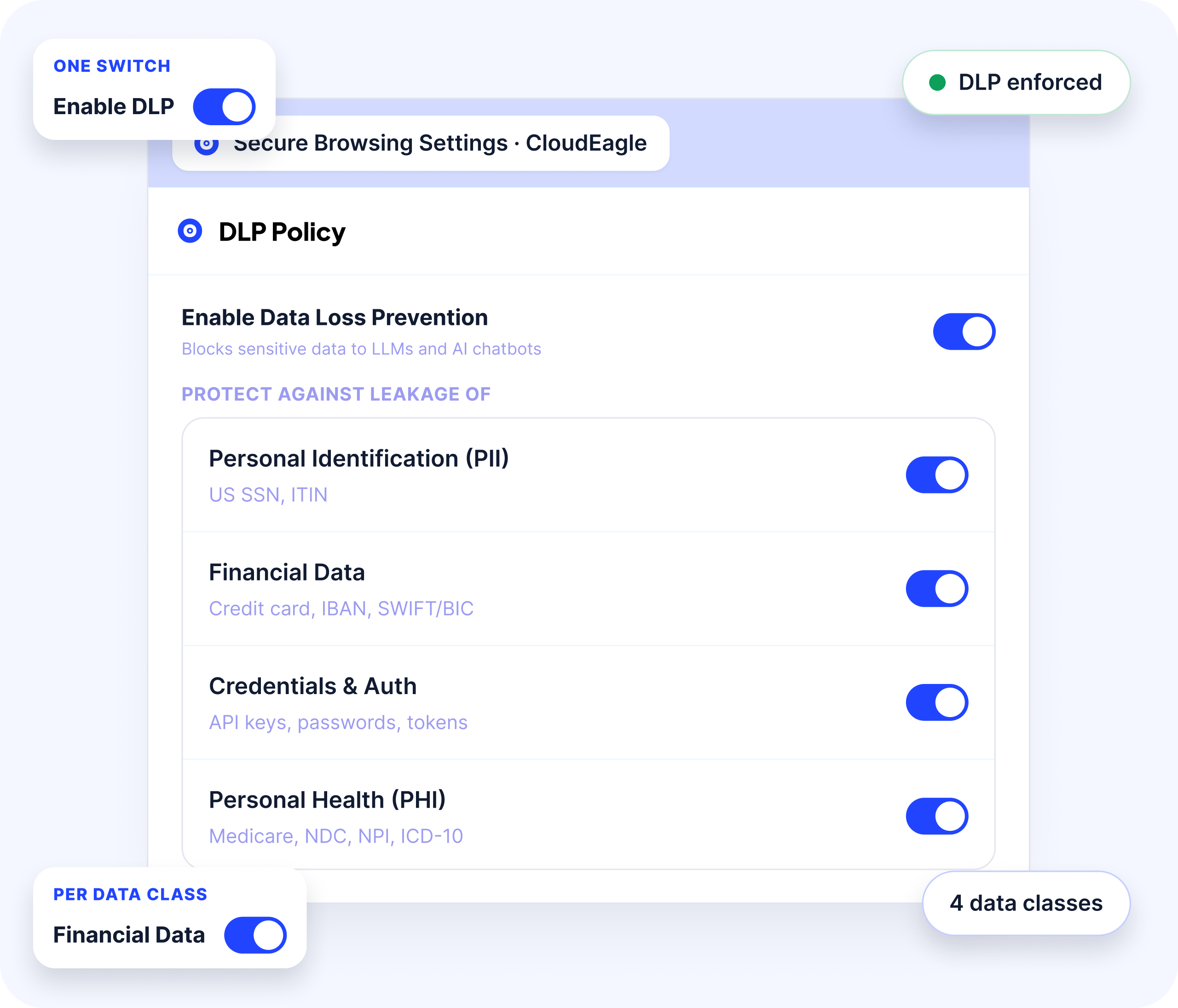
- Enforced AI policy: AI policy enforcement monitors data entering AI tools, blocks sensitive content including PII, and redirects users to approved alternatives.
- Accountable access: access reviews cover AI apps, non-human identities such as API tokens get the same governance as user accounts, and AI access is revoked during offboarding.

See Your Governance Gaps in One View


Conclusion
Your AI governance maturity level reflects how prepared your organization is to manage AI safely and responsibly. As AI adoption grows, governance can no longer be reactive or fragmented.
By using a clear maturity model - Ad Hoc, Developing, Defined, and Optimized, organizations can assess where they stand today, identify capability gaps, and build a roadmap toward proactive, scalable responsible AI.
Structured governance isn’t just a compliance requirement, it’s the foundation for sustainable, trustworthy AI adoption.
Frequently Asked Questions
1. What triggers the need for AI governance maturity assessment?
Rapid AI adoption, new regulations, increased Shadow AI usage, or leadership wanting clarity on AI risks often trigger a maturity assessment.
2. How often should organizations reassess their AI governance maturity?
Every 6–12 months, especially if AI adoption is growing or new tools/models are introduced.
3. Who should lead an AI governance maturity initiative?
Typically a cross-functional team led by compliance, data governance, or a Chief AI/Technology Officer.
4. Do AI maturity models apply to both traditional ML and generative AI?
Yes, modern maturity frameworks evaluate governance for predictive models, LLMs, embedded AI, and third-party AI tools.
5. Can AI governance maturity impact vendor selection?
Absolutely. Mature organizations use governance criteria when evaluating SaaS tools, LLM providers, or model APIs.
6. Is AI governance only relevant for regulated industries?
No. Any business using AI for decisions, automation, or content generation benefits from structured governance.
7. What are the 5 levels of the AI governance maturity model?
The five levels are Ad Hoc, Reactive, Defined, Managed, and Optimized. Each adds a capability the level below lacks, from a first AI inventory to automated enforcement.
Stop Guessing Your Maturity Level


.avif)


.avif)
.avif)




.png)






.avif)
.avif)
.avif)


