You need to enable JavaScript in order to use the AI chatbot tool powered by ChatBot

What is AI Usage Control?

Share via:
blog-cms-banner-bg
Little-Known Negotiation Hacks to Get the Best Deal on Slack
cta-bg-blogDownload Your Copy

HIPAA Compliance Checklist for 2025

Download PDF

AI adoption inside enterprises has moved faster than most governance frameworks can keep up with. Employees are using generative AI tools to draft emails, analyze data, write code, summarize contracts, and automate decisions, often without clear guardrails. 

Over 75% of enterprises are already using AI in at least one business function, and adoption continues to accelerate across departments.

Traditional access controls were never designed to handle how AI systems consume, generate, and move data. This gap is where AI usage control becomes critical. It focuses not just on who can access a tool, but how AI is used, what data flows into it, and what outputs are allowed.

In this blog, we’ll break down what AI usage control means, why it’s essential for modern enterprises, how it works across SaaS and AI environments, and how organizations can implement it effectively.

TL;DR

  • AI usage control helps organizations govern how AI tools and models are used, not just who can access them.
  • It prevents sensitive data leakage, Shadow AI, and compliance risks caused by unmonitored AI adoption.
  • Effective AI usage control combines visibility, policy enforcement, monitoring, and compliance alignment.
  • Traditional access control alone is insufficient for managing AI-driven workflows.
  • Platforms like CloudEagle.ai help enterprises define, enforce, and automate AI usage control at scale.

Looking to simplify SaaS purchasing?

Our finance approval checklist organizes billing, contracts, and approvals for efficient, clear decision-making.

Download Resource
CTA Thumbnail

1. What Is AI Usage Control?

AI usage control is a governance approach that defines, monitors, and enforces how artificial intelligence tools, models, and features are used within an organization.

Instead of focusing only on user authentication or permissions, AI usage control answers deeper questions, such as:

  • What types of data can be shared with AI tools?
  • Which AI models are approved for specific business use cases?
  • How are AI-generated outputs reviewed, logged, or restricted?
  • Are employees using AI tools outside approved policies?

At its core, AI usage control ensures AI systems are used responsibly, securely, and in alignment with business, legal, and ethical requirements.

2. Why AI Usage Control Is Becoming Essential for Enterprises

AI is now embedded into everyday workflows, from CRM systems and HR platforms to procurement tools and security products. As adoption accelerates, organizations are encountering a new set of governance challenges that traditional controls weren’t designed to handle.

Why Shadow AI Is Becoming a Major Risk

Enterprises are increasingly dealing with Shadow AI, situations where employees use unapproved AI tools without IT or security oversight. These tools often process confidential company data, which can bypass existing security controls and create serious exposure risks.

Why Data Leakage Risks Are Increasing

Data leakage becomes a critical concern when sensitive information such as customer records, financial data, or source code is entered into generative AI systems. Many of these systems may retain, log, or reuse inputs, increasing the likelihood of unintended data exposure.

Why Regulatory Pressure Is Rising

Regulatory scrutiny around AI usage is intensifying. Frameworks like GDPR, SOC 2, ISO 27001, and the EU AI Act require organizations to demonstrate control, accountability, and transparency over automated and AI-driven decision-making systems. Without clear governance, compliance becomes difficult to prove.

Without AI usage control, enterprises struggle to answer basic audit questions like:

  • Which AI tools are in use?
  • What data is being shared with them?
  • Who approved these tools and use cases?

AI usage control brings structure and accountability to an otherwise fragmented AI landscape.

3. What Are the Key Components of an Effective AI Usage Control Framework?

An effective AI usage control framework consists of multiple interconnected components that work together to reduce risk and improve oversight.

  • AI discovery and visibility is the foundation. Organizations must be able to identify all AI tools, SaaS platforms with embedded AI, and standalone AI models being used across departments.
  • Usage policies and guardrails define acceptable and unacceptable AI usage. These policies outline approved tools, restricted data types, and allowed use cases for different roles.
  • Data-level controls ensure sensitive data is not exposed to AI systems that are not authorized to process it. This includes restrictions on PII, financial data, and intellectual property.
  • Monitoring and audit logging track how AI tools are used, what data flows into them, and what outputs are generated. This creates traceability for compliance and incident response.
  • Enforcement mechanisms apply policies in real time or near real time, preventing violations instead of just reporting them after the fact.

Together, these components allow enterprises to move from reactive AI governance to proactive AI usage control.

Concerned about undetected SaaS security gaps?

Our checklist enables your team to identify vulnerabilities and implement measures to protect sensitive data effectively.

Download Resource
CTA Thumbnail

4. How AI Usage Control Works Across SaaS, Data, and AI Models

AI usage control does not operate in isolation. It spans multiple layers of the enterprise technology stack.

Across SaaS applications, AI usage control governs built-in AI features such as copilots, automated insights, and recommendation engines. Policies determine who can enable these features and what data they can access.

At the data layer, AI usage control restricts which datasets can be used for training, fine-tuning, or prompting AI models. This prevents sensitive or regulated data from being exposed unintentionally.

For AI models and tools, usage control defines which models are approved, whether external APIs can be used, and how outputs are reviewed or validated before use in business decisions.

This cross-layer approach ensures consistent governance regardless of where AI is embedded in the organization.

5. AI Usage Control vs Traditional Access Control: Key Differences

Traditional access control focuses on permissions, granting or denying access to systems based on identity. While necessary, it is not sufficient for managing AI risks.

AI usage control goes further by governing behavior and context, not just access.

Traditional access control answers:

  • Who can log in?
  • Which applications can they access?

AI usage control answers:

  • What can the AI do with the data it receives?
  • How are AI outputs used downstream?
  • Are AI actions compliant with internal and external policies?

In short, access control protects systems, while AI usage control protects outcomes, data, and decision integrity.

6. What Are the Challenges Companies Face Without AI Usage Control?

Organizations without AI usage control face a growing list of operational and compliance challenges.

Lack of Visibility Into AI Usage

Security and IT teams often have no clear inventory of AI tools in use across the organization. Without visibility into where and how AI is being used, risk assessment and governance become nearly impossible.

Inconsistent Policy Enforcement

Different teams tend to adopt AI tools independently. This leads to fragmented usage practices, contradictory policies, and uneven enforcement across departments.

Audit and Compliance Gaps

Without centralized monitoring, logging, and reporting, organizations struggle to demonstrate compliance during audits or regulatory investigations. This increases exposure to penalties and remediation costs.

Increased Reputational Risk

AI misuse—whether through biased outputs, data leakage, or unauthorized automation—can quickly damage trust with customers, partners, and regulators.

These challenges highlight why AI usage control is no longer optional for mature enterprises.

7. What Are the Best Practices for Implementing AI Usage Control?

Effective AI usage control requires a structured and collaborative approach.

Align Cross-Functional Stakeholders

AI governance cannot be owned by a single function. IT, security, legal, compliance, and business teams must work together to define shared ownership and accountability.

Catalog AI Tools and Use Cases

Enterprises should start by identifying all AI tools and use cases in use, including both approved and unapproved applications. This creates a foundation for risk assessment and policy enforcement.

Define Clear and Adaptive AI Usage Policies

AI usage policies should be practical, role-based, and aligned with regulatory requirements. As AI capabilities evolve, policies must be reviewed and updated regularly.

Automate Discovery and Enforcement

Manual approvals and reviews do not scale with enterprise-wide AI adoption. Automation enables continuous discovery, monitoring, and enforcement while reducing operational overhead.

Educate Employees on Responsible AI Use

Employee education is essential to reducing Shadow AI. Clear guidance on acceptable AI usage helps encourage compliance without slowing innovation.

Seeking smoother offboarding processes?

Our checklist helps HR and IT complete asset collection and access revocation for secure transitions.

Download Resource
CTA Thumbnail

8. How CloudEagle.ai Helps Enterprises Implement AI Usage Control Policies?

As AI adoption rapidly accelerates, enterprises face growing challenges in securing and governing how these tools are accessed and used. CloudEagle.ai empowers organizations to implement robust AI usage control policies by extending its comprehensive SaaS governance capabilities to include the evolving world of AI-enabled applications.

A. Centralized visibility on Shadow AI

AI tools such as ChatGPT, Gemini, Copilot, and other generative AI apps are being adopted rapidly across teams, often without IT or security approval. This creates Shadow AI, where sensitive data may be shared with unapproved AI tools without visibility or control.

CloudEagle.ai helps organizations gain centralized visibility into all AI-enabled SaaS applications in use, including those adopted informally by employees. Using 500+ prebuilt integrations, CloudEagle connects with identity providers, financial systems, and browser activity to detect AI tool logins, usage, and purchases in real time.

This allows IT and security teams to quickly identify unauthorized AI tools, understand where AI is being used, and take action before it leads to data exposure, compliance violations, or unnecessary spending. By surfacing Shadow AI early, organizations can safely enable AI innovation while maintaining governance and control.

B. AI Usage Detection and Monitoring

Beyond discovery, CloudEagle automatically detects how AI features are being used, such as generative AI modules within apps like Notion, Zoom, or Salesforce. This allows IT and security leaders to understand exposure points, monitor compliance with corporate data policies, and flag apps or users violating internal guidelines.

C. Policy-Driven AI Governance

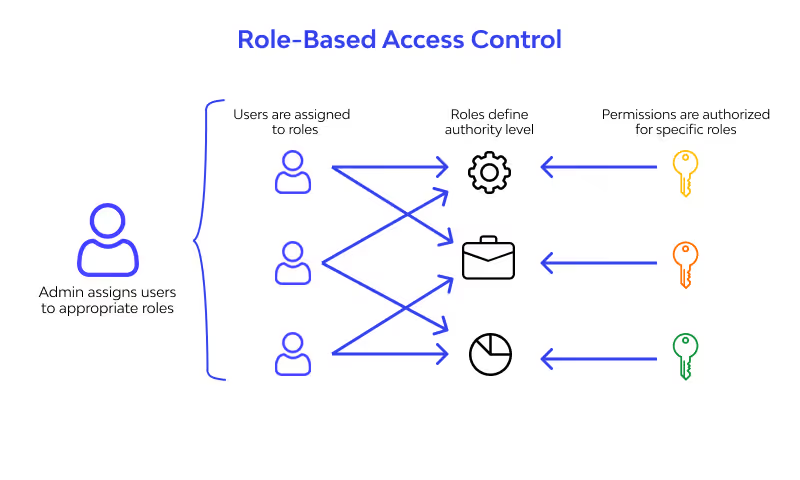
CloudEagle enables enterprises to define and enforce role-based and risk-based guardrails around AI usage. For example, companies can restrict generative AI features to only specific departments, or apply Just-In-Time access for temporary use cases. With automated access provisioning and deprovisioning, organizations reduce excessive privileges and close the window for misuse.

D. Audit-Ready Compliance Reporting
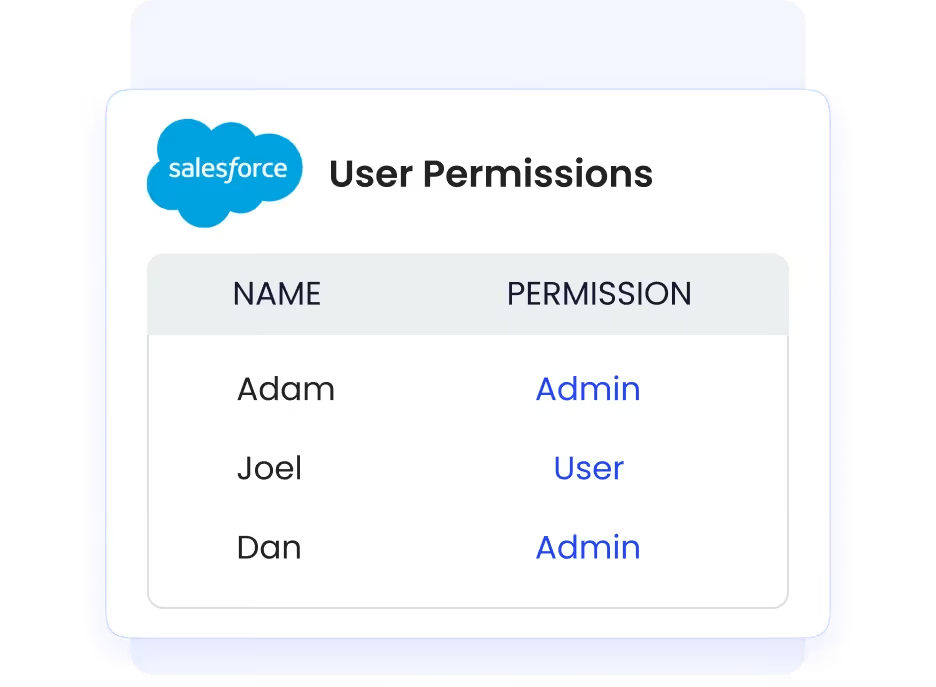
Compliance and GRC teams can leverage CloudEagle’s SOC2-ready workflows to automate user access reviews, track privileged access, and generate detailed audit logs for every application, including AI tools outside the SSO/IDP perimeter. This reduces the risk of failed audits and improves operational resilience.

E. Integrated SaaS + AI Governance in One Platform
CloudEagle is the only platform that brings together AI usage control with broader SaaS spend and access governance

By combining discovery, access control, compliance automation, and spend optimization in a single interface, CloudEagle enables organizations to implement responsible AI strategies without fragmenting their toolset or overloading IT teams.

F. Business Impact

  • Reduce security risks by identifying and eliminating unapproved AI tools.
  • Enforce responsible AI use through automated guardrails and risk scoring.
  • Support compliance frameworks like SOC2, GDPR, and internal AI ethics policies.
  • Optimize cost by eliminating duplicative AI tools and reclaiming unused licenses.
  • Improve IT productivity by automating reviews and workflows for AI and SaaS apps alike.

9. Conclusion

AI is transforming how enterprises operate, but unmanaged AI usage introduces serious risks. AI usage control fills the governance gap by focusing on how AI tools are used, what data they process, and how outputs are applied.

As AI becomes embedded into every layer of enterprise technology, organizations need more than access controls and policies on paper. They need real-time visibility, enforcement, and accountability.

Implementing AI usage control today helps enterprises protect sensitive data, meet compliance requirements, and build trust in AI-driven decisions, without slowing innovation at scale.

With CloudEagle (CE), organizations can discover AI usage, enforce access controls, automate compliance, and optimize AI spend from a single platform. CE enables teams to move fast with AI while staying secure, compliant, and in control.

CTA: Take control of AI usage across your organization with CloudEagle. Start building responsible, scalable AI governance today.

FAQs

1. How does AI usage control apply to generative AI tools?
AI usage control governs how generative AI tools are used, including what data can be shared, which prompts are allowed, and how outputs are reviewed or restricted before use.

2. How does AI usage control protect against Shadow AI?
It provides visibility into unapproved AI tools and enforces policies that restrict or block usage outside approved guidelines.

3. What technologies are used to enforce AI usage control?
Common technologies include SaaS discovery tools, policy engines, data loss prevention controls, monitoring systems, and audit logging platforms.

4. How does AI usage control support compliance requirements like SOC 2, GDPR, or the EU AI Act?
It creates traceability, accountability, and documented controls around AI usage, which are critical for meeting regulatory and audit requirements.

5. What tools or platforms help automate AI usage control in organizations?
Platforms like CloudEagle.ai help automate AI usage discovery, policy enforcement, monitoring, and compliance reporting across enterprise environments.

Advertisement for a SaaS Subscription Tracking Template with a call-to-action button to download and a partial graphic of a tablet showing charts.Banner promoting a SaaS Agreement Checklist to streamline SaaS management and avoid budget waste with a call-to-action button labeled Download checklist.Blue banner with text 'The Ultimate Employee Offboarding Checklist!' and a black button labeled 'Download checklist' alongside partial views of checklist documents from cloudeagle.ai.Digital ad for download checklist titled 'The Ultimate Checklist for IT Leaders to Optimize SaaS Operations' by cloudeagle.ai, showing checklist pages.Slack Buyer's Guide offer with text 'Unlock insider insights to get the best deal on Slack!' and a button labeled 'Get Your Copy', accompanied by a preview of the guide featuring Slack's logo.Monday Pricing Guide by cloudeagle.ai offering exclusive pricing secrets to maximize investment with a call-to-action button labeled Get Your Copy and an image of the guide's cover.Blue banner for Canva Pricing Guide by cloudeagle.ai offering a guide to Canva costs, features, and alternatives with a call-to-action button saying Get Your Copy.Blue banner with white text reading 'Little-Known Negotiation Hacks to Get the Best Deal on Slack' and a white button labeled 'Get Your Copy'.Blue banner with text 'Little-Known Negotiation Hacks to Get the Best Deal on Monday.com' and a white button labeled 'Get Your Copy'.Blue banner with text 'Little-Known Negotiation Hacks to Get the Best Deal on Canva' and a white button labeled 'Get Your Copy'.Banner with text 'Slack Buyer's Guide' and a 'Download Now' button next to images of a guide titled 'Slack Buyer’s Guide: Features, Pricing & Best Practices'.Digital cover of Monday Pricing Guide with a button labeled Get Your Copy on a blue background.Canva Pricing Guide cover with a button labeled Get Your Copy on a blue gradient background.

Enter your email to
unlock the report

Oops! Something went wrong while submitting the form.
License Count
Benchmark
Per User/Per Year

Enter your email to
unlock the report

Oops! Something went wrong while submitting the form.
License Count
Benchmark
Per User/Per Year

Enter your email to
unlock the report

Oops! Something went wrong while submitting the form.
Notion Plus
License Count
Benchmark
Per User/Per Year
100-500
$67.20 - $78.72
500-1000
$59.52 - $72.00
1000+
$51.84 - $57.60
Canva Pro
License Count
Benchmark
Per User/Per Year
100-500
$74.33-$88.71
500-1000
$64.74-$80.32
1000+
$55.14-$62.34

Enter your email to
unlock the report

Oops! Something went wrong while submitting the form.

Enter your email to
unlock the report

Oops! Something went wrong while submitting the form.
Zoom Business
License Count
Benchmark
Per User/Per Year
100-500
$216.00 - $264.00
500-1000
$180.00 - $216.00
1000+
$156.00 - $180.00

Enter your email to
unlock the report

Oops! Something went wrong while submitting the form.

Get the Right Security Platform To Secure Your Cloud Infrastructure

Please enter a business email
Thank you!
The 2023 SaaS report has been sent to your email. Check your promotional or spam folder.
Oops! Something went wrong while submitting the form.

Access full report

Please enter a business email
Thank you!
The 2023 SaaS report has been sent to your email. Check your promotional or spam folder.
Oops! Something went wrong while submitting the form.

AI adoption inside enterprises has moved faster than most governance frameworks can keep up with. Employees are using generative AI tools to draft emails, analyze data, write code, summarize contracts, and automate decisions, often without clear guardrails. 

Over 75% of enterprises are already using AI in at least one business function, and adoption continues to accelerate across departments.

Traditional access controls were never designed to handle how AI systems consume, generate, and move data. This gap is where AI usage control becomes critical. It focuses not just on who can access a tool, but how AI is used, what data flows into it, and what outputs are allowed.

In this blog, we’ll break down what AI usage control means, why it’s essential for modern enterprises, how it works across SaaS and AI environments, and how organizations can implement it effectively.

TL;DR

  • AI usage control helps organizations govern how AI tools and models are used, not just who can access them.
  • It prevents sensitive data leakage, Shadow AI, and compliance risks caused by unmonitored AI adoption.
  • Effective AI usage control combines visibility, policy enforcement, monitoring, and compliance alignment.
  • Traditional access control alone is insufficient for managing AI-driven workflows.
  • Platforms like CloudEagle.ai help enterprises define, enforce, and automate AI usage control at scale.

Looking to simplify SaaS purchasing?

Our finance approval checklist organizes billing, contracts, and approvals for efficient, clear decision-making.

Download Resource
CTA Thumbnail

1. What Is AI Usage Control?

AI usage control is a governance approach that defines, monitors, and enforces how artificial intelligence tools, models, and features are used within an organization.

Instead of focusing only on user authentication or permissions, AI usage control answers deeper questions, such as:

  • What types of data can be shared with AI tools?
  • Which AI models are approved for specific business use cases?
  • How are AI-generated outputs reviewed, logged, or restricted?
  • Are employees using AI tools outside approved policies?

At its core, AI usage control ensures AI systems are used responsibly, securely, and in alignment with business, legal, and ethical requirements.

2. Why AI Usage Control Is Becoming Essential for Enterprises

AI is now embedded into everyday workflows, from CRM systems and HR platforms to procurement tools and security products. As adoption accelerates, organizations are encountering a new set of governance challenges that traditional controls weren’t designed to handle.

Why Shadow AI Is Becoming a Major Risk

Enterprises are increasingly dealing with Shadow AI, situations where employees use unapproved AI tools without IT or security oversight. These tools often process confidential company data, which can bypass existing security controls and create serious exposure risks.

Why Data Leakage Risks Are Increasing

Data leakage becomes a critical concern when sensitive information such as customer records, financial data, or source code is entered into generative AI systems. Many of these systems may retain, log, or reuse inputs, increasing the likelihood of unintended data exposure.

Why Regulatory Pressure Is Rising

Regulatory scrutiny around AI usage is intensifying. Frameworks like GDPR, SOC 2, ISO 27001, and the EU AI Act require organizations to demonstrate control, accountability, and transparency over automated and AI-driven decision-making systems. Without clear governance, compliance becomes difficult to prove.

Without AI usage control, enterprises struggle to answer basic audit questions like:

  • Which AI tools are in use?
  • What data is being shared with them?
  • Who approved these tools and use cases?

AI usage control brings structure and accountability to an otherwise fragmented AI landscape.

3. What Are the Key Components of an Effective AI Usage Control Framework?

An effective AI usage control framework consists of multiple interconnected components that work together to reduce risk and improve oversight.

  • AI discovery and visibility is the foundation. Organizations must be able to identify all AI tools, SaaS platforms with embedded AI, and standalone AI models being used across departments.
  • Usage policies and guardrails define acceptable and unacceptable AI usage. These policies outline approved tools, restricted data types, and allowed use cases for different roles.
  • Data-level controls ensure sensitive data is not exposed to AI systems that are not authorized to process it. This includes restrictions on PII, financial data, and intellectual property.
  • Monitoring and audit logging track how AI tools are used, what data flows into them, and what outputs are generated. This creates traceability for compliance and incident response.
  • Enforcement mechanisms apply policies in real time or near real time, preventing violations instead of just reporting them after the fact.

Together, these components allow enterprises to move from reactive AI governance to proactive AI usage control.

Concerned about undetected SaaS security gaps?

Our checklist enables your team to identify vulnerabilities and implement measures to protect sensitive data effectively.

Download Resource
CTA Thumbnail

4. How AI Usage Control Works Across SaaS, Data, and AI Models

AI usage control does not operate in isolation. It spans multiple layers of the enterprise technology stack.

Across SaaS applications, AI usage control governs built-in AI features such as copilots, automated insights, and recommendation engines. Policies determine who can enable these features and what data they can access.

At the data layer, AI usage control restricts which datasets can be used for training, fine-tuning, or prompting AI models. This prevents sensitive or regulated data from being exposed unintentionally.

For AI models and tools, usage control defines which models are approved, whether external APIs can be used, and how outputs are reviewed or validated before use in business decisions.

This cross-layer approach ensures consistent governance regardless of where AI is embedded in the organization.

5. AI Usage Control vs Traditional Access Control: Key Differences

Traditional access control focuses on permissions, granting or denying access to systems based on identity. While necessary, it is not sufficient for managing AI risks.

AI usage control goes further by governing behavior and context, not just access.

Traditional access control answers:

  • Who can log in?
  • Which applications can they access?

AI usage control answers:

  • What can the AI do with the data it receives?
  • How are AI outputs used downstream?
  • Are AI actions compliant with internal and external policies?

In short, access control protects systems, while AI usage control protects outcomes, data, and decision integrity.

6. What Are the Challenges Companies Face Without AI Usage Control?

Organizations without AI usage control face a growing list of operational and compliance challenges.

Lack of Visibility Into AI Usage

Security and IT teams often have no clear inventory of AI tools in use across the organization. Without visibility into where and how AI is being used, risk assessment and governance become nearly impossible.

Inconsistent Policy Enforcement

Different teams tend to adopt AI tools independently. This leads to fragmented usage practices, contradictory policies, and uneven enforcement across departments.

Audit and Compliance Gaps

Without centralized monitoring, logging, and reporting, organizations struggle to demonstrate compliance during audits or regulatory investigations. This increases exposure to penalties and remediation costs.

Increased Reputational Risk

AI misuse—whether through biased outputs, data leakage, or unauthorized automation—can quickly damage trust with customers, partners, and regulators.

These challenges highlight why AI usage control is no longer optional for mature enterprises.

7. What Are the Best Practices for Implementing AI Usage Control?

Effective AI usage control requires a structured and collaborative approach.

Align Cross-Functional Stakeholders

AI governance cannot be owned by a single function. IT, security, legal, compliance, and business teams must work together to define shared ownership and accountability.

Catalog AI Tools and Use Cases

Enterprises should start by identifying all AI tools and use cases in use, including both approved and unapproved applications. This creates a foundation for risk assessment and policy enforcement.

Define Clear and Adaptive AI Usage Policies

AI usage policies should be practical, role-based, and aligned with regulatory requirements. As AI capabilities evolve, policies must be reviewed and updated regularly.

Automate Discovery and Enforcement

Manual approvals and reviews do not scale with enterprise-wide AI adoption. Automation enables continuous discovery, monitoring, and enforcement while reducing operational overhead.

Educate Employees on Responsible AI Use

Employee education is essential to reducing Shadow AI. Clear guidance on acceptable AI usage helps encourage compliance without slowing innovation.

Seeking smoother offboarding processes?

Our checklist helps HR and IT complete asset collection and access revocation for secure transitions.

Download Resource
CTA Thumbnail

8. How CloudEagle.ai Helps Enterprises Implement AI Usage Control Policies?

As AI adoption rapidly accelerates, enterprises face growing challenges in securing and governing how these tools are accessed and used. CloudEagle.ai empowers organizations to implement robust AI usage control policies by extending its comprehensive SaaS governance capabilities to include the evolving world of AI-enabled applications.

A. Centralized visibility on Shadow AI

AI tools such as ChatGPT, Gemini, Copilot, and other generative AI apps are being adopted rapidly across teams, often without IT or security approval. This creates Shadow AI, where sensitive data may be shared with unapproved AI tools without visibility or control.

CloudEagle.ai helps organizations gain centralized visibility into all AI-enabled SaaS applications in use, including those adopted informally by employees. Using 500+ prebuilt integrations, CloudEagle connects with identity providers, financial systems, and browser activity to detect AI tool logins, usage, and purchases in real time.

This allows IT and security teams to quickly identify unauthorized AI tools, understand where AI is being used, and take action before it leads to data exposure, compliance violations, or unnecessary spending. By surfacing Shadow AI early, organizations can safely enable AI innovation while maintaining governance and control.

B. AI Usage Detection and Monitoring

Beyond discovery, CloudEagle automatically detects how AI features are being used, such as generative AI modules within apps like Notion, Zoom, or Salesforce. This allows IT and security leaders to understand exposure points, monitor compliance with corporate data policies, and flag apps or users violating internal guidelines.

C. Policy-Driven AI Governance

CloudEagle enables enterprises to define and enforce role-based and risk-based guardrails around AI usage. For example, companies can restrict generative AI features to only specific departments, or apply Just-In-Time access for temporary use cases. With automated access provisioning and deprovisioning, organizations reduce excessive privileges and close the window for misuse.

D. Audit-Ready Compliance Reporting

Compliance and GRC teams can leverage CloudEagle’s SOC2-ready workflows to automate user access reviews, track privileged access, and generate detailed audit logs for every application, including AI tools outside the SSO/IDP perimeter. This reduces the risk of failed audits and improves operational resilience.

E. Integrated SaaS + AI Governance in One Platform

CloudEagle is the only platform that brings together AI usage control with broader SaaS spend and access governance

By combining discovery, access control, compliance automation, and spend optimization in a single interface, CloudEagle enables organizations to implement responsible AI strategies without fragmenting their toolset or overloading IT teams.

F. Business Impact

  • Reduce security risks by identifying and eliminating unapproved AI tools.
  • Enforce responsible AI use through automated guardrails and risk scoring.
  • Support compliance frameworks like SOC2, GDPR, and internal AI ethics policies.
  • Optimize cost by eliminating duplicative AI tools and reclaiming unused licenses.
  • Improve IT productivity by automating reviews and workflows for AI and SaaS apps alike.

9. Conclusion

AI is transforming how enterprises operate, but unmanaged AI usage introduces serious risks. AI usage control fills the governance gap by focusing on how AI tools are used, what data they process, and how outputs are applied.

As AI becomes embedded into every layer of enterprise technology, organizations need more than access controls and policies on paper. They need real-time visibility, enforcement, and accountability.

Implementing AI usage control today helps enterprises protect sensitive data, meet compliance requirements, and build trust in AI-driven decisions, without slowing innovation at scale.

With CloudEagle (CE), organizations can discover AI usage, enforce access controls, automate compliance, and optimize AI spend from a single platform. CE enables teams to move fast with AI while staying secure, compliant, and in control.

CTA: Take control of AI usage across your organization with CloudEagle. Start building responsible, scalable AI governance today.

FAQs

1. How does AI usage control apply to generative AI tools?
AI usage control governs how generative AI tools are used, including what data can be shared, which prompts are allowed, and how outputs are reviewed or restricted before use.

2. How does AI usage control protect against Shadow AI?
It provides visibility into unapproved AI tools and enforces policies that restrict or block usage outside approved guidelines.

3. What technologies are used to enforce AI usage control?
Common technologies include SaaS discovery tools, policy engines, data loss prevention controls, monitoring systems, and audit logging platforms.

4. How does AI usage control support compliance requirements like SOC 2, GDPR, or the EU AI Act?
It creates traceability, accountability, and documented controls around AI usage, which are critical for meeting regulatory and audit requirements.

5. What tools or platforms help automate AI usage control in organizations?
Platforms like CloudEagle.ai help automate AI usage discovery, policy enforcement, monitoring, and compliance reporting across enterprise environments.

CloudEagle.ai recognized in the 2025 Gartner® Magic Quadrant™ for SaaS Management Platforms
Download now
gartner chart
5x
Faster employee
onboarding
80%
Reduction in time for
user access reviews
30k
Workflows
automated
$15Bn
Analyzed in
contract spend
$2Bn
Saved in
SaaS spend

Recognized as an Industry leader for our AI

CloudEagle.ai is Recognized in the 2024 Gartner® Magic Quadrant™ for SaaS Management Platforms

Recognition highlights CloudEagle’s innovation and leadership in the rapidly evolving SaaS management and procurement space.
Read More
Gartner Magic Quadrant for SaaS Management Platforms showing a chart divided into Challengers and Leaders quadrants with various companies plotted as dots.

CloudEagle.ai Recognized in the GigaOm Radar for SaaS Management Platforms

CloudEagle named a Leader and Outperformer in GigaOm Radar Report, validating its impact in the SaaS management platform landscape.
Read More
gigaom

Everest Group Positions CloudEagle.ai as a Trailblazer in SaaS Management Platforms

CloudEagle recognized as a Trailblazer by Everest Group, showcasing its rapid growth and innovation in SaaS spend and operations management.
Read More
qks

CloudEagle.ai is Recognized in the 2024 Gartner® Magic Quadrant™ for SaaS Management Platforms

Recognition highlights CloudEagle’s innovation and leadership in the rapidly evolving SaaS management and procurement space.
Read More
gartner

Streamline SaaS governance and save 10-30%

Book a Demo with Expert
CTA image
One platform to Manage
all SaaS Products
Learn More