
%201.svg)


HIPAA Compliance Checklist for 2025

When companies say “We don’t use many AI tools,” they’re usually wrong, because they forget about embedded AI.
Microsoft Copilot, Salesforce Einstein, Notion AI, Google Duet AI, AI is already inside the apps your teams use daily.
Yet 70% of CIOs admit they have no visibility into embedded AI usage inside SaaS platforms, even though these tools access corporate data, automate decisions, and affect compliance posture.
That makes embedded AI governance one of the biggest blind spots in enterprise risk today.
This guide breaks down what embedded AI is, why IT can’t track it, and how enterprises can govern it before exposure, misuse, or runaway costs occur.
TL;DR
- Embedded AI inside tools like Microsoft 365, Salesforce, and Google Workspace creates a massive governance blind spot.
- Traditional SaaS tracking fails because embedded AI doesn’t appear as a separate app.
- Unmonitored usage increases compliance risk, security exposure, and runaway AI costs.
- Enterprises need usage monitoring, access controls, and audit-ready reporting to regain visibility.
- CloudEagle solves embedded AI governance by giving IT real-time visibility and automated control over every SaaS and AI tool, approved or not.
1. What Is Embedded AI?
Embedded AI means building intelligence directly into devices and apps, so they can learn, analyze, and act locally without always depending on the cloud.
It delivers faster responses, better privacy, and smarter automation for things like maintenance, personalization, and real-time decision-making, often powered by TinyML.
a. AI capabilities inside existing SaaS tools
Think of:
- Microsoft Copilot in Outlook, Teams, and PowerPoint
- Einstein AI inside Salesforce
- AI summaries in Slack, Zoom, Jira
- Duet AI inside Google Workspace
The AI is already there; users don’t need to download anything.
b. Not deployed as standalone products
Unlike ChatGPT or Midjourney, embedded AI arrives:
- Automatically
- As part of the updates
- Without procurement review
- Without explicit IT enablement
Which creates a governance problem:
AI is being used even when IT didn’t intentionally approve it.
2. Why Embedded AI Creates a Governance Blind Spot?
Embedded AI creates governance blind spots because it spreads quickly and quietly inside systems (“Shadow AI”), moving faster than an organization’s ability to track, control, or enforce oversight and accountability.
a. Hidden activation and auto-enable features
Vendors turn on AI capabilities silently, sometimes through:
- Feature rollouts
- UI updates
- Workspace policy defaults
IT rarely receives visibility before activation.
b. No visibility through traditional SaaS discovery
SaaS discovery tools detect apps, not features inside apps.
So embedded AI doesn’t appear in:
- Expense logs
- SSO logs
- Identity provisioning tools
Meaning AI usage tracking fails.
c. Usage is fragmented across platforms
- Sales calls use Salesforce AI
- Notes sync via Microsoft AI
- Docs summarize via Google AI
- Teams adopt Slack AI helpers
The result?
There isn’t a single pane of glass showing where embedded AI exists or how it’s used.
3. Risks Created by Unmonitored Embedded AI
Unmonitored embedded AI, often emerging as “Shadow AI”, brings major risks across security, compliance, operations, and ethics because unapproved AI tools and models operate outside IT and security oversight, leaving organizations blind to how data is used or decisions are made.
a. Compliance Exposure
When AI models operate outside governance boundaries, organizations inadvertently break requirements in frameworks like:
- GDPR – personal data processing without a lawful basis or transparency
- SOC2 – missing access controls, monitoring, and audit trails
- ISO 42001 – unmanaged AI lifecycle and governance checks
- HIPAA – potential leakage or misuse of healthcare data
If your team is working toward EU AI Act compliance, the obligations around embedded AI tools are worth reviewing separately. Because nobody knows what data the AI touched, where it went, or who accessed it, compliance breaks before anyone even realizes the risk exists.
b. Data Security & Access Abuse
Embedded AI tools quietly read and process sensitive information, emails, CRM records, documents, calendars, pipelines, yet most operate with:
- No access review or approval
- No logging or auditing
- No monitoring of permissions or data flow
That turns Shadow AI into a live security vulnerability where data exfiltration or misuse can occur, and no one can trace it back.
c. Cost & Resource Inflation
AI isn’t “free,” yet teams deploy it like it is. Vendors increasingly monetize AI via:
- Premium AI seat pricing
- Per-action or per-API charges
- Storage and inference fees
- Tier-based usage jumps
Without visibility into how embedded AI is being used, spend escalates faster than value, and finance has no levers to optimize or control it.
4. How Enterprises Can Govern Embedded AI?
Enterprises can govern embedded AI by building a cross-functional framework anchored in accountability, transparency, fairness, and ongoing monitoring, one that addresses risks traditional IT governance misses, such as bias, data misuse, and model drift.
If you're unsure how AI governance and AI security differ in scope and ownership, that distinction is worth clarifying before building the framework.
a. Continuous AI Usage Monitoring
AI governance cannot rely on one-time app discovery; usage changes daily. Organizations need:
- Real-time feature-level monitoring to see which AI capabilities employees are using
- AI usage analytics to spot spikes, risky patterns, or redundant tools
- Seat and activation tracking to know who actually uses AI licenses
- Exception reporting to surface unapproved apps or unusual access
This establishes live visibility to detect unauthorized AI behavior before it becomes a risk.
b. Access Governance and Approval Controls
Embedded AI capabilities must be treated like privileged access. Every entitlement should be:
- Requested through a formal workflow
- Reviewed for business justification
- Approved by an owner or risk stakeholder
- Re-certified on a defined schedule
Identity-based governance ensures the right people get the right AI access, and it’s revoked when no longer needed.
c. Audit-Ready Reporting
Regulators and auditors now ask AI-specific questions, including:
- Who has access to AI tools and models?
- Which AI systems touched sensitive data?
- What datasets trained internal or vendor models?
Organizations need live, exportable, verifiable reporting, not brittle spreadsheets, so they can prove oversight, trace decisions, and satisfy compliance obligations.
5. How CloudEagle.ai Solves Embedded AI Governance?
Enterprises are experiencing an explosion of unmanaged AI tools, from ChatGPT to DeepSeek, many of which operate entirely outside IT visibility.
CloudEagle's AI usage governance platform gives IT teams a single place to discover, monitor, and control every AI tool in the environment, including the ones employees adopted without asking. In fact, 60% of AI and SaaS applications run as shadow IT, bypassing traditional IAM systems like Okta and SailPoint.
CloudEagle.ai solves this by delivering AI-powered identity and access governance built for the modern SaaS + AI environment, where not all apps sit behind SSO, where employees self-adopt AI tools overnight, and where legacy IAM tools can no longer keep up.
a. Unified Visibility Into All SaaS & AI Tools — Even Those Outside the IDP
Traditional IAM solutions only govern apps behind SSO.

CloudEagle.ai goes beyond this limitation by detecting AI and SaaS tools through usage, login, card, and browser signals, giving IT and security teams a complete view of sanctioned and unsanctioned apps.
- Detects unsanctioned AI usage automatically
- Cross-verifies logins with finance/card data
- Flag risky tools before they become operationally entrenched
This eliminates the governance blind spot created by employee-bought AI tools.
b. Automated Provisioning & Deprovisioning, Even for Apps Not Connected to IAM
Manual access management is a major security gap; 48% of ex-employees still retain app access after termination, especially in apps not tied to Okta or IDP systems.
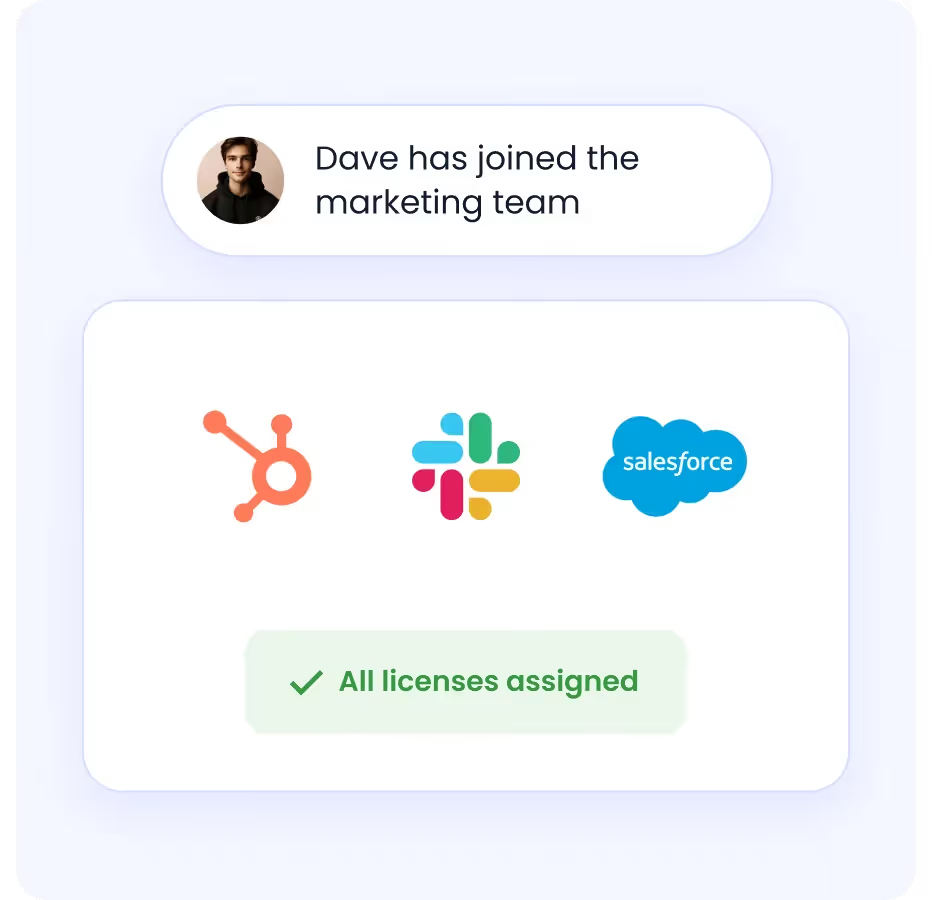
CloudEagle.ai solves this with:
- Automated provisioning/deprovisioning for all SaaS & AI tools
- Zero-touch onboarding mapped to role, department, and location
- Automated removal of access for departing users, including non-SSO apps
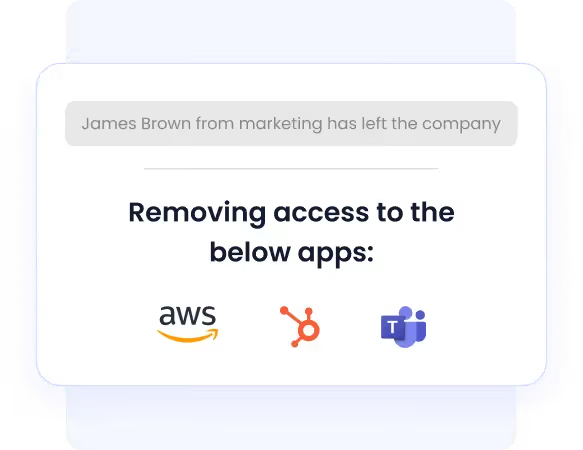
This dramatically reduces identity-related breach risks stemming from stale or orphaned access.
c. Continuous, AI-Powered Access Reviews (vs. Legacy Quarterly Audits)
Most organizations still rely on quarterly or annual access reviews, and 95% do not use AI for continuous monitoring. This leaves excessive privileges and privilege creep unnoticed for long periods.
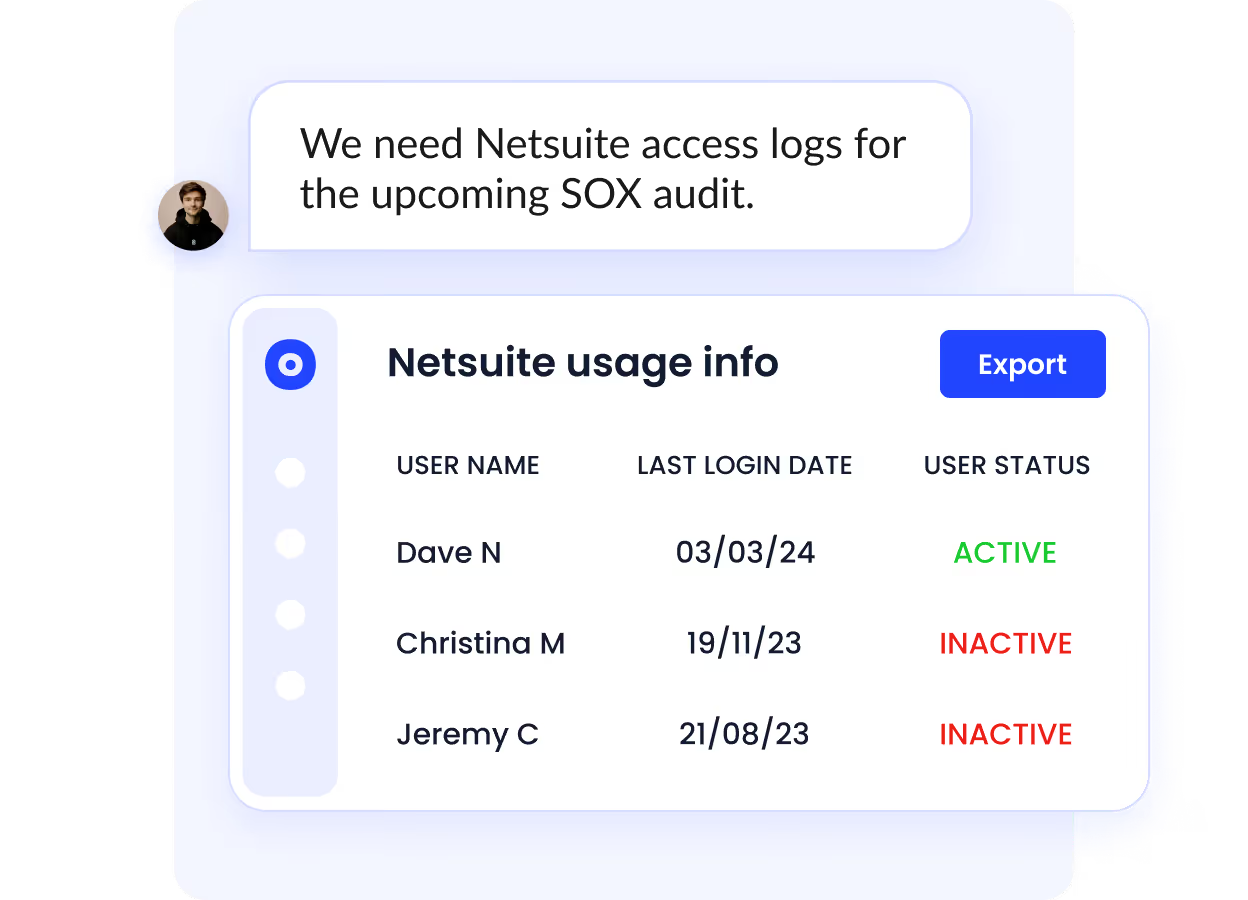
CloudEagle.ai modernizes governance with:
- AI-driven review cycles that run continuously
- Risk-based identity scoring to surface overprivileged users
- Automatic deprovisioning workflows
- SOC 2-ready audit logs
This reduces compliance effort by up to 80% while strengthening security.
d. Shadow IT & Shadow AI Governance, Mitigated in One Platform
AI tools accelerate productivity but also introduce unprecedented security risks. For teams dealing with AI agents specifically, the governance challenges and controls are somewhat different from what applies to embedded tools. 70% of CIOs cite unapproved AI usage as a top concern.
CloudEagle.ai delivers guardrails for AI governance:
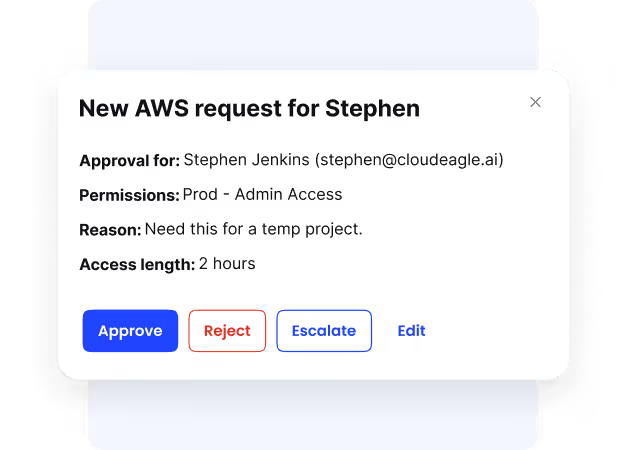
- Discovery of AI usage across all departments
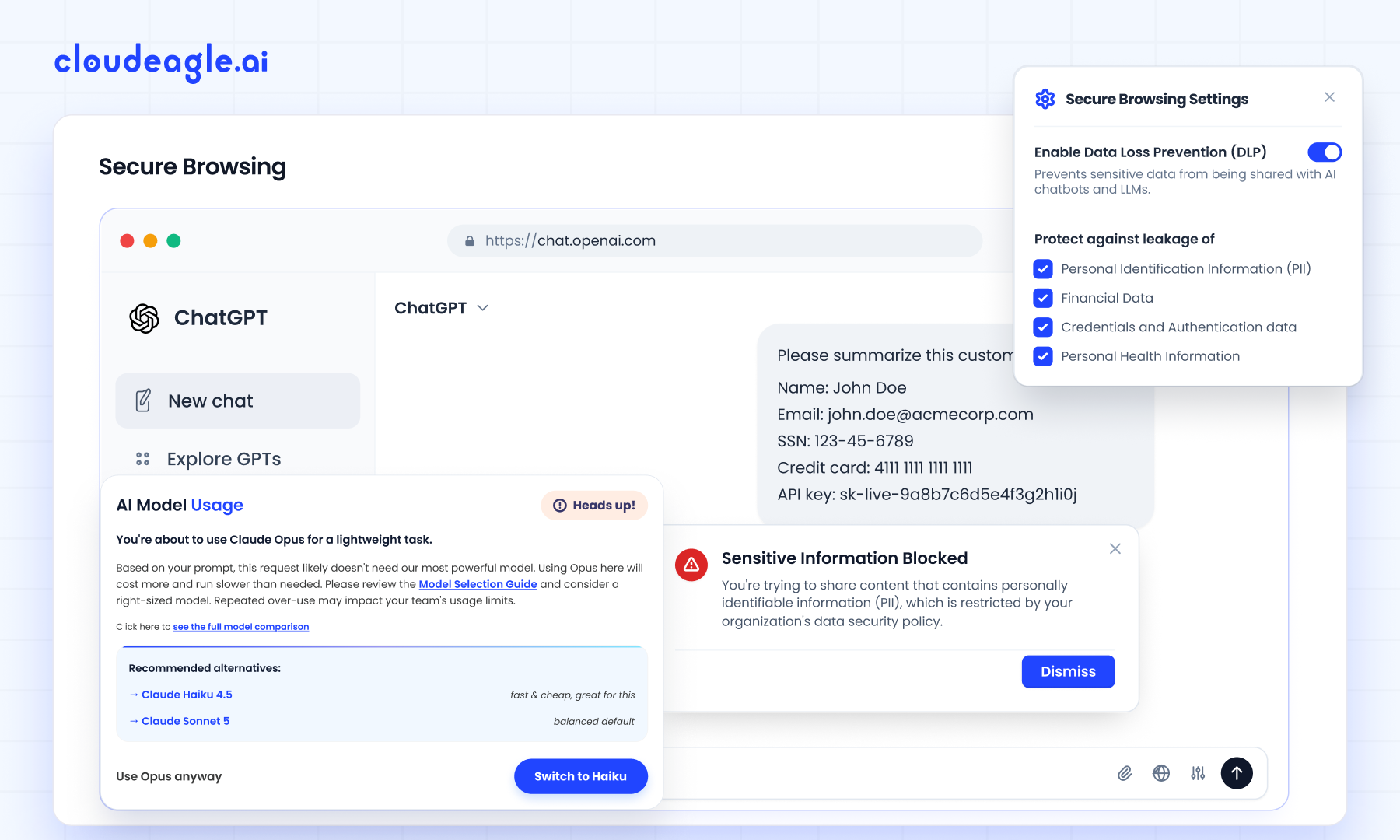
- Automatic policy enforcement (block, flag, notify)
- Time-based and just-in-time access for sensitive tools
- Automated Slack/email workflows for remediation
Enterprises can finally govern AI tools with the same rigor as traditional SaaS.
e. Embedded Governance That Reduces Cost AND Risk
AI governance is not only a security issue, but it also has a spending impact.
CloudEagle.ai enables:
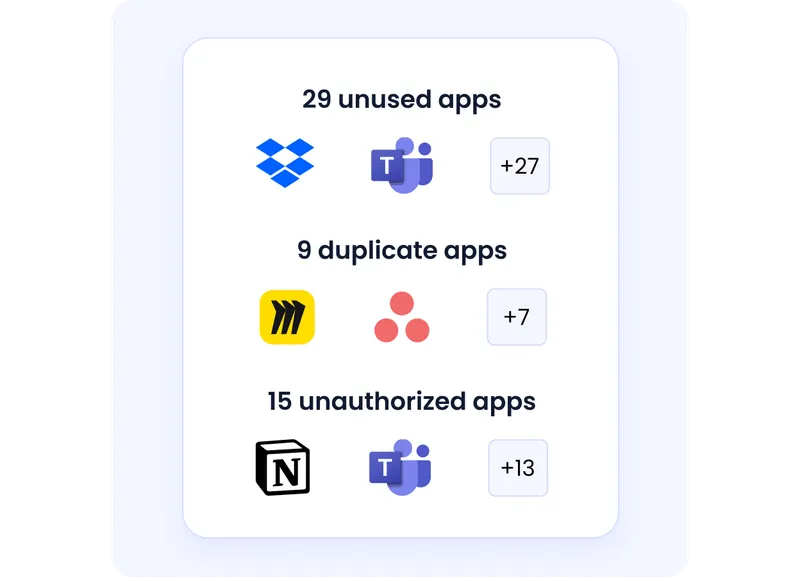
- Identification of duplicate AI tools
- Harvesting unused or underutilized AI/SaaS licenses
- Role-based cataloging for approved tools
- Benchmarking and optimization during renewals
Customers typically save 10–30% on SaaS spend while reducing insider threat exposure.
f. CloudEagle.ai Is the Only Platform Built for SaaS + AI Governance
Where legacy IAM tools stop, CloudEagle.ai begins.
It provides the real-time visibility, automated workflows, AI detection, and continuous risk monitoring required to govern modern SaaS and AI environments, delivering:
- Stronger security
- Faster IT operations
- Better employee experience
- Significant cost savings
Conclusion
Embedded AI isn’t coming; it’s already inside your business tools, shaping decisions and consuming enterprise data. The real challenge isn’t adopting AI, it’s ensuring it’s monitored, governed, and aligned to business outcomes instead of operating in the shadows.
Organizations that invest in visibility, access controls, and audit-ready reporting turn embedded AI from a risk vector into a measurable growth driver.
CloudEagle.ai helps enterprises centralize AI visibility, enforce governance through automated access reviews, and align AI usage to ownership and ROI, so embedded AI becomes controlled, accountable, and cost-efficient.
Book a free demo to see how CloudEagle.ai governs embedded AI before it governs you.
FAQ
1. What is embedded AI, and how is it different from standard AI tools?
Embedded AI is built into existing SaaS apps (like Copilot inside Outlook), while standalone AI tools are separate platforms like ChatGPT.
2. How can companies track embedded AI usage?
Through automated AI usage monitoring platforms that detect feature-level activation and track user-level consumption.
3. How do access controls help govern embedded AI?
By enforcing approvals, role-based access, and periodic reviews to prevent unauthorized use and data exposure.
4. What causes Shadow AI and unapproved AI use?
Auto-enabled AI features, self-service experimentation, and embedded AI that bypasses procurement oversight.
5. What tools help govern embedded AI across SaaS apps?
AI governance tools with visibility, usage tracking, access reviews, and spend intelligence — not just traditional SaaS discovery tools.


.avif)


.avif)
.avif)




.png)




.png)

.avif)
.avif)
.avif)


