You need to enable JavaScript in order to use the AI chatbot tool powered by ChatBot

How CIOs and CISOs Should Think About AI Controls

Share via:
blog-cms-banner-bg
Little-Known Negotiation Hacks to Get the Best Deal on Slack
cta-bg-blogDownload Your Copy

HIPAA Compliance Checklist for 2025

Download PDF

Artificial intelligence is spreading across organizations faster than most teams can track. Every week, a new SaaS tool introduces an AI add-on, employees experiment with ChatGPT or Claude in the browser, and teams quietly adopt AI-powered plugins to speed up daily work. 

CIOs and CISOs suddenly find themselves responsible for an ecosystem moving ten times faster than their governance frameworks. AI delivers value, yes but it also introduces risk, fragmentation, and regulatory pressure that didn’t exist even a year ago. 

Today, AI controls are not a “future maturity” project. They’re an urgent requirement.

TL;DR

  • AI adoption is accelerating faster than internal controls and oversight.
  • CIOs and CISOs need a unified, risk-tiered framework that aligns policy with real-world workflows.
  • Effective AI controls must protect data, enforce safe usage, and prevent Shadow AI across SaaS tools and browsers.
  • Governance is only successful when operationalized through automated workflows, not static documentation.
  • CloudEagle.ai helps leaders implement centralized visibility, AI risk scoring, and automated policy enforcement.

Aiming to improve Identity & Access Management?

Our eBook outlines eight key areas and solutions to enhance access security and maintain compliance.

Download Resource
CTA Thumbnail

1. How Is Shadow AI Quietly Costing CIOs and CISOs Millions?

Enterprises are experiencing an explosion of AI usage, but much of it is invisible. When teams experiment with generative AI tools without approval, they create “Shadow AI,” a growing blind spot where data flows into models without oversight. 

This isn’t malicious; employees simply want to move faster. But the consequences compound quickly.

Teams rely on AI-generated content that may hallucinate or misinterpret regulatory guidelines. Departments adopt AI tools without vendor risk checks, leading to inconsistent defenses across the organization. 

And as SaaS platforms like Notion, HubSpot, Asana, and Figma quietly introduce AI capabilities inside their products, IT has no clear way to see which features are being used, what data is being processed, or who turned them on.

2. What Core AI Controls Should CIOs and CISOs Prioritize in 2025?

To manage AI responsibly, leaders need a clear, structured set of control domains. These pillars form the foundation of a modern enterprise AI governance framework.

a. Access & Identity Controls

AI tools must be tied to identity. Organizations need role-based access policies, SSO-enforced authentication, and strict management of AI-related API keys. Multi-tenant visibility is essential to ensure only the right employees use AI tools and only within approved boundaries.

b. Data Handling & Classification Controls

Since the biggest AI risk is data leakage, controls must prevent sensitive information from entering generative models. This includes DLP rules, content filtering, classification-based restrictions, and monitoring of what goes into and comes out of AI tools. Data residency and cross-border transfer guardrails help ensure regulatory compliance as AI expands globally.

c. Application Usage Controls (Shadow AI Prevention)

Enterprises must detect which AI applications are being used, approved or not. This includes vendor risk checks, integration scoring, and insights into AI browsing activity. Without these controls, Shadow AI grows unchecked, leading to gaps in monitoring and significant exposure.

d. Model Behavior & Output Controls

Even approved models can produce inaccurate or biased results. Organizations need output filtering, hallucination detection, and audit trails for AI-generated content. Implementing human-in-the-loop reviews for high-risk outputs ensures AI doesn’t make unsupervised decisions that could harm the business.

e. Compliance & Regulatory Controls

With AI regulations accelerating, organizations must align with frameworks like NIST AI RMF and the EU AI Act. Documentation expectations are increasing, and sector-specific controls (finance, healthcare, legal) are becoming mandatory. Proper governance requires transparent records of every AI system, vendor, and usage pattern.

3. How Can CIOs and CISOs Operationalize AI Controls Across the Organization?

Most AI governance issues arise not because companies lack policies, but because those policies never make it into daily workflows. Operationalizing controls means embedding them into the systems employees already use.

a. Centralized AI Inventory
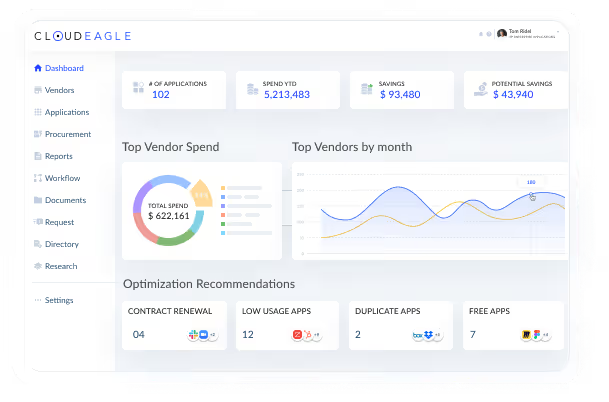
A complete AI inventory helps leaders see the full picture: approved tools, unapproved tools, embedded AI features inside SaaS platforms, and browser-based AI activity. Without a single view, enforcement becomes guesswork, and gaps quickly widen.

b. Risk-Tiered Control Implementation

Not all AI tools carry the same risk. By categorizing AI applications into low, medium, and high-risk tiers based on their data sensitivity and purpose, organizations can apply proportional controls rather than blanket restrictions. This approach allows innovation while keeping high-risk areas tightly governed.

c. Workflow-Based Governance (Not Just Policy PDFs)

Static documents rarely influence daily behavior. Automated workflows, triggered when a user accesses an AI tool, requests a new one, or violates a rule, create real accountability. Real-time alerts, contextual guidance, and routing to IT or security teams ensure policies translate into action.

d. Control Integration with Existing Security Stack

AI controls should complement, not replace, existing tools. By integrating with IAM systems, DLP engines, SIEM platforms, CASBs, SaaS management platforms, and procurement systems, AI governance becomes part of the broader enterprise security fabric. This unified approach reduces friction and improves adoption.

Interested in streamlining Identity and Access Management?

Our eBook provides a clear framework to secure access and optimize operations confidently.

Download Resource
CTA Thumbnail

4. How Does CloudEagle.ai Help CIOs and CISOs Build Effective AI Controls?

Most CIOs and CISOs have the same reaction when they finally see a complete map of AI usage inside their company: “I had no idea it was this much.”

That’s because AI adoption doesn’t follow traditional software patterns. Employees don’t request access. Teams don’t wait for formal approvals. AI creeps in quietly inside SaaS tools, through browser tabs, inside personal accounts, and via plugins no one notices until something goes wrong.

CloudEagle.ai was purpose-built for this new reality. It gives enterprises a single AI governance layer, one that sits across SaaS, browser activity, embedded AI features, and vendor risk. Instead of reacting to AI issues after a breach or compliance audit, CIOs and CISOs can finally govern AI proactively and with confidence.

Here’s what that transformation looks like in practice.

a. AI Application Discovery: From “We Think” to “We Know Everything”

Most AI risk begins with AI tools leadership doesn’t know exist. CloudEagle.ai solves this by automatically discovering every AI tool being used - approved or unapproved. 
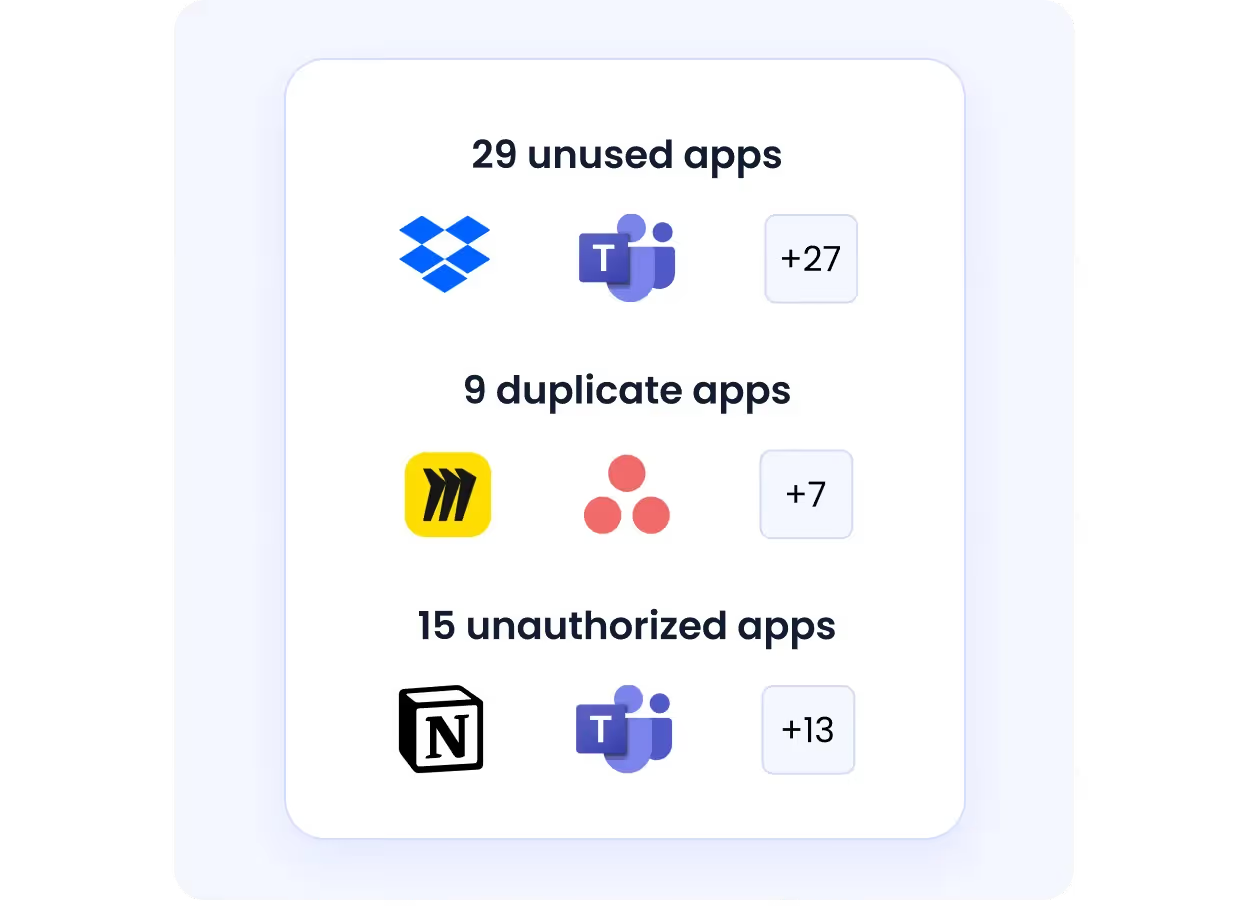
It sees when employees open ChatGPT in the browser, when someone logs into Gemini from a personal account, and when an AI plugin suddenly appears inside Chrome.

But the real magic is deeper visibility into SaaS platforms. When a tool like Notion, HubSpot, Figma, or Asana quietly launches a new AI feature, CloudEagle.ai detects who turned it on, how often it’s being used, and which data is likely flowing into the model. This type of insight simply doesn’t exist in SSO or CASB tools.

For CIOs and CISOs, that means the days of hoping teams follow policy are over. Now you have actual intelligence - real usage, real data movement, and real patterns of risk.

b. Automated Risk Scoring: Turning Vendor Guesswork Into Clarity

Every AI tool behaves differently. Some store prompts. Some use your data to retrain their models. Some ship data outside your region. Some have no certifications or transparency at all.

Instead of leaving leaders to navigate this complexity manually, CloudEagle.ai evaluates each AI vendor using a structured risk model. It looks at:

  • how data is stored
  • how prompts are handled
  • whether the vendor uses customer data for training
  • compliance coverage (SOC2, ISO, GDPR, AI Act)
  • model transparency and safety disclosures
  • breach history and security maturity

The result is a clear, objective AI risk score, a signal CIOs and CISOs can use to approve, restrict, or deny AI tools without guesswork. It turns vendor uncertainty into predictable governance.

c. AI Spending & Usage Governance: Ending the “Invisible Spend” Problem

Every enterprise today has hidden AI spend. A marketing intern buying ChatGPT Plus. A design team upgrading Figma AI credits. A sales team enabling HubSpot AI on a single card. These purchases fly under Finance and IT radar because they don’t trigger procurement workflows.

CloudEagle.ai uncovers all of it.

It highlights where teams are duplicating AI tools, which AI features are being paid for but never used, and where consumption-based AI tools are quietly inflating monthly bills. For CIOs, this brings sanity back to AI budgeting. For CISOs, it eliminates the risk of runaway Shadow AI spending tied to unvetted vendors.

AI governance becomes not just safer, but more cost-efficient.

d. Policy and Control Enforcement: Governance That Actually Enforces Itself

This is where CloudEagle.ai becomes a game changer. Most organizations have AI policies written in documents that sit unread in a shared folder. CloudEagle.ai turns those policies into automated workflows that operate across the company.

Here’s what that looks like:

  • A user tries to use an unapproved AI tool → CloudEagle.ai blocks access or requests justification.
  • A department turns on a risky AI feature in a SaaS tool → CloudEagle.ai alerts IT and routes a review to Security.
  • Someone uploads sensitive data into a generative model → CloudEagle.ai logs the event and notifies the right stakeholders.
  • A team tries to purchase an AI add-on → CloudEagle.ai enforces approval workflows automatically.

Everything is trackable, everything is auditable. AI governance finally stops depending on manual policing or good intentions.

For CIOs, it ensures AI is used efficiently, safely, and consistently across systems. For CISOs, it creates the guardrails needed to meet upcoming regulations without slowing innovation or blocking teams unnecessarily.

Want to ensure robust SaaS contracts?

Our checklist guides you to review key terms like renewals and security for complete confidence.

Download Resource
CTA Thumbnail

Final Takeaway

AI is no longer a technology trend, it’s a fundamental shift in how enterprises operate. But without structured controls, unified visibility, and automated governance, the risks grow as quickly as the opportunities. CIOs and CISOs now share a mandate to create AI systems that are powerful, safe, and compliant. That requires moving beyond policy documents and building operational guardrails that integrate with the tools employees already use.

CloudEagle.ai gives enterprises the visibility, risk scoring, and enforcement workflows needed to govern AI effectively, allowing organizations to innovate confidently while maintaining security and compliance.

Frequently Asked Questions

1. What are AI controls and why do they matter?

AI controls define how AI tools are accessed and monitored. They help CIOs and CISOs prevent data leaks, ensure responsible use, and maintain compliance as AI adoption grows.

2. How do CIOs decide which AI tools need strict controls?

They assess the sensitivity of data the AI tool handles, the decisions it influences, and the vendor’s security posture. High-risk tools require stronger oversight.

3. What frameworks guide enterprise AI governance?

CIOs and CISOs rely on frameworks like NIST AI RMF, EU AI Act, and ISO 42001 to shape safe, compliant, and transparent AI programs.

4. How can CIOs prevent Shadow AI without slowing teams down?

By focusing on visibility instead of bans. When leaders can see all AI usage, they can apply tiered controls that keep innovation moving safely.

5. What’s the best way to operationalize AI controls?

Automation. Workflows that enforce approvals, flag violations, and monitor usage ensure AI governance scales across the organization.

6. What new responsibilities do CISOs have with AI?

CISOs oversee data protection, vendor risk, model behavior, and audit readiness, ensuring AI systems operate safely and compliantly.

7. Why do AI governance programs often fail?

They fail when policies exist only on paper. Without automation and real visibility, employees bypass rules and Shadow AI spreads.

Advertisement for a SaaS Subscription Tracking Template with a call-to-action button to download and a partial graphic of a tablet showing charts.Banner promoting a SaaS Agreement Checklist to streamline SaaS management and avoid budget waste with a call-to-action button labeled Download checklist.Blue banner with text 'The Ultimate Employee Offboarding Checklist!' and a black button labeled 'Download checklist' alongside partial views of checklist documents from cloudeagle.ai.Digital ad for download checklist titled 'The Ultimate Checklist for IT Leaders to Optimize SaaS Operations' by cloudeagle.ai, showing checklist pages.Slack Buyer's Guide offer with text 'Unlock insider insights to get the best deal on Slack!' and a button labeled 'Get Your Copy', accompanied by a preview of the guide featuring Slack's logo.Monday Pricing Guide by cloudeagle.ai offering exclusive pricing secrets to maximize investment with a call-to-action button labeled Get Your Copy and an image of the guide's cover.Blue banner for Canva Pricing Guide by cloudeagle.ai offering a guide to Canva costs, features, and alternatives with a call-to-action button saying Get Your Copy.Blue banner with white text reading 'Little-Known Negotiation Hacks to Get the Best Deal on Slack' and a white button labeled 'Get Your Copy'.Blue banner with text 'Little-Known Negotiation Hacks to Get the Best Deal on Monday.com' and a white button labeled 'Get Your Copy'.Blue banner with text 'Little-Known Negotiation Hacks to Get the Best Deal on Canva' and a white button labeled 'Get Your Copy'.Banner with text 'Slack Buyer's Guide' and a 'Download Now' button next to images of a guide titled 'Slack Buyer’s Guide: Features, Pricing & Best Practices'.Digital cover of Monday Pricing Guide with a button labeled Get Your Copy on a blue background.Canva Pricing Guide cover with a button labeled Get Your Copy on a blue gradient background.

Enter your email to
unlock the report

Oops! Something went wrong while submitting the form.
License Count
Benchmark
Per User/Per Year

Enter your email to
unlock the report

Oops! Something went wrong while submitting the form.
License Count
Benchmark
Per User/Per Year

Enter your email to
unlock the report

Oops! Something went wrong while submitting the form.
Notion Plus
License Count
Benchmark
Per User/Per Year
100-500
$67.20 - $78.72
500-1000
$59.52 - $72.00
1000+
$51.84 - $57.60
Canva Pro
License Count
Benchmark
Per User/Per Year
100-500
$74.33-$88.71
500-1000
$64.74-$80.32
1000+
$55.14-$62.34

Enter your email to
unlock the report

Oops! Something went wrong while submitting the form.

Enter your email to
unlock the report

Oops! Something went wrong while submitting the form.
Zoom Business
License Count
Benchmark
Per User/Per Year
100-500
$216.00 - $264.00
500-1000
$180.00 - $216.00
1000+
$156.00 - $180.00

Enter your email to
unlock the report

Oops! Something went wrong while submitting the form.

Get the Right Security Platform To Secure Your Cloud Infrastructure

Please enter a business email
Thank you!
The 2023 SaaS report has been sent to your email. Check your promotional or spam folder.
Oops! Something went wrong while submitting the form.

Access full report

Please enter a business email
Thank you!
The 2023 SaaS report has been sent to your email. Check your promotional or spam folder.
Oops! Something went wrong while submitting the form.

Artificial intelligence is spreading across organizations faster than most teams can track. Every week, a new SaaS tool introduces an AI add-on, employees experiment with ChatGPT or Claude in the browser, and teams quietly adopt AI-powered plugins to speed up daily work. 

CIOs and CISOs suddenly find themselves responsible for an ecosystem moving ten times faster than their governance frameworks. AI delivers value, yes but it also introduces risk, fragmentation, and regulatory pressure that didn’t exist even a year ago. 

Today, AI controls are not a “future maturity” project. They’re an urgent requirement.

TL;DR

  • AI adoption is accelerating faster than internal controls and oversight.
  • CIOs and CISOs need a unified, risk-tiered framework that aligns policy with real-world workflows.
  • Effective AI controls must protect data, enforce safe usage, and prevent Shadow AI across SaaS tools and browsers.
  • Governance is only successful when operationalized through automated workflows, not static documentation.
  • CloudEagle.ai helps leaders implement centralized visibility, AI risk scoring, and automated policy enforcement.

Aiming to improve Identity & Access Management?

Our eBook outlines eight key areas and solutions to enhance access security and maintain compliance.

Download Resource
CTA Thumbnail

1. How Is Shadow AI Quietly Costing CIOs and CISOs Millions?

Enterprises are experiencing an explosion of AI usage, but much of it is invisible. When teams experiment with generative AI tools without approval, they create “Shadow AI,” a growing blind spot where data flows into models without oversight. 

This isn’t malicious; employees simply want to move faster. But the consequences compound quickly.

Teams rely on AI-generated content that may hallucinate or misinterpret regulatory guidelines. Departments adopt AI tools without vendor risk checks, leading to inconsistent defenses across the organization. 

And as SaaS platforms like Notion, HubSpot, Asana, and Figma quietly introduce AI capabilities inside their products, IT has no clear way to see which features are being used, what data is being processed, or who turned them on.

2. What Core AI Controls Should CIOs and CISOs Prioritize in 2025?

To manage AI responsibly, leaders need a clear, structured set of control domains. These pillars form the foundation of a modern enterprise AI governance framework.

a. Access & Identity Controls

AI tools must be tied to identity. Organizations need role-based access policies, SSO-enforced authentication, and strict management of AI-related API keys. Multi-tenant visibility is essential to ensure only the right employees use AI tools and only within approved boundaries.

b. Data Handling & Classification Controls

Since the biggest AI risk is data leakage, controls must prevent sensitive information from entering generative models. This includes DLP rules, content filtering, classification-based restrictions, and monitoring of what goes into and comes out of AI tools. Data residency and cross-border transfer guardrails help ensure regulatory compliance as AI expands globally.

c. Application Usage Controls (Shadow AI Prevention)

Enterprises must detect which AI applications are being used, approved or not. This includes vendor risk checks, integration scoring, and insights into AI browsing activity. Without these controls, Shadow AI grows unchecked, leading to gaps in monitoring and significant exposure.

d. Model Behavior & Output Controls

Even approved models can produce inaccurate or biased results. Organizations need output filtering, hallucination detection, and audit trails for AI-generated content. Implementing human-in-the-loop reviews for high-risk outputs ensures AI doesn’t make unsupervised decisions that could harm the business.

e. Compliance & Regulatory Controls

With AI regulations accelerating, organizations must align with frameworks like NIST AI RMF and the EU AI Act. Documentation expectations are increasing, and sector-specific controls (finance, healthcare, legal) are becoming mandatory. Proper governance requires transparent records of every AI system, vendor, and usage pattern.

3. How Can CIOs and CISOs Operationalize AI Controls Across the Organization?

Most AI governance issues arise not because companies lack policies, but because those policies never make it into daily workflows. Operationalizing controls means embedding them into the systems employees already use.

a. Centralized AI Inventory

A complete AI inventory helps leaders see the full picture: approved tools, unapproved tools, embedded AI features inside SaaS platforms, and browser-based AI activity. Without a single view, enforcement becomes guesswork, and gaps quickly widen.

b. Risk-Tiered Control Implementation

Not all AI tools carry the same risk. By categorizing AI applications into low, medium, and high-risk tiers based on their data sensitivity and purpose, organizations can apply proportional controls rather than blanket restrictions. This approach allows innovation while keeping high-risk areas tightly governed.

c. Workflow-Based Governance (Not Just Policy PDFs)

Static documents rarely influence daily behavior. Automated workflows, triggered when a user accesses an AI tool, requests a new one, or violates a rule, create real accountability. Real-time alerts, contextual guidance, and routing to IT or security teams ensure policies translate into action.

d. Control Integration with Existing Security Stack

AI controls should complement, not replace, existing tools. By integrating with IAM systems, DLP engines, SIEM platforms, CASBs, SaaS management platforms, and procurement systems, AI governance becomes part of the broader enterprise security fabric. This unified approach reduces friction and improves adoption.

Interested in streamlining Identity and Access Management?

Our eBook provides a clear framework to secure access and optimize operations confidently.

Download Resource
CTA Thumbnail

4. How Does CloudEagle.ai Help CIOs and CISOs Build Effective AI Controls?

Most CIOs and CISOs have the same reaction when they finally see a complete map of AI usage inside their company: “I had no idea it was this much.”

That’s because AI adoption doesn’t follow traditional software patterns. Employees don’t request access. Teams don’t wait for formal approvals. AI creeps in quietly inside SaaS tools, through browser tabs, inside personal accounts, and via plugins no one notices until something goes wrong.

CloudEagle.ai was purpose-built for this new reality. It gives enterprises a single AI governance layer, one that sits across SaaS, browser activity, embedded AI features, and vendor risk. Instead of reacting to AI issues after a breach or compliance audit, CIOs and CISOs can finally govern AI proactively and with confidence.

Here’s what that transformation looks like in practice.

a. AI Application Discovery: From “We Think” to “We Know Everything”

Most AI risk begins with AI tools leadership doesn’t know exist. CloudEagle.ai solves this by automatically discovering every AI tool being used - approved or unapproved. 

It sees when employees open ChatGPT in the browser, when someone logs into Gemini from a personal account, and when an AI plugin suddenly appears inside Chrome.

But the real magic is deeper visibility into SaaS platforms. When a tool like Notion, HubSpot, Figma, or Asana quietly launches a new AI feature, CloudEagle.ai detects who turned it on, how often it’s being used, and which data is likely flowing into the model. This type of insight simply doesn’t exist in SSO or CASB tools.

For CIOs and CISOs, that means the days of hoping teams follow policy are over. Now you have actual intelligence - real usage, real data movement, and real patterns of risk.

b. Automated Risk Scoring: Turning Vendor Guesswork Into Clarity

Every AI tool behaves differently. Some store prompts. Some use your data to retrain their models. Some ship data outside your region. Some have no certifications or transparency at all.

Instead of leaving leaders to navigate this complexity manually, CloudEagle.ai evaluates each AI vendor using a structured risk model. It looks at:

  • how data is stored
  • how prompts are handled
  • whether the vendor uses customer data for training
  • compliance coverage (SOC2, ISO, GDPR, AI Act)
  • model transparency and safety disclosures
  • breach history and security maturity

The result is a clear, objective AI risk score, a signal CIOs and CISOs can use to approve, restrict, or deny AI tools without guesswork. It turns vendor uncertainty into predictable governance.

c. AI Spending & Usage Governance: Ending the “Invisible Spend” Problem

Every enterprise today has hidden AI spend. A marketing intern buying ChatGPT Plus. A design team upgrading Figma AI credits. A sales team enabling HubSpot AI on a single card. These purchases fly under Finance and IT radar because they don’t trigger procurement workflows.

CloudEagle.ai uncovers all of it.

It highlights where teams are duplicating AI tools, which AI features are being paid for but never used, and where consumption-based AI tools are quietly inflating monthly bills. For CIOs, this brings sanity back to AI budgeting. For CISOs, it eliminates the risk of runaway Shadow AI spending tied to unvetted vendors.

AI governance becomes not just safer, but more cost-efficient.

d. Policy and Control Enforcement: Governance That Actually Enforces Itself

This is where CloudEagle.ai becomes a game changer. Most organizations have AI policies written in documents that sit unread in a shared folder. CloudEagle.ai turns those policies into automated workflows that operate across the company.

Here’s what that looks like:

  • A user tries to use an unapproved AI tool → CloudEagle.ai blocks access or requests justification.
  • A department turns on a risky AI feature in a SaaS tool → CloudEagle.ai alerts IT and routes a review to Security.
  • Someone uploads sensitive data into a generative model → CloudEagle.ai logs the event and notifies the right stakeholders.
  • A team tries to purchase an AI add-on → CloudEagle.ai enforces approval workflows automatically.

Everything is trackable, everything is auditable. AI governance finally stops depending on manual policing or good intentions.

For CIOs, it ensures AI is used efficiently, safely, and consistently across systems. For CISOs, it creates the guardrails needed to meet upcoming regulations without slowing innovation or blocking teams unnecessarily.

Want to ensure robust SaaS contracts?

Our checklist guides you to review key terms like renewals and security for complete confidence.

Download Resource
CTA Thumbnail

Final Takeaway

AI is no longer a technology trend, it’s a fundamental shift in how enterprises operate. But without structured controls, unified visibility, and automated governance, the risks grow as quickly as the opportunities. CIOs and CISOs now share a mandate to create AI systems that are powerful, safe, and compliant. That requires moving beyond policy documents and building operational guardrails that integrate with the tools employees already use.

CloudEagle.ai gives enterprises the visibility, risk scoring, and enforcement workflows needed to govern AI effectively, allowing organizations to innovate confidently while maintaining security and compliance.

Frequently Asked Questions

1. What are AI controls and why do they matter?

AI controls define how AI tools are accessed and monitored. They help CIOs and CISOs prevent data leaks, ensure responsible use, and maintain compliance as AI adoption grows.

2. How do CIOs decide which AI tools need strict controls?

They assess the sensitivity of data the AI tool handles, the decisions it influences, and the vendor’s security posture. High-risk tools require stronger oversight.

3. What frameworks guide enterprise AI governance?

CIOs and CISOs rely on frameworks like NIST AI RMF, EU AI Act, and ISO 42001 to shape safe, compliant, and transparent AI programs.

4. How can CIOs prevent Shadow AI without slowing teams down?

By focusing on visibility instead of bans. When leaders can see all AI usage, they can apply tiered controls that keep innovation moving safely.

5. What’s the best way to operationalize AI controls?

Automation. Workflows that enforce approvals, flag violations, and monitor usage ensure AI governance scales across the organization.

6. What new responsibilities do CISOs have with AI?

CISOs oversee data protection, vendor risk, model behavior, and audit readiness, ensuring AI systems operate safely and compliantly.

7. Why do AI governance programs often fail?

They fail when policies exist only on paper. Without automation and real visibility, employees bypass rules and Shadow AI spreads.

CloudEagle.ai recognized in the 2025 Gartner® Magic Quadrant™ for SaaS Management Platforms
Download now
gartner chart
5x
Faster employee
onboarding
80%
Reduction in time for
user access reviews
30k
Workflows
automated
$15Bn
Analyzed in
contract spend
$2Bn
Saved in
SaaS spend

Recognized as an Industry leader for our AI

CloudEagle.ai is Recognized in the 2024 Gartner® Magic Quadrant™ for SaaS Management Platforms

Recognition highlights CloudEagle’s innovation and leadership in the rapidly evolving SaaS management and procurement space.
Read More
Gartner Magic Quadrant for SaaS Management Platforms showing a chart divided into Challengers and Leaders quadrants with various companies plotted as dots.

CloudEagle.ai Recognized in the GigaOm Radar for SaaS Management Platforms

CloudEagle named a Leader and Outperformer in GigaOm Radar Report, validating its impact in the SaaS management platform landscape.
Read More
gigaom

Everest Group Positions CloudEagle.ai as a Trailblazer in SaaS Management Platforms

CloudEagle recognized as a Trailblazer by Everest Group, showcasing its rapid growth and innovation in SaaS spend and operations management.
Read More
qks

CloudEagle.ai is Recognized in the 2024 Gartner® Magic Quadrant™ for SaaS Management Platforms

Recognition highlights CloudEagle’s innovation and leadership in the rapidly evolving SaaS management and procurement space.
Read More
gartner

Streamline SaaS governance and save 10-30%

Book a Demo with Expert
CTA image
One platform to Manage
all SaaS Products
Learn More