You need to enable JavaScript in order to use the AI chatbot tool powered by ChatBot

What Is Ethical AI?

Share via:
blog-cms-banner-bg
Little-Known Negotiation Hacks to Get the Best Deal on Slack
cta-bg-blogDownload Your Copy

HIPAA Compliance Checklist for 2025

Download PDF

Artificial Intelligence is no longer a future concept, it’s already making decisions that affect real people, in real time. From screening job applicants and recommending financial products to generating content and analyzing customer behavior, AI systems are now deeply embedded in everyday business operations.

But as AI adoption accelerates, so do the risks.

What happens when an AI system discriminates without intent? Who is responsible when an AI model leaks sensitive data? And how do organizations balance innovation with trust, safety, and accountability?

These questions are exactly why Ethical AI has become a critical topic, not just for technologists, but for business leaders, compliance teams, and everyday users of AI tools. 

We’ll break down what Ethical AI really means, why it matters today, its core principles, and how organizations can start adopting responsible and trustworthy AI in a practical way.

Concerned about undetected SaaS security gaps?

Our checklist enables your team to identify vulnerabilities and implement measures to protect sensitive data effectively

Download Resource
CTA Thumbnail

TL;DR

  • Ethical AI focuses on building and using AI systems that are fair, transparent, accountable, and safe.
  • It exists to reduce real-world harm like bias, discrimination, data misuse, and unpredictable outcomes.
  • Ethical AI frameworks help organizations make better decisions across AI design, deployment, and usage.
  • Without ethical guardrails, AI introduces serious business, compliance, and reputational risks.
  • Ethical AI is the foundation of trustworthy AI and long-term, responsible AI adoption.

1. What Is Ethical AI?

Ethical AI refers to the practice of designing, deploying, and using AI systems in ways that are fair, transparent, accountable, and aligned with human values. 91% of companies believe AI strategies must align with ethical principles, showing ethics is a top priority. At its core, Ethical AI ensures that AI technologies benefit people rather than unintentionally harming them.

Unlike traditional software, AI systems learn from data and adapt over time. This makes them powerful, but also unpredictable if left unchecked. Ethical AI acts as a framework that guides how AI should behave, how decisions should be made, and who is responsible when things go wrong.

Ethical AI is closely connected to broader concepts like AI ethics, responsible AI, and trustworthy AI. While the terminology may differ, the goal remains the same: ensuring AI systems are used safely, fairly, and responsibly across their entire lifecycle.

Importantly, Ethical AI applies not only to how AI models are built, but also to how they are used, especially in the age of generative AI. Employees today can adopt AI tools instantly, often without formal approval, creating new ethical and compliance challenges.

2. Why Ethical AI Matters Today

AI adoption has moved faster than governance.

Generative AI tools are now widely used in hiring, finance, healthcare, customer support, and marketing, often without clear oversight. While this speed enables innovation, it also increases AI risk.

Unethical or poorly governed AI can lead to:

  • Bias and discrimination in automated decisions
  • Exposure of confidential or regulated data
  • Hallucinated or misleading outputs
  • Lack of accountability when errors occur

At the same time, expectations are rising. Regulators, customers, and partners increasingly expect organizations to demonstrate responsible AI practices. Ethical AI is no longer optional, it’s becoming foundational to trust, compliance readiness, and long-term AI success.

4. Core Principles of Ethical AI

Ethical AI isn’t one rule, it’s a set of guiding principles that shape how AI behaves in the real world.

a. Fairness and Non-Discrimination

AI should not unfairly disadvantage individuals or groups.

Bias can enter AI systems through:

  • Skewed training data
  • Design choices made during model development
  • Biased prompts or misuse by users

Ethical AI requires organizations to test for bias, monitor outputs continuously, and correct issues as they appear. Fairness isn’t a one-time check, it’s an ongoing responsibility.

b. Transparency and Explainability

Users should understand how and why AI systems make decisions.

Black-box AI models create risk, especially in regulated industries. When decisions affect hiring, credit, or healthcare, explanations matter.

Ethical AI promotes:

  • Clear documentation of AI use cases
  • Plain-language explanations of outputs
  • Visibility into data sources and limitations

Transparency builds trust,  both internally and externally.

c. Accountability and Human Oversight

AI does not eliminate responsibility.

Ethical AI makes it clear that humans remain accountable for AI-driven outcomes. This means:

  • Defined ownership for AI tools and decisions
  • Review and approval workflows
  • Incident response plans when AI goes wrong

Without accountability, AI becomes a liability instead of an asset.

d. Privacy and Data Protection

AI systems often rely on large volumes of data including personal, confidential, or regulated information.

Ethical AI ensures:

  • Data is collected and used with informed consent
  • Access is restricted to what’s necessary
  • Sensitive data is not exposed through prompts or outputs

Data minimization and access control reduce AI risk significantly.

e. Safety and Reliability

AI systems should behave predictably under expected conditions.

Ethical AI requires testing for:

  • Hallucinations and misleading outputs
  • Harmful or unsafe responses
  • Misuse scenarios

Guardrails, validation, and monitoring help prevent AI from producing damaging results.

f. Inclusivity and Accessibility

AI should be usable and beneficial for diverse users.

Ethical AI avoids assumptions that exclude:

  • Certain demographics
  • Non-native language speakers
  • Marginalized communities

Inclusive AI design ensures broader, fairer impact.

Want to ensure robust SaaS contracts?

Our checklist guides you to review key terms like renewals and security for complete confidence.

Download Resource
CTA Thumbnail

5. How Organizations Can Start Implementing Ethical AI Today

Ethical AI becomes easier to understand when you see it in action.

  • Hiring and Recruitment - AI used for resume screening must evaluate candidates based on skills and qualifications, not gender, ethnicity, or background. Ethical AI requires regular bias testing and transparent decision criteria.
  • Content and Information Generation - AI chatbots and GenAI tools should avoid generating misleading, harmful, or unsafe advice. Guardrails and usage policies help ensure responsible outputs.
  • Healthcare and Finance - AI recommendations must be validated and monitored. Errors in these areas can have serious consequences, making accountability and explainability critical.

6. How CloudEagle.ai Helps Support Ethical AI Adoption

As AI proliferates across departments, ensuring its ethical and compliant usage is critical. CloudEagle.ai empowers IT, security, and procurement teams with the tools needed to detect, govern, and manage AI tools responsibly, helping organizations align with ethical standards and reduce AI-related risks.

a. Shadow AI Detection

  • Provides deep visibility into unsanctioned AI tools like ChatGPT, DeepSeek, Midjourney.
  • Cross-verifies login data (SSO, browser activity) with finance systems to detect hidden usage.
  • Identifies shadow AI before it becomes a compliance risk, closing gaps traditional IT tools miss.
  • Helps eliminate blind spots in AI adoption across the organization.

b. AI Policy Enforcement and Governance Automation

  • Allows admins to define and enforce AI usage policies, e.g., restricting sensitive data sharing.
  • Enables just-in-time (JIT) access for high-risk AI apps to minimize exposure.
  • Embedded in a no-code workflow engine for seamless enforcement without slowing productivity.
  • Ensures ethical AI usage across teams while maintaining operational efficiency.

c. Risk-Based AI Vendor Assessment
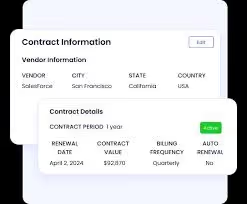
  • Evaluates AI vendors using security posture, SOC2 status, and compliance metadata.
  • Uses risk scoring based on usage trends to flag potential ethical or regulatory risks.
  • Helps prevent adoption of tools that could expose the organization to compliance violations.
  • Supports informed, risk-aware decision-making before AI implementation.

d. Continuous Monitoring & Privilege Management
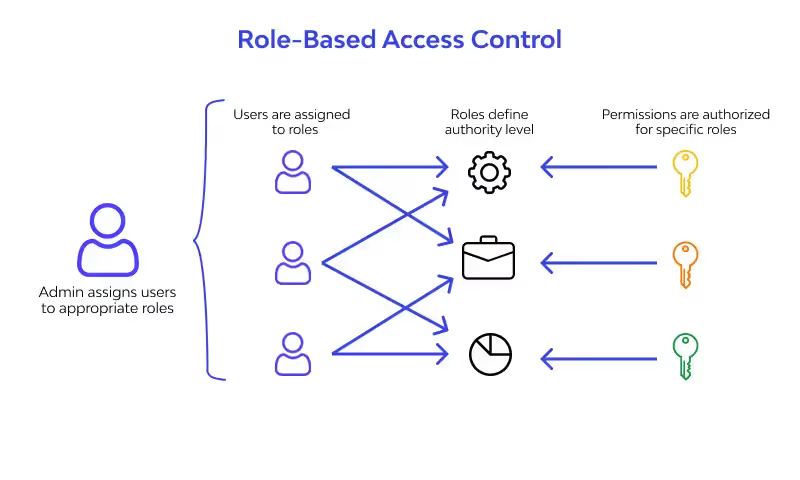
  • Performs AI-powered access reviews to detect privilege creep and unnecessary access.
  • Automates workflows to regularly review and revoke permissions, maintaining least-privilege principles.
  • Reduces insider risk and limits potential misuse of AI tools.
  • Ensures ongoing compliance and security across AI platforms.

Why It Matters

  • 60% of AI tools operate outside IT visibility, with Marketing and Sales leading in unauthorized adoption.
  • 70% of CIOs view unapproved AI usage as a top security risk.
  • 48% of ex-employees retain access to business applications, posing significant compliance and ethical risks.

CloudEagle.ai addresses these challenges head-on, transforming ethical AI governance from a manual afterthought into an automated, proactive program.

Looking to simplify SaaS purchasing?

Our finance approval checklist organizes billing, contracts, and approvals for efficient, clear decision-making

Download Resource
CTA Thumbnail

7. Conclusion

Ethical AI is the foundation of trustworthy and responsible AI adoption. Without ethical guardrails, AI can introduce bias, risk, and reputational damage at scale. With the right principles, policies, and monitoring in place, Ethical AI becomes a practical and sustainable approach, not just a theoretical ideal. CloudEagle.ai helps organizations enforce these ethical standards by providing visibility, governance, and proactive risk mitigation for AI usage across the enterprise. Take control of your AI landscape today, ensure your AI is not only powerful but also responsible and compliant.

Frequently Asked Questions

  1. Why is Ethical AI important?

Ethical AI reduces risks like bias, data misuse, and harmful outputs while building trust with customers, regulators, and employees.

  1. What are the main principles of Ethical AI?

Key principles include fairness, transparency, accountability, privacy, safety, and inclusivity.

  1. How does Ethical AI reduce risk?

By identifying bias, protecting sensitive data, enforcing accountability, and monitoring AI behavior continuously.

  1. What is the difference between Ethical AI and Responsible AI?

Ethical AI focuses on values and principles, while Responsible AI focuses on implementing those principles through governance, controls, and processes.

Advertisement for a SaaS Subscription Tracking Template with a call-to-action button to download and a partial graphic of a tablet showing charts.Banner promoting a SaaS Agreement Checklist to streamline SaaS management and avoid budget waste with a call-to-action button labeled Download checklist.Blue banner with text 'The Ultimate Employee Offboarding Checklist!' and a black button labeled 'Download checklist' alongside partial views of checklist documents from cloudeagle.ai.Digital ad for download checklist titled 'The Ultimate Checklist for IT Leaders to Optimize SaaS Operations' by cloudeagle.ai, showing checklist pages.Slack Buyer's Guide offer with text 'Unlock insider insights to get the best deal on Slack!' and a button labeled 'Get Your Copy', accompanied by a preview of the guide featuring Slack's logo.Monday Pricing Guide by cloudeagle.ai offering exclusive pricing secrets to maximize investment with a call-to-action button labeled Get Your Copy and an image of the guide's cover.Blue banner for Canva Pricing Guide by cloudeagle.ai offering a guide to Canva costs, features, and alternatives with a call-to-action button saying Get Your Copy.Blue banner with white text reading 'Little-Known Negotiation Hacks to Get the Best Deal on Slack' and a white button labeled 'Get Your Copy'.Blue banner with text 'Little-Known Negotiation Hacks to Get the Best Deal on Monday.com' and a white button labeled 'Get Your Copy'.Blue banner with text 'Little-Known Negotiation Hacks to Get the Best Deal on Canva' and a white button labeled 'Get Your Copy'.Banner with text 'Slack Buyer's Guide' and a 'Download Now' button next to images of a guide titled 'Slack Buyer’s Guide: Features, Pricing & Best Practices'.Digital cover of Monday Pricing Guide with a button labeled Get Your Copy on a blue background.Canva Pricing Guide cover with a button labeled Get Your Copy on a blue gradient background.

Enter your email to
unlock the report

Oops! Something went wrong while submitting the form.
License Count
Benchmark
Per User/Per Year

Enter your email to
unlock the report

Oops! Something went wrong while submitting the form.
License Count
Benchmark
Per User/Per Year

Enter your email to
unlock the report

Oops! Something went wrong while submitting the form.
Notion Plus
License Count
Benchmark
Per User/Per Year
100-500
$67.20 - $78.72
500-1000
$59.52 - $72.00
1000+
$51.84 - $57.60
Canva Pro
License Count
Benchmark
Per User/Per Year
100-500
$74.33-$88.71
500-1000
$64.74-$80.32
1000+
$55.14-$62.34

Enter your email to
unlock the report

Oops! Something went wrong while submitting the form.

Enter your email to
unlock the report

Oops! Something went wrong while submitting the form.
Zoom Business
License Count
Benchmark
Per User/Per Year
100-500
$216.00 - $264.00
500-1000
$180.00 - $216.00
1000+
$156.00 - $180.00

Enter your email to
unlock the report

Oops! Something went wrong while submitting the form.

Get the Right Security Platform To Secure Your Cloud Infrastructure

Please enter a business email
Thank you!
The 2023 SaaS report has been sent to your email. Check your promotional or spam folder.
Oops! Something went wrong while submitting the form.

Access full report

Please enter a business email
Thank you!
The 2023 SaaS report has been sent to your email. Check your promotional or spam folder.
Oops! Something went wrong while submitting the form.

Artificial Intelligence is no longer a future concept, it’s already making decisions that affect real people, in real time. From screening job applicants and recommending financial products to generating content and analyzing customer behavior, AI systems are now deeply embedded in everyday business operations.

But as AI adoption accelerates, so do the risks.

What happens when an AI system discriminates without intent? Who is responsible when an AI model leaks sensitive data? And how do organizations balance innovation with trust, safety, and accountability?

These questions are exactly why Ethical AI has become a critical topic, not just for technologists, but for business leaders, compliance teams, and everyday users of AI tools. 

We’ll break down what Ethical AI really means, why it matters today, its core principles, and how organizations can start adopting responsible and trustworthy AI in a practical way.

Concerned about undetected SaaS security gaps?

Our checklist enables your team to identify vulnerabilities and implement measures to protect sensitive data effectively

Download Resource
CTA Thumbnail

TL;DR

  • Ethical AI focuses on building and using AI systems that are fair, transparent, accountable, and safe.
  • It exists to reduce real-world harm like bias, discrimination, data misuse, and unpredictable outcomes.
  • Ethical AI frameworks help organizations make better decisions across AI design, deployment, and usage.
  • Without ethical guardrails, AI introduces serious business, compliance, and reputational risks.
  • Ethical AI is the foundation of trustworthy AI and long-term, responsible AI adoption.

1. What Is Ethical AI?

Ethical AI refers to the practice of designing, deploying, and using AI systems in ways that are fair, transparent, accountable, and aligned with human values. 91% of companies believe AI strategies must align with ethical principles, showing ethics is a top priority. At its core, Ethical AI ensures that AI technologies benefit people rather than unintentionally harming them.

Unlike traditional software, AI systems learn from data and adapt over time. This makes them powerful, but also unpredictable if left unchecked. Ethical AI acts as a framework that guides how AI should behave, how decisions should be made, and who is responsible when things go wrong.

Ethical AI is closely connected to broader concepts like AI ethics, responsible AI, and trustworthy AI. While the terminology may differ, the goal remains the same: ensuring AI systems are used safely, fairly, and responsibly across their entire lifecycle.

Importantly, Ethical AI applies not only to how AI models are built, but also to how they are used, especially in the age of generative AI. Employees today can adopt AI tools instantly, often without formal approval, creating new ethical and compliance challenges.

2. Why Ethical AI Matters Today

AI adoption has moved faster than governance.

Generative AI tools are now widely used in hiring, finance, healthcare, customer support, and marketing, often without clear oversight. While this speed enables innovation, it also increases AI risk.

Unethical or poorly governed AI can lead to:

  • Bias and discrimination in automated decisions
  • Exposure of confidential or regulated data
  • Hallucinated or misleading outputs
  • Lack of accountability when errors occur

At the same time, expectations are rising. Regulators, customers, and partners increasingly expect organizations to demonstrate responsible AI practices. Ethical AI is no longer optional, it’s becoming foundational to trust, compliance readiness, and long-term AI success.

4. Core Principles of Ethical AI

Ethical AI isn’t one rule, it’s a set of guiding principles that shape how AI behaves in the real world.

a. Fairness and Non-Discrimination

AI should not unfairly disadvantage individuals or groups.

Bias can enter AI systems through:

  • Skewed training data
  • Design choices made during model development
  • Biased prompts or misuse by users

Ethical AI requires organizations to test for bias, monitor outputs continuously, and correct issues as they appear. Fairness isn’t a one-time check, it’s an ongoing responsibility.

b. Transparency and Explainability

Users should understand how and why AI systems make decisions.

Black-box AI models create risk, especially in regulated industries. When decisions affect hiring, credit, or healthcare, explanations matter.

Ethical AI promotes:

  • Clear documentation of AI use cases
  • Plain-language explanations of outputs
  • Visibility into data sources and limitations

Transparency builds trust,  both internally and externally.

c. Accountability and Human Oversight

AI does not eliminate responsibility.

Ethical AI makes it clear that humans remain accountable for AI-driven outcomes. This means:

  • Defined ownership for AI tools and decisions
  • Review and approval workflows
  • Incident response plans when AI goes wrong

Without accountability, AI becomes a liability instead of an asset.

d. Privacy and Data Protection

AI systems often rely on large volumes of data including personal, confidential, or regulated information.

Ethical AI ensures:

  • Data is collected and used with informed consent
  • Access is restricted to what’s necessary
  • Sensitive data is not exposed through prompts or outputs

Data minimization and access control reduce AI risk significantly.

e. Safety and Reliability

AI systems should behave predictably under expected conditions.

Ethical AI requires testing for:

  • Hallucinations and misleading outputs
  • Harmful or unsafe responses
  • Misuse scenarios

Guardrails, validation, and monitoring help prevent AI from producing damaging results.

f. Inclusivity and Accessibility

AI should be usable and beneficial for diverse users.

Ethical AI avoids assumptions that exclude:

  • Certain demographics
  • Non-native language speakers
  • Marginalized communities

Inclusive AI design ensures broader, fairer impact.

Want to ensure robust SaaS contracts?

Our checklist guides you to review key terms like renewals and security for complete confidence.

Download Resource
CTA Thumbnail

5. How Organizations Can Start Implementing Ethical AI Today

Ethical AI becomes easier to understand when you see it in action.

  • Hiring and Recruitment - AI used for resume screening must evaluate candidates based on skills and qualifications, not gender, ethnicity, or background. Ethical AI requires regular bias testing and transparent decision criteria.
  • Content and Information Generation - AI chatbots and GenAI tools should avoid generating misleading, harmful, or unsafe advice. Guardrails and usage policies help ensure responsible outputs.
  • Healthcare and Finance - AI recommendations must be validated and monitored. Errors in these areas can have serious consequences, making accountability and explainability critical.

6. How CloudEagle.ai Helps Support Ethical AI Adoption

As AI proliferates across departments, ensuring its ethical and compliant usage is critical. CloudEagle.ai empowers IT, security, and procurement teams with the tools needed to detect, govern, and manage AI tools responsibly, helping organizations align with ethical standards and reduce AI-related risks.

a. Shadow AI Detection

  • Provides deep visibility into unsanctioned AI tools like ChatGPT, DeepSeek, Midjourney.
  • Cross-verifies login data (SSO, browser activity) with finance systems to detect hidden usage.
  • Identifies shadow AI before it becomes a compliance risk, closing gaps traditional IT tools miss.
  • Helps eliminate blind spots in AI adoption across the organization.

b. AI Policy Enforcement and Governance Automation

  • Allows admins to define and enforce AI usage policies, e.g., restricting sensitive data sharing.
  • Enables just-in-time (JIT) access for high-risk AI apps to minimize exposure.
  • Embedded in a no-code workflow engine for seamless enforcement without slowing productivity.
  • Ensures ethical AI usage across teams while maintaining operational efficiency.

c. Risk-Based AI Vendor Assessment

  • Evaluates AI vendors using security posture, SOC2 status, and compliance metadata.
  • Uses risk scoring based on usage trends to flag potential ethical or regulatory risks.
  • Helps prevent adoption of tools that could expose the organization to compliance violations.
  • Supports informed, risk-aware decision-making before AI implementation.

d. Continuous Monitoring & Privilege Management

  • Performs AI-powered access reviews to detect privilege creep and unnecessary access.
  • Automates workflows to regularly review and revoke permissions, maintaining least-privilege principles.
  • Reduces insider risk and limits potential misuse of AI tools.
  • Ensures ongoing compliance and security across AI platforms.

Why It Matters

  • 60% of AI tools operate outside IT visibility, with Marketing and Sales leading in unauthorized adoption.
  • 70% of CIOs view unapproved AI usage as a top security risk.
  • 48% of ex-employees retain access to business applications, posing significant compliance and ethical risks.

CloudEagle.ai addresses these challenges head-on, transforming ethical AI governance from a manual afterthought into an automated, proactive program.

Looking to simplify SaaS purchasing?

Our finance approval checklist organizes billing, contracts, and approvals for efficient, clear decision-making

Download Resource
CTA Thumbnail

7. Conclusion

Ethical AI is the foundation of trustworthy and responsible AI adoption. Without ethical guardrails, AI can introduce bias, risk, and reputational damage at scale. With the right principles, policies, and monitoring in place, Ethical AI becomes a practical and sustainable approach, not just a theoretical ideal. CloudEagle.ai helps organizations enforce these ethical standards by providing visibility, governance, and proactive risk mitigation for AI usage across the enterprise. Take control of your AI landscape today, ensure your AI is not only powerful but also responsible and compliant.

Frequently Asked Questions

  1. Why is Ethical AI important?

Ethical AI reduces risks like bias, data misuse, and harmful outputs while building trust with customers, regulators, and employees.

  1. What are the main principles of Ethical AI?

Key principles include fairness, transparency, accountability, privacy, safety, and inclusivity.

  1. How does Ethical AI reduce risk?

By identifying bias, protecting sensitive data, enforcing accountability, and monitoring AI behavior continuously.

  1. What is the difference between Ethical AI and Responsible AI?

Ethical AI focuses on values and principles, while Responsible AI focuses on implementing those principles through governance, controls, and processes.

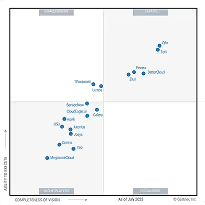
CloudEagle.ai recognized in the 2025 Gartner® Magic Quadrant™ for SaaS Management Platforms
Download now
gartner chart
5x
Faster employee
onboarding
80%
Reduction in time for
user access reviews
30k
Workflows
automated
$15Bn
Analyzed in
contract spend
$2Bn
Saved in
SaaS spend

Recognized as an Industry leader for our AI

CloudEagle.ai is Recognized in the 2024 Gartner® Magic Quadrant™ for SaaS Management Platforms

Recognition highlights CloudEagle’s innovation and leadership in the rapidly evolving SaaS management and procurement space.
Read More
Gartner Magic Quadrant for SaaS Management Platforms showing a chart divided into Challengers and Leaders quadrants with various companies plotted as dots.

CloudEagle.ai Recognized in the GigaOm Radar for SaaS Management Platforms

CloudEagle named a Leader and Outperformer in GigaOm Radar Report, validating its impact in the SaaS management platform landscape.
Read More
gigaom

Everest Group Positions CloudEagle.ai as a Trailblazer in SaaS Management Platforms

CloudEagle recognized as a Trailblazer by Everest Group, showcasing its rapid growth and innovation in SaaS spend and operations management.
Read More
qks

CloudEagle.ai is Recognized in the 2024 Gartner® Magic Quadrant™ for SaaS Management Platforms

Recognition highlights CloudEagle’s innovation and leadership in the rapidly evolving SaaS management and procurement space.
Read More
gartner

Streamline SaaS governance and save 10-30%

Book a Demo with Expert
CTA image
One platform to Manage
all SaaS Products
Learn More