How to Bring Non-Human Identities Into Your Access Reviews

Share via:
blog-cms-banner-bg
Little-Known Negotiation Hacks to Get the Best Deal on Slack
cta-bg-blogDownload Your Copy

HIPAA Compliance Checklist for 2025

Download PDF

Traditional access reviews were built for employees. Managers certify user accounts, review permissions, and remove access that's no longer needed.

Today's environments also rely on thousands of non-human identities (NHIs) such as service accounts, API keys, workload identities, etc. Many have privileged access, yet most never appear in access review campaigns.

Bringing NHIs into your access reviews means discovering every machine identity, assigning ownership, reviewing its access, and certifying whether it still needs those permissions.

In this guide, we'll show you how to extend your access review process to include every NHI and how CloudEagle.ai automates discovery, ownership mapping, and risk-based reviews at scale.

TL;DR

  • Traditional access reviews often exclude non-human identities, leaving service accounts, API keys, and AI agents outside certification processes.
  • Effective NHI access reviews require complete discovery, clear ownership, risk-based reviews, automated certification, and continuous monitoring.
  • CloudEagle.ai automatically discovers and inventories non-human identities across identity providers, cloud platforms, and SaaS applications.
  • Ownership assignment, risk prioritization, and audit-ready workflows simplify reviewing and governing machine identities at scale.
  • CloudEagle.ai extends access reviews beyond human users by centralizing NHI discovery, certification, and governance in a single platform.

1. Why Traditional Access Reviews Miss Non-Human Identities

Traditional access reviews were designed around employees. The goal is simple: verify that a person still needs access based on their role, manager approval, and employment status.

Comparison of employee and non-human identities cloudeagle

Non-human identities don't follow that lifecycle, which is why they're often excluded from certification campaigns.

  • Human-Centric Workflows: Access reviews route approvals to managers or application owners responsible for employee accounts.
  • No HR Lifecycle: Service accounts, API keys, OAuth apps, and AI agents aren't tied to hiring, role changes, or offboarding events.
  • No Assigned Reviewer: Many machine identities have privileged access but no clear owner responsible for reviewing them.
  • Outside Traditional Scope: Since they aren't treated as user accounts, NHIs often remain active without ever being certified.

As a result, organizations regularly review employee access while non-human identities continue operating with little or no oversight. 

Extending access reviews to NHIs closes that gap by bringing every identity into the same review and certification process.

Every App Is A Security Decision

Review it regularly.
Get The Checklist

2. How to Bring Non-Human Identities Into Your Access Reviews

Bringing non-human identities into your access reviews requires more than adding them to an existing certification campaign. You first need to know what machine identities exist and who is responsible for them.

The following five steps provide a practical framework for reviewing service accounts, API keys, workload identities, OAuth apps, and other NHIs alongside your human identities.

A. Build a Complete Inventory of Non-Human Identities

Start by identifying every non-human identity across your environment. This includes service accounts, API keys, workload identities, OAuth apps, automation bots, AI agents, and cloud roles.

Without a complete inventory, access reviews will always miss identities that continue operating with privileged access.

B. Assign a Reviewer to Every Non-Human Identity

Every non-human identity should have someone accountable for validating its access during an access review.

  • Assign Business Ownership: Identify the team or business owner responsible for the identity's purpose.
  • Map Technical Responsibility: Assign an administrator or application owner who understands how the identity is used.
  • Define Review Accountability: Ensure the designated reviewer validates whether the identity and its permissions are still required during every certification cycle.

Clear ownership prevents machine identities from being overlooked simply because no one knows who should review them.

C. Review Access Based on Risk and Activity

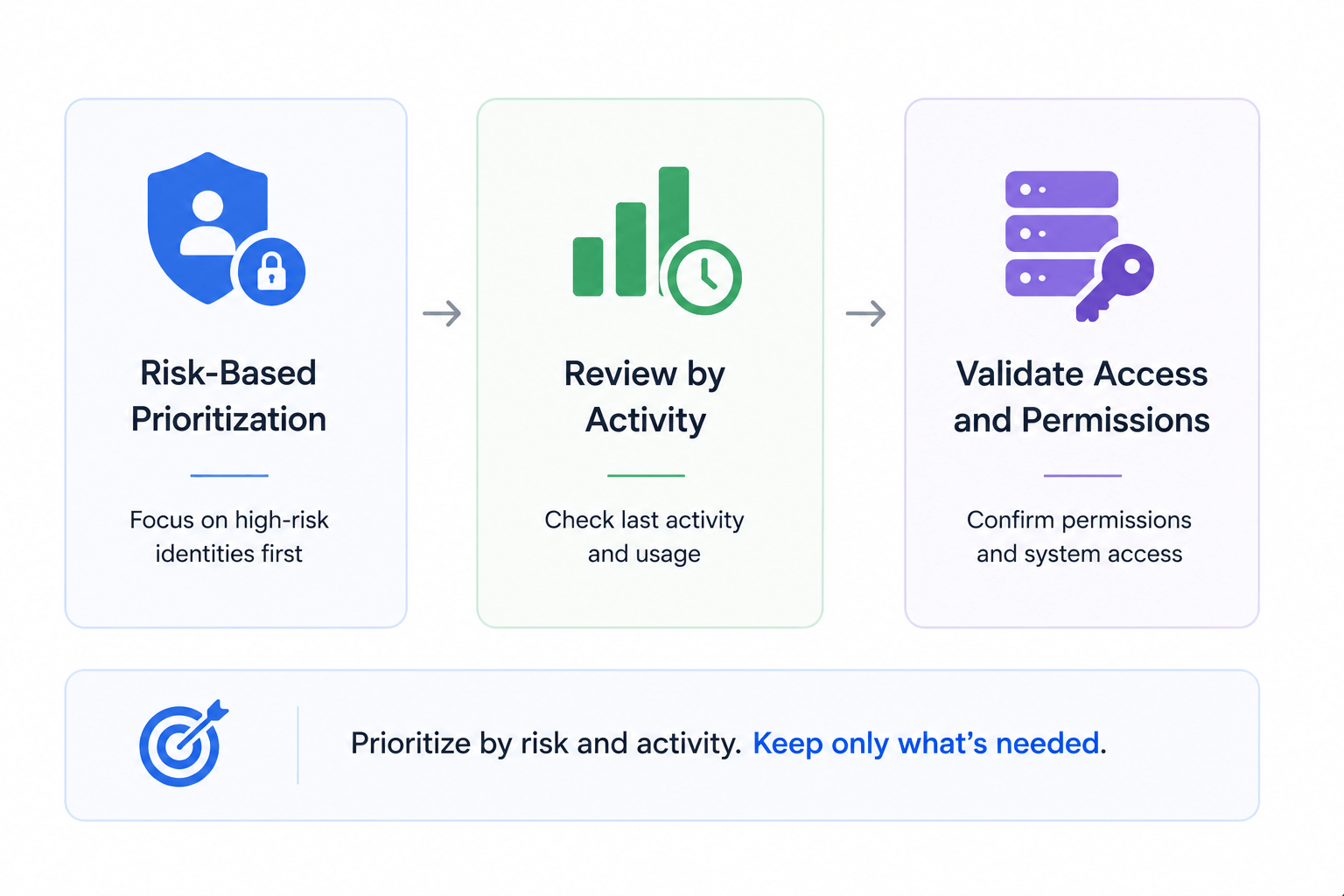
Not every non-human identity carries the same level of risk. Prioritize reviews for identities with privileged permissions, broad access, or little recent activity.
Risk-based prioritization infographic cloudeagle

Use factors such as last activity, permission levels, and the systems an identity can access to determine whether its current privileges are still justified.

D. Certify or Revoke Access with Automated Workflows

Once reviews are complete, automate the actions that follow.

  • Route Review Requests: Send access certification tasks to the appropriate business or technical owners.
  • Approve or Modify Access: Retain legitimate permissions and reduce access where it's no longer needed.
  • Revoke Unnecessary Access: Remove dormant identities or permissions that are no longer justified.
  • Maintain an Audit Trail: Record every certification decision to support future audits and compliance requirements.

Automation keeps reviews consistent while eliminating manual follow-ups and documentation.

E. Continuously Monitor New and Existing Non-Human Identities

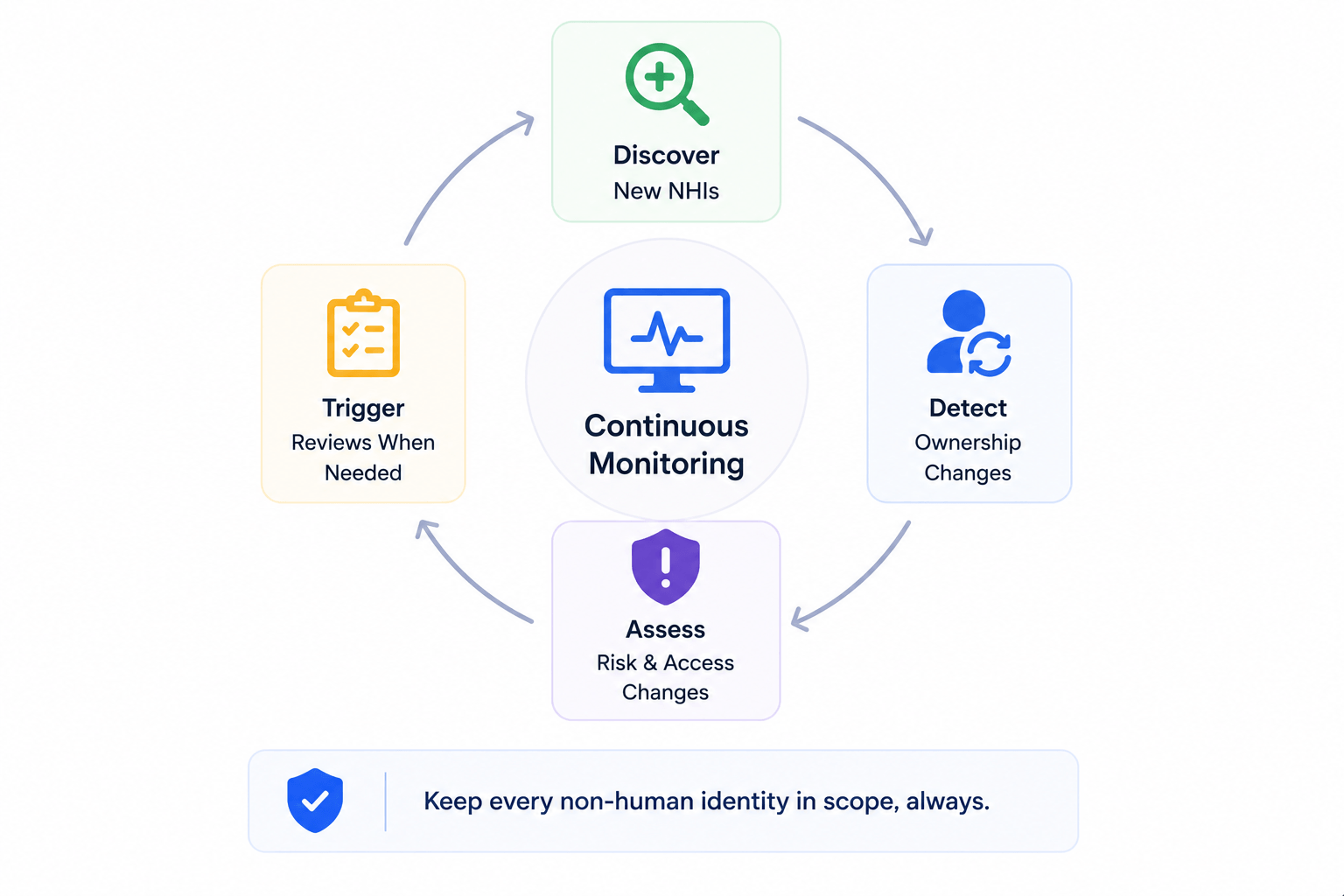
Access reviews shouldn't be limited to an annual certification exercise. Continuously discover newly created non-human identities, detect ownership changes, and trigger reviews whenever privileged access or risk levels change.
Continuous monitoring and identity management cloudeagle

Ongoing monitoring helps ensure new machine identities don't remain outside the review process until the next scheduled campaign.

Compliance Doesn't Drift Overnight

Neither should your controls.
See Why

3. How CloudEagle.ai Simplifies Non-Human Identity Access Reviews

CloudEagle.ai's NHI module maps directly to all five steps: inventory, risk scoring, access reviews, ownership assignment, and audit trail. Here's what each capability looks like in the product:

A. CloudEagle.ai's NHI Dashboard: Inventory and Risk in One View

The moment CloudEagle.ai connects to your environment, the NHI dashboard surfaces total NHIs, environment breakdown, identity type split, and a risk-prioritized insights panel that tells your security team exactly where to start.

Here's how the NHI dashboard surfaces inventory and risk simultaneously:
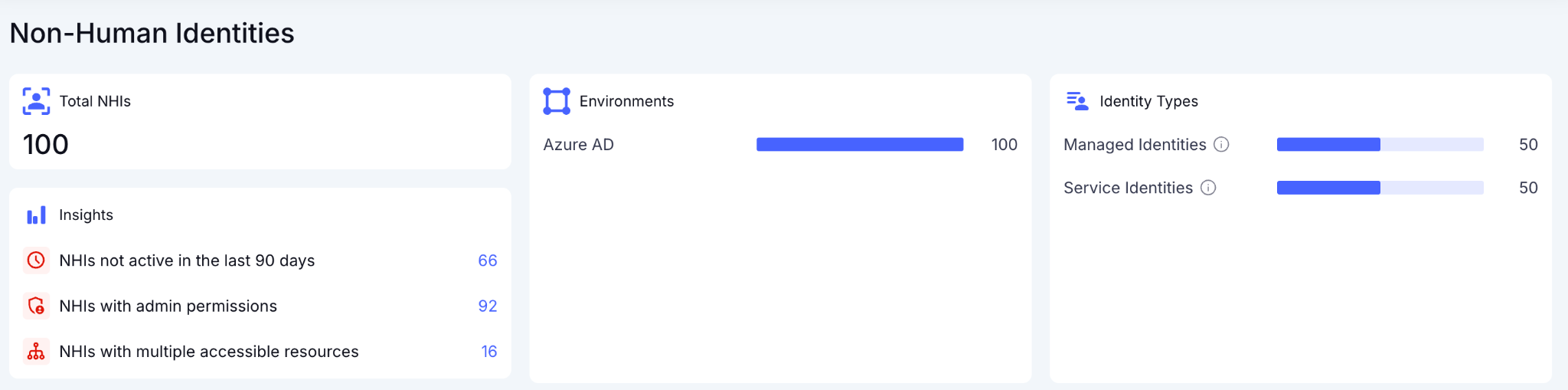
In CloudEagle.ai's NHI dashboard, the insights panel flags the three highest-priority risk categories immediately: NHIs not active in the last 90 days, NHIs with admin permissions, and NHIs with multiple accessible resources:
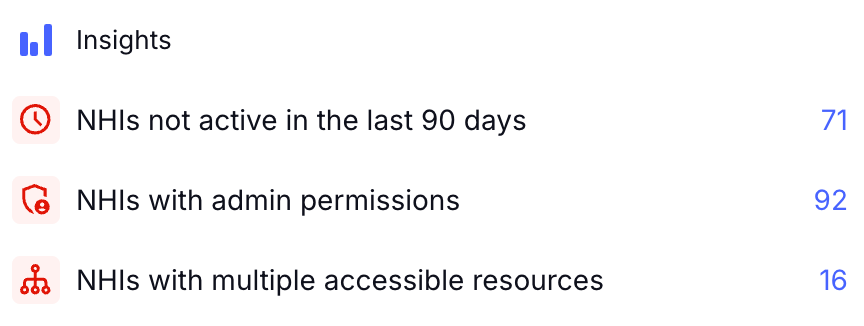
In the Freshworks deployment, this view was live in production the moment Azure AD was connected without separate data collection exercise and manual export. 

AWS and GCP are confirmed on the roadmap, expanding the same inventory and risk layer to cloud infrastructure NHIs in phase two.

B. CloudEagle.ai's NHI Inventory: Every Identity, Credential Type, and Owner in One Table

The full NHI inventory delivers the detailed per-identity view the program requires, credential type, last activity date, source environment, and owner status visible in a single table without opening a separate system.

Here's how the NHI inventory surfaces the full per-identity picture:
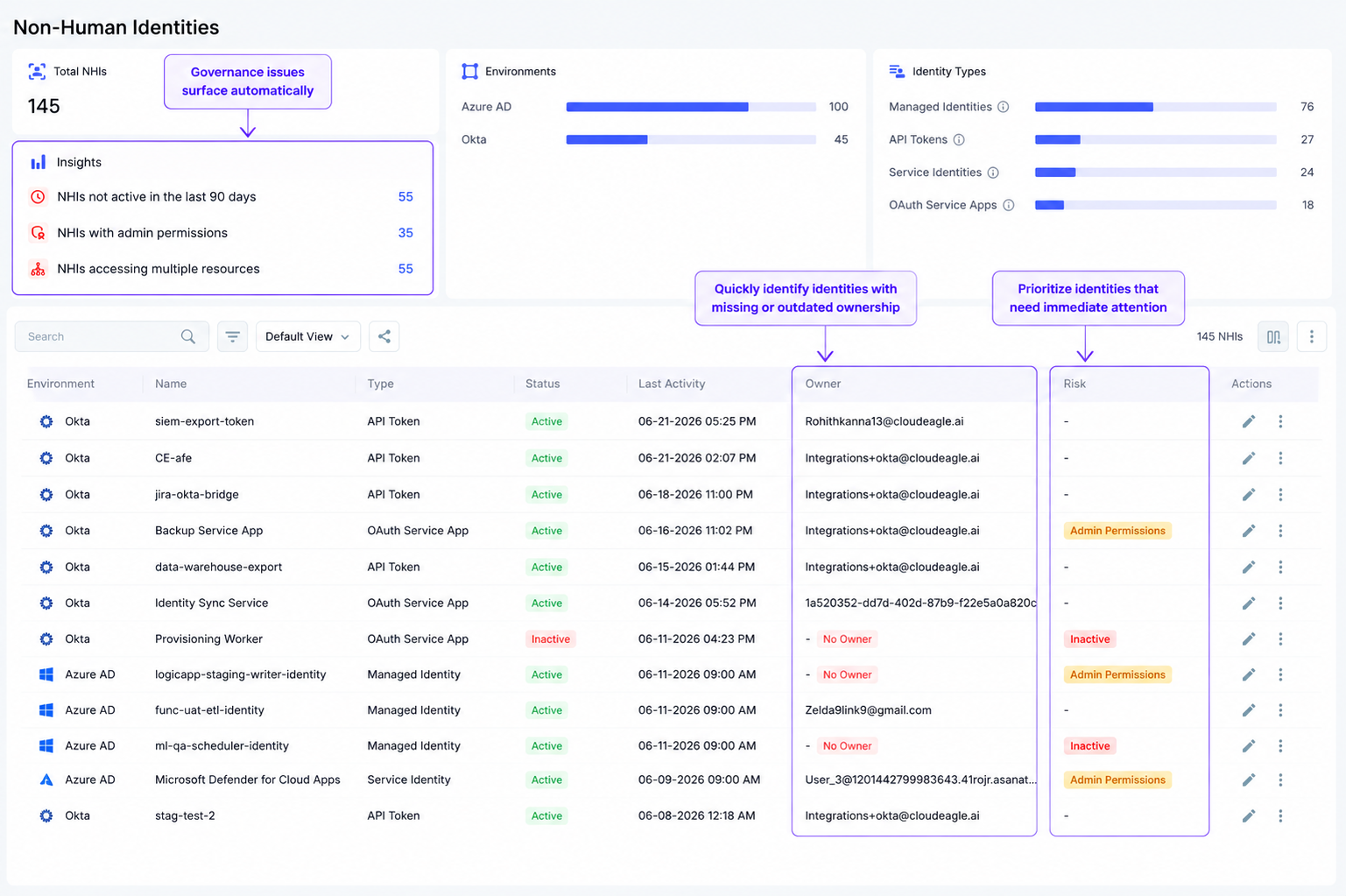
In CloudEagle.ai's NHI inventory, every identity appears with its source, type, active status, credential type, last activity date, and assigned owner. Every NHI with a missing owner is immediately visible:
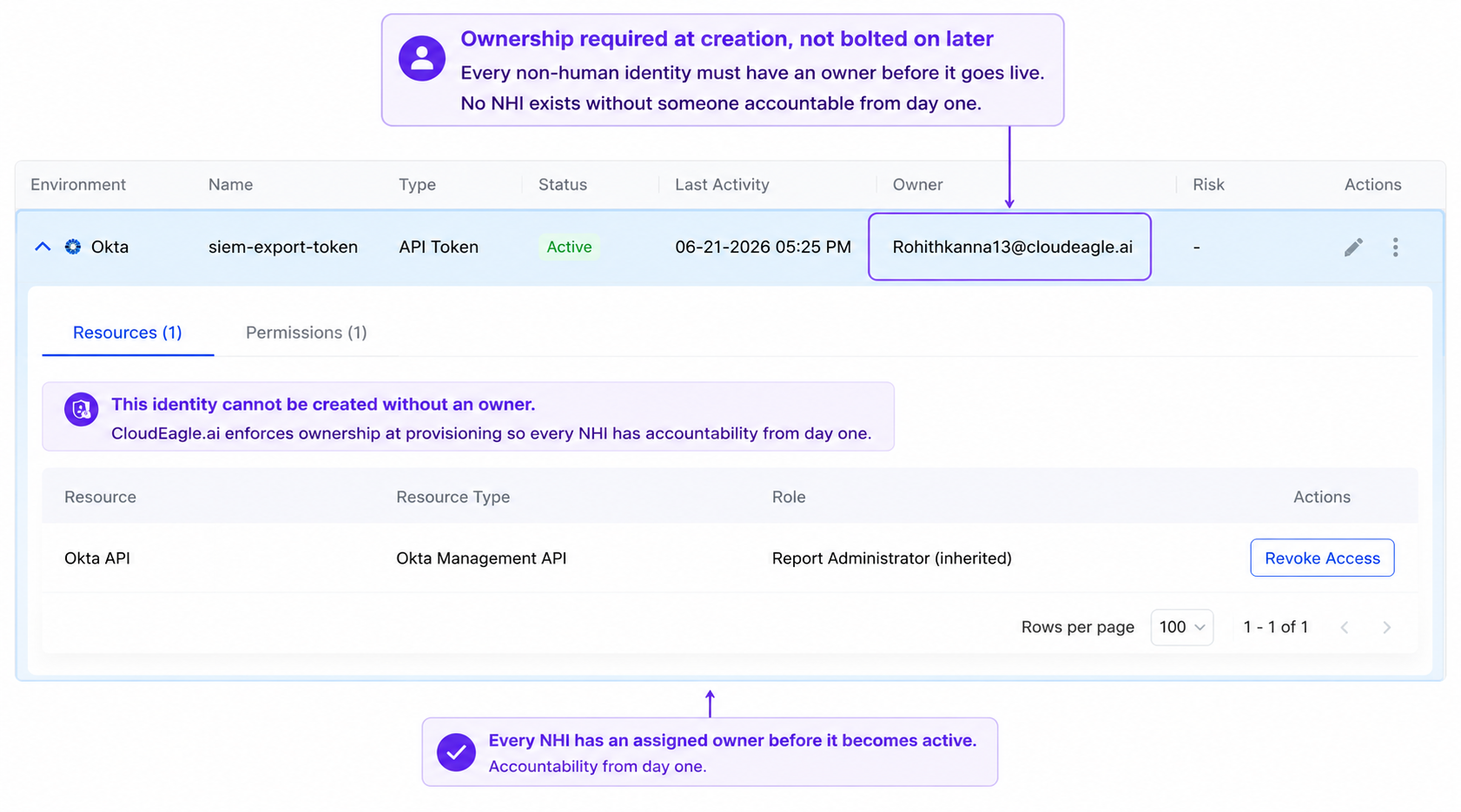
Expanding any row surfaces the role and permission drill-down, the exact view an access review requires to answer whether the permission scope is still appropriate. 

C. Ownership Assignment: Every Unowned NHI Flagged and Routed

CloudEagle.ai flags every unowned NHI automatically and routes it to the most likely owner based on application context including the integration creator, the application administrator, or the team responsible for the connected system.
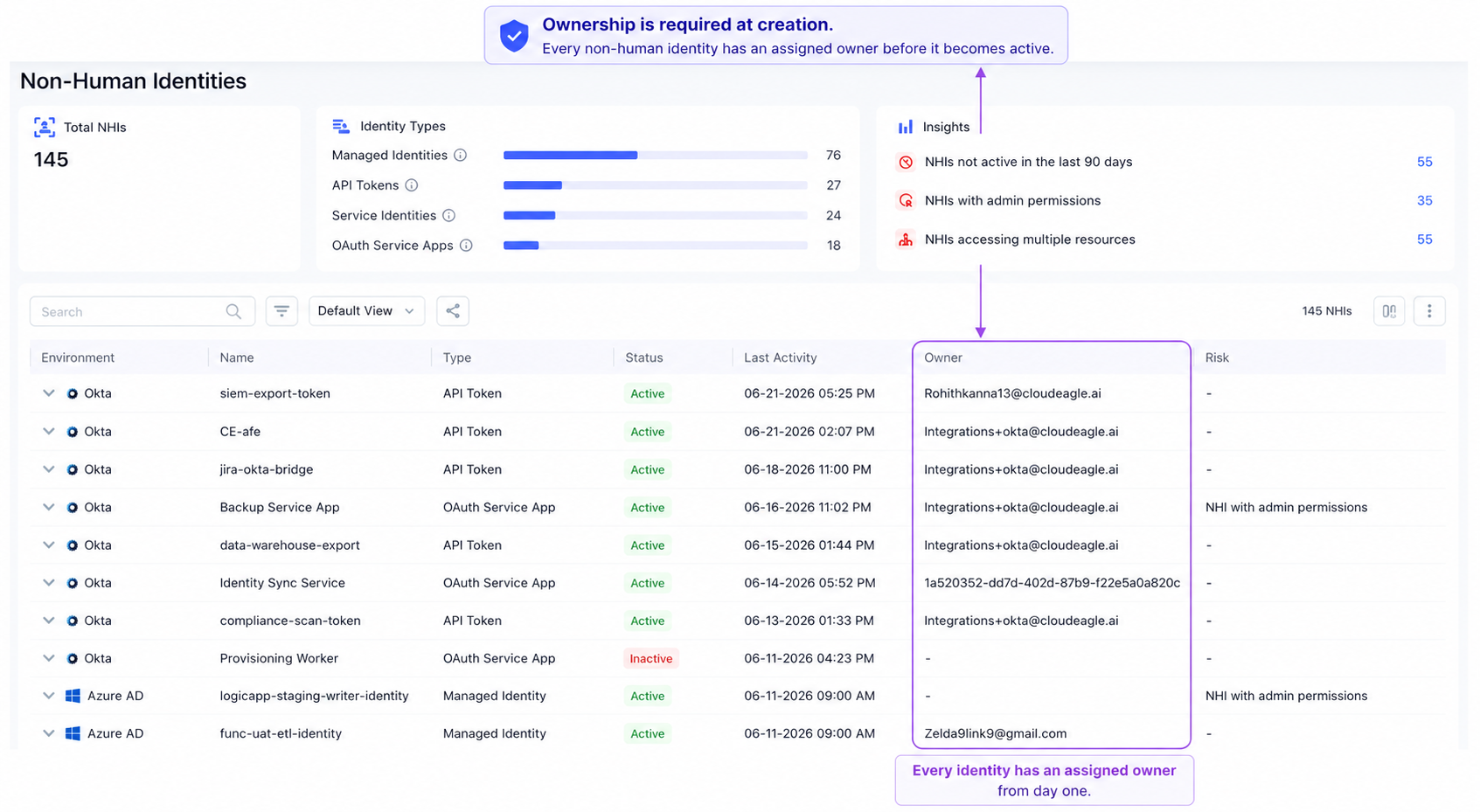
Every unowned NHI surfaces in a queue with suggested owner, application context, and permission scope. Ownership is confirmed before the next review cycle rather than discovered during an incident. 

D. Audit Log: Every Governance Action Timestamped and Traceable

Every action taken on a non-human identity such as ownership assignment, access revocation, permission downscope, credential rotation is logged automatically with the action, the change, who performed it, and the exact timestamp.

In CloudEagle.ai's audit log, every governance action is timestamped and attributable, producing the defensible evidence trail the program requires without any manual compilation:
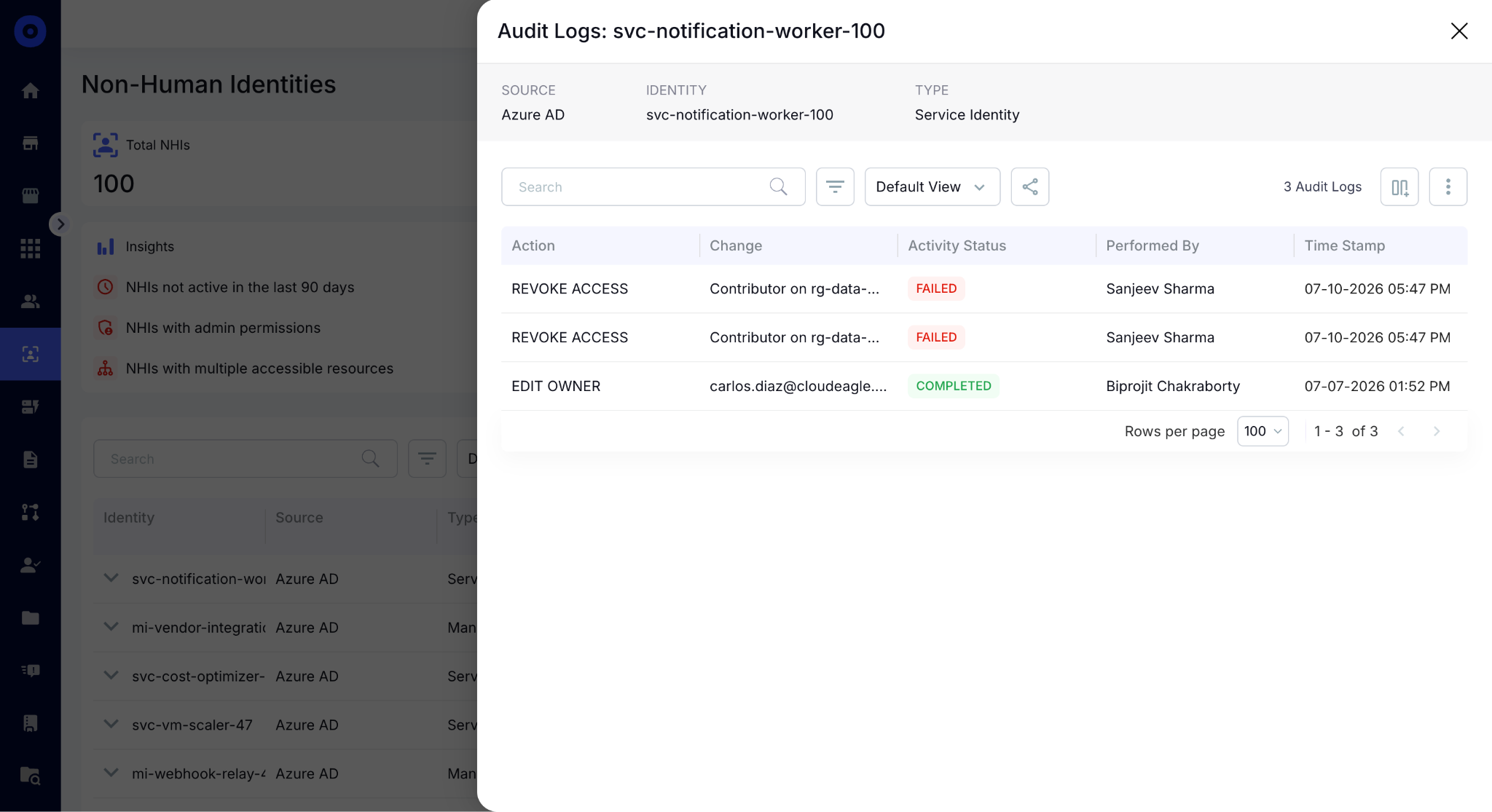
When an auditor asks who owns a specific service account and what actions have been taken on it, the answer is already in CloudEagle.ai, not assembled from Jira tickets the night before the review.

4. Conclusion

Traditional access reviews can no longer focus only on employee accounts. As non-human identities continue to grow, they need the same level of visibility, ownership, and periodic certification as human users.

By discovering every NHI, assigning the right reviewer, evaluating permissions based on risk and activity, and automating certification workflows, organizations can extend access reviews without adding manual effort. 

CloudEagle.ai centralizes this entire process, helping security teams with identity governance from a single platform while maintaining an audit-ready record of every decision.

5. FAQs

1. What is a non-human identity (NHI)?

A non-human identity (NHI) is a digital identity used by applications, services, workloads, scripts, or AI agents instead of people. Common examples include service accounts, API keys, OAuth applications, workload identities, and automation bots.

2. Why should non-human identities be included in access reviews?

Many NHIs have access to sensitive systems and data. Including them in access reviews helps identify unnecessary permissions, remove orphaned identities, and ensure machine identities have only the access they need.

3. Who should review non-human identities during an access certification?

Non-human identities should be reviewed by the business owner, application owner, or technical administrator responsible for their purpose and ongoing operation. Every NHI should have a clearly assigned reviewer.

4. How often should non-human identities be reviewed?

Organizations should review non-human identities on a regular schedule, such as quarterly, while also triggering reviews whenever new identities are created, ownership changes, or high-risk permissions are granted.

5. How does CloudEagle.ai simplify non-human identity access reviews?

CloudEagle.ai automatically discovers non-human identities across identity providers, cloud platforms, and SaaS applications, assigns ownership, prioritizes high-risk identities, and automates access review workflows from a centralized platform.

Advertisement for a SaaS Subscription Tracking Template with a call-to-action button to download and a partial graphic of a tablet showing charts.Banner promoting a SaaS Agreement Checklist to streamline SaaS management and avoid budget waste with a call-to-action button labeled Download checklist.Blue banner with text 'The Ultimate Employee Offboarding Checklist!' and a black button labeled 'Download checklist' alongside partial views of checklist documents from cloudeagle.ai.Digital ad for download checklist titled 'The Ultimate Checklist for IT Leaders to Optimize SaaS Operations' by cloudeagle.ai, showing checklist pages.Slack Buyer's Guide offer with text 'Unlock insider insights to get the best deal on Slack!' and a button labeled 'Get Your Copy', accompanied by a preview of the guide featuring Slack's logo.Monday Pricing Guide by cloudeagle.ai offering exclusive pricing secrets to maximize investment with a call-to-action button labeled Get Your Copy and an image of the guide's cover.Blue banner for Canva Pricing Guide by cloudeagle.ai offering a guide to Canva costs, features, and alternatives with a call-to-action button saying Get Your Copy.Blue banner with white text reading 'Little-Known Negotiation Hacks to Get the Best Deal on Slack' and a white button labeled 'Get Your Copy'.Blue banner with text 'Little-Known Negotiation Hacks to Get the Best Deal on Monday.com' and a white button labeled 'Get Your Copy'.Blue banner with text 'Little-Known Negotiation Hacks to Get the Best Deal on Canva' and a white button labeled 'Get Your Copy'.Banner with text 'Slack Buyer's Guide' and a 'Download Now' button next to images of a guide titled 'Slack Buyer’s Guide: Features, Pricing & Best Practices'.Digital cover of Monday Pricing Guide with a button labeled Get Your Copy on a blue background.Canva Pricing Guide cover with a button labeled Get Your Copy on a blue gradient background.

Enter your email to
unlock the report

Oops! Something went wrong while submitting the form.
License Count
Benchmark
Per User/Per Year

Enter your email to
unlock the report

Oops! Something went wrong while submitting the form.
License Count
Benchmark
Per User/Per Year

Enter your email to
unlock the report

Oops! Something went wrong while submitting the form.
Notion Plus
License Count
Benchmark
Per User/Per Year
100-500
$67.20 - $78.72
500-1000
$59.52 - $72.00
1000+
$51.84 - $57.60
Canva Pro
License Count
Benchmark
Per User/Per Year
100-500
$74.33-$88.71
500-1000
$64.74-$80.32
1000+
$55.14-$62.34

Enter your email to
unlock the report

Oops! Something went wrong while submitting the form.

Enter your email to
unlock the report

Oops! Something went wrong while submitting the form.
Zoom Business
License Count
Benchmark
Per User/Per Year
100-500
$216.00 - $264.00
500-1000
$180.00 - $216.00
1000+
$156.00 - $180.00

Enter your email to
unlock the report

Oops! Something went wrong while submitting the form.

Get the Right Security Platform To Secure Your Cloud Infrastructure

Please enter a business email
Thank you!
The 2023 SaaS report has been sent to your email. Check your promotional or spam folder.
Oops! Something went wrong while submitting the form.

Access full report

Please enter a business email
Thank you!
The 2023 SaaS report has been sent to your email. Check your promotional or spam folder.
Oops! Something went wrong while submitting the form.

Traditional access reviews were built for employees. Managers certify user accounts, review permissions, and remove access that's no longer needed.

Today's environments also rely on thousands of non-human identities (NHIs) such as service accounts, API keys, workload identities, etc. Many have privileged access, yet most never appear in access review campaigns.

Bringing NHIs into your access reviews means discovering every machine identity, assigning ownership, reviewing its access, and certifying whether it still needs those permissions.

In this guide, we'll show you how to extend your access review process to include every NHI and how CloudEagle.ai automates discovery, ownership mapping, and risk-based reviews at scale.

TL;DR

  • Traditional access reviews often exclude non-human identities, leaving service accounts, API keys, and AI agents outside certification processes.
  • Effective NHI access reviews require complete discovery, clear ownership, risk-based reviews, automated certification, and continuous monitoring.
  • CloudEagle.ai automatically discovers and inventories non-human identities across identity providers, cloud platforms, and SaaS applications.
  • Ownership assignment, risk prioritization, and audit-ready workflows simplify reviewing and governing machine identities at scale.
  • CloudEagle.ai extends access reviews beyond human users by centralizing NHI discovery, certification, and governance in a single platform.

1. Why Traditional Access Reviews Miss Non-Human Identities

Traditional access reviews were designed around employees. The goal is simple: verify that a person still needs access based on their role, manager approval, and employment status.

Comparison of employee and non-human identities cloudeagle

Non-human identities don't follow that lifecycle, which is why they're often excluded from certification campaigns.

  • Human-Centric Workflows: Access reviews route approvals to managers or application owners responsible for employee accounts.
  • No HR Lifecycle: Service accounts, API keys, OAuth apps, and AI agents aren't tied to hiring, role changes, or offboarding events.
  • No Assigned Reviewer: Many machine identities have privileged access but no clear owner responsible for reviewing them.
  • Outside Traditional Scope: Since they aren't treated as user accounts, NHIs often remain active without ever being certified.

As a result, organizations regularly review employee access while non-human identities continue operating with little or no oversight. 

Extending access reviews to NHIs closes that gap by bringing every identity into the same review and certification process.

Every App Is A Security Decision

Review it regularly.
Get The Checklist

2. How to Bring Non-Human Identities Into Your Access Reviews

Bringing non-human identities into your access reviews requires more than adding them to an existing certification campaign. You first need to know what machine identities exist and who is responsible for them.

The following five steps provide a practical framework for reviewing service accounts, API keys, workload identities, OAuth apps, and other NHIs alongside your human identities.

A. Build a Complete Inventory of Non-Human Identities

Start by identifying every non-human identity across your environment. This includes service accounts, API keys, workload identities, OAuth apps, automation bots, AI agents, and cloud roles.

Without a complete inventory, access reviews will always miss identities that continue operating with privileged access.

B. Assign a Reviewer to Every Non-Human Identity

Every non-human identity should have someone accountable for validating its access during an access review.

  • Assign Business Ownership: Identify the team or business owner responsible for the identity's purpose.
  • Map Technical Responsibility: Assign an administrator or application owner who understands how the identity is used.
  • Define Review Accountability: Ensure the designated reviewer validates whether the identity and its permissions are still required during every certification cycle.

Clear ownership prevents machine identities from being overlooked simply because no one knows who should review them.

C. Review Access Based on Risk and Activity

Not every non-human identity carries the same level of risk. Prioritize reviews for identities with privileged permissions, broad access, or little recent activity.

Risk-based prioritization infographic cloudeagle

Use factors such as last activity, permission levels, and the systems an identity can access to determine whether its current privileges are still justified.

D. Certify or Revoke Access with Automated Workflows

Once reviews are complete, automate the actions that follow.

  • Route Review Requests: Send access certification tasks to the appropriate business or technical owners.
  • Approve or Modify Access: Retain legitimate permissions and reduce access where it's no longer needed.
  • Revoke Unnecessary Access: Remove dormant identities or permissions that are no longer justified.
  • Maintain an Audit Trail: Record every certification decision to support future audits and compliance requirements.

Automation keeps reviews consistent while eliminating manual follow-ups and documentation.

E. Continuously Monitor New and Existing Non-Human Identities

Access reviews shouldn't be limited to an annual certification exercise. Continuously discover newly created non-human identities, detect ownership changes, and trigger reviews whenever privileged access or risk levels change.

Continuous monitoring and identity management cloudeagle

Ongoing monitoring helps ensure new machine identities don't remain outside the review process until the next scheduled campaign.

Compliance Doesn't Drift Overnight

Neither should your controls.
See Why

3. How CloudEagle.ai Simplifies Non-Human Identity Access Reviews

CloudEagle.ai's NHI module maps directly to all five steps: inventory, risk scoring, access reviews, ownership assignment, and audit trail. Here's what each capability looks like in the product:

A. CloudEagle.ai's NHI Dashboard: Inventory and Risk in One View

The moment CloudEagle.ai connects to your environment, the NHI dashboard surfaces total NHIs, environment breakdown, identity type split, and a risk-prioritized insights panel that tells your security team exactly where to start.

Here's how the NHI dashboard surfaces inventory and risk simultaneously:

In CloudEagle.ai's NHI dashboard, the insights panel flags the three highest-priority risk categories immediately: NHIs not active in the last 90 days, NHIs with admin permissions, and NHIs with multiple accessible resources:

In the Freshworks deployment, this view was live in production the moment Azure AD was connected without separate data collection exercise and manual export. 

AWS and GCP are confirmed on the roadmap, expanding the same inventory and risk layer to cloud infrastructure NHIs in phase two.

B. CloudEagle.ai's NHI Inventory: Every Identity, Credential Type, and Owner in One Table

The full NHI inventory delivers the detailed per-identity view the program requires, credential type, last activity date, source environment, and owner status visible in a single table without opening a separate system.

Here's how the NHI inventory surfaces the full per-identity picture:

In CloudEagle.ai's NHI inventory, every identity appears with its source, type, active status, credential type, last activity date, and assigned owner. Every NHI with a missing owner is immediately visible:

Expanding any row surfaces the role and permission drill-down, the exact view an access review requires to answer whether the permission scope is still appropriate. 

C. Ownership Assignment: Every Unowned NHI Flagged and Routed

CloudEagle.ai flags every unowned NHI automatically and routes it to the most likely owner based on application context including the integration creator, the application administrator, or the team responsible for the connected system.

Every unowned NHI surfaces in a queue with suggested owner, application context, and permission scope. Ownership is confirmed before the next review cycle rather than discovered during an incident. 

D. Audit Log: Every Governance Action Timestamped and Traceable

Every action taken on a non-human identity such as ownership assignment, access revocation, permission downscope, credential rotation is logged automatically with the action, the change, who performed it, and the exact timestamp.

In CloudEagle.ai's audit log, every governance action is timestamped and attributable, producing the defensible evidence trail the program requires without any manual compilation:

When an auditor asks who owns a specific service account and what actions have been taken on it, the answer is already in CloudEagle.ai, not assembled from Jira tickets the night before the review.

4. Conclusion

Traditional access reviews can no longer focus only on employee accounts. As non-human identities continue to grow, they need the same level of visibility, ownership, and periodic certification as human users.

By discovering every NHI, assigning the right reviewer, evaluating permissions based on risk and activity, and automating certification workflows, organizations can extend access reviews without adding manual effort. 

CloudEagle.ai centralizes this entire process, helping security teams with identity governance from a single platform while maintaining an audit-ready record of every decision.

5. FAQs

1. What is a non-human identity (NHI)?

A non-human identity (NHI) is a digital identity used by applications, services, workloads, scripts, or AI agents instead of people. Common examples include service accounts, API keys, OAuth applications, workload identities, and automation bots.

2. Why should non-human identities be included in access reviews?

Many NHIs have access to sensitive systems and data. Including them in access reviews helps identify unnecessary permissions, remove orphaned identities, and ensure machine identities have only the access they need.

3. Who should review non-human identities during an access certification?

Non-human identities should be reviewed by the business owner, application owner, or technical administrator responsible for their purpose and ongoing operation. Every NHI should have a clearly assigned reviewer.

4. How often should non-human identities be reviewed?

Organizations should review non-human identities on a regular schedule, such as quarterly, while also triggering reviews whenever new identities are created, ownership changes, or high-risk permissions are granted.

5. How does CloudEagle.ai simplify non-human identity access reviews?

CloudEagle.ai automatically discovers non-human identities across identity providers, cloud platforms, and SaaS applications, assigns ownership, prioritizes high-risk identities, and automates access review workflows from a centralized platform.

CloudEagle.ai recognized in the 2025 Gartner® Magic Quadrant™ for SaaS Management Platforms
Download now
gartner chart
5x
Faster employee
onboarding
80%
Reduction in time for
user access reviews
30k
Workflows
automated
$15Bn
Analyzed in
contract spend
$2Bn
Saved in
SaaS spend

Streamline SaaS governance and save 10-30%

Book a Demo with Expert
CTA image