AI Governance

How to Find and Govern Every AI Agent in Your Stack

Share via:
Written by:
CloudEagle.ai Team
Review by:
Nidhi Jain
Last Updated:
August 24, 2026
blog-cms-banner-bg
Little-Known Negotiation Hacks to Get the Best Deal on Slack
cta-bg-blogDownload Your Copy

HIPAA Compliance Checklist for 2025

Download PDF

TL;DR

  • AI agents enter through three channels simultaneously: internally built in low-code platforms, vendor-embedded in approved products, and purchased platforms adopted by business units without IT. Each channel has a different discovery mechanism. None of them talk to each other
  • Every AI agent is a non-human identity with standing access to enterprise systems. Most have no assigned owner, no review cadence, and no offboarding trigger
  • A complete AI agent governance program requires continuous discovery across all three channels, ownership assignment at discovery, scope validation, a certification cadence, and offboarding workflows that extend to agents when their owner leaves
  • CloudEagle.ai finds AI agents across all three channels in a single continuous inventory, with owner, connected systems, and permission scope attached to each
  • Transfer or decommission. No third option

You can name the AI agents IT approved. You cannot name the ones your sales team built in Copilot Studio last month, the vendor agent that activated in your CRM two weeks ago, or the n8n workflow your ops team deployed to production without a ticket.

That is the actual state of AI agent governance at most enterprises in 2026. Most IT and security teams can produce a list of approved AI tools. 

Very few can produce a list of every AI agent running in their environment, including the ones built by business users in low-code platforms, the ones vendors shipped inside approved products, and the ones created as part of agentic workflows nobody explicitly initiated.

Finding AI agents and governing AI agents are two separate problems, and most organizations have not solved either. Discovery is the prerequisite. Governance is what you do once you know what is there. This blog covers both, in order.

1. Why Finding Every AI Agent Is Harder Than It Sounds

Most security leaders know AI agents are hard to find. The challenge is that they enter the organization through different channels, and each one leaves a different trail.

The three-channel problem: AI agents typically enter in three ways:

  • Internally built workflows: Employees create agents in platforms like Copilot Studio, n8n, Zapier, and Make.
  • Vendor-embedded agents: SaaS vendors introduce agents through products like Salesforce Agentforce, Microsoft Copilot, HubSpot AI, and Zendesk AI.
  • Standalone agent platforms: Business units purchase and deploy agent platforms without involving IT.

Each channel requires a different discovery method. None gives security teams a complete view of agents across the organization.

The identity problem: AI agents also do not appear in the systems IT traditionally uses to govern access. They often show up only inside the platforms where they were created.

For example, a Copilot Studio agent may create a service principal in Azure AD rather than an IT ticket. Security teams might not discover that identity until an audit months later.

Meanwhile, service accounts, API tokens, and other non-human identities can continue operating without regular review. This creates a structural discovery gap.

You cannot govern what you cannot find. Finding every AI agent requires visibility across all three entry points at the same time.

2. How CloudEagle.ai Finds Every AI Agent Across All Three Channels

AI agents do not all enter the enterprise through the same path. Some are built internally, some come through third-party platforms, and others are embedded inside applications employees already use.

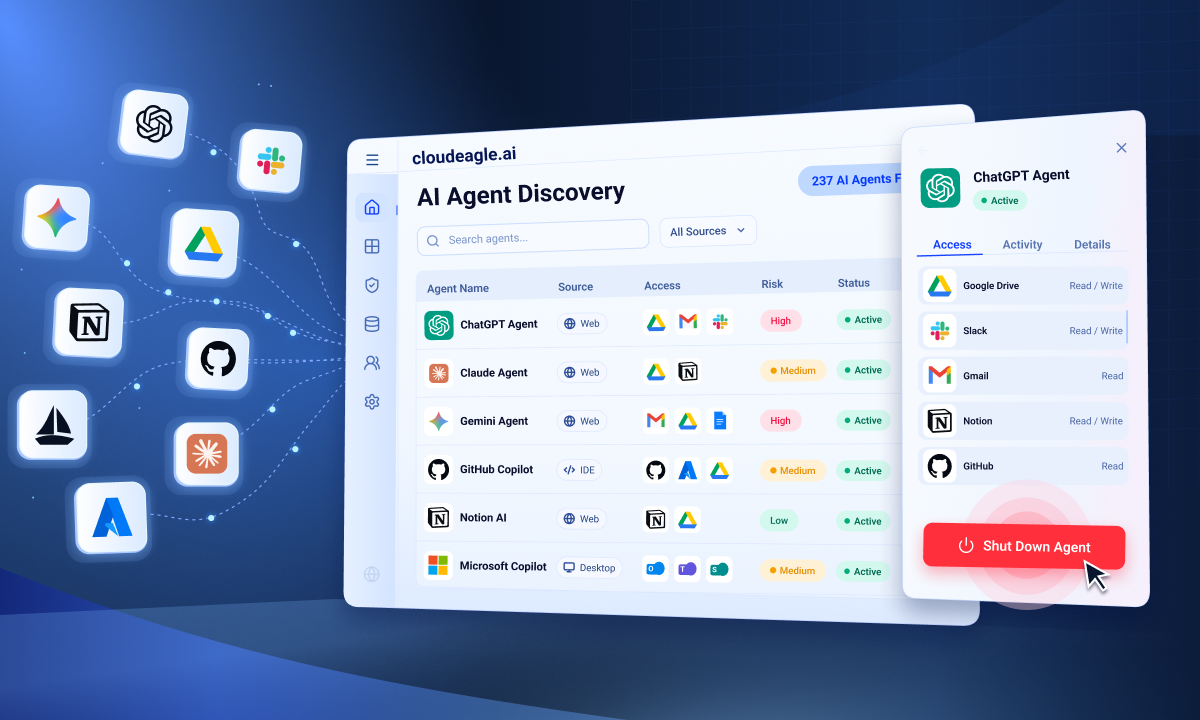
CloudEagle.ai treats these agents as non-human identities (NHIs) when they operate with credentials, tokens, permissions, or access to enterprise resources. This lets security teams move beyond simply discovering an agent to understanding what identity it uses, what it can access, who owns it, and whether that access creates risk.

The discovery layer correlates signals across browser, endpoint, SSO, OAuth, finance, and network sources to build a continuous inventory of AI agents. That inventory can then be evaluated alongside other machine identities, including service accounts, managed identities, OAuth service applications, and API tokens.

Channel 1: Internally Built Agents

This is the channel most governance programs miss because internally built agents may never pass through a formal IT provisioning process.

An engineering team can deploy an agent that uses an API token, service account, or another machine credential to interact with internal systems. The agent may not appear as a standalone application in the organization's SSO environment, but the identity behind it still has access that needs to be governed.
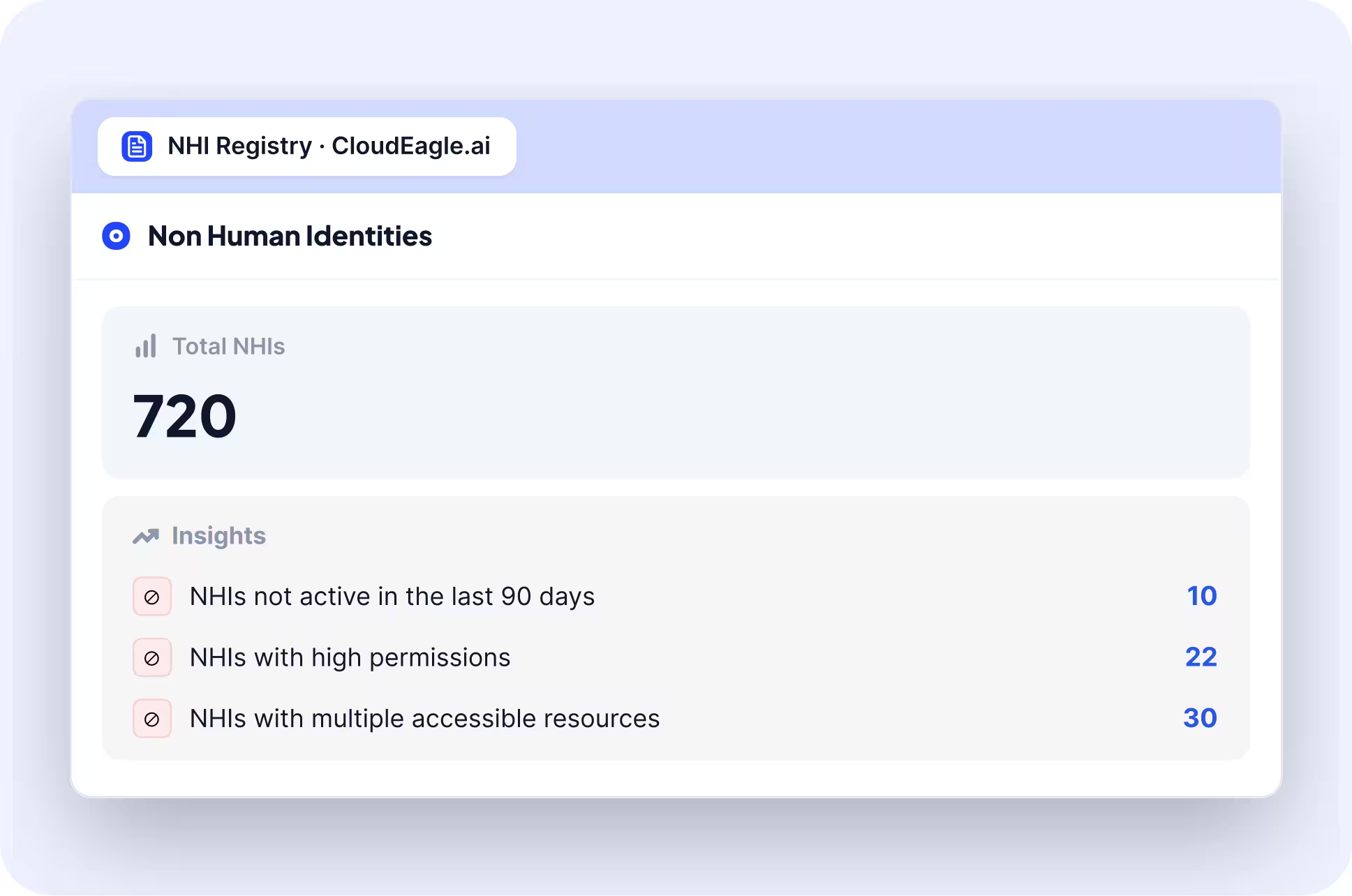
CloudEagle.ai helps security teams identify:

  • Agent identity: The machine identity, service account, API token, or other credential operating the agent.
  • Access scope: The resources and permissions available to that identity.
  • Ownership: The person or team responsible for the identity, or whether it is unowned.
  • Activity: Whether the identity is active or has been inactive for an extended period.
  • Privilege level: Whether the identity holds administrative or other high-risk permissions.
  • Connections: Whether the identity is connected to multiple enterprise resources.

The result is a shift from “Do we know this AI agent exists?” to “What identity is operating this agent, what can it access, and who is accountable for it?”

Channel 2: Third-Party AI Agents

Third-party AI agents introduce a different visibility problem. An organization may approve the underlying application while individual agents, integrations, OAuth connections, or API credentials operate within it.

Discovery therefore needs to go beyond the application name. CloudEagle.ai brings the associated non-human identities into the same governance view so security teams can evaluate the access behind the application.
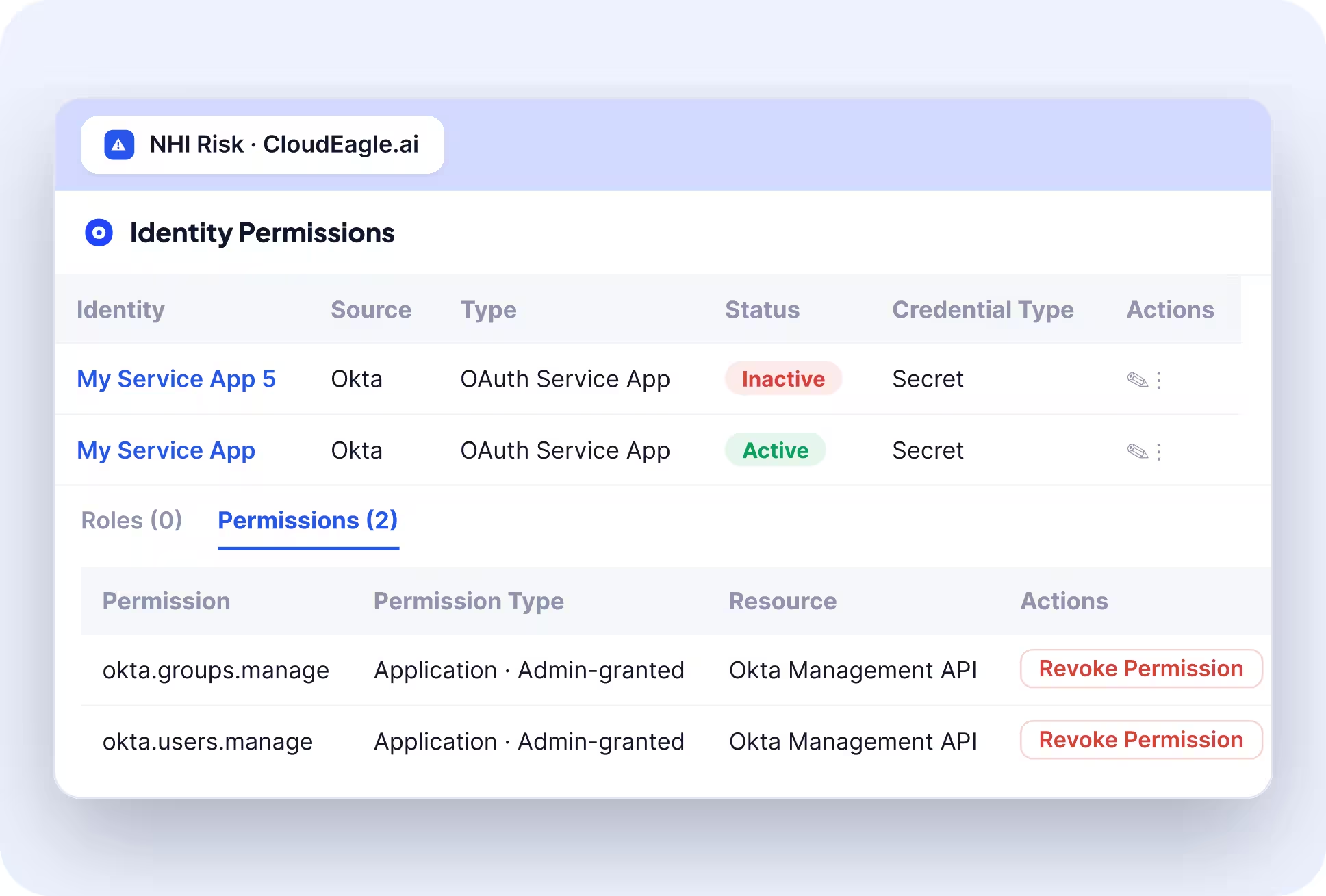
Security teams can assess:

  • Identity type: Whether the agent relies on a managed identity, service identity, OAuth application, or API token.
  • Application relationship: Which third-party application or environment the identity is associated with.
  • Permissions: What level of access the identity has across enterprise resources.
  • Activity: Whether the identity is still being used or has become inactive.
  • Ownership: Whether a responsible owner is assigned.
  • Risk exposure: Whether the identity is over-privileged or connected to multiple resources.

This means teams can prioritize the identities that actually create exposure instead of treating every third-party AI agent as an equal governance concern.

Channel 3: Embedded AI Agents

Embedded agents can be even harder to govern because the agent is part of a larger SaaS application rather than a separately procured tool.

The application may be approved, but the embedded agent can still use machine identities, API tokens, or other credentials to perform actions on behalf of users or systems. Application approval alone therefore does not establish that the agent's access is safe.
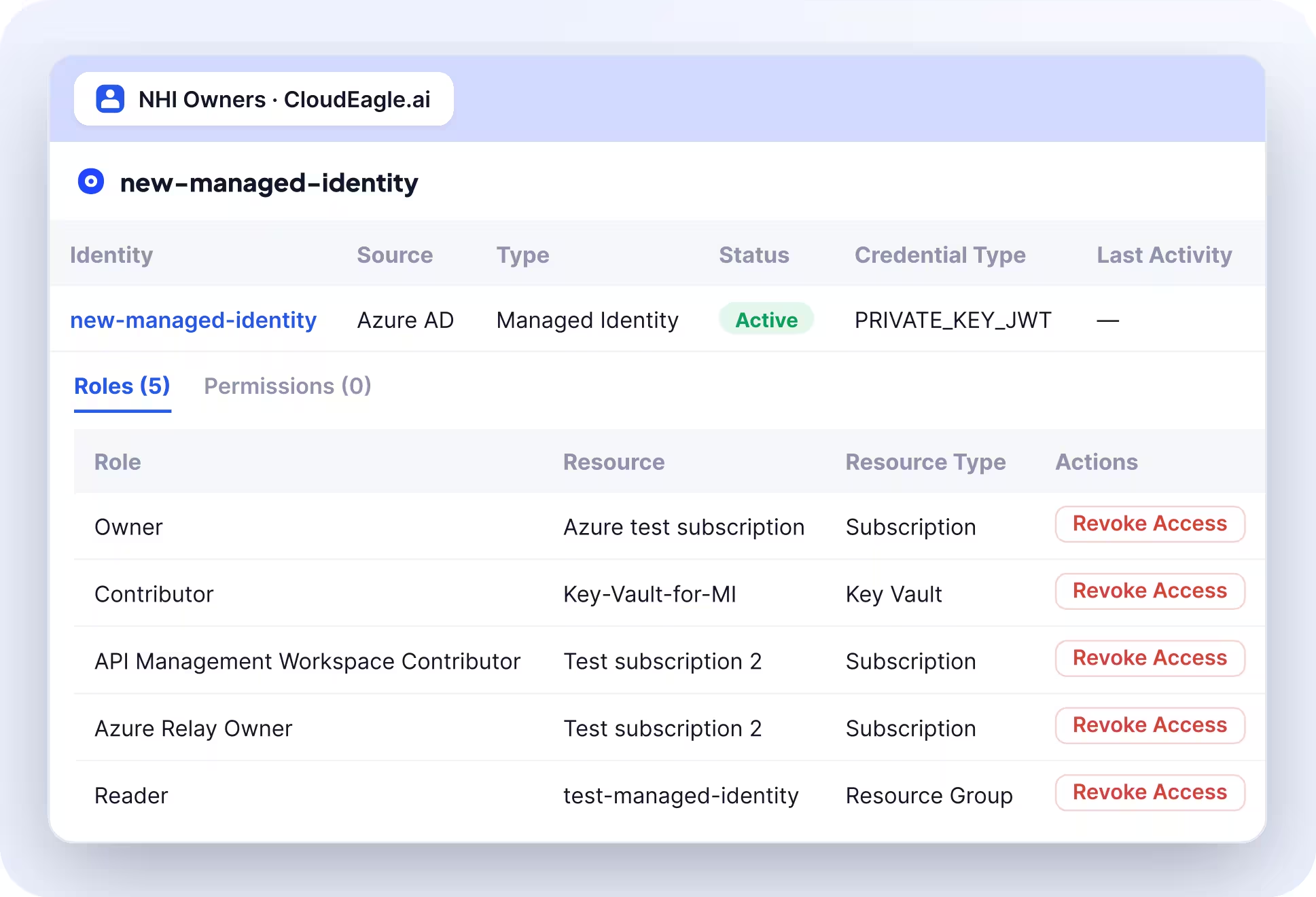
CloudEagle.ai gives security teams visibility into:

  • The underlying identity: Which non-human identity enables the agent to operate.
  • Credential type: Whether access relies on an API token, service identity, OAuth application, or other machine credential.
  • Access and permissions: What resources the identity can reach and what actions it can perform.
  • Ownership: Who is accountable for maintaining the identity and its access.
  • Last activity: Whether the identity is actively required or potentially abandoned.
  • Risk indicators: Whether the identity is inactive, over-privileged, or over-connected.

This allows teams to govern the identity behind the embedded agent, rather than assuming that approving the parent SaaS application is enough.

Discovery Is Only the First Step

Finding AI agents is not enough. The security risk comes from what those agents and the identities behind them can do.

CloudEagle.ai connects discovery with NHI governance by helping teams:

  • Inventory: Bring machine identities into a centralized registry.
  • Classify: Identify identity and credential types across environments.
  • Assess: Surface inactive, over-privileged, and over-connected identities.
  • Assign accountability: Identify owners or flag unowned identities.
  • Remediate: Rotate keys, revoke access or permissions, and reassign owners.
  • Audit: Track remediation actions, including what changed, who performed it, and when.

The result is a continuous path from AI agent discovery → identity mapping → risk analysis → ownership → remediation → auditability.

That is what makes AI-agent discovery useful for security teams: every agent can be evaluated as an identity with access that needs to be governed, rather than simply another application in the software inventory.

3. The Four Things You Need to Know About Every Agent You Find

Once an agent is discovered, four pieces of information determine whether it is properly governed.

Who Owns It

Every agent needs a named owner accountable for three things: certifying the agent still needs to exist, ensuring its access scope remains appropriate, and initiating decommissioning when the use case ends.

An agent with no owner is an agent nobody is governing. Ownership is the prerequisite for every other governance action.

What It Can Reach

The connected systems and permission scope of every agent: what data it can read, what actions it can take, what external systems it connects to.

An agent's data footprint is the primary risk variable. Knowing it is the prerequisite for assessing whether the agent's access is appropriate. Without scope visibility, every other governance step is operating blind.

Whether Its Access Scope Matches Its Purpose

The agent's permission scope compared against its documented purpose.

A support agent with read-only access to a specific ticket queue has appropriate scope. The same agent with write access to the entire CRM does not. This mismatch is the most common AI agent governance finding, and it is invisible without scope visibility per agent.

What Happens When the Owner Leaves

AI agents have no offboarding trigger. When the employee who built or owns an agent departs, the agent keeps running with standing access to connected systems. Offboarding processes at most organizations are not AI-specific, leaving active API tokens and OAuth connections behind indefinitely.

Knowing who owns each agent is what makes the offboarding trigger possible. Without an ownership record, there is no mechanism to catch the agent when its owner is deprovisioned.

📖 Worth a Read 👉 Why Most of Your Non-Human Identities Are Now AI Agents and Not Service Accounts

4. The Five-Step AI Agent Governance Workflow

This is the complete governance workflow in the sequence that works. Each step is independently actionable and builds on the one before.

Step 1: Discover Continuously, Not Periodically

Agent governance starts with a complete, current inventory. Not a quarterly audit that is stale before it is finished.

New agents should surface the day they are created across all three channels. A governance program built on periodic discovery is always governing a partial problem, because agents created between audit cycles are ungoverned until the next one runs.

CloudEagle's continuous discovery layer means the inventory is live before the governance workflow begins.

Step 2: Assign Ownership at Discovery

Every agent that surfaces in the inventory immediately gets an ownership assignment: the creator by default, with a defined escalation for agents whose creator is unknown or has already left the organization.

No agent should exist in the inventory without a named owner for more than 24 hours. That standard forces a decision rather than allowing the ownership gap to persist indefinitely while the team figures out what to do.

Step 3: Scope the Access

Every agent's connected systems and permission scope documented against its stated purpose.

Flag agents where the actual scope exceeds the documented purpose. These are the highest governance priority because excessive permissions increase the potential blast radius if an agent is compromised or behaves unexpectedly.

  • Connected systems: Which applications, data sources, and APIs can the agent access?
  • Permissions: What actions can the agent perform within those systems?
  • Purpose alignment: Does the access granted match what the agent was created to do?
  • Excess access: Are there permissions or connections the agent does not actually need?

Step 4: Review on Cadence

Agent ownership certifications run on a defined schedule. The owner confirms:

  • The agent still needs to exist
  • Its access scope is still appropriate for its current purpose
  • Its connected systems are still current and intended

CloudEagle.ai automates the end-to-end process from assigning agents to reviewers, processing certifications, revoking access for agents that fail review, attaching evidence, and generating the compliance report for auditors. The certification becomes a continuous process rather than a campaign.

Step 5: Extend Offboarding to Cover Agents

When an employee is offboarded, every agent they own surfaces automatically for transfer or decommission review.

Transfer or decommission. No third option.

Allowing a third option, leaving the agent running while the team figures out what to do, is what creates the accumulation problem the governance program is trying to solve. Agents with no active owner after offboarding are decommissioned on a defined timeline.

You Can't Govern the AI You Can't Find.

Learn how to uncover shadow AI and build a complete AI inventory across your organization.
Get the Guide

5. What AI Agent Governance Needs to Cover That IGA Doesn't

IGA was built for human identities with defined roles, HR-triggered lifecycle events, and manager-based access certification. Applying the same model to AI agents breaks down in three specific areas.

1. No Role Model

Human IGA assigns access based on role: a defined set of permissions appropriate for a job function. AI agents do not have job roles. They have collections of connections and permissions assembled for specific tasks.

Agent governance therefore requires purpose-based scoping, not role-based scoping. The right permission scope depends on what the agent was built to do, not on an organizational role.

2. No HR Trigger

Human offboarding typically starts with an HR event. AI agents have no equivalent trigger.

Their lifecycle needs to be tied to the use case. When the business purpose ends, the agent should be reviewed and retired. Applying a human offboarding workflow to an agent can create the wrong trigger for the wrong lifecycle.

3. No Manager

Human access reviews are typically certified by a manager who understands the employee's responsibilities and can determine whether access is appropriate.

AI agents need owner-based certification. The agent's owner should be able to verify what it does, what systems it connects to, and whether those permissions are still necessary. Routing an agent review to a manager without that technical context can result in a certification without meaningful validation.

CloudEagle's NHI governance layer accounts for these differences:

  • Purpose-based scoping instead of role-based access
  • Use-case lifecycle management instead of HR-triggered events
  • Owner-based certification instead of manager-based reviews

Rather than forcing AI agents into a human IGA model that was never designed for them, this approach gives security teams a governance model aligned with how agents are created, used, reviewed, and retired.

Conclusion

Finding every AI agent in your stack is the prerequisite for governing any of them. And governing them requires a workflow built for how agents are actually created, not adapted from how humans are onboarded.

The three-channel discovery problem, the ownership gap, the scope validation, the certification cadence, and the offboarding extension are five distinct governance requirements. Most organizations are meeting zero of them for their full agent inventory. 

CloudEagle.ai provides that discovery layer, along with the ownership assignment, scope visibility, certification workflow, and offboarding integration that turn a discovery program into a functioning AI agent governance program.

See CloudEagle's AI Agent Governance in Action → Book a Demo

Frequently Asked Questions

1. What is AI agent governance?

AI agent governance is the set of controls that ensure every AI agent has a named owner, appropriate permissions, regular reviews, and a defined offboarding process.

2. Why is it so hard to find all the AI agents in an enterprise environment?

AI agents can be built internally, embedded in SaaS products, or purchased as standalone tools. Each channel requires different discovery methods, making complete visibility difficult.

3. What should every AI agent record contain for governance purposes?

Every record should include the agent's owner, connected systems, permissions, documented purpose, and offboarding process.

4. How is AI agent governance different from standard IGA?

IGA uses role-based access, HR-triggered lifecycle events, and manager reviews. AI agent governance requires purpose-based access, use-case-driven lifecycles, and owner-based certification.

5. How often should AI agents be reviewed?

AI agents should be reviewed regularly based on their risk and access scope. Agents with sensitive data or critical system access should be reviewed more frequently.

Advertisement for a SaaS Subscription Tracking Template with a call-to-action button to download and a partial graphic of a tablet showing charts.Banner promoting a SaaS Agreement Checklist to streamline SaaS management and avoid budget waste with a call-to-action button labeled Download checklist.Blue banner with text 'The Ultimate Employee Offboarding Checklist!' and a black button labeled 'Download checklist' alongside partial views of checklist documents from cloudeagle.ai.Digital ad for download checklist titled 'The Ultimate Checklist for IT Leaders to Optimize SaaS Operations' by cloudeagle.ai, showing checklist pages.Slack Buyer's Guide offer with text 'Unlock insider insights to get the best deal on Slack!' and a button labeled 'Get Your Copy', accompanied by a preview of the guide featuring Slack's logo.Monday Pricing Guide by cloudeagle.ai offering exclusive pricing secrets to maximize investment with a call-to-action button labeled Get Your Copy and an image of the guide's cover.Blue banner for Canva Pricing Guide by cloudeagle.ai offering a guide to Canva costs, features, and alternatives with a call-to-action button saying Get Your Copy.Blue banner with white text reading 'Little-Known Negotiation Hacks to Get the Best Deal on Slack' and a white button labeled 'Get Your Copy'.Blue banner with text 'Little-Known Negotiation Hacks to Get the Best Deal on Monday.com' and a white button labeled 'Get Your Copy'.Blue banner with text 'Little-Known Negotiation Hacks to Get the Best Deal on Canva' and a white button labeled 'Get Your Copy'.Banner with text 'Slack Buyer's Guide' and a 'Download Now' button next to images of a guide titled 'Slack Buyer’s Guide: Features, Pricing & Best Practices'.Digital cover of Monday Pricing Guide with a button labeled Get Your Copy on a blue background.Canva Pricing Guide cover with a button labeled Get Your Copy on a blue gradient background.

Enter your email to
unlock the report

Oops! Something went wrong while submitting the form.
License Count
Benchmark
Per User/Per Year

Enter your email to
unlock the report

Oops! Something went wrong while submitting the form.
License Count
Benchmark
Per User/Per Year

Enter your email to
unlock the report

Oops! Something went wrong while submitting the form.
Notion Plus
License Count
Benchmark
Per User/Per Year
100-500
$67.20 - $78.72
500-1000
$59.52 - $72.00
1000+
$51.84 - $57.60
Canva Pro
License Count
Benchmark
Per User/Per Year
100-500
$74.33-$88.71
500-1000
$64.74-$80.32
1000+
$55.14-$62.34

Enter your email to
unlock the report

Oops! Something went wrong while submitting the form.

Enter your email to
unlock the report

Oops! Something went wrong while submitting the form.
Zoom Business
License Count
Benchmark
Per User/Per Year
100-500
$216.00 - $264.00
500-1000
$180.00 - $216.00
1000+
$156.00 - $180.00

Enter your email to
unlock the report

Oops! Something went wrong while submitting the form.

Get the Right Security Platform To Secure Your Cloud Infrastructure

Please enter a business email
Thank you!
The 2023 SaaS report has been sent to your email. Check your promotional or spam folder.
Oops! Something went wrong while submitting the form.

Access full report

Please enter a business email
Thank you!
The 2023 SaaS report has been sent to your email. Check your promotional or spam folder.
Oops! Something went wrong while submitting the form.

TL;DR

  • AI agents enter through three channels simultaneously: internally built in low-code platforms, vendor-embedded in approved products, and purchased platforms adopted by business units without IT. Each channel has a different discovery mechanism. None of them talk to each other
  • Every AI agent is a non-human identity with standing access to enterprise systems. Most have no assigned owner, no review cadence, and no offboarding trigger
  • A complete AI agent governance program requires continuous discovery across all three channels, ownership assignment at discovery, scope validation, a certification cadence, and offboarding workflows that extend to agents when their owner leaves
  • CloudEagle.ai finds AI agents across all three channels in a single continuous inventory, with owner, connected systems, and permission scope attached to each
  • Transfer or decommission. No third option

You can name the AI agents IT approved. You cannot name the ones your sales team built in Copilot Studio last month, the vendor agent that activated in your CRM two weeks ago, or the n8n workflow your ops team deployed to production without a ticket.

That is the actual state of AI agent governance at most enterprises in 2026. Most IT and security teams can produce a list of approved AI tools. 

Very few can produce a list of every AI agent running in their environment, including the ones built by business users in low-code platforms, the ones vendors shipped inside approved products, and the ones created as part of agentic workflows nobody explicitly initiated.

Finding AI agents and governing AI agents are two separate problems, and most organizations have not solved either. Discovery is the prerequisite. Governance is what you do once you know what is there. This blog covers both, in order.

1. Why Finding Every AI Agent Is Harder Than It Sounds

Most security leaders know AI agents are hard to find. The challenge is that they enter the organization through different channels, and each one leaves a different trail.

The three-channel problem: AI agents typically enter in three ways:

  • Internally built workflows: Employees create agents in platforms like Copilot Studio, n8n, Zapier, and Make.
  • Vendor-embedded agents: SaaS vendors introduce agents through products like Salesforce Agentforce, Microsoft Copilot, HubSpot AI, and Zendesk AI.
  • Standalone agent platforms: Business units purchase and deploy agent platforms without involving IT.

Each channel requires a different discovery method. None gives security teams a complete view of agents across the organization.

The identity problem: AI agents also do not appear in the systems IT traditionally uses to govern access. They often show up only inside the platforms where they were created.

For example, a Copilot Studio agent may create a service principal in Azure AD rather than an IT ticket. Security teams might not discover that identity until an audit months later.

Meanwhile, service accounts, API tokens, and other non-human identities can continue operating without regular review. This creates a structural discovery gap.

You cannot govern what you cannot find. Finding every AI agent requires visibility across all three entry points at the same time.

2. How CloudEagle.ai Finds Every AI Agent Across All Three Channels

AI agents do not all enter the enterprise through the same path. Some are built internally, some come through third-party platforms, and others are embedded inside applications employees already use.

CloudEagle.ai treats these agents as non-human identities (NHIs) when they operate with credentials, tokens, permissions, or access to enterprise resources. This lets security teams move beyond simply discovering an agent to understanding what identity it uses, what it can access, who owns it, and whether that access creates risk.

The discovery layer correlates signals across browser, endpoint, SSO, OAuth, finance, and network sources to build a continuous inventory of AI agents. That inventory can then be evaluated alongside other machine identities, including service accounts, managed identities, OAuth service applications, and API tokens.

Channel 1: Internally Built Agents

This is the channel most governance programs miss because internally built agents may never pass through a formal IT provisioning process.

An engineering team can deploy an agent that uses an API token, service account, or another machine credential to interact with internal systems. The agent may not appear as a standalone application in the organization's SSO environment, but the identity behind it still has access that needs to be governed.

CloudEagle.ai helps security teams identify:

  • Agent identity: The machine identity, service account, API token, or other credential operating the agent.
  • Access scope: The resources and permissions available to that identity.
  • Ownership: The person or team responsible for the identity, or whether it is unowned.
  • Activity: Whether the identity is active or has been inactive for an extended period.
  • Privilege level: Whether the identity holds administrative or other high-risk permissions.
  • Connections: Whether the identity is connected to multiple enterprise resources.

The result is a shift from “Do we know this AI agent exists?” to “What identity is operating this agent, what can it access, and who is accountable for it?”

Channel 2: Third-Party AI Agents

Third-party AI agents introduce a different visibility problem. An organization may approve the underlying application while individual agents, integrations, OAuth connections, or API credentials operate within it.

Discovery therefore needs to go beyond the application name. CloudEagle.ai brings the associated non-human identities into the same governance view so security teams can evaluate the access behind the application.

Security teams can assess:

  • Identity type: Whether the agent relies on a managed identity, service identity, OAuth application, or API token.
  • Application relationship: Which third-party application or environment the identity is associated with.
  • Permissions: What level of access the identity has across enterprise resources.
  • Activity: Whether the identity is still being used or has become inactive.
  • Ownership: Whether a responsible owner is assigned.
  • Risk exposure: Whether the identity is over-privileged or connected to multiple resources.

This means teams can prioritize the identities that actually create exposure instead of treating every third-party AI agent as an equal governance concern.

Channel 3: Embedded AI Agents

Embedded agents can be even harder to govern because the agent is part of a larger SaaS application rather than a separately procured tool.

The application may be approved, but the embedded agent can still use machine identities, API tokens, or other credentials to perform actions on behalf of users or systems. Application approval alone therefore does not establish that the agent's access is safe.

CloudEagle.ai gives security teams visibility into:

  • The underlying identity: Which non-human identity enables the agent to operate.
  • Credential type: Whether access relies on an API token, service identity, OAuth application, or other machine credential.
  • Access and permissions: What resources the identity can reach and what actions it can perform.
  • Ownership: Who is accountable for maintaining the identity and its access.
  • Last activity: Whether the identity is actively required or potentially abandoned.
  • Risk indicators: Whether the identity is inactive, over-privileged, or over-connected.

This allows teams to govern the identity behind the embedded agent, rather than assuming that approving the parent SaaS application is enough.

Discovery Is Only the First Step

Finding AI agents is not enough. The security risk comes from what those agents and the identities behind them can do.

CloudEagle.ai connects discovery with NHI governance by helping teams:

  • Inventory: Bring machine identities into a centralized registry.
  • Classify: Identify identity and credential types across environments.
  • Assess: Surface inactive, over-privileged, and over-connected identities.
  • Assign accountability: Identify owners or flag unowned identities.
  • Remediate: Rotate keys, revoke access or permissions, and reassign owners.
  • Audit: Track remediation actions, including what changed, who performed it, and when.

The result is a continuous path from AI agent discovery → identity mapping → risk analysis → ownership → remediation → auditability.

That is what makes AI-agent discovery useful for security teams: every agent can be evaluated as an identity with access that needs to be governed, rather than simply another application in the software inventory.

3. The Four Things You Need to Know About Every Agent You Find

Once an agent is discovered, four pieces of information determine whether it is properly governed.

Who Owns It

Every agent needs a named owner accountable for three things: certifying the agent still needs to exist, ensuring its access scope remains appropriate, and initiating decommissioning when the use case ends.

An agent with no owner is an agent nobody is governing. Ownership is the prerequisite for every other governance action.

What It Can Reach

The connected systems and permission scope of every agent: what data it can read, what actions it can take, what external systems it connects to.

An agent's data footprint is the primary risk variable. Knowing it is the prerequisite for assessing whether the agent's access is appropriate. Without scope visibility, every other governance step is operating blind.

Whether Its Access Scope Matches Its Purpose

The agent's permission scope compared against its documented purpose.

A support agent with read-only access to a specific ticket queue has appropriate scope. The same agent with write access to the entire CRM does not. This mismatch is the most common AI agent governance finding, and it is invisible without scope visibility per agent.

What Happens When the Owner Leaves

AI agents have no offboarding trigger. When the employee who built or owns an agent departs, the agent keeps running with standing access to connected systems. Offboarding processes at most organizations are not AI-specific, leaving active API tokens and OAuth connections behind indefinitely.

Knowing who owns each agent is what makes the offboarding trigger possible. Without an ownership record, there is no mechanism to catch the agent when its owner is deprovisioned.

📖 Worth a Read 👉 Why Most of Your Non-Human Identities Are Now AI Agents and Not Service Accounts

4. The Five-Step AI Agent Governance Workflow

This is the complete governance workflow in the sequence that works. Each step is independently actionable and builds on the one before.

Step 1: Discover Continuously, Not Periodically

Agent governance starts with a complete, current inventory. Not a quarterly audit that is stale before it is finished.

New agents should surface the day they are created across all three channels. A governance program built on periodic discovery is always governing a partial problem, because agents created between audit cycles are ungoverned until the next one runs.

CloudEagle's continuous discovery layer means the inventory is live before the governance workflow begins.

Step 2: Assign Ownership at Discovery

Every agent that surfaces in the inventory immediately gets an ownership assignment: the creator by default, with a defined escalation for agents whose creator is unknown or has already left the organization.

No agent should exist in the inventory without a named owner for more than 24 hours. That standard forces a decision rather than allowing the ownership gap to persist indefinitely while the team figures out what to do.

Step 3: Scope the Access

Every agent's connected systems and permission scope documented against its stated purpose.

Flag agents where the actual scope exceeds the documented purpose. These are the highest governance priority because excessive permissions increase the potential blast radius if an agent is compromised or behaves unexpectedly.

  • Connected systems: Which applications, data sources, and APIs can the agent access?
  • Permissions: What actions can the agent perform within those systems?
  • Purpose alignment: Does the access granted match what the agent was created to do?
  • Excess access: Are there permissions or connections the agent does not actually need?

Step 4: Review on Cadence

Agent ownership certifications run on a defined schedule. The owner confirms:

  • The agent still needs to exist
  • Its access scope is still appropriate for its current purpose
  • Its connected systems are still current and intended

CloudEagle.ai automates the end-to-end process from assigning agents to reviewers, processing certifications, revoking access for agents that fail review, attaching evidence, and generating the compliance report for auditors. The certification becomes a continuous process rather than a campaign.

Step 5: Extend Offboarding to Cover Agents

When an employee is offboarded, every agent they own surfaces automatically for transfer or decommission review.

Transfer or decommission. No third option.

Allowing a third option, leaving the agent running while the team figures out what to do, is what creates the accumulation problem the governance program is trying to solve. Agents with no active owner after offboarding are decommissioned on a defined timeline.

You Can't Govern the AI You Can't Find.

Learn how to uncover shadow AI and build a complete AI inventory across your organization.
Get the Guide

5. What AI Agent Governance Needs to Cover That IGA Doesn't

IGA was built for human identities with defined roles, HR-triggered lifecycle events, and manager-based access certification. Applying the same model to AI agents breaks down in three specific areas.

1. No Role Model

Human IGA assigns access based on role: a defined set of permissions appropriate for a job function. AI agents do not have job roles. They have collections of connections and permissions assembled for specific tasks.

Agent governance therefore requires purpose-based scoping, not role-based scoping. The right permission scope depends on what the agent was built to do, not on an organizational role.

2. No HR Trigger

Human offboarding typically starts with an HR event. AI agents have no equivalent trigger.

Their lifecycle needs to be tied to the use case. When the business purpose ends, the agent should be reviewed and retired. Applying a human offboarding workflow to an agent can create the wrong trigger for the wrong lifecycle.

3. No Manager

Human access reviews are typically certified by a manager who understands the employee's responsibilities and can determine whether access is appropriate.

AI agents need owner-based certification. The agent's owner should be able to verify what it does, what systems it connects to, and whether those permissions are still necessary. Routing an agent review to a manager without that technical context can result in a certification without meaningful validation.

CloudEagle's NHI governance layer accounts for these differences:

  • Purpose-based scoping instead of role-based access
  • Use-case lifecycle management instead of HR-triggered events
  • Owner-based certification instead of manager-based reviews

Rather than forcing AI agents into a human IGA model that was never designed for them, this approach gives security teams a governance model aligned with how agents are created, used, reviewed, and retired.

Conclusion

Finding every AI agent in your stack is the prerequisite for governing any of them. And governing them requires a workflow built for how agents are actually created, not adapted from how humans are onboarded.

The three-channel discovery problem, the ownership gap, the scope validation, the certification cadence, and the offboarding extension are five distinct governance requirements. Most organizations are meeting zero of them for their full agent inventory. 

CloudEagle.ai provides that discovery layer, along with the ownership assignment, scope visibility, certification workflow, and offboarding integration that turn a discovery program into a functioning AI agent governance program.

See CloudEagle's AI Agent Governance in Action → Book a Demo

Frequently Asked Questions

1. What is AI agent governance?

AI agent governance is the set of controls that ensure every AI agent has a named owner, appropriate permissions, regular reviews, and a defined offboarding process.

2. Why is it so hard to find all the AI agents in an enterprise environment?

AI agents can be built internally, embedded in SaaS products, or purchased as standalone tools. Each channel requires different discovery methods, making complete visibility difficult.

3. What should every AI agent record contain for governance purposes?

Every record should include the agent's owner, connected systems, permissions, documented purpose, and offboarding process.

4. How is AI agent governance different from standard IGA?

IGA uses role-based access, HR-triggered lifecycle events, and manager reviews. AI agent governance requires purpose-based access, use-case-driven lifecycles, and owner-based certification.

5. How often should AI agents be reviewed?

AI agents should be reviewed regularly based on their risk and access scope. Agents with sensitive data or critical system access should be reviewed more frequently.

CloudEagle.ai recognized in the 2025 Gartner® Magic Quadrant™ for SaaS Management Platforms
Download now
gartner chart
5x
Faster employee
onboarding
80%
Reduction in time for
user access reviews
30k
Workflows
automated
$15Bn
Analyzed in
contract spend
$2Bn
Saved in
SaaS spend

Streamline SaaS governance and save 10-30%

Book a Demo with Expert
CTA image