
%201.svg)


HIPAA Compliance Checklist for 2025

The first sign that most companies have an AI governance problem is usually not a security alert. It is an expense report. What looked like eight approved AI tools often turns out to be twenty-six once Finance starts digging.
That is not surprising when 23% to 58% of employees, depending on the industry, are bringing their own AI tools to work.
That gap is exactly what Singulr AI was built to address. Its unified control plane helps organizations discover and govern AI usage across the enterprise.
But it is not the only option. This guide breaks down six Singulr alternatives, where each platform fits best, and how to choose the right one for your environment.
TL;DR
1. What Singulr Does and Where It Fits?
Singulr AI delivers enterprise AI governance with complete visibility, security, and compliance across the AI adoption lifecycle. It discovers and manages a wide variety of AI agents, including in-house agents, agents for employee use, and agents embedded in SaaS applications.
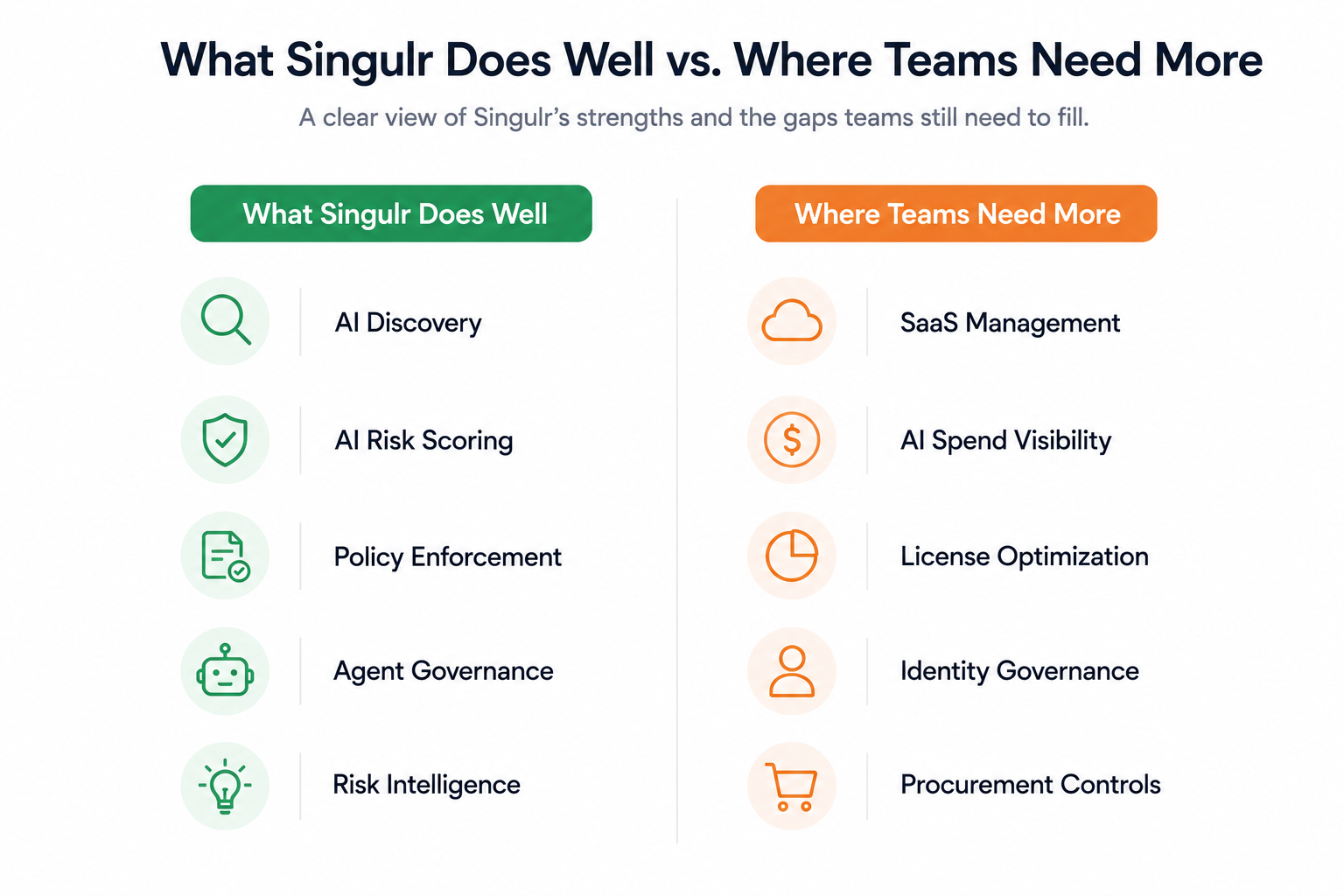
Here is what is genuinely strong about Singulr:
- Discovers all three types of generative AI: homegrown applications, public AI services, and embedded AI features in SaaS
- Singulr Pulse maintains real-time profiles of millions of AI models, services, MCP servers, agents, and datasets, which is one of the deepest risk intelligence feeds in the category
- Transforms weeks-long vetting cycles into hours with automated assessment and approval workflows
- Continuous red-teaming to identify control gaps and vulnerabilities in real time
Here is where it fits: security and IT teams whose primary mandate is AI discovery, risk scoring, and policy enforcement at the model and agent level.
Here is where it does not fit:
- SaaS license governance and optimization
- AI spend management across teams and business units
- Identity lifecycle automation and access governance
- A shared platform for Finance, Procurement, IT, and Security teams
- Broader SaaS management capabilities beyond AI governance

6 Best Singulr Alternatives in 2026
The best Singulr alternatives take different approaches to AI governance, from AI discovery and compliance to SaaS management and spend control.
Here are our top 6
1. CloudEagle.ai
CloudEagle.ai takes a broader approach than Singulr. While Singulr focuses on AI discovery, risk scoring, and policy enforcement, CloudEagle.ai combines AI governance with SaaS management, identity governance, and spend control, helping organizations manage both AI and SaaS risk from one platform.
"Once AI adoption accelerated across teams, visibility alone wasn't enough. We needed clear rules around who could use AI tools, under what conditions, and how those decisions were enforced and reviewed. CloudEagle helped us move from ad-hoc approvals to structured, defensible AI governance." Aditya Khosla, CTO, Iterative Health
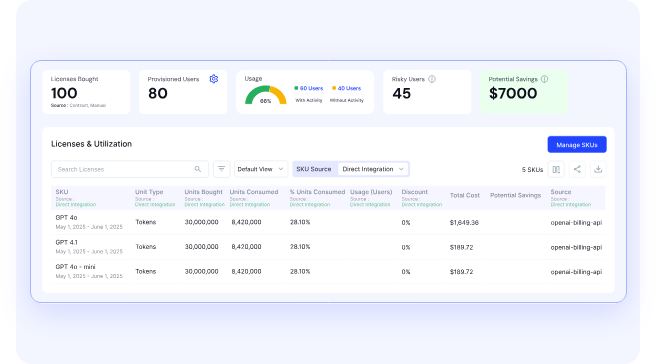
Key capabilities:
- Multi-signal Shadow AI discovery across browser extensions, SSO, finance systems, Zscaler, CrowdStrike, and other security signals, including visibility into unsanctioned AI tools and personal accounts
- Discovery and governance of AI agents, embedded GenAI features, and AI capabilities activated inside existing SaaS applications
- Real-time AI usage, token consumption, spend tracking, chargeback reporting, and optimization of duplicate or unused AI subscriptions
- Browser-based AI governance controls that redirect employees to approved tools and prevent sensitive data from being shared with unapproved AI applications
- Netskope-powered AI risk scoring based on data residency, training data practices, model lineage, and overall security posture
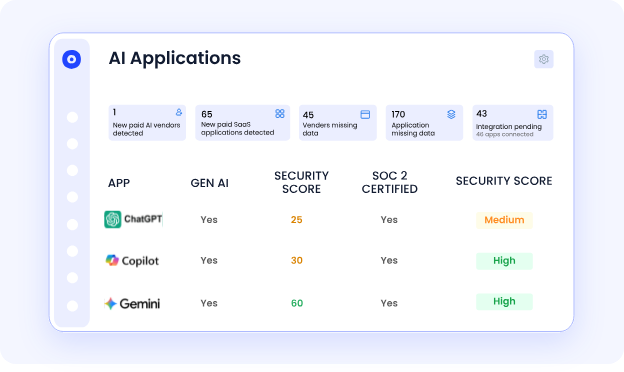
Key differentiator vs. Singulr: Broader operational governance beyond AI risk management. In addition to AI discovery and governance, CloudEagle.ai provides SaaS management, identity governance, and AI spend controls, reducing the need for separate platforms across IT, Security, Finance, and Procurement.
- Limitation: Less specialized depth in agentic AI red-teaming and model lineage intelligence.
- Pricing: Custom Pricing
- Ideal org size: Mid-market to enterprise.
You Probably Have 60 to 80 AI Tools Running That IT Has Never Reviewed.


2. Reco.ai
Reco takes a different approach to the problem. Rather than starting from an AI inventory, it starts from identity and behavioral signals, detecting when AI tools create risk through anomalous access patterns, overprivileged OAuth grants, and identity-based threat indicators.
Organizations comparing Singulr alternatives often shortlist Reco when identity-based AI risk is a bigger concern than model-level governance.
18% of enterprise employees paste data into GenAI tools, and over 50% of those pastes include corporate information. Reco's identity-aware approach catches these patterns through behavioral signals that model-centric platforms miss.
- Key differentiator vs. Singulr: Identity-aware threat detection alongside AI discovery vs. Singulr's model-centric risk intelligence. When the risk vector is a compromised identity or an overprivileged OAuth grant rather than a model-level risk, Reco sees it first.
- Limitation: Less depth on AI spend governance, token consumption tracking, and SaaS lifecycle management. Strong on security signals, lighter on operational governance that Finance and Procurement need.
- Pricing: Custom pricing. Contact Reco for enterprise quotes.
- Ideal org size: Mid-market to enterprise security teams
3. Credo AI
Credo AI enables governance teams to assess AI models for compliance with internal policies and external regulations, supporting standardized workflows for model evaluation, risk assessment, and reporting.
Among compliance-focused Singulr alternatives, Credo AI stands out for its regulatory alignment and audit-readiness capabilities.
- Key differentiator vs. Singulr: Audit-ready compliance documentation and regulatory framework mapping vs. Singulr's runtime discovery and enforcement focus. Two different parts of the governance problem.
- Limitation: Credo AI governs the AI models your organization builds and deploys. It does not discover shadow AI tools your employees adopted independently, does not cover SaaS-embedded GenAI features, and has no token spend visibility.
- Pricing: Subscription-based, varying on organizational scale and features. Typically $50,000+ annually for focused deployments.
- Ideal org size: Enterprise with dedicated GRC function and regulatory compliance requirements
4. Aurascape
Aurascape is purpose-built for AI security at the traffic and prompt layer. It monitors what employees are actually sending to AI tools, inspects content for sensitive data patterns in real time, and provides behavioral visibility across LLM interactions at enterprise scale.
Your DLP scans files leaving sanctioned channels. It doesn't read what an employee types into a chat field. Aurascape fills that gap specifically, focusing on what is being sent rather than just which tools are being used.
- Key differentiator vs. Singulr: Real-time content inspection and data protection at the prompt layer vs. Singulr's model and agent-level governance. When data leakage through AI prompts is the primary concern, Aurascape's inspection depth is stronger.
- Limitation: Focused narrowly on AI security and data protection rather than broader operational governance, compliance documentation, or SaaS management. Does not replace a SaaS platform.
- Pricing: Custom pricing. Contact Aurascape for enterprise quotes.
- Ideal org size: Enterprise security teams with data protection as primary mandate
5. Holistic AI
Holistic AI delivers a full-stack AI governance platform with end-to-end lifecycle management, from initial data checks through deployment and monitoring. Features include automated risk assessment, data quality management, shadow AI detection, and a unified repository that displays all AI systems and their corresponding compliance status.
Teams evaluating enterprise-grade Singulr alternatives frequently consider Holistic AI for its broader model lifecycle governance capabilities.
- Key differentiator vs. Singulr: Broader ethical AI and model lifecycle coverage, including bias detection and fairness assessments, vs. Singulr's real-time control plane and agentic AI focus.
- Limitation: Higher implementation cost and longer time-to-value than operationally focused platforms. Limited coverage of SaaS management, token spend governance, or identity lifecycle automation.
- Pricing: Typically $50,000 to several hundred thousand annually, depending on scope and deployment.
- Ideal org size: Enterprise with mature AI programs and dedicated AI governance teams
6. BetterCloud
BetterCloud is primarily a SaaS management and IT automation platform that has layered AI tool governance capabilities into its unified SMP layer. If your primary need is IT workflow automation alongside basic AI tool visibility, it avoids the need for a separate point tool.
- Key differentiator vs. Singulr: Broader SaaS management and workflow automation depth vs. Singulr's AI-specific governance depth. Better suited when IT automation is equally important to AI governance.
- Limitation: AI governance capabilities are significantly less deep than purpose-built platforms. Limited to model risk scoring, token consumption tracking, and agentic AI governance. The AI governance layer is a feature of a broader SaaS tool, not the core product.
- Pricing: Custom, modular pricing based on license count, connected apps, and modules selected.
- Ideal org size: Mid-market to enterprise, IT operations-focused teams
3. Why Teams Are Looking for Singulr Alternatives
Singulr is a strong AI governance platform, but organizations evaluating Singulr alternatives often have requirements that extend beyond AI discovery and risk management.
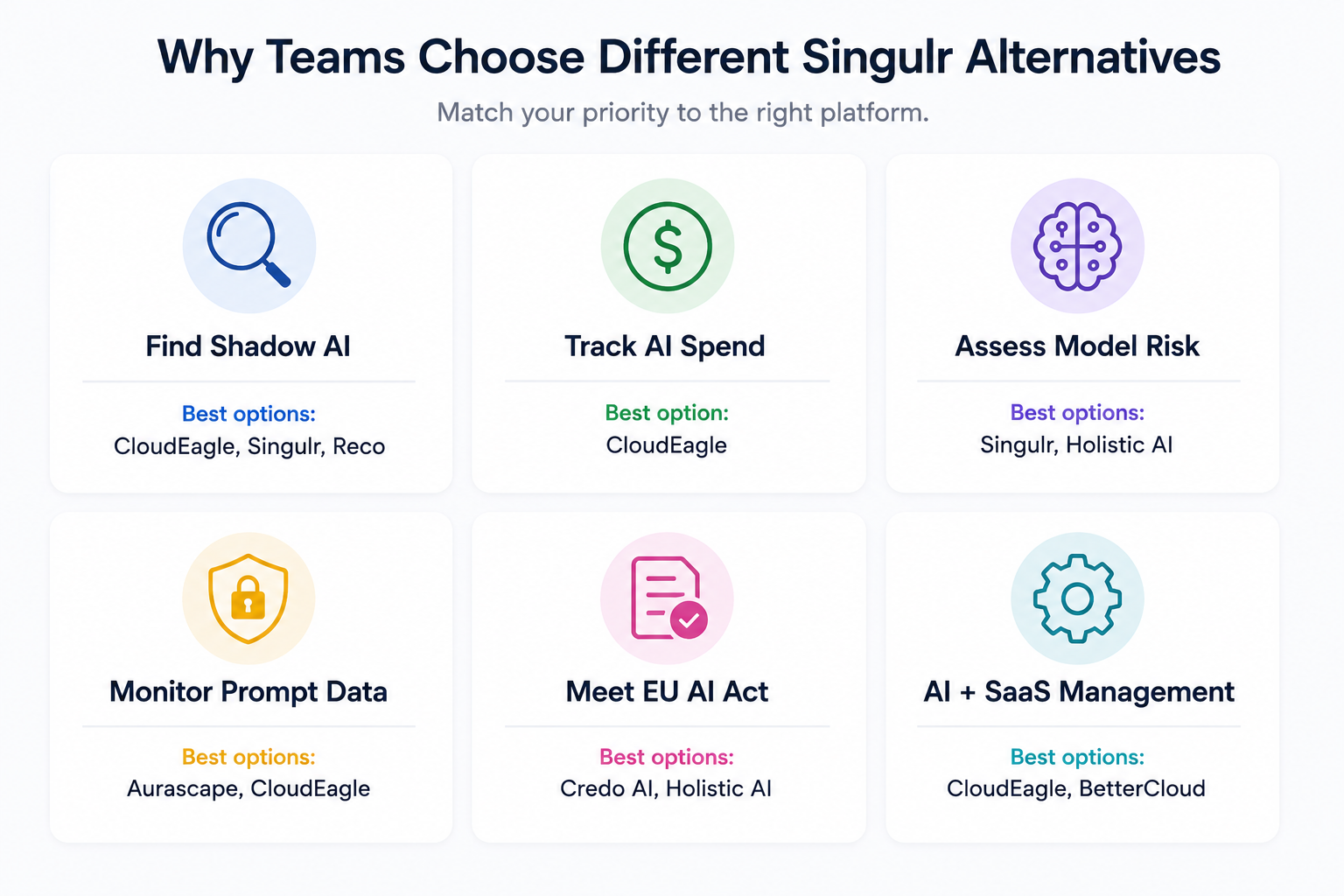
Some of the most common reasons teams explore alternatives include:
- Broader governance requirements: AI governance increasingly overlaps with SaaS management, identity governance, procurement, and spend management. Organizations looking for a single platform across these functions may evaluate broader solutions.
- AI usage and cost visibility: As AI spending shifts toward token-, credit-, and API-based pricing models, many teams want deeper visibility into AI usage, consumption patterns, and costs across business units.
- Different governance priorities: Some organizations prioritize compliance and audit readiness, while others focus on runtime security, data protection, AI risk management, or operational governance. Different platforms emphasize different parts of the AI governance lifecycle.
- Pricing transparency: For organizations comparing multiple vendors, publicly available pricing or clearer packaging can make budgeting and procurement discussions easier.
📖 Worth a Read: 👉 How Enterprises Can Track Claude, Cursor, and Gemini Spend in One Place
SaaS and AI Spend Calculator
CloudEagle.ai customers typically recover 10–30% of annual SaaS and AI spend. Answer 12 questions to benchmark your maturity, see your recoverable spend estimate, and get a personalized 3-page savings report.
No signup required to start · Instant results
Enter your work email to reveal your personalized estimate, maturity scores, and a downloadable 3-page report.
—
Based on your responses, you are likely overspending approximately $XXXX. There may be unused licenses, overlapping tools, or suboptimal pricing across your SaaS and AI ecosystem.
Download your report for the specific gaps, the consequences if left unaddressed, and the first action to recover spend on each one.

The areas below scored 1 or 2 in your assessment. Each represents a specific gap where spend is leaking or optimization is being left on the table, with a clear first action to address it.
CloudEagle.ai is the AI-powered command center for SaaS, AI, and identity governance. Trusted by RingCentral, Automation Anywhere, Shiji, and Rec Room, the platform has processed $20B+ in spend and delivered $2B+ in savings — typically 10–30% of annual SaaS and AI spend. The gaps surfaced in this report are exactly what CloudEagle was built to close.
Most organizations are governing a fraction of their actual SaaS and AI footprint. CloudEagle.ai builds a real-time inventory through 500+ direct integrations across SSO, finance, HRIS, browser, firewall, and contract data — surfacing every sanctioned tool, every shadow purchase, and every AI tool employees adopted without IT approval. Onboarding takes 30 minutes, with usable visibility from day one.
Unused licenses, duplicate tools, and over-tiered subscriptions accumulate silently between renewal cycles. CloudEagle.ai runs continuous license harvesting, flags overlapping tools across departments, and arms renewals with peer pricing benchmarks and usage data — turning insights into action through no-code Slack-enabled workflows. Customers typically recover 10–30% of annual SaaS spend within the first 90 days.
AI tool costs are usage-based, token-driven, and largely invisible until invoices arrive. CloudEagle.ai tracks AI tool adoption across the organization, monitors usage against budget thresholds, enforces approval workflows for new AI tools, and detects sensitive content shared with public AI services — giving finance, IT, and security a shared real-time view before overruns hit the P&L.
In a focused session with a CloudEagle.ai specialist, we map your specific spend profile against our optimization framework and show you exactly where your savings are — across unused licenses, duplicate tools, renewal negotiation leverage, and AI spend governance.
4. How to Choose Between Singulr and Its Alternatives
Stop starting with the feature matrix. Start with the question your auditor, your CFO, or your CISO is going to ask you in the next 90 days.
When comparing Singulr alternatives, the right choice depends less on feature counts and more on the governance problem you need to solve first.
Hear how enterprise IT and security leaders are navigating the AI governance challenge in practice before committing to a platform:
🎙️ Podcast Optimizing Shadow IT Risks and Innovations in SaaS Management. Real perspective on what AI governance looks like when it has to scale across teams that are already using AI, whether IT approved it or not. 👉 Listen now
Start With the Problem, Not the Platform
The enterprise AI landscape has fundamentally shifted. Many vendors claim comprehensive AI governance while covering only specific parts of the lifecycle. That is true of Singulr, and it is true of every platform in this list, including CloudEagle.ai.
The platforms that win enterprise evaluations are not the ones with the most features.
They are the ones that answer the specific question your organization is being asked right now, whether that is "show me every AI tool in use," "show me where our AI spend is going by team," or "show me the evidence that our AI governance would hold up in an EU AI Act audit."
Want visibility beyond AI discovery? CloudEagle.ai helps organizations govern Shadow AI, track token consumption, manage AI-enabled SaaS applications, and enforce AI policies from a single platform.
Frequently Asked Questions
- What is an AI governance platform?
An AI governance platform is software that helps organizations manage the security, compliance, risk, and usage of AI tools and models. It provides visibility into AI adoption, enforces policies, monitors AI-related risks, supports regulatory compliance, and helps teams govern AI usage across the enterprise.
- What are the 4 AI platforms?
There is no official list of the four AI platforms. However, some widely used enterprise AI governance platforms include CloudEagle.ai, Singulr AI, Credo AI, and Holistic AI. Each platform focuses on different aspects of AI governance, such as AI discovery, compliance management, risk assessment, and operational controls.
- What are the best AI governance tools?
Some of the leading AI governance tools include CloudEagle.ai, Singulr AI, Credo AI, Holistic AI, Reco, and Aurascape. The best option depends on your organization's needs, whether that is AI discovery, compliance, security monitoring, AI spend management, or governance across both AI and SaaS applications.
- Which are the top 5 AI platforms?
The top AI platforms vary based on use case, but commonly recognized enterprise AI governance platforms include CloudEagle.ai, Singulr AI, Credo AI, Holistic AI, and Reco. These solutions help organizations manage AI adoption through governance, security, compliance, and risk management capabilities.
- Who are the Big 4 in AI?
There is no universally accepted "Big 4" in AI. However, OpenAI, Google, Microsoft, and Anthropic are often considered among the most influential AI companies because of their foundation models, research advancements, and impact on enterprise AI adoption.
You Probably Have 60 to 80 AI Tools Running That IT Has Never Reviewed.


.avif)


.avif)
.avif)




.png)




.avif)
.avif)
.avif)


