
%201.svg)


HIPAA Compliance Checklist for 2025

Do you know how many AI systems your organization is running right now, including the ones nobody approved?
Embedded AI now exists inside nearly every SaaS tool your teams use, from browser extensions and copilots to smart suggestions and automated workflows. Most of it operates quietly, outside IT visibility.
According to CloudEagle.ai’s IGA report, 60% of AI and SaaS apps operate completely outside IT visibility.
This creates serious risk. Sensitive data flows into unmanaged AI tools, shadow AI bypasses security policies, and compliance gaps grow before anyone notices.
Embedded AI discovery platforms help enterprises close this gap by uncovering hidden AI usage, governing access, and reducing risk across the SaaS stack.
Here are the 10 best embedded AI discovery platforms for 2026.
TL;DR
- Embedded AI is everywhere, and most of it is invisible to IT and security teams
- Embedded AI discovery platforms uncover hidden AI usage across apps, APIs, extensions, and SaaS tools in real time
- A strong embedded AI discovery platform provides risk scoring, usage insights, access governance, and compliance automation
- CloudEagle.ai leads the market with full AI, SaaS, and access discovery, shadow AI detection, and embedded AI visibility in one unified platform
- This list covers the top 10 platforms helping security, IT, governance, and compliance teams stay ahead of rising AI risk
1. What Are Embedded AI Discovery Platforms and What Do They Find?
Embedded AI discovery platforms help organizations clearly understand how AI is being used across their SaaS stack, not just which apps are active. They scan tools, workflows, and user activity to show where AI features exist, who is using them, and whether sensitive data is being sent to AI models.
These platforms also uncover hidden AI features inside everyday tools like auto-generate buttons, smart suggestions, summaries, and predictive insights that employees use without realizing they are powered by AI.
What they help identify:
- Which applications contain embedded or generative AI capabilities
- Which users or teams are engaging with those AI features
- Whether sensitive or regulated data is being sent to AI models
- Where AI is processing or generating business-critical information
- Whether AI usage aligns with internal policies and compliance requirements
- Hidden or unapproved AI features inside common SaaS tools
Types of AI activity they track:
- LLM-powered functionalities, including chat, summarization, generation, and Q&A
- Autonomous or semi-autonomous AI agents
- AI-driven analytics and insights
- Embedded AI APIs and backend model calls
- Model-generated content, recommendations, or actions
- Automatic workflows or decisions triggered by AI
Traditional SaaS discovery tools cannot detect any of this. Embedded AI discovery are built specifically for this purpose.
2. Why Embedded AI Is the Governance Gap Most Enterprises Have Not Closed Yet
Most enterprises have invested in SaaS management. They track renewals, manage licenses, and control spend. But almost none of those platforms were designed to answer the question that now matters most: what is the AI inside those tools actually doing?
This is the governance gap embedded AI has created.
AI adoption inside enterprises is happening bottom-up. Employees independently sign up for AI tools, enable AI features inside approved SaaS apps, and use browser extensions powered by third-party LLMs, all without formal IT review or security assessment.
The result is that your enterprise is almost certainly running AI that it has never evaluated, governed, or secured. And the longer that continues, the larger the compliance and security exposure becomes.
Most enterprises are not struggling with AI adoption; they are struggling with defensible AI governance. Duplicate copilots, unmanaged AI agents, and AI tool sprawl create risks that traditional SaaS governance was never built to handle.
Embedded AI discovery platforms are the control plane for this problem, giving IT, security, and compliance teams the visibility they need to govern AI the same way they govern SaaS.

3. 10 Best Embedded AI Discovery Platforms in 2026
1. CloudEagle.ai
CloudEagle.ai is the AI Command Center for SaaS, Identity, and AI Governance, helping enterprises discover shadow AI, govern embedded AI usage, and secure access across their SaaS ecosystem.
Trusted by RingCentral, Automation Anywhere, Lapzo, and Rec Room, CloudEagle manages $20B+ in SaaS spend and has delivered $2B+ in savings through better AI governance, access control, and vendor rationalization.
It stands out by combining embedded AI discovery, shadow AI detection, SaaS governance, and access control in one unified platform instead of treating them as separate tools.
Centralized AI Governance Dashboard
CloudEagle.ai discovers and governs AI usage across your entire SaaS ecosystem from a single control plane. IT and security teams get real-time visibility into AI adoption, along with the ability to enforce policies and manage risk centrally.

How it helps:
- Discovers every AI tool in use using browser signals, SSO, and integrations like Zscaler and CrowdStrike
- Identifies embedded AI features inside existing SaaS tools and surfaces shadow AI usage across teams
- Provides a centralized view of AI usage, risk, and policy enforcement across the organization
- Surfaces policy violations and compliance gaps before they become incidents
- Maintains a continuously updated AI inventory with adoption insights by team and user
Shadow AI Detection Before It Spreads
Employees often install AI extensions, plugins, and new tools without approval. CloudEagle.ai detects these tools the moment they appear, whether in browsers, apps, or user activity patterns, and flags them for IT and Security review.

How it helps:
- Surfaces unauthorized AI tools accessing sensitive data outside approved systems
- Enables remediation: blocking sensitive content shared to unapproved AI tools and redirecting users to approved alternatives
- Closes the governance gap between what the IdP sees and what employees actually use
User Access Reviews
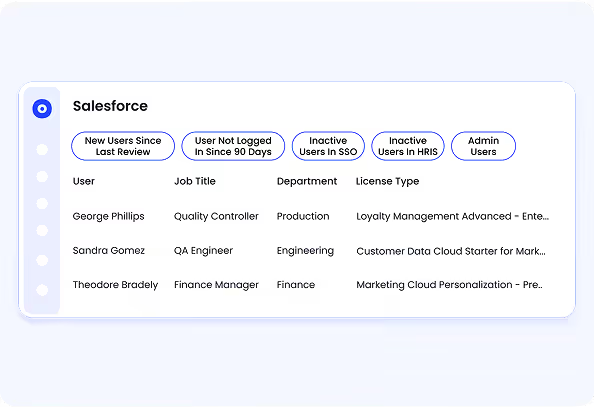
CloudEagle.ai helps security teams continuously review access across SaaS and AI tools, ensuring permissions stay aligned with actual job needs and risky access does not go unchecked.
How it helps:
- Identifies inactive users, excessive permissions, and unnecessary admin access
- Automates review workflows, so teams focus only on high-risk access decisions
- Maintains complete audit-ready evidence for compliance reviews and certifications
Excessive Privileged Users
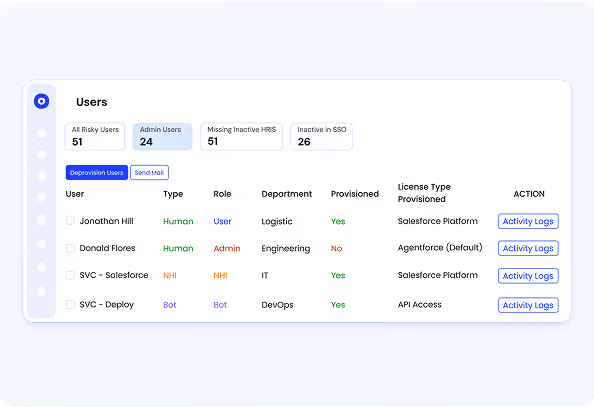
CloudEagle.ai enforces least-privilege access across AI tools, ensuring only the right users can access high-risk applications handling sensitive data.
How it helps:
- Prevents over-provisioned access to AI tools that process sensitive information
- Maintains audit-ready access controls for continuous compliance
- Supports secure AI adoption without creating unmanaged access risk
Pricing: Custom pricing based on company size, number of SaaS and AI tools, and governance requirements. Most teams see quick ROI through SaaS savings and reduced security risk.
See Every AI Tool Your Organization Is Actually Running


2. Zylo
Zylo is a SaaS management platform that helps companies see and control all the software they use. It tracks which apps are active, how employees use them, and where money is being spent. A strong choice for organizations focused on cutting SaaS waste and managing vendor renewals effectively.
Key Features
- Identifies SaaS apps through SSO, finance, and browser data
- Tracks usage trends and inactive licenses
- Monitors renewal dates and contract terms
- Provides spend insights and optimization suggestions
Cons
- Limited AI-specific discovery
- Not ideal for deep security validation or AI governance
Pricing: Custom enterprise quotes.
3. Zluri
Zluri helps IT teams find and manage every SaaS app in the organization. It automates onboarding, offboarding, and user access, reducing manual IT work while providing clear usage insights to eliminate shadow IT and unused licenses.
Key Features
- Discovers SaaS apps via SSO, finance, and system logs
- Automates user onboarding and offboarding
- Tracks app usage and engagement patterns
- Provides spend analytics and workflow automation
Cons
- Limited embedded AI visibility
- Lacks deep risk scoring for AI activity
Pricing: Custom pricing, typically mid-market friendly.
4. Productiv
Productiv helps companies understand how people actually use their SaaS apps. Its analytics make it easy to see which tools are valuable and which are not, with centralized contract and spend data for better renewal decisions.
Key Features
- Tracks granular app engagement at the feature level
- Provides license optimization suggestions
- Centralizes contract and renewal data
- Offers usage-based insights for ROI reporting
Cons
- Weak security and AI tracking
- Limited governance capabilities
Pricing: Enterprise pricing only.
5. Torii
Torii is built for IT teams that want to automate SaaS operations. It discovers new apps, tracks renewals, provides clear usage and spend visibility, and automates repetitive IT workflows.
Key Features
- Discovers apps through SSO, finance, and network logs
- Automates lifecycle tasks for joiner, mover, and leaver workflows
- Monitors SaaS spend, renewals, and app ownership
- Provides policy-based workflow automation
Cons
- Limited embedded AI discovery
- Basic compliance workflows
Pricing: Custom enterprise quotes.
6. BetterCloud
BetterCloud gives companies greater control over SaaS security and user access. It automates provisioning, deprovisioning, and policy enforcement across apps with no-code workflows designed for IT and security teams.
Key Features
- Automates user provisioning and deprovisioning
- Enforces security and usage policies across connected apps
- Monitors activity within connected applications
- Supports workflow orchestration for IT operations
Cons
- No embedded AI detection
- Complex setup for smaller teams
Pricing: Enterprise-only, premium-priced.
7. Wing Security
Wing Security focuses on finding shadow IT and reducing risks from unapproved SaaS apps. It checks vendor security posture, monitors risky activity, and protects sensitive data with policy controls and real-time alerts.
Key Features
- Detects unsanctioned SaaS apps automatically
- Monitors permissions and user activity
- Evaluates vendor security posture
- Alerts on risky behavior or unauthorized connections
Cons
- Not optimized for spend management
- Limited embedded AI visibility
Pricing: Free tier available. Paid plans start at affordable mid-market pricing.
8. Lumos
Lumos brings all SaaS access and permissions into one place. It automates access reviews, approvals, and governance to keep permissions clean and compliant with least-privilege controls built in.
Key Features
- Centralizes app access and permissions across the stack
- Automates access approvals and reviews
- Tracks user activity and entitlements
- Provides least-privilege recommendations
Cons
- No AI-specific discovery
- Limited spend insights
Pricing: Custom enterprise pricing.
9. Grip Security
Grip Security provides visibility into shadow SaaS, access risks, and data exposure. It helps security teams find unauthorized apps and enforce consistent access policies using identity-based protection.
Key Features
- Detects shadow IT automatically
- Monitors risky SaaS usage patterns
- Maps user access and data flow
- Provides identity-based threat detection for SaaS
Cons
- Limited AI visibility
- Basic spend management
Pricing: Enterprise pricing, quote-based.
10. SailPoint
SailPoint is a leading identity governance platform used by large enterprises. It automates access reviews, certifications, and risk scoring to support strict compliance requirements at enterprise scale.
Key Features
- Automates access reviews and certifications
- Offers identity risk scoring
- Provides deep governance workflows
- Integrates with hundreds of enterprise applications
Cons
- Not built for embedded AI discovery
- Complex setup and long deployment cycles
Pricing: Enterprise pricing, generally high-end.
4. What to Look for in an Embedded AI Discovery Platform Before You Buy
A strong embedded AI discovery platform should reveal AI usage across your entire environment, not just known apps. Use this framework when evaluating options:
Questions to ask before buying:
- Does it go beyond detecting apps to governing access and data flows within those apps?
- Can it detect AI features embedded inside approved SaaS tools, not just standalone AI apps?
- Does it cover non-human identities, including service accounts, bots, and API keys that interact with AI systems?
- How does it handle remediation, not just detection?
- Can it generate audit-ready compliance evidence without manual effort?
5. How Embedded AI Discovery Improves Visibility, Governance, and Risk Management
Embedded AI discovery helps organizations see how AI is being used across their tools and catch risks early. Here is what it delivers in practice:
- Real-Time Risk Reduction: It quickly spots risky AI behavior, including PII exposure, unapproved prompts, unsafe model outputs, and unauthorized AI actions, so teams can respond immediately rather than discovering incidents after the fact.
- Better Policy Enforcement: It ensures all AI usage follows key standards, including SOC 2, ISO 27001, HIPAA, GDPR, the EU AI Act, and internal governance policies. Policy enforcement becomes continuous rather than point-in-time.
- Complete Audit Trails: The platform maintains full records of AI usage, prompts, outputs, and AI agent actions, making compliance audits faster, more accurate, and less dependent on manual evidence collection.
- Improved SaaS Visibility: It provides one clear view of AI features inside tools, SaaS usage, access levels, and shadow IT, helping teams manage everything in one place rather than across fragmented systems.
- Reduced Attack Surface: Embedded AI can bypass traditional security controls by acting as a proxy for data access. Discovery identifies these blind spots and reduces overall exposure before attackers can exploit them.
6. Is Your Organization Running AI It Has Never Approved?
Most IT and security teams believe they have a reasonable handle on what is running in their environment. The reality, for most enterprises, is that AI has already proliferated well beyond what any governance process has reviewed.
If your team cannot confidently answer these questions, embedded AI is already creating risk you cannot see:
- Do you know which AI features are active inside every SaaS tool your organization uses?
- Are any employees using AI browser extensions or plugins that IT has never reviewed?
- Can you demonstrate to an auditor which AI tools have access to sensitive or regulated data?
- Do you have a process for reviewing and approving new embedded AI features before employees start using them?
- Are any former employees still holding active access to AI tools that process business-critical information?
Conclusion
AI is now built into nearly every tool, and traditional SaaS discovery is no longer enough. Hidden AI features, shadow AI adoption, and embedded AI inside everyday apps create real security and compliance risks that most organizations cannot currently see.
The best embedded AI discovery platforms help you uncover hidden AI, detect shadow AI early, track how employees use AI tools, monitor data flowing into AI models, and provide audit-ready visibility for regulators and auditors. They give IT, Security, and Compliance the control they need to stay protected and compliant.
CloudEagle.ai helps enterprises move from reactive AI discovery to defensible AI governance, giving IT, Security, and Compliance teams the control they need to scale AI safely without creating long-term governance debt.
Ready to see what AI is really running in your environment? Schedule a demo with CloudEagle.ai today.
FAQs
1. What features should the best AI governance platform include?
AI discovery, access governance, risk scoring, embedded AI detection, policy automation, usage monitoring, and compliance reporting.
2. How do AI governance platforms help with compliance?
They provide audit logs, enforce policies, detect risky usage, manage access, and automate reports for SOC 2, GDPR, HIPAA, and the EU AI Act.
3. Can AI governance platforms detect shadow AI?
Yes, platforms like CloudEagle.ai can detect shadow AI apps, extensions, APIs, and unapproved tools.
4. How do I evaluate which AI governance platform is best for my business?
Evaluate coverage, accuracy, access governance, AI discovery depth, compliance automation, and integration capabilities.
5. Which industries benefit most from AI governance platforms?
Finance, healthcare, SaaS, e-commerce, retail, education, public sector, and any enterprise deploying AI or using SaaS tools.
See Every AI Tool Your Organization Is Actually Running


.avif)


.avif)
.avif)




.png)




.avif)
.avif)
.avif)


