%201.svg)


HIPAA Compliance Checklist for 2025

A data governance platform is software that inventories an organisation's data, defines who owns it and who may use it, and enforces those rules through catalogues, lineage, access policies, and quality checks.
The best data governance platforms in 2026 also extend those controls to AI models, agents, and the SaaS tools where data now travels.
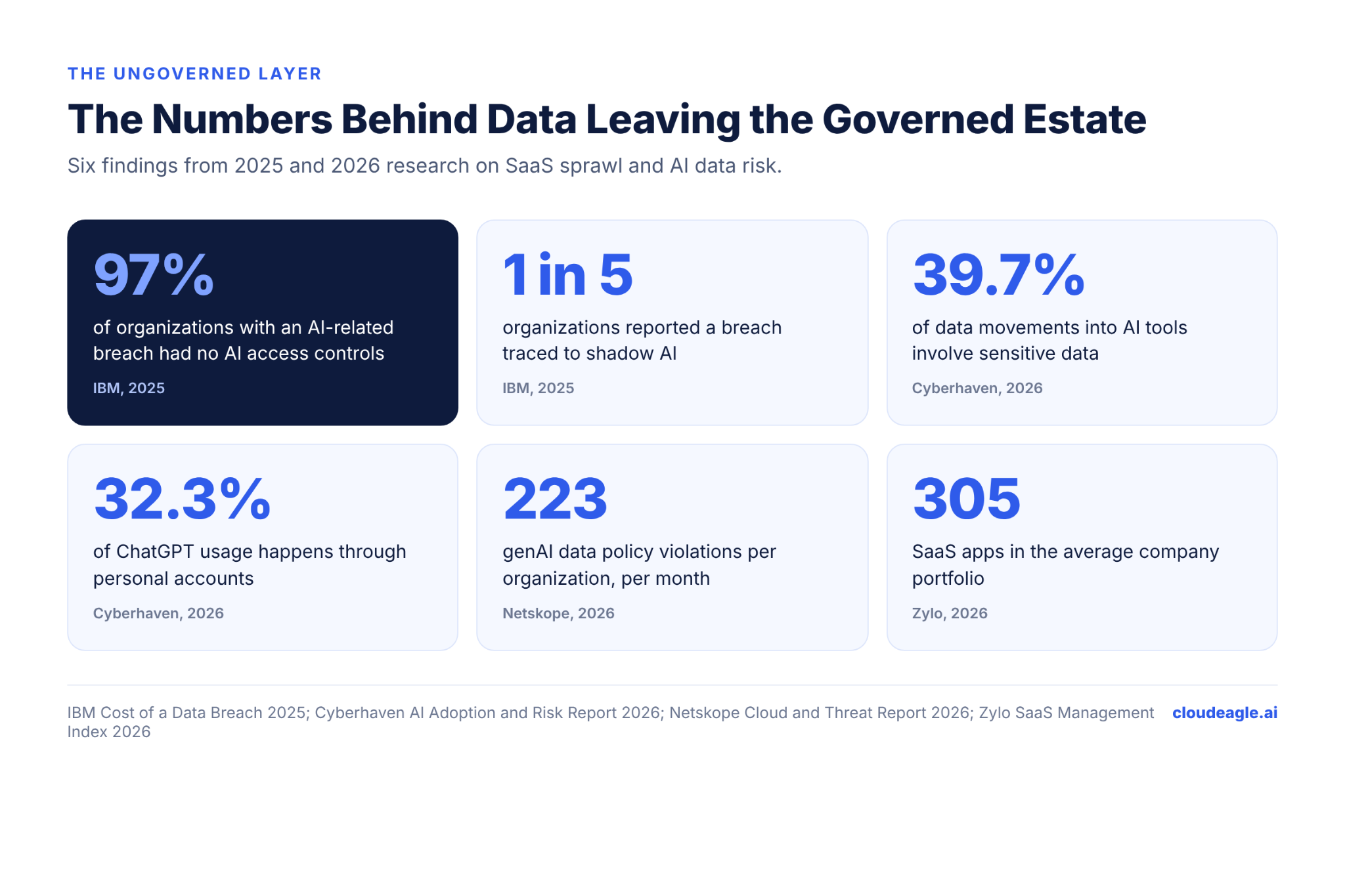
That last part is where most programmes break. IBM's 2025 breach research found that 97% of organizations hit by an AI-related breach had no AI access controls in place, and one in five had a breach traced to shadow AI.
The catalog knew where the customer table lived. It did not know an analyst had pasted it into a personal ChatGPT account.
This list covers nine platforms across both layers: eight that govern data at the source and one that governs it after it leaves.
What Does a Data Governance Platform Need to Do in 2026?
A data governance platform in 2026 needs to cover six jobs, and the newest two are the ones most tools handle worst.
Gartner's second Magic Quadrant for Data and Analytics Governance Platforms, published January 6, 2026, added weight to unstructured data, data products and AI model governance.
The stakes are concrete. Gartner predicts organizations will abandon 60% of AI projects unsupported by AI-ready data through 2026, and a Gartner survey found 63% lack, or are unsure they have, the right data management practices for AI.
Why Do Data Governance Programs Miss SaaS and AI Data?
Data governance platforms connect to databases, warehouses, lakes and BI tools. Company data also lives, and moves somewhere else:
- The average company runs 305 SaaS apps, according to Zylo's 2026 index, and most hold data that never reaches the warehouse
- 39.7% of data movements into AI tools involve sensitive data, per Cyberhaven's 2026 report
- 32.3% of ChatGPT usage happens through personal accounts, outside any corporate tenant
- Netskope counts an average 223 genAI data policy violations per organization each month, 42% of them involving source code
- Service accounts, OAuth apps and AI agents hold standing access that access reviews built for people often ski
Our take: a catalog tells you what data you have. It cannot tell you where that data went after an employee copied it. In 2026 you need both answers.

How Did We Evaluate These Data Governance Platforms?
We judged each platform on five criteria, then set aside shared features and looked for what is genuinely different:
- Catalog and lineage depth, including business glossary and stewardship
- Policy enforcement: whether rules are applied at the source or only documented
- AI governance: models, agents, MCP servers and AI-ready data
- Reach beyond the data estate, into SaaS apps, AI tools and non-human identities
- Proof: 2026 Gartner placement where confirmed, and G2 rating and review volume checked in October 2026
We read product documentation, release notes, analyst summaries and G2 reviews for every platform. None publish full list pricing except where noted.
Which Data Governance Platforms Are Worth Shortlisting in 2026?
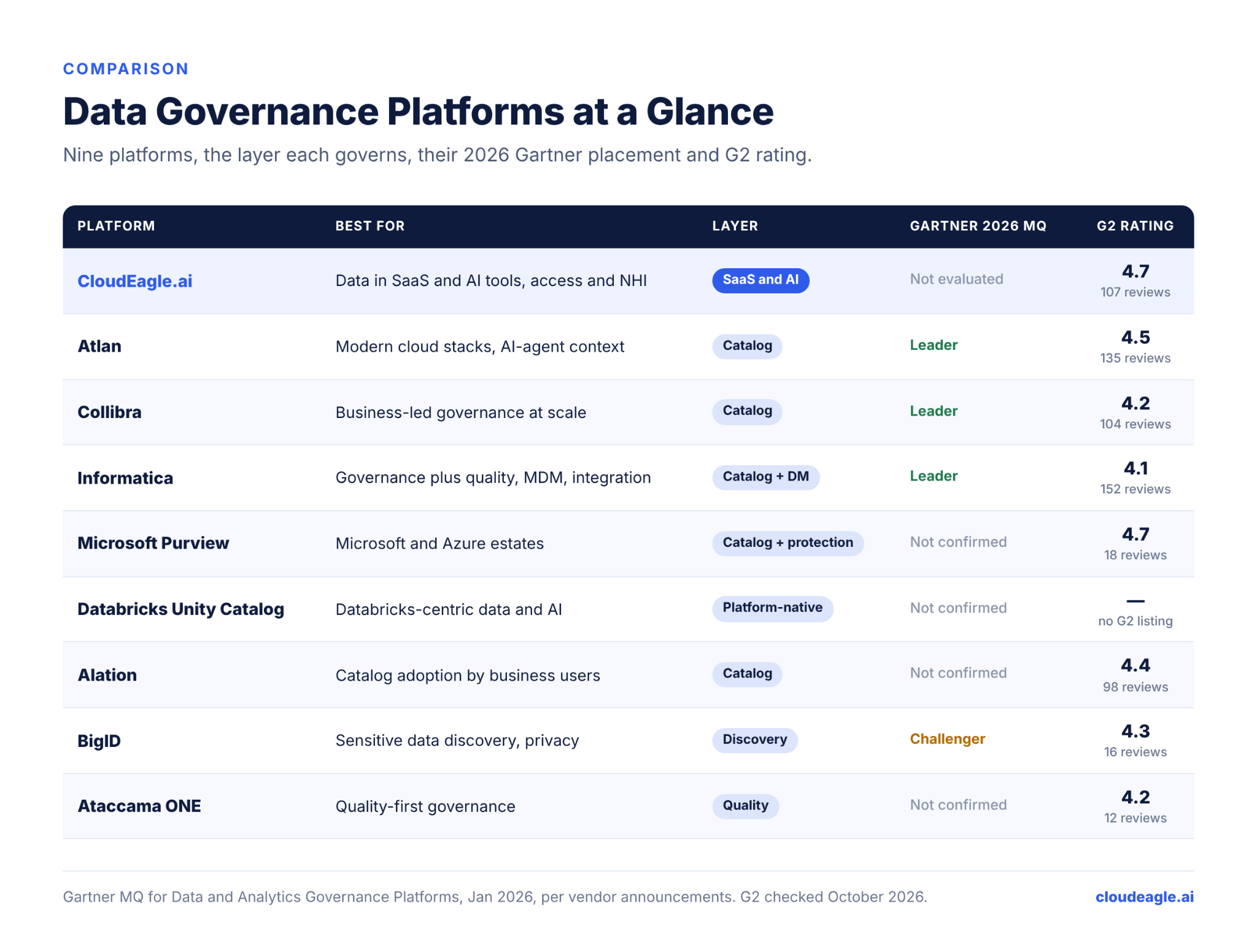
CloudEagle.ai ranks first because it governs the data your catalog cannot see: what flows into SaaS apps and AI tools and which people and machine identities can reach it. Atlan is our pick for the catalog layer; Collibra and Informatica suit the largest regulated estates.
1. CloudEagle.ai
CloudEagle.ai is an AI-powered SaaS management, AI governance and SaaS security platform. It gives enterprises one command center to discover, secure, govern and optimize their SaaS and AI stack, including AI usage and both human and non-human identities. RingCentral, Automation Anywhere, Shiji and Rec Room use it, and it connects to 500+ apps with onboarding in about 30 minutes.
What Makes It Different
- Finds shadow AI and SaaS by correlating SSO, card spend, browser and firewall data, including tools that never touch SSO
- Steps in at the prompt: its AI governance browser layer redirects users before PII or PHI is entered into an unapproved AI tool, rather than flagging it after submission
- Detects logins to non-corporate tenants, the personal ChatGPT accounts that sit outside every corporate policy
- Governs non-human identities, flagging service accounts, API keys, OAuth apps and AI agents that are unowned, inactive for 90 days or holding admin rights
- Runs continuous user access reviews with timestamped evidence for SOC 2, SOX, HIPAA, ISO 27001 and GDPR audits
An information security manager reviewing it on G2 described the gap it closed: "We'd written an AI usage policy like everyone else, and like everyone else, nobody read it."
Where It Falls Short
CloudEagle.ai has no business glossary, lineage or data quality engine, so it complements a catalog rather than replacing one. G2 reviewers note that setup takes coordination across IT, finance and HR systems.
Rating and Pricing
G2 rates it 4.7 out of 5 from 107 reviews. Pricing is custom; first insights arrive about 30 minutes after onboarding.
See Where Your Data Goes After the Warehouse


2. Atlan
Atlan is the catalog we would shortlist first for a cloud-native stack. It moved from Visionary to Leader in Gartner's 2026 governance Magic Quadrant.
What Makes It Different
- Unifies technical, business and operational metadata in a context lakehouse built on Apache Iceberg
- Serves governed business context to AI agents through its MCP server; Workday's data leader is quoted saying its shared business language reaches AI this way
- Positions governance as the context layer for unstructured data and AI agents, not only a compliance record
Where It Falls Short
G2 users report an average three months to implement. Its strength is metadata and context; deep data quality and MDM need other tools.
Rating and Pricing
G2 rates it 4.5 out of 5 from 135 reviews. Pricing is on request.
3. Collibra
Collibra suits large enterprises that want business teams, not engineers, to own governance. Gartner named it a Leader for the second year running.
What Makes It Different
- Built on a semantic graph spanning catalog, lineage, quality, observability and privacy
- Launched an AI Command Center on May 6, 2026 to monitor AI agents and models after deployment, with drift detection and intervention
- Its MCP server feeds governed context to agents, and Collibra says more than 100 customers use it
- Offers a bi-directional SAP integration, a practical edge for SAP-heavy enterprises
Where It Falls Short
It is a heavy rollout: G2 users report an average six months to implement, the longest on this list.
Rating and Pricing
G2 rates it 4.2 out of 5 from 104 reviews. Pricing is on request.
4. Informatica
Informatica brings the widest data management suite to governance, combining catalog, quality, MDM and integration on one platform. Salesforce completed its acquisition on November 18, 2025.
What Makes It Different
- Claims Leader status across six Gartner Magic Quadrants, including D&A governance, data quality, MDM and integration
- Uses CLAIRE AI to automate classification and curation across structured data, unstructured data and AI assets
- Is adding enterprise metadata and lineage to Salesforce's Agentforce and Data 360
Where It Falls Short
Salesforce says Informatica will keep integrating with "every system, not just Salesforce," but buyers outside that ecosystem should test roadmap commitments. Its 4.1 rating is the lowest of the leaders here.
Rating and Pricing
G2 rates Informatica Data & AI Governance, Privacy 4.1 out of 5 from 152 reviews, with three months average implementation. Pricing is consumption-based and quoted on request.
5. Microsoft Purview
Purview is the default shortlist entry for organizations standardized on Microsoft 365 and Azure. Its billing model is its most distinct trait.
What Makes It Different
- Bills per governed asset per day: only tables linked to a data product or critical data element count, so a 200-table database with 20 governed tables bills for 20
- Data quality runs on separate processing units with Basic, Standard and Advanced tiers
- Governed assets can include AI and semantic models alongside tables
Where It Falls Short
Coverage is strongest inside Microsoft's estate. With 18 G2 reviews, public proof for the governance product is thin.
Rating and Pricing
G2 rates Purview Data Governance 4.7 out of 5 from 18 reviews. Pricing is pay-as-you-go via the Azure calculator.
Wondering what ungoverned AI use costs once data slips past the catalog? Our breakdown of the real cost of shadow AI puts numbers on it.
6. Databricks Unity Catalog
Unity Catalog is governance built into the Databricks lakehouse. For teams that already run there, it is the lowest-friction option on this list.
What Makes It Different
- Included with Databricks Premium and Enterprise at no separate licence cost; you pay for compute and storage
- One policy model governs data, models, agents and apps, with automated column-level lineage
- Attribute-based access control, with row filters and column masks driven by governed tags, reached general availability at Data + AI Summit 2026
- Unity AI Gateway extends access and spend controls to agents, models and MCP tools
Where It Falls Short
Governance is strongest inside Databricks. Estates spread across Snowflake, SaaS sources and BI tools often add a cross-platform catalog on top; Collibra's MCP server ranks highly on the Databricks Marketplace for that reason.
Rating and Pricing
Unity Catalog has no standalone G2 listing. It is bundled with Databricks Premium and Enterprise tiers.
7. Alation
Alation built its name on catalog adoption, the problem that sinks many governance programs. In 2026 it is repositioning around an operating layer for governed AI agents.
What Makes It Different
- Added six products to its AIOS platform on September 17, 2026, including AI Governance and Ontologies
- Named a Leader in the 2026 IDC MarketScape for data intelligence platforms
- Earned 2026 Gartner Peer Insights Customers' Choice in both metadata management and D&A governance, a signal from users rather than analysts
Where It Falls Short
We could not confirm an Alation placement in Gartner's 2026 governance Magic Quadrant. The AIOS products are weeks old, so test them in a proof of concept.
Rating and Pricing
G2 rates it 4.4 out of 5 from 98 reviews; one reviewer credits its implementation approach with delivering value within weeks. Pricing is on request.
8. BigID
BigID approaches governance from security and privacy. Its core strength is finding and classifying sensitive data wherever it sits, including SaaS and AI ecosystems.
What Makes It Different
- Deep discovery and classification across cloud, SaaS, on-premises and AI environments on its BigID Next platform
- One view across privacy, security and AI governance, with workflows to act on findings
- Challenger in Gartner's 2026 governance Magic Quadrant, and a Leader in Forrester's 2026 Wave for sensitive data discovery and classification
Where It Falls Short
It finds sensitive data at rest; it does not stop an employee pasting it into an AI tool. Business glossary and stewardship are lighter than in catalog-first platforms.
Rating and Pricing
G2 rates it 4.3 out of 5 from 16 reviews. Pricing is on request.
9. Ataccama ONE
Ataccama ONE puts data quality at the center of governance. It suits programs where trust in the numbers, not catalog breadth, is the main problem.
What Makes It Different
- Runs catalog, lineage, quality, observability and MDM on one platform, with an AI agent acting as a digital data steward
- Launched agentic data observability on February 26, 2026 for dbt, Airflow, Dagster, ADF and AWS Glue pipelines
- Its MCP server gives tools such as Claude and Microsoft Copilot access to governed, validated data
- Vendor-stated Leader in the 2026 Gartner Magic Quadrant for Augmented Data Quality
Where It Falls Short
We could not confirm its 2026 governance Magic Quadrant placement. One G2 reviewer called the initial on-premises setup very hard.
Rating and Pricing
G2 rates it 4.2 out of 5 from 12 reviews. Pricing is on request.
Which Data Governance Platform Should You Choose?
Our recommendation for most mid-to-large enterprises is a two-layer stack: Atlan for the catalog, CloudEagle.ai for data in SaaS and AI tools. Swap Atlan only when your estate already points elsewhere.
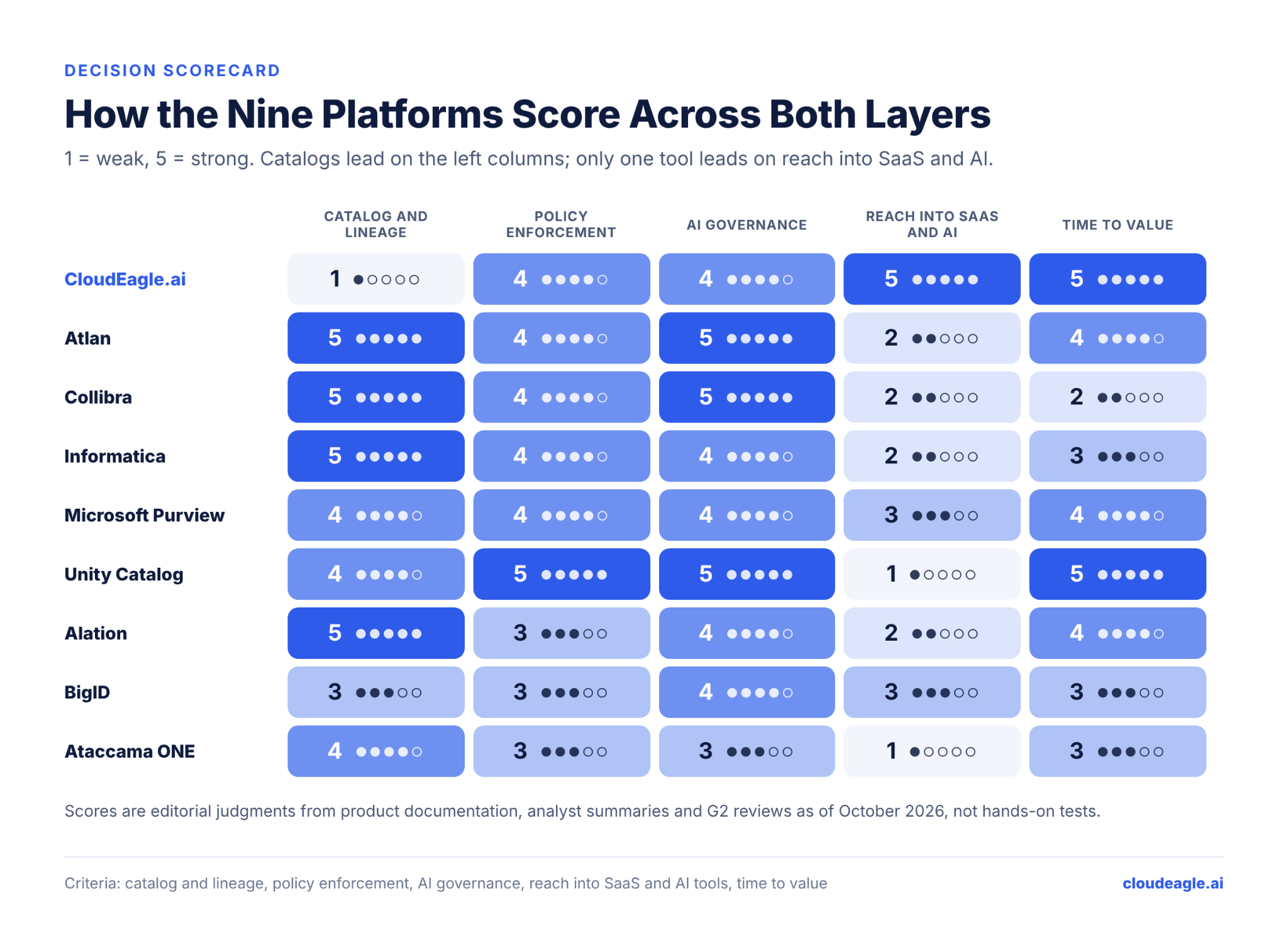
The catalog column changes with your stack. The second column does not, because no catalog on this list sees data once employees move it into SaaS apps and AI tools.
Our scorecard rates each platform from 1 to 5 on the evaluation criteria. Scores are editorial judgments from documentation, analyst summaries and G2 reviews, not hands-on tests.
How Does CloudEagle.ai Govern Data Your Catalog Cannot See?
CloudEagle.ai works at the point where data leaves the governed estate: in the browser, in SaaS apps and in the identities that hold access. It runs alongside your catalog, not instead of it.
- Discovers every SaaS app, AI tool and agent in use by correlating SSO, finance, browser and firewall signals across 500+ integrations
- Enforces AI usage policy in the browser, redirecting users to an approved tool before sensitive data is entered
- Flags logins to personal AI accounts and steers usage back to the corporate tenant
- Reviews human access continuously and revokes it automatically when people change roles or leave
- Brings service accounts, API keys, OAuth apps and AI agents into one registry with owners, activity and one-click revocation
The result is an answer to the question a catalog cannot answer: who, and what, can reach this data outside the warehouse.
Book a demo to see which AI tools your data is reaching today.
Frequently Asked Questions About Data Governance Platforms
What Is the Difference Between a Data Catalog and a Data Governance Platform?
A data catalog inventories and describes data assets so people can find and understand them. A data governance platform adds ownership, policies, access enforcement, quality and lineage on top. Most platforms on this list include a catalog; the governance layer is what turns that inventory into enforced rules.
How Long Does a Data Governance Platform Take to Implement?
Implementation usually takes three to six months for enterprise catalogs. G2 users report about three months for Atlan and Informatica and six months for Collibra. Platform-native options such as Databricks Unity Catalog start faster because they are enabled automatically in new workspaces.
How Do You Govern Company Data Shared With AI Tools Like ChatGPT?
You need controls at the point of use, not only at the source. That means discovering which AI tools employees use, detecting personal-account logins, and stopping sensitive data before it is entered. Data catalogs do not see this traffic, so it takes a SaaS and AI governance layer.
Does CloudEagle.ai Replace a Data Catalog?
No. CloudEagle.ai has no business glossary, lineage or data quality engine. It governs SaaS apps, AI tools and the human and machine identities that access them, so it works alongside a catalog such as Atlan, Collibra or Microsoft Purview.
Does CloudEagle.ai Govern AI Agents and Service Accounts?
Yes. CloudEagle.ai pulls service accounts, API keys, OAuth apps, bots and AI agents from Entra ID and Okta into one registry. It flags identities that are unowned, inactive for 90 days or holding admin rights, and lets teams rotate keys or revoke access with an audit log.
The Catalog Knows. CloudEagle.ai Follows.


.avif)


.avif)
.avif)




.png)




.avif)
.avif)
.avif)


