AI Governance

What Is a Data Governance Framework? Principles and Best Practices

Share via:
Written by:
CloudEagle.ai Team
Reviewed by
Nidhi Jain
Last Updated:
September 29, 2026
blog-cms-banner-bg
Little-Known Negotiation Hacks to Get the Best Deal on Slack
cta-bg-blogDownload Your Copy

HIPAA Compliance Checklist for 2025

Download PDF

‍

Data drives business decisions, customer experiences, and AI applications. But when teams work with inconsistent definitions, unclear ownership, and scattered systems, data can create more problems than value.

Cisco’s 2026 Data and Privacy Benchmark Study found that 65% of organizations struggle to access relevant, high-quality data efficiently.

The study surveyed more than 5,200 IT, technology, and security professionals across 12 markets, highlighting the growing need for stronger data governance as AI adoption expands.

A data governance framework gives organizations a structured way to manage data through clear ownership, defined policies, quality standards, and security controls. This guide covers the key principles, core components, and practical best practices for building a framework that supports reliable data, regulatory compliance, and responsible AI adoption.

‍

What Is a Data Governance Framework?

A data governance framework is an operating structure of policies, roles, processes, standards, and controls that defines how an organization manages, protects, and uses its data throughout its lifecycle. It establishes who owns data, who can access it, how quality is maintained, and how compliance is enforced.

By connecting accountability with practical controls, a data governance framework helps organizations maintain trusted, secure, consistent, and AI-ready data governance across business systems and cloud environments.

‍

Why Is a Data Governance Framework Important?

A data governance framework helps organizations turn fragmented data into a trusted, secure, and usable business asset. It establishes clear accountability and consistent standards, enabling teams to make informed decisions while reducing operational and compliance risks.

A strong framework helps organizations:

  • Improve data quality: Maintain accurate, consistent, complete, and reliable data.
  • Strengthen security and compliance: Control data access and support regulatory requirements.
  • Establish accountability: Define who owns, manages, and approves data-related decisions.
  • Support AI and analytics: Provide reliable, traceable data for AI systems, reporting, and business insights.
  • Reduce operational risks: Minimize duplicated data, inconsistent processes, and unauthorized usage.

Effective data governance balances access and control, allowing teams to use data productively without compromising security, privacy, or trust.

‍

What Are the Core Components of a Data Governance Framework?

A practical data governance framework connects accountability, policies, data controls, and measurable outcomes. Its core components include:

1. Governance Structure and Ownership

Assign clear decision rights to data owners, stewards, governance councils, and technical teams. Each critical data asset should have a named owner, defined responsibilities, and an escalation path for resolving conflicts.

2. Policies and Data Standards

Establish enforceable rules for data classification, access, retention, sharing, quality, and AI usage. Standards should translate broad policies into specific requirements, such as quality thresholds, approved access methods, and metadata fields.

3. Data Quality Management

Define quality expectations for critical data elements across dimensions such as accuracy, completeness, consistency, and timeliness. Monitor failures, assign remediation owners, and track resolution rather than simply reporting quality scores.

4. Metadata and Data Lineage

Capture business definitions, ownership, sensitivity, freshness, and data origin. Lineage helps teams trace how data moves across systems, investigate reporting errors, and assess the impact of changes on analytics or AI models.

5. Security, Privacy, and Compliance

Align data classification with access controls, encryption, retention rules, and audit requirements. Document exceptions and maintain evidence showing whether controls operate as intended.

6. Monitoring and Continuous Improvement

Measure governance through practical indicators such as ownership coverage, quality issues, access review completion, policy violations, and remediation time. Use these metrics to identify gaps and improve governance as systems and business needs change.

The central principle: Governance should connect every policy to an accountable owner, an operational control, and a measurable outcome.

‍

Governance Without Controls Is Just a Policy Doc

Build the compliance baseline your data framework needs to hold.
Download Checklist

‍

What Are the Key Principles of Data Governance?

Data governance principles guide how organizations make decisions about data, manage risk, and maintain trust. They should influence everyday workflows, not remain limited to policy documents.

1. Accountability and Clear Ownership

Assign responsibility for data quality, access, and compliance to specific individuals or teams. Each critical data asset should have an accountable owner who can approve decisions, resolve conflicts, and address risks when issues arise.

2. Data Quality and Integrity

Define quality standards for accuracy, completeness, consistency, and timeliness. Monitor critical data throughout its lifecycle and fix problems at their source. This prevents unreliable information from affecting reports, business decisions, or AI outputs.

3. Transparency and Traceability

Document data definitions, sources, transformations, and access decisions. Teams should be able to understand where data came from, how it changed, and whether it is reliable enough for its intended use. Metadata and lineage support this principle.

4. Security, Privacy, and Purpose Limitation

Collect and use data for defined, legitimate purposes. Apply access controls and security safeguards based on data sensitivity, while limiting unnecessary collection, retention, and sharing.

5. Standardization and Interoperability

Use shared definitions, formats, and classification rules across systems. Standardization reduces conflicting reports, improves data exchange, and helps teams integrate information without repeatedly interpreting or transforming it.

6. Auditability and Continuous Improvement

Maintain evidence of important governance decisions, policy exceptions, and control activities. Review performance through metrics such as data quality issues, access review completion, and remediation time. Update the framework as regulations, systems, and business requirements change.

‍

Key takeaway: Effective governance connects every principle to a responsible owner, a practical control, and evidence that the control is working.

‍

How to Build a Data Governance Framework

Building a data governance framework is not about creating policies or purchasing a data catalog. It is about establishing decision rights, operational controls, and accountability for critical data. A practical implementation should follow these steps:

1. Start With Critical Data and Business Risks

Do not attempt to govern every dataset immediately. Identify data that supports financial reporting, customer operations, regulatory obligations, or AI applications. Prioritize it based on business impact, sensitivity, quality risks, and regulatory exposure.

For each critical data element, document its definition, source, owner, consumers, quality requirements, and risk if it becomes unreliable.

2. Define Decision Rights Before Assigning Roles

Clarify who can approve data definitions, access requests, quality exceptions, and changes to authoritative sources. Assign one accountable owner to each decision and establish an escalation route for unresolved issues.

This prevents a common governance gap: having data owners and stewards on paper without giving them clear authority to act.

3. Convert Policies Into Operational Controls

A policy stating that data must be accurate is not enough. Define the specific quality rule, acceptable threshold, monitoring method, remediation owner, and escalation timeline.

For example, a customer ID may require uniqueness and completeness checks. When a rule fails, the issue should automatically enter a workflow with an assigned owner and documented resolution.

4. Embed Governance Into Existing Workflows

Integrate governance into data pipeline changes, access approvals, reporting processes, and AI development rather than treating it as a separate administrative activity. This helps ensure that new datasets, schema changes, and sensitive-data usage are reviewed before they create downstream risks.

5. Pilot, Measure, and Expand

Start with one business-critical domain and validate whether the operating model works in real situations. Measure ownership coverage, recurring quality failures, issue resolution time, access-review completion, and lineage for critical reports.

Use the pilot to refine decision rights and controls before expanding to other domains. Scale the process that works, not just the documentation that has been approved.

Also Read: A Quick Guide on AI Governance Policies and Controls 

‍

What Are the Best Practices for Data Governance?

Effective data governance requires more than documented policies. It must establish controls that work across data pipelines, business workflows, cloud environments, and AI applications.

1. Prioritize Data Based on Risk and Business Impact

Start with critical data used for financial reporting, customer operations, compliance, and AI tools or systems. Assess each asset based on sensitivity, business dependency, data quality, and potential impact if compromised or inaccurate.

For every priority asset, document its owner, business definition, source, permitted uses, and quality requirements. This creates a clear foundation for governance instead of attempting to control every dataset at once.

2. Enforce Policies at the Point of Access

Access policies should work when data is queried or retrieved, not only during periodic reviews. Apply role-based or attribute-based permissions, data masking, and purpose-based restrictions where required.

For AI applications, ensure permissions carry through retrieval and downstream workflows. An AI agent should not access or reveal data that the requesting user is not authorized to see.

3. Make Data Quality Measurable and Actionable

Define quality rules for critical data elements, including accuracy, completeness, consistency, and freshness. Connect failed checks to a remediation workflow with an assigned owner, root-cause analysis, and resolution deadline.

For AI use cases, also verify whether data is fit for its intended purpose. Outdated policies, duplicate records, conflicting sources, or incomplete metadata can produce unreliable outputs even when the AI model performs as expected.

4. Maintain Lineage and Provenance

Track where data originates, how it is transformed, and which reports, models, or applications depend on it. For AI systems, capture the sources used for training or retrieval and maintain enough context to investigate significant outputs.

This makes it easier to identify the source of an error, validate information, respond to audit requests, and determine the impact of a data change.

5. Govern the Entire Data Lifecycle

Define controls for data collection, classification, usage, sharing, retention, archiving, and deletion. Reassess permissions and approved purposes when data is reused for new applications, particularly AI training, retrieval-augmented generation, or automated decision-making.

6. Build Auditability Into Daily Operations

Maintain evidence of access approvals, policy exceptions, quality remediation, lineage changes, and control reviews. Auditability should be built into workflows rather than recreated manually when an audit or incident occurs.

7. Measure Outcomes and Improve Continuously

Track metrics such as critical data ownership coverage, recurring quality failures, access-review completion, policy violations, and remediation time. Review these measures with business and technical stakeholders to identify control gaps and adjust the framework as systems and risks evolve.

Strong data governance makes policies enforceable, data quality measurable, and every important data action traceable to an accountable owner.

Also Read: Agentic AI Governance: Challenges and Best Practices 

‍

How Does AI and Cloud Adoption Affect Data Governance?

AI and cloud adoption expand where data is stored, processed, and accessed. Governance must therefore extend beyond databases to include data movement, AI workflows, and automated identities.

1. Maintain Consistent Cloud Controls

Apply common standards for data classification, ownership, access, and lineage across cloud platforms, SaaS tools, and data pipelines. A fragmented approach can leave sensitive data outside existing governance controls.

2. Govern Data Before AI Access

Validate data quality, provenance, and permissions before information reaches models, retrieval systems, or AI agents. Access should be limited to the data required for a specific task, not unrestricted access to connected sources.

3. Track AI Data Lineage

Record the sources used for training, retrieval, and model responses where applicable. This supports investigations, helps identify unreliable outputs, and makes sensitive-data usage more traceable.

4. Control Non-Human Identities

Assign every AI agent, service account, and API a defined owner, purpose, and limited permissions. Monitor its activity and revoke access when it is no longer required.

Modern governance must follow data across cloud systems and AI workflows, enforcing least-privilege access, traceability, and continuous monitoring.

‍

AI Agents Are Accessing Data Nobody Approved

Find every shadow tool and automated identity in your environment.
Download Checklist

‍

What Are the Common Data Governance Challenges and How Can You Address Them?

Data governance initiatives often struggle because organizations lack clear ownership, consistent standards, or the technical controls needed to enforce policies. Addressing these challenges requires operational changes, not just additional documentation.

1. Fragmented Data and Inconsistent Definitions

Challenge: Data is spread across applications, departments, and cloud platforms. Teams may use different definitions for the same business term, creating conflicting reports and unreliable AI outputs.

How to address it: Identify authoritative sources, create a shared business glossary, assign domain owners, and use metadata and lineage to connect data across systems.

2. Unclear Ownership and Low Accountability

Challenge: Data issues remain unresolved when multiple teams share responsibility but no one has the authority to act.

How to address it: Assign a named data owner for each critical domain. Document decision rights, escalation paths, and remediation responsibilities, then track whether issues are resolved within defined timelines.

3. Poor Data Quality

Challenge: Duplicate, incomplete, outdated, or inconsistent data reduces confidence in reporting and AI applications.

How to address it: Define quality rules for critical data elements, monitor failures at the source, and connect each issue to an accountable owner and remediation workflow.

4. Governance That Cannot Keep Pace With AI

Challenge: Manual approvals and periodic reviews cannot adequately govern high-volume machine access, AI agents, or rapidly changing data flows.

How to address it: Apply policy-based access controls at runtime, enforce least-privilege permissions, and maintain audit trails for automated actions. Use risk-based controls so high-impact AI activities receive stronger oversight.

5. Limited Adoption Across Teams

Challenge: Employees may view governance as additional administrative work, particularly when policies slow access to data or lack clear business relevance.

How to address it: Involve business and technical teams when designing policies, embed controls into existing workflows, and demonstrate value through faster access to trusted data, fewer recurring errors, and reduced compliance risk.

Address governance challenges by connecting each problem to a defined owner, a practical control, and a measurable resolution process.

‍

How Can CloudEagle.ai Support Data Governance?

Data governance becomes more complex as organizations adopt SaaS applications, AI tools, and automated identities. CloudEagle.ai helps operationalize governance through AI discovery, access controls, identity visibility, and continuous monitoring.

Its capabilities support organizations in:

  • Discovering AI and SaaS risks: Identify shadow AI tools, service accounts, and API tokens operating outside established governance processes.
  • Enforcing access controls: Apply policy-based controls based on user roles, data sensitivity, and approval context.
  • Improving accountability: Connect applications and identities to owners, access decisions, and review workflows.
  • Maintaining auditability: Track access activity, policy enforcement, and remediation evidence across the AI and SaaS environment.

Customer Example: Iterative Health

Iterative Health used CloudEagle to strengthen AI governance, achieving 500+ AI applications governed, 60% faster AI approvals, and 100% AI access auditing, according to CloudEagle’s case study.

The example shows how organizations can turn governance policies into practical controls through centralized visibility, structured approvals, and continuous access monitoring.

‍

Conclusion

A data governance framework gives organizations the structure to manage data as a trusted business asset. Its value comes from more than policies or governance tools. It depends on clear ownership, measurable quality standards, enforceable access controls, and evidence that those controls work.

As cloud adoption and AI usage expand, governance must cover the full data lifecycle, including data sources, transformations, access, lineage, and downstream usage. Organizations that build these practices into daily workflows can improve data reliability while reducing security, compliance, and operational risks.

‍

FAQs

1. What are the main components of a data governance framework?

A. The main components are data ownership, governance policies, data quality, metadata and lineage, security controls, compliance processes, and performance metrics. Together, they define who manages data, how standards are enforced, and how governance outcomes are measured.

2. What is the difference between data governance and data management?

A. Data governance defines the rules, roles, and decision-making authority for managing data. Data management implements those decisions through activities such as data storage, integration, processing, and maintenance.

3. How do you implement a data governance framework?

A. To implement a data governance framework, identify critical data assets, assign accountable owners, establish policies and quality standards, and introduce access and monitoring controls. Start with a focused data domain, measure results, and expand the framework as processes mature.

4. How does AI affect data governance?

A. AI increases the need for data governance because organizations must control the data used for training, retrieval, and model outputs. Effective governance should address data quality, provenance, access permissions, lineage, and monitoring throughout the AI lifecycle.

5. Which data governance framework should an organization choose?

A. There is no single framework suitable for every organization. DAMA-DMBOK supports broad data management practices, DCAM helps assess governance maturity, CDMC focuses on cloud data controls, and NIST AI RMF addresses AI-related risks. Organizations can combine frameworks based on their business objectives, regulatory needs, and technology environment.

‍

Advertisement for a SaaS Subscription Tracking Template with a call-to-action button to download and a partial graphic of a tablet showing charts.Banner promoting a SaaS Agreement Checklist to streamline SaaS management and avoid budget waste with a call-to-action button labeled Download checklist.Blue banner with text 'The Ultimate Employee Offboarding Checklist!' and a black button labeled 'Download checklist' alongside partial views of checklist documents from cloudeagle.ai.Digital ad for download checklist titled 'The Ultimate Checklist for IT Leaders to Optimize SaaS Operations' by cloudeagle.ai, showing checklist pages.Slack Buyer's Guide offer with text 'Unlock insider insights to get the best deal on Slack!' and a button labeled 'Get Your Copy', accompanied by a preview of the guide featuring Slack's logo.Monday Pricing Guide by cloudeagle.ai offering exclusive pricing secrets to maximize investment with a call-to-action button labeled Get Your Copy and an image of the guide's cover.Blue banner for Canva Pricing Guide by cloudeagle.ai offering a guide to Canva costs, features, and alternatives with a call-to-action button saying Get Your Copy.Blue banner with white text reading 'Little-Known Negotiation Hacks to Get the Best Deal on Slack' and a white button labeled 'Get Your Copy'.Blue banner with text 'Little-Known Negotiation Hacks to Get the Best Deal on Monday.com' and a white button labeled 'Get Your Copy'.Blue banner with text 'Little-Known Negotiation Hacks to Get the Best Deal on Canva' and a white button labeled 'Get Your Copy'.Banner with text 'Slack Buyer's Guide' and a 'Download Now' button next to images of a guide titled 'Slack Buyer’s Guide: Features, Pricing & Best Practices'.Digital cover of Monday Pricing Guide with a button labeled Get Your Copy on a blue background.Canva Pricing Guide cover with a button labeled Get Your Copy on a blue gradient background.

Enter your email to
unlock the report

Oops! Something went wrong while submitting the form.
License Count
Benchmark
Per User/Per Year

Enter your email to
unlock the report

Oops! Something went wrong while submitting the form.
License Count
Benchmark
Per User/Per Year

Enter your email to
unlock the report

Oops! Something went wrong while submitting the form.
Notion Plus
License Count
Benchmark
Per User/Per Year
100-500
$67.20 - $78.72
500-1000
$59.52 - $72.00
1000+
$51.84 - $57.60
Canva Pro
License Count
Benchmark
Per User/Per Year
100-500
$74.33-$88.71
500-1000
$64.74-$80.32
1000+
$55.14-$62.34

Enter your email to
unlock the report

Oops! Something went wrong while submitting the form.

Enter your email to
unlock the report

Oops! Something went wrong while submitting the form.
Zoom Business
License Count
Benchmark
Per User/Per Year
100-500
$216.00 - $264.00
500-1000
$180.00 - $216.00
1000+
$156.00 - $180.00

Enter your email to
unlock the report

Oops! Something went wrong while submitting the form.

Get the Right Security Platform To Secure Your Cloud Infrastructure

Please enter a business email
Thank you!
The 2023 SaaS report has been sent to your email. Check your promotional or spam folder.
Oops! Something went wrong while submitting the form.

Access full report

Please enter a business email
Thank you!
The 2023 SaaS report has been sent to your email. Check your promotional or spam folder.
Oops! Something went wrong while submitting the form.

TL;DR 

  • A data governance framework defines how organizations manage, protect, and use data.
  • Its core components include ownership, policies, data quality, metadata, security, and monitoring.
  • Effective governance connects every policy to an accountable owner and measurable control.
  • AI and cloud adoption require stronger access management, data lineage, and continuous monitoring.

‍

‍

Data drives business decisions, customer experiences, and AI applications. But when teams work with inconsistent definitions, unclear ownership, and scattered systems, data can create more problems than value.

Cisco’s 2026 Data and Privacy Benchmark Study found that 65% of organizations struggle to access relevant, high-quality data efficiently.

The study surveyed more than 5,200 IT, technology, and security professionals across 12 markets, highlighting the growing need for stronger data governance as AI adoption expands.

A data governance framework gives organizations a structured way to manage data through clear ownership, defined policies, quality standards, and security controls. This guide covers the key principles, core components, and practical best practices for building a framework that supports reliable data, regulatory compliance, and responsible AI adoption.

‍

What Is a Data Governance Framework?

A data governance framework is an operating structure of policies, roles, processes, standards, and controls that defines how an organization manages, protects, and uses its data throughout its lifecycle. It establishes who owns data, who can access it, how quality is maintained, and how compliance is enforced.

By connecting accountability with practical controls, a data governance framework helps organizations maintain trusted, secure, consistent, and AI-ready data governance across business systems and cloud environments.

‍

Why Is a Data Governance Framework Important?

A data governance framework helps organizations turn fragmented data into a trusted, secure, and usable business asset. It establishes clear accountability and consistent standards, enabling teams to make informed decisions while reducing operational and compliance risks.

A strong framework helps organizations:

  • Improve data quality: Maintain accurate, consistent, complete, and reliable data.
  • Strengthen security and compliance: Control data access and support regulatory requirements.
  • Establish accountability: Define who owns, manages, and approves data-related decisions.
  • Support AI and analytics: Provide reliable, traceable data for AI systems, reporting, and business insights.
  • Reduce operational risks: Minimize duplicated data, inconsistent processes, and unauthorized usage.

Effective data governance balances access and control, allowing teams to use data productively without compromising security, privacy, or trust.

‍

What Are the Core Components of a Data Governance Framework?

A practical data governance framework connects accountability, policies, data controls, and measurable outcomes. Its core components include:

1. Governance Structure and Ownership

Assign clear decision rights to data owners, stewards, governance councils, and technical teams. Each critical data asset should have a named owner, defined responsibilities, and an escalation path for resolving conflicts.

2. Policies and Data Standards

Establish enforceable rules for data classification, access, retention, sharing, quality, and AI usage. Standards should translate broad policies into specific requirements, such as quality thresholds, approved access methods, and metadata fields.

3. Data Quality Management

Define quality expectations for critical data elements across dimensions such as accuracy, completeness, consistency, and timeliness. Monitor failures, assign remediation owners, and track resolution rather than simply reporting quality scores.

4. Metadata and Data Lineage

Capture business definitions, ownership, sensitivity, freshness, and data origin. Lineage helps teams trace how data moves across systems, investigate reporting errors, and assess the impact of changes on analytics or AI models.

5. Security, Privacy, and Compliance

Align data classification with access controls, encryption, retention rules, and audit requirements. Document exceptions and maintain evidence showing whether controls operate as intended.

6. Monitoring and Continuous Improvement

Measure governance through practical indicators such as ownership coverage, quality issues, access review completion, policy violations, and remediation time. Use these metrics to identify gaps and improve governance as systems and business needs change.

The central principle: Governance should connect every policy to an accountable owner, an operational control, and a measurable outcome.

‍

Governance Without Controls Is Just a Policy Doc

Build the compliance baseline your data framework needs to hold.
Download Checklist

‍

What Are the Key Principles of Data Governance?

Data governance principles guide how organizations make decisions about data, manage risk, and maintain trust. They should influence everyday workflows, not remain limited to policy documents.

1. Accountability and Clear Ownership

Assign responsibility for data quality, access, and compliance to specific individuals or teams. Each critical data asset should have an accountable owner who can approve decisions, resolve conflicts, and address risks when issues arise.

2. Data Quality and Integrity

Define quality standards for accuracy, completeness, consistency, and timeliness. Monitor critical data throughout its lifecycle and fix problems at their source. This prevents unreliable information from affecting reports, business decisions, or AI outputs.

3. Transparency and Traceability

Document data definitions, sources, transformations, and access decisions. Teams should be able to understand where data came from, how it changed, and whether it is reliable enough for its intended use. Metadata and lineage support this principle.

4. Security, Privacy, and Purpose Limitation

Collect and use data for defined, legitimate purposes. Apply access controls and security safeguards based on data sensitivity, while limiting unnecessary collection, retention, and sharing.

5. Standardization and Interoperability

Use shared definitions, formats, and classification rules across systems. Standardization reduces conflicting reports, improves data exchange, and helps teams integrate information without repeatedly interpreting or transforming it.

6. Auditability and Continuous Improvement

Maintain evidence of important governance decisions, policy exceptions, and control activities. Review performance through metrics such as data quality issues, access review completion, and remediation time. Update the framework as regulations, systems, and business requirements change.

‍

Key takeaway: Effective governance connects every principle to a responsible owner, a practical control, and evidence that the control is working.

‍

How to Build a Data Governance Framework

Building a data governance framework is not about creating policies or purchasing a data catalog. It is about establishing decision rights, operational controls, and accountability for critical data. A practical implementation should follow these steps:

1. Start With Critical Data and Business Risks

Do not attempt to govern every dataset immediately. Identify data that supports financial reporting, customer operations, regulatory obligations, or AI applications. Prioritize it based on business impact, sensitivity, quality risks, and regulatory exposure.

For each critical data element, document its definition, source, owner, consumers, quality requirements, and risk if it becomes unreliable.

2. Define Decision Rights Before Assigning Roles

Clarify who can approve data definitions, access requests, quality exceptions, and changes to authoritative sources. Assign one accountable owner to each decision and establish an escalation route for unresolved issues.

This prevents a common governance gap: having data owners and stewards on paper without giving them clear authority to act.

3. Convert Policies Into Operational Controls

A policy stating that data must be accurate is not enough. Define the specific quality rule, acceptable threshold, monitoring method, remediation owner, and escalation timeline.

For example, a customer ID may require uniqueness and completeness checks. When a rule fails, the issue should automatically enter a workflow with an assigned owner and documented resolution.

4. Embed Governance Into Existing Workflows

Integrate governance into data pipeline changes, access approvals, reporting processes, and AI development rather than treating it as a separate administrative activity. This helps ensure that new datasets, schema changes, and sensitive-data usage are reviewed before they create downstream risks.

5. Pilot, Measure, and Expand

Start with one business-critical domain and validate whether the operating model works in real situations. Measure ownership coverage, recurring quality failures, issue resolution time, access-review completion, and lineage for critical reports.

Use the pilot to refine decision rights and controls before expanding to other domains. Scale the process that works, not just the documentation that has been approved.

Also Read: A Quick Guide on AI Governance Policies and Controls 

‍

What Are the Best Practices for Data Governance?

Effective data governance requires more than documented policies. It must establish controls that work across data pipelines, business workflows, cloud environments, and AI applications.

1. Prioritize Data Based on Risk and Business Impact

Start with critical data used for financial reporting, customer operations, compliance, and AI tools or systems. Assess each asset based on sensitivity, business dependency, data quality, and potential impact if compromised or inaccurate.

For every priority asset, document its owner, business definition, source, permitted uses, and quality requirements. This creates a clear foundation for governance instead of attempting to control every dataset at once.

2. Enforce Policies at the Point of Access

Access policies should work when data is queried or retrieved, not only during periodic reviews. Apply role-based or attribute-based permissions, data masking, and purpose-based restrictions where required.

For AI applications, ensure permissions carry through retrieval and downstream workflows. An AI agent should not access or reveal data that the requesting user is not authorized to see.

3. Make Data Quality Measurable and Actionable

Define quality rules for critical data elements, including accuracy, completeness, consistency, and freshness. Connect failed checks to a remediation workflow with an assigned owner, root-cause analysis, and resolution deadline.

For AI use cases, also verify whether data is fit for its intended purpose. Outdated policies, duplicate records, conflicting sources, or incomplete metadata can produce unreliable outputs even when the AI model performs as expected.

4. Maintain Lineage and Provenance

Track where data originates, how it is transformed, and which reports, models, or applications depend on it. For AI systems, capture the sources used for training or retrieval and maintain enough context to investigate significant outputs.

This makes it easier to identify the source of an error, validate information, respond to audit requests, and determine the impact of a data change.

5. Govern the Entire Data Lifecycle

Define controls for data collection, classification, usage, sharing, retention, archiving, and deletion. Reassess permissions and approved purposes when data is reused for new applications, particularly AI training, retrieval-augmented generation, or automated decision-making.

6. Build Auditability Into Daily Operations

Maintain evidence of access approvals, policy exceptions, quality remediation, lineage changes, and control reviews. Auditability should be built into workflows rather than recreated manually when an audit or incident occurs.

7. Measure Outcomes and Improve Continuously

Track metrics such as critical data ownership coverage, recurring quality failures, access-review completion, policy violations, and remediation time. Review these measures with business and technical stakeholders to identify control gaps and adjust the framework as systems and risks evolve.

Strong data governance makes policies enforceable, data quality measurable, and every important data action traceable to an accountable owner.

Also Read: Agentic AI Governance: Challenges and Best Practices 

‍

How Does AI and Cloud Adoption Affect Data Governance?

AI and cloud adoption expand where data is stored, processed, and accessed. Governance must therefore extend beyond databases to include data movement, AI workflows, and automated identities.

1. Maintain Consistent Cloud Controls

Apply common standards for data classification, ownership, access, and lineage across cloud platforms, SaaS tools, and data pipelines. A fragmented approach can leave sensitive data outside existing governance controls.

2. Govern Data Before AI Access

Validate data quality, provenance, and permissions before information reaches models, retrieval systems, or AI agents. Access should be limited to the data required for a specific task, not unrestricted access to connected sources.

3. Track AI Data Lineage

Record the sources used for training, retrieval, and model responses where applicable. This supports investigations, helps identify unreliable outputs, and makes sensitive-data usage more traceable.

4. Control Non-Human Identities

Assign every AI agent, service account, and API a defined owner, purpose, and limited permissions. Monitor its activity and revoke access when it is no longer required.

Modern governance must follow data across cloud systems and AI workflows, enforcing least-privilege access, traceability, and continuous monitoring.

‍

AI Agents Are Accessing Data Nobody Approved

Find every shadow tool and automated identity in your environment.
Download Checklist

‍

What Are the Common Data Governance Challenges and How Can You Address Them?

Data governance initiatives often struggle because organizations lack clear ownership, consistent standards, or the technical controls needed to enforce policies. Addressing these challenges requires operational changes, not just additional documentation.

1. Fragmented Data and Inconsistent Definitions

Challenge: Data is spread across applications, departments, and cloud platforms. Teams may use different definitions for the same business term, creating conflicting reports and unreliable AI outputs.

How to address it: Identify authoritative sources, create a shared business glossary, assign domain owners, and use metadata and lineage to connect data across systems.

2. Unclear Ownership and Low Accountability

Challenge: Data issues remain unresolved when multiple teams share responsibility but no one has the authority to act.

How to address it: Assign a named data owner for each critical domain. Document decision rights, escalation paths, and remediation responsibilities, then track whether issues are resolved within defined timelines.

3. Poor Data Quality

Challenge: Duplicate, incomplete, outdated, or inconsistent data reduces confidence in reporting and AI applications.

How to address it: Define quality rules for critical data elements, monitor failures at the source, and connect each issue to an accountable owner and remediation workflow.

4. Governance That Cannot Keep Pace With AI

Challenge: Manual approvals and periodic reviews cannot adequately govern high-volume machine access, AI agents, or rapidly changing data flows.

How to address it: Apply policy-based access controls at runtime, enforce least-privilege permissions, and maintain audit trails for automated actions. Use risk-based controls so high-impact AI activities receive stronger oversight.

5. Limited Adoption Across Teams

Challenge: Employees may view governance as additional administrative work, particularly when policies slow access to data or lack clear business relevance.

How to address it: Involve business and technical teams when designing policies, embed controls into existing workflows, and demonstrate value through faster access to trusted data, fewer recurring errors, and reduced compliance risk.

Address governance challenges by connecting each problem to a defined owner, a practical control, and a measurable resolution process.

‍

How Can CloudEagle.ai Support Data Governance?

Data governance becomes more complex as organizations adopt SaaS applications, AI tools, and automated identities. CloudEagle.ai helps operationalize governance through AI discovery, access controls, identity visibility, and continuous monitoring.

Its capabilities support organizations in:

  • Discovering AI and SaaS risks: Identify shadow AI tools, service accounts, and API tokens operating outside established governance processes.
  • Enforcing access controls: Apply policy-based controls based on user roles, data sensitivity, and approval context.
  • Improving accountability: Connect applications and identities to owners, access decisions, and review workflows.
  • Maintaining auditability: Track access activity, policy enforcement, and remediation evidence across the AI and SaaS environment.

Customer Example: Iterative Health

Iterative Health used CloudEagle to strengthen AI governance, achieving 500+ AI applications governed, 60% faster AI approvals, and 100% AI access auditing, according to CloudEagle’s case study.

The example shows how organizations can turn governance policies into practical controls through centralized visibility, structured approvals, and continuous access monitoring.

‍

Conclusion

A data governance framework gives organizations the structure to manage data as a trusted business asset. Its value comes from more than policies or governance tools. It depends on clear ownership, measurable quality standards, enforceable access controls, and evidence that those controls work.

As cloud adoption and AI usage expand, governance must cover the full data lifecycle, including data sources, transformations, access, lineage, and downstream usage. Organizations that build these practices into daily workflows can improve data reliability while reducing security, compliance, and operational risks.

‍

FAQs

1. What are the main components of a data governance framework?

A. The main components are data ownership, governance policies, data quality, metadata and lineage, security controls, compliance processes, and performance metrics. Together, they define who manages data, how standards are enforced, and how governance outcomes are measured.

2. What is the difference between data governance and data management?

A. Data governance defines the rules, roles, and decision-making authority for managing data. Data management implements those decisions through activities such as data storage, integration, processing, and maintenance.

3. How do you implement a data governance framework?

A. To implement a data governance framework, identify critical data assets, assign accountable owners, establish policies and quality standards, and introduce access and monitoring controls. Start with a focused data domain, measure results, and expand the framework as processes mature.

4. How does AI affect data governance?

A. AI increases the need for data governance because organizations must control the data used for training, retrieval, and model outputs. Effective governance should address data quality, provenance, access permissions, lineage, and monitoring throughout the AI lifecycle.

5. Which data governance framework should an organization choose?

A. There is no single framework suitable for every organization. DAMA-DMBOK supports broad data management practices, DCAM helps assess governance maturity, CDMC focuses on cloud data controls, and NIST AI RMF addresses AI-related risks. Organizations can combine frameworks based on their business objectives, regulatory needs, and technology environment.

‍

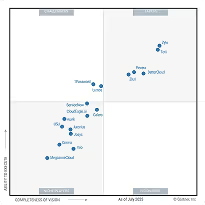
CloudEagle.ai recognized in the 2025 Gartner® Magic Quadrant™ for SaaS Management Platforms
Download now
gartner chart
5x
Faster employee
onboarding
80%
Reduction in time for
user access reviews
30k
Workflows
automated
$15Bn
Analyzed in
contract spend
$2Bn
Saved in
SaaS spend

Streamline SaaS governance and save 10-30%

Book a Demo with Expert
CTA image