AI Governance

The Shadow AI Economy: Why Employees Use Personal AI Accounts

Share via:
Written by:
CloudEagle.ai Team
Reviewed by
Nidhi Jain
Last Updated:
September 25, 2026
blog-cms-banner-bg
Little-Known Negotiation Hacks to Get the Best Deal on Slack
cta-bg-blogDownload Your Copy

HIPAA Compliance Checklist for 2025

Download PDF

‍

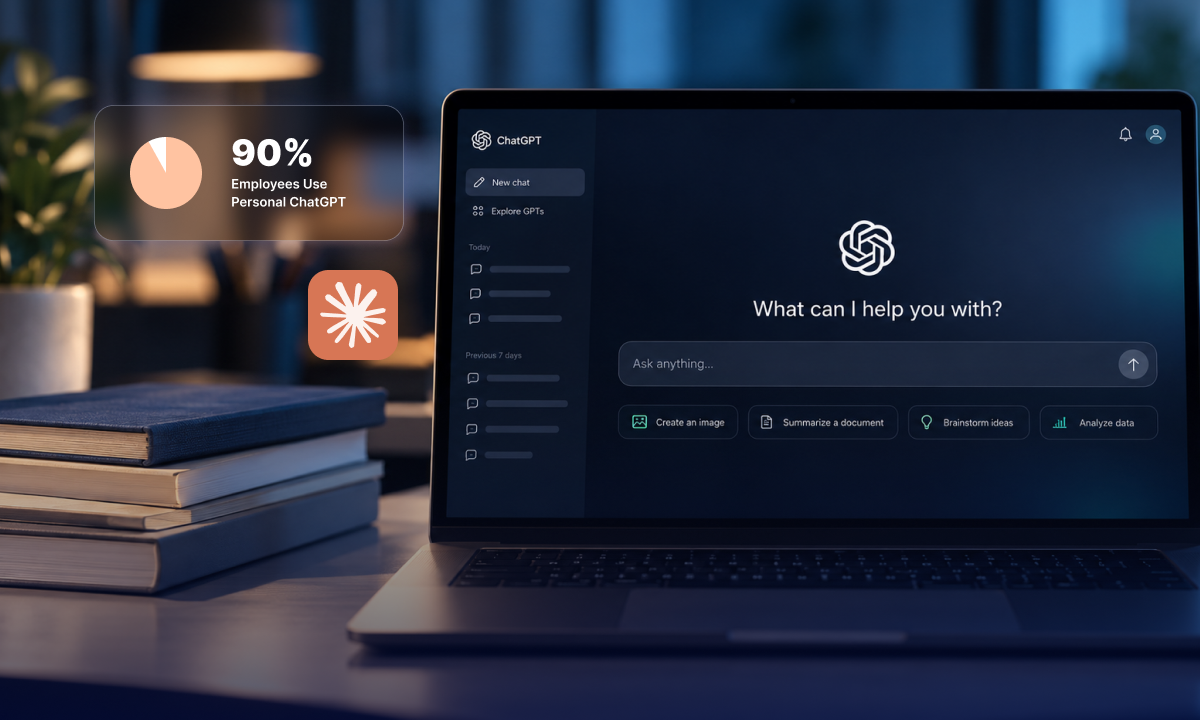
In August 2025, MIT's Project NANDA published State of AI in Business and gave the category its name: only 40% of companies had bought an official LLM subscription, while more than 90% had employees regularly using personal AI tools for work. The prescribed fix was obvious: sanction the tools, close the gap.

Enterprises did exactly that. Netskope's threat research, published in January 2026, found that personal-account use of generative AI platforms fell from 78% to 47% in a single year, while company-sanctioned account use climbed from 25% to 62%.

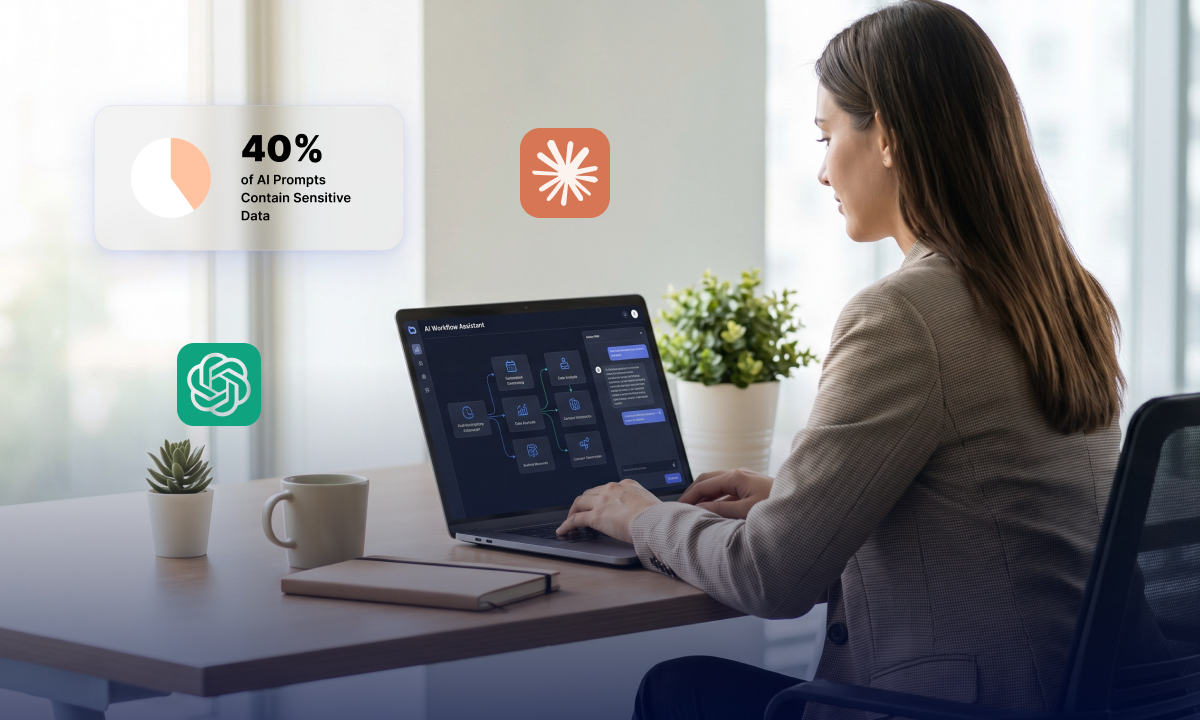
Over that same period, the number of incidents involving employees sending sensitive data to AI applications doubled. The average organization now logs 223 of them every month.

Sanctioning worked as a migration exercise and failed as a control; the exposure did not follow the account, it followed the workflow.

Closing the account gap without closing the visibility gap moved the problem somewhere darker.

‍

1. What Does the Shadow AI Economy Actually Measure?

The shadow AI economy describes the gap between AI that an organization pays for and AI that its people actually use. It is shadow IT with a shorter fuse, because the barrier to entry is an email address and the data leaving the building is unstructured.

The MIT numbers are the standard reference, so they are worth reading precisely rather than loosely.

A. The 90% Figure Is a Leadership Estimate, Not a Headcount

The study reviewed 300+ publicly disclosed AI initiatives, interviewed 52 organizations, and surveyed 153 senior leaders.

That last figure matters. The 90% is leaders characterizing their own workforce, not a headcount of employees. It is an estimate made by the people with the least visibility into the behavior being estimated.

Which makes it a floor, not a ceiling.

‍

What got quoted What the MIT study actually shows
90%+ of employees use personal AI tools Estimate by 153 senior leaders about their own workforce; a floor, not a ceiling
95% of enterprise AI pilots fail Applies to custom-built enterprise tools only
AI adoption is failing General-purpose AI tools reached production ~40% of the time
Build beats buy Vendor partnerships deployed 67% of the time; internal builds 33%

‍

B. The 95% Pilot Failure Claim Was About Custom Builds

The rest of the report made the headlines, mostly through misreading. The widely circulated claim that 95% of enterprise AI pilots fail applied specifically to custom-built enterprise tools, not to AI adoption generally.

VentureBeat's analysis made the correction most coverage skipped: general-purpose AI tools reached production around 40% of the time, and external vendor partnerships deployed successfully 67% of the time against 33% for internally built systems.

So the failure was never the technology. It was the procurement and design decisions wrapped around it.

‍

Your AI Inventory Is Missing More Than You Think

Find every hidden tool.
Catch Hidden AI

‍

2. Why Do Employees Keep Using Personal AI Accounts at Work?

It is tempting to frame this as a compliance problem with a training solution. The data does not support that framing, and your employees would tell you so.

The shadow path wins on four structural advantages, none of which are about rule-breaking.

‍

Advantage Why the sanctioned path loses
Access is immediate 90 seconds to sign up vs a 3–6 month intake, security, legal and procurement cycle
The consumer tool is often better A $50,000 specialized legal tool lost to personal ChatGPT on quality
Context survives between sessions Many enterprise deployments reset every session
Nobody is watching 52% hide AI use on their most important tasks, so self-declared inventories run small

‍

A. Access Is Immediate

An employee needing a tool today can have it in ninety seconds. The sanctioned equivalent runs through intake, security review, legal, and procurement, a cycle that routinely takes three to six months for a net-new AI vendor.

Nobody waits out that gap on a deadline. They route around it.

B. The Consumer Tool Is Often Genuinely Better

MIT's researchers documented a corporate lawyer who kept using personal ChatGPT despite the firm having bought a $50,000 specialized legal AI tool, on the grounds that the quality difference was noticeable.

That is not a training failure. That is a buying failure, and it is the more expensive of the two.

C. Context Survives Between Sessions

Consumer tools remember. Many enterprise deployments, particularly internally built ones, reset with every session, which destroys the exact thing that makes the tool useful for iterative work.

D. Nobody Is Watching, and Everybody Knows It

Microsoft's research found that 52% of people who use AI at work are reluctant to admit using it for their most important tasks, and 53% worry that doing so makes them look replaceable.

That creates a second-order problem.

Even where a company asks employees to self-declare their AI use, the incentive runs the other way, so the declared inventory is systematically smaller than the real one.

E. Some Employees Are Paying for It Themselves

One more signal should end the discipline conversation entirely. In a survey of 1,003 AI users published by Exploding Topics, 29% said they pay for their own AI tools at work, with more than four in ten at least partially self-funding.

Those figures are self-reported and the sample is modest, so treat them as directional. The direction is clear enough.

Your people are not cutting corners. A meaningful share of them are personally subsidizing a capability the company did not ship.

‍

One Missed App. One Big Risk.

Review your entire stack.
Secure Your Stack

‍

3. What Is the Governance Latency Gap?

Here is the mechanic underneath all of it.

Adoption happens in seconds. Discovery happens quarterly. Everything that lives inside that gap is, by definition, ungoverned, and the gap is not closing on its own.

Microsoft's 2026 Work Trend Index put a number on why.

Organizational factors account for roughly twice the impact of individual effort on AI outcomes, 67% against 32%, and only 26% of AI users say their leadership is clearly aligned on AI strategy.

The constraint is structural, sitting above the individual, and it is not something a policy document reaches.

A. Where Most Enterprises Are Blind

Most enterprises are blind in three specific places.

  1. The app inventory is built from the identity provider, so it sees federated apps and nothing else. Anything accessed with a personal email or a free tier is invisible by construction.
  2. AI tools bought on corporate cards or bundled into existing SaaS agreements never trigger a separate procurement review, so they never enter the register.
  3. Browser-level use, which is where most gen-AI work actually happens, leaves no trace in any system finance or IT is looking at.

Add agentic tooling and the gap widens again, because every new agent and integration spins up its own non-human identity, service accounts, API keys, tokens, each with standing access and no accountable owner.

B. Visibility, Not Policy, Is the Binding Constraint

We covered the policy side of this in the governance gap, where IBM found 63% of organizations have no formal AI governance policy at all.

The point worth adding here is that a policy is not the binding constraint. Visibility is. A policy governs the apps you know about, which is the smaller half of the estate.

C. How to Size Your Own Gap in Ten Minutes

The latency number is easy to calculate and uncomfortable to look at, which is why most teams never run it.

  1. Take the last five AI tools you found in your environment.
  2. For each one, note the date it first appeared in any signal you hold, card spend, a firewall log, a browser event, and the date it entered your app register.
  3. The median distance between those two dates is your time to discovery.

Anything you cannot date at all belongs in a separate count, because that is the part of the estate you did not find; it found you.

‍

4. Why Doesn’t Sanctioning AI Accounts Close the Gap?

Alongside the shift to sanctioned accounts, the share of employees switching between personal and corporate credentials rose from 4% to 9%. It doubled.

Credential switching is the behavioral signature of a governance gap that sanctioning did not close.

Employees accepted the corporate account for the work that fits it and kept the personal one for the work that does not.

From an audit perspective, the organization now looks more compliant than it did a year ago while the underlying exposure has grown.

A. What the Breach Data Says

IBM's 2025 Cost of a Data Breach report puts a price on the difference. Organizations with high levels of shadow AI carried an additional $670,000 on the average breach.

More pointed still, 97% of breached organizations that suffered an AI-related security incident reported lacking proper AI access controls.

Not lacking a policy. Lacking controls.

B. The Audit Consequence

The audit consequence is worth stating plainly, because it is the version that reaches a board.

An organization that has migrated most of its AI usage to sanctioned accounts can produce a clean report: named users, attributable sessions, a defensible policy on file.

The report is accurate. It is also describing 62% of the activity and presenting it as the whole picture.

That is a worse position than the one you were in two years ago, when nobody believed the inventory was complete.

‍

5. Which Controls Close the Governance Latency Gap?

Policy coverage is the wrong metric. Time to discovery is the right one, and these are the four things that move it.

A. Continuous, Multi-Signal Discovery

An SSO-derived inventory covers the federated estate and misses everything else.

Correlating identity data with finance records, browser activity, and firewall logs is what surfaces the free-tier account and the tool bought on a personal card. CloudEagle.ai’s shadow AI discovery is built on exactly that correlation.

B. Risk Scoring, So Unsanctioned Does Not Mean Equally Urgent

A team using an unapproved transcription tool and a team pasting customer records into an unvetted model are not the same incident, and treating them identically is how security teams burn credibility.

Scoring every discovered app on data sensitivity and vendor posture lets you triage a list of two hundred findings down to the nine that matter this week.

C. Enforcement at the Prompt Layer

Network blocking and post-submission DLP both act after the decision is made.

Blocking has a failure mode worth naming: it pushes the behavior onto personal devices, where visibility drops to zero.

Intervening in the browser at the moment an employee opens an unapproved tool, and redirecting them to the approved one, is the only control that sits where the behavior actually happens.

D. Non-Human Identity Governance

Service accounts, API keys, and AI agents need the same lifecycle controls as employees, including ownership, review, and revocation.

An orphaned agent is a bot with standing access and nobody’s name on it, and this is the layer that grows fastest because no human has to sign up for anything.

E. ,Why the Order Matters

The sequence matters as much as the list. Discovery comes first because the other three are unenforceable against an estate you cannot see, and most teams attempt them in reverse order.

‍

‍

6. What Should Leaders Ask About Shadow AI at the Next Steering Meeting?

Stop asking what percentage of your workforce has read the AI policy. Ask how long it takes you to find out that a new AI tool has entered your environment.

If the honest answer is "at the next quarterly review," then your shadow AI economy is roughly the size of a quarter, and the Netskope data says it is growing even as your account metrics improve.

A second question follows, and it is the more useful one to put to your security lead.

Of the AI tools currently in your register, how many did you find, and how many were disclosed to you?

A register built mostly from disclosure is a register of the compliant, which is not the population you are trying to govern.

Sanctioning accounts was the right first move. It was never the whole move.

The organizations that get this right in 2027 will be the ones that stopped treating shadow AI as a behavior to eliminate and started treating it as a signal to read, a live feed of what your people need that you have not yet given them.

Govern the estate you can see, and you will govern the smaller half of it. Start with discovery.

‍

7. FAQs

1. What Is the Shadow AI Economy?

The shadow AI economy is the gap between the AI tools an organization officially pays for and the AI tools its employees actually use. MIT's Project NANDA coined the term in 2025 after finding that while only 40% of companies had purchased an official LLM subscription, more than 90% had employees regularly using personal AI accounts for work.

2. Is Shadow AI a Security Problem or a Compliance Problem?

Both, and the security exposure is the one with a price attached. IBM's 2025 Cost of a Data Breach report found that organizations with high levels of shadow AI carried an extra $670,000 on the average breach, and that 97% of organizations hit by an AI-related incident lacked proper AI access controls.

3. How Do You Detect Shadow AI Without Blocking It?

Detection requires correlating signals your identity provider cannot see on its own: finance and card spend, browser activity, and firewall logs, matched against a known inventory of AI vendors. That approach surfaces free-tier and personal-account usage without a network block, which matters because blocking pushes the behavior to personal devices where you lose visibility entirely.

‍

Advertisement for a SaaS Subscription Tracking Template with a call-to-action button to download and a partial graphic of a tablet showing charts.Banner promoting a SaaS Agreement Checklist to streamline SaaS management and avoid budget waste with a call-to-action button labeled Download checklist.Blue banner with text 'The Ultimate Employee Offboarding Checklist!' and a black button labeled 'Download checklist' alongside partial views of checklist documents from cloudeagle.ai.Digital ad for download checklist titled 'The Ultimate Checklist for IT Leaders to Optimize SaaS Operations' by cloudeagle.ai, showing checklist pages.Slack Buyer's Guide offer with text 'Unlock insider insights to get the best deal on Slack!' and a button labeled 'Get Your Copy', accompanied by a preview of the guide featuring Slack's logo.Monday Pricing Guide by cloudeagle.ai offering exclusive pricing secrets to maximize investment with a call-to-action button labeled Get Your Copy and an image of the guide's cover.Blue banner for Canva Pricing Guide by cloudeagle.ai offering a guide to Canva costs, features, and alternatives with a call-to-action button saying Get Your Copy.Blue banner with white text reading 'Little-Known Negotiation Hacks to Get the Best Deal on Slack' and a white button labeled 'Get Your Copy'.Blue banner with text 'Little-Known Negotiation Hacks to Get the Best Deal on Monday.com' and a white button labeled 'Get Your Copy'.Blue banner with text 'Little-Known Negotiation Hacks to Get the Best Deal on Canva' and a white button labeled 'Get Your Copy'.Banner with text 'Slack Buyer's Guide' and a 'Download Now' button next to images of a guide titled 'Slack Buyer’s Guide: Features, Pricing & Best Practices'.Digital cover of Monday Pricing Guide with a button labeled Get Your Copy on a blue background.Canva Pricing Guide cover with a button labeled Get Your Copy on a blue gradient background.

Enter your email to
unlock the report

Oops! Something went wrong while submitting the form.
License Count
Benchmark
Per User/Per Year

Enter your email to
unlock the report

Oops! Something went wrong while submitting the form.
License Count
Benchmark
Per User/Per Year

Enter your email to
unlock the report

Oops! Something went wrong while submitting the form.
Notion Plus
License Count
Benchmark
Per User/Per Year
100-500
$67.20 - $78.72
500-1000
$59.52 - $72.00
1000+
$51.84 - $57.60
Canva Pro
License Count
Benchmark
Per User/Per Year
100-500
$74.33-$88.71
500-1000
$64.74-$80.32
1000+
$55.14-$62.34

Enter your email to
unlock the report

Oops! Something went wrong while submitting the form.

Enter your email to
unlock the report

Oops! Something went wrong while submitting the form.
Zoom Business
License Count
Benchmark
Per User/Per Year
100-500
$216.00 - $264.00
500-1000
$180.00 - $216.00
1000+
$156.00 - $180.00

Enter your email to
unlock the report

Oops! Something went wrong while submitting the form.

Get the Right Security Platform To Secure Your Cloud Infrastructure

Please enter a business email
Thank you!
The 2023 SaaS report has been sent to your email. Check your promotional or spam folder.
Oops! Something went wrong while submitting the form.

Access full report

Please enter a business email
Thank you!
The 2023 SaaS report has been sent to your email. Check your promotional or spam folder.
Oops! Something went wrong while submitting the form.
  • The shadow AI economy measures the gap between the AI tools organizations officially provide and the personal AI tools employees actually use.
  • Employees adopt personal AI accounts because they offer faster access, better user experience, persistent context, and fewer workflow barriers—not simply due to policy violations.
  • Sanctioning enterprise AI accounts reduces personal account usage but doesn't eliminate governance gaps, credential switching, or sensitive data exposure.
  • Closing the governance latency gap requires continuous multi-signal discovery, risk scoring, prompt-layer enforcement, and non-human identity governance.
  • CloudEagle.ai discovers shadow AI by correlating identity, browser, finance, and firewall signals, giving organizations continuous visibility into AI apps, agents, and accounts beyond what SSO alone can detect

‍

In August 2025, MIT's Project NANDA published State of AI in Business and gave the category its name: only 40% of companies had bought an official LLM subscription, while more than 90% had employees regularly using personal AI tools for work. The prescribed fix was obvious: sanction the tools, close the gap.

Enterprises did exactly that. Netskope's threat research, published in January 2026, found that personal-account use of generative AI platforms fell from 78% to 47% in a single year, while company-sanctioned account use climbed from 25% to 62%.

Over that same period, the number of incidents involving employees sending sensitive data to AI applications doubled. The average organization now logs 223 of them every month.

Sanctioning worked as a migration exercise and failed as a control; the exposure did not follow the account, it followed the workflow.

Closing the account gap without closing the visibility gap moved the problem somewhere darker.

‍

1. What Does the Shadow AI Economy Actually Measure?

The shadow AI economy describes the gap between AI that an organization pays for and AI that its people actually use. It is shadow IT with a shorter fuse, because the barrier to entry is an email address and the data leaving the building is unstructured.

The MIT numbers are the standard reference, so they are worth reading precisely rather than loosely.

A. The 90% Figure Is a Leadership Estimate, Not a Headcount

The study reviewed 300+ publicly disclosed AI initiatives, interviewed 52 organizations, and surveyed 153 senior leaders.

That last figure matters. The 90% is leaders characterizing their own workforce, not a headcount of employees. It is an estimate made by the people with the least visibility into the behavior being estimated.

Which makes it a floor, not a ceiling.

‍

What got quoted What the MIT study actually shows
90%+ of employees use personal AI tools Estimate by 153 senior leaders about their own workforce; a floor, not a ceiling
95% of enterprise AI pilots fail Applies to custom-built enterprise tools only
AI adoption is failing General-purpose AI tools reached production ~40% of the time
Build beats buy Vendor partnerships deployed 67% of the time; internal builds 33%

‍

B. The 95% Pilot Failure Claim Was About Custom Builds

The rest of the report made the headlines, mostly through misreading. The widely circulated claim that 95% of enterprise AI pilots fail applied specifically to custom-built enterprise tools, not to AI adoption generally.

VentureBeat's analysis made the correction most coverage skipped: general-purpose AI tools reached production around 40% of the time, and external vendor partnerships deployed successfully 67% of the time against 33% for internally built systems.

So the failure was never the technology. It was the procurement and design decisions wrapped around it.

‍

Your AI Inventory Is Missing More Than You Think

Find every hidden tool.
Catch Hidden AI

‍

2. Why Do Employees Keep Using Personal AI Accounts at Work?

It is tempting to frame this as a compliance problem with a training solution. The data does not support that framing, and your employees would tell you so.

The shadow path wins on four structural advantages, none of which are about rule-breaking.

‍

Advantage Why the sanctioned path loses
Access is immediate 90 seconds to sign up vs a 3–6 month intake, security, legal and procurement cycle
The consumer tool is often better A $50,000 specialized legal tool lost to personal ChatGPT on quality
Context survives between sessions Many enterprise deployments reset every session
Nobody is watching 52% hide AI use on their most important tasks, so self-declared inventories run small

‍

A. Access Is Immediate

An employee needing a tool today can have it in ninety seconds. The sanctioned equivalent runs through intake, security review, legal, and procurement, a cycle that routinely takes three to six months for a net-new AI vendor.

Nobody waits out that gap on a deadline. They route around it.

B. The Consumer Tool Is Often Genuinely Better

MIT's researchers documented a corporate lawyer who kept using personal ChatGPT despite the firm having bought a $50,000 specialized legal AI tool, on the grounds that the quality difference was noticeable.

That is not a training failure. That is a buying failure, and it is the more expensive of the two.

C. Context Survives Between Sessions

Consumer tools remember. Many enterprise deployments, particularly internally built ones, reset with every session, which destroys the exact thing that makes the tool useful for iterative work.

D. Nobody Is Watching, and Everybody Knows It

Microsoft's research found that 52% of people who use AI at work are reluctant to admit using it for their most important tasks, and 53% worry that doing so makes them look replaceable.

That creates a second-order problem.

Even where a company asks employees to self-declare their AI use, the incentive runs the other way, so the declared inventory is systematically smaller than the real one.

E. Some Employees Are Paying for It Themselves

One more signal should end the discipline conversation entirely. In a survey of 1,003 AI users published by Exploding Topics, 29% said they pay for their own AI tools at work, with more than four in ten at least partially self-funding.

Those figures are self-reported and the sample is modest, so treat them as directional. The direction is clear enough.

Your people are not cutting corners. A meaningful share of them are personally subsidizing a capability the company did not ship.

‍

One Missed App. One Big Risk.

Review your entire stack.
Secure Your Stack

‍

3. What Is the Governance Latency Gap?

Here is the mechanic underneath all of it.

Adoption happens in seconds. Discovery happens quarterly. Everything that lives inside that gap is, by definition, ungoverned, and the gap is not closing on its own.

Microsoft's 2026 Work Trend Index put a number on why.

Organizational factors account for roughly twice the impact of individual effort on AI outcomes, 67% against 32%, and only 26% of AI users say their leadership is clearly aligned on AI strategy.

The constraint is structural, sitting above the individual, and it is not something a policy document reaches.

A. Where Most Enterprises Are Blind

Most enterprises are blind in three specific places.

  1. The app inventory is built from the identity provider, so it sees federated apps and nothing else. Anything accessed with a personal email or a free tier is invisible by construction.
  2. AI tools bought on corporate cards or bundled into existing SaaS agreements never trigger a separate procurement review, so they never enter the register.
  3. Browser-level use, which is where most gen-AI work actually happens, leaves no trace in any system finance or IT is looking at.

Add agentic tooling and the gap widens again, because every new agent and integration spins up its own non-human identity, service accounts, API keys, tokens, each with standing access and no accountable owner.

B. Visibility, Not Policy, Is the Binding Constraint

We covered the policy side of this in the governance gap, where IBM found 63% of organizations have no formal AI governance policy at all.

The point worth adding here is that a policy is not the binding constraint. Visibility is. A policy governs the apps you know about, which is the smaller half of the estate.

C. How to Size Your Own Gap in Ten Minutes

The latency number is easy to calculate and uncomfortable to look at, which is why most teams never run it.

  1. Take the last five AI tools you found in your environment.
  2. For each one, note the date it first appeared in any signal you hold, card spend, a firewall log, a browser event, and the date it entered your app register.
  3. The median distance between those two dates is your time to discovery.

Anything you cannot date at all belongs in a separate count, because that is the part of the estate you did not find; it found you.

‍

4. Why Doesn’t Sanctioning AI Accounts Close the Gap?

Alongside the shift to sanctioned accounts, the share of employees switching between personal and corporate credentials rose from 4% to 9%. It doubled.

Credential switching is the behavioral signature of a governance gap that sanctioning did not close.

Employees accepted the corporate account for the work that fits it and kept the personal one for the work that does not.

From an audit perspective, the organization now looks more compliant than it did a year ago while the underlying exposure has grown.

A. What the Breach Data Says

IBM's 2025 Cost of a Data Breach report puts a price on the difference. Organizations with high levels of shadow AI carried an additional $670,000 on the average breach.

More pointed still, 97% of breached organizations that suffered an AI-related security incident reported lacking proper AI access controls.

Not lacking a policy. Lacking controls.

B. The Audit Consequence

The audit consequence is worth stating plainly, because it is the version that reaches a board.

An organization that has migrated most of its AI usage to sanctioned accounts can produce a clean report: named users, attributable sessions, a defensible policy on file.

The report is accurate. It is also describing 62% of the activity and presenting it as the whole picture.

That is a worse position than the one you were in two years ago, when nobody believed the inventory was complete.

‍

5. Which Controls Close the Governance Latency Gap?

Policy coverage is the wrong metric. Time to discovery is the right one, and these are the four things that move it.

A. Continuous, Multi-Signal Discovery

An SSO-derived inventory covers the federated estate and misses everything else.

Correlating identity data with finance records, browser activity, and firewall logs is what surfaces the free-tier account and the tool bought on a personal card. CloudEagle.ai’s shadow AI discovery is built on exactly that correlation.

B. Risk Scoring, So Unsanctioned Does Not Mean Equally Urgent

A team using an unapproved transcription tool and a team pasting customer records into an unvetted model are not the same incident, and treating them identically is how security teams burn credibility.

Scoring every discovered app on data sensitivity and vendor posture lets you triage a list of two hundred findings down to the nine that matter this week.

C. Enforcement at the Prompt Layer

Network blocking and post-submission DLP both act after the decision is made.

Blocking has a failure mode worth naming: it pushes the behavior onto personal devices, where visibility drops to zero.

Intervening in the browser at the moment an employee opens an unapproved tool, and redirecting them to the approved one, is the only control that sits where the behavior actually happens.

D. Non-Human Identity Governance

Service accounts, API keys, and AI agents need the same lifecycle controls as employees, including ownership, review, and revocation.

An orphaned agent is a bot with standing access and nobody’s name on it, and this is the layer that grows fastest because no human has to sign up for anything.

E. ,Why the Order Matters

The sequence matters as much as the list. Discovery comes first because the other three are unenforceable against an estate you cannot see, and most teams attempt them in reverse order.

‍

‍

6. What Should Leaders Ask About Shadow AI at the Next Steering Meeting?

Stop asking what percentage of your workforce has read the AI policy. Ask how long it takes you to find out that a new AI tool has entered your environment.

If the honest answer is "at the next quarterly review," then your shadow AI economy is roughly the size of a quarter, and the Netskope data says it is growing even as your account metrics improve.

A second question follows, and it is the more useful one to put to your security lead.

Of the AI tools currently in your register, how many did you find, and how many were disclosed to you?

A register built mostly from disclosure is a register of the compliant, which is not the population you are trying to govern.

Sanctioning accounts was the right first move. It was never the whole move.

The organizations that get this right in 2027 will be the ones that stopped treating shadow AI as a behavior to eliminate and started treating it as a signal to read, a live feed of what your people need that you have not yet given them.

Govern the estate you can see, and you will govern the smaller half of it. Start with discovery.

‍

7. FAQs

1. What Is the Shadow AI Economy?

The shadow AI economy is the gap between the AI tools an organization officially pays for and the AI tools its employees actually use. MIT's Project NANDA coined the term in 2025 after finding that while only 40% of companies had purchased an official LLM subscription, more than 90% had employees regularly using personal AI accounts for work.

2. Is Shadow AI a Security Problem or a Compliance Problem?

Both, and the security exposure is the one with a price attached. IBM's 2025 Cost of a Data Breach report found that organizations with high levels of shadow AI carried an extra $670,000 on the average breach, and that 97% of organizations hit by an AI-related incident lacked proper AI access controls.

3. How Do You Detect Shadow AI Without Blocking It?

Detection requires correlating signals your identity provider cannot see on its own: finance and card spend, browser activity, and firewall logs, matched against a known inventory of AI vendors. That approach surfaces free-tier and personal-account usage without a network block, which matters because blocking pushes the behavior to personal devices where you lose visibility entirely.

‍

CloudEagle.ai recognized in the 2025 Gartner® Magic Quadrant™ for SaaS Management Platforms
Download now
gartner chart
5x
Faster employee
onboarding
80%
Reduction in time for
user access reviews
30k
Workflows
automated
$15Bn
Analyzed in
contract spend
$2Bn
Saved in
SaaS spend

Streamline SaaS governance and save 10-30%

Book a Demo with Expert
CTA image