
%201.svg)


HIPAA Compliance Checklist for 2025

TL;DR
- Every service account, token, and agent you create and never retire is identity debt: standing access nobody needs, nobody owns, and nobody dares remove.
- It's not a cleanup backlog. It's paralysis. You can see the stale credentials, you just can't prove which are safe to delete, so you leave them all.
- The proof you'd need doesn't exist, because these identities mostly don't sign in, so "check if it's used" returns nothing.
- The debt keeps growing because every stage of the lifecycle creates a credential and no stage retires one, and it stays invisible because these logins have no manager, no leaving date, and no login trail.
- You clear it by ranking on risk instead of waiting for proof: triage by privilege and dormancy, force an owner onto every identity, and set an expiry at creation.
- CloudEagle.ai brings every non-human identity into one view with its owner, age, and permissions, so you can act on the riskiest ones with something to stand behind.
Ask whoever runs your directory about its oldest service accounts and you'll often get a shrug: a decade of tokens and secrets, created by people who've left, for projects nobody remembers.
That pile has a name. Non-human identity debt is the access you accumulate governing service accounts, API keys, tokens, and agents from creation but never to retirement. This is a piece about why the pile keeps growing, what it costs you, and how to pay it down.
Why Unused Non-Human Identities Never Get Deleted
The reason the stale ones don't get deleted isn't laziness. It's that deleting any single one is a bad bet, and you can't get the information that would make it a good one.
Deleting a Live Credential Is Riskier Than Keeping a Dead One
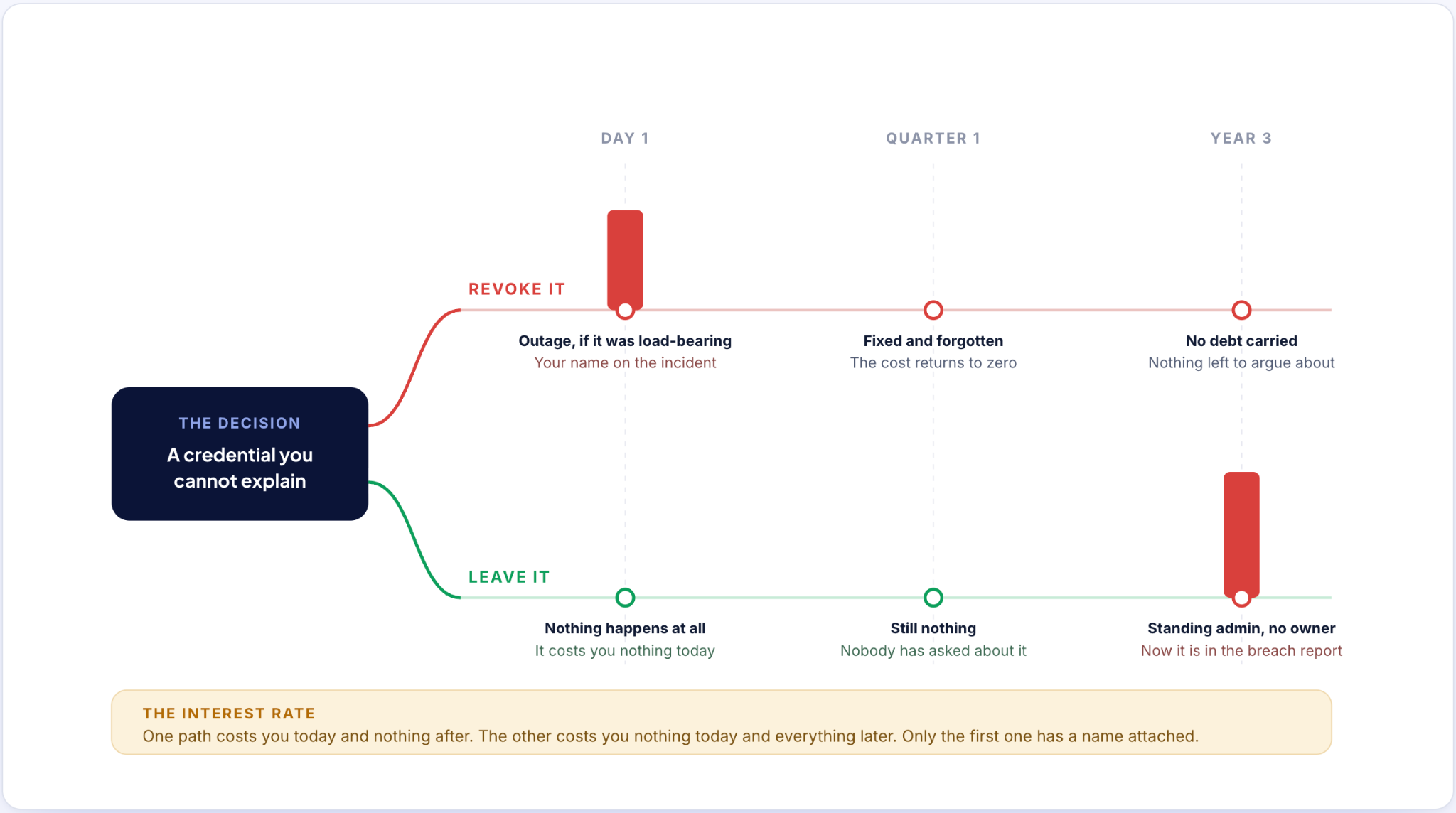
Deleting a live credential is loud, immediate, and yours: if something depended on it, you've caused an outage with your name on the change.
Leaving a dead one is silent and free, on any timescale that shows up in your quarter. So the rational move on any given credential is to wait, and "wait" repeated across thousands of them is the debt.
This is why "just deactivate unused accounts" is useless advice. It treats deletion as a decision when it's really a gamble, and it hands the whole downside to whoever acts.
Why You Can't Prove a Service Account Is Unused
The obvious escape is to remove the gamble: prove which ones are dead, delete only those. It doesn't work for non-human identities because the proof mostly isn't there. Most of them never sign in.
They authenticate with a token or a certificate, or sit as a placeholder in a system that never logs an interactive event, so the last-activity date you see is often just the day the identity was created.
The trap that catches everyone is the no-reply address wired into a marketing or alerting system. Zero sign-in activity since the day it was made, and it's pushing thousands of messages a week.
Delete it on the strength of the log and you break something that was never idle for a second. A service account can be dead by every signal you can see and load-bearing anyway.
So stop trying to prove these are dead. The answerable question isn't "is this used," it's "how much would it cost me if this were compromised, and who will own that call."

How Non-Human Identity Debt Builds Up Across the Lifecycle
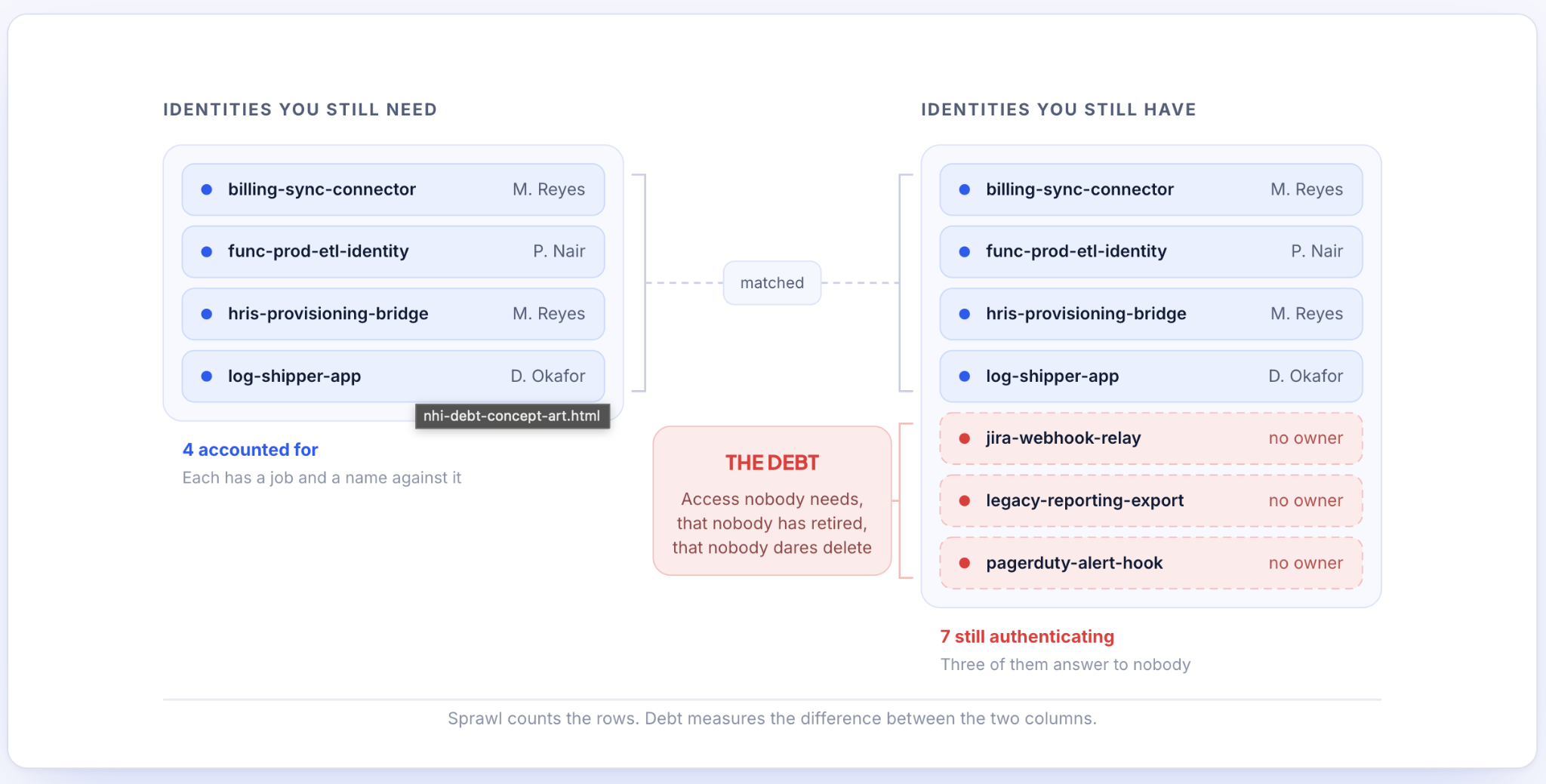
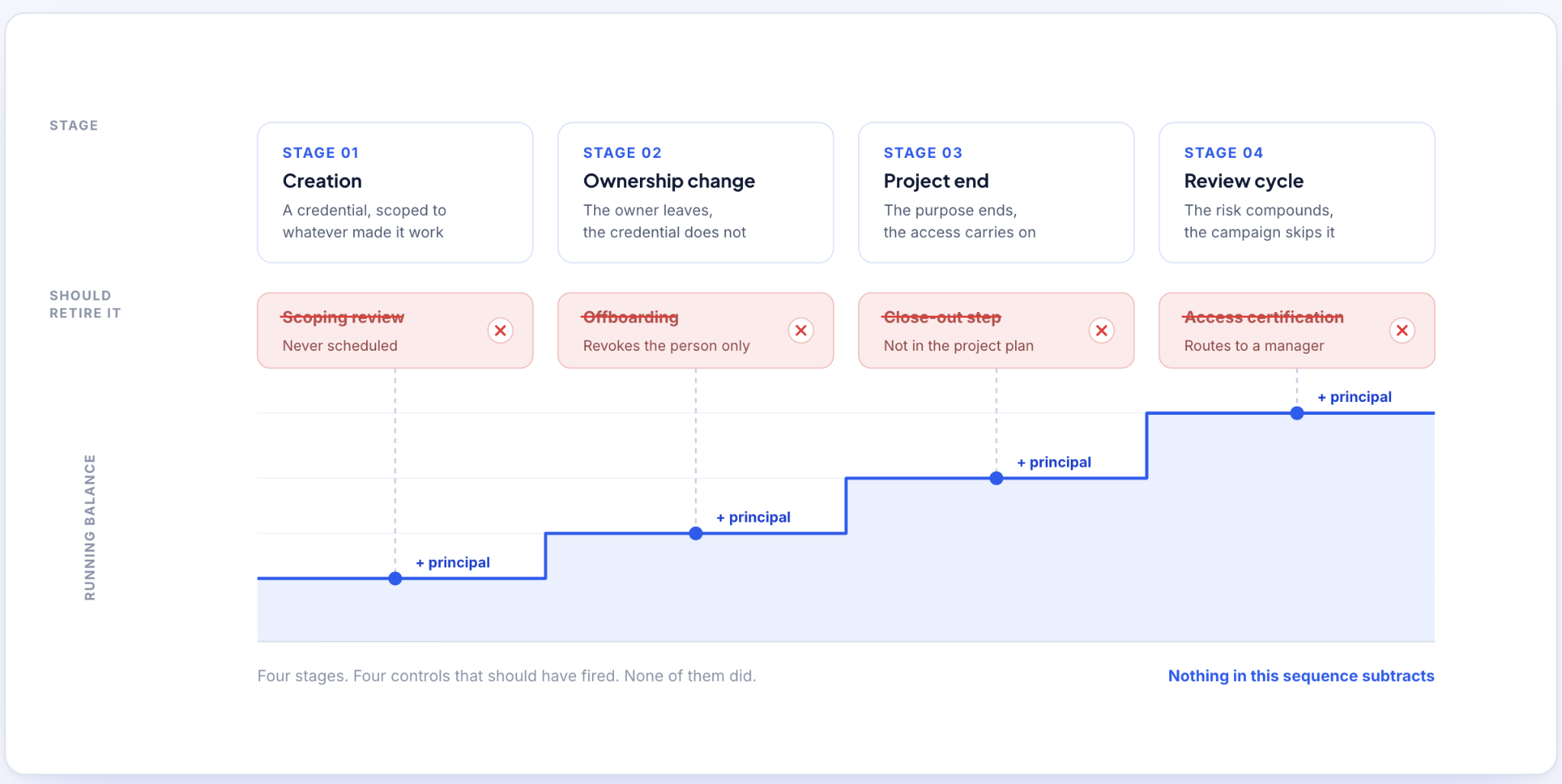
Non-human identity debt is the gap between the identities you still need and the ones you still have. It grows at four points in the lifecycle, and none of them has a step that ends in retirement.
The Four Stages Where Credentials Accrue and Never Retire
How Orphaned Accounts Form When an Employee Leaves
The owner-leaves stage is where orphaned accounts come from, and it's the worst of the four.
A developer is handed a secret code, builds something, leaves two years later; the code still runs and the only person who knew what the credential was for is gone.
Human offboarding doesn't catch it, because the service account was never linked to that person in any system offboarding reads.
It's why employee onboarding and offboarding has to cover what someone built, not just what they could reach. These orphaned accounts are the hardest to clear, because there's no one left to ask what they do.
Why Access Reviews Skip Non-Human Identities and AI Agents Multiply Them
The review cycle is the quiet failure: access reviews were built to catch exactly this and skip it by design, because campaigns route to a manager and certify against an employment status that a token doesn't have.
Closing that gap is how to bring non-human identities into your access reviews.
And it's accelerating. A growing share of these credentials now belong to AI agents that inherit their builder's permissions, so one afternoon's work stands up an over-scoped identity nobody registered, which is why AI agents end up with more access than your security team.
Put the four stages together and the invisibility explains itself: no manager, no leaving date, no login trail, so none of the mechanisms that would flag a stray account ever fire. It accrues at every stage and surfaces at none. That's how it builds up quietly.
What Unretired Non-Human Identities Cost You in Risk and Audit Gaps
The cost of identity debt isn't the storage or the license. It's that the access becomes something you can see but can't act on, which is a worse position than not knowing at all.
The Real Cost Is Access You Can See but Can't Safely Remove
An admin looking at a six-year-old service account with broad permissions, no owner, and no activity in the logs still won't delete it, because there's no evidence to stand behind saying nothing breaks when it goes.
Seeing the risk doesn't help if you can't act on it.
The credential stays, fully privileged, precisely because it's suspicious enough to worry about and unprovable enough that nobody will sign off on removing it.
Multiply that hesitation across the estate and you're not managing risk, you're accumulating it in plain sight.
Dormant Privileged Credentials Are Your Largest Blast Radius
That standing, un-removable access is the real exposure. These orphaned accounts are also your worst-defended ones.
A dormant credential with real privilege is the least-defended path into a system that matters: no MFA in any meaningful sense, excluded from reviews, unlikely to sit behind conditional access, and holding permissions nobody has questioned since the day they were granted.
If one is compromised, it reaches everything it was ever over-scoped to reach, and nothing was watching it.
Unowned Service Accounts Become Audit Findings
The same gap shows up quieter at audit. When an assessor asks who owns a given service account and when its access was last certified, the honest answer across most of the estate is nobody and never.
That's a finding, and it's a hole in whatever you claim about your controls over privileged access. You can't certify what you can't attribute.
How to Pay Down Non-Human Identity Debt
Non-human identity lifecycle management, done for real, is two efforts at once: clear what you carry, and stop new debt forming.
See Every Identity You Are Carrying


Triage by Privilege and Dormancy Instead of Certainty
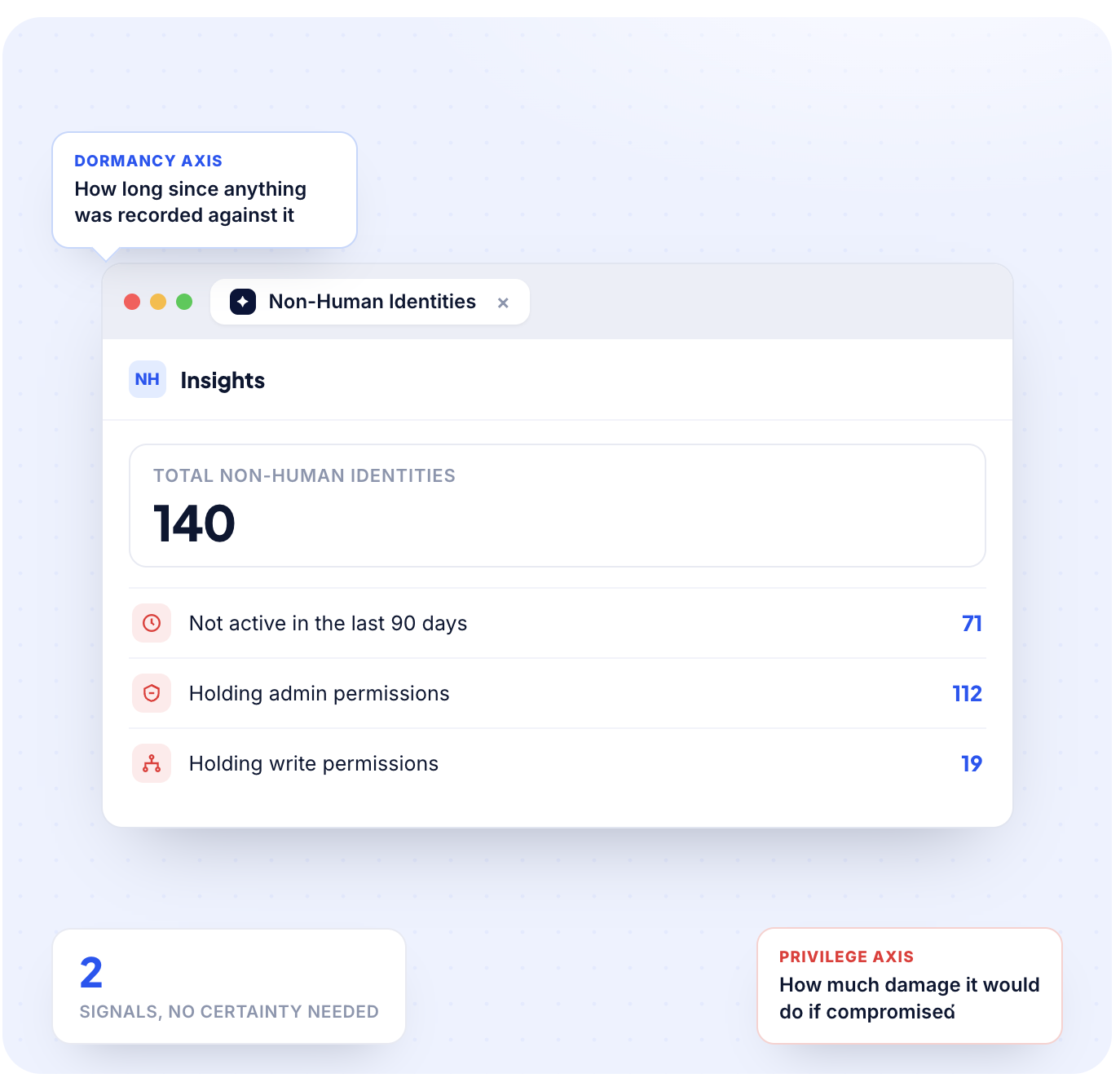
Rank the estate instead of trying to clear it, by what an identity can reach, then how long since it did anything, then whether a human will vouch for it.
Then disable rather than delete, and remove only after a quiet period with no breakage. Disabling is the whole trick: it makes the reversal cheap, which is what neutralizes the asymmetry that built the debt.
Assign an Owner to Every Non-Human Identity
Ownership is what makes every other control possible: the reviews above can't run on an identity with nobody to route to.
Where the creator's gone, reassign to the team that runs the system it touches. Ownership isn't understanding it on day one, it's being on the hook to find out.
Set an Expiry Date on Every New Credential
This is the only control that works without anyone remembering to act later. A credential that lapses on a date can't quietly become a ten-year liability. Triage clears the backlog; expiry stops it rebuilding.
How CloudEagle.ai Governs Non-Human Identities
CloudEagle.ai turns non-human identity lifecycle management into something you can run: it brings service accounts, tokens, managed identities, and agents into one governed inventory and applies the ownership, review, and expiry controls our identity governance platform already runs for people.
Every Non-Human Identity in One View, With Its Owner and Age
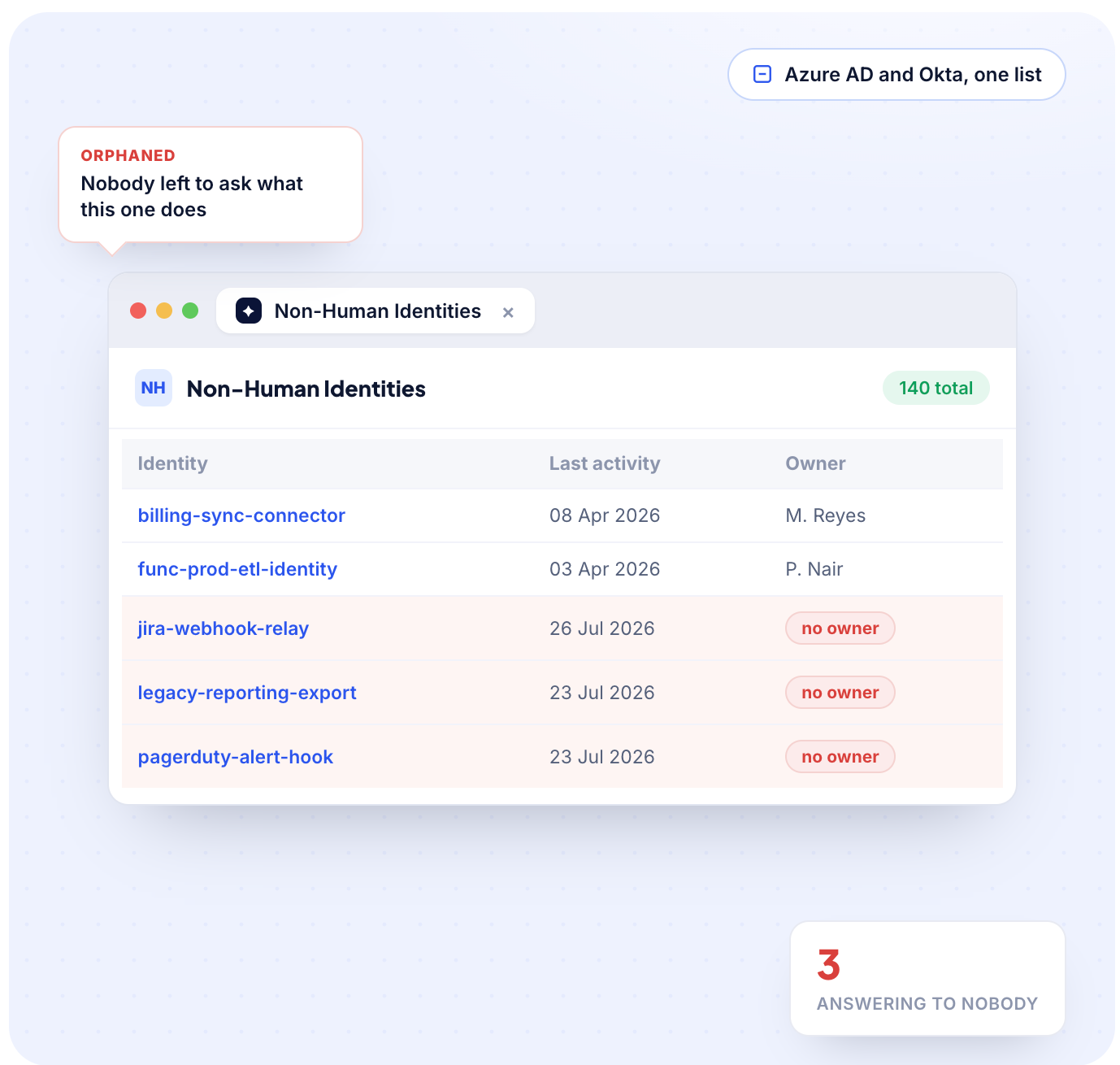
For each identity you get its type and credential type, its source, whether it's active, its last recorded activity, and its owner. Else, you get a blank where nobody holds it, with a drill-down into roles and permissions you can revoke back to the source.
We're straight about the limit, because it shapes how you use this: we don't give you API-call-level telemetry proving an identity is dead, and neither does your directory.
What we give you are the four things you can actually triage on, scope, dormancy, ownership, and age, which is enough to act with something to stand behind.
Non-Human Identity Reviews and Expiry That Keep the Balance Flat
From there the lifecycle controls run:
- Access reviews extended to non-human identities, so they enter the same certification cadence as your people.
- Owner assignment with a notification to the new owner when the original creator is gone.
- Insights that surface the orphaned accounts with no recent activity or no roles at all.
- Time-Based Access that expires a credential on a set date at creation.
Armorcode used it to take non-human identity visibility from 40% to 95%, remediate 480 unmanaged accounts, and scope down 220 over-permissioned ones. Every one of those was a credential someone had chosen to leave rather than risk deleting.
The way you stop the next thousand reaching that state is to make the safe choice the easy one: an owner on every identity, and an end date on every new credential.
Stop Adding To The Balance
FAQs
Q1: What is non-human identity debt?
Non-human identity debt is access held by service accounts, tokens, and agents that no longer serve a purpose but were never retired. It builds up because every stage of a credential's life adds access and none removes it. Unlike a normal backlog, it's access you can see but can't safely delete, because you usually can't prove what's still in use.
Q2: How is a non-human identity different from a regular user account?
A non-human identity authenticates software, not a person, so employee controls don't apply. It has no manager to certify its access, completes no MFA, and keeps no working hours to baseline against. It also rarely signs in, so the activity logs you'd use to judge a user account show almost nothing.
Q3: How do you tell if a service account is still being used?
Often you can't, and that's the core problem. Most service accounts authenticate with a token or certificate instead of logging in, so their last-activity date is frequently just their creation date. A no-reply account can show zero sign-ins while sending thousands of emails a week. Rank identities by privilege and dormancy instead of waiting for proof.
Q4: How do you clean up orphaned service accounts without breaking production?
Disable before you delete. Orphaned accounts pile up because deleting a live credential risks an outage, so nobody acts. Disabling is cheap to reverse: disable it, wait through a quiet period, delete only if nothing breaks. Work the highest-privilege, longest-dormant, unowned accounts first, and give each one an owner.
Q5: How does CloudEagle.ai help manage non-human identities?
CloudEagle.ai brings service accounts, tokens, managed identities, and agents into one view, each with its owner, age, permissions, and last activity. It flags dormant and over-permissioned ones, reassigns owners when the creator has left, extends access reviews to non-human identities, and sets expiry at creation. It won't prove an identity is dead, but it gives you the signals to act.


.avif)


.avif)
.avif)




.png)






.avif)
.avif)
.avif)


