%201.svg)


HIPAA Compliance Checklist for 2025

Ask a security leader how many identities have access to their environment right now and you will get a number. Ask how many of those they can name an owner for, and the number gets smaller. Ask which ones were reviewed in the last 30 days, and the conversation usually stops.
That is the gap identity governance has to close in 2026. The population being governed now includes contractors, service accounts, API keys, and AI agents, and a growing share of the applications they reach were never connected to the identity provider in the first place.
CloudEagle.ai has been named a Representative Vendor in the 2026 Gartner Market Guide for Identity Governance and Administration, listed for its Identity Governance product among full-suite IGA vendors.
The rest of this piece covers what has changed in the discipline and how CloudEagle.ai governs identities, access, and AI across the full stack.
Read official announcement about the recognition here: CloudEagle.ai Is a Representative Vendor in the 2026 Gartner® Market Guide for Identity Governance and Administration
Where Identity Governance Breaks Down Today
The core question has not changed. Should this identity have this access, and can you prove it? What has changed is the size and shape of the population you have to answer that question for.
Access has moved outside the identity provider
Most identity teams govern what sits behind Okta or Entra. That covers the federated, approved list, and it is usually the smaller half of the picture.
The rest arrives a different way:
- Applications bought on a corporate card and expensed later
- Free tiers signed up for with a work email
- AI tools adopted by a team weeks before IT hears about them
- Departmental tools inherited through an acquisition
None of these show up in a quarterly review, because none of them were ever onboarded into the system that generates the review.
The review cadence no longer matches the risk
Quarterly access reviews were designed for an environment where roles changed slowly. Today, permissions drift between reviews, contractors come and go inside a single cycle, and reviewers facing hundreds of rows approve in bulk to clear the deadline.
The result is a review that satisfies the auditor and misses the risk. If your access review process still runs on exports and reminder emails, this breakdown of what actually goes wrong is worth reading alongside this piece.
A large share of identities were never hired
Every integration you connect creates a service account. Every automation creates a token. Every AI agent you deploy creates something that can authenticate, act, and reach data, often inheriting the permissions of whoever created it.
These identities have no HR record, manager, or offboarding trigger. They accumulate quietly, and in most organizations nobody owns tracking them centrally.

How CloudEagle.ai Approaches Identity Governance
Those three gaps share a root cause: identity data lives in one system, application data in another, usage data in a third, and nobody is correlating them. CloudEagle.ai was built to sit across all of it.
"Most enterprises can tell you who works for them. Very few can tell you what every employee, contractor, service account, and AI agent has access to right now. CloudEagle.ai closes that gap by pulling identity, entitlement, and usage data into one place, so access reviews run continuously instead of quarterly and offboarding completes the same day someone leaves. Governance only counts if it keeps pace with the business."
Nidhi Jain, CEO and Founder, CloudEagle.ai
With CloudEagle.ai, enterprises govern identities, orchestrate access, secure SaaS and AI, while continuously optimizing usage and renewals. In practice, that breaks into four areas.
a) Access reviews that close in days instead of months
Reviewers today pull exports, log into applications one by one to confirm what a permission actually grants, and rubber-stamp the rest when the audit date arrives.
How CloudEagle.ai solves it:
- Assigns reviewers automatically and tracks who has not completed their review
- Gives each reviewer full context on roles, entitlements, privilege level, and SSO or HRIS presence, so high-risk users get attention first
- Deprovisions rejected access and attaches the proof to an audit-ready report

Compliance evidence is assembled as the review runs, rather than reconstructed from Jira tickets afterward.
b) Joiner, mover, and leaver automation
When provisioning depends on tickets and checklists, new hires wait days for tools, and departing employees keep access to whatever nobody remembered to check.
How CloudEagle.ai solves it:
- Provisions birthright applications automatically at onboarding
- Routes access requests through a self-service catalog with approval policies attached
- Applies time-based access so temporary permissions expire on their own
- Deprovisions across every connected application at offboarding, including apps outside the identity provider
Teams cut access-request resolution time by up to 80%, and employees are productive on day one.
c) Non-human identity governance
Service accounts, API keys, OAuth apps, and AI agents carry standing access with no accountable owner, and traditional review campaigns skip them entirely.
How CloudEagle.ai solves it:
- Pulls non-human identities from Entra, Okta, and other connected providers into one registry
- Shows status, ownership, credential type, last activity, and what each identity can reach
- Extends the same review and certification cadence used for employees to machine identities
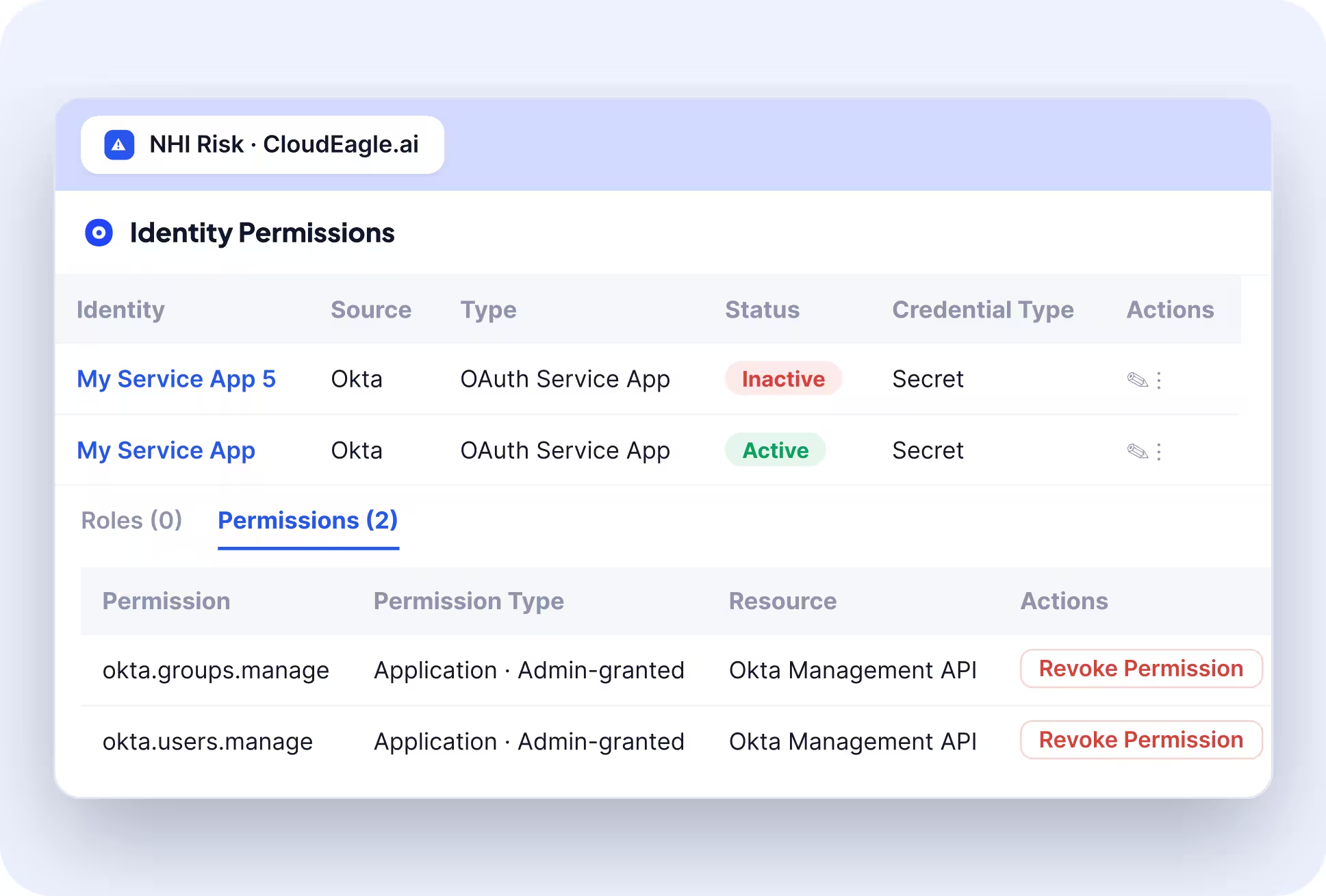
One CloudEagle.ai customer took non-human identity visibility from 40% to 95%, turning an unmeasured attack surface into a governed one. If you are scoping this work now, start here on how NHI governance fits into an existing SaaS program.
d) Security posture you can show an auditor
Posture assessments run app by app, go stale within weeks, and leave leadership without a defensible answer on where the stack actually stands.
How CloudEagle.ai solves it:
- Tracks application security posture continuously against frameworks such as NIST 800
- Monitors MFA and SSO enforcement across the portfolio
- Risk-scores sanctioned and unsanctioned SaaS and AI applications so review effort goes where exposure is highest
One live view replaces the point-in-time audit, and the board question has an answer that is current on the day it is asked.
Where This Leaves IT and Security Teams
Identity governance stopped being a quarterly project the moment the identity population started growing faster than the team managing it. Employees, contractors, service accounts, and AI agents all need the same thing: a record of what they can access, an owner, and a review that actually happens.
CloudEagle.ai correlates identity, entitlement, usage, HRIS, finance, and security signals across 500+ integrations, going beyond logins to the features, roles, and permissions underneath them. Onboarding takes 30 minutes.
Book a demo to see identity governance running across your full SaaS and AI stack.
Gartner, Market Guide for Identity Governance and Administration, Rebecca Archambault, Brian Guthrie, Paul Mezzera, Steve Wessels, 28 August 2026.
GARTNER is a registered trademark and service mark of Gartner, Inc. and/or its affiliates in the U.S. and internationally and is used herein with permission. All rights reserved.
Gartner does not endorse any vendor, product, or service depicted in its research publications and does not advise technology users to select only those vendors with the highest ratings or other designation. Gartner research publications consist of the opinions of Gartner's research organization and should not be construed as statements of fact. Gartner disclaims all warranties, expressed or implied, with respect to this research, including any warranties of merchantability or fitness for a particular purpose.
Govern Every Identity in Your Stack




.avif)


.avif)
.avif)




.png)





.avif)
.avif)
.avif)


