How the NIST AI Risk Management Framework Applies to the AI Tools Your Team Uses

Share via:
blog-cms-banner-bg
Little-Known Negotiation Hacks to Get the Best Deal on Slack
cta-bg-blogDownload Your Copy

HIPAA Compliance Checklist for 2025

Download PDF

Your board is asking about your AI risk posture. Someone mentioned the NIST AI risk management framework in the last audit committee meeting, and now it's on your list. Most teams have read the summary. Almost none have mapped it to the AI tools their employees actually open every day.

That's the gap this article closes. 

The NIST AI risk management framework was written with AI developers in mind, the teams building and training models. But most enterprises aren't building AI. They're using it. 

Employees open ChatGPT in a browser tab, Copilot ships inside the M365 tenant IT already pays for, and a developer wires Cursor into a production repo before anyone in security hears about it.

The NIST AI risk management framework's four functions, Govern, Map, Measure, and Manage, apply directly to that reality. This article translates each one, tool by tool, so you can walk into the board conversation with answers instead of a framework summary.

TL;DR

  • The NIST AI risk management framework applies to AI tool usage, not just AI development. If your org uses ChatGPT, Copilot, or Cursor, the framework already applies to you.
  • Govern means someone owns the decision to approve or block each AI tool and that decision is documented.
  • Map means you know which tools are in use, by whom, and what data they touch, including the ones nobody approved.
  • Measure means every tool in your inventory has a risk score that gets reviewed, not a one-time checkbox.
  • Manage means enforcement happens in real time: unapproved tools get blocked, access gets revoked on offboarding, and AI agents have an owner.

1. What This Looks Like on the Tools You Actually Have

Before the function-by-function breakdown, here's the whole argument in one view: the same four questions, asked of four tools most enterprises already run.

AI tool Govern asks Map asks Measure asks Manage asks
ChatGPT (browser, personal or team accounts) Is it on the approved list, and who decided that? Who's using it, and with what data? Does it train on inputs at this pricing tier? Is unapproved access blocked at the browser?
Copilot (inside M365) Who owns the license and access decision? Which tenant data can it query? Has its permission scope drifted since rollout? What happens to its access when the owner leaves?
Cursor (AI coding tool) Approved for which repositories? What code and secrets can it reach? Is it scored against the same criteria as other vendors? Is access tied to the developer's identity lifecycle?
Internal AI agents Who's accountable for what it does autonomously? What code and secrets can it reach? Is its permission footprint tracked as an NHI? Is there a lifecycle process for decommissioning it?

The rest of this article walks through each function in depth, using these same tools as the working examples.

Your Board Is Asking About AI Risk. Can You Answer?

Start with this checklist before the next audit committee meeting.
Download Checklist

2. What the NIST AI RMF Is, and Why It Applies to You?

The NIST AI risk management framework applies to your organization whether or not you build AI, because using AI tools carries the same risk categories the framework was designed to address.
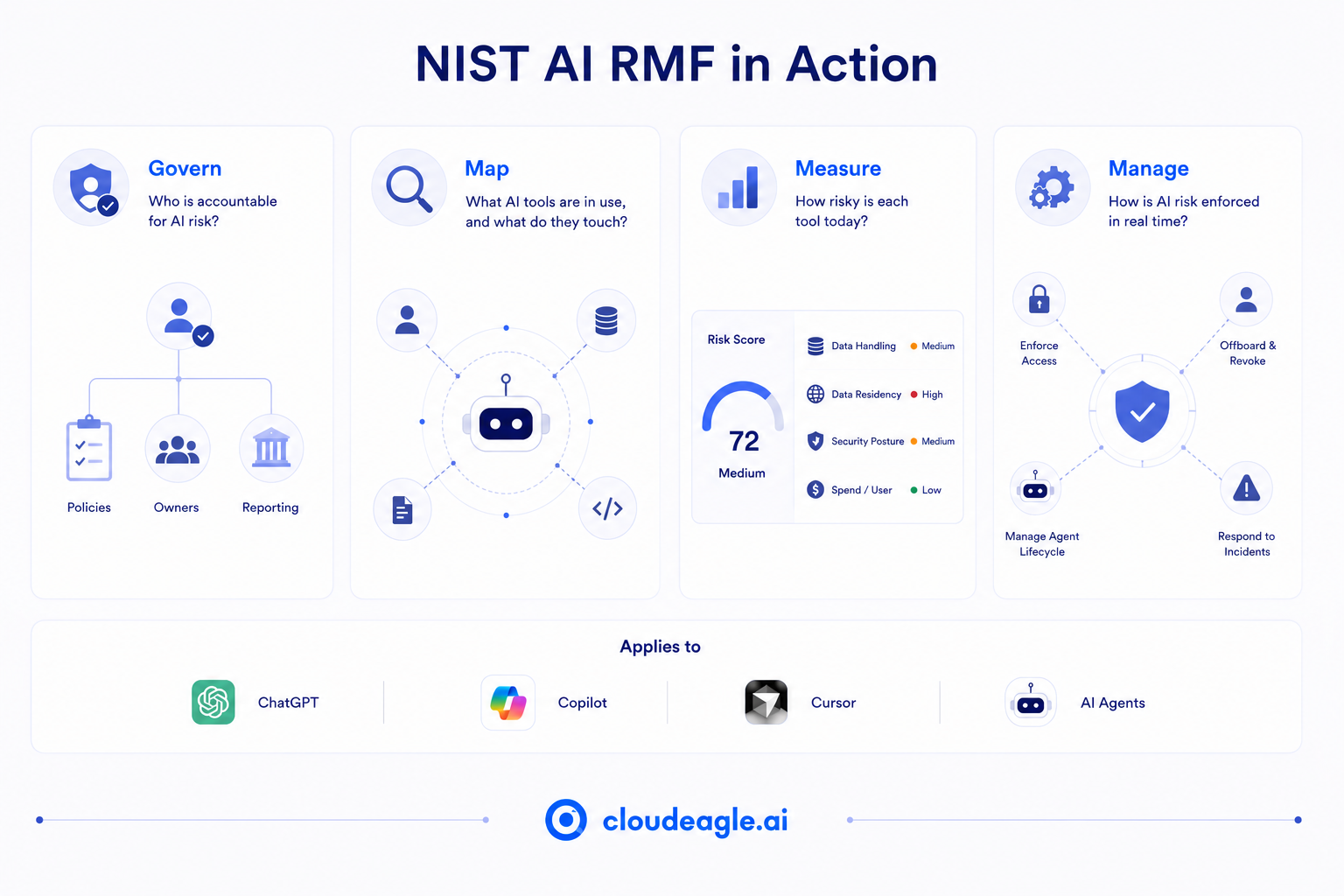
CloudEagle.ai visualization of the NIST AI Risk Management Framework (AI RMF), showing Govern, Map, Measure, and Manage functions for AI governance across ChatGPT, Copilot, Cursor, and AI agents.

NIST published the AI RMF as NIST AI 100-1 on January 26, 2023. A few things worth knowing before you apply it:

  • It's voluntary: The NIST AI risk management framework creates no legal obligation on its own. It becomes a requirement only when a contract, regulator, or internal policy references it directly.
  • It's not a certification: There is no such thing as being "NIST AI RMF certified." Anyone who tells you otherwise is selling something.
  • It's not developer-only: The framework explicitly covers AI deployment and use, not just AI development. That line is easy to miss on a first read, and it's the whole reason this article exists.
  • It's still expanding: NIST released a Generative AI Profile (NIST AI 600-1) in 2024 to address GenAI-specific risks like data training and content provenance, and a Critical Infrastructure AI Profile concept note followed in 2026. The framework is a moving target, not a document you read once.
If your organization deploys or uses AI tools, which it does, whether IT approved them or not, NIST AI RMF governance applies to how you manage that usage. The four functions below are how.

A related standard worth knowing about: ISO 42001 covers similar ground with a certifiable management system rather than a voluntary framework. That's a different article. This one stays focused on the NIST AI risk management framework and NIST AI RMF governance as it applies to the tools your team already has open.

2. How the Four Functions Apply to ChatGPT, Copilot, Cursor, and Your AI Agents

Each NIST AI RMF function below answers a different question about the same tools. Together, they're the whole picture the mapping table above previewed.
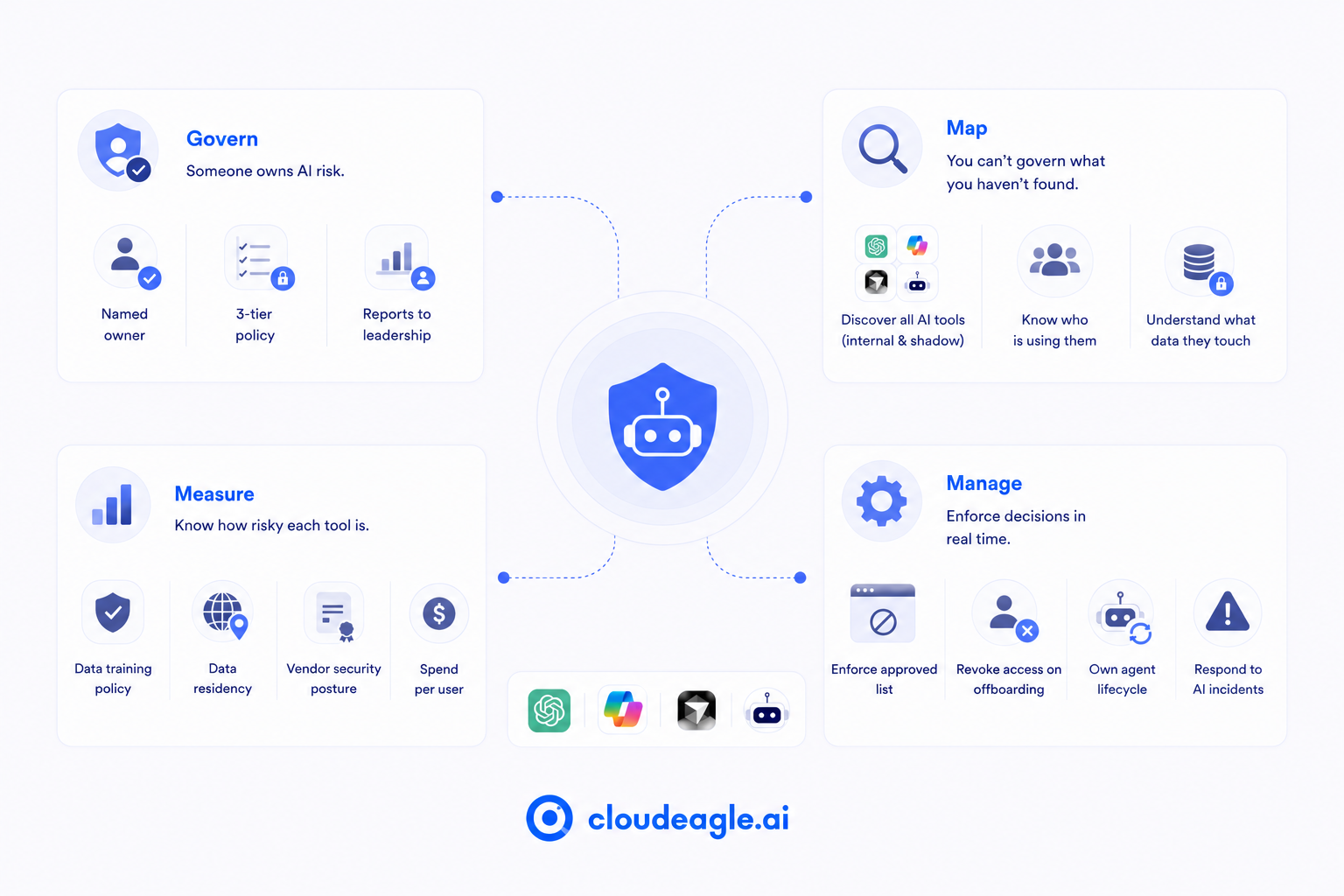
Diagram illustrating the four pillars of AI governance: Govern, Map, Measure, and Manage, helping organizations discover AI tools, assess risk, assign ownership, and enforce AI security policies.

a) Govern: Someone Has to Own AI Risk. Right Now, No One Does.

In the NIST AI risk management framework, Govern means defining who is accountable for AI risk decisions before those decisions are made by default.

The gap: nobody signed off on the finance team's ChatGPT Team subscription. IT switched on Copilot tenant-wide because it shipped with the M365 renewal. Ask who approved either tool, and there's no clean answer, because approval never happened. Adoption did.

What Govern looks like applied to real tools:

  • A named owner per tool tier: Someone approves new AI tools, someone owns the acceptable use policy, and someone is accountable when a tool creates a data exposure.
  • A documented three-tier policy: Approved tools get full access. Conditionally approved tools get access with restrictions or monitoring. Blocked tools get denied outright, with a process for exceptions.
  • A reporting line to leadership: When the CFO asks where AI spend is going, or the board asks about AI risk posture, someone in the organization has that answer ready, not scrambling for it.

Why it persists: business teams adopt AI tools independently, outside the CIO and CISO office, and security finds out only after the tool is embedded in a workflow. Ownership is the actual failure point, not the policy document. Most organizations skip it because naming an owner feels smaller than writing one.

Also read: AI Governance Model: How to Monitor, Control & Optimize AI Usage if ownership is the piece missing from your governance function. It walks through how IT, security, finance, and the CIO split accountability without duplicating it.

b) Map: You Can't Govern What You Haven't Found

In the NIST AI risk management framework, Map means building an accurate picture of which AI tools are in use, who's using them, and what data they touch.

The gap: Copilot is licensed for 400 employees on paper. What the license doesn't show: sixty of those same employees are also feeding customer contracts into personal ChatGPT accounts on their phones, and a developer connected Cursor to a repository holding production API keys. Security is aware of neither.

Map, applied to actual tools, requires:

  • Tool-level data classification: Which tools touch customer PII, financial records, or proprietary code, and which are limited to internal documentation.
  • User attribution: A tool used by two people carries a different risk profile than the same tool used by five hundred people processing customer data.
  • Business-function context: A developer using Cursor for code completion is a different risk than a finance analyst pasting contracts into a free-tier chatbot.

The scale: roughly 60% of AI and SaaS tools in use sit entirely outside IT and procurement's line of sight. SSO-based discovery misses personal accounts, browser extensions, and free-tier signups by design.

In practice: a CISO in a regulated industry put it plainly: discovery is table stakes. Measure and Manage both depend on the inventory Map is supposed to produce.

Also read: The Shadow AI Governance Gap: Why 63% of Enterprises Have No Shadow AI Policy breaks down exactly why that 60% blind spot exists and what closes it.

60% of AI Tools in Your Stack Are Invisible to IT.

Map what's actually running before you try to govern it.
Download Checklist

c) Measure: Finding a Tool Isn't the Same as Knowing How Risky It Is

In the NIST AI risk management framework, Measure means scoring each AI tool against defined risk criteria on an ongoing basis, not once at procurement and never again.

The gap: Copilot and ChatGPT Enterprise showed up on the same procurement cycle. Few teams can say whether the two retain prompts the same way, train on inputs by default, or have changed their data handling terms since signing. Vendor terms shift, and almost nobody re-checks them after the initial review.

Measure, applied to real tools, means tracking:

  • Data training policy: Does the tool train on your inputs, and at which pricing tier does that change?
  • Data residency: Where does data go once it enters the tool, a real compliance question for regulated industries and a real risk factor everywhere else.
  • Vendor security posture: SOC 2, ISO 27001, and the terms of service clauses that actually govern data handling.
  • Spend per user: Not a single vendor invoice total, but per-user, per-model tracking that catches drift before finance does.

In practice: one finance leader's invoices didn't match usage data, and the CEO and CFO had no clean answer for where AI spend was actually going. That's a Measure failure with a dollar figure attached.

Also read: CIO's AI Governance Checklist 2026 for the ten questions this function needs answered before your board asks them first.

d) Manage: A Policy Document Has Never Stopped Anyone From Pasting a Contract Into ChatGPT

In the NIST AI risk management framework, Manage means enforcing AI risk decisions in real time, not documenting them and hoping employees comply.

The gap: an AI agent built by an employee who left three weeks ago is still running, still connected to the Slack workspace and the CRM it was given access to on day one. Nobody owns the decision to shut it down. That's the default outcome when Manage doesn't exist as an operational function.

What Manage looks like applied to real tools and agents:

  • Enforcement of the approved list: A browser-layer control that blocks or redirects access to unapproved AI tools before data gets entered, not a policy that relies on employees remembering the rules.
  • Access revocation on offboarding: Deprovisioning that reaches AI-specific access, including API keys and agent connections, not just SSO.
  • Agent lifecycle ownership: A defined process for what happens to an AI agent when the employee who built it leaves or changes roles.
  • Incident response for AI-specific exposure: A documented protocol for what happens when someone submits customer data to an unsanctioned tool.

In practice: growing AI workloads and agentic workflows require governance controls to prevent rogue behavior, and most organizations don't have that layer built yet. Some IT teams have started locking down MCP server connections for exactly this reason, restricting which agents can reach internal systems.

Also read: How to Reduce AI Risk: 7 Enterprise AI Security Best Practices for the operational controls that make this function real.

3. Where Most Organizations Actually Sit on the Framework

Most organizations aren't failing the NIST AI risk management framework uniformly. They're strong in one function and missing the other three entirely, and knowing which one you're missing tells you what to fix first.

Function Common posture in 2026
Govern A policy draft exists, but it isn't enforced and has no named owner.
Map 60% of AI tools remain invisible to IT and procurement.
Measure No standardized risk scoring; spend tracked at the invoice level, not per user.
Manage Manual, reactive response to incidents rather than automated controls.

The sequence that works:

  1. Map first: You can't govern, measure, or manage a tool you haven't found.
  2. Govern in parallel: Ownership and inventory reinforce each other.
  3. Measure once the inventory is live.
  4. Manage last: Hardest to build, and the only function that actually reduces risk instead of documenting it.

The warning: many organizations will hit these gaps in the next six months and scramble for a response. Starting now, even just at Map, gets you ahead of that scramble. Waiting means building the framework in response to an incident instead of ahead of one.

4. The Visibility Layer Every NIST AI RMF Function Assumes You Have

To be clear upfront: using CloudEagle.ai does not make your organization NIST AI RMF compliant, and there is no such thing as NIST AI RMF certification to claim. What the framework's four functions assume is visibility into your AI tool environment. 

Here's what that visibility looks like in practice: 
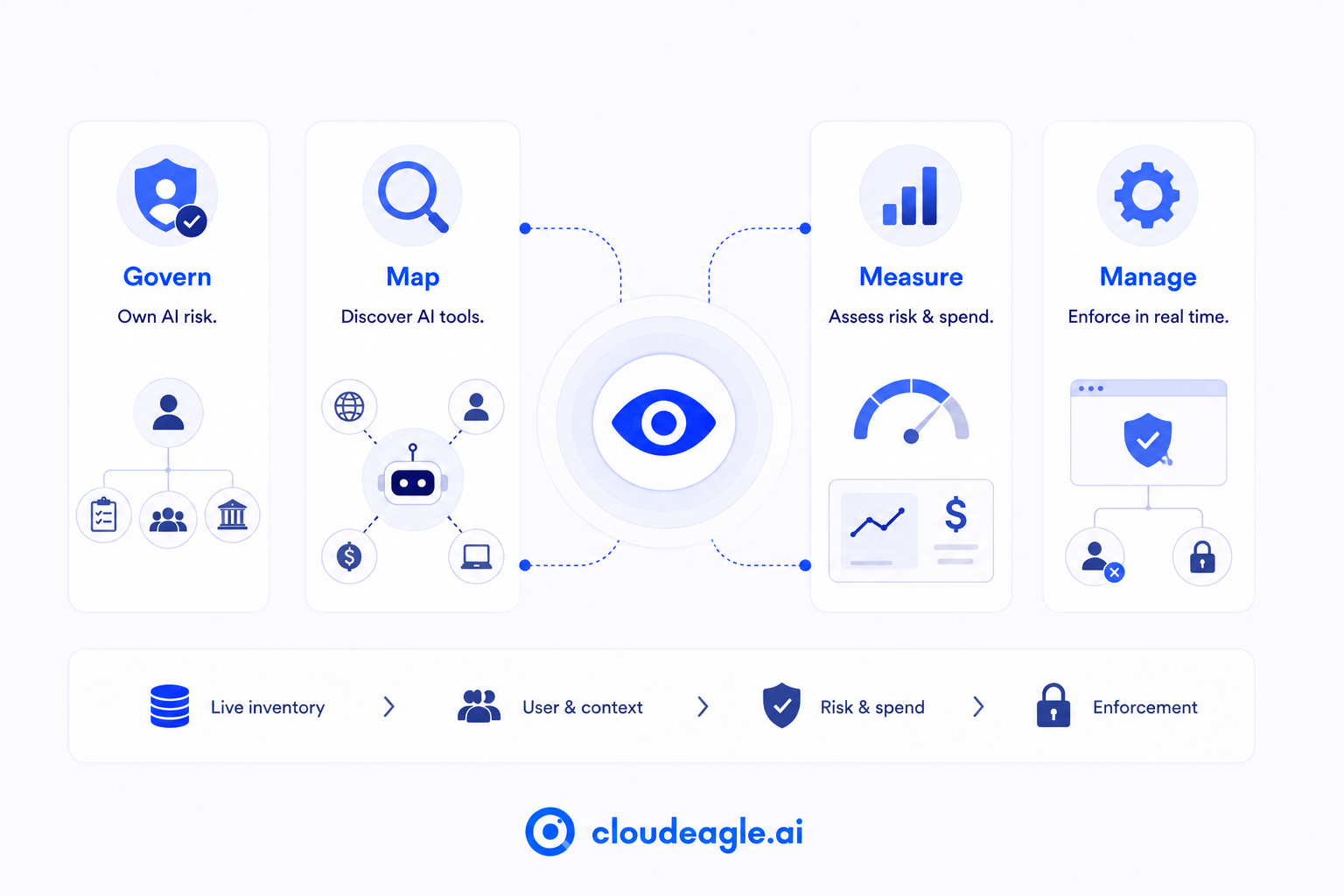
CloudEagle.ai AI governance workflow connecting AI discovery, ownership, risk assessment, spend visibility, and policy enforcement for enterprise AI management.

Govern: without a live inventory or an enforced policy, tool approval decisions get made by default rather than by design. 

How CloudEagle.ai solves it:

  • A policy-based flash page intercepts access to unapproved AI tools and communicates your organization's policy at the moment of use
  • Ownership is assigned per tool tier, so approval and exception decisions have a named accountable person. 

Governance decisions get made before a tool is adopted, not after it's already embedded in a workflow.
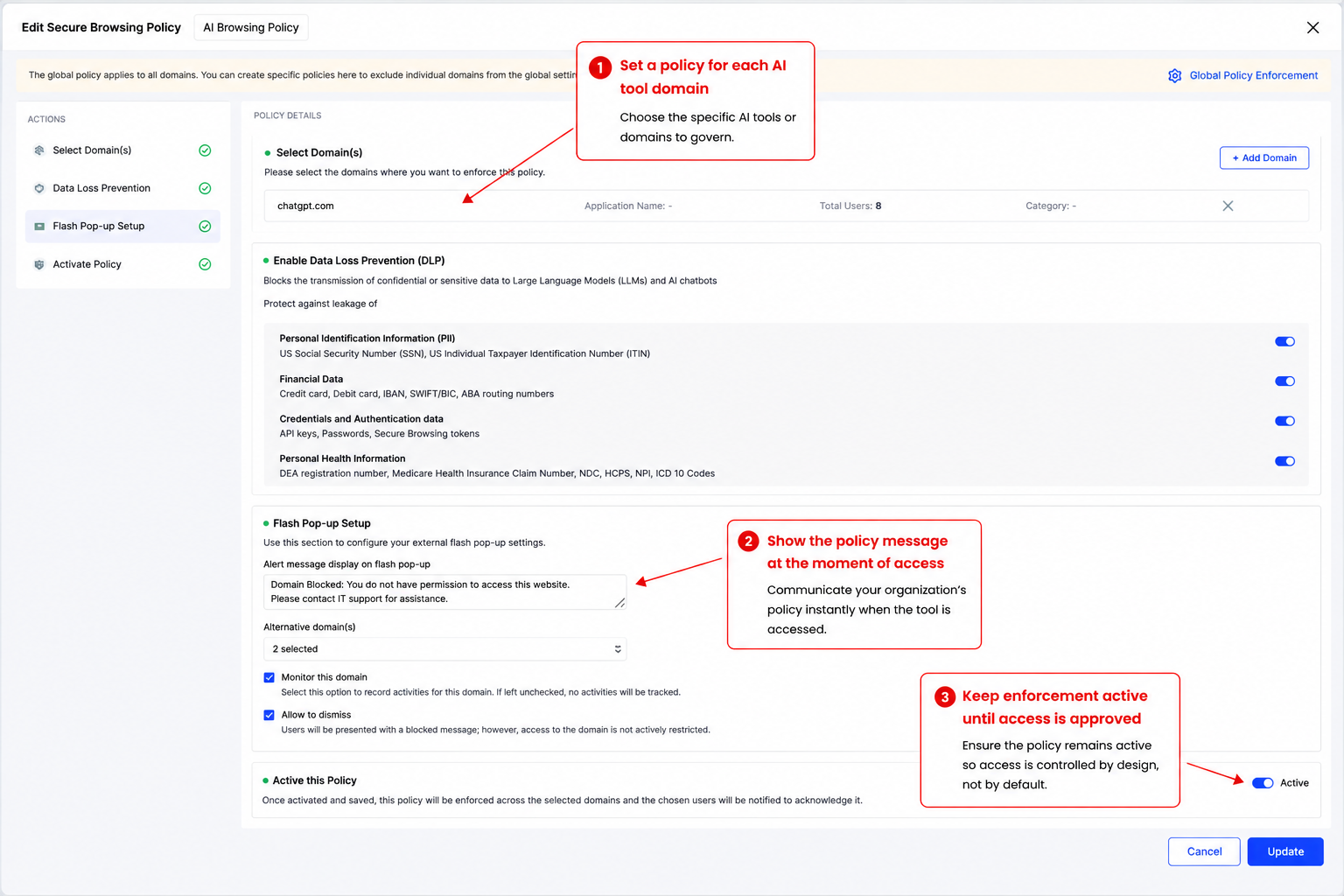
CloudEagle.ai AI browsing policy configuration screen for enforcing secure AI usage with domain-specific policies, data loss prevention (DLP), access notifications, and policy activation.

Map: SSO-based discovery misses the personal accounts, browser extensions, and free-tier signups that make up a large share of actual AI usage. 

How CloudEagle.ai solves it:

  • Correlates signals across browser activity, SSO, finance data, and endpoint telemetry to surface AI tools that never touched your identity provider
  • Keeps the inventory continuously updated instead of refreshed on a quarterly cycle.  

You get a live inventory of AI tool usage instead of a guess that's already stale by the time it's compiled.
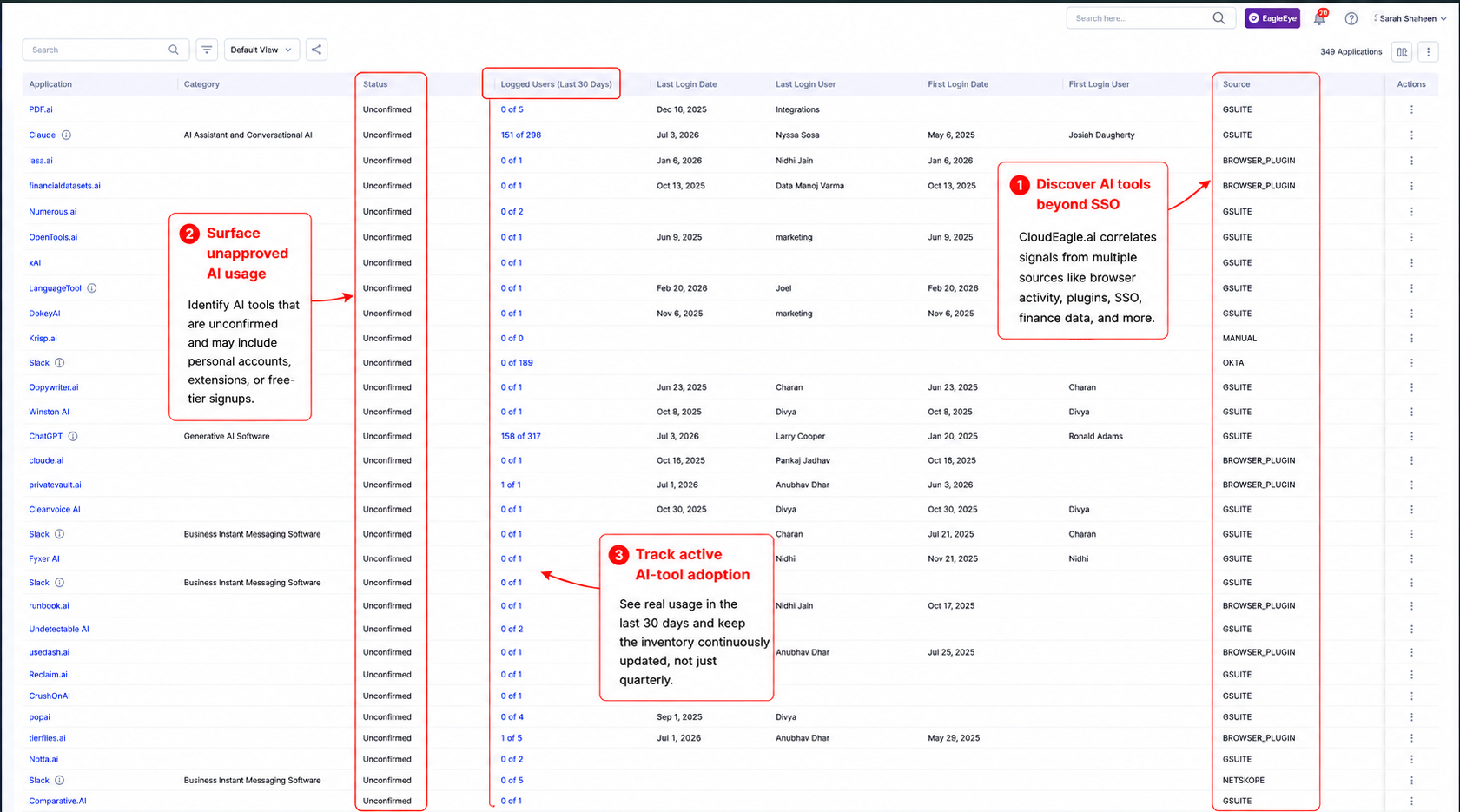
CloudEagle.ai AI application inventory showing discovered AI tools, approval status, active users, login activity, and discovery sources for shadow AI visibility and governance.

Measure: most organizations have no standardized way to score AI tool risk, so they either block everything or approve everything. 

How CloudEagle.ai solves it:

  • Assigns an automatic risk score per tool based on data training policy, data residency, security certifications, and vendor posture
  • Tracks AI spend at the per-user and per-tool level, not just the vendor invoice total 
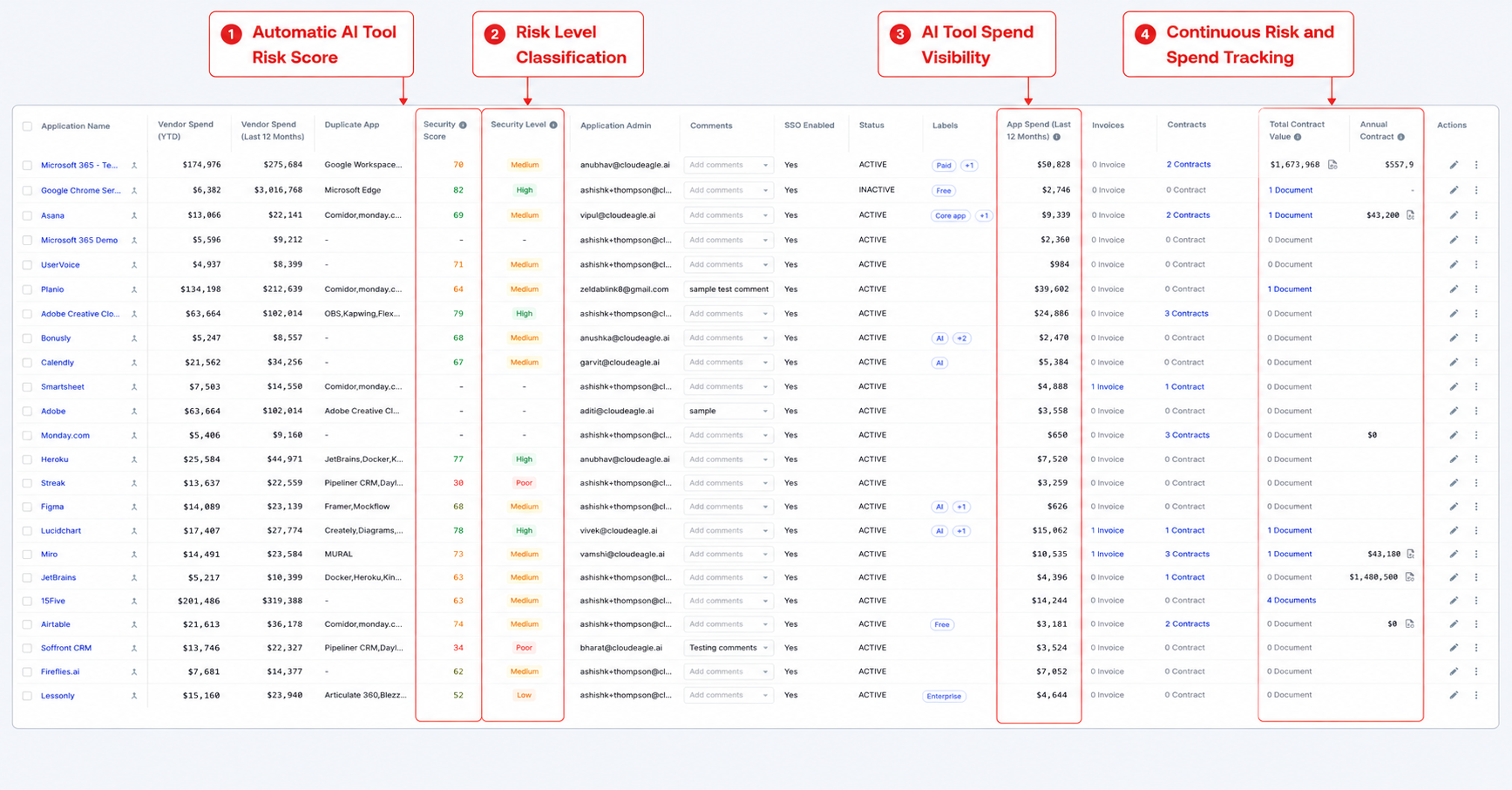
CloudEagle.ai dashboard displaying AI application risk scores, security classifications, application spend, contract values, and continuous AI risk and cost monitoring.

Risk and spend become visible on an ongoing basis instead of surfacing only at renewal or during a board review.

Manage: policies without enforcement rely on employees remembering rules under pressure, which doesn't hold up. 

How CloudEagle.ai solves it:

  • Intercepts and redirects access to unapproved AI tools at the browser layer before data is entered
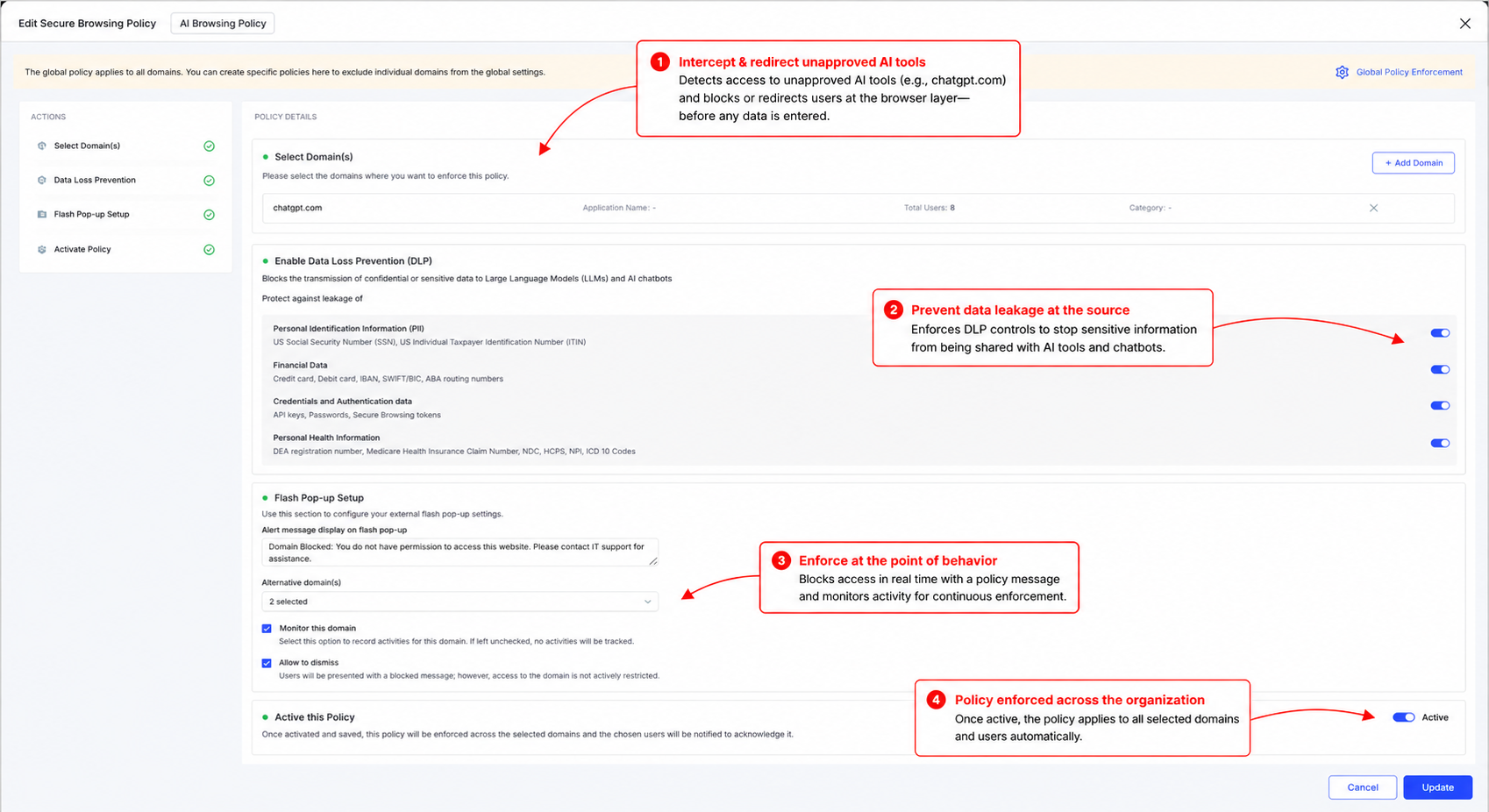
CloudEagle.ai secure browsing policy demonstrating browser-based AI governance with AI tool blocking, data loss prevention controls, policy enforcement, and real-time access protection.

  • Ties AI access deprovisioning to the HR-driven identity lifecycle and surfaces external MCP server connections and agent ownership. 
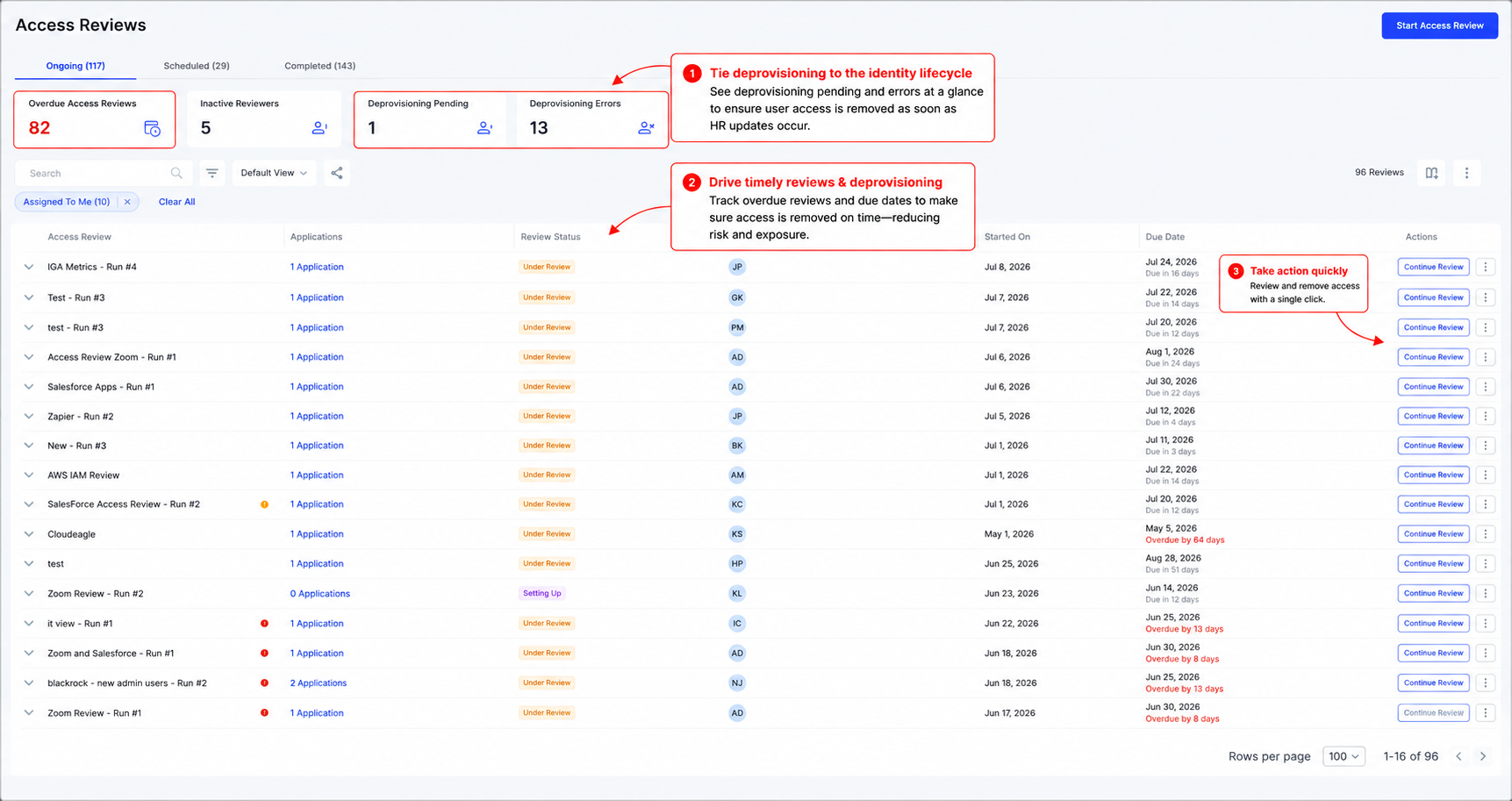
CloudEagle.ai access review dashboard tracking AI and application access reviews, deprovisioning status, review progress, due dates, and remediation workflows for identity governance.

Exposure gets stopped at the point of behavior instead of being discovered afterward in an access review.

Aditya Khosla, CTO at Iterative Health, put it, 
“Once AI adoption accelerated across teams, visibility alone wasn’t enough. We needed clear rules around who could use AI tools, under what conditions, and how those decisions were enforced and reviewed. CloudEagle helped us move from ad-hoc approvals to structured, defensible AI governance.”

Also read: AI Governance Auditing: A 2026 Playbook for Internal Audit Teams if you're past translating the framework and ready to build the audit evidence trail behind it.

5. FAQs

1. What is the purpose of the AI risk management framework introduced by NIST? 

To give organizations a voluntary, structured way to identify, assess, and manage risk from AI systems they build, deploy, or use.

2. What are the 7 steps of the NIST risk management framework? 

That's the general NIST RMF (Prepare, Categorize, Select, Implement, Assess, Authorize, Monitor), not the AI RMF, which uses four functions instead.

3. What are the 4 components of risk management NIST? 

Govern, Map, Measure, and Manage, the four core functions of the NIST AI risk management framework.

4. What is the risk management framework for AI? 

NIST's AI RMF is the primary US framework, organized around Govern, Map, Measure, and Manage, applicable to AI development, deployment, and use.

The NIST AI risk management framework isn't asking whether you have an AI strategy. It's asking whether you can govern, map, measure, and manage the AI tools your employees are already using. 

See how CloudEagle.ai gives you the visibility layer each function assumes you have → book a demo.

Advertisement for a SaaS Subscription Tracking Template with a call-to-action button to download and a partial graphic of a tablet showing charts.Banner promoting a SaaS Agreement Checklist to streamline SaaS management and avoid budget waste with a call-to-action button labeled Download checklist.Blue banner with text 'The Ultimate Employee Offboarding Checklist!' and a black button labeled 'Download checklist' alongside partial views of checklist documents from cloudeagle.ai.Digital ad for download checklist titled 'The Ultimate Checklist for IT Leaders to Optimize SaaS Operations' by cloudeagle.ai, showing checklist pages.Slack Buyer's Guide offer with text 'Unlock insider insights to get the best deal on Slack!' and a button labeled 'Get Your Copy', accompanied by a preview of the guide featuring Slack's logo.Monday Pricing Guide by cloudeagle.ai offering exclusive pricing secrets to maximize investment with a call-to-action button labeled Get Your Copy and an image of the guide's cover.Blue banner for Canva Pricing Guide by cloudeagle.ai offering a guide to Canva costs, features, and alternatives with a call-to-action button saying Get Your Copy.Blue banner with white text reading 'Little-Known Negotiation Hacks to Get the Best Deal on Slack' and a white button labeled 'Get Your Copy'.Blue banner with text 'Little-Known Negotiation Hacks to Get the Best Deal on Monday.com' and a white button labeled 'Get Your Copy'.Blue banner with text 'Little-Known Negotiation Hacks to Get the Best Deal on Canva' and a white button labeled 'Get Your Copy'.Banner with text 'Slack Buyer's Guide' and a 'Download Now' button next to images of a guide titled 'Slack Buyer’s Guide: Features, Pricing & Best Practices'.Digital cover of Monday Pricing Guide with a button labeled Get Your Copy on a blue background.Canva Pricing Guide cover with a button labeled Get Your Copy on a blue gradient background.

Enter your email to
unlock the report

Oops! Something went wrong while submitting the form.
License Count
Benchmark
Per User/Per Year

Enter your email to
unlock the report

Oops! Something went wrong while submitting the form.
License Count
Benchmark
Per User/Per Year

Enter your email to
unlock the report

Oops! Something went wrong while submitting the form.
Notion Plus
License Count
Benchmark
Per User/Per Year
100-500
$67.20 - $78.72
500-1000
$59.52 - $72.00
1000+
$51.84 - $57.60
Canva Pro
License Count
Benchmark
Per User/Per Year
100-500
$74.33-$88.71
500-1000
$64.74-$80.32
1000+
$55.14-$62.34

Enter your email to
unlock the report

Oops! Something went wrong while submitting the form.

Enter your email to
unlock the report

Oops! Something went wrong while submitting the form.
Zoom Business
License Count
Benchmark
Per User/Per Year
100-500
$216.00 - $264.00
500-1000
$180.00 - $216.00
1000+
$156.00 - $180.00

Enter your email to
unlock the report

Oops! Something went wrong while submitting the form.

Get the Right Security Platform To Secure Your Cloud Infrastructure

Please enter a business email
Thank you!
The 2023 SaaS report has been sent to your email. Check your promotional or spam folder.
Oops! Something went wrong while submitting the form.

Access full report

Please enter a business email
Thank you!
The 2023 SaaS report has been sent to your email. Check your promotional or spam folder.
Oops! Something went wrong while submitting the form.

Your board is asking about your AI risk posture. Someone mentioned the NIST AI risk management framework in the last audit committee meeting, and now it's on your list. Most teams have read the summary. Almost none have mapped it to the AI tools their employees actually open every day.

That's the gap this article closes. 

The NIST AI risk management framework was written with AI developers in mind, the teams building and training models. But most enterprises aren't building AI. They're using it. 

Employees open ChatGPT in a browser tab, Copilot ships inside the M365 tenant IT already pays for, and a developer wires Cursor into a production repo before anyone in security hears about it.

The NIST AI risk management framework's four functions, Govern, Map, Measure, and Manage, apply directly to that reality. This article translates each one, tool by tool, so you can walk into the board conversation with answers instead of a framework summary.

TL;DR

  • The NIST AI risk management framework applies to AI tool usage, not just AI development. If your org uses ChatGPT, Copilot, or Cursor, the framework already applies to you.
  • Govern means someone owns the decision to approve or block each AI tool and that decision is documented.
  • Map means you know which tools are in use, by whom, and what data they touch, including the ones nobody approved.
  • Measure means every tool in your inventory has a risk score that gets reviewed, not a one-time checkbox.
  • Manage means enforcement happens in real time: unapproved tools get blocked, access gets revoked on offboarding, and AI agents have an owner.

1. What This Looks Like on the Tools You Actually Have

Before the function-by-function breakdown, here's the whole argument in one view: the same four questions, asked of four tools most enterprises already run.

AI tool Govern asks Map asks Measure asks Manage asks
ChatGPT (browser, personal or team accounts) Is it on the approved list, and who decided that? Who's using it, and with what data? Does it train on inputs at this pricing tier? Is unapproved access blocked at the browser?
Copilot (inside M365) Who owns the license and access decision? Which tenant data can it query? Has its permission scope drifted since rollout? What happens to its access when the owner leaves?
Cursor (AI coding tool) Approved for which repositories? What code and secrets can it reach? Is it scored against the same criteria as other vendors? Is access tied to the developer's identity lifecycle?
Internal AI agents Who's accountable for what it does autonomously? What code and secrets can it reach? Is its permission footprint tracked as an NHI? Is there a lifecycle process for decommissioning it?

The rest of this article walks through each function in depth, using these same tools as the working examples.

Your Board Is Asking About AI Risk. Can You Answer?

Start with this checklist before the next audit committee meeting.
Download Checklist

2. What the NIST AI RMF Is, and Why It Applies to You?

The NIST AI risk management framework applies to your organization whether or not you build AI, because using AI tools carries the same risk categories the framework was designed to address.

CloudEagle.ai visualization of the NIST AI Risk Management Framework (AI RMF), showing Govern, Map, Measure, and Manage functions for AI governance across ChatGPT, Copilot, Cursor, and AI agents.

NIST published the AI RMF as NIST AI 100-1 on January 26, 2023. A few things worth knowing before you apply it:

  • It's voluntary: The NIST AI risk management framework creates no legal obligation on its own. It becomes a requirement only when a contract, regulator, or internal policy references it directly.
  • It's not a certification: There is no such thing as being "NIST AI RMF certified." Anyone who tells you otherwise is selling something.
  • It's not developer-only: The framework explicitly covers AI deployment and use, not just AI development. That line is easy to miss on a first read, and it's the whole reason this article exists.
  • It's still expanding: NIST released a Generative AI Profile (NIST AI 600-1) in 2024 to address GenAI-specific risks like data training and content provenance, and a Critical Infrastructure AI Profile concept note followed in 2026. The framework is a moving target, not a document you read once.
If your organization deploys or uses AI tools, which it does, whether IT approved them or not, NIST AI RMF governance applies to how you manage that usage. The four functions below are how.

A related standard worth knowing about: ISO 42001 covers similar ground with a certifiable management system rather than a voluntary framework. That's a different article. This one stays focused on the NIST AI risk management framework and NIST AI RMF governance as it applies to the tools your team already has open.

2. How the Four Functions Apply to ChatGPT, Copilot, Cursor, and Your AI Agents

Each NIST AI RMF function below answers a different question about the same tools. Together, they're the whole picture the mapping table above previewed.

Diagram illustrating the four pillars of AI governance: Govern, Map, Measure, and Manage, helping organizations discover AI tools, assess risk, assign ownership, and enforce AI security policies.

a) Govern: Someone Has to Own AI Risk. Right Now, No One Does.

In the NIST AI risk management framework, Govern means defining who is accountable for AI risk decisions before those decisions are made by default.

The gap: nobody signed off on the finance team's ChatGPT Team subscription. IT switched on Copilot tenant-wide because it shipped with the M365 renewal. Ask who approved either tool, and there's no clean answer, because approval never happened. Adoption did.

What Govern looks like applied to real tools:

  • A named owner per tool tier: Someone approves new AI tools, someone owns the acceptable use policy, and someone is accountable when a tool creates a data exposure.
  • A documented three-tier policy: Approved tools get full access. Conditionally approved tools get access with restrictions or monitoring. Blocked tools get denied outright, with a process for exceptions.
  • A reporting line to leadership: When the CFO asks where AI spend is going, or the board asks about AI risk posture, someone in the organization has that answer ready, not scrambling for it.

Why it persists: business teams adopt AI tools independently, outside the CIO and CISO office, and security finds out only after the tool is embedded in a workflow. Ownership is the actual failure point, not the policy document. Most organizations skip it because naming an owner feels smaller than writing one.

Also read: AI Governance Model: How to Monitor, Control & Optimize AI Usage if ownership is the piece missing from your governance function. It walks through how IT, security, finance, and the CIO split accountability without duplicating it.

b) Map: You Can't Govern What You Haven't Found

In the NIST AI risk management framework, Map means building an accurate picture of which AI tools are in use, who's using them, and what data they touch.

The gap: Copilot is licensed for 400 employees on paper. What the license doesn't show: sixty of those same employees are also feeding customer contracts into personal ChatGPT accounts on their phones, and a developer connected Cursor to a repository holding production API keys. Security is aware of neither.

Map, applied to actual tools, requires:

  • Tool-level data classification: Which tools touch customer PII, financial records, or proprietary code, and which are limited to internal documentation.
  • User attribution: A tool used by two people carries a different risk profile than the same tool used by five hundred people processing customer data.
  • Business-function context: A developer using Cursor for code completion is a different risk than a finance analyst pasting contracts into a free-tier chatbot.

The scale: roughly 60% of AI and SaaS tools in use sit entirely outside IT and procurement's line of sight. SSO-based discovery misses personal accounts, browser extensions, and free-tier signups by design.

In practice: a CISO in a regulated industry put it plainly: discovery is table stakes. Measure and Manage both depend on the inventory Map is supposed to produce.

Also read: The Shadow AI Governance Gap: Why 63% of Enterprises Have No Shadow AI Policy breaks down exactly why that 60% blind spot exists and what closes it.

60% of AI Tools in Your Stack Are Invisible to IT.

Map what's actually running before you try to govern it.
Download Checklist

c) Measure: Finding a Tool Isn't the Same as Knowing How Risky It Is

In the NIST AI risk management framework, Measure means scoring each AI tool against defined risk criteria on an ongoing basis, not once at procurement and never again.

The gap: Copilot and ChatGPT Enterprise showed up on the same procurement cycle. Few teams can say whether the two retain prompts the same way, train on inputs by default, or have changed their data handling terms since signing. Vendor terms shift, and almost nobody re-checks them after the initial review.

Measure, applied to real tools, means tracking:

  • Data training policy: Does the tool train on your inputs, and at which pricing tier does that change?
  • Data residency: Where does data go once it enters the tool, a real compliance question for regulated industries and a real risk factor everywhere else.
  • Vendor security posture: SOC 2, ISO 27001, and the terms of service clauses that actually govern data handling.
  • Spend per user: Not a single vendor invoice total, but per-user, per-model tracking that catches drift before finance does.

In practice: one finance leader's invoices didn't match usage data, and the CEO and CFO had no clean answer for where AI spend was actually going. That's a Measure failure with a dollar figure attached.

Also read: CIO's AI Governance Checklist 2026 for the ten questions this function needs answered before your board asks them first.

d) Manage: A Policy Document Has Never Stopped Anyone From Pasting a Contract Into ChatGPT

In the NIST AI risk management framework, Manage means enforcing AI risk decisions in real time, not documenting them and hoping employees comply.

The gap: an AI agent built by an employee who left three weeks ago is still running, still connected to the Slack workspace and the CRM it was given access to on day one. Nobody owns the decision to shut it down. That's the default outcome when Manage doesn't exist as an operational function.

What Manage looks like applied to real tools and agents:

  • Enforcement of the approved list: A browser-layer control that blocks or redirects access to unapproved AI tools before data gets entered, not a policy that relies on employees remembering the rules.
  • Access revocation on offboarding: Deprovisioning that reaches AI-specific access, including API keys and agent connections, not just SSO.
  • Agent lifecycle ownership: A defined process for what happens to an AI agent when the employee who built it leaves or changes roles.
  • Incident response for AI-specific exposure: A documented protocol for what happens when someone submits customer data to an unsanctioned tool.

In practice: growing AI workloads and agentic workflows require governance controls to prevent rogue behavior, and most organizations don't have that layer built yet. Some IT teams have started locking down MCP server connections for exactly this reason, restricting which agents can reach internal systems.

Also read: How to Reduce AI Risk: 7 Enterprise AI Security Best Practices for the operational controls that make this function real.

3. Where Most Organizations Actually Sit on the Framework

Most organizations aren't failing the NIST AI risk management framework uniformly. They're strong in one function and missing the other three entirely, and knowing which one you're missing tells you what to fix first.

Function Common posture in 2026
Govern A policy draft exists, but it isn't enforced and has no named owner.
Map 60% of AI tools remain invisible to IT and procurement.
Measure No standardized risk scoring; spend tracked at the invoice level, not per user.
Manage Manual, reactive response to incidents rather than automated controls.

The sequence that works:

  1. Map first: You can't govern, measure, or manage a tool you haven't found.
  2. Govern in parallel: Ownership and inventory reinforce each other.
  3. Measure once the inventory is live.
  4. Manage last: Hardest to build, and the only function that actually reduces risk instead of documenting it.

The warning: many organizations will hit these gaps in the next six months and scramble for a response. Starting now, even just at Map, gets you ahead of that scramble. Waiting means building the framework in response to an incident instead of ahead of one.

4. The Visibility Layer Every NIST AI RMF Function Assumes You Have

To be clear upfront: using CloudEagle.ai does not make your organization NIST AI RMF compliant, and there is no such thing as NIST AI RMF certification to claim. What the framework's four functions assume is visibility into your AI tool environment. 

Here's what that visibility looks like in practice: 

CloudEagle.ai AI governance workflow connecting AI discovery, ownership, risk assessment, spend visibility, and policy enforcement for enterprise AI management.

Govern: without a live inventory or an enforced policy, tool approval decisions get made by default rather than by design. 

How CloudEagle.ai solves it:

  • A policy-based flash page intercepts access to unapproved AI tools and communicates your organization's policy at the moment of use
  • Ownership is assigned per tool tier, so approval and exception decisions have a named accountable person. 

Governance decisions get made before a tool is adopted, not after it's already embedded in a workflow.

CloudEagle.ai AI browsing policy configuration screen for enforcing secure AI usage with domain-specific policies, data loss prevention (DLP), access notifications, and policy activation.

Map: SSO-based discovery misses the personal accounts, browser extensions, and free-tier signups that make up a large share of actual AI usage. 

How CloudEagle.ai solves it:

  • Correlates signals across browser activity, SSO, finance data, and endpoint telemetry to surface AI tools that never touched your identity provider
  • Keeps the inventory continuously updated instead of refreshed on a quarterly cycle.  

You get a live inventory of AI tool usage instead of a guess that's already stale by the time it's compiled.

CloudEagle.ai AI application inventory showing discovered AI tools, approval status, active users, login activity, and discovery sources for shadow AI visibility and governance.

Measure: most organizations have no standardized way to score AI tool risk, so they either block everything or approve everything. 

How CloudEagle.ai solves it:

  • Assigns an automatic risk score per tool based on data training policy, data residency, security certifications, and vendor posture
  • Tracks AI spend at the per-user and per-tool level, not just the vendor invoice total 

CloudEagle.ai dashboard displaying AI application risk scores, security classifications, application spend, contract values, and continuous AI risk and cost monitoring.

Risk and spend become visible on an ongoing basis instead of surfacing only at renewal or during a board review.

Manage: policies without enforcement rely on employees remembering rules under pressure, which doesn't hold up. 

How CloudEagle.ai solves it:

  • Intercepts and redirects access to unapproved AI tools at the browser layer before data is entered

CloudEagle.ai secure browsing policy demonstrating browser-based AI governance with AI tool blocking, data loss prevention controls, policy enforcement, and real-time access protection.

  • Ties AI access deprovisioning to the HR-driven identity lifecycle and surfaces external MCP server connections and agent ownership. 

CloudEagle.ai access review dashboard tracking AI and application access reviews, deprovisioning status, review progress, due dates, and remediation workflows for identity governance.

Exposure gets stopped at the point of behavior instead of being discovered afterward in an access review.

Aditya Khosla, CTO at Iterative Health, put it, 
“Once AI adoption accelerated across teams, visibility alone wasn’t enough. We needed clear rules around who could use AI tools, under what conditions, and how those decisions were enforced and reviewed. CloudEagle helped us move from ad-hoc approvals to structured, defensible AI governance.”

Also read: AI Governance Auditing: A 2026 Playbook for Internal Audit Teams if you're past translating the framework and ready to build the audit evidence trail behind it.

5. FAQs

1. What is the purpose of the AI risk management framework introduced by NIST? 

To give organizations a voluntary, structured way to identify, assess, and manage risk from AI systems they build, deploy, or use.

2. What are the 7 steps of the NIST risk management framework? 

That's the general NIST RMF (Prepare, Categorize, Select, Implement, Assess, Authorize, Monitor), not the AI RMF, which uses four functions instead.

3. What are the 4 components of risk management NIST? 

Govern, Map, Measure, and Manage, the four core functions of the NIST AI risk management framework.

4. What is the risk management framework for AI? 

NIST's AI RMF is the primary US framework, organized around Govern, Map, Measure, and Manage, applicable to AI development, deployment, and use.

The NIST AI risk management framework isn't asking whether you have an AI strategy. It's asking whether you can govern, map, measure, and manage the AI tools your employees are already using. 

See how CloudEagle.ai gives you the visibility layer each function assumes you have → book a demo.

CloudEagle.ai recognized in the 2025 Gartner® Magic Quadrant™ for SaaS Management Platforms
Download now
gartner chart
5x
Faster employee
onboarding
80%
Reduction in time for
user access reviews
30k
Workflows
automated
$15Bn
Analyzed in
contract spend
$2Bn
Saved in
SaaS spend

Streamline SaaS governance and save 10-30%

Book a Demo with Expert
CTA image