
%201.svg)


HIPAA Compliance Checklist for 2025

In late 2025, ServiceNow announced it had agreed to acquire Veza, the identity security startup known for its authorization graph, for more than one billion dollars. If you are a current Veza customer or were in the midst of an evaluation when the news broke, you are likely asking the same question that every security team in this situation does.
What happens to the roadmap? What happens to pricing inside a billion-dollar platform play? And more practically: is this still the right tool, or should I be looking elsewhere?
This blog does not answer those questions for you. But it gives you the clearest picture available of the best Veza alternatives in 2026, organized by what you actually need, so you can make the decision with your eyes open.
TL;DR
1. Why Teams Are Looking for Veza Alternatives Right Now?
Acquisitions create uncertainty. That is not an opinion; it is a documented pattern.
The acquisition is ServiceNow’s sixth in 2025 and part of its broader push into AI-driven enterprise security. Veza strengthens ServiceNow’s authorization and identity intelligence capabilities, but it also raises a familiar question for customers: Will Veza continue evolving as a standalone platform or eventually become tightly folded into the broader ServiceNow ecosystem?

Here is what that uncertainty concretely means for you:
- Roadmap shifts: Veza's development priorities will increasingly align with ServiceNow's platform strategy, not standalone identity security
- Pricing risk: Enterprise acquisitions historically lead to pricing restructuring, particularly when the acquired product becomes part of a bundle
- Support changes: Post-acquisition, support structures change. Account teams change. Implementation partners change
- Dependency risk: If Veza becomes deeply embedded in the ServiceNow platform, replacing it later becomes significantly harder
None of this means Veza becomes a bad product. It might genuinely improve. But for security teams that need a stable, purpose-built identity governance platform, that uncertainty is reason enough to run a parallel evaluation.

2. What Veza Does Well and Where It Falls Short?
Before evaluating alternatives, it is worth being honest about what you are actually replacing.
What Veza does genuinely well:
- Authorization graph that visualizes who can do what across cloud, SaaS, and on-prem systems in a way few platforms match
- Granular entitlement visibility down to the permission level, not just the role level
- 300+ connectors covering a broad range of enterprise systems
- Non-human identity coverage, including service accounts, API keys, and AI agents
- Strong ISPM positioning with continuous authorization visibility
Where Veza falls short:
- High TCO. Enterprise deployments are typically $50,000 to $100,000+ annually before professional services
- No in-platform remediation. Veza surfaces identity risks but does not fix them. Remediation requires action in connected systems
- Complex implementation. Getting full value from the authorization graph requires significant setup time
- Limited SaaS governance depth. Strong on authorization visualization, weaker on shadow app discovery, license management, and SaaS lifecycle governance
- Acquisition uncertainty, as outlined above
If your primary need was the authorization graph and entitlement visibility, you will want alternatives that match that depth. If you were evaluating Veza for broader SaaS governance, some platforms do that more comprehensively than Veza ever did.

📖 Worth a Read: How CloudEagle.ai Streamlines App Access Review for Compliance Success
3. 7 Best Veza Alternatives for Identity & Access Governance
1. CloudEagle.ai
Here is the honest positioning. Veza is built around authorization intelligence and entitlement visibility across complex enterprise environments. CloudEagle.ai focuses more on the SaaS and AI access layer that many traditional identity governance platforms still leave unmanaged.
If your biggest challenges are shadow AI usage, lingering contractor access, or slow app provisioning for employees, CloudEagle is built to solve those operational gaps directly.
"Provisioning and deprovisioning took hours and created security gaps. CloudEagle.ai's automated workflows now deliver Day 1 access for new hires and instant offboarding, saving time and boosting security." Sam Middleton, Head of IT, Bloom & Wild
Zero-Touch Identity Lifecycle Automation
When someone joins the organization, CloudEagle provisions access automatically based on their role, department, and location. When they move, access adjusts. When they leave, it is revoked across every app, including those outside the IdP.
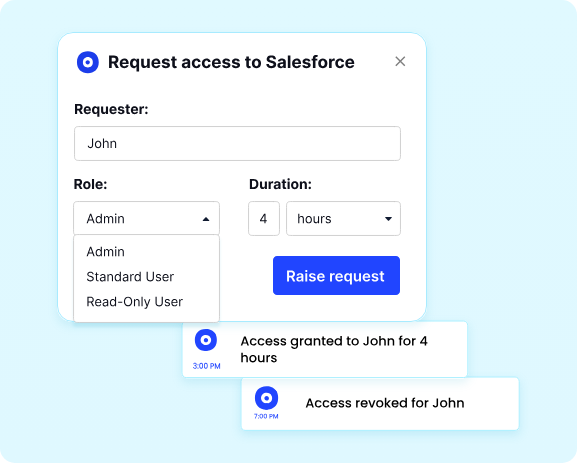
- Role-based access is provisioned the moment a new hire appears in HR systems
- Offboarding triggered automatically, removing access across SSO and non-SSO apps
- Licenses reclaimed immediately and returned to the pool
Self-Service App Catalog That Ends Access Request Tickets
Most access request processes are either email chains or IT ticket queues. CloudEagle replaces both with a governed self-service catalog where employees see only the apps approved for their role.
- MTTR for access requests reduced by up to 80%
- Every request and approval is logged automatically, audit-ready, without manual documentation
- Shadow IT has been eliminated because employees have a fast, approved alternative
Just-in-Time Access That Does Not Become Permanent
Contractors, project-based access, and temporary elevated permissions are the most consistent sources of access sprawl. CloudEagle grants time-bound access that expires automatically when the period ends.
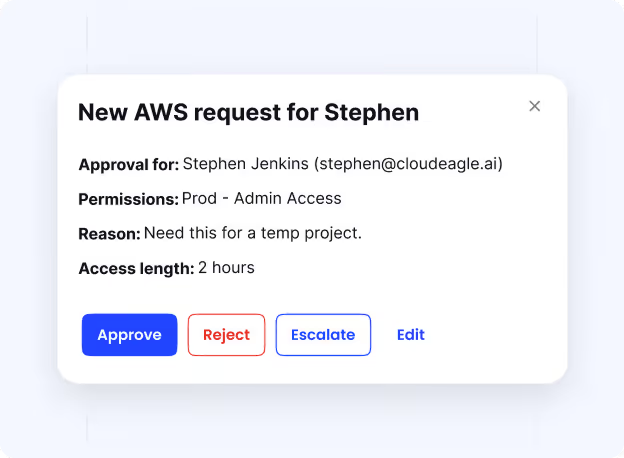
- Temporary access revoked without IT having to track or follow up
- Dormant and unnecessary access is removed continuously
- Zero standing access for high-sensitivity systems
App Access Requests Without the Ticket Chaos
Most access requests still happen through Slack messages, emails, or IT tickets with very little visibility or governance. CloudEagle replaces that with a self-service app catalog and automated approval workflows tied directly to identity context.
Employees request apps directly through Slack or the app catalog, managers approve access in minutes, and provisioning happens automatically across both SSO and non-SSO apps.

- Role-based app visibility prevents overprovisioning
- Automated approval workflows reduce manual IT work
- Time-bound access prevents long-term access sprawl
- Every request and approval stays audit-ready automatically
Continuous User Access Reviews
Most access reviews happen quarterly and often become checkbox exercises that miss risky users, ex-employees, and excessive permissions.
CloudEagle automates continuous access validation so reviewers focus on high-risk access rather than manually gathering evidence across systems.
- Flags ex-employees, dormant users, and over-privileged accounts automatically
- Surfaces high-risk users with a clear access context
- Creates audit-ready evidence automatically for SOC 2 and compliance reviews
- Reduces reviewer fatigue and limits rubber-stamping behavior
Pricing: Enterprise pricing based on user count and integrations.
Apart from identity governance, CloudEagle.ai also helps enterprises manage SaaS spend, procurement workflows, SaaS security & compliance, and AI governance from a single platform.
Is Your Identity Governance Missing Apps Outside Your IdP?


2. ConductorOne
ConductorOne is an AI-native IGA platform that converts standing access into time-bound temporary permissions, automates access reviews, and manages least-privilege enforcement across hybrid environments. It provides real-time automation, multi-step conditional approvals, and emergency break-glass policies, designed for cloud and SaaS environments.
- Key differentiator vs. Veza: In-platform provisioning and deprovisioning, whereas Veza only surfaces risks without remediating them.
- Limitation: Requires CLI and Terraform expertise, adding training costs and making it less suitable for non-technical users. NHI governance has been promised but not meaningfully delivered yet.
Pricing: Custom. Third-party estimates suggest approximately $120,000 annually for mid-sized deployments before add-ons.
3. Lumos
Lumos built its platform around the employee experience problem: people cannot get access to the tools they need without waiting in IT queues. It solves that through a self-service app catalog, Slack-native access requests, and automated approval workflows that route to the right stakeholders instantly.
- Key differentiator vs. Veza: Faster deployment and SaaS-first governance vs. Veza's deep authorization graph for complex environments.
- Limitation: Less depth on authorization visualization, non-human identity governance, and compliance automation for regulated industries.
Pricing: Custom pricing. Contact sales for a quote based on company size and feature needs.
4. SailPoint
SailPoint is a comprehensive enterprise IGA solution that targets companies needing serious compliance frameworks, deep SAP integration, and governance that handles regulations across multiple countries. It manages human, machine, and AI agent identities from a single platform with one of the broadest integration libraries available.
- Key differentiator vs. Veza: Full lifecycle automation and compliance reporting vs. Veza's authorization visualization with no in-platform remediation.
- Limitation: Legacy platforms like SailPoint IdentityIQ almost always require vendor-led professional services, with implementations taking 6 to 12 months. Costs start around $75,000 for small deployments and scale to $800,000+ for large enterprises.
Pricing: Approximately $75,000 for small deployments, $240,000 for mid-sized, and $800,000+ for large enterprises.
5. Saviynt
Saviynt is an enterprise IGA platform known for its compliance, risk analytics, and cloud-focused access governance capabilities, providing extensive controls for managing entitlements, securing privileged identities, and enforcing regulatory standards across hybrid and multi-cloud environments.
- Key differentiator vs. Veza: Full IGA lifecycle, including PAM and ERP governance vs. Veza's entitlement visualization focus.
- Limitation: Enterprise-grade complexity comes with enterprise-grade implementation timelines. Multi-month deployments with professional services are the norm.
Pricing: Custom enterprise pricing. Typically lower than SailPoint IdentityIQ at comparable feature sets.
6. Linx Security
Linx Security is positioned as a modern IGA platform with ISPM natively included, designed for organizations that want identity risk surfacing and remediation in the same platform. It is one of the few alternatives that matches Veza's non-human identity coverage while adding lifecycle automation that Veza never provided.
- Key differentiator vs. Veza: ISPM plus lifecycle governance in one platform, plus in-platform remediation that Veza lacked entirely.
- Limitation: Newer platform with a smaller track record than SailPoint or Saviynt for the largest regulated enterprise environments.
Pricing: Custom pricing. Contact Linx for a quote.
7. Zluri
Zluri built its identity governance capabilities on top of its original SaaS management foundation, which means it treats app visibility and user access as equally important. Organizations mainly pick Zluri when they want quicker provisioning, comprehensive spend tracking, and automated reviews that tie governance directly to cost control.
- Key differentiator vs. Veza: SaaS spend and license governance combined with access reviews vs. Veza's pure authorization focus.
- Limitation: Less depth on authorization graph visualization and non-human identity governance for complex enterprise environments.
Pricing: Custom, based on employee count, applications, and modules selected.
4. How to Choose the Right Veza Alternative for Your Use Case
You do not need to evaluate all seven. Here is the honest shortcut:
For context on how identity governance connects to broader SaaS security, this conversation from a practitioner who has run these programs across real enterprise environments is worth your time.
🎙️ Podcast: Why Identity Governance Is a Leadership Problem, Not Just an IT Problem. Practical perspective on building access governance programs that actually hold up under audit and scale. 👉 Listen now
Final Thoughts
ServiceNow’s acquisition of Veza reflects how important authorization intelligence has become as enterprises manage more SaaS apps, AI agents, and non-human identities.
But acquisitions also change product direction. Over time, Veza will likely become more tightly aligned with ServiceNow’s broader platform strategy rather than evolving purely as a standalone identity security product.
That is why evaluating alternatives now makes sense.
The right platform ultimately depends on the problem you are trying to solve. If you need deep authorization visibility across complex environments, platforms like Linx Security and ConductorOne are closer matches.
If your priority is SaaS lifecycle governance, shadow AI discovery, and automated access management, CloudEagle.ai is one of the strongest SaaS-first options available. And for large enterprises focused heavily on compliance automation, SailPoint and Saviynt remain established choices.
Frequently Asked Questions
- What are the best alternatives to Veza in 2026?
The best alternative depends on your use case. Linx Security and ConductorOne are strong for authorization visibility, while CloudEagle.ai, Lumos, and Zluri focus more on SaaS-first identity governance and access automation.
- How does the ServiceNow acquisition affect Veza customers?
The acquisition could bring stronger platform integration and more engineering investment, but it may also shift Veza’s roadmap toward the broader ServiceNow ecosystem over time.
- How should companies evaluate identity governance platforms?
Start with the gap you are actually trying to solve, whether that is access visibility, SaaS lifecycle automation, compliance reporting, or shadow IT discovery. Deployment complexity, operational overhead, and implementation costs matter just as much as feature lists.
- Which Veza alternative is best for SaaS-first companies?
SaaS-first organizations usually need fast deployment, automated provisioning and deprovisioning, app access governance, and visibility into shadow IT and AI usage. Platforms like CloudEagle.ai, Lumos, and Zluri are generally better suited for that than traditional enterprise-heavy IGA tools.
- Can Veza manage non-human identities and AI agents?
Veza has strong authorization visibility capabilities for human and non-human identities, including service accounts and machine identities. However, organizations evaluating AI governance, SaaS access automation, and shadow AI discovery may still need additional platforms depending on how broad their governance requirements are.
Is Your Identity Governance Missing Apps Outside Your IdP?


.avif)


.avif)
.avif)




.png)






.avif)
.avif)
.avif)


