You need to enable JavaScript in order to use the AI chatbot tool powered by ChatBot

AI Governance Auditing: A 2026 Playbook for Internal Audit and Compliance Teams

Share via:
blog-cms-banner-bg
Little-Known Negotiation Hacks to Get the Best Deal on Slack
cta-bg-blogDownload Your Copy

HIPAA Compliance Checklist for 2025

Download PDF

99% of organizations reported financial losses from AI-related risks in 2025. Average damage: $4.4 million per company, per EY's Responsible AI Pulse survey.

That number is not coming from model failures at AI-native companies. It is coming from ordinary enterprises that deployed AI without governance frameworks and found out the hard way.

Internal audit has a choice right now. Build an AI governance auditing program before something goes wrong, or scramble to explain what controls were in place after it does.

This playbook is written for internal audit directors and compliance teams who need to build that program from scratch. Not why it matters. How to actually do it.

TL;DR

  • AI governance auditing is fundamentally different from traditional IT audit because AI systems make decisions, not just execute instructions, and traditional audit evidence does not capture model behavior or output risk
  • The six domains every AI audit must cover: inventory completeness, data governance, model risk, access and entitlement governance, policy enforcement, and regulatory alignment
  • The 90-day phased playbook moves from AI inventory (Days 1-30) to control testing (Days 31-60) to regulatory mapping and reporting (Days 61-90)
  • Nearly half of Fortune 100 companies now disclose AI risk as part of board oversight responsibilities, a threefold increase in one year
  • CloudEagle.ai provides the AI inventory and continuous audit evidence layer that makes each phase of this playbook operationally executable

1. Why AI Governance Auditing Is Different From Traditional IT Audit?

You have audited IT systems before. You know how to test access controls, review change management logs, and assess configuration against a baseline.

AI systems break most of those assumptions.

Traditional systems execute instructions, while AI systems make decisions. Traditional outputs are deterministic, but AI outputs are probabilistic. You can audit whether access was granted, but you cannot evaluate an AI recommendation using the same controls or evidence.

Here is what that means for your audit program:

Dimension Traditional IT Audit AI Governance Auditing
What you are auditing System configurations, access logs, change records Model behavior, training data, output risk, vendor opacity
Primary evidence Access logs, change tickets, configuration exports Model cards, validation records, drift monitoring logs, incident history
Control testing Access controls, patch management, backup procedures Policy enforcement mechanisms, model validation, explainability requirements
Risk origin Unauthorized access, misconfiguration, software failure Biased outputs, data leakage, model drift, shadow AI adoption
Regulatory standard ISO 27001, SOC 2, NIST CSF NIST AI RMF, ISO 42001, EU AI Act, sector-specific AI rules
Vendor coverage Software licensing and support contracts AI transparency, training data provisions, audit rights in AI vendor contracts

The core difference is this. Traditional IT audit asks: did the right people have the right access to the right systems? AI governance auditing asks: are the AI systems in production making decisions in ways that are accurate, fair, explainable, and compliant with the obligations the organization has accepted?

Those are different questions. They require different evidence. And they require a different audit methodology.

Is Your AI Inventory Audit-Ready?

Most aren't. Learn how to uncover every AI tool, including the ones IT never approved.
Get the Guide

2. The AI Governance Auditing Playbook: Phase by Phase

Phase 1 (Days 1-30): Establish the AI Inventory

Build a complete, risk-classified inventory of every AI system in the organization.

You are looking for four categories:

  • Internally developed AI models and applications
  • Major vendor AI deployments such as ChatGPT Enterprise, Microsoft Copilot, Google Gemini, and Salesforce Einstein
  • AI features embedded in approved SaaS tools
  • Employee-adopted AI tools operating outside IT

Step 1: Pull from every available data source.

Don't start with what IT has documented. Start with what is actually running:

  • SSO logs for AI-category application authentication
  • Expense reports and corporate card statements for Anthropic, OpenAI, and other AI vendor charges
  • Browser activity and endpoint signals for Claude, ChatGPT, Gemini, and similar domains
  • OAuth grant audits for AI plugins authorized through Google or Microsoft consent flows
  • Finance system data for AI subscription charges below procurement thresholds

Step 2: Classify each system by risk level.

Use a consistent three-tier classification:

Risk Level Criteria Examples
High Regulated data, customer impact, or autonomous actions Credit scoring, HR screening, medical AI, transactional chatbots
Medium Internal workflow automation or external content generation Coding assistants, AI reports, internal knowledge tools
Low Productivity tools with limited data access Writing assistants, summarization tools

Step 3: Identify documentation, ownership, and oversight gaps.

For each AI system, record:

  • Named owner accountable for governance
  • Last formal risk assessment date
  • Whether a model card or equivalent documentation exists
  • Whether the system has been included in an access certification
  • Whether it falls under any regulatory classification

Phase 2 (Days 31-60): Test Controls and Gather Evidence

Test whether documented AI controls actually work.

AI Usage Policy Enforcement Testing

Ask for the organization's AI acceptable use policy. Then test whether it is enforced:

  • Attempt to access an unapproved AI tool from a corporate device. Does anything intercept the attempt?
  • Verify whether the policy is technically enforced or exists only on paper.
  • Sample employee usage logs to determine whether unapproved AI tool usage is occurring at scale.

Access Control Testing for AI Systems

For each high-risk AI system:

  • Pull the list of users with direct model access, modification rights, or override capability
  • Cross-reference against employee and contractor status in the HRIS
  • Identify accounts that should have been deprovisioned
  • Verify that AI agents and API keys are included in access reviews

Model Validation and Drift Monitoring Verification

Request documentation covering:

  • Validation methodology and results before deployment
  • Drift monitoring processes and alert thresholds
  • Incidents where model behavior deviated materially from expected outputs
  • The incident response process and whether it was followed

Vendor Contract Review for AI Transparency

Review vendor contracts for every high- and medium-risk AI system.

Verify:

  • What data is used to train or improve the vendor's AI models
  • Whether the organization can audit the vendor's AI governance practices
  • Whether vendors must notify customers when AI features change materially
  • Whether personal data flows are covered by a data processing addendum

Phase 3 (Days 61-90): Map to Regulatory Requirements and Report

Produce a prioritized gap analysis, audit report, and 90-day remediation roadmap.

Regulatory Gap Analysis

Map inventory and control findings against each applicable framework:

  • NIST AI RMF: Assess coverage across Govern, Map, Measure, and Manage.
  • ISO 42001: Verify the existence of an AI policy, defined governance roles, a risk management process, and an internal audit program. ISO 42001 requires a complete management system, not just individual controls.
  • EU AI Act: Classify each AI system by risk tier and verify technical documentation, human oversight, data governance, and post-market monitoring requirements.
  • Sector-specific regulations: FINRA Rule 3110, HIPAA minimum necessary standards, and SOC 2 Type II may impose additional requirements depending on the use case.

Audit Report Structure

Organize findings by domain and regulatory exposure:

  • Critical: Immediate regulatory exposure or material breach risk
  • High: Significant governance gaps requiring remediation within 30 days
  • Medium: Documentation gaps and process weaknesses requiring remediation within 60–90 days
  • Observations: Emerging risks requiring monitoring

90-Day Remediation Roadmap

Present to the audit committee:

  • Finding prioritization by risk and regulatory exposure
  • Named owner and remediation timeline for each finding
  • A 30-day checkpoint for critical and high findings
  • A definition of done for each remediation item

📖 Worth a Read: AI Governance During M&A: What Enterprises Should Focus On

3. AI Governance Audit Questions Every Internal Auditor Should Ask

These questions should drive your interviews, document requests, and control tests across all three phases:

  • Inventory: Do we have a complete register of every AI system, including AI features inside approved SaaS tools, and how is that inventory maintained?
  • Data governance: Can we trace training data for every high-risk AI system to its source and lawful basis, and has any personal data been used?
  • Model risk: Have all high-risk AI systems been validated before deployment, and are drift monitoring thresholds documented and actively monitored?
  • Access governance: Are AI agents and API keys included in access certifications, and can we identify every human and non-human identity with permission to modify or retrain an AI system?
  • Policy enforcement: Is the AI acceptable use policy technically enforced, and what percentage of employees have completed AI usage training?
  • Vendor governance: Do vendor contracts provide audit rights and require notification when AI features that process company data are introduced?
  • Regulatory alignment: Which AI systems fall under high-risk regulatory categories, and can we produce a complete audit trail on demand?

4. How CloudEagle.ai Supports AI Governance Auditing Programs

The most common barrier to building an AI governance auditing program is not understanding what to audit. It is not having the data to audit against.

CloudEagle.ai is an AI-powered AI governance platform for SaaS security and identity governance that serves as the control plane for enterprise AI, giving IT and security teams the visibility layer that makes each of these seven practices operationally executable.

Discover Shadow AI. Eliminate Excess Access. Reduce SaaS Risk.

Shadow AI Discovery Outside SSO

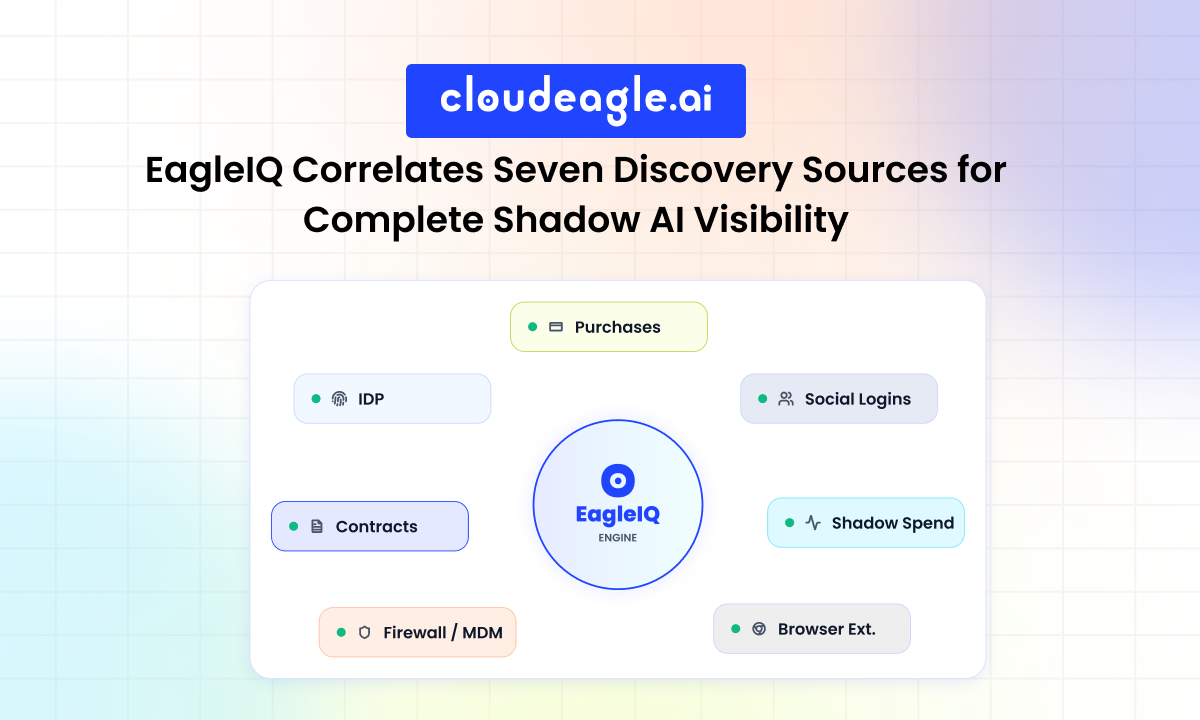
CloudEagle discovers every AI tool in use by correlating signals across browser extensions, SSO, Zscaler, CrowdStrike, CASB, and finance integrations simultaneously:
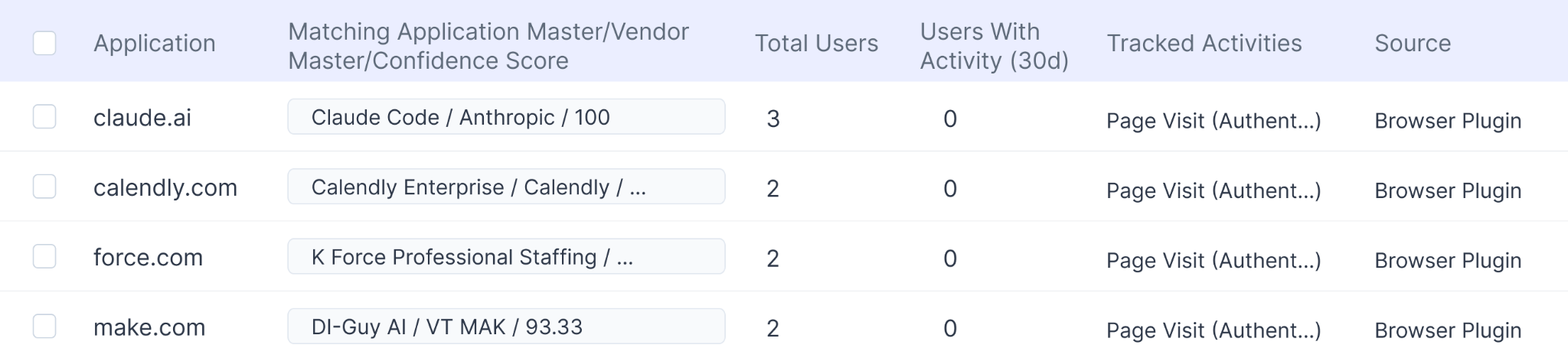
  • Sanctioned and unsanctioned AI tools surfaced including personal accounts and free trials
  • GenAI features activating silently inside approved SaaS products detected automatically
  • Every tool, every user, every risk visible in one inventory
  • Multi-signal discovery covers 95%+ of the AI footprint vs 40 to 60% for SSO-only approaches

Real-Time Policy Enforcement at the Point of Behavior

When an employee tries to access an unapproved AI tool, CloudEagle's lightweight browser extension intercepts the session before any company data is entered:
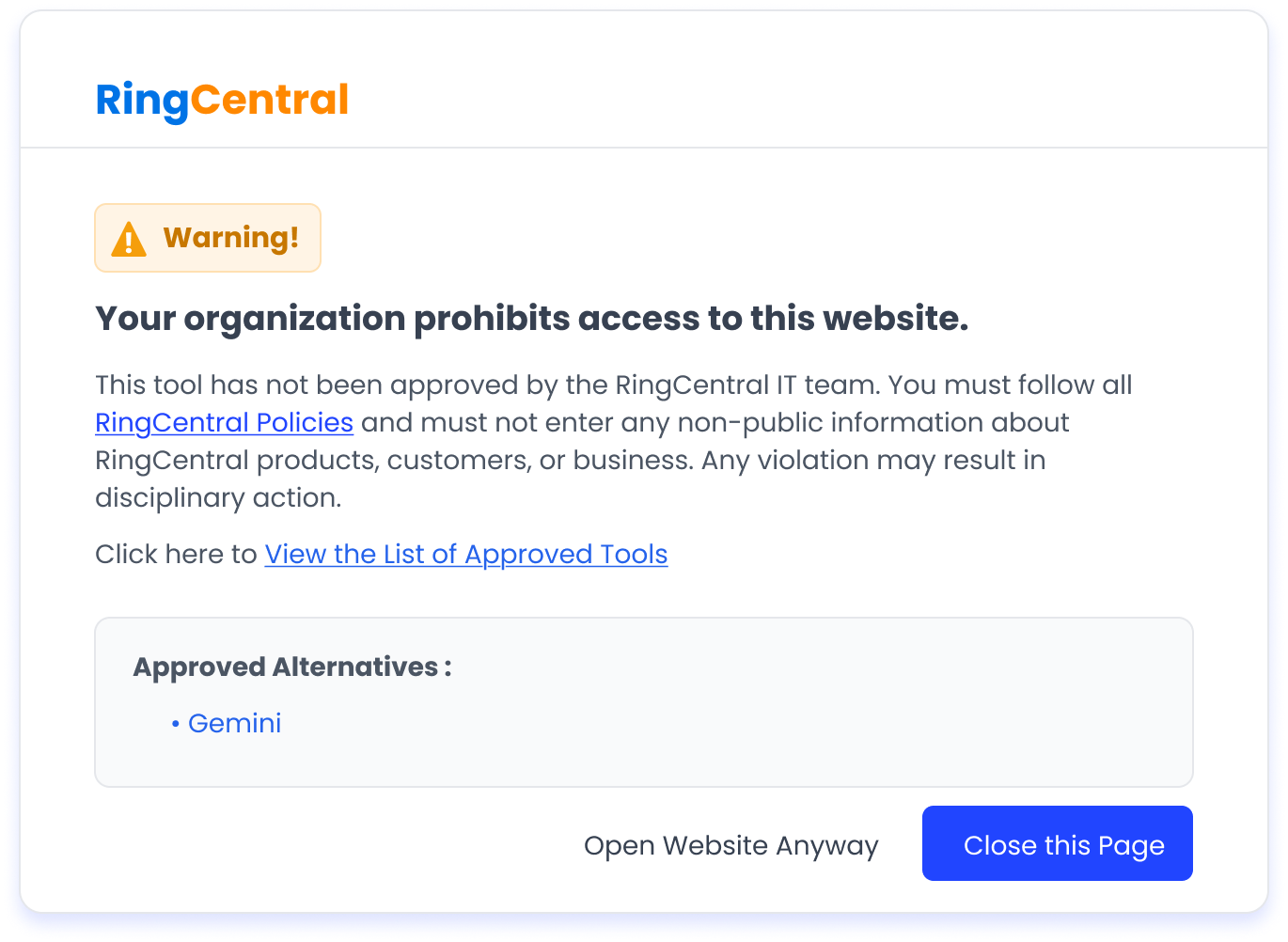
  • Flash page redirect to approved alternative, no separate DLP or endpoint agent required
  • Tiered policy enforcement: approved, conditionally approved, blocked with redirect, blocked
  • Sensitive data prevented from entering unapproved AI tools before the prompt is submitted

AI Vendor Risk Scoring Powered by Netskope

Every AI tool in your environment gets an automatically assigned risk score based on data residency, training data policies, security posture, and compliance certifications:
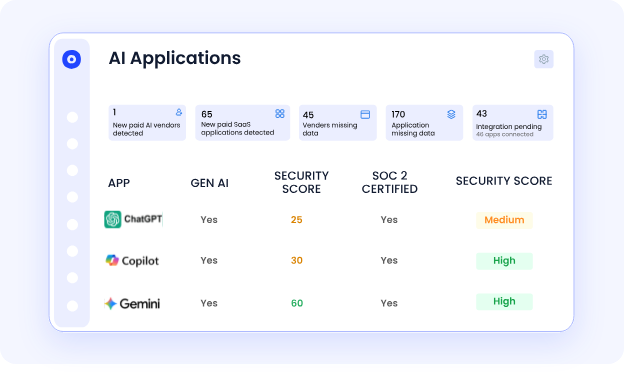
  • High-risk tools surfaced for human review, low-risk tools cleared for conditional use
  • GenAI features embedded inside approved SaaS products identified and scored
  • Continuous monitoring so risk scores update as vendor posture changes

Token-Level AI Spend Visibility

AI tools bill by token, API call, and credit, not by seat. CloudEagle gives Finance and IT the breakdown they both need:
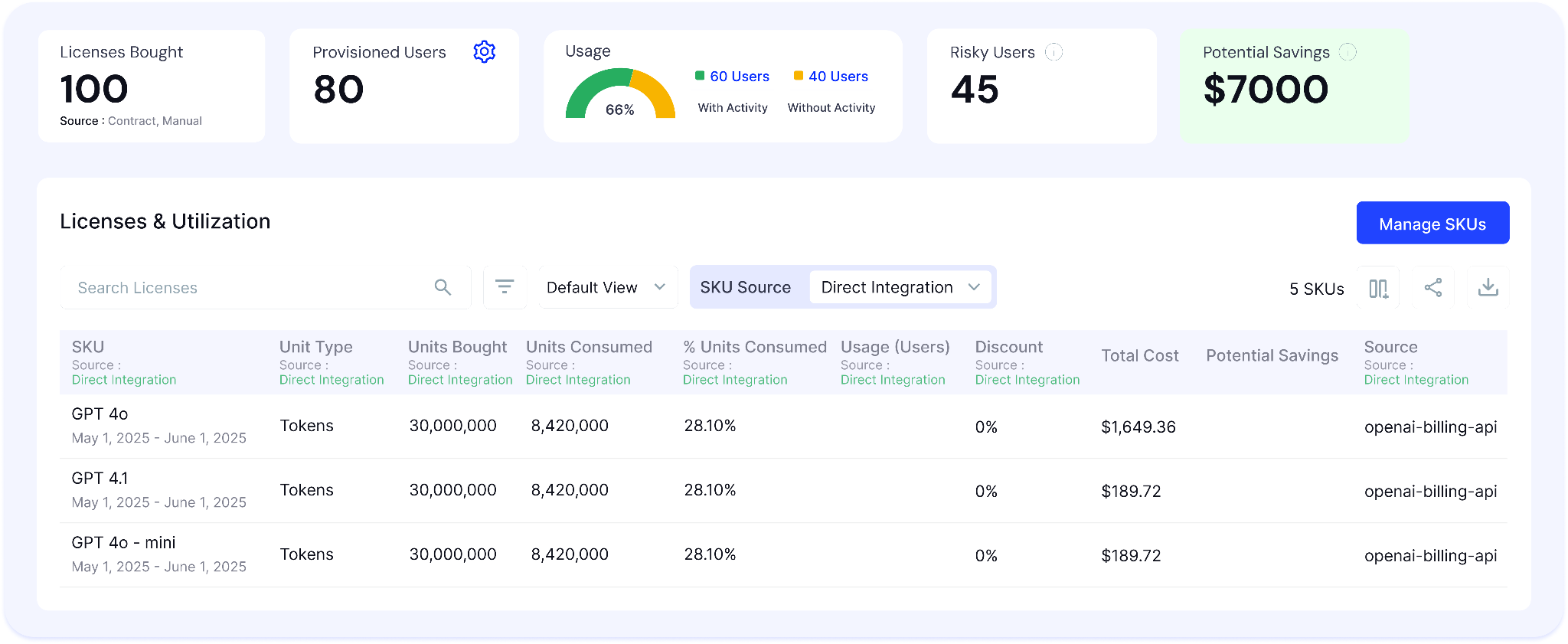
  • Real-time token consumption tracked per user, per team, per tool
  • Duplicate AI subscriptions and unused seats surfaced before the next billing cycle
  • AI costs allocated back to business units so every team owns its own AI budget

With 500+ direct integrations and $20B+ in SaaS spend managed across its customer base, CloudEagle delivers the AI governance coverage that makes these seven practices executable rather than aspirational.

Conclusion

AI governance auditing is no longer a future capability. It is a current obligation for internal audit teams at any organization using AI.

This AI audit framework provides a practical path from no AI audit capability to a functioning program in 90 days. Start with the inventory. Test the controls. Map findings to regulatory requirements.

CloudEagle.ai provides the data layer that makes each phase executable rather than theoretical.

The organizations building these capabilities now will be the ones prepared when regulators and insurers ask for evidence of AI governance. For many enterprises, that moment has already arrived.

Frequently Asked Questions

  1. How to audit AI governance?
    Audit AI governance by reviewing AI inventory, data governance, model risk, access controls, policy enforcement, and compliance with frameworks like NIST AI RMF or ISO 42001.
  2. How is AI used in auditing?
    AI helps auditors automate data analysis, detect anomalies, assess risks, review transactions, and continuously monitor controls across large datasets.
  3. What are the six pillars of AI governance?
    The six pillars are AI inventory, data governance, model risk management, access governance, policy enforcement, and regulatory alignment.
  4. What are the 7 Sutras of AI governance?
    The 7 Sutras emphasize responsible AI principles such as transparency, fairness, accountability, privacy, security, human oversight, and continuous monitoring.
  5. What are the three pillars of AI governance?
    The three pillars of AI governance are governance and accountability, risk and compliance management, and technical controls for secure and responsible AI use.

Advertisement for a SaaS Subscription Tracking Template with a call-to-action button to download and a partial graphic of a tablet showing charts.Banner promoting a SaaS Agreement Checklist to streamline SaaS management and avoid budget waste with a call-to-action button labeled Download checklist.Blue banner with text 'The Ultimate Employee Offboarding Checklist!' and a black button labeled 'Download checklist' alongside partial views of checklist documents from cloudeagle.ai.Digital ad for download checklist titled 'The Ultimate Checklist for IT Leaders to Optimize SaaS Operations' by cloudeagle.ai, showing checklist pages.Slack Buyer's Guide offer with text 'Unlock insider insights to get the best deal on Slack!' and a button labeled 'Get Your Copy', accompanied by a preview of the guide featuring Slack's logo.Monday Pricing Guide by cloudeagle.ai offering exclusive pricing secrets to maximize investment with a call-to-action button labeled Get Your Copy and an image of the guide's cover.Blue banner for Canva Pricing Guide by cloudeagle.ai offering a guide to Canva costs, features, and alternatives with a call-to-action button saying Get Your Copy.Blue banner with white text reading 'Little-Known Negotiation Hacks to Get the Best Deal on Slack' and a white button labeled 'Get Your Copy'.Blue banner with text 'Little-Known Negotiation Hacks to Get the Best Deal on Monday.com' and a white button labeled 'Get Your Copy'.Blue banner with text 'Little-Known Negotiation Hacks to Get the Best Deal on Canva' and a white button labeled 'Get Your Copy'.Banner with text 'Slack Buyer's Guide' and a 'Download Now' button next to images of a guide titled 'Slack Buyer’s Guide: Features, Pricing & Best Practices'.Digital cover of Monday Pricing Guide with a button labeled Get Your Copy on a blue background.Canva Pricing Guide cover with a button labeled Get Your Copy on a blue gradient background.

Enter your email to
unlock the report

Oops! Something went wrong while submitting the form.
License Count
Benchmark
Per User/Per Year

Enter your email to
unlock the report

Oops! Something went wrong while submitting the form.
License Count
Benchmark
Per User/Per Year

Enter your email to
unlock the report

Oops! Something went wrong while submitting the form.
Notion Plus
License Count
Benchmark
Per User/Per Year
100-500
$67.20 - $78.72
500-1000
$59.52 - $72.00
1000+
$51.84 - $57.60
Canva Pro
License Count
Benchmark
Per User/Per Year
100-500
$74.33-$88.71
500-1000
$64.74-$80.32
1000+
$55.14-$62.34

Enter your email to
unlock the report

Oops! Something went wrong while submitting the form.

Enter your email to
unlock the report

Oops! Something went wrong while submitting the form.
Zoom Business
License Count
Benchmark
Per User/Per Year
100-500
$216.00 - $264.00
500-1000
$180.00 - $216.00
1000+
$156.00 - $180.00

Enter your email to
unlock the report

Oops! Something went wrong while submitting the form.

Get the Right Security Platform To Secure Your Cloud Infrastructure

Please enter a business email
Thank you!
The 2023 SaaS report has been sent to your email. Check your promotional or spam folder.
Oops! Something went wrong while submitting the form.

Access full report

Please enter a business email
Thank you!
The 2023 SaaS report has been sent to your email. Check your promotional or spam folder.
Oops! Something went wrong while submitting the form.

99% of organizations reported financial losses from AI-related risks in 2025. Average damage: $4.4 million per company, per EY's Responsible AI Pulse survey.

That number is not coming from model failures at AI-native companies. It is coming from ordinary enterprises that deployed AI without governance frameworks and found out the hard way.

Internal audit has a choice right now. Build an AI governance auditing program before something goes wrong, or scramble to explain what controls were in place after it does.

This playbook is written for internal audit directors and compliance teams who need to build that program from scratch. Not why it matters. How to actually do it.

TL;DR

  • AI governance auditing is fundamentally different from traditional IT audit because AI systems make decisions, not just execute instructions, and traditional audit evidence does not capture model behavior or output risk
  • The six domains every AI audit must cover: inventory completeness, data governance, model risk, access and entitlement governance, policy enforcement, and regulatory alignment
  • The 90-day phased playbook moves from AI inventory (Days 1-30) to control testing (Days 31-60) to regulatory mapping and reporting (Days 61-90)
  • Nearly half of Fortune 100 companies now disclose AI risk as part of board oversight responsibilities, a threefold increase in one year
  • CloudEagle.ai provides the AI inventory and continuous audit evidence layer that makes each phase of this playbook operationally executable

1. Why AI Governance Auditing Is Different From Traditional IT Audit?

You have audited IT systems before. You know how to test access controls, review change management logs, and assess configuration against a baseline.

AI systems break most of those assumptions.

Traditional systems execute instructions, while AI systems make decisions. Traditional outputs are deterministic, but AI outputs are probabilistic. You can audit whether access was granted, but you cannot evaluate an AI recommendation using the same controls or evidence.

Here is what that means for your audit program:

Dimension Traditional IT Audit AI Governance Auditing
What you are auditing System configurations, access logs, change records Model behavior, training data, output risk, vendor opacity
Primary evidence Access logs, change tickets, configuration exports Model cards, validation records, drift monitoring logs, incident history
Control testing Access controls, patch management, backup procedures Policy enforcement mechanisms, model validation, explainability requirements
Risk origin Unauthorized access, misconfiguration, software failure Biased outputs, data leakage, model drift, shadow AI adoption
Regulatory standard ISO 27001, SOC 2, NIST CSF NIST AI RMF, ISO 42001, EU AI Act, sector-specific AI rules
Vendor coverage Software licensing and support contracts AI transparency, training data provisions, audit rights in AI vendor contracts

The core difference is this. Traditional IT audit asks: did the right people have the right access to the right systems? AI governance auditing asks: are the AI systems in production making decisions in ways that are accurate, fair, explainable, and compliant with the obligations the organization has accepted?

Those are different questions. They require different evidence. And they require a different audit methodology.

Is Your AI Inventory Audit-Ready?

Most aren't. Learn how to uncover every AI tool, including the ones IT never approved.
Get the Guide

2. The AI Governance Auditing Playbook: Phase by Phase

Phase 1 (Days 1-30): Establish the AI Inventory

Build a complete, risk-classified inventory of every AI system in the organization.

You are looking for four categories:

  • Internally developed AI models and applications
  • Major vendor AI deployments such as ChatGPT Enterprise, Microsoft Copilot, Google Gemini, and Salesforce Einstein
  • AI features embedded in approved SaaS tools
  • Employee-adopted AI tools operating outside IT

Step 1: Pull from every available data source.

Don't start with what IT has documented. Start with what is actually running:

  • SSO logs for AI-category application authentication
  • Expense reports and corporate card statements for Anthropic, OpenAI, and other AI vendor charges
  • Browser activity and endpoint signals for Claude, ChatGPT, Gemini, and similar domains
  • OAuth grant audits for AI plugins authorized through Google or Microsoft consent flows
  • Finance system data for AI subscription charges below procurement thresholds

Step 2: Classify each system by risk level.

Use a consistent three-tier classification:

Risk Level Criteria Examples
High Regulated data, customer impact, or autonomous actions Credit scoring, HR screening, medical AI, transactional chatbots
Medium Internal workflow automation or external content generation Coding assistants, AI reports, internal knowledge tools
Low Productivity tools with limited data access Writing assistants, summarization tools

Step 3: Identify documentation, ownership, and oversight gaps.

For each AI system, record:

  • Named owner accountable for governance
  • Last formal risk assessment date
  • Whether a model card or equivalent documentation exists
  • Whether the system has been included in an access certification
  • Whether it falls under any regulatory classification

Phase 2 (Days 31-60): Test Controls and Gather Evidence

Test whether documented AI controls actually work.

AI Usage Policy Enforcement Testing

Ask for the organization's AI acceptable use policy. Then test whether it is enforced:

  • Attempt to access an unapproved AI tool from a corporate device. Does anything intercept the attempt?
  • Verify whether the policy is technically enforced or exists only on paper.
  • Sample employee usage logs to determine whether unapproved AI tool usage is occurring at scale.

Access Control Testing for AI Systems

For each high-risk AI system:

  • Pull the list of users with direct model access, modification rights, or override capability
  • Cross-reference against employee and contractor status in the HRIS
  • Identify accounts that should have been deprovisioned
  • Verify that AI agents and API keys are included in access reviews

Model Validation and Drift Monitoring Verification

Request documentation covering:

  • Validation methodology and results before deployment
  • Drift monitoring processes and alert thresholds
  • Incidents where model behavior deviated materially from expected outputs
  • The incident response process and whether it was followed

Vendor Contract Review for AI Transparency

Review vendor contracts for every high- and medium-risk AI system.

Verify:

  • What data is used to train or improve the vendor's AI models
  • Whether the organization can audit the vendor's AI governance practices
  • Whether vendors must notify customers when AI features change materially
  • Whether personal data flows are covered by a data processing addendum

Phase 3 (Days 61-90): Map to Regulatory Requirements and Report

Produce a prioritized gap analysis, audit report, and 90-day remediation roadmap.

Regulatory Gap Analysis

Map inventory and control findings against each applicable framework:

  • NIST AI RMF: Assess coverage across Govern, Map, Measure, and Manage.
  • ISO 42001: Verify the existence of an AI policy, defined governance roles, a risk management process, and an internal audit program. ISO 42001 requires a complete management system, not just individual controls.
  • EU AI Act: Classify each AI system by risk tier and verify technical documentation, human oversight, data governance, and post-market monitoring requirements.
  • Sector-specific regulations: FINRA Rule 3110, HIPAA minimum necessary standards, and SOC 2 Type II may impose additional requirements depending on the use case.

Audit Report Structure

Organize findings by domain and regulatory exposure:

  • Critical: Immediate regulatory exposure or material breach risk
  • High: Significant governance gaps requiring remediation within 30 days
  • Medium: Documentation gaps and process weaknesses requiring remediation within 60–90 days
  • Observations: Emerging risks requiring monitoring

90-Day Remediation Roadmap

Present to the audit committee:

  • Finding prioritization by risk and regulatory exposure
  • Named owner and remediation timeline for each finding
  • A 30-day checkpoint for critical and high findings
  • A definition of done for each remediation item

📖 Worth a Read: AI Governance During M&A: What Enterprises Should Focus On

3. AI Governance Audit Questions Every Internal Auditor Should Ask

These questions should drive your interviews, document requests, and control tests across all three phases:

  • Inventory: Do we have a complete register of every AI system, including AI features inside approved SaaS tools, and how is that inventory maintained?
  • Data governance: Can we trace training data for every high-risk AI system to its source and lawful basis, and has any personal data been used?
  • Model risk: Have all high-risk AI systems been validated before deployment, and are drift monitoring thresholds documented and actively monitored?
  • Access governance: Are AI agents and API keys included in access certifications, and can we identify every human and non-human identity with permission to modify or retrain an AI system?
  • Policy enforcement: Is the AI acceptable use policy technically enforced, and what percentage of employees have completed AI usage training?
  • Vendor governance: Do vendor contracts provide audit rights and require notification when AI features that process company data are introduced?
  • Regulatory alignment: Which AI systems fall under high-risk regulatory categories, and can we produce a complete audit trail on demand?

4. How CloudEagle.ai Supports AI Governance Auditing Programs

The most common barrier to building an AI governance auditing program is not understanding what to audit. It is not having the data to audit against.

CloudEagle.ai is an AI-powered AI governance platform for SaaS security and identity governance that serves as the control plane for enterprise AI, giving IT and security teams the visibility layer that makes each of these seven practices operationally executable.

Discover Shadow AI. Eliminate Excess Access. Reduce SaaS Risk.

Shadow AI Discovery Outside SSO

CloudEagle discovers every AI tool in use by correlating signals across browser extensions, SSO, Zscaler, CrowdStrike, CASB, and finance integrations simultaneously:

  • Sanctioned and unsanctioned AI tools surfaced including personal accounts and free trials
  • GenAI features activating silently inside approved SaaS products detected automatically
  • Every tool, every user, every risk visible in one inventory
  • Multi-signal discovery covers 95%+ of the AI footprint vs 40 to 60% for SSO-only approaches

Real-Time Policy Enforcement at the Point of Behavior

When an employee tries to access an unapproved AI tool, CloudEagle's lightweight browser extension intercepts the session before any company data is entered:

  • Flash page redirect to approved alternative, no separate DLP or endpoint agent required
  • Tiered policy enforcement: approved, conditionally approved, blocked with redirect, blocked
  • Sensitive data prevented from entering unapproved AI tools before the prompt is submitted

AI Vendor Risk Scoring Powered by Netskope

Every AI tool in your environment gets an automatically assigned risk score based on data residency, training data policies, security posture, and compliance certifications:

  • High-risk tools surfaced for human review, low-risk tools cleared for conditional use
  • GenAI features embedded inside approved SaaS products identified and scored
  • Continuous monitoring so risk scores update as vendor posture changes

Token-Level AI Spend Visibility

AI tools bill by token, API call, and credit, not by seat. CloudEagle gives Finance and IT the breakdown they both need:

  • Real-time token consumption tracked per user, per team, per tool
  • Duplicate AI subscriptions and unused seats surfaced before the next billing cycle
  • AI costs allocated back to business units so every team owns its own AI budget

With 500+ direct integrations and $20B+ in SaaS spend managed across its customer base, CloudEagle delivers the AI governance coverage that makes these seven practices executable rather than aspirational.

Conclusion

AI governance auditing is no longer a future capability. It is a current obligation for internal audit teams at any organization using AI.

This AI audit framework provides a practical path from no AI audit capability to a functioning program in 90 days. Start with the inventory. Test the controls. Map findings to regulatory requirements.

CloudEagle.ai provides the data layer that makes each phase executable rather than theoretical.

The organizations building these capabilities now will be the ones prepared when regulators and insurers ask for evidence of AI governance. For many enterprises, that moment has already arrived.

Frequently Asked Questions

  1. How to audit AI governance?
    Audit AI governance by reviewing AI inventory, data governance, model risk, access controls, policy enforcement, and compliance with frameworks like NIST AI RMF or ISO 42001.
  2. How is AI used in auditing?
    AI helps auditors automate data analysis, detect anomalies, assess risks, review transactions, and continuously monitor controls across large datasets.
  3. What are the six pillars of AI governance?
    The six pillars are AI inventory, data governance, model risk management, access governance, policy enforcement, and regulatory alignment.
  4. What are the 7 Sutras of AI governance?
    The 7 Sutras emphasize responsible AI principles such as transparency, fairness, accountability, privacy, security, human oversight, and continuous monitoring.
  5. What are the three pillars of AI governance?
    The three pillars of AI governance are governance and accountability, risk and compliance management, and technical controls for secure and responsible AI use.

CloudEagle.ai recognized in the 2025 Gartner® Magic Quadrant™ for SaaS Management Platforms
Download now
gartner chart
5x
Faster employee
onboarding
80%
Reduction in time for
user access reviews
30k
Workflows
automated
$15Bn
Analyzed in
contract spend
$2Bn
Saved in
SaaS spend

Streamline SaaS governance and save 10-30%

Book a Demo with Expert
CTA image