You need to enable JavaScript in order to use the AI chatbot tool powered by ChatBot

What AI Security Software Security Leaders Are Using to Govern Enterprise AI

Share via:
blog-cms-banner-bg
Little-Known Negotiation Hacks to Get the Best Deal on Slack
cta-bg-blogDownload Your Copy

HIPAA Compliance Checklist for 2025

Download PDF

Every security leader in 2026 is managing AI tools that appeared faster than policy did. 

Claude, Copilot, ChatGPT, agents built inside platforms nobody officially approved. 

The question now is not whether you have an AI governance problem. You already know you do. 

The question is: what tools actually solve it, and which ones just look like they do?

This is a buyer's guide for security leaders who already have a security stack and are trying to figure out which category covers AI governance, which categories almost cover it, and where the real gaps sit.

TL;DR

  • Native AI vendor dashboards show usage for one tool at a time. Every enterprise running multiple AI platforms ends up manually reconciling data across dashboards
  • CASB and network security tools see traffic to AI domains but cannot see what data was entered, who is using a personal account, or whether usage is anomalous
  • IAM and IGA platforms govern human identities accessing known applications. They have no concept of AI agents, which don't log in the way human users do
  • Developer productivity tools are often mistaken for AI governance tools. They are not. They measure output, not risk
  • Dedicated AI governance platforms close the specific gaps that the other four categories leave open, by combining multi-source discovery, risk scoring, cross-vendor visibility, and lifecycle automation in one place

Category 1: Native AI Vendor Dashboards

Every paid AI tool comes with its own usage dashboard. The Microsoft Copilot Dashboard, the Claude Admin Console, the OpenAI usage dashboard.

They are free, already there, and tell you something real about adoption.

What they do well:

  • Provide per-tool usage data, showing who is active on that specific platform.
  • Track token consumption and basic adoption metrics for that specific AI platform.
  • Give you a reasonable picture of what is happening inside the platform if your only AI tool is Copilot.

What they miss: They only show their own tool. The Copilot Dashboard has no knowledge that Claude exists in your environment. The Claude Admin Console has no idea anyone is using OpenAI's API.

Every enterprise managing more than one AI platform, which by 2026 is effectively every enterprise, ends up logging into three or four separate dashboards.

"What we're looking for the platform to do is bring it all together in a single pane of glass."

That gap shows up even within a single vendor's ecosystem: 

  • One Microsoft-only enterprise used Purview, Viva Insights, and the Copilot Dashboard simultaneously.
  • They still ended up exporting everything to Excel every two weeks because none of the three views consolidated into one source of truth.

The real limitation: Vendor dashboards are designed to show adoption, not to flag risk, govern access, or connect to identity or HR systems.

Visibility Is Only the First Step.

See the security controls every enterprise should have beyond vendor dashboards.
Get the Checklist

Category 2: CASB and Network Security Tools

Zscaler, Netskope, and Palo Alto Prisma sit at the network layer, and most enterprises already have one deployed for general SaaS visibility.

What they do well:

  • Provide network-level visibility across enterprise traffic.
  • Block or flag traffic to known AI domains.
  • Add AI-specific app categories to their classification engines to improve AI discovery.

What they miss: They see network traffic, not AI-specific behavior.

A CASB can tell you an employee visited claude.ai. It cannot tell you whether that employee was logged into a personal account, what data they typed into the prompt field, whether the tool is approved under policy, or whether the usage pattern is unusual.

  • They have no concept of token consumption, agent activity, or per-user AI spend, because none of those data types exist at the network layer they were built to monitor.
  • Firewall logs are useful as one discovery layer, but they remain just that: one layer, not a governance platform.
  • They still require manual correlation against other data sources to build anything close to a complete picture.

The real limitation: CASB was designed to govern cloud app access at the network layer.

AI governance requires application-layer understanding, prompt-level behavior, and identity correlation that network tools were never architected to provide.

Category 3: IAM and IGA Platforms

Okta, Microsoft Entra, SailPoint, and Saviynt form the identity backbone of nearly every enterprise security stack.

This is not optional infrastructure. Almost everyone has it.

What they do well:

  • Support identity lifecycle management across enterprise applications.
  • Handle access governance, provisioning and deprovisioning.
  • Conduct access reviews for known applications.

What they miss: They govern human identities accessing known applications.

They have no concept of AI agents, the non-human identities employees create inside platforms like Copilot Studio.

They don't track AI token consumption. They don't know what an employee does inside an AI tool, only whether that employee has access to it.

"I have Entra, IGA, and existing compliance tools, and none of them were telling me what I needed to know about AI."

That gap is structural, not a configuration problem. 

  • IAM assumes a human logs in, authenticates, and accesses a defined resource, but AI breaks two of those three assumptions at once.
  • Agents don't log in the way humans do, and the "resource" is often an external model processing company data through a prompt rather than a defined enterprise application with a fixed permission boundary.

The real limitation: IAM was built around a model of identity that AI does not fit into cleanly, which is why the most mature identity stacks in the enterprise still leave AI governance completely uncovered.

📖 Worth a Read 👉 How CIOs & CISOs Should Think About AI Controls

Category 4: Developer Productivity and AI Analytics Tools

LinearB, Jellyfish, and Waydev measure developer output, code contribution, and productivity metrics. Some now include AI-assisted coding metrics like Copilot suggestion acceptance rates.

This category often confuses buyers because these tools are sometimes positioned, or mistaken, as AI governance solutions. They are not. 

What they do well:

  • Measure developer output across engineering teams.
  • Measure AI-assisted productivity within engineering workflows.
  • Include AI-assisted coding metrics like Copilot suggestion acceptance rates.

What they miss: Everything security-related.

  • They don't discover shadow AI, so they can't identify employees using unapproved AI tools across the organization.
  • They don't enforce access policies or help security teams control who can use approved AI applications.
  • They don't flag AI-related risk or provide visibility into risky AI usage patterns.
  • They don't track data exposure through prompts, making it difficult to identify sensitive information shared with AI tools.
  • They were built to measure engineering productivity, not to provide AI governance or enterprise security controls.

If you are evaluating tools and a vendor in this category is positioning itself as solving your AI governance problem, that is a mismatch worth catching early, before it costs you a budget cycle and leaves the actual governance gap untouched.

Your Security Stack Wasn't Built for AI.

Learn where the biggest AI governance gaps still exist.
See the Gaps

Category 5: Dedicated AI Governance Platforms

This is the category built specifically to close the gaps the first four leave open.

It does not replace native dashboards, CASB, or IAM. It sits across all of them, pulling their signals together into one governed view.

What they do well:

  • Combine SSO, browser activity, firewall logs, and finance and expense data into a single AI inventory through multi-source discovery.
  • Deliver AI-specific risk scoring based on data residency, training data policies, and security certifications.
  • Provide a cross-vendor unified view of Claude, Copilot, and OpenAI usage with a consistent data format.
  • Support per-user consumption tracking, agent inventory, browser-level enforcement, and HRIS-triggered lifecycle management.

One Platform to Manage SaaS, AI, and Identity

AI governance doesn't happen in isolation. Organizations also need visibility into SaaS applications, user identities, access permissions, spending, and vendor risk. CloudEagle.ai brings these capabilities together in a single platform, eliminating the need for separate tools and disconnected workflows.

By combining SaaS Management, AI Governance, SaaS Security, and Identity Governance, CloudEagle.ai gives IT, security, procurement, and finance teams one place to discover AI tools, enforce policies, manage access, optimize SaaS spend, and continuously monitor risk across the enterprise.

How CloudEagle.ai Governs AI Across the Enterprise?

Traditional security tools help monitor networks, identities, or endpoints. CloudEagle sits above them as the control plane for enterprise AI, bringing together discovery, governance, policy enforcement, identity controls, and AI usage intelligence into a single platform.

CloudEagle.ai is an AI-powered SaaS Security, AI Governance, and Identity Governance platform that helps enterprises discover shadow AI, govern AI agents, enforce AI usage policies, and continuously monitor AI risk across their entire SaaS and AI ecosystem.

Shadow AI Discovery

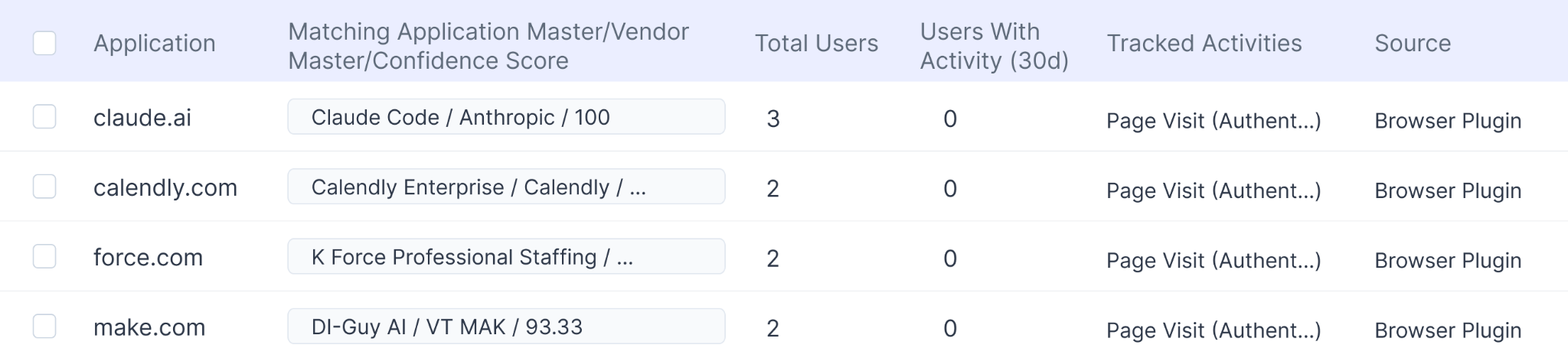
AI governance starts with visibility. CloudEagle automatically discovers AI tools operating across the enterprise, including those that never pass through traditional identity or procurement workflows.
How it helps

  • Correlates browser signals, SSO, firewall logs, Zscaler, CrowdStrike, and finance data into one AI inventory
  • Detects personal AI accounts, Shadow AI, and GenAI capabilities embedded inside SaaS applications
  • Maps AI adoption by user, department, and business unit
  • Identifies duplicate copilots and unauthorized AI tools before they become institutionalized

GenAI Risk Scoring

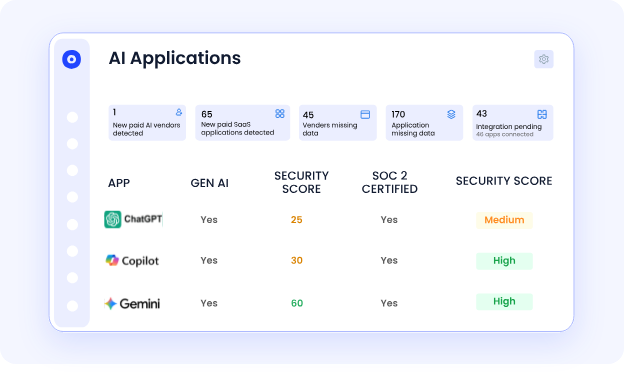
Not every AI application carries the same level of risk. CloudEagle helps security teams understand which tools require immediate attention.
How it helps

  • Assigns GenAI risk scores based on vendor security posture and AI-specific controls
  • Evaluates data residency, training data policies, and security certifications
  • Prioritizes high-risk AI applications for remediation
  • Provides consistent risk scoring across every AI vendor

AI Usage, Spend, and Tokenomics

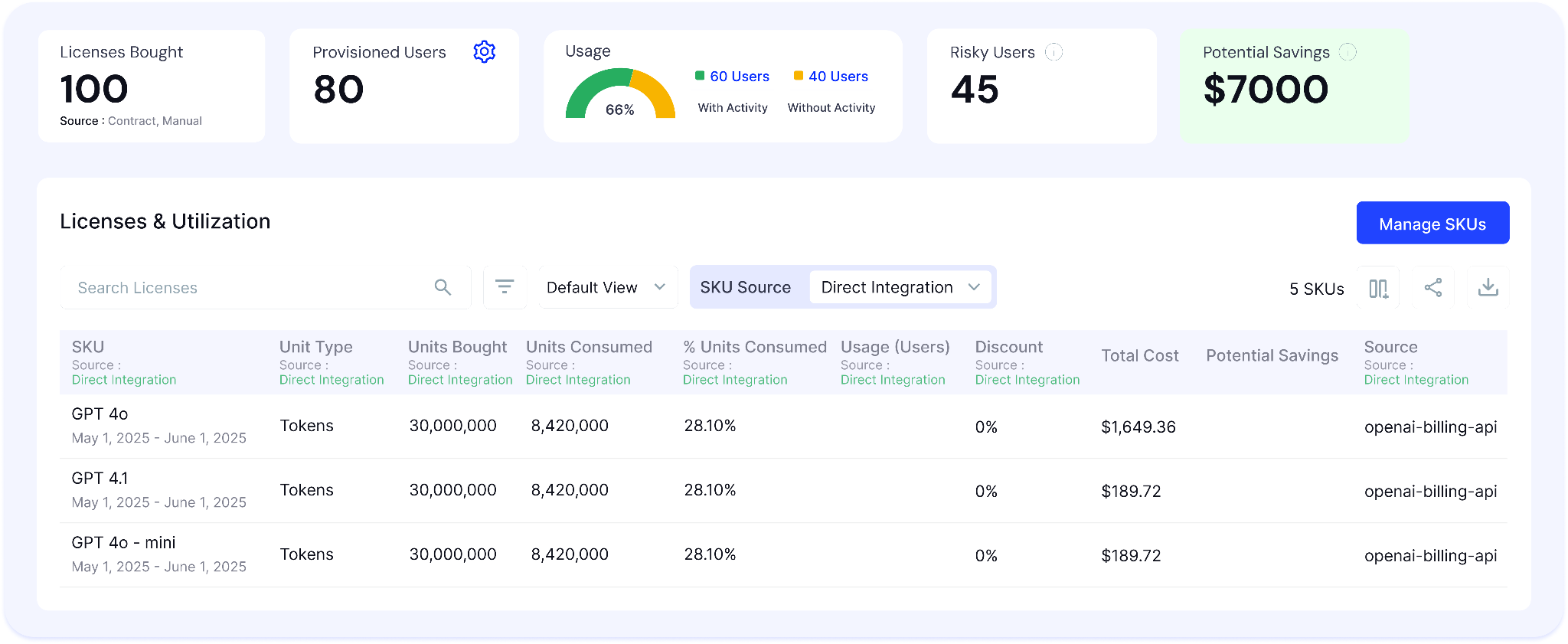
AI costs are increasingly driven by consumption rather than licenses. CloudEagle gives organizations visibility into how AI is actually being used and where costs are accumulating.
How it helps

  • Tracks AI adoption, usage, and spend across vendors from one dashboard
  • Monitors token consumption at the user and organizational level
  • Identifies underutilized AI licenses and duplicate copilots
  • Surfaces usage trends before they become renewal or budget issues

Real-Time AI Policy Enforcement

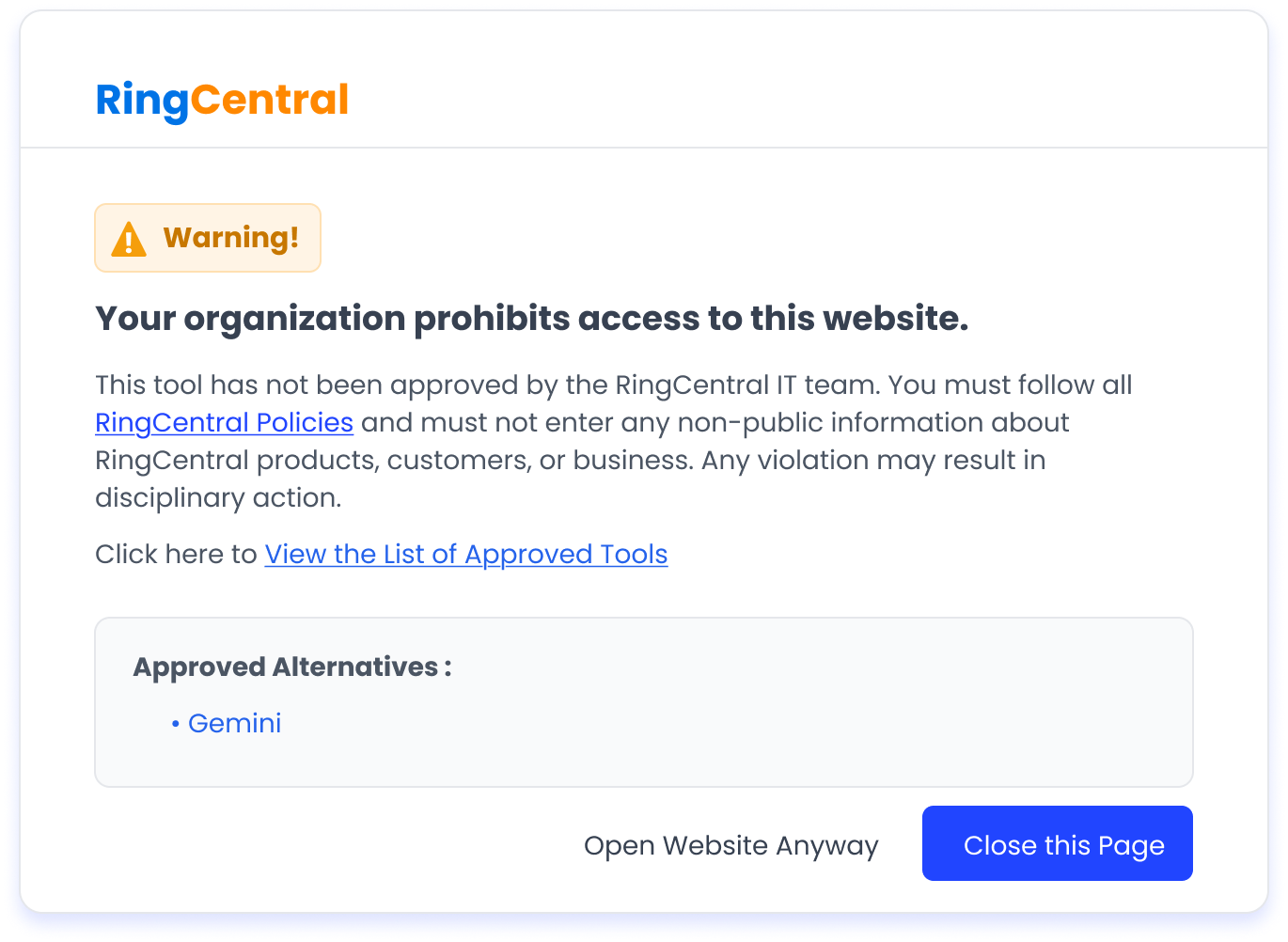
Policies are only effective if they are enforced where employees actually use AI.
How it helps

  • Uses flash-page redirects to guide users toward approved AI tools
  • Applies browser-level policy enforcement before sensitive data is submitted
  • Supports DLP controls for prompts containing sensitive or regulated information
  • Helps standardize AI usage across departments without blocking productivity

Automated AI Lifecycle Governance

AI access should follow the same lifecycle as employee identities.

How it helps

  • Integrates with HR systems like Workday and BambooHR
  • Automatically revokes AI access when employees leave or change roles
  • Reclaims AI licenses and removes unnecessary permissions
  • Maintains audit-ready logs for every AI access change and governance action

Conclusion

There isn't a single security tool that can govern enterprise AI on its own. Native dashboards, CASB, IAM, and developer analytics each solve an important problem, but they were built for different purposes and leave gaps when used for AI governance.

That's why more organizations are treating AI governance as its own security layer rather than an extension of existing tools. It gives security teams a complete view of AI usage, risk, and policy enforcement across the enterprise.

See how CloudEagle.ai helps security teams close those gaps with AI discovery, governance, and policy enforcement built for enterprise AI.

Frequently Asked Questions

  1. What tools do enterprises use for AI governance?

Most enterprises use native AI vendor dashboards, CASB, and IAM/IGA platforms. Since these tools weren't built specifically for AI governance, many organizations also adopt dedicated AI governance platforms to unify visibility, risk, and policy enforcement.

  1. Can a CASB govern AI tool usage on its own?

No. A CASB can detect traffic to AI tools, but it cannot see prompts, token usage, AI agents, or whether employees use personal accounts. It provides one layer of visibility but not complete AI governance.

  1. Are developer productivity tools the same as AI governance tools?

No. Tools like LinearB and Jellyfish measure developer productivity and AI coding adoption. They don't discover shadow AI, enforce access policies, assess AI risk, or monitor prompt-based data exposure.

  1. Why can't IAM platforms govern AI agents?

IAM and IGA platforms manage human identities and application access. AI agents often operate differently, connect directly to data sources, and don't fit traditional identity models, leaving a gap in AI governance.

  1. Why do organizations need a dedicated AI governance platform?

A dedicated AI governance platform brings together AI discovery, risk scoring, cross-vendor visibility, agent inventory, and policy enforcement in one place. It complements existing security tools instead of replacing them.

Advertisement for a SaaS Subscription Tracking Template with a call-to-action button to download and a partial graphic of a tablet showing charts.Banner promoting a SaaS Agreement Checklist to streamline SaaS management and avoid budget waste with a call-to-action button labeled Download checklist.Blue banner with text 'The Ultimate Employee Offboarding Checklist!' and a black button labeled 'Download checklist' alongside partial views of checklist documents from cloudeagle.ai.Digital ad for download checklist titled 'The Ultimate Checklist for IT Leaders to Optimize SaaS Operations' by cloudeagle.ai, showing checklist pages.Slack Buyer's Guide offer with text 'Unlock insider insights to get the best deal on Slack!' and a button labeled 'Get Your Copy', accompanied by a preview of the guide featuring Slack's logo.Monday Pricing Guide by cloudeagle.ai offering exclusive pricing secrets to maximize investment with a call-to-action button labeled Get Your Copy and an image of the guide's cover.Blue banner for Canva Pricing Guide by cloudeagle.ai offering a guide to Canva costs, features, and alternatives with a call-to-action button saying Get Your Copy.Blue banner with white text reading 'Little-Known Negotiation Hacks to Get the Best Deal on Slack' and a white button labeled 'Get Your Copy'.Blue banner with text 'Little-Known Negotiation Hacks to Get the Best Deal on Monday.com' and a white button labeled 'Get Your Copy'.Blue banner with text 'Little-Known Negotiation Hacks to Get the Best Deal on Canva' and a white button labeled 'Get Your Copy'.Banner with text 'Slack Buyer's Guide' and a 'Download Now' button next to images of a guide titled 'Slack Buyer’s Guide: Features, Pricing & Best Practices'.Digital cover of Monday Pricing Guide with a button labeled Get Your Copy on a blue background.Canva Pricing Guide cover with a button labeled Get Your Copy on a blue gradient background.

Enter your email to
unlock the report

Oops! Something went wrong while submitting the form.
License Count
Benchmark
Per User/Per Year

Enter your email to
unlock the report

Oops! Something went wrong while submitting the form.
License Count
Benchmark
Per User/Per Year

Enter your email to
unlock the report

Oops! Something went wrong while submitting the form.
Notion Plus
License Count
Benchmark
Per User/Per Year
100-500
$67.20 - $78.72
500-1000
$59.52 - $72.00
1000+
$51.84 - $57.60
Canva Pro
License Count
Benchmark
Per User/Per Year
100-500
$74.33-$88.71
500-1000
$64.74-$80.32
1000+
$55.14-$62.34

Enter your email to
unlock the report

Oops! Something went wrong while submitting the form.

Enter your email to
unlock the report

Oops! Something went wrong while submitting the form.
Zoom Business
License Count
Benchmark
Per User/Per Year
100-500
$216.00 - $264.00
500-1000
$180.00 - $216.00
1000+
$156.00 - $180.00

Enter your email to
unlock the report

Oops! Something went wrong while submitting the form.

Get the Right Security Platform To Secure Your Cloud Infrastructure

Please enter a business email
Thank you!
The 2023 SaaS report has been sent to your email. Check your promotional or spam folder.
Oops! Something went wrong while submitting the form.

Access full report

Please enter a business email
Thank you!
The 2023 SaaS report has been sent to your email. Check your promotional or spam folder.
Oops! Something went wrong while submitting the form.

Every security leader in 2026 is managing AI tools that appeared faster than policy did. 

Claude, Copilot, ChatGPT, agents built inside platforms nobody officially approved. 

The question now is not whether you have an AI governance problem. You already know you do. 

The question is: what tools actually solve it, and which ones just look like they do?

This is a buyer's guide for security leaders who already have a security stack and are trying to figure out which category covers AI governance, which categories almost cover it, and where the real gaps sit.

TL;DR

  • Native AI vendor dashboards show usage for one tool at a time. Every enterprise running multiple AI platforms ends up manually reconciling data across dashboards
  • CASB and network security tools see traffic to AI domains but cannot see what data was entered, who is using a personal account, or whether usage is anomalous
  • IAM and IGA platforms govern human identities accessing known applications. They have no concept of AI agents, which don't log in the way human users do
  • Developer productivity tools are often mistaken for AI governance tools. They are not. They measure output, not risk
  • Dedicated AI governance platforms close the specific gaps that the other four categories leave open, by combining multi-source discovery, risk scoring, cross-vendor visibility, and lifecycle automation in one place

Category 1: Native AI Vendor Dashboards

Every paid AI tool comes with its own usage dashboard. The Microsoft Copilot Dashboard, the Claude Admin Console, the OpenAI usage dashboard.

They are free, already there, and tell you something real about adoption.

What they do well:

  • Provide per-tool usage data, showing who is active on that specific platform.
  • Track token consumption and basic adoption metrics for that specific AI platform.
  • Give you a reasonable picture of what is happening inside the platform if your only AI tool is Copilot.

What they miss: They only show their own tool. The Copilot Dashboard has no knowledge that Claude exists in your environment. The Claude Admin Console has no idea anyone is using OpenAI's API.

Every enterprise managing more than one AI platform, which by 2026 is effectively every enterprise, ends up logging into three or four separate dashboards.

"What we're looking for the platform to do is bring it all together in a single pane of glass."

That gap shows up even within a single vendor's ecosystem: 

  • One Microsoft-only enterprise used Purview, Viva Insights, and the Copilot Dashboard simultaneously.
  • They still ended up exporting everything to Excel every two weeks because none of the three views consolidated into one source of truth.

The real limitation: Vendor dashboards are designed to show adoption, not to flag risk, govern access, or connect to identity or HR systems.

Visibility Is Only the First Step.

See the security controls every enterprise should have beyond vendor dashboards.
Get the Checklist

Category 2: CASB and Network Security Tools

Zscaler, Netskope, and Palo Alto Prisma sit at the network layer, and most enterprises already have one deployed for general SaaS visibility.

What they do well:

  • Provide network-level visibility across enterprise traffic.
  • Block or flag traffic to known AI domains.
  • Add AI-specific app categories to their classification engines to improve AI discovery.

What they miss: They see network traffic, not AI-specific behavior.

A CASB can tell you an employee visited claude.ai. It cannot tell you whether that employee was logged into a personal account, what data they typed into the prompt field, whether the tool is approved under policy, or whether the usage pattern is unusual.

  • They have no concept of token consumption, agent activity, or per-user AI spend, because none of those data types exist at the network layer they were built to monitor.
  • Firewall logs are useful as one discovery layer, but they remain just that: one layer, not a governance platform.
  • They still require manual correlation against other data sources to build anything close to a complete picture.

The real limitation: CASB was designed to govern cloud app access at the network layer.

AI governance requires application-layer understanding, prompt-level behavior, and identity correlation that network tools were never architected to provide.

Category 3: IAM and IGA Platforms

Okta, Microsoft Entra, SailPoint, and Saviynt form the identity backbone of nearly every enterprise security stack.

This is not optional infrastructure. Almost everyone has it.

What they do well:

  • Support identity lifecycle management across enterprise applications.
  • Handle access governance, provisioning and deprovisioning.
  • Conduct access reviews for known applications.

What they miss: They govern human identities accessing known applications.

They have no concept of AI agents, the non-human identities employees create inside platforms like Copilot Studio.

They don't track AI token consumption. They don't know what an employee does inside an AI tool, only whether that employee has access to it.

"I have Entra, IGA, and existing compliance tools, and none of them were telling me what I needed to know about AI."

That gap is structural, not a configuration problem. 

  • IAM assumes a human logs in, authenticates, and accesses a defined resource, but AI breaks two of those three assumptions at once.
  • Agents don't log in the way humans do, and the "resource" is often an external model processing company data through a prompt rather than a defined enterprise application with a fixed permission boundary.

The real limitation: IAM was built around a model of identity that AI does not fit into cleanly, which is why the most mature identity stacks in the enterprise still leave AI governance completely uncovered.

📖 Worth a Read 👉 How CIOs & CISOs Should Think About AI Controls

Category 4: Developer Productivity and AI Analytics Tools

LinearB, Jellyfish, and Waydev measure developer output, code contribution, and productivity metrics. Some now include AI-assisted coding metrics like Copilot suggestion acceptance rates.

This category often confuses buyers because these tools are sometimes positioned, or mistaken, as AI governance solutions. They are not. 

What they do well:

  • Measure developer output across engineering teams.
  • Measure AI-assisted productivity within engineering workflows.
  • Include AI-assisted coding metrics like Copilot suggestion acceptance rates.

What they miss: Everything security-related.

  • They don't discover shadow AI, so they can't identify employees using unapproved AI tools across the organization.
  • They don't enforce access policies or help security teams control who can use approved AI applications.
  • They don't flag AI-related risk or provide visibility into risky AI usage patterns.
  • They don't track data exposure through prompts, making it difficult to identify sensitive information shared with AI tools.
  • They were built to measure engineering productivity, not to provide AI governance or enterprise security controls.

If you are evaluating tools and a vendor in this category is positioning itself as solving your AI governance problem, that is a mismatch worth catching early, before it costs you a budget cycle and leaves the actual governance gap untouched.

Your Security Stack Wasn't Built for AI.

Learn where the biggest AI governance gaps still exist.
See the Gaps

Category 5: Dedicated AI Governance Platforms

This is the category built specifically to close the gaps the first four leave open.

It does not replace native dashboards, CASB, or IAM. It sits across all of them, pulling their signals together into one governed view.

What they do well:

  • Combine SSO, browser activity, firewall logs, and finance and expense data into a single AI inventory through multi-source discovery.
  • Deliver AI-specific risk scoring based on data residency, training data policies, and security certifications.
  • Provide a cross-vendor unified view of Claude, Copilot, and OpenAI usage with a consistent data format.
  • Support per-user consumption tracking, agent inventory, browser-level enforcement, and HRIS-triggered lifecycle management.

One Platform to Manage SaaS, AI, and Identity

AI governance doesn't happen in isolation. Organizations also need visibility into SaaS applications, user identities, access permissions, spending, and vendor risk. CloudEagle.ai brings these capabilities together in a single platform, eliminating the need for separate tools and disconnected workflows.

By combining SaaS Management, AI Governance, SaaS Security, and Identity Governance, CloudEagle.ai gives IT, security, procurement, and finance teams one place to discover AI tools, enforce policies, manage access, optimize SaaS spend, and continuously monitor risk across the enterprise.

How CloudEagle.ai Governs AI Across the Enterprise?

Traditional security tools help monitor networks, identities, or endpoints. CloudEagle sits above them as the control plane for enterprise AI, bringing together discovery, governance, policy enforcement, identity controls, and AI usage intelligence into a single platform.

CloudEagle.ai is an AI-powered SaaS Security, AI Governance, and Identity Governance platform that helps enterprises discover shadow AI, govern AI agents, enforce AI usage policies, and continuously monitor AI risk across their entire SaaS and AI ecosystem.

Shadow AI Discovery

AI governance starts with visibility. CloudEagle automatically discovers AI tools operating across the enterprise, including those that never pass through traditional identity or procurement workflows.

How it helps

  • Correlates browser signals, SSO, firewall logs, Zscaler, CrowdStrike, and finance data into one AI inventory
  • Detects personal AI accounts, Shadow AI, and GenAI capabilities embedded inside SaaS applications
  • Maps AI adoption by user, department, and business unit
  • Identifies duplicate copilots and unauthorized AI tools before they become institutionalized

GenAI Risk Scoring

Not every AI application carries the same level of risk. CloudEagle helps security teams understand which tools require immediate attention.

How it helps

  • Assigns GenAI risk scores based on vendor security posture and AI-specific controls
  • Evaluates data residency, training data policies, and security certifications
  • Prioritizes high-risk AI applications for remediation
  • Provides consistent risk scoring across every AI vendor

AI Usage, Spend, and Tokenomics

AI costs are increasingly driven by consumption rather than licenses. CloudEagle gives organizations visibility into how AI is actually being used and where costs are accumulating.

How it helps

  • Tracks AI adoption, usage, and spend across vendors from one dashboard
  • Monitors token consumption at the user and organizational level
  • Identifies underutilized AI licenses and duplicate copilots
  • Surfaces usage trends before they become renewal or budget issues

Real-Time AI Policy Enforcement

Policies are only effective if they are enforced where employees actually use AI.

How it helps

  • Uses flash-page redirects to guide users toward approved AI tools
  • Applies browser-level policy enforcement before sensitive data is submitted
  • Supports DLP controls for prompts containing sensitive or regulated information
  • Helps standardize AI usage across departments without blocking productivity

Automated AI Lifecycle Governance

AI access should follow the same lifecycle as employee identities.

How it helps

  • Integrates with HR systems like Workday and BambooHR
  • Automatically revokes AI access when employees leave or change roles
  • Reclaims AI licenses and removes unnecessary permissions
  • Maintains audit-ready logs for every AI access change and governance action

Conclusion

There isn't a single security tool that can govern enterprise AI on its own. Native dashboards, CASB, IAM, and developer analytics each solve an important problem, but they were built for different purposes and leave gaps when used for AI governance.

That's why more organizations are treating AI governance as its own security layer rather than an extension of existing tools. It gives security teams a complete view of AI usage, risk, and policy enforcement across the enterprise.

See how CloudEagle.ai helps security teams close those gaps with AI discovery, governance, and policy enforcement built for enterprise AI.

Frequently Asked Questions

  1. What tools do enterprises use for AI governance?

Most enterprises use native AI vendor dashboards, CASB, and IAM/IGA platforms. Since these tools weren't built specifically for AI governance, many organizations also adopt dedicated AI governance platforms to unify visibility, risk, and policy enforcement.

  1. Can a CASB govern AI tool usage on its own?

No. A CASB can detect traffic to AI tools, but it cannot see prompts, token usage, AI agents, or whether employees use personal accounts. It provides one layer of visibility but not complete AI governance.

  1. Are developer productivity tools the same as AI governance tools?

No. Tools like LinearB and Jellyfish measure developer productivity and AI coding adoption. They don't discover shadow AI, enforce access policies, assess AI risk, or monitor prompt-based data exposure.

  1. Why can't IAM platforms govern AI agents?

IAM and IGA platforms manage human identities and application access. AI agents often operate differently, connect directly to data sources, and don't fit traditional identity models, leaving a gap in AI governance.

  1. Why do organizations need a dedicated AI governance platform?

A dedicated AI governance platform brings together AI discovery, risk scoring, cross-vendor visibility, agent inventory, and policy enforcement in one place. It complements existing security tools instead of replacing them.

CloudEagle.ai recognized in the 2025 Gartner® Magic Quadrant™ for SaaS Management Platforms
Download now
gartner chart
5x
Faster employee
onboarding
80%
Reduction in time for
user access reviews
30k
Workflows
automated
$15Bn
Analyzed in
contract spend
$2Bn
Saved in
SaaS spend

Streamline SaaS governance and save 10-30%

Book a Demo with Expert
CTA image