You need to enable JavaScript in order to use the AI chatbot tool powered by ChatBot

Top 10 Compliance Standards in 2026: What IT & Security Leaders Must Know

Share via:
blog-cms-banner-bg
Little-Known Negotiation Hacks to Get the Best Deal on Slack
cta-bg-blogDownload Your Copy

HIPAA Compliance Checklist for 2025

Download PDF

Get SOC 2 Ready Faster

Use this practical checklist to streamline controls, collect audit evidence, and accelerate enterprise deal approvals..
Download Checklist

The compliance landscape is constantly shifting, and 2026 is no different. 

With data breaches costing companies an average of $4.88 million per incident, according to IBM's latest Cost of a Data Breach Report, staying on top of compliance standards isn't just about checking boxes; it's about protecting your organization from financial and reputational damage.

Whether you're managing a SaaS platform, overseeing cloud infrastructure, or leading IT security for a growing company, understanding which compliance standards matter most can feel overwhelming. 

The good news? 

You don't need to be an expert in every framework. You just need to know which ones apply to your business and how to prioritize them.

TL;DR

  • Compliance standards are now a business-critical requirement, not just a legal checkbox, directly tied to revenue, trust, and audit readiness
  • SaaS compliance standards like SOC 2 and ISO 27001 are table stakes for any cloud-based business selling to enterprise customers in 2026
  • Cloud compliance standards such as ISO 27017 and FedRAMP are essential if you run infrastructure or sell to the government
  • Your industry and geography determine your mandatory security compliance standards; start there before layering on broader frameworks
  • Organizations using compliance automation reduce audit prep time by up to 70%, making tooling a priority, not an afterthought.

1. Why Compliance Standards Matter More Than Ever?

Here's the reality: 

Compliance isn't optional anymore. Having strong IT governance best practices in place is now a fundamental requirement for staying competitive. 

According to Gartner's July 2025 forecast, global spending on information security is projected to reach $213 billion in 2025 and is expected to grow a further 12.5% in 2026, hitting $240 billion, with regulatory compliance and AI-driven threats cited as key growth drivers.

Organizations are increasingly investing in identity governance and administration tools to meet these compliance requirements.

But compliance standards do more than just help you avoid penalties. They:

  • Build trust with customers who want assurance that their data is safe
  • Create a structured approach to security that reduces vulnerabilities
  • Streamline vendor due diligence and partnership opportunities
  • Provide a competitive advantage in industries where security matters

The challenge? There are dozens of compliance frameworks out there, and not all of them are relevant to your organization. Let's break down the top 10 you need to know about in 2026.

2. What Are the Top 10 Compliance Standards CIOs and CISOs Should Pay Attention to?

A. SOC 2 (System and Organization Controls 2)

What it is

SOC 2 is the gold standard for SaaS and cloud service providers. Developed by the American Institute of CPAs (AICPA), it focuses on five trust service criteria: security, availability, processing integrity, confidentiality, and privacy.

Why it matters in 2026

If you're selling software or managing customer data in the cloud, chances are your prospects are asking for SOC 2 compliance before they'll sign on the dotted line. It's become table stakes for B2B SaaS companies, especially those targeting enterprise customers. Understanding identity and access governance is crucial for maintaining SOC 2 compliance.

Research from Vanta shows that 89% of enterprise buyers now require security certifications like SOC 2 before making purchasing decisions. Without it, you're leaving revenue on the table.

Who needs it

SaaS companies, cloud service providers, data centers, and any organization that stores customer data in the cloud.

B. ISO 27001

What it is

ISO 27001 is an internationally recognized standard for information security management systems (ISMS). It provides a systematic approach to managing sensitive company information and ensuring it remains secure.

Why it matters in 2026

Unlike region-specific compliance standards, ISO 27001 is globally recognized, making it essential for companies operating internationally. It's particularly valuable if you're expanding into European or Asian markets where ISO certifications carry significant weight. 

Many organizations use SOC 2 Type 2 compliance platforms alongside ISO 27001 for comprehensive coverage.

Who needs it

Organizations of any size looking to demonstrate robust security practices, especially those with international customers or operations.

C. GDPR (General Data Protection Regulation)

What it is

GDPR is the European Union's comprehensive data protection law that governs how organizations collect, process, and store personal data of EU residents.

Why it matters in 2026

Even if your company isn't based in Europe, if you have EU customers, you need to comply. GDPR fines can reach up to €20 million or 4% of annual global turnover, whichever is higher. According to Statista, GDPR fines exceeded €4.5 billion since its introduction in 2018. Implementing an effective access governance system can help prevent GDPR violations.

The regulation also influenced similar laws worldwide, making it a blueprint for privacy compliance globally.

Who needs it

Any organization that processes personal data of EU residents, regardless of where the company is located.

Simplify Your GDPR Compliance Journey

Follow a step-by-step checklist to reduce data privacy risk and avoid costly regulatory fines..
Download Checklist

D. HIPAA (Health Insurance Portability and Accountability Act)

What it is

HIPAA is the US federal law that sets standards for protecting sensitive patient health information. It applies to healthcare providers, health plans, and any business associates who handle protected health information (PHI).

Why it matters in 2026

Healthcare technology continues to boom, and with it comes increased scrutiny on how patient data is handled. HIPAA violations can result in fines ranging from $100 to $50,000 per violation, with annual maximums reaching $1.5 million per violation category.

Who needs it

Healthcare providers, health tech companies, medical device manufacturers, telemedicine platforms, and any vendors who access or process patient health data.

E. PCI DSS (Payment Card Industry Data Security Standard)

What it is

PCI DSS is a set of security standards designed to ensure that all companies that accept, process, store, or transmit credit card information maintain a secure environment.

Why it matters in 2026

If you handle payment card data, PCI DSS isn't optional. Non-compliance can result in fines ranging from $5,000 to $100,000 per month, plus you could lose the ability to process card payments altogether.

Version 4.0, which became mandatory in March 2024, introduced new requirements around multi-factor authentication and enhanced monitoring, making security more robust but also more complex.

Who needs it

E-commerce platforms, retailers, payment processors, and any business that accepts credit card payments.

F. CCPA/CPRA (California Consumer Privacy Act/California Privacy Rights Act)

What it is

CCPA and its successor, CPRA, are California's answer to GDPR, giving California residents control over their personal information. CPRA expanded on CCPA with stronger enforcement and additional rights.

Why it matters in 2026

California represents a massive market, and its privacy laws often set the tone for other states. Currently, over a dozen US states have enacted their own privacy laws, many modeled after CCPA. If you do business in California or with California residents, compliance is mandatory.

Who needs it

Companies that do business in California and meet certain thresholds for revenue or data processing volume.

G. NIST Cybersecurity Framework

What it is

The National Institute of Standards and Technology (NIST) Cybersecurity Framework provides a policy framework of computer security guidance for organizations to better manage and reduce cybersecurity risk.

Why it matters in 2026

While not always mandatory, the NIST framework is increasingly referenced in government contracts and regulatory guidance. It's also one of the most practical frameworks for building a comprehensive security program because it's flexible and risk-based.

Many organizations use NIST as their foundational security framework and then layer on industry-specific compliance requirements. Building a strong SaaS security posture with NIST guidelines helps establish baseline controls.

Who needs it

Government contractors, critical infrastructure operators, and organizations looking for a comprehensive approach to cybersecurity.

H. FedRAMP (Federal Risk and Authorization Management Program)

What it is

FedRAMP is a US government program that provides a standardized approach to security assessment, authorization, and continuous monitoring for cloud products and services used by federal agencies.

Why it matters in 2026

If you want to sell cloud services to the federal government, FedRAMP authorization is required. It's rigorous and expensive to achieve, but it opens the door to lucrative government contracts.

Who needs it

Cloud service providers are targeting federal government agencies as customers.

I. CMMC (Cybersecurity Maturity Model Certification)

What it is

CMMC is a framework that verifies the implementation of cybersecurity practices across the Defense Industrial Base (DIB). It combines various standards and best practices to protect Controlled Unclassified Information (CUI).

Why it matters in 2026

CMMC 2.0 requirements are being phased into Department of Defense contracts, making it mandatory for defense contractors and their subcontractors. Without the appropriate CMMC level, you can't bid on DoD contracts.

Who needs it

Defense contractors, subcontractors, and any organization in the defense supply chain.

J. ISO 27017 and ISO 27018

What it is

These are cloud-specific extensions of ISO 27001. ISO 27017 provides guidelines for information security controls for cloud services, while ISO 27018 focuses specifically on protecting personal data in the cloud.

Why it matters in 2026

As cloud adoption continues to accelerate, customers are looking for cloud-specific security assurances. These standards demonstrate that your cloud security controls go beyond general IT security and address cloud-specific risks.

Who needs it

Cloud service providers, SaaS companies, and organizations offering infrastructure-as-a-service (IaaS) or platform-as-a-service (PaaS) solutions.

3. How Should IT Teams Prioritize Compliance Standards in 2026?

Now that you know the major players, how do you decide where to focus your energy? Here's a practical approach:

Start with mandatory requirements

Identify compliance standards that are legally required based on your industry and geography. For example:

  • SOC 2 is the starting point for almost every SaaS and cloud business. If you store or process customer data, this is the first certification prospects and enterprise buyers will ask for
  • HIPAA is non-negotiable for any company touching patient health data; violations carry fines up to $1.5 million per violation category
  • GDPR applies to any organization handling EU resident data, regardless of where your company is headquartered
  • PCI DSS is mandatory the moment you accept, store, or transmit credit card information, non-compliance can cost you the ability to process payments altogether

Consider your customer base

Look at what your customers are asking for. If you're a B2B SaaS company and prospects keep requesting SOC 2 reports, that's a clear signal to prioritize it.

Evaluate your risk profile

Consider where your biggest security and compliance risks lie. If you're heavily cloud-based, ISO 27001 and ISO 27017/27018 might provide the most comprehensive coverage.

Think about scalability

Some frameworks are easier to build upon than others. NIST provides a flexible foundation that you can adapt as you layer on more specific requirements. As AI adoption increases, AI governance platforms are becoming essential for managing data compliance regulations in AI-powered systems.

Calculate ROI

Compliance isn't just about avoiding fines; it's about enabling business growth. According to Deloitte's research, companies with mature compliance programs see 20% faster revenue growth compared to their peers.

4. What Are the Most Common Compliance Challenges and How Do You Solve Them?

Challenge 1: Managing multiple frameworks simultaneously

Many organizations need to comply with several standards at once, which can create redundancy and confusion.

Solution: Map common controls across frameworks. Many requirements overlap—for example, access controls and encryption requirements appear in almost every standard. Build your security program around these common controls, then add framework-specific requirements as needed. Strong SaaS governance helps you manage these overlapping requirements efficiently.

Challenge 2: Keeping up with regulatory changes

Compliance standards evolve constantly, and staying current can feel like a full-time job.

Solution: Leverage compliance management platforms that track regulatory changes and send alerts when standards are updated. CloudEagle.ai, for instance, helps IT teams stay on top of compliance requirements across their entire SaaS stack.

Challenge 3: Resource constraints

Small and mid-sized companies often lack dedicated compliance teams.

Solution: Start with risk-based prioritization and use automation wherever possible. Many compliance tasks like evidence collection, access reviews, and policy enforcement can be automated, freeing up your team to focus on strategic initiatives. Use a SaaS governance checklist to ensure you're covering all critical areas.

Challenge 4: Maintaining continuous compliance

Compliance isn't a one-and-done exercise; it requires ongoing monitoring and maintenance.

Solution: Implement continuous monitoring tools and establish regular cadences for control testing. Treat compliance as an ongoing program rather than an annual audit event. Identity Governance and Administration (IGA) systems enable continuous compliance monitoring.

5. How Does SaaS Management Affect Compliance?

Here's something many IT and security leaders overlook: your SaaS stack itself can be a significant compliance risk or a powerful compliance enabler. Understanding the hidden risks of poor SaaS compliance is crucial for modern enterprises.

With organizations now running 500+ SaaS applications on average, according to CloudEagle.ai's own research, maintaining visibility and control over every tool in your stack is critical for compliance, maintaining visibility and control over these tools is critical for compliance. Organizations need to move from Shadow IT to Zero Trust to lock down their SaaS environment.

Questions to ask:

  • Do all your SaaS vendors meet your compliance requirements?
  • Can you prove who has access to what systems and data? Access governance provides this visibility.
  • Are you tracking and remediating security findings across all your applications?
  • Do you have centralized documentation for compliance audits?

SaaS management platforms help by:

  • Automatically discovering all SaaS applications in use (including shadow IT)
  • Tracking vendor compliance certifications and security documentation
  • Managing access controls and user provisioning
  • Collecting evidence for audits
  • Identifying compliance gaps across your software portfolio

6. How Does CloudEagle.ai Help Organizations Stay Compliant in 2026?

As AI regulations expand and global privacy laws evolve, SaaS compliance is no longer a once-a-year audit activity. Organizations must now enforce continuous SaaS governance, AI risk management, and identity security controls across hundreds of applications.

CloudEagle.ai is an AI-powered SaaS security and identity governance platform that helps enterprises maintain continuous compliance across SaaS and AI environments, without increasing manual workload.

It acts as a unified control plane to discover, govern, monitor, and optimize every SaaS and AI application in your ecosystem.

1. Continuous SaaS Visibility and Automated Monitoring

Modern SaaS environments change daily. New tools are adopted, roles evolve, and licenses are reassigned. Manual audits and spreadsheets cannot keep up.
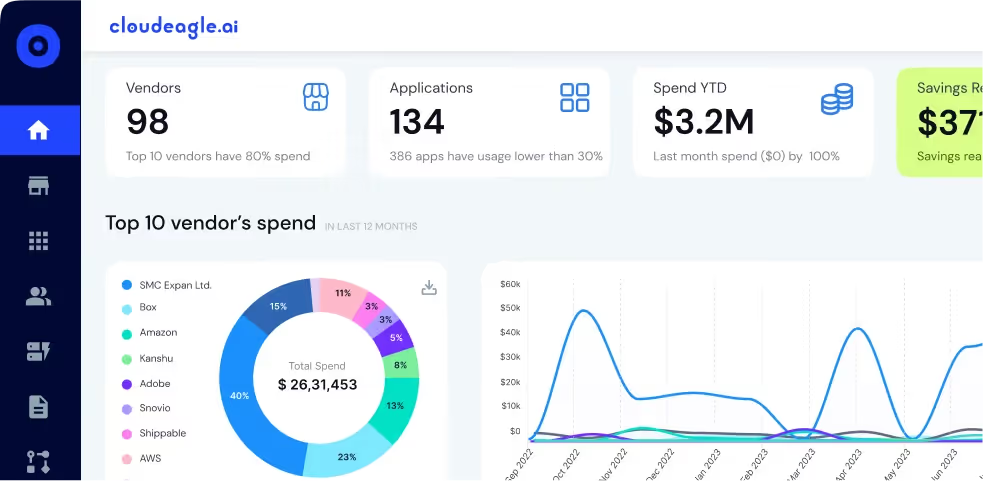
CloudEagle.ai enables continuous SaaS compliance by providing real-time visibility across:

  • Shadow IT and shadow AI discovery from IdP, browser, finance, firewall, and HR data
  • Roles, permissions, entitlements, and feature-level access, not just login activity
  • License usage vs. contract limits to prevent vendor audit risk
  • Dormant accounts and orphaned identities
  • Privileged users with excessive or unnecessary access

By continuously monitoring SaaS access controls and enforcing least-privilege policies, CloudEagle helps organizations align with frameworks such as SOC 2, ISO 27001, GDPR, and emerging AI compliance regulations.

Instead of identifying risk months later, automated workflows trigger access removal, entitlement downgrades, and license reclamation in real time, directly inside Slack and existing IT systems.

Outcome: Reduced SaaS security risk and improved audit readiness.

2. AI Governance and AI Compliance Management

AI governance is now a board-level priority. Organizations must understand which AI tools employees are using, how they are accessed, and whether those tools meet regulatory standards.

CloudEagle.ai provides structured AI governance by:
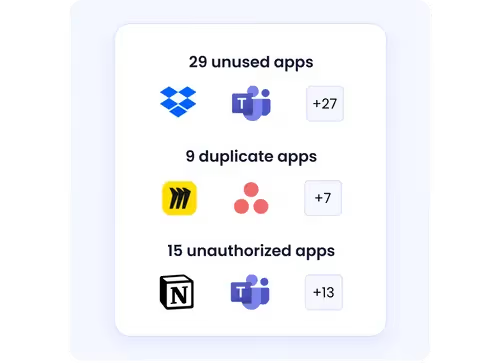
  • Detecting generative AI and AI-powered SaaS tools through browser, Zscaler, CrowdStrike, and financial data correlation
  • Identifying unsanctioned AI applications and shadow AI usage
  • Enforcing approval workflows before new AI tools are adopted
  • Applying role-based and time-bound access controls
  • Redirecting users from unapproved AI tools to approved alternatives with real-time policy guidance.

This structured AI governance model helps enterprises manage AI risk, reduce unauthorized data exposure, and support compliance with AI transparency and data privacy mandates.

Outcome: Secure and compliant AI adoption without limiting innovation.

3. SaaS Vendor Risk Management and Contract Compliance

Third-party SaaS vendors are part of your compliance surface area. Regulatory frameworks require proof that vendors meet security and data protection standards.

CloudEagle.ai centralizes SaaS vendor governance by combining contract management, renewal orchestration, and compliance tracking in one platform.

Organizations can:

  • Extract contract metadata such as renewal dates, pricing terms, and compliance clauses using AI-powered ingestion
  • Trigger renewal workflows 60–90 days in advance to avoid auto-renewal risk
  • Map every application to a named owner for accountability
  • Integrate procurement approvals with security and risk stakeholders
  • Maintain a searchable, audit-ready contract repository

By shifting renewals from reactive to proactive, organizations prevent compliance gaps and strengthen vendor oversight across their SaaS supply chain.

Outcome: Reduced vendor risk and improved contract compliance

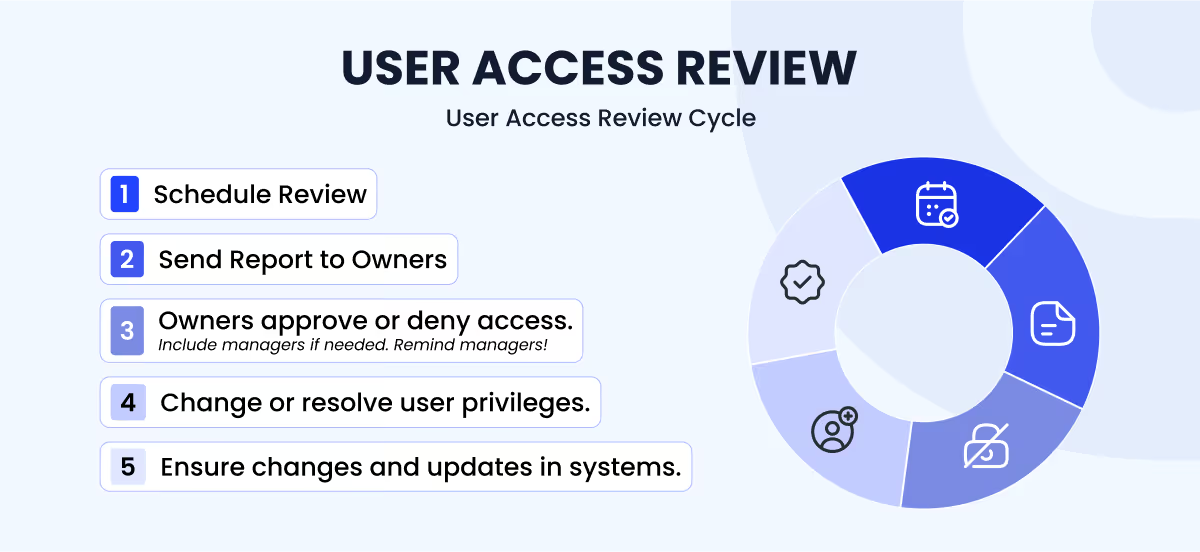
4. Continuous User Access Reviews and Identity Governance

Regulators require documented proof that only authorized users have access to sensitive systems. Traditional quarterly access reviews are manual, slow, and prone to rubber-stamping.

CloudEagle.ai automates continuous user access reviews across the entire SaaS portfolio.

Security and IT teams can:

  • Schedule automated access certifications
  • Prioritize high-risk users with elevated privileges
  • Automatically deprovision rejected or inactive users
  • Track review completion status in a centralized dashboard
  • Generate auditor-ready compliance reports with timestamped evidence

In addition, Joiner–Mover–Leaver (JML) automation ensures that onboarding, role changes, and offboarding events trigger policy-driven provisioning and deprovisioning.

When an employee leaves, access is revoked automatically, and licenses are returned to the pool, reducing both security exposure and unnecessary SaaS spend.

Outcome: Faster audits, stronger identity governance, and continuous compliance enforcement.
5. Unified SaaS Governance Across IT, Security, and Finance

Effective SaaS compliance requires coordination across identity governance, procurement controls, and spend management.

CloudEagle.ai unifies these functions by correlating HR, finance, security, and usage data into a single system of record.

This enables:

  • License optimization aligned with compliance controls
  • Security approvals embedded in procurement workflows
  • Real-time SaaS spend tracking tied to approved applications
  • Automated policy enforcement across access, renewals, and usage
  • Executive dashboards showing compliance posture and SaaS risk exposure

By connecting security governance with spend intelligence, organizations achieve both regulatory compliance and cost efficiency.

Outcome:

  • Reduced SaaS attack surface
  • Continuous compliance with SOC 2, ISO 27001, GDPR, and AI governance requirements
  • 10–30% reduction in SaaS and AI spend
  • Scalable governance without adding headcount

7. Ready to Simplify Your IT Compliance Standards in 2026?

Compliance standards don't have to be overwhelming. Be strategic, know which frameworks apply to your business, prioritize by legal requirement and business value, and build from there.

Compliance is not a destination; it's an ongoing journey. Start with the standards that matter most, establish strong foundational controls, and expand as your risk profile grows.

CloudEagle.ai helps you stay audit-ready across SOC 2, ISO 27001, GDPR, and more, without the manual overhead.

Frequently Asked Questions

1. What are the most important compliance standards organizations must follow in 2026?

The most important standards depend on your industry and geography. Key frameworks include SOC 2 for SaaS companies, GDPR for EU data, HIPAA for healthcare, PCI DSS for payments, and ISO 27001 for international businesses. Start with legally mandated requirements.

2. Which compliance standards are critical for SaaS and cloud-based companies?

SOC 2 is the gold standard for SaaS, especially for enterprise customers. ISO 27001 provides international credibility, while ISO 27017 and 27018 offer cloud-specific guidance. GDPR and CCPA/CPRA are essential for customer data. Most SaaS companies need multiple certifications.

3. How can IT and security leaders manage multiple compliance standards effectively?

Focus on common controls across frameworks - access management, encryption, and incident response. Build around shared requirements, then add framework-specific controls. Use compliance tools to automate evidence collection. Map controls to multiple frameworks simultaneously.

Advertisement for a SaaS Subscription Tracking Template with a call-to-action button to download and a partial graphic of a tablet showing charts.Banner promoting a SaaS Agreement Checklist to streamline SaaS management and avoid budget waste with a call-to-action button labeled Download checklist.Blue banner with text 'The Ultimate Employee Offboarding Checklist!' and a black button labeled 'Download checklist' alongside partial views of checklist documents from cloudeagle.ai.Digital ad for download checklist titled 'The Ultimate Checklist for IT Leaders to Optimize SaaS Operations' by cloudeagle.ai, showing checklist pages.Slack Buyer's Guide offer with text 'Unlock insider insights to get the best deal on Slack!' and a button labeled 'Get Your Copy', accompanied by a preview of the guide featuring Slack's logo.Monday Pricing Guide by cloudeagle.ai offering exclusive pricing secrets to maximize investment with a call-to-action button labeled Get Your Copy and an image of the guide's cover.Blue banner for Canva Pricing Guide by cloudeagle.ai offering a guide to Canva costs, features, and alternatives with a call-to-action button saying Get Your Copy.Blue banner with white text reading 'Little-Known Negotiation Hacks to Get the Best Deal on Slack' and a white button labeled 'Get Your Copy'.Blue banner with text 'Little-Known Negotiation Hacks to Get the Best Deal on Monday.com' and a white button labeled 'Get Your Copy'.Blue banner with text 'Little-Known Negotiation Hacks to Get the Best Deal on Canva' and a white button labeled 'Get Your Copy'.Banner with text 'Slack Buyer's Guide' and a 'Download Now' button next to images of a guide titled 'Slack Buyer’s Guide: Features, Pricing & Best Practices'.Digital cover of Monday Pricing Guide with a button labeled Get Your Copy on a blue background.Canva Pricing Guide cover with a button labeled Get Your Copy on a blue gradient background.

Enter your email to
unlock the report

Oops! Something went wrong while submitting the form.
License Count
Benchmark
Per User/Per Year

Enter your email to
unlock the report

Oops! Something went wrong while submitting the form.
License Count
Benchmark
Per User/Per Year

Enter your email to
unlock the report

Oops! Something went wrong while submitting the form.
Notion Plus
License Count
Benchmark
Per User/Per Year
100-500
$67.20 - $78.72
500-1000
$59.52 - $72.00
1000+
$51.84 - $57.60
Canva Pro
License Count
Benchmark
Per User/Per Year
100-500
$74.33-$88.71
500-1000
$64.74-$80.32
1000+
$55.14-$62.34

Enter your email to
unlock the report

Oops! Something went wrong while submitting the form.

Enter your email to
unlock the report

Oops! Something went wrong while submitting the form.
Zoom Business
License Count
Benchmark
Per User/Per Year
100-500
$216.00 - $264.00
500-1000
$180.00 - $216.00
1000+
$156.00 - $180.00

Enter your email to
unlock the report

Oops! Something went wrong while submitting the form.

Get the Right Security Platform To Secure Your Cloud Infrastructure

Please enter a business email
Thank you!
The 2023 SaaS report has been sent to your email. Check your promotional or spam folder.
Oops! Something went wrong while submitting the form.

Access full report

Please enter a business email
Thank you!
The 2023 SaaS report has been sent to your email. Check your promotional or spam folder.
Oops! Something went wrong while submitting the form.

Get SOC 2 Ready Faster

Use this practical checklist to streamline controls, collect audit evidence, and accelerate enterprise deal approvals..
Download Checklist

The compliance landscape is constantly shifting, and 2026 is no different. 

With data breaches costing companies an average of $4.88 million per incident, according to IBM's latest Cost of a Data Breach Report, staying on top of compliance standards isn't just about checking boxes; it's about protecting your organization from financial and reputational damage.

Whether you're managing a SaaS platform, overseeing cloud infrastructure, or leading IT security for a growing company, understanding which compliance standards matter most can feel overwhelming. 

The good news? 

You don't need to be an expert in every framework. You just need to know which ones apply to your business and how to prioritize them.

TL;DR

  • Compliance standards are now a business-critical requirement, not just a legal checkbox, directly tied to revenue, trust, and audit readiness
  • SaaS compliance standards like SOC 2 and ISO 27001 are table stakes for any cloud-based business selling to enterprise customers in 2026
  • Cloud compliance standards such as ISO 27017 and FedRAMP are essential if you run infrastructure or sell to the government
  • Your industry and geography determine your mandatory security compliance standards; start there before layering on broader frameworks
  • Organizations using compliance automation reduce audit prep time by up to 70%, making tooling a priority, not an afterthought.

1. Why Compliance Standards Matter More Than Ever?

Here's the reality: 

Compliance isn't optional anymore. Having strong IT governance best practices in place is now a fundamental requirement for staying competitive. 

According to Gartner's July 2025 forecast, global spending on information security is projected to reach $213 billion in 2025 and is expected to grow a further 12.5% in 2026, hitting $240 billion, with regulatory compliance and AI-driven threats cited as key growth drivers.

Organizations are increasingly investing in identity governance and administration tools to meet these compliance requirements.

But compliance standards do more than just help you avoid penalties. They:

  • Build trust with customers who want assurance that their data is safe
  • Create a structured approach to security that reduces vulnerabilities
  • Streamline vendor due diligence and partnership opportunities
  • Provide a competitive advantage in industries where security matters

The challenge? There are dozens of compliance frameworks out there, and not all of them are relevant to your organization. Let's break down the top 10 you need to know about in 2026.

2. What Are the Top 10 Compliance Standards CIOs and CISOs Should Pay Attention to?

A. SOC 2 (System and Organization Controls 2)

What it is

SOC 2 is the gold standard for SaaS and cloud service providers. Developed by the American Institute of CPAs (AICPA), it focuses on five trust service criteria: security, availability, processing integrity, confidentiality, and privacy.

Why it matters in 2026

If you're selling software or managing customer data in the cloud, chances are your prospects are asking for SOC 2 compliance before they'll sign on the dotted line. It's become table stakes for B2B SaaS companies, especially those targeting enterprise customers. Understanding identity and access governance is crucial for maintaining SOC 2 compliance.

Research from Vanta shows that 89% of enterprise buyers now require security certifications like SOC 2 before making purchasing decisions. Without it, you're leaving revenue on the table.

Who needs it

SaaS companies, cloud service providers, data centers, and any organization that stores customer data in the cloud.

B. ISO 27001

What it is

ISO 27001 is an internationally recognized standard for information security management systems (ISMS). It provides a systematic approach to managing sensitive company information and ensuring it remains secure.

Why it matters in 2026

Unlike region-specific compliance standards, ISO 27001 is globally recognized, making it essential for companies operating internationally. It's particularly valuable if you're expanding into European or Asian markets where ISO certifications carry significant weight. 

Many organizations use SOC 2 Type 2 compliance platforms alongside ISO 27001 for comprehensive coverage.

Who needs it

Organizations of any size looking to demonstrate robust security practices, especially those with international customers or operations.

C. GDPR (General Data Protection Regulation)

What it is

GDPR is the European Union's comprehensive data protection law that governs how organizations collect, process, and store personal data of EU residents.

Why it matters in 2026

Even if your company isn't based in Europe, if you have EU customers, you need to comply. GDPR fines can reach up to €20 million or 4% of annual global turnover, whichever is higher. According to Statista, GDPR fines exceeded €4.5 billion since its introduction in 2018. Implementing an effective access governance system can help prevent GDPR violations.

The regulation also influenced similar laws worldwide, making it a blueprint for privacy compliance globally.

Who needs it

Any organization that processes personal data of EU residents, regardless of where the company is located.

Simplify Your GDPR Compliance Journey

Follow a step-by-step checklist to reduce data privacy risk and avoid costly regulatory fines..
Download Checklist

D. HIPAA (Health Insurance Portability and Accountability Act)

What it is

HIPAA is the US federal law that sets standards for protecting sensitive patient health information. It applies to healthcare providers, health plans, and any business associates who handle protected health information (PHI).

Why it matters in 2026

Healthcare technology continues to boom, and with it comes increased scrutiny on how patient data is handled. HIPAA violations can result in fines ranging from $100 to $50,000 per violation, with annual maximums reaching $1.5 million per violation category.

Who needs it

Healthcare providers, health tech companies, medical device manufacturers, telemedicine platforms, and any vendors who access or process patient health data.

E. PCI DSS (Payment Card Industry Data Security Standard)

What it is

PCI DSS is a set of security standards designed to ensure that all companies that accept, process, store, or transmit credit card information maintain a secure environment.

Why it matters in 2026

If you handle payment card data, PCI DSS isn't optional. Non-compliance can result in fines ranging from $5,000 to $100,000 per month, plus you could lose the ability to process card payments altogether.

Version 4.0, which became mandatory in March 2024, introduced new requirements around multi-factor authentication and enhanced monitoring, making security more robust but also more complex.

Who needs it

E-commerce platforms, retailers, payment processors, and any business that accepts credit card payments.

F. CCPA/CPRA (California Consumer Privacy Act/California Privacy Rights Act)

What it is

CCPA and its successor, CPRA, are California's answer to GDPR, giving California residents control over their personal information. CPRA expanded on CCPA with stronger enforcement and additional rights.

Why it matters in 2026

California represents a massive market, and its privacy laws often set the tone for other states. Currently, over a dozen US states have enacted their own privacy laws, many modeled after CCPA. If you do business in California or with California residents, compliance is mandatory.

Who needs it

Companies that do business in California and meet certain thresholds for revenue or data processing volume.

G. NIST Cybersecurity Framework

What it is

The National Institute of Standards and Technology (NIST) Cybersecurity Framework provides a policy framework of computer security guidance for organizations to better manage and reduce cybersecurity risk.

Why it matters in 2026

While not always mandatory, the NIST framework is increasingly referenced in government contracts and regulatory guidance. It's also one of the most practical frameworks for building a comprehensive security program because it's flexible and risk-based.

Many organizations use NIST as their foundational security framework and then layer on industry-specific compliance requirements. Building a strong SaaS security posture with NIST guidelines helps establish baseline controls.

Who needs it

Government contractors, critical infrastructure operators, and organizations looking for a comprehensive approach to cybersecurity.

H. FedRAMP (Federal Risk and Authorization Management Program)

What it is

FedRAMP is a US government program that provides a standardized approach to security assessment, authorization, and continuous monitoring for cloud products and services used by federal agencies.

Why it matters in 2026

If you want to sell cloud services to the federal government, FedRAMP authorization is required. It's rigorous and expensive to achieve, but it opens the door to lucrative government contracts.

Who needs it

Cloud service providers are targeting federal government agencies as customers.

I. CMMC (Cybersecurity Maturity Model Certification)

What it is

CMMC is a framework that verifies the implementation of cybersecurity practices across the Defense Industrial Base (DIB). It combines various standards and best practices to protect Controlled Unclassified Information (CUI).

Why it matters in 2026

CMMC 2.0 requirements are being phased into Department of Defense contracts, making it mandatory for defense contractors and their subcontractors. Without the appropriate CMMC level, you can't bid on DoD contracts.

Who needs it

Defense contractors, subcontractors, and any organization in the defense supply chain.

J. ISO 27017 and ISO 27018

What it is

These are cloud-specific extensions of ISO 27001. ISO 27017 provides guidelines for information security controls for cloud services, while ISO 27018 focuses specifically on protecting personal data in the cloud.

Why it matters in 2026

As cloud adoption continues to accelerate, customers are looking for cloud-specific security assurances. These standards demonstrate that your cloud security controls go beyond general IT security and address cloud-specific risks.

Who needs it

Cloud service providers, SaaS companies, and organizations offering infrastructure-as-a-service (IaaS) or platform-as-a-service (PaaS) solutions.

3. How Should IT Teams Prioritize Compliance Standards in 2026?

Now that you know the major players, how do you decide where to focus your energy? Here's a practical approach:

Start with mandatory requirements

Identify compliance standards that are legally required based on your industry and geography. For example:

  • SOC 2 is the starting point for almost every SaaS and cloud business. If you store or process customer data, this is the first certification prospects and enterprise buyers will ask for
  • HIPAA is non-negotiable for any company touching patient health data; violations carry fines up to $1.5 million per violation category
  • GDPR applies to any organization handling EU resident data, regardless of where your company is headquartered
  • PCI DSS is mandatory the moment you accept, store, or transmit credit card information, non-compliance can cost you the ability to process payments altogether

Consider your customer base

Look at what your customers are asking for. If you're a B2B SaaS company and prospects keep requesting SOC 2 reports, that's a clear signal to prioritize it.

Evaluate your risk profile

Consider where your biggest security and compliance risks lie. If you're heavily cloud-based, ISO 27001 and ISO 27017/27018 might provide the most comprehensive coverage.

Think about scalability

Some frameworks are easier to build upon than others. NIST provides a flexible foundation that you can adapt as you layer on more specific requirements. As AI adoption increases, AI governance platforms are becoming essential for managing data compliance regulations in AI-powered systems.

Calculate ROI

Compliance isn't just about avoiding fines; it's about enabling business growth. According to Deloitte's research, companies with mature compliance programs see 20% faster revenue growth compared to their peers.

4. What Are the Most Common Compliance Challenges and How Do You Solve Them?

Challenge 1: Managing multiple frameworks simultaneously

Many organizations need to comply with several standards at once, which can create redundancy and confusion.

Solution: Map common controls across frameworks. Many requirements overlap—for example, access controls and encryption requirements appear in almost every standard. Build your security program around these common controls, then add framework-specific requirements as needed. Strong SaaS governance helps you manage these overlapping requirements efficiently.

Challenge 2: Keeping up with regulatory changes

Compliance standards evolve constantly, and staying current can feel like a full-time job.

Solution: Leverage compliance management platforms that track regulatory changes and send alerts when standards are updated. CloudEagle.ai, for instance, helps IT teams stay on top of compliance requirements across their entire SaaS stack.

Challenge 3: Resource constraints

Small and mid-sized companies often lack dedicated compliance teams.

Solution: Start with risk-based prioritization and use automation wherever possible. Many compliance tasks like evidence collection, access reviews, and policy enforcement can be automated, freeing up your team to focus on strategic initiatives. Use a SaaS governance checklist to ensure you're covering all critical areas.

Challenge 4: Maintaining continuous compliance

Compliance isn't a one-and-done exercise; it requires ongoing monitoring and maintenance.

Solution: Implement continuous monitoring tools and establish regular cadences for control testing. Treat compliance as an ongoing program rather than an annual audit event. Identity Governance and Administration (IGA) systems enable continuous compliance monitoring.

5. How Does SaaS Management Affect Compliance?

Here's something many IT and security leaders overlook: your SaaS stack itself can be a significant compliance risk or a powerful compliance enabler. Understanding the hidden risks of poor SaaS compliance is crucial for modern enterprises.

With organizations now running 500+ SaaS applications on average, according to CloudEagle.ai's own research, maintaining visibility and control over every tool in your stack is critical for compliance, maintaining visibility and control over these tools is critical for compliance. Organizations need to move from Shadow IT to Zero Trust to lock down their SaaS environment.

Questions to ask:

  • Do all your SaaS vendors meet your compliance requirements?
  • Can you prove who has access to what systems and data? Access governance provides this visibility.
  • Are you tracking and remediating security findings across all your applications?
  • Do you have centralized documentation for compliance audits?

SaaS management platforms help by:

  • Automatically discovering all SaaS applications in use (including shadow IT)
  • Tracking vendor compliance certifications and security documentation
  • Managing access controls and user provisioning
  • Collecting evidence for audits
  • Identifying compliance gaps across your software portfolio

6. How Does CloudEagle.ai Help Organizations Stay Compliant in 2026?

As AI regulations expand and global privacy laws evolve, SaaS compliance is no longer a once-a-year audit activity. Organizations must now enforce continuous SaaS governance, AI risk management, and identity security controls across hundreds of applications.

CloudEagle.ai is an AI-powered SaaS security and identity governance platform that helps enterprises maintain continuous compliance across SaaS and AI environments, without increasing manual workload.

It acts as a unified control plane to discover, govern, monitor, and optimize every SaaS and AI application in your ecosystem.

1. Continuous SaaS Visibility and Automated Monitoring

Modern SaaS environments change daily. New tools are adopted, roles evolve, and licenses are reassigned. Manual audits and spreadsheets cannot keep up.

CloudEagle.ai enables continuous SaaS compliance by providing real-time visibility across:

  • Shadow IT and shadow AI discovery from IdP, browser, finance, firewall, and HR data
  • Roles, permissions, entitlements, and feature-level access, not just login activity
  • License usage vs. contract limits to prevent vendor audit risk
  • Dormant accounts and orphaned identities
  • Privileged users with excessive or unnecessary access

By continuously monitoring SaaS access controls and enforcing least-privilege policies, CloudEagle helps organizations align with frameworks such as SOC 2, ISO 27001, GDPR, and emerging AI compliance regulations.

Instead of identifying risk months later, automated workflows trigger access removal, entitlement downgrades, and license reclamation in real time, directly inside Slack and existing IT systems.

Outcome: Reduced SaaS security risk and improved audit readiness.

2. AI Governance and AI Compliance Management

AI governance is now a board-level priority. Organizations must understand which AI tools employees are using, how they are accessed, and whether those tools meet regulatory standards.

CloudEagle.ai provides structured AI governance by:

  • Detecting generative AI and AI-powered SaaS tools through browser, Zscaler, CrowdStrike, and financial data correlation
  • Identifying unsanctioned AI applications and shadow AI usage
  • Enforcing approval workflows before new AI tools are adopted
  • Applying role-based and time-bound access controls
  • Redirecting users from unapproved AI tools to approved alternatives with real-time policy guidance.

This structured AI governance model helps enterprises manage AI risk, reduce unauthorized data exposure, and support compliance with AI transparency and data privacy mandates.

Outcome: Secure and compliant AI adoption without limiting innovation.

3. SaaS Vendor Risk Management and Contract Compliance

Third-party SaaS vendors are part of your compliance surface area. Regulatory frameworks require proof that vendors meet security and data protection standards.

CloudEagle.ai centralizes SaaS vendor governance by combining contract management, renewal orchestration, and compliance tracking in one platform.

Organizations can:

  • Extract contract metadata such as renewal dates, pricing terms, and compliance clauses using AI-powered ingestion
  • Trigger renewal workflows 60–90 days in advance to avoid auto-renewal risk
  • Map every application to a named owner for accountability
  • Integrate procurement approvals with security and risk stakeholders
  • Maintain a searchable, audit-ready contract repository

By shifting renewals from reactive to proactive, organizations prevent compliance gaps and strengthen vendor oversight across their SaaS supply chain.

Outcome: Reduced vendor risk and improved contract compliance

4. Continuous User Access Reviews and Identity Governance

Regulators require documented proof that only authorized users have access to sensitive systems. Traditional quarterly access reviews are manual, slow, and prone to rubber-stamping.

CloudEagle.ai automates continuous user access reviews across the entire SaaS portfolio.

Security and IT teams can:

  • Schedule automated access certifications
  • Prioritize high-risk users with elevated privileges
  • Automatically deprovision rejected or inactive users
  • Track review completion status in a centralized dashboard
  • Generate auditor-ready compliance reports with timestamped evidence

In addition, Joiner–Mover–Leaver (JML) automation ensures that onboarding, role changes, and offboarding events trigger policy-driven provisioning and deprovisioning.

When an employee leaves, access is revoked automatically, and licenses are returned to the pool, reducing both security exposure and unnecessary SaaS spend.

Outcome: Faster audits, stronger identity governance, and continuous compliance enforcement.

5. Unified SaaS Governance Across IT, Security, and Finance

Effective SaaS compliance requires coordination across identity governance, procurement controls, and spend management.

CloudEagle.ai unifies these functions by correlating HR, finance, security, and usage data into a single system of record.

This enables:

  • License optimization aligned with compliance controls
  • Security approvals embedded in procurement workflows
  • Real-time SaaS spend tracking tied to approved applications
  • Automated policy enforcement across access, renewals, and usage
  • Executive dashboards showing compliance posture and SaaS risk exposure

By connecting security governance with spend intelligence, organizations achieve both regulatory compliance and cost efficiency.

Outcome:

  • Reduced SaaS attack surface
  • Continuous compliance with SOC 2, ISO 27001, GDPR, and AI governance requirements
  • 10–30% reduction in SaaS and AI spend
  • Scalable governance without adding headcount

7. Ready to Simplify Your IT Compliance Standards in 2026?

Compliance standards don't have to be overwhelming. Be strategic, know which frameworks apply to your business, prioritize by legal requirement and business value, and build from there.

Compliance is not a destination; it's an ongoing journey. Start with the standards that matter most, establish strong foundational controls, and expand as your risk profile grows.

CloudEagle.ai helps you stay audit-ready across SOC 2, ISO 27001, GDPR, and more, without the manual overhead.

Frequently Asked Questions

1. What are the most important compliance standards organizations must follow in 2026?

The most important standards depend on your industry and geography. Key frameworks include SOC 2 for SaaS companies, GDPR for EU data, HIPAA for healthcare, PCI DSS for payments, and ISO 27001 for international businesses. Start with legally mandated requirements.

2. Which compliance standards are critical for SaaS and cloud-based companies?

SOC 2 is the gold standard for SaaS, especially for enterprise customers. ISO 27001 provides international credibility, while ISO 27017 and 27018 offer cloud-specific guidance. GDPR and CCPA/CPRA are essential for customer data. Most SaaS companies need multiple certifications.

3. How can IT and security leaders manage multiple compliance standards effectively?

Focus on common controls across frameworks - access management, encryption, and incident response. Build around shared requirements, then add framework-specific controls. Use compliance tools to automate evidence collection. Map controls to multiple frameworks simultaneously.

CloudEagle.ai recognized in the 2025 Gartner® Magic Quadrant™ for SaaS Management Platforms
Download now
gartner chart
5x
Faster employee
onboarding
80%
Reduction in time for
user access reviews
30k
Workflows
automated
$15Bn
Analyzed in
contract spend
$2Bn
Saved in
SaaS spend

Recognized as an Industry leader for our AI

CloudEagle.ai is Recognized in the 2024 Gartner® Magic Quadrant™ for SaaS Management Platforms

Recognition highlights CloudEagle’s innovation and leadership in the rapidly evolving SaaS management and procurement space.
Read More
Gartner Magic Quadrant for SaaS Management Platforms showing a chart divided into Challengers and Leaders quadrants with various companies plotted as dots.

CloudEagle.ai Recognized in the GigaOm Radar for SaaS Management Platforms

CloudEagle named a Leader and Outperformer in GigaOm Radar Report, validating its impact in the SaaS management platform landscape.
Read More
gigaom

Everest Group Positions CloudEagle.ai as a Trailblazer in SaaS Management Platforms

CloudEagle recognized as a Trailblazer by Everest Group, showcasing its rapid growth and innovation in SaaS spend and operations management.
Read More
qks

CloudEagle.ai is Recognized in the 2024 Gartner® Magic Quadrant™ for SaaS Management Platforms

Recognition highlights CloudEagle’s innovation and leadership in the rapidly evolving SaaS management and procurement space.
Read More
gartner

Streamline SaaS governance and save 10-30%

Book a Demo with Expert
CTA image
One platform to Manage
all SaaS Products
Learn More