You need to enable JavaScript in order to use the AI chatbot tool powered by ChatBot

Why SaaS Compliance Is Breaking Traditional IT Governance

Share via:
blog-cms-banner-bg
Little-Known Negotiation Hacks to Get the Best Deal on Slack
cta-bg-blogDownload Your Copy

HIPAA Compliance Checklist for 2025

Download PDF

Are You Following SaaS Compliance Best Practices

Learn essential governance controls to reduce risk and prevent costly compliance failures.

Download The Resource
CTA Thumbnail

Traditional IT governance was built for a world that no longer exists. Control was centralized, access was predictable, and ownership was clear.

SaaS and rapid AI adoption changed all of that.

The growing mismatch is why SaaS compliance is breaking traditional IT governance. The frameworks, controls, and assumptions that once worked are failing under SaaS scale and speed, creating audit gaps, security blind spots, and operational chaos.

This blog explains why traditional IT governance struggles with SaaS compliance, how SaaS governance fundamentally differs from legacy models, and what IT and security leaders must change to stay compliant in a SaaS-first world.

TL;DR

  • Traditional IT governance was built for centralized, slow-moving systems, not fast, decentralized SaaS environments.
  • SaaS compliance breaks legacy models because identity, access, and integrations change continuously.
  • Shadow IT, over-privileged accounts, and unmanaged OAuth apps create major compliance gaps.
  • Periodic reviews and manual processes cannot meet modern audit and security expectations.
  • SaaS-native governance with continuous visibility and shared ownership is now essential.

1. Why SaaS Compliance Is Breaking Traditional IT Governance Models

At a high level, traditional IT governance assumes centralized control, static environments, and slow change. SaaS violates every one of those assumptions.

Traditional IT governance assumes centralized control, static environments, and slow change. SaaS breaks all three.

Business teams across marketing, sales, HR, and finance now buy SaaS tools independently using credit cards, free trials, and bundled plans. This decentralization creates immediate compliance risk. 

Security teams often discover new applications only during audits or after incidents, making compliance reactive rather than continuous. Ownership is unclear, contracts are missing, and controls vary widely, now common IT governance challenges.

Legacy governance frameworks were never designed to manage identity sprawl across hundreds of SaaS vendors, leading to failed audits despite strong infrastructure controls.

Finally, SaaS compliance is continuous, not periodic. 

SaaS environments change daily as users, permissions, and integrations evolve. Quarterly reviews and manual evidence collection cannot keep up, creating a gap between real-time SaaS risk and outdated governance processes.

2. How SaaS Governance Differs From Traditional IT Governance

Is Your Organization Ready for SOC 2

Use structured controls and audit checkpoints to achieve SOC 2 compliance confidently.

Download The Resource
CTA Thumbnail

SaaS governance is not just a modernized version of legacy governance. It is a fundamentally different operating model.

a. From Managing Assets to Managing Applications and Access

Traditional IT governance tracked physical and virtual assets. SaaS governance tracks applications, users, permissions, integrations, and data exposure.

Instead of asking how many servers exist, SaaS governance asks which applications have access to sensitive data, who holds admin roles, and whether unused tools still retain active access. This shift requires entirely new visibility and control mechanisms.

b. From Static Policies to Dynamic Controls

Legacy governance relied on static policies enforced through slow, manual processes. SaaS governance must be dynamic.

User roles change frequently. Contractors and partners rotate constantly. Integrations evolve rapidly. SaaS security governance depends on controls that adapt in real time, flag risky changes, and enforce remediation without waiting for human intervention.

Static governance policies are simply incompatible with SaaS velocity.

c. From IT-Owned Governance to Shared Accountability

In traditional IT governance, accountability sat almost entirely with IT. SaaS governance spans IT, security, finance, compliance, and business teams.

Finance cares about spending and renewals. Security focuses on access and risk. Compliance needs audit evidence. Business teams prioritize productivity. Effective SaaS governance aligns all of these stakeholders around a single source of truth.

Without that alignment, governance becomes fragmented and SaaS compliance breaks down.

3. The Hidden Compliance Risks Traditional Governance Misses

When organizations apply traditional IT governance models to SaaS environments, several high-risk areas are consistently overlooked.

a. Shadow IT Compliance Exposure

Shadow IT is no longer just an inventory problem. It is a compliance problem.

Unapproved SaaS tools may store regulated data without proper contracts, security reviews, or access controls. This creates exposure under frameworks like SOC 2, ISO 27001, GDPR, and HIPAA. Shadow IT compliance gaps often surface only during audits, when teams scramble to justify tools they barely understand.

b. Orphaned and Over-Privileged Accounts

Traditional offboarding processes were built around Active Directory and on-prem systems. SaaS requires application-level access revocation.

When governance lacks centralized SaaS visibility, former employees retain access, admins accumulate excessive privileges, and contractors remain active indefinitely. These issues directly undermine SaaS risk management and frequently appear as repeat audit findings.

c. Uncontrolled Third-Party and OAuth Access

OAuth apps and third-party integrations represent one of the fastest-growing SaaS risk vectors. Traditional IT governance rarely accounts for machine identities operating inside SaaS platforms.

As a result, integrations often retain broad permissions long after they are needed, violating least-privilege requirements and increasing breach impact.

4. Why Traditional Controls Fail Audits in SaaS‑First Organizations

Most SaaS-related audit failures are not caused by missing policies. They are caused by missing visibility.

Auditors increasingly expect evidence of continuous access reviews, timely user deprovisioning, centralized SaaS inventories, and control over third-party access. Manual spreadsheets, ticket-based processes, and fragmented ownership models cannot reliably produce this evidence at scale.

This is why even mature enterprises struggle with recurring SaaS compliance issues despite having well-documented governance frameworks.

If CIOs don’t act now, the risks compound fast:

⚠️ Audit findings that repeat year after year — damaging credibility with boards and regulators

⚠️ Ex-employees retaining SaaS access — creating silent insider risk

⚠️ Shadow IT growth without detection — expanding the attack surface unnoticed

⚠️ Unverified third-party integrations — increasing data exposure risk

⚠️ Delayed deprovisioning during layoffs or M&A — leading to compliance violations

⚠️ Inability to prove control maturity — impacting SOC 2, ISO 27001, SOX readiness

And here’s the truth:

By the time an audit flags SaaS governance gaps, the problem has already been visible to attackers for months.

Organizations that invest in real-time SaaS visibility and automated governance workflows today will move into audits with confidence. Those that wait will continue firefighting exceptions, remediation plans, and board-level escalations.

SaaS compliance is no longer a documentation problem. It’s a control execution problem.

5. What Security and IT Leaders Must Change to Modernize SaaS Governance

Solving SaaS compliance doesn’t mean adding more spreadsheets, more tickets, or more quarterly reviews.

It requires rethinking governance itself.

a. Treat SaaS as a First-Class Governance Domain

SaaS is no longer “just applications.” It is infrastructure. It is identity. It is data exposure.

Yet in many enterprises, SaaS governance still lacks clear ownership, defined KPIs, and executive accountability.

If SaaS isn’t formally recognized as a governance domain:

  • No one owns risk end-to-end
  • Shadow IT spreads quietly
  • Access reviews become checkbox exercises
  • Compliance efforts stay reactive

Modern organizations elevate SaaS governance to the same strategic level as cloud security and IAM — with measurable outcomes and board visibility.

b. Move From Periodic Reviews to Continuous Monitoring

Quarterly access reviews are built for static environments. SaaS environments change daily.

Admins get added. Integrations get installed. Permissions escalate. Employees change roles.

By the time a quarterly review happens, risk has already accumulated.

Modern governance requires:

  • Continuous detection of over-privileged users
  • Automated deprovisioning workflows
  • Real-time alerts for dormant admins
  • Immediate visibility into new SaaS apps and Shadow AI

This is where AI-powered SaaS management platforms like CloudEagle.ai become critical.

CloudEagle enables organizations to automatically discover SaaS apps, monitor access in near real time, streamline access reviews, and enforce governance controls without slowing business teams down.

The shift is simple:
From reactive audit preparation → to continuous control enforcement.

c. Centralize SaaS Visibility Across Teams

SaaS compliance fails when data lives in silos.

IT tracks apps. Security tracks access.

Finance tracks spend. Compliance tracks controls.

But no one sees the full picture.

Modern governance requires a shared system of record for:

Platforms like CloudEagle.ai help unify this data across IT, security, finance, and compliance teams — creating a centralized control layer across the SaaS ecosystem.

Centralization doesn’t just simplify audits. It strengthens accountability and accelerates remediation.

d. Redefine Governance Metrics Around Risk

Traditional IT governance measures assets and licenses.

Modern SaaS governance measures risk outcomes.

Leading organizations now track:

  • Mean time to deprovision users
  • % of apps with assigned business owners
  • Number of dormant or over-privileged admins
  • Shadow IT detection and remediation rate
  • Third-party app approval coverage

These metrics directly tie governance to security posture and compliance resilience, not just operational hygiene.

The bottom line?

Modernizing SaaS governance isn’t about adding controls. It’s about making controls intelligent, automated, and continuously enforced.

That’s the difference between governance that documents risk  and governance that actually reduces it.

Are You Prepared for GDPR Compliance Requirements

Identify data protection gaps and implement policies to avoid regulatory penalties.

Download The Resource
CTA Thumbnail

6. The Future of IT Governance Is AI-Powered

IT governance has always existed. What’s changed is the speed, scale, and complexity of SaaS.

SaaS compliance isn’t temporary. It’s the new operating reality.

The real problem? Traditional IT governance frameworks simply can’t keep up. They were designed for centralized control, predictable systems, and slower change cycles — not decentralized SaaS buying, identity sprawl, automated integrations, and Shadow AI.

The longer organizations try to force-fit modern SaaS environments into legacy governance models, the greater the exposure:

  • Escalating audit exceptions
  • Expanding identity risk across hundreds of apps
  • Invisible third-party data flows
  • Compounding SaaS spend waste
  • Delayed response to access violations

The shift is no longer optional.

The future of IT governance is AI-powered, continuous, and adaptive — not manual and reactive.

Take Action Now

If you’re still relying on spreadsheets, manual audits, or disconnected tools, the gap is already growing.

With platforms like CloudEagle.ai, you can centralize SaaS visibility, automate governance, and reduce compliance risk, before it becomes a board-level issue.

Don’t wait for an audit to expose the cracks. Build SaaS-native governance today.

Frequently Asked Questions

1. What is SaaS-native IT governance? 

SaaS-native IT governance is a modern framework built for cloud environments. It provides real-time app visibility, automated access controls, and continuous compliance monitoring to manage decentralized SaaS usage securely and efficiently.

2. Why do traditional IT governance models fail in SaaS environments?

Traditional governance relies on centralized control and manual audits. SaaS is decentralized and fast-moving, making spreadsheets and periodic reviews ineffective for managing access, compliance, and Shadow IT risks.

3. How can organizations reduce SaaS compliance risks proactively?

Organizations can reduce risk through automated SaaS discovery, role-based access controls, continuous access reviews, Shadow IT monitoring, and centralized SaaS management platforms that provide full visibility and control.

4. Why does SaaS compliance challenge traditional IT governance?

SaaS compliance challenges traditional IT governance because SaaS environments are decentralized, identity‑driven, and constantly changing. 

5. How is SaaS governance different from legacy IT governance?

SaaS governance focuses on continuous visibility into applications, users, permissions, and integrations rather than infrastructure assets. It requires dynamic controls, shared ownership across teams, and real‑time risk monitoring instead of manual, point‑in‑time processes.

Advertisement for a SaaS Subscription Tracking Template with a call-to-action button to download and a partial graphic of a tablet showing charts.Banner promoting a SaaS Agreement Checklist to streamline SaaS management and avoid budget waste with a call-to-action button labeled Download checklist.Blue banner with text 'The Ultimate Employee Offboarding Checklist!' and a black button labeled 'Download checklist' alongside partial views of checklist documents from cloudeagle.ai.Digital ad for download checklist titled 'The Ultimate Checklist for IT Leaders to Optimize SaaS Operations' by cloudeagle.ai, showing checklist pages.Slack Buyer's Guide offer with text 'Unlock insider insights to get the best deal on Slack!' and a button labeled 'Get Your Copy', accompanied by a preview of the guide featuring Slack's logo.Monday Pricing Guide by cloudeagle.ai offering exclusive pricing secrets to maximize investment with a call-to-action button labeled Get Your Copy and an image of the guide's cover.Blue banner for Canva Pricing Guide by cloudeagle.ai offering a guide to Canva costs, features, and alternatives with a call-to-action button saying Get Your Copy.Blue banner with white text reading 'Little-Known Negotiation Hacks to Get the Best Deal on Slack' and a white button labeled 'Get Your Copy'.Blue banner with text 'Little-Known Negotiation Hacks to Get the Best Deal on Monday.com' and a white button labeled 'Get Your Copy'.Blue banner with text 'Little-Known Negotiation Hacks to Get the Best Deal on Canva' and a white button labeled 'Get Your Copy'.Banner with text 'Slack Buyer's Guide' and a 'Download Now' button next to images of a guide titled 'Slack Buyer’s Guide: Features, Pricing & Best Practices'.Digital cover of Monday Pricing Guide with a button labeled Get Your Copy on a blue background.Canva Pricing Guide cover with a button labeled Get Your Copy on a blue gradient background.

Enter your email to
unlock the report

Oops! Something went wrong while submitting the form.
License Count
Benchmark
Per User/Per Year

Enter your email to
unlock the report

Oops! Something went wrong while submitting the form.
License Count
Benchmark
Per User/Per Year

Enter your email to
unlock the report

Oops! Something went wrong while submitting the form.
Notion Plus
License Count
Benchmark
Per User/Per Year
100-500
$67.20 - $78.72
500-1000
$59.52 - $72.00
1000+
$51.84 - $57.60
Canva Pro
License Count
Benchmark
Per User/Per Year
100-500
$74.33-$88.71
500-1000
$64.74-$80.32
1000+
$55.14-$62.34

Enter your email to
unlock the report

Oops! Something went wrong while submitting the form.

Enter your email to
unlock the report

Oops! Something went wrong while submitting the form.
Zoom Business
License Count
Benchmark
Per User/Per Year
100-500
$216.00 - $264.00
500-1000
$180.00 - $216.00
1000+
$156.00 - $180.00

Enter your email to
unlock the report

Oops! Something went wrong while submitting the form.

Get the Right Security Platform To Secure Your Cloud Infrastructure

Please enter a business email
Thank you!
The 2023 SaaS report has been sent to your email. Check your promotional or spam folder.
Oops! Something went wrong while submitting the form.

Access full report

Please enter a business email
Thank you!
The 2023 SaaS report has been sent to your email. Check your promotional or spam folder.
Oops! Something went wrong while submitting the form.

Are You Following SaaS Compliance Best Practices

Learn essential governance controls to reduce risk and prevent costly compliance failures.

Download The Resource
CTA Thumbnail

Traditional IT governance was built for a world that no longer exists. Control was centralized, access was predictable, and ownership was clear.

SaaS and rapid AI adoption changed all of that.

The growing mismatch is why SaaS compliance is breaking traditional IT governance. The frameworks, controls, and assumptions that once worked are failing under SaaS scale and speed, creating audit gaps, security blind spots, and operational chaos.

This blog explains why traditional IT governance struggles with SaaS compliance, how SaaS governance fundamentally differs from legacy models, and what IT and security leaders must change to stay compliant in a SaaS-first world.

TL;DR

  • Traditional IT governance was built for centralized, slow-moving systems, not fast, decentralized SaaS environments.
  • SaaS compliance breaks legacy models because identity, access, and integrations change continuously.
  • Shadow IT, over-privileged accounts, and unmanaged OAuth apps create major compliance gaps.
  • Periodic reviews and manual processes cannot meet modern audit and security expectations.
  • SaaS-native governance with continuous visibility and shared ownership is now essential.

1. Why SaaS Compliance Is Breaking Traditional IT Governance Models

At a high level, traditional IT governance assumes centralized control, static environments, and slow change. SaaS violates every one of those assumptions.

Traditional IT governance assumes centralized control, static environments, and slow change. SaaS breaks all three.

Business teams across marketing, sales, HR, and finance now buy SaaS tools independently using credit cards, free trials, and bundled plans. This decentralization creates immediate compliance risk. 

Security teams often discover new applications only during audits or after incidents, making compliance reactive rather than continuous. Ownership is unclear, contracts are missing, and controls vary widely, now common IT governance challenges.

Legacy governance frameworks were never designed to manage identity sprawl across hundreds of SaaS vendors, leading to failed audits despite strong infrastructure controls.

Finally, SaaS compliance is continuous, not periodic. 

SaaS environments change daily as users, permissions, and integrations evolve. Quarterly reviews and manual evidence collection cannot keep up, creating a gap between real-time SaaS risk and outdated governance processes.

2. How SaaS Governance Differs From Traditional IT Governance

Is Your Organization Ready for SOC 2

Use structured controls and audit checkpoints to achieve SOC 2 compliance confidently.

Download The Resource
CTA Thumbnail

SaaS governance is not just a modernized version of legacy governance. It is a fundamentally different operating model.

a. From Managing Assets to Managing Applications and Access

Traditional IT governance tracked physical and virtual assets. SaaS governance tracks applications, users, permissions, integrations, and data exposure.

Instead of asking how many servers exist, SaaS governance asks which applications have access to sensitive data, who holds admin roles, and whether unused tools still retain active access. This shift requires entirely new visibility and control mechanisms.

b. From Static Policies to Dynamic Controls

Legacy governance relied on static policies enforced through slow, manual processes. SaaS governance must be dynamic.

User roles change frequently. Contractors and partners rotate constantly. Integrations evolve rapidly. SaaS security governance depends on controls that adapt in real time, flag risky changes, and enforce remediation without waiting for human intervention.

Static governance policies are simply incompatible with SaaS velocity.

c. From IT-Owned Governance to Shared Accountability

In traditional IT governance, accountability sat almost entirely with IT. SaaS governance spans IT, security, finance, compliance, and business teams.

Finance cares about spending and renewals. Security focuses on access and risk. Compliance needs audit evidence. Business teams prioritize productivity. Effective SaaS governance aligns all of these stakeholders around a single source of truth.

Without that alignment, governance becomes fragmented and SaaS compliance breaks down.

3. The Hidden Compliance Risks Traditional Governance Misses

When organizations apply traditional IT governance models to SaaS environments, several high-risk areas are consistently overlooked.

a. Shadow IT Compliance Exposure

Shadow IT is no longer just an inventory problem. It is a compliance problem.

Unapproved SaaS tools may store regulated data without proper contracts, security reviews, or access controls. This creates exposure under frameworks like SOC 2, ISO 27001, GDPR, and HIPAA. Shadow IT compliance gaps often surface only during audits, when teams scramble to justify tools they barely understand.

b. Orphaned and Over-Privileged Accounts

Traditional offboarding processes were built around Active Directory and on-prem systems. SaaS requires application-level access revocation.

When governance lacks centralized SaaS visibility, former employees retain access, admins accumulate excessive privileges, and contractors remain active indefinitely. These issues directly undermine SaaS risk management and frequently appear as repeat audit findings.

c. Uncontrolled Third-Party and OAuth Access

OAuth apps and third-party integrations represent one of the fastest-growing SaaS risk vectors. Traditional IT governance rarely accounts for machine identities operating inside SaaS platforms.

As a result, integrations often retain broad permissions long after they are needed, violating least-privilege requirements and increasing breach impact.

4. Why Traditional Controls Fail Audits in SaaS‑First Organizations

Most SaaS-related audit failures are not caused by missing policies. They are caused by missing visibility.

Auditors increasingly expect evidence of continuous access reviews, timely user deprovisioning, centralized SaaS inventories, and control over third-party access. Manual spreadsheets, ticket-based processes, and fragmented ownership models cannot reliably produce this evidence at scale.

This is why even mature enterprises struggle with recurring SaaS compliance issues despite having well-documented governance frameworks.

If CIOs don’t act now, the risks compound fast:

⚠️ Audit findings that repeat year after year — damaging credibility with boards and regulators

⚠️ Ex-employees retaining SaaS access — creating silent insider risk

⚠️ Shadow IT growth without detection — expanding the attack surface unnoticed

⚠️ Unverified third-party integrations — increasing data exposure risk

⚠️ Delayed deprovisioning during layoffs or M&A — leading to compliance violations

⚠️ Inability to prove control maturity — impacting SOC 2, ISO 27001, SOX readiness

And here’s the truth:

By the time an audit flags SaaS governance gaps, the problem has already been visible to attackers for months.

Organizations that invest in real-time SaaS visibility and automated governance workflows today will move into audits with confidence. Those that wait will continue firefighting exceptions, remediation plans, and board-level escalations.

SaaS compliance is no longer a documentation problem. It’s a control execution problem.

5. What Security and IT Leaders Must Change to Modernize SaaS Governance

Solving SaaS compliance doesn’t mean adding more spreadsheets, more tickets, or more quarterly reviews.

It requires rethinking governance itself.

a. Treat SaaS as a First-Class Governance Domain

SaaS is no longer “just applications.” It is infrastructure. It is identity. It is data exposure.

Yet in many enterprises, SaaS governance still lacks clear ownership, defined KPIs, and executive accountability.

If SaaS isn’t formally recognized as a governance domain:

  • No one owns risk end-to-end
  • Shadow IT spreads quietly
  • Access reviews become checkbox exercises
  • Compliance efforts stay reactive

Modern organizations elevate SaaS governance to the same strategic level as cloud security and IAM — with measurable outcomes and board visibility.

b. Move From Periodic Reviews to Continuous Monitoring

Quarterly access reviews are built for static environments. SaaS environments change daily.

Admins get added. Integrations get installed. Permissions escalate. Employees change roles.

By the time a quarterly review happens, risk has already accumulated.

Modern governance requires:

  • Continuous detection of over-privileged users
  • Automated deprovisioning workflows
  • Real-time alerts for dormant admins
  • Immediate visibility into new SaaS apps and Shadow AI

This is where AI-powered SaaS management platforms like CloudEagle.ai become critical.

CloudEagle enables organizations to automatically discover SaaS apps, monitor access in near real time, streamline access reviews, and enforce governance controls without slowing business teams down.

The shift is simple:
From reactive audit preparation → to continuous control enforcement.

c. Centralize SaaS Visibility Across Teams

SaaS compliance fails when data lives in silos.

IT tracks apps. Security tracks access.

Finance tracks spend. Compliance tracks controls.

But no one sees the full picture.

Modern governance requires a shared system of record for:

Platforms like CloudEagle.ai help unify this data across IT, security, finance, and compliance teams — creating a centralized control layer across the SaaS ecosystem.

Centralization doesn’t just simplify audits. It strengthens accountability and accelerates remediation.

d. Redefine Governance Metrics Around Risk

Traditional IT governance measures assets and licenses.

Modern SaaS governance measures risk outcomes.

Leading organizations now track:

  • Mean time to deprovision users
  • % of apps with assigned business owners
  • Number of dormant or over-privileged admins
  • Shadow IT detection and remediation rate
  • Third-party app approval coverage

These metrics directly tie governance to security posture and compliance resilience, not just operational hygiene.

The bottom line?

Modernizing SaaS governance isn’t about adding controls. It’s about making controls intelligent, automated, and continuously enforced.

That’s the difference between governance that documents risk  and governance that actually reduces it.

Are You Prepared for GDPR Compliance Requirements

Identify data protection gaps and implement policies to avoid regulatory penalties.

Download The Resource
CTA Thumbnail

6. The Future of IT Governance Is AI-Powered

IT governance has always existed. What’s changed is the speed, scale, and complexity of SaaS.

SaaS compliance isn’t temporary. It’s the new operating reality.

The real problem? Traditional IT governance frameworks simply can’t keep up. They were designed for centralized control, predictable systems, and slower change cycles — not decentralized SaaS buying, identity sprawl, automated integrations, and Shadow AI.

The longer organizations try to force-fit modern SaaS environments into legacy governance models, the greater the exposure:

  • Escalating audit exceptions
  • Expanding identity risk across hundreds of apps
  • Invisible third-party data flows
  • Compounding SaaS spend waste
  • Delayed response to access violations

The shift is no longer optional.

The future of IT governance is AI-powered, continuous, and adaptive — not manual and reactive.

Take Action Now

If you’re still relying on spreadsheets, manual audits, or disconnected tools, the gap is already growing.

With platforms like CloudEagle.ai, you can centralize SaaS visibility, automate governance, and reduce compliance risk, before it becomes a board-level issue.

Don’t wait for an audit to expose the cracks. Build SaaS-native governance today.

Frequently Asked Questions

1. What is SaaS-native IT governance? 

SaaS-native IT governance is a modern framework built for cloud environments. It provides real-time app visibility, automated access controls, and continuous compliance monitoring to manage decentralized SaaS usage securely and efficiently.

2. Why do traditional IT governance models fail in SaaS environments?

Traditional governance relies on centralized control and manual audits. SaaS is decentralized and fast-moving, making spreadsheets and periodic reviews ineffective for managing access, compliance, and Shadow IT risks.

3. How can organizations reduce SaaS compliance risks proactively?

Organizations can reduce risk through automated SaaS discovery, role-based access controls, continuous access reviews, Shadow IT monitoring, and centralized SaaS management platforms that provide full visibility and control.

4. Why does SaaS compliance challenge traditional IT governance?

SaaS compliance challenges traditional IT governance because SaaS environments are decentralized, identity‑driven, and constantly changing. 

5. How is SaaS governance different from legacy IT governance?

SaaS governance focuses on continuous visibility into applications, users, permissions, and integrations rather than infrastructure assets. It requires dynamic controls, shared ownership across teams, and real‑time risk monitoring instead of manual, point‑in‑time processes.

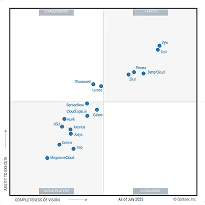
CloudEagle.ai recognized in the 2025 Gartner® Magic Quadrant™ for SaaS Management Platforms
Download now
gartner chart
5x
Faster employee
onboarding
80%
Reduction in time for
user access reviews
30k
Workflows
automated
$15Bn
Analyzed in
contract spend
$2Bn
Saved in
SaaS spend

Recognized as an Industry leader for our AI

CloudEagle.ai is Recognized in the 2024 Gartner® Magic Quadrant™ for SaaS Management Platforms

Recognition highlights CloudEagle’s innovation and leadership in the rapidly evolving SaaS management and procurement space.
Read More
Gartner Magic Quadrant for SaaS Management Platforms showing a chart divided into Challengers and Leaders quadrants with various companies plotted as dots.

CloudEagle.ai Recognized in the GigaOm Radar for SaaS Management Platforms

CloudEagle named a Leader and Outperformer in GigaOm Radar Report, validating its impact in the SaaS management platform landscape.
Read More
gigaom

Everest Group Positions CloudEagle.ai as a Trailblazer in SaaS Management Platforms

CloudEagle recognized as a Trailblazer by Everest Group, showcasing its rapid growth and innovation in SaaS spend and operations management.
Read More
qks

CloudEagle.ai is Recognized in the 2024 Gartner® Magic Quadrant™ for SaaS Management Platforms

Recognition highlights CloudEagle’s innovation and leadership in the rapidly evolving SaaS management and procurement space.
Read More
gartner

Streamline SaaS governance and save 10-30%

Book a Demo with Expert
CTA image
One platform to Manage
all SaaS Products
Learn More