You need to enable JavaScript in order to use the AI chatbot tool powered by ChatBot

Business Units Buy Their Own Tools: How to Get Visibility Before It Becomes a Budget Problem

Share via:
blog-cms-banner-bg
Little-Known Negotiation Hacks to Get the Best Deal on Slack
cta-bg-blogDownload Your Copy

HIPAA Compliance Checklist for 2025

Download PDF

Your organization probably isn't one IT environment anymore. It's five, seven, or more business units, each with its own tech stack, its own purchasing habits, and in many cases its own identity provider.

Teams adopt tools independently. There often isn't a centralized procurement process that spans every business.

The visibility gap is manageable until it isn't. It becomes urgent the moment someone from security, finance, or audit asks "what software does this business unit actually use?"

Solving it isn't about forcing centralized procurement. It's about building a discovery layer that works across fragmented environments, multiple SSOs, multiple finance systems, and different levels of IT maturity.

CloudEagle.ai pulls application and identity data across every connected source into a single consolidated view, regardless of how fragmented the underlying infrastructure is. In this article, we'll show you how.

TL;DR

  • Decentralized business units create SaaS blind spots because applications, identities, and purchasing are managed independently.
  • Fragmented SSO, finance systems, and procurement processes make it difficult to build a complete software inventory.
  • CloudEagle.ai consolidates application and identity data across multiple discovery sources into a unified visibility layer.
  • Shadow IT, shadow AI, and application risk scoring help security teams prioritize governance across every business unit.
  • CloudEagle.ai gives enterprises a centralized view of fragmented SaaS environments, enabling stronger governance, security, and spend optimization.

1. Why Decentralized Business Units Create a Structural Visibility Gap

The biggest challenge isn't that business units buy their own software. It's that no single team sees everything they've bought.

In many organizations, a central IT, security, or finance team supports multiple semi-independent business units. Some use a corporate Microsoft Entra tenant. Others rely on Google Workspace.

As one IT leader managing visibility across seven independently operated businesses described it: 

"There is a whole landscape of tools out there like Shopify, subscription management, productivity tools, etc. We are really trying to get an overall holistic view of all of the tools in use across these independently operated businesses."

That holistic view rarely exists. Here's why:

  • Every Business Unit Has Its Own Tech Stack: Different teams adopt different tools based on their operational needs without central IT or security visibility.
  • Identity Is Fragmented: Some applications are federated through SSO, while others use standalone credentials that were never centralized.
  • Visibility Stops at Organizational Boundaries: What one business unit can see rarely extends to another. So a shared vendor, a duplicate tool, or a risky application can exist across multiple entities.
  • The Numbers Add Up Fast: When each business manages 150 to 250 applications, a seven-business-unit organization can easily be running more than 1,000 SaaS applications.

Most of those applications were never federated through a corporate identity provider. Employees bookmarked the application and logged in with credentials created directly with the service provider.

You don't have one shadow AI problem. You have one per business unit and none of them are visible from the center.

Shadow AI Starts With One Signup

Then it spreads.
Expose It

2. How CloudEagle.ai Builds One Visibility Layer Across Fragmented Business Units

CloudEagle.ai doesn't require every business unit to share an identity provider, use the same finance system, or reach a minimum level of IT maturity before visibility becomes possible.

It meets the environment where it is, pulling application and identity data from every available source and consolidating it into a single view regardless of how fragmented the underlying infrastructure is.

A. Multi-SSO Consolidation: One View Across Every Identity Provider

CloudEagle connects to JumpCloud, Okta, Entra, and Google Workspace simultaneously. 

It consolidates every identity and application signal into a single centralized view without requiring infrastructure changes at each business unit.
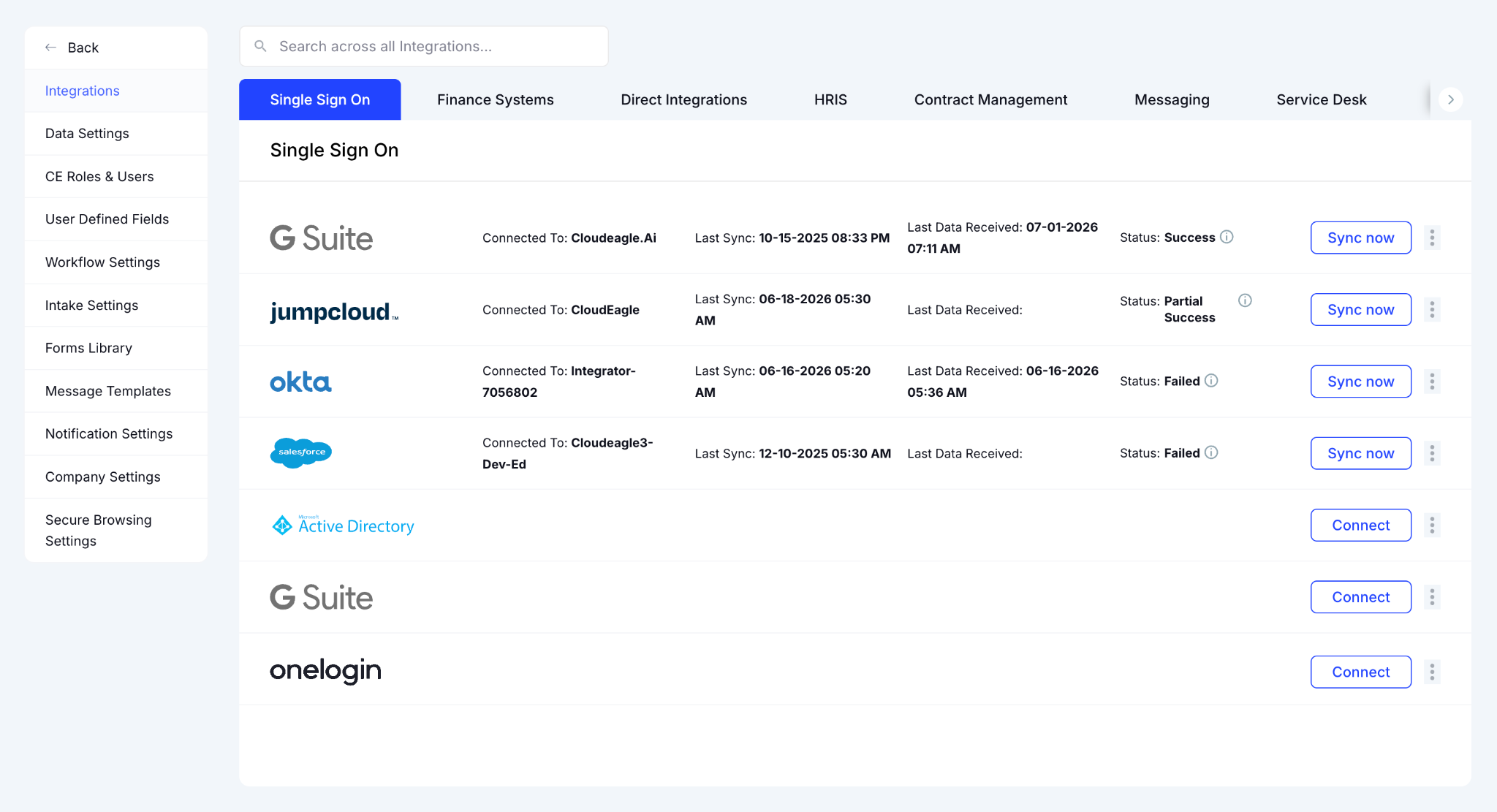
In CloudEagle's multi-tenant dashboard, you can toggle between a business-unit-level view and a consolidated view across all entities, seeing each unit's application inventory, identity coverage, and risk posture independently or combined.

B. Five-Source Discovery: Finding What SSO Doesn't Reach

CloudEagle scans SSO logs, finance data, browser activity, and app integrations to uncover every tool employees use, even ones purchased with personal cards or free trials. The five sources are:

  • IdP and SSO logs: What's already federated across each business unit
  • Finance and expense systems: Subscriptions purchased on corporate cards that never went through IT
  • Browser plugin: Tools accessed via browser regardless of how the account was created
  • CASB integration (Zscaler and Netskope): Network-level visibility for API-based access
  • Social sign-ins: Accounts created with a work email through OAuth flows that bypass SSO

In CloudEagle's discovery source coverage map, you can see which sources are contributing application data per business unit and where gaps exist.

C. Shadow IT and Shadow AI Detection: Surface What Was Never Sanctioned

CloudEagle identifies tools employees adopt independently including free trials and card-based purchases. It surfaces which apps overlap with approved tools so IT can act while alternatives are still viable. 
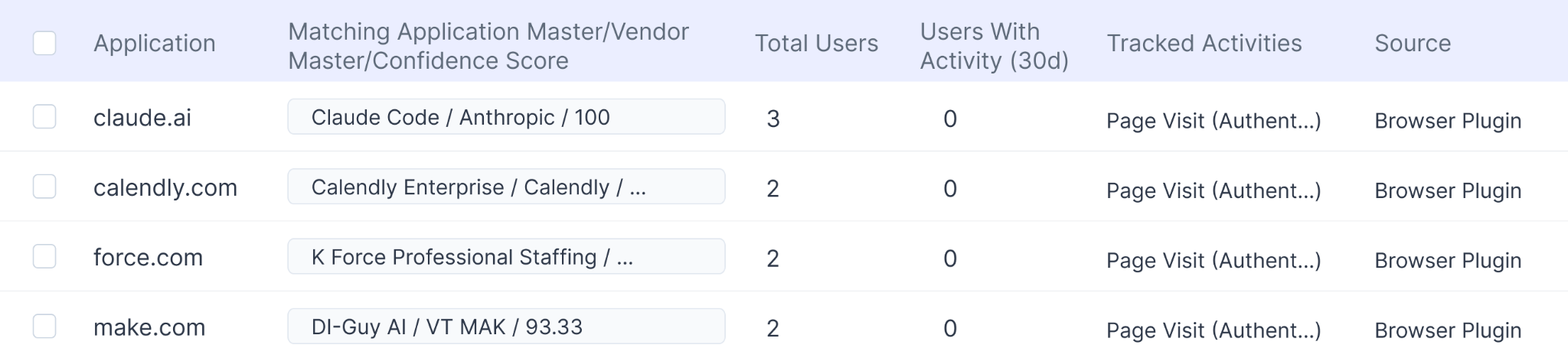
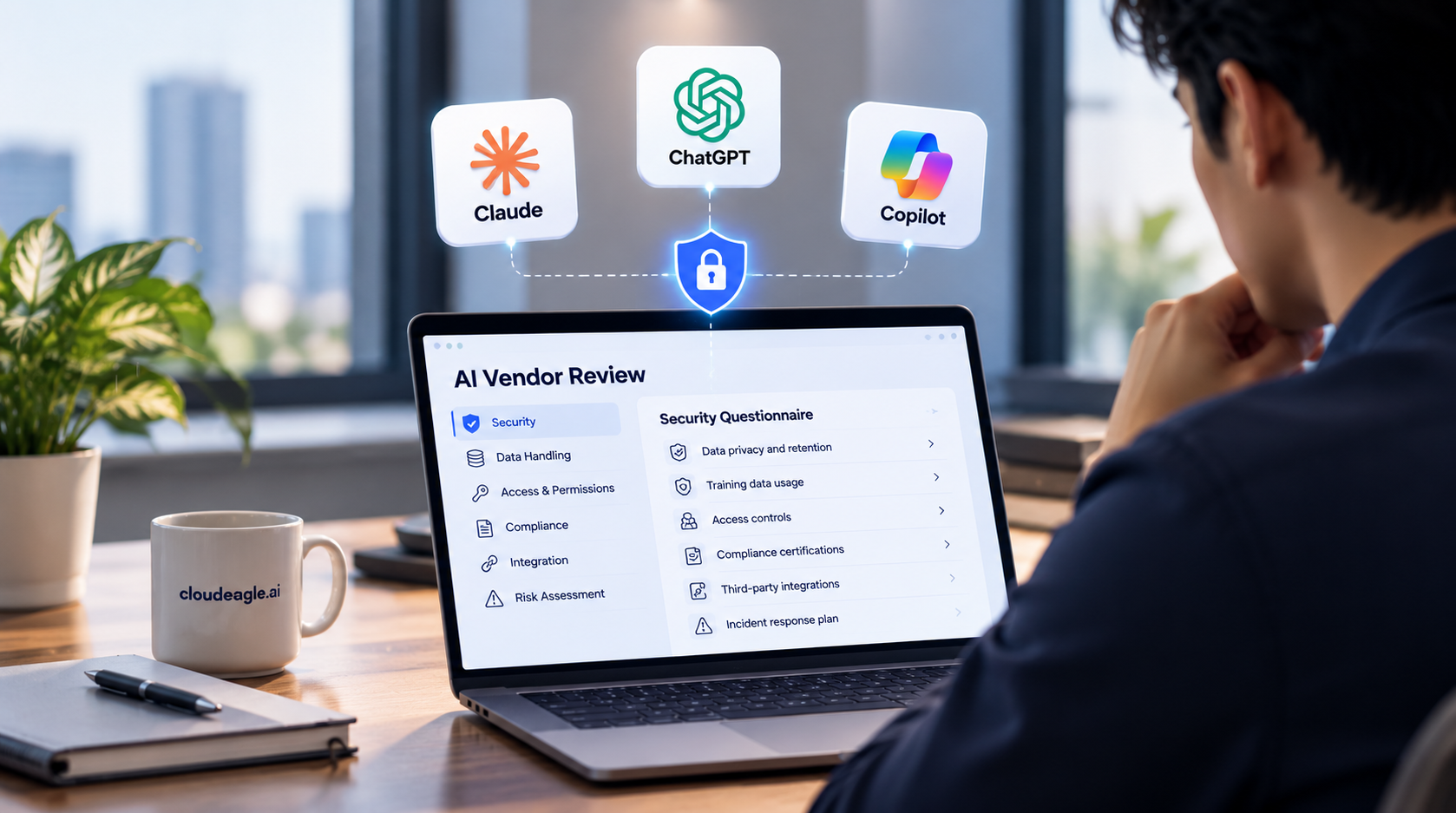
This includes shadow AI specifically. CloudEagle detects AI capabilities hidden within SaaS applications, not just standalone AI tools, and identifies free trials and personal AI accounts used for work purposes before they create security gaps. 
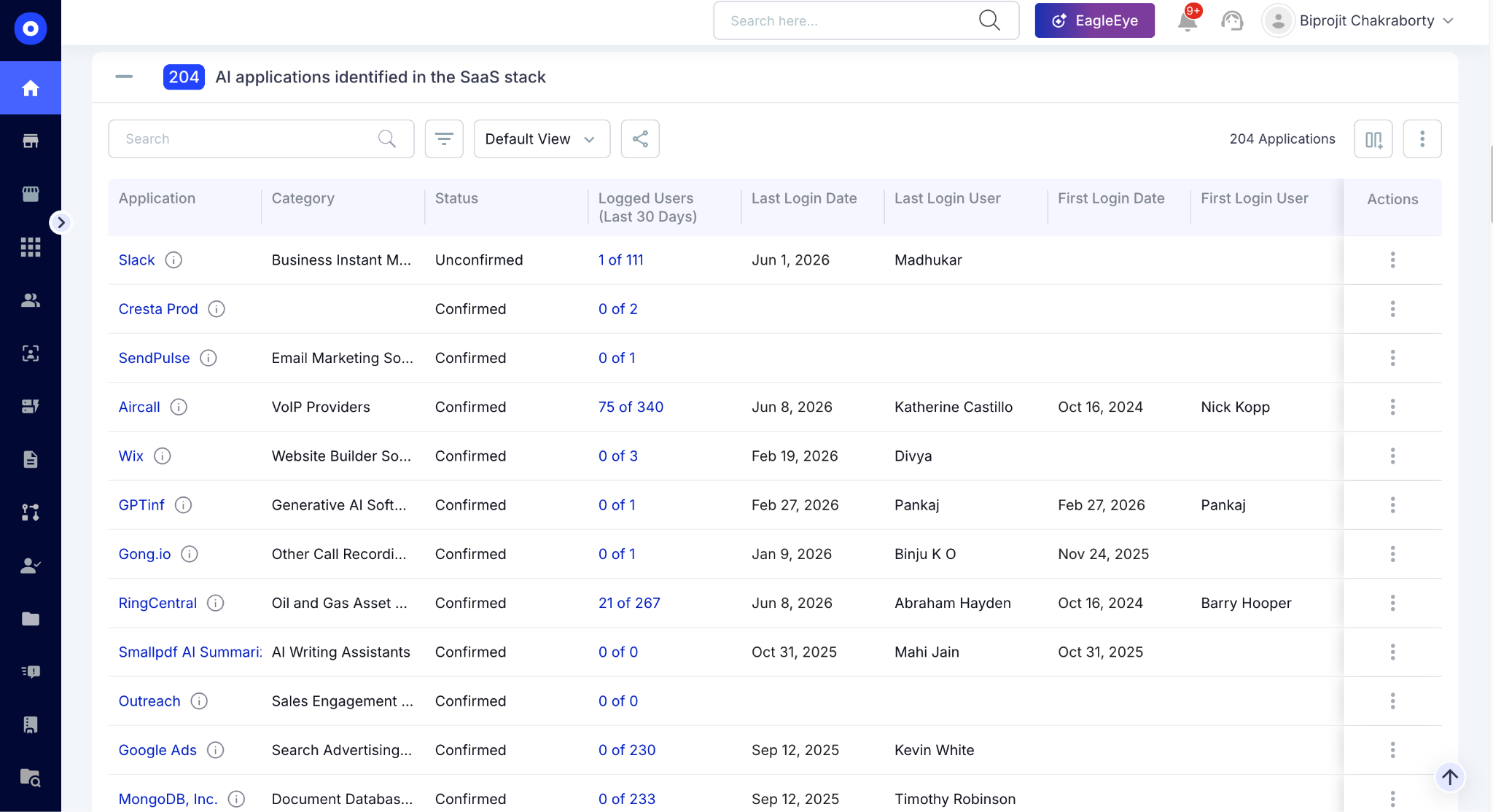
The shadow IT detection output answers the question Zach's team was asking: not just "what tools exist", but "which of those tools does nobody in central IT know about."

D. Application Classification with Netskope Risk Scoring: Prioritize What Needs Attention

The CloudEagle and Netskope integration enables IT and security teams to gain deeper SaaS insights beyond logins, prevent shadow IT, and remediate security risks instantly from a single platform. 
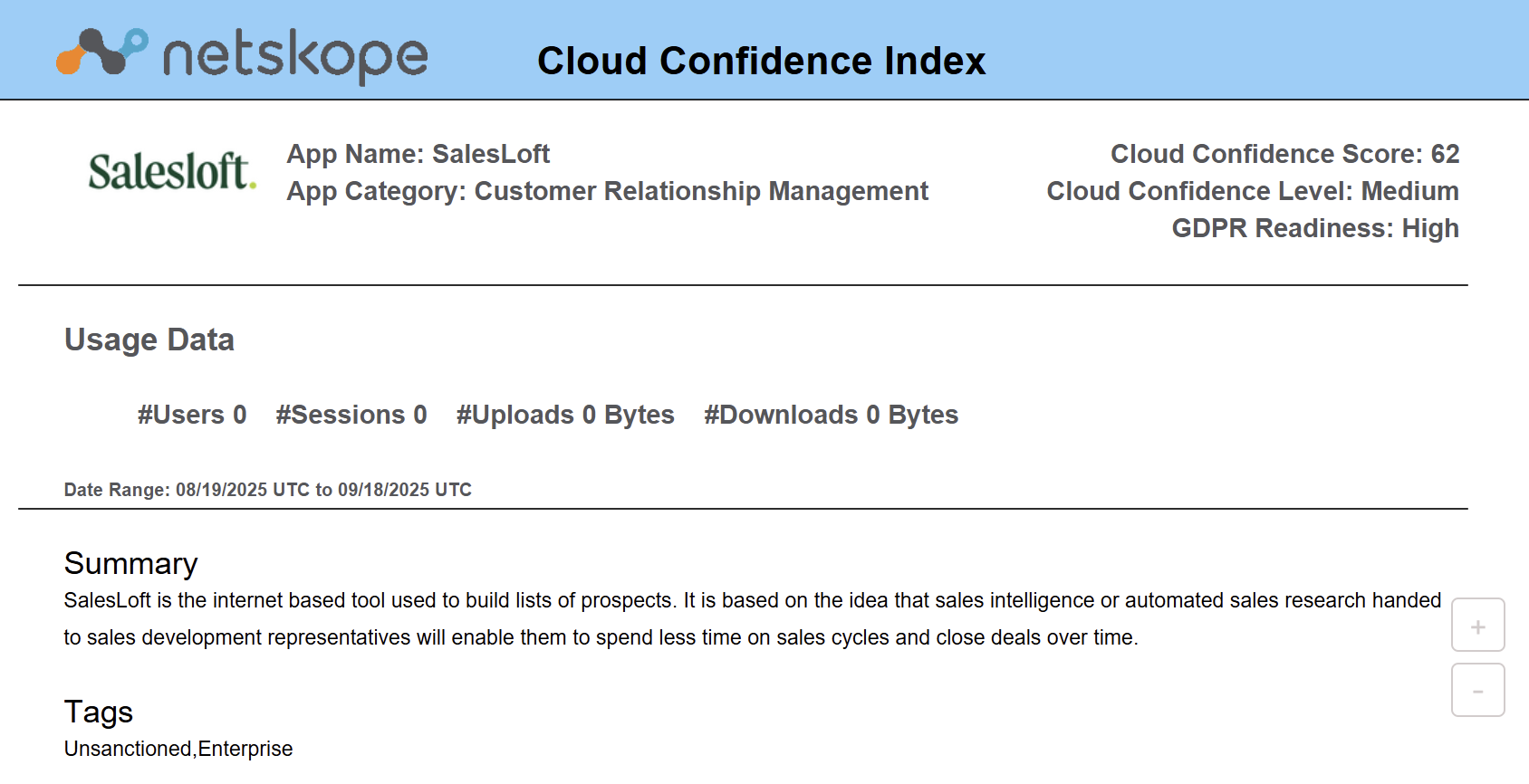
Every discovered application is automatically classified by business function, MFA support, SSO support, data residency, and security posture,  scored across a 50,000+ application database. 
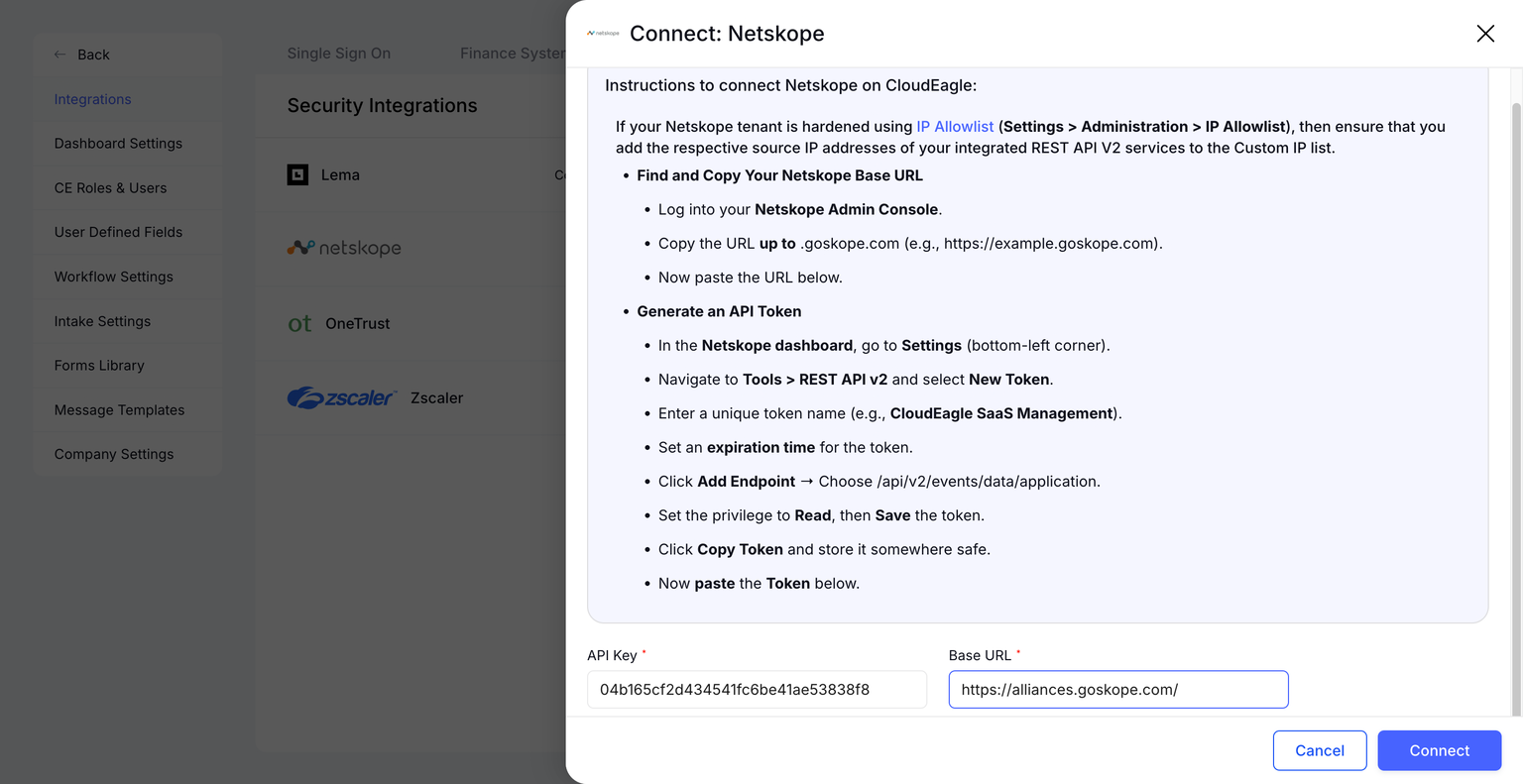
Every tool appears with its risk score, certification status, and MFA and SSO support, so security teams prioritize which applications need attention without manually researching each one.

3. What "Good Visibility" Looks Like When There's No Unifying SSO

Good visibility doesn't require every business unit to use the same identity provider or procurement process. It requires a discovery strategy that works with the infrastructure you already have.

A. Start With What's Already in Production

You don't need every business unit fully onboarded before you begin.

  • Connect the identity and network tools already in production.
  • Even a partial CASB rollout can surface meaningful application data.
  • Expand coverage over time as additional business units come online.

Waiting for every entity to standardize on one IdP usually means waiting indefinitely.

B. Don't Conflate Visibility With Sanctioning

The first goal is to understand what's being used, not to decide whether it's approved.

  • Build a complete application inventory first.
  • Identify gaps and overlaps.
  • Discuss sanctioned versus unsanctioned tools after the data exists.

That approach is often easier for business units to support because it feels like discovery rather than an audit.

C. Visibility Doesn't Require a Financial Mandate

Many organizations assume they need finance data before they can start. They don't.

  • CASB and IdP data can already identify applications and their users.
  • Security and governance teams gain immediate visibility without waiting for procurement or finance integrations.
  • Spend optimization can come later using the same discovery foundation.

Good visibility starts with knowing what's there. Cost optimization becomes much easier once that foundation is in place.

Every New App Changes Your Attack Surface

Instantly.
Stay Protected

4. Conclusion

Decentralized software purchasing isn't the problem. The lack of visibility is.

When every business unit manages its own applications, the first priority isn't consolidating vendors or cutting costs. It's building a complete inventory of what's actually in use.

Once you have that visibility, governance, risk management, and spend optimization become much easier. Without it, every decision is based on incomplete information.

You can't govern what you can't see, and in a multi-business-unit organization, seeing everything is the first step.

Advertisement for a SaaS Subscription Tracking Template with a call-to-action button to download and a partial graphic of a tablet showing charts.Banner promoting a SaaS Agreement Checklist to streamline SaaS management and avoid budget waste with a call-to-action button labeled Download checklist.Blue banner with text 'The Ultimate Employee Offboarding Checklist!' and a black button labeled 'Download checklist' alongside partial views of checklist documents from cloudeagle.ai.Digital ad for download checklist titled 'The Ultimate Checklist for IT Leaders to Optimize SaaS Operations' by cloudeagle.ai, showing checklist pages.Slack Buyer's Guide offer with text 'Unlock insider insights to get the best deal on Slack!' and a button labeled 'Get Your Copy', accompanied by a preview of the guide featuring Slack's logo.Monday Pricing Guide by cloudeagle.ai offering exclusive pricing secrets to maximize investment with a call-to-action button labeled Get Your Copy and an image of the guide's cover.Blue banner for Canva Pricing Guide by cloudeagle.ai offering a guide to Canva costs, features, and alternatives with a call-to-action button saying Get Your Copy.Blue banner with white text reading 'Little-Known Negotiation Hacks to Get the Best Deal on Slack' and a white button labeled 'Get Your Copy'.Blue banner with text 'Little-Known Negotiation Hacks to Get the Best Deal on Monday.com' and a white button labeled 'Get Your Copy'.Blue banner with text 'Little-Known Negotiation Hacks to Get the Best Deal on Canva' and a white button labeled 'Get Your Copy'.Banner with text 'Slack Buyer's Guide' and a 'Download Now' button next to images of a guide titled 'Slack Buyer’s Guide: Features, Pricing & Best Practices'.Digital cover of Monday Pricing Guide with a button labeled Get Your Copy on a blue background.Canva Pricing Guide cover with a button labeled Get Your Copy on a blue gradient background.

Enter your email to
unlock the report

Oops! Something went wrong while submitting the form.
License Count
Benchmark
Per User/Per Year

Enter your email to
unlock the report

Oops! Something went wrong while submitting the form.
License Count
Benchmark
Per User/Per Year

Enter your email to
unlock the report

Oops! Something went wrong while submitting the form.
Notion Plus
License Count
Benchmark
Per User/Per Year
100-500
$67.20 - $78.72
500-1000
$59.52 - $72.00
1000+
$51.84 - $57.60
Canva Pro
License Count
Benchmark
Per User/Per Year
100-500
$74.33-$88.71
500-1000
$64.74-$80.32
1000+
$55.14-$62.34

Enter your email to
unlock the report

Oops! Something went wrong while submitting the form.

Enter your email to
unlock the report

Oops! Something went wrong while submitting the form.
Zoom Business
License Count
Benchmark
Per User/Per Year
100-500
$216.00 - $264.00
500-1000
$180.00 - $216.00
1000+
$156.00 - $180.00

Enter your email to
unlock the report

Oops! Something went wrong while submitting the form.

Get the Right Security Platform To Secure Your Cloud Infrastructure

Please enter a business email
Thank you!
The 2023 SaaS report has been sent to your email. Check your promotional or spam folder.
Oops! Something went wrong while submitting the form.

Access full report

Please enter a business email
Thank you!
The 2023 SaaS report has been sent to your email. Check your promotional or spam folder.
Oops! Something went wrong while submitting the form.

Your organization probably isn't one IT environment anymore. It's five, seven, or more business units, each with its own tech stack, its own purchasing habits, and in many cases its own identity provider.

Teams adopt tools independently. There often isn't a centralized procurement process that spans every business.

The visibility gap is manageable until it isn't. It becomes urgent the moment someone from security, finance, or audit asks "what software does this business unit actually use?"

Solving it isn't about forcing centralized procurement. It's about building a discovery layer that works across fragmented environments, multiple SSOs, multiple finance systems, and different levels of IT maturity.

CloudEagle.ai pulls application and identity data across every connected source into a single consolidated view, regardless of how fragmented the underlying infrastructure is. In this article, we'll show you how.

TL;DR

  • Decentralized business units create SaaS blind spots because applications, identities, and purchasing are managed independently.
  • Fragmented SSO, finance systems, and procurement processes make it difficult to build a complete software inventory.
  • CloudEagle.ai consolidates application and identity data across multiple discovery sources into a unified visibility layer.
  • Shadow IT, shadow AI, and application risk scoring help security teams prioritize governance across every business unit.
  • CloudEagle.ai gives enterprises a centralized view of fragmented SaaS environments, enabling stronger governance, security, and spend optimization.

1. Why Decentralized Business Units Create a Structural Visibility Gap

The biggest challenge isn't that business units buy their own software. It's that no single team sees everything they've bought.

In many organizations, a central IT, security, or finance team supports multiple semi-independent business units. Some use a corporate Microsoft Entra tenant. Others rely on Google Workspace.

As one IT leader managing visibility across seven independently operated businesses described it: 

"There is a whole landscape of tools out there like Shopify, subscription management, productivity tools, etc. We are really trying to get an overall holistic view of all of the tools in use across these independently operated businesses."

That holistic view rarely exists. Here's why:

  • Every Business Unit Has Its Own Tech Stack: Different teams adopt different tools based on their operational needs without central IT or security visibility.
  • Identity Is Fragmented: Some applications are federated through SSO, while others use standalone credentials that were never centralized.
  • Visibility Stops at Organizational Boundaries: What one business unit can see rarely extends to another. So a shared vendor, a duplicate tool, or a risky application can exist across multiple entities.
  • The Numbers Add Up Fast: When each business manages 150 to 250 applications, a seven-business-unit organization can easily be running more than 1,000 SaaS applications.

Most of those applications were never federated through a corporate identity provider. Employees bookmarked the application and logged in with credentials created directly with the service provider.

You don't have one shadow AI problem. You have one per business unit and none of them are visible from the center.

Shadow AI Starts With One Signup

Then it spreads.
Expose It

2. How CloudEagle.ai Builds One Visibility Layer Across Fragmented Business Units

CloudEagle.ai doesn't require every business unit to share an identity provider, use the same finance system, or reach a minimum level of IT maturity before visibility becomes possible.

It meets the environment where it is, pulling application and identity data from every available source and consolidating it into a single view regardless of how fragmented the underlying infrastructure is.

A. Multi-SSO Consolidation: One View Across Every Identity Provider

CloudEagle connects to JumpCloud, Okta, Entra, and Google Workspace simultaneously. 

It consolidates every identity and application signal into a single centralized view without requiring infrastructure changes at each business unit.

In CloudEagle's multi-tenant dashboard, you can toggle between a business-unit-level view and a consolidated view across all entities, seeing each unit's application inventory, identity coverage, and risk posture independently or combined.

B. Five-Source Discovery: Finding What SSO Doesn't Reach

CloudEagle scans SSO logs, finance data, browser activity, and app integrations to uncover every tool employees use, even ones purchased with personal cards or free trials. The five sources are:

  • IdP and SSO logs: What's already federated across each business unit
  • Finance and expense systems: Subscriptions purchased on corporate cards that never went through IT
  • Browser plugin: Tools accessed via browser regardless of how the account was created
  • CASB integration (Zscaler and Netskope): Network-level visibility for API-based access
  • Social sign-ins: Accounts created with a work email through OAuth flows that bypass SSO

In CloudEagle's discovery source coverage map, you can see which sources are contributing application data per business unit and where gaps exist.

C. Shadow IT and Shadow AI Detection: Surface What Was Never Sanctioned

CloudEagle identifies tools employees adopt independently including free trials and card-based purchases. It surfaces which apps overlap with approved tools so IT can act while alternatives are still viable. 

This includes shadow AI specifically. CloudEagle detects AI capabilities hidden within SaaS applications, not just standalone AI tools, and identifies free trials and personal AI accounts used for work purposes before they create security gaps. 

The shadow IT detection output answers the question Zach's team was asking: not just "what tools exist", but "which of those tools does nobody in central IT know about."

D. Application Classification with Netskope Risk Scoring: Prioritize What Needs Attention

The CloudEagle and Netskope integration enables IT and security teams to gain deeper SaaS insights beyond logins, prevent shadow IT, and remediate security risks instantly from a single platform. 

Every discovered application is automatically classified by business function, MFA support, SSO support, data residency, and security posture,  scored across a 50,000+ application database. 

Every tool appears with its risk score, certification status, and MFA and SSO support, so security teams prioritize which applications need attention without manually researching each one.

3. What "Good Visibility" Looks Like When There's No Unifying SSO

Good visibility doesn't require every business unit to use the same identity provider or procurement process. It requires a discovery strategy that works with the infrastructure you already have.

A. Start With What's Already in Production

You don't need every business unit fully onboarded before you begin.

  • Connect the identity and network tools already in production.
  • Even a partial CASB rollout can surface meaningful application data.
  • Expand coverage over time as additional business units come online.

Waiting for every entity to standardize on one IdP usually means waiting indefinitely.

B. Don't Conflate Visibility With Sanctioning

The first goal is to understand what's being used, not to decide whether it's approved.

  • Build a complete application inventory first.
  • Identify gaps and overlaps.
  • Discuss sanctioned versus unsanctioned tools after the data exists.

That approach is often easier for business units to support because it feels like discovery rather than an audit.

C. Visibility Doesn't Require a Financial Mandate

Many organizations assume they need finance data before they can start. They don't.

  • CASB and IdP data can already identify applications and their users.
  • Security and governance teams gain immediate visibility without waiting for procurement or finance integrations.
  • Spend optimization can come later using the same discovery foundation.

Good visibility starts with knowing what's there. Cost optimization becomes much easier once that foundation is in place.

Every New App Changes Your Attack Surface

Instantly.
Stay Protected

4. Conclusion

Decentralized software purchasing isn't the problem. The lack of visibility is.

When every business unit manages its own applications, the first priority isn't consolidating vendors or cutting costs. It's building a complete inventory of what's actually in use.

Once you have that visibility, governance, risk management, and spend optimization become much easier. Without it, every decision is based on incomplete information.

You can't govern what you can't see, and in a multi-business-unit organization, seeing everything is the first step.

CloudEagle.ai recognized in the 2025 Gartner® Magic Quadrant™ for SaaS Management Platforms
Download now
gartner chart
5x
Faster employee
onboarding
80%
Reduction in time for
user access reviews
30k
Workflows
automated
$15Bn
Analyzed in
contract spend
$2Bn
Saved in
SaaS spend

Streamline SaaS governance and save 10-30%

Book a Demo with Expert
CTA image