.avif)
%201.svg)


HIPAA Compliance Checklist for 2025

AI tools don't wait for procurement approval. They show up the same way Dropbox did a decade ago: an employee signs in on a work device, for two minutes, and no ticket is filed or reviewed. Except now it's Claude, Perplexity, and Gemini, and what's going on isn't just files. It's customer data, internal strategy docs, code, and anything else someone needed help with at 2 pm on a Tuesday.
By the time IT sees the access event – if they ever do – the tool has been running for months. The sensitive data is already in a vendor's system that nobody approved, under terms nobody reviewed. The compliance gap didn't open recently. It's been open.
That's the problem CloudEagle.ai's new AI Governance capability is built to close. It provides continuous visibility into every AI tool in use, real-time enforcement at the point of access, GenAI risk scoring for every vendor, and full token and spend visibility in one place, from day one.
Read more about the feature here: CloudEagle.ai Launches AI Governance to Help Enterprises Discover Shadow AI, Enforce Usage Policies, and Stop AI Risk
The Visibility Gap That's Already Costing You
Most enterprises already have a shadow AI problem. They just don't know the shape of it yet.
A Gartner survey of 302 cybersecurity leaders found that 69% of organizations suspect or have confirmed that employees are using prohibited public GenAI: IP loss and data exposure are the risks they keep naming. A separate Gartner survey puts 57% of employees on personal GenAI accounts for work, with a third admitting they've fed sensitive data into tools their organization never sanctioned.
That's the baseline.
Every time an employee signs into an AI tool outside IT's approved list, three things happen with no record: sensitive data enters a vendor's system, a license goes untracked, and an access event goes unlogged. One employee, one afternoon. Now scale it.
The hard part is not that enterprises don’t want to govern AI. It is that the SaaS governance tools weren't built to see what AI tools are doing: who's using them, what's going on, or whether anyone approved them in the first place.

What AI Governance Unlocks for Security, IT, and Finance
CloudEagle.ai's AI Governance capability extends the same continuous lifecycle management enterprises already use for SaaS into the AI layer, and goes further to address the risks that are specific to AI: token-based billing, training data exposure, non-human identities, and MCP-connected agent workflows.
With AI Governance in place, security, IT, and finance teams can now do what they could not before:
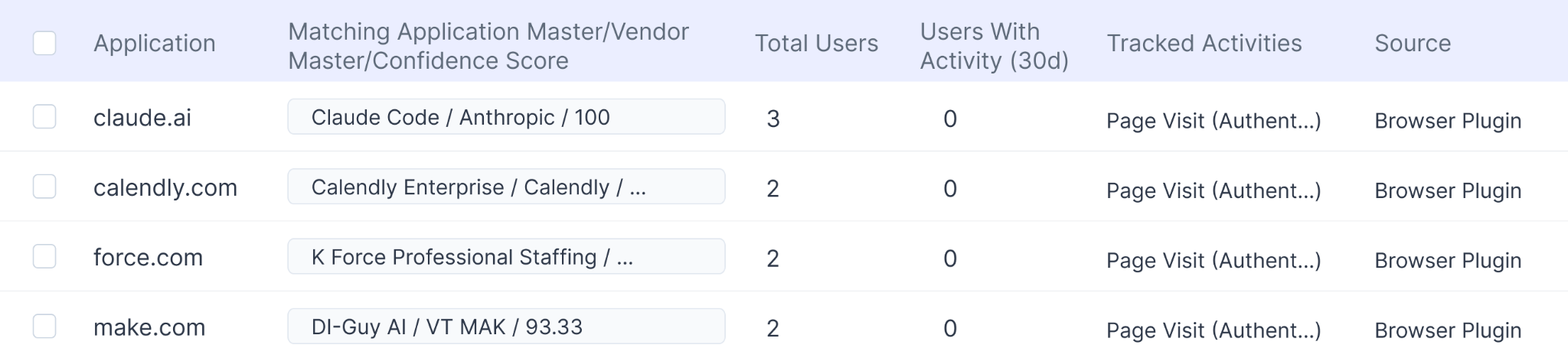
a) Shadow AI discovery
Every AI tool in use across the organization is identified the moment adoption begins, including the ones that never touch a procurement workflow.
b) GenAI risk scoring
Every AI vendor in the portfolio carries a risk score: does the vendor train on customer data, can AI features be disabled at the enterprise level, and does the tool hold required security certifications?
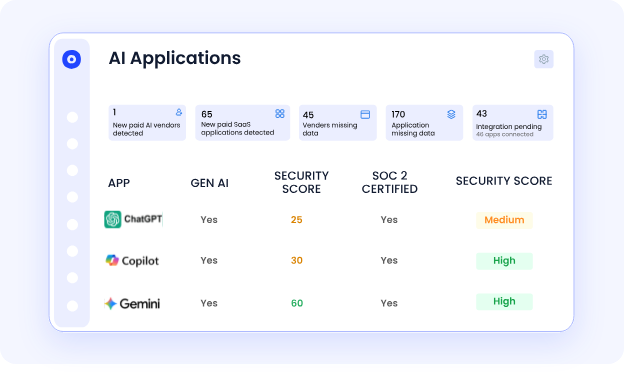
Security teams make approval decisions based on structured risk data. What previously required days of manual research is now available the moment a tool appears in the environment.
c) Token consumption and usage tracking
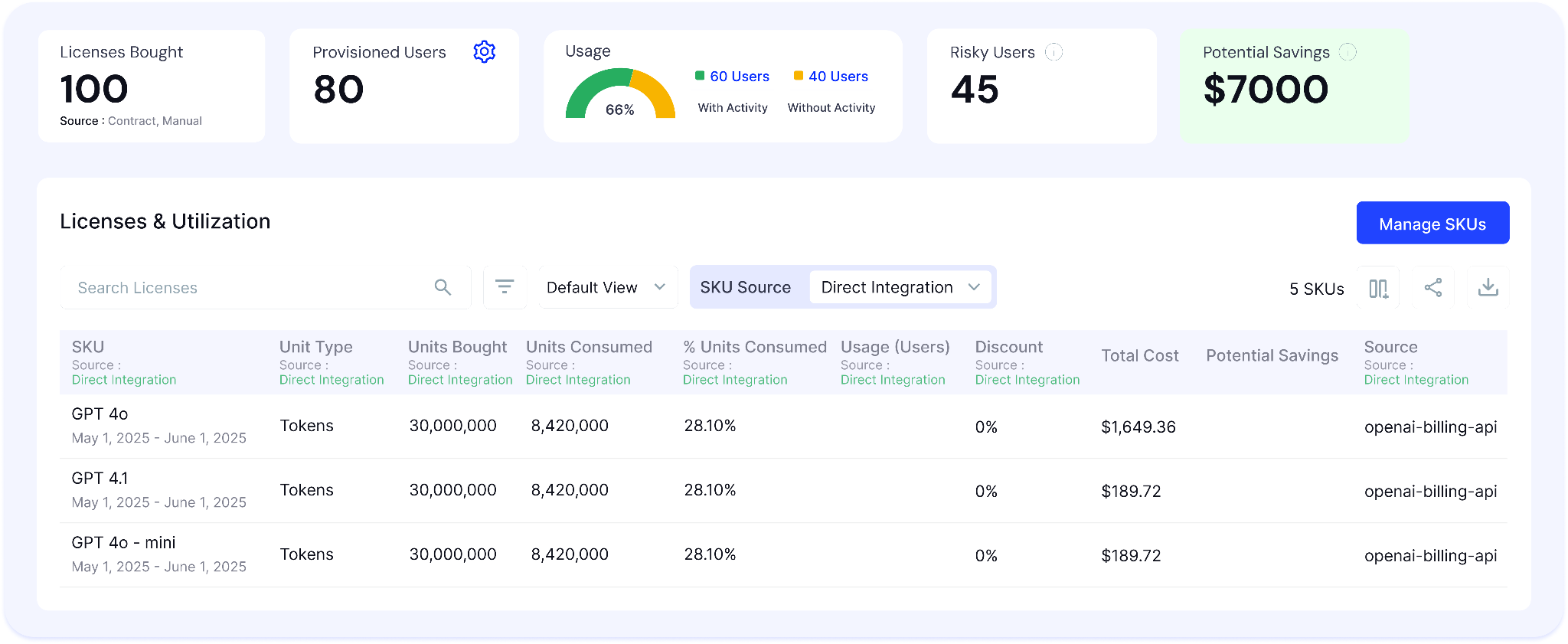
AI spend is unlike any other software cost. It scales with usage in ways a contract never captures. CloudEagle.ai gives Finance and IT visibility into which models are being consumed, by which teams, and at what rate, so the bill at the end of the month is never a surprise.
d) MCP server governance
As third-party MCP servers connect to enterprise data and AI agents proliferate across workflows, most organizations have no visibility into which servers are active, who authorized them, or what they can access.
CloudEagle.ai surfaces every external MCP server in the environment, its ownership, permissions, and connected agent workflows, so teams can govern what is running before it becomes an unaudited data pipeline.
e) Real-time usage enforcement
When an employee accesses an unapproved AI tool, a policy-based flash page intercepts the session, communicates the organization's AI policy, and redirects to the approved alternative. Governance happens at the point of behavior.
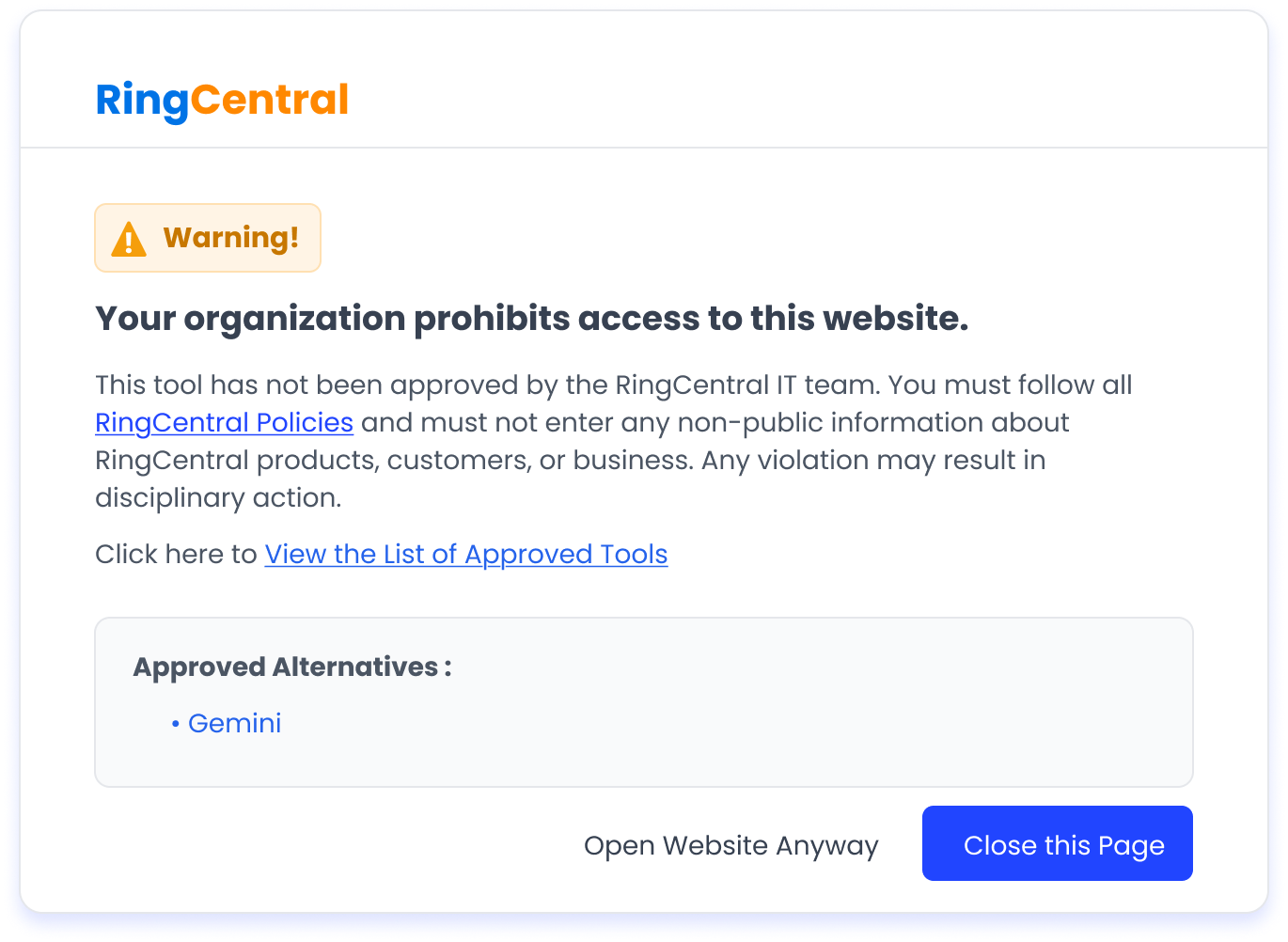
Security teams are not reviewing access logs after the fact. They are stopping the exposure before it begins.
f) Secure browser controls
Sensitive data shared with AI tools is monitored and blocked at the browser layer before it leaves the organization. The data exposure risk that makes shadow AI governance urgent is contained at the source.
g) Audit-ready access logs
Every AI access event is captured automatically. Compliance teams do not scramble for evidence at review time. The trail exists before anyone asks for it.
h) AI spend and license visibility
Duplicate tools, underutilized licenses, and upcoming renewals are visible in one place. Procurement decisions are based on what teams actually use, not what was purchased.
"AI spend is unlike any other software cost; it scales with usage in ways a contract never captures. CloudEagle.ai gives enterprises visibility into token consumption, license utilization, and shadow AI in one place, so the bill at the end of the month is never a surprise," said Nidhi Jain, CEO and Founder of CloudEagle.ai.
Your AI Governance Gap Is Already Open. This Closes It.


The Cost of Building Governance After the Fact
The enterprises that establish AI Governance programs while adoption is still manageable will be in a fundamentally different position than those attempting to retrofit controls after AI is embedded in every workflow.
That is what boards and regulators are already asking direct questions about AI oversight: which tools are approved, what data is being shared, and what controls are in place.
The organizations that can answer those questions confidently today are the ones that built governance before the pressure arrived.
"We didn't always know what data was being fed into these tools or how teams were actually using them, and that's a hard gap to close once it's wide open. CloudEagle.ai gives us visibility into both the data going in and the usage patterns behind it, so we can support adoption without losing sight of what's happening underneath," said Edward Hausauer, Technology Operations Manager, Pioneer Schools.
CloudEagle.ai's AI Governance is available to all customers today.
If you are assessing the broader shadow AI risk landscape before building your governance program, this is a useful starting point: The Shadow AI Governance Gap: Why 63% of Enterprises Have No Shadow AI Policy
See AI Governance in action: Discover every AI tool in use, enforce policy in real time, and bring AI spend under control from day one. Book a demo
The Window to Govern AI Before It Governs You Is Closing.


.avif)


.avif)
.avif)




.png)




.avif)
.avif)
.avif)


