
%201.svg)


HIPAA Compliance Checklist for 2025

Only 12% of enterprises have mature AI governance processes in place, even as agentic AI deployment moves into production at scale across most large organizations.
That number tells you everything about where we are right now. AI adoption is moving at one speed. Governance is moving at another. And the gap between them is where the biggest enterprise risks in 2026 actually live.
This is not a prediction post. These are documented AI governance trends already reshaping how CISOs operate, with the data behind each one and what leading teams are actually doing in response.
TL;DR
- Only 25% of organizations report comprehensive visibility into how employees are using AI, making shadow AI the defining governance challenge of 2026
- Agentic AI is moving from pilot to production faster than governance frameworks can adapt, with active agents in the Microsoft 365 ecosystem growing 15x year over year
- The EU AI Act's enforcement deadline hit August 2026, and 78% of enterprises were unprepared for their obligations
- The CISO role is evolving from security gatekeeper to AI governance owner, with accountability now sitting at the executive level
- The AI governance trends CISOs are getting wrong: treating governance as a policy exercise instead of a technical enforcement program
1. How AI Governance Trends Are Reshaping the CISO Role in 2026
Three years ago, AI governance was a Legal and Compliance conversation. Today it lands on the CISO's desk.
In a typical enterprise, the CISO is responsible for AI-related security risks. That shift happened fast, and it happened because the risks that AI introduces, shadow tool adoption, data exposure through prompts, agentic systems acting without oversight, are fundamentally security problems, not just policy problems.
77% of businesses reported an AI-related security incident in 2024, costing enterprises an average of $4.88 million per breach. By 2026, that number is not getting smaller. It is getting more complex because the attack surface is not just your infrastructure anymore. It is every AI tool your employees have adopted, whether IT knows about them or not.
The CISO AI governance role now requires owning both the technical enforcement layer and the cross-functional accountability structure. That is a different job than it was two years ago.
2. 10 AI Governance Trends Every CISO Must Know
Trend 1: Agentic AI Is Moving to Production Without Governance Frameworks
Close to 75% of companies plan to deploy agentic AI within two years, but only 21% report mature agent governance. That gap is not closing fast.
AI agents are autonomous. They execute multi-step tasks without human intervention. They access data, trigger actions, and connect to external systems. And most of them are being deployed by product and engineering teams that have no governance framework for what they are building.
The average enterprise now manages 37 deployed agents. More than half of those agents run without any security oversight or logging.
What leading CISOs are doing:
- Building an agent inventory before deployment scales further
- Defining human oversight thresholds for any agent that touches sensitive data or production systems
- Applying least-privilege access controls to agent identities the same way they apply them to human users
- Requiring mandatory kill-switch and rollback capability before any agentic workflow goes to production
Trend 2: Shadow AI Is Now a Top-5 Breach Risk Factor
68% of employees use AI tools without IT approval, creating a shadow AI visibility gap that most security frameworks cannot address.
Shadow AI is not just a policy violation. Enterprises where 65% or more of AI tools operate without IT oversight face average data breach costs $670,000 higher than those with governed AI environments.
The problem is structural. Legacy DLP, CASB, and endpoint tools are structurally blind to AI-specific risk because they cannot understand conversational intent, inspect bidirectional AI traffic, or see activity in native apps and IDEs.
What leading CISOs are doing:
- Deploying multi-signal discovery across browser extensions, SSO, Zscaler, CrowdStrike, and finance data simultaneously
- Moving from periodic shadow AI audits to continuous real-time monitoring
- Building fast-track approval workflows so the sanctioned path is faster than the unsanctioned one
Trend 3: Regulatory Enforcement Has Shifted From Guidance to Penalties
The EU AI Act's enforcement deadline for high-risk AI systems arrived in August 2026. 78% of enterprises were unprepared for their obligations.
The back half of 2026 and into 2027 will see compressed timelines for control mapping, evidence generation, and regulatory disclosure. The Colorado AI Act, New York's Local Law 144, and state-level AI bills across the US are adding jurisdictional complexity that no single policy document covers.
What leading CISOs are doing:
- Mapping their AI tool inventory against EU AI Act risk classifications
- Treating ISO 42001 as the enterprise standard for AI management systems rather than building from scratch
- Building compliance evidence generation into the AI governance platform rather than assembling it manually before each audit
Trend 4: AI Usage Policies Exist But Are Not Being Enforced
Only 41% of employees report that their organization has a generative AI usage policy, and 44% have already violated it.
A policy document is not a control. This is the governance mistake most organizations are still making in 2026. The policy exists. Nobody enforces it at the point of behavior. Employees use the tools they want because the approved alternative is slower or harder to access.
What leading CISOs are doing:
- Moving enforcement to the browser layer with real-time redirect pages when employees attempt to access unapproved AI tools
- Connecting policy to access controls so unapproved tools are blocked or redirected before any data is submitted
- Measuring policy compliance through usage monitoring, not annual acknowledgment forms
Trend 5: Non-Human Identities Are the Fastest Growing Access Risk
Service accounts, API keys, OAuth grants, and AI agents now outnumber human users in most enterprise environments. And unlike human users, they almost never get reviewed during standard access certification campaigns.
Active agents in the Microsoft 365 ecosystem have grown 15x year over year, far outpacing the governance frameworks built for supervised AI tools. Every one of those agents has permissions. Most of those permissions were never formally reviewed.
What leading CISOs are doing:
- Including non-human identities in access review scope alongside human accounts
- Auditing OAuth grants quarterly for AI-category apps with broad read scopes on email and Drive
- Applying time-bound access controls to API keys the same way they apply them to temporary human access
📖 Worth a Read: 👉 Shadow AI in Financial Services: How Finance Teams Are Introducing Unseen Risk
Trend 6: Boards Are Demanding AI Governance Evidence
The CISO is no longer just explaining security incidents to the board. They are being asked to demonstrate AI governance maturity before incidents occur.
41% of organizations say AI is central to long-term business planning, and 72% of organizations expect GRC technology budgets to increase. That budget increase is coming with a demand for evidence, not assurances.
Boards want to see: which AI tools are in use, what data they can access, what controls are in place, and how the organization would know if something went wrong.
What leading CISOs are doing:
- Building quarterly AI governance dashboards for board reporting
- Implementing continuous audit logging for AI access events rather than assembling evidence retrospectively
- Presenting AI governance as a business enablement function, not just a compliance cost
Trend 7: ISO 42001 Is Emerging as the Enterprise AI Management Standard
ISO 42001, the AI management system standard, is rapidly becoming the framework enterprises use to structure their AI compliance trends response in the same way ISO 27001 structured their information security program.
It provides a structured approach to AI risk management that maps across NIST AI RMF, EU AI Act, and GDPR obligations simultaneously, reducing the compliance overhead of managing multiple frameworks independently.
What leading CISOs are doing:
- Using ISO 42001 as the organizing framework for their AI governance program
- Mapping existing controls against ISO 42001 requirements to identify gaps rather than starting from scratch
- Treating ISO 42001 certification as a board-level signal of AI governance maturity
Trend 8: AI Governance Is Consolidating Into Existing Platforms
The market for standalone AI governance tools is compressing. 72% of organizations expect GRC technology budgets to increase, but IT and Security teams are resisting adding yet another point tool to an already crowded stack.
The AI governance 2026 buying pattern is shifting toward platforms that embed AI governance into SaaS management, GRC, or identity governance tools rather than requiring a separate deployment.
What leading CISOs are doing:
- Evaluating AI governance as a capability within platforms they already use rather than procuring standalone AI governance tools
- Prioritizing platforms that cover discovery, enforcement, spend visibility, and compliance evidence in one place
Trend 9: Vendor AI Opacity Is a Growing Enterprise Risk
Your SaaS vendors added AI features mid-contract. You did not review the updated data processing terms. That data is now flowing to an AI sub-processor you never approved.
Enterprise AI procurement still lags behind employees' actual use of AI tools, often through personal accounts outside IT oversight. But the harder problem is the AI embedded in tools IT already approved.
What leading CISOs are doing:
- Adding AI feature disclosure requirements to vendor contracts
- Running quarterly reviews of AI feature changes across their approved SaaS stack
- Using risk scoring to continuously assess vendor AI posture rather than relying on annual security reviews
Trend 10: CISO-CFO Collaboration Is Increasing as AI Governance Meets SaaS Spend
AI governance used to be purely a security conversation. In 2026 it is also a Finance conversation.
Shadow AI costs organizations an average of $412,000 per year in direct losses. Add duplicate AI subscriptions, ungoverned token consumption, and AI tools auto-renewing without review, and the financial exposure compounds fast.
CISOs who are getting ahead of this are building joint AI governance programs with their CFO counterparts, connecting security controls to spend visibility in a way that makes governance a shared business priority rather than a security mandate.
What leading CISOs are doing:
- Building shared AI governance dashboards that serve both Security and Finance
- Tracking token consumption by team and business unit alongside security risk signals
- Including AI spend governance in renewal reviews so ungoverned AI contracts do not auto-renew

3. The AI Governance Trends CISOs Are Getting Wrong
These are the patterns that consistently show up in organizations that are behind on AI risk management trends, even when they believe they have a governance program in place.
- Treating AI governance as a policy exercise: A policy document is not enforcement. AI governance exists on paper but not in practice in many organizations, and risk accumulates in the gaps between teams. Policy without a technical enforcement layer is just documentation.
- Governing the models they built while ignoring embedded AI: Most governance programs focus on internally developed AI systems. The bigger risk in 2026 is the AI embedded in every SaaS tool you already bought. Salesforce, Microsoft 365, Slack, Notion, all of them have AI features that may be processing your data in ways your last security review did not cover.
- Relying on employee training as the primary shadow AI control: If the governed system is harder to access than the shadow alternative, policy alone will not change user behavior. Training tells employees what not to do. Technical controls at the point of behavior actually prevent it.
4. How to Prioritize AI Governance Trends for Your Organization
You do not need to address all ten trends simultaneously. Here is the sequence that gets you to meaningful coverage fastest:
5. How CloudEagle.ai Helps CISOs Stay Ahead of AI Governance Trends
Most CISO AI governance programs stall because the visibility layer is incomplete and the enforcement layer does not exist. Knowing which AI tools are in your environment is step one. Actually controlling what employees can do with them is step two. Most organizations are still on step one.
CloudEagle.ai is an AI-powered SaaS Management, AI Governance, and Identity Governance platform that acts as the control plane for enterprise AI, helping security teams close the gap between AI adoption speed and governance maturity.
Discover Shadow AI. Eliminate Excess Access. Reduce SaaS Risk.
"Once AI adoption accelerated across teams, visibility alone wasn't enough. We needed clear rules around who could use AI tools, under what conditions, and how those decisions were enforced and reviewed. CloudEagle helped us move from ad-hoc approvals to structured, defensible AI governance." - Aditya Khosla, CTO, Iterative Health
Shadow AI Discovery That Goes Beyond SSO
Your SSO sees the tools IT provisioned. CloudEagle sees everything else.
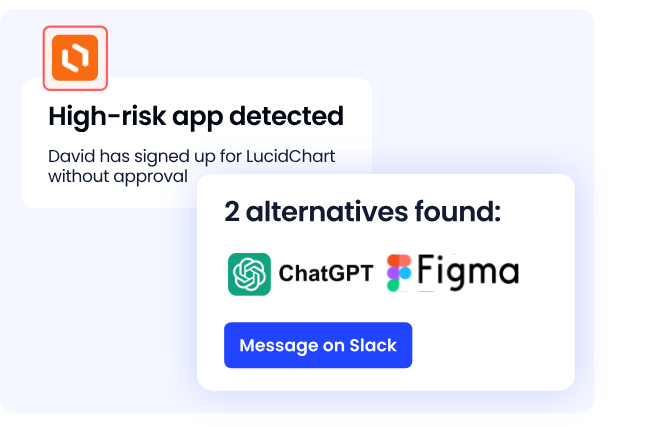
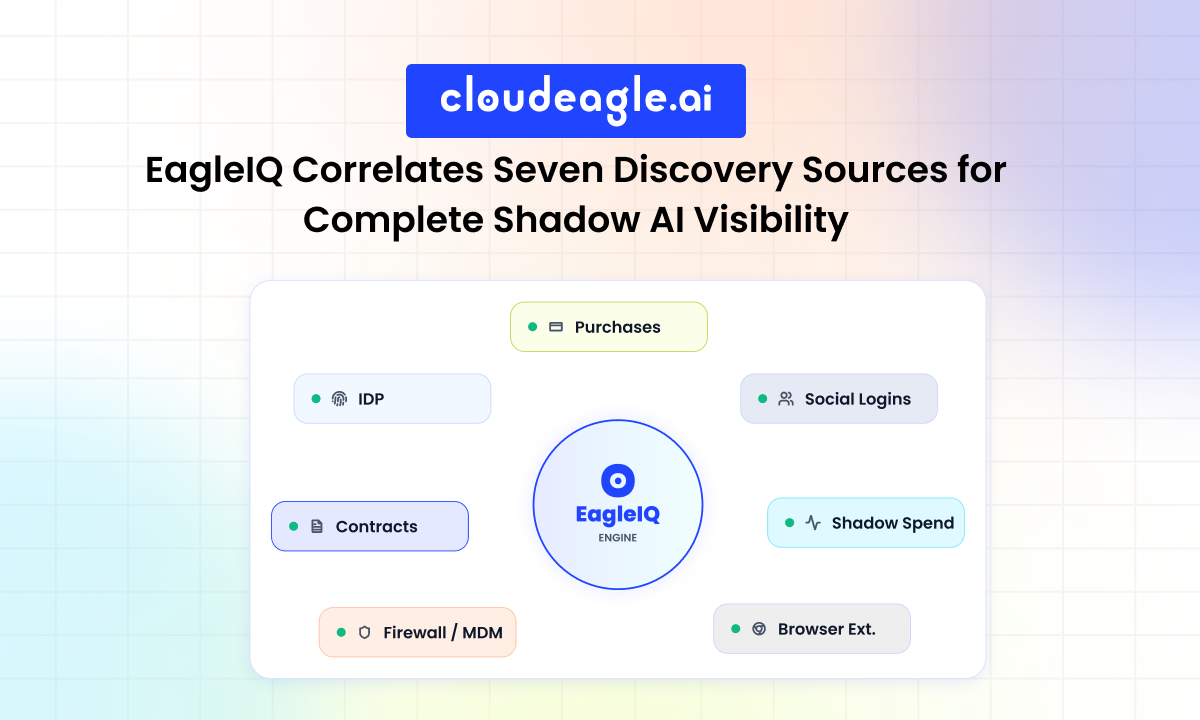
By correlating signals across browser extensions, SSO, Zscaler, CrowdStrike, CASB, and finance integrations simultaneously, CloudEagle surfaces every AI tool in use across your organization including personal accounts, free trials, and GenAI features activating silently inside approved SaaS products.
- Sanctioned and unsanctioned AI tools discovered across every signal source
- AI adoption visible by user, team, and department, not just a list of app names
- Traditional discovery covers 40 to 60% of unsanctioned AI tools. Multi-signal AI-aware discovery covers 95% or more
Real-Time Policy Enforcement at the Point of Behavior
When an employee tries to access an unapproved AI tool, CloudEagle steps in before any company data is entered. A lightweight browser extension redirects them to the approved alternative in real time.
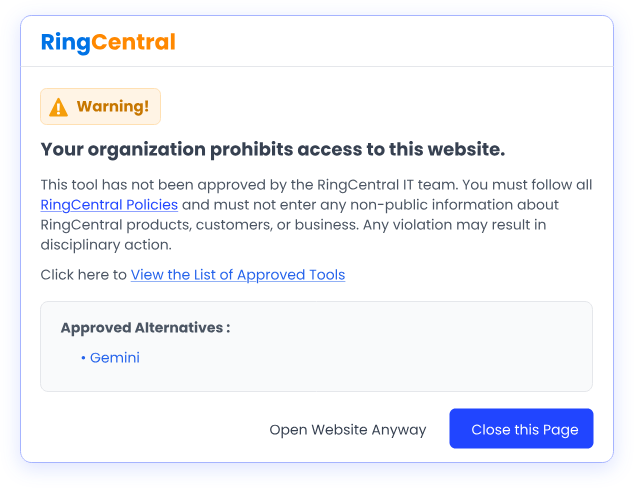
- No separate DLP or endpoint agent required
- Policy enforced at the moment of access, not discovered in a quarterly audit
- Sensitive data prevented from entering unapproved AI tools before the prompt is submitted
AI Vendor Risk Scoring Powered by Netskope
Every AI tool and GenAI feature in your stack gets an automatically assigned risk score based on data residency, training data use, model lineage, and security posture.
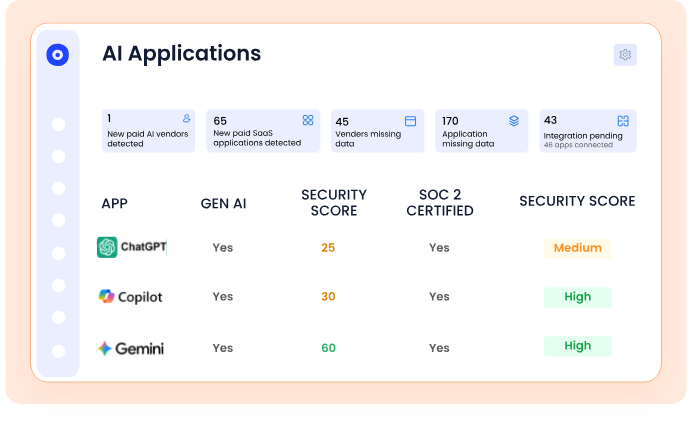
- Instantly see which AI tools are high-risk and exactly why
- GenAI features embedded inside approved SaaS products identified and scored
- Continuous monitoring so risk scores update as vendor posture changes, not just at annual review
Token-Level AI Spend Visibility
AI tools bill by token and API call, not by seat. Most enterprises have no visibility into where that consumption is going until the invoice arrives.
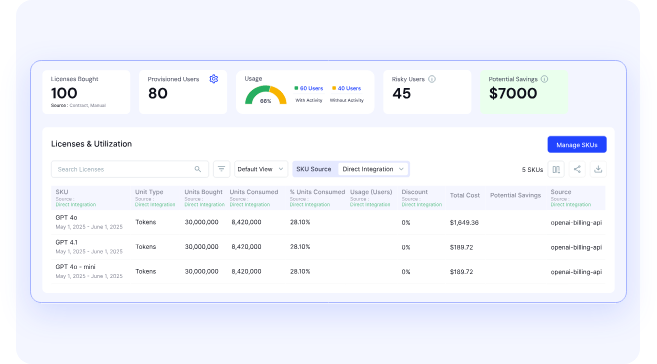
- Real-time token consumption tracked per user, per team, per tool
- Duplicate AI subscriptions and unused seats surfaced for harvesting before the next billing cycle
- AI costs allocated back to the teams generating them so Finance has the breakdown it needs
With 500+ direct integrations and $20B+ in SaaS spend managed across its customer base, CloudEagle delivers the AI governance coverage that addresses the trends on this list, not just the ones that are easiest to check off.
Still Discovering Shadow AI Through Incident Reports?


For context on how AI governance connects to broader enterprise risk programs, this conversation from practitioners who have built these programs across real organizations is worth your time.
🎙️ Podcast: How AI-Driven Innovation Meets Real-World Governance: A Blueprint for CIOs and CTOs. What enterprise AI governance looks like when innovation has to scale without creating audit debt. 👉 Listen now
Conclusion
The AI governance trends of 2026 all point to the same reality: AI adoption is moving faster than governance. Organizations that close that gap with visibility, enforcement, and automated evidence will be the ones that scale AI securely.
The CISOs leading this shift are treating AI compliance trends as an operational challenge, not a documentation exercise. That is what modern CISO AI governance looks like: continuous discovery, real-time controls, and audit-ready evidence by default.
CloudEagle.ai gives security teams the infrastructure to operationalize AI governance at scale, from shadow AI discovery to real-time enforcement, vendor risk scoring, and token-level spend visibility. Book a demo to see what your full AI footprint actually looks like.
Book a demo with CloudEagle.ai and see what your full AI footprint actually looks like.
Frequently Asked Questions
- What are the top AI governance trends in 2026?
The biggest AI governance trends in 2026 include agentic AI oversight, real-time AI monitoring, shadow AI discovery, automated compliance evidence, and stronger governance controls as enterprises scale AI across business functions. - Why are AI governance trends becoming more important?
AI governance trends are gaining importance as organizations adopt AI faster than they can manage its risks. New regulations, security concerns, and the rise of autonomous AI systems are pushing enterprises to invest in stronger controls. - What are the biggest AI compliance trends organizations should watch?
Key AI compliance trends include automated policy enforcement, continuous AI risk assessments, governance for agentic AI, vendor risk monitoring, and frameworks designed to meet evolving global AI regulations. - How are CISOs approaching AI governance in 2026?
CISO AI governance strategies focus on complete AI visibility, real-time enforcement, and automated audit evidence. Security leaders are prioritizing controls that reduce shadow AI risks while enabling safe AI adoption. - What are the biggest challenges in implementing AI governance?
The biggest challenges include discovering shadow AI, keeping pace with changing regulations, governing agentic AI systems, and proving compliance across a growing ecosystem of AI models, apps, and vendors.
Still Discovering Shadow AI Through Incident Reports?


.avif)


.avif)
.avif)




.png)





.png)
.avif)
.avif)
.avif)


