.avif)
%201.svg)


HIPAA Compliance Checklist for 2025

"Which AI tools are employees using, and what data are they submitting to them?"
If that question landed in your board deck today, how long would it take to produce a defensible answer? One CIO pulled his Palo Alto firewall logs to find out. His managed inventory listed around 40 tools. The logs showed 92 AI engines actively in use. None had passed a security review.
IBM's 2025 Cost of a Data Breach Report puts the cost of that gap at $670,000 per incident. Most organizations are still building the policy while the tools are already running.
TL;DR
- AI tools enter through browsers, personal accounts, and bundled features, not procurement channels. SSO and CASB do not catch them.
- Shadow AI adds $670,000 to the average breach cost and takes 247 days to detect.
- SOC 2 auditors and EU AI Act regulators are asking for access control evidence in 2026. A written policy does not satisfy either.
- The governance gaps that surface most often in practice: agent identity sprawl, personal-vs-corporate tenant confusion, and access reviews that cover IDP apps but not AI tools.
- CloudEagle.ai maps to every question on this checklist and keeps the answers current, not point-in-time.
1. The AI Governance Checklist: 10 Questions to Answer Before Your Board Asks
Most AI governance checklists ask whether policies exist. This one asks whether the controls underneath them actually work. Each question has a qualifier: the thing that makes a comfortable yes collapse under scrutiny.
1. Do you have a live inventory of every AI tool in use, sanctioned and shadow, updated in real time?
Or does building that inventory require a manual exercise that takes days and is stale the moment it is finished?
2. Can you identify which employees are accessing unsanctioned AI tools, including browser-based tools that bypass SSO?
Or does your visibility stop at what employees access through your IDP, leaving browser-installed tools, personal accounts, and free-tier signups invisible?
3. Do you know what data is being shared with each AI tool, including whether PII, IP, or financial data is being submitted?
Or do you know the tool is in use, but have no visibility into what employees are entering into it?
4. Are ex-employees and contractors fully offboarded from AI tools, including tools that were never behind your IDP?
Or does your offboarding process cover only what your identity provider manages, leaving tools that were entered outside of procurement still active?
5. Do you have a process for reviewing and approving new AI tools before employees start using them?
Or does IT find out about new AI tools after the fact, from expense reports, finance data, or a security incident?
6. Are your AI agents and automations governed? Do you know every service account, API key, and OAuth token they have created?
Or do you have visibility into the AI tools employees use but not the non-human identities those tools spawn when they run automations?
7. Can you produce an audit trail of AI access events: who accessed what, when, from where, and whether it was approved?
Or is your current audit trail a spreadsheet assembled manually before each review cycle?
8. Do you have token consumption visibility? Can you see which teams and workflows are driving AI spend and why?
Or do you receive an aggregate invoice at the end of the month with no breakdown by team, user, or workflow?
9. Are your access reviews covering AI tools, or only the apps behind your IDP?
Or have your access reviews remained scoped to IDP-governed applications, while AI tools that entered outside that perimeter accumulate with no review cycle attached?
10. Can you demonstrate AI governance to a regulator or auditor today?
Or would a request for evidence require you to build the documentation from scratch in the days before the review?
The checklist is not hard to build. The visibility layer underneath it is.

2. What Happens When the Board Asks Before You're Ready
Three scenarios. Any one of them is enough to reshape a CIO's tenure.
a) A breach traces back to an unsanctioned AI tool
Investigators pull the thread, and it leads to a browser-installed tool that never passed a security review, accessed by an employee who left six months ago and was never offboarded from it. The tool was never behind the IDP, so the offboarding process never touched it. Nobody knew it was still active.
IBM's report found that 1 in 5 data breaches now involves shadow AI. Those breaches take an average of 247 days to detect, nearly a week longer than the global average, because most security stacks have no AI-specific monitoring. The exposure window is long. The forensic trail is thin.
b) An auditor asks for evidence of AI data handling controls
SOC 2 auditors in 2026 are asking for access control documentation on AI tools specifically: access logs, review records, and evidence of how unsanctioned tool access is handled. A written policy does not satisfy the control.
The current state at most enterprises is manual exports into Excel, VLookups, and pivot tables assembled every two weeks before a review cycle. That is not audit-ready. It is a liability that looks like a process.
c) A regulator cites the EU AI Act and the documentation does not exist
The EU AI Act entered full enforcement in August 2026 with penalties of up to €35 million or 7% of worldwide annual turnover for prohibited practices. KPMG research found that 61% of in-scope organizations had not yet completed an AI inventory at the time enforcement began.
The board is not asking out of curiosity. They are asking because they are being asked.
3. Where AI Governance Programs Actually Break Down
Generic best practices exist everywhere. IT and security leaders reveal where governance programs break down in practice, specifically, and why the fixes are not obvious until you have seen the failure mode.
a) The quarterly access review problem
One team moved from quarterly to daily user access reviews after implementing continuous identity governance. The reasoning was simple: if automation runs the process every day, a quarterly cadence is governance theater.
The AI tool landscape moves faster than any quarterly snapshot can capture:
- New tools appear between cycles
- Personal accounts get created outside managed channels
- AI agents spin up service accounts nobody is tracking
The fix is not a process change. It is making discovery continuous so access reviews reflect what is happening today, not 90 days ago.
b) The agent identity problem
Even a controlled pilot creates this fast. One information security lead rolled out Microsoft Copilot to 100 licensed users. Within weeks, dozens of personal and workflow agents had emerged, each spinning up service accounts and OAuth tokens with no central oversight.
His framing: "I want to say almost claw that back, so we can have a more refined governance around that."
The distinction matters:
- Conversational agents are relatively contained: they respond, they do not act
- Workflow agents move data between systems, trigger approvals, and connect to external APIs; each one creates non-human identities with permissions nobody has reviewed
If those identities are not in your IGA scope, they are ungoverned by definition.
c) The tenant-level enforcement gap
A tool approval list is not a governance policy if it is not enforced at the tenant level. The specific failure mode: an employee accesses the personal tenant of a tool instead of the corporate tenant.
Same vendor name, different URL, entirely different data governance perimeter. The corporate tenant has DLP controls, audit logging, and SSO enforcement. The personal tenant has none of that.
An IT team that has approved the tool and blocked the personal account creation flow has covered this. Most have not.
d) The token consumption blind spot
Aggregate invoices tell you the total. They do not tell you:
- Which team is driving a 300% month-over-month increase
- Which workflow is burning tokens faster than the model it replaced
- Whether one user accounts for 40% of the spend
The ask from IT and finance leaders is consistent: per-user, per-model, per-week breakdowns. That is what connects AI spend to business decisions and surfaces runaway costs before they compound.
4. How CloudEagle.ai Helps You Answer All 10
CloudEagle.ai is a SaaS management and AI governance platform that gives IT, security, and finance teams a single control plane for every AI tool in the environment: sanctioned or shadow, human-accessed or agent-driven.
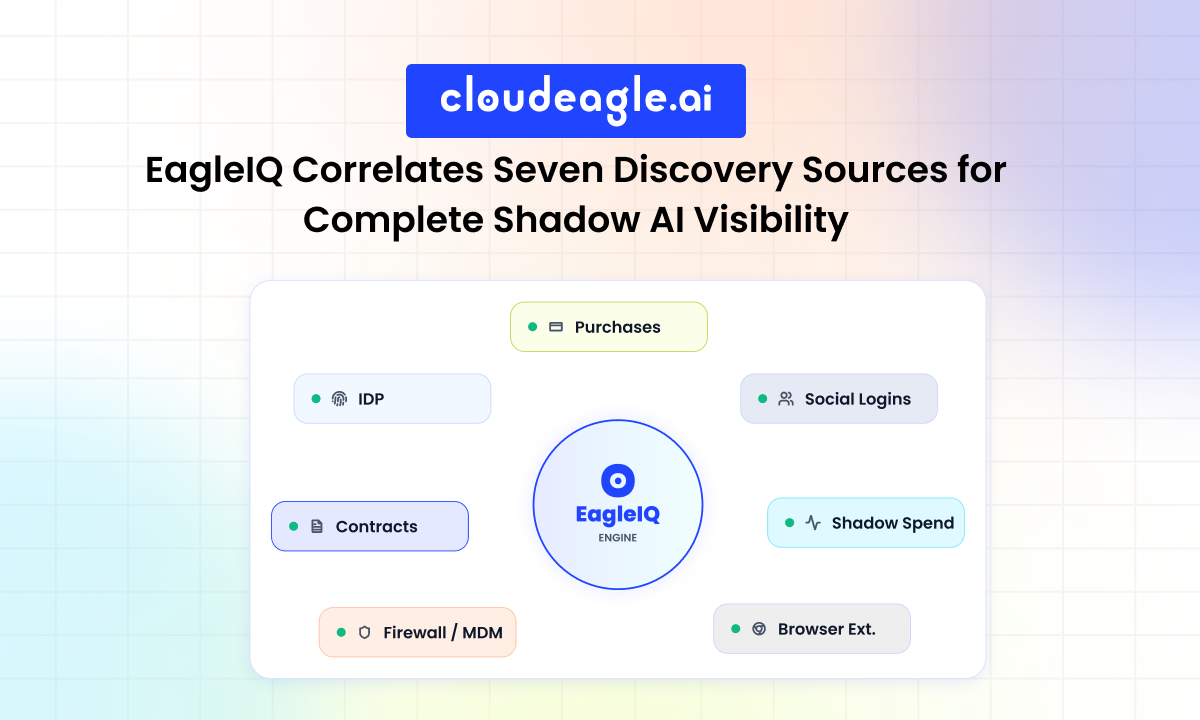
It correlates signals across browser activity, MDM, finance data, firewall logs, and endpoint telemetry to surface what other tools miss, and applies identity governance controls across both human and non-human identities.
Here is how it maps to the checklist:
a) Continuous AI tool discovery across every entry point – Q1, Q2, Q9
Most governance tools wait for IT to tell them what to look for. CloudEagle does not.
- Correlates signals across browser activity, MDM, finance data, firewall logs, and endpoint telemetry
- Surfaces tools that never touched the IDP: free-tier signups, browser extensions, personal accounts
- No new agent required, the same approach that uncovered 92 active AI engines in a single firewall log pull
- Keeps the inventory live, not point-in-time, so access reviews reflect what is actually happening today
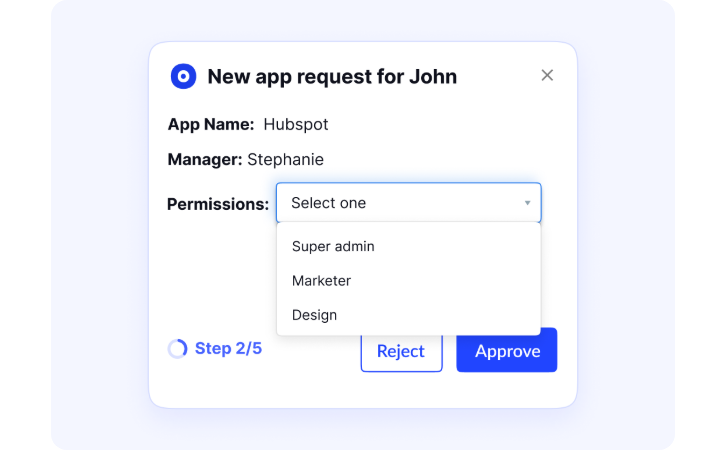
b) Approval workflows that intercept access before data is submitted – Q3, Q5
Governance that runs at the point of behavior, not in the quarterly review that follows it.
- SaaSMap cross-references every AI tool at the moment of first access
- If the tool is unsanctioned, a flash page redirects the employee to an approved alternative before data is entered
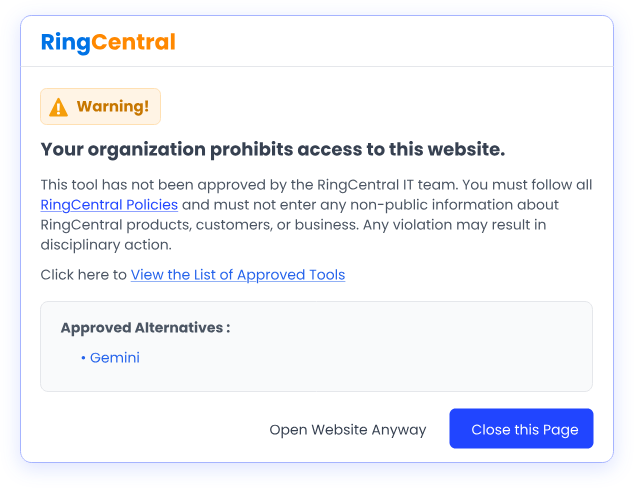
- Tenant-level enforcement catches employees accessing personal accounts of approved tools
- Approval records are maintained automatically
c) NHI governance for AI agents and automations – Q4, Q6
Every automation creates identities. CloudEagle governs them.
- Every service account, API key, and OAuth token created by an AI agent is tracked from creation
- Same lifecycle controls applied to non-human identities as human ones: provisioning, review, revocation
- Offboarding covers AI tools outside the IDP, not just managed applications
- Closes the gap that surfaces in every pilot rollout: agents that spawn identities nobody reviews until something goes wrong
d) Audit-ready access trails from day one – Q7, Q10
When an auditor asks for evidence, the answer should be an export.
- Complete log of every AI access event: who, what, when, where, approval status
- Maintained continuously, not assembled before each review
- Access review records and inventory exports available on demand
- Audit readiness is the default state, not a preparation exercise
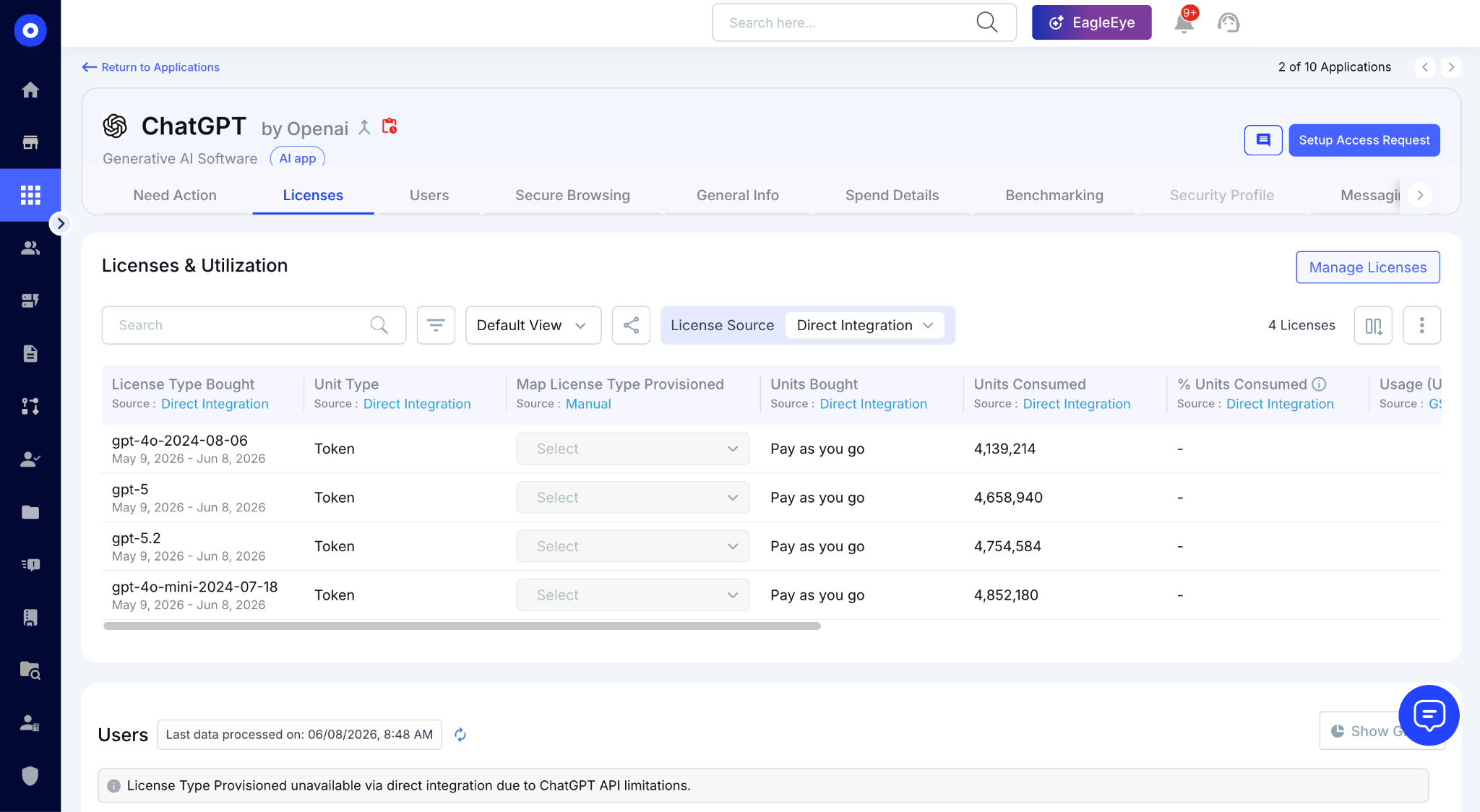
e) Per-team, per-user token consumption visibility – Q8
Aggregate invoices tell you nothing. CloudEagle gives finance and IT the breakdown they are actually asking for.
- Per-team, per-user, per-model spend across OpenAI, Anthropic, Azure AI, Gemini, and Cursor
- Trend views that surface acceleration before it compounds into a CFO conversation
- Single view across all AI platforms
f) Role-based views for CIO, CISO, and IT operations
IT sees the full AI tool inventory and flag status. Security sees risk scoring and access review completion. Finance sees spending by team and trend. The board gets a governance posture summary that requires no assembly.
If your audit prep starts with an accurate AI inventory, this is where it ends: CloudEagle AI Governance
Your Board Is Already Asking. Do You Have the Answers?


5. AI Governance Checklist by Role: What CIOs, CISOs, and IT Directors Each Own
The 10 questions do not belong to one team. Distributing ownership is what makes the AI governance checklist operational rather than aspirational.
CIO owns questions 1, 5, 8, and 10
Inventory completeness, approval process design, token consumption reporting, and audit readiness are strategy-level decisions. The CIO sets the posture; the other roles execute within it.
CISO owns questions 2, 3, 4, and 6
Identifying unsanctioned access, understanding what data is flowing into which tools, validating offboarding completeness, and governing AI agents are all within the security scope. The CISO needs tooling that surfaces these signals without relying on employee self-reporting.
The IT Director or VP of IT Operations owns questions 7 and 9
Audit trail completeness and access review coverage are operational controls. Traditional access review processes were built around IDP-governed applications. AI tools that are entered outside the IDP fall through the gap unless IT extends its scope explicitly.
CloudEagle.ai gives each role a dedicated view. IT sees the discovery layer. Security sees the risk and access flags. Finance sees the spend.
FAQs
1. What is an AI governance checklist and why does it matter for CIOs?
An AI governance checklist defines the controls a CIO must have in place to govern AI tool access, data handling, and compliance visibility. Without it, board and audit questions catch teams unprepared.
2. How is an AI governance checklist different from a SaaS governance framework?
AI tools introduce model behavior, data training, and NHI risks that standard SaaS governance does not cover. AI governance extends SaaS controls to include token consumption, agent identity, and data submission monitoring.
3. What do SOC 2 auditors ask about AI governance in 2026?
SOC 2 auditors now request evidence of access controls on AI tools: access logs, review records, and documentation of how unsanctioned tools are handled. A written policy alone does not satisfy the control.
4. How do I discover shadow AI tools my employees are already using?
Shadow AI discovery requires correlating signals from browser activity, SSO, finance data, and firewall logs rather than relying on employee self-reporting or quarterly tool surveys.
5. What is token consumption visibility and why do boards care?
Token consumption visibility shows which teams, users, and workflows are driving AI spend and at what rate. Aggregate invoices do not show variance. Per-team, per-user breakdowns do.
6. What does the EU AI Act require from enterprise IT teams?
Organizations with EU market exposure must document AI system governance, maintain data handling records, and demonstrate human oversight mechanisms. Penalties for high-risk system non-compliance reach €15 million or 3% of global turnover.
The board is going to ask. The question is whether you have the answers ready or if you are scrambling to build them the week before.
See how CloudEagle.ai maps to the full AI governance checklist
The Board Is Going to Ask. Have the Answers Ready.


.avif)


.avif)
.avif)




.png)





.png)
.avif)
.avif)
.avif)


