You need to enable JavaScript in order to use the AI chatbot tool powered by ChatBot

Why Governing Non-Human Identities Is Different From Governing People

Share via:
blog-cms-banner-bg
Little-Known Negotiation Hacks to Get the Best Deal on Slack
cta-bg-blogDownload Your Copy

HIPAA Compliance Checklist for 2025

Download PDF

An IAM team extends its access review program to service accounts and API keys and immediately hits a wall. 

There's no manager to notify. HRIS record to pull, or offboarding event to trigger deprovisioning. The joiner-mover-leaver model that works cleanly for people produces nothing useful for machine identities.

That's not a gap in execution. It's a mismatch in design. 

Human IGA was built around a lifecycle anchored to employment: someone joins, moves roles, eventually leaves. Non-human identities have none of those anchors. They're created for a purpose, and most IGA platforms were never built with that distinction in mind.

Here are six ways governing non-human identities is different from governing people, why those differences compound as NHI counts grow, and what governing non-human identities actually requires instead of a borrowed human framework.

TL;DR

  • Non-human identity (NHI) governance breaks in six specific places where human-centric IGA models don't translate: ownership, offboarding triggers, discovery, access reviews, behavioral baselines, and lifecycle continuity
  • At scale, each unowned non-human identity becomes a standing exception, and Gartner survey data shows IAM teams are directly responsible for less than half of their organization's machine identities
  • Fixing NHI governance requires discovery that doesn't depend on logins, ownership assigned deliberately, and lifecycle policy tied to use case rather than HR events
  • CloudEagle.ai assigns ownership to every discovered non-human identity and runs certifications on the same review cadence as human identities

1. 6 Ways Governing Non-Human Identities Is Different From Governing People

Every one of these differences comes down to the same root cause: non-human identity governance was retrofitted from a model built for people, and people are not machines.
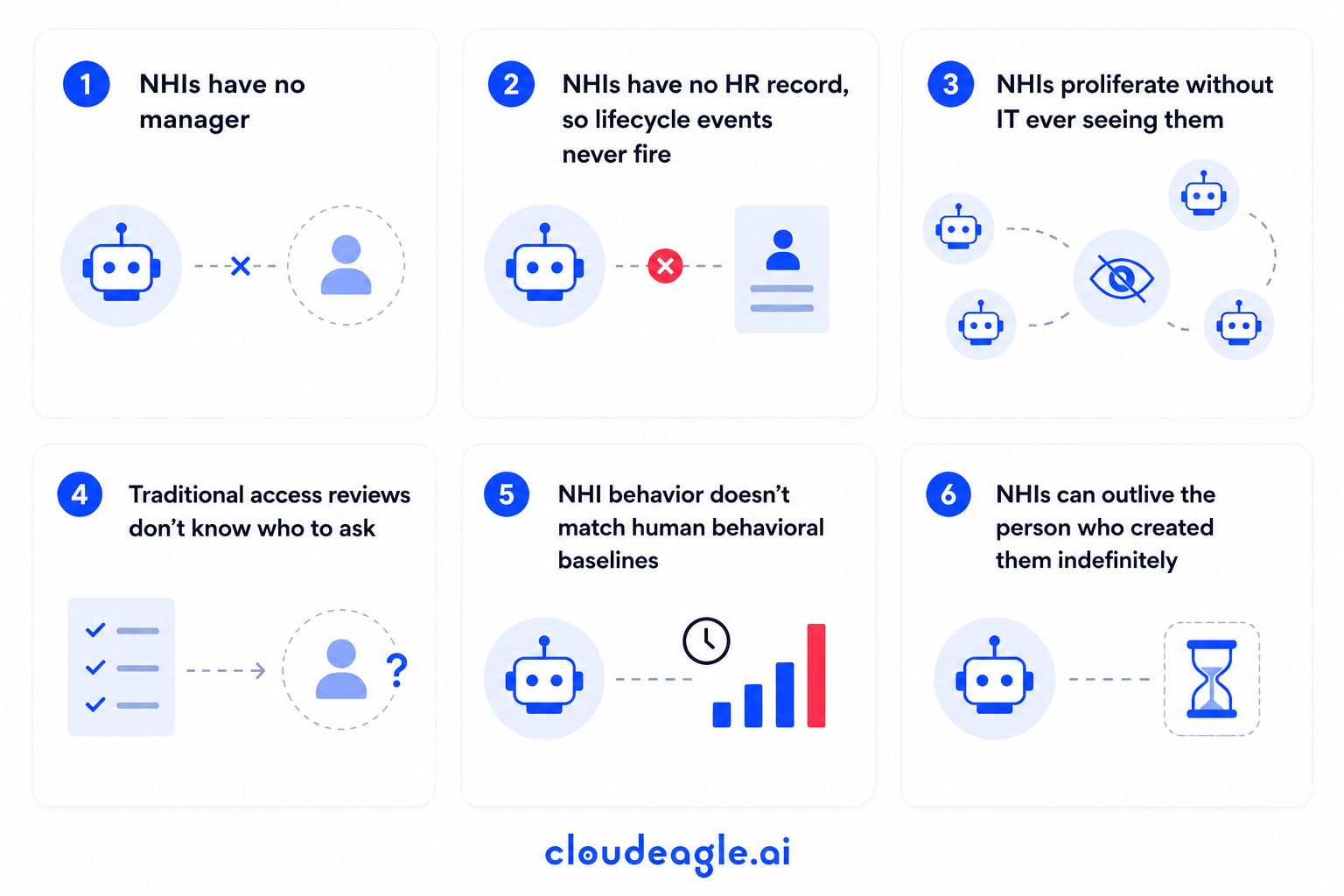
Six reasons traditional access governance fails for non-human identities: no manager, no HR record, limited visibility, unclear reviewers, atypical behavior, and identities that outlive their creators.

1. NHIs have no manager

  • Human IGA: every identity has a manager who certifies access, approves changes, and triggers offboarding
  • NHI reality: the identity has a creator, who may have left the company, and no ongoing accountable party unless one is explicitly assigned
  • What breaks: access certifications route to no one, so they get skipped, rubber-stamped, or dumped in a generic IT queue

Ownership has to be assigned on purpose. It doesn't emerge from an org chart the way a manager relationship does.

No Manager. No Review. No Owner. That's Your NHI Problem.

Find every ungoverned identity right now.
Download Checklist

2. NHIs have no HR record, so lifecycle events never fire

  • Human IGA: offboarding triggers an HR event, a termination date, and a status change in the HRIS
  • NHI reality: there is no equivalent event. NHIs don't get terminated; they just stop being used, or keep running long after the project that created them has ended
  • What breaks: deprovisioning becomes manual, so it happens inconsistently or not at all

An IT leader at a mid-market insurance company described piloting Microsoft Copilot with a hundred licensed users. 

Within weeks, employees had spun up dozens of personal and workflow agents connecting to SharePoint and internal files, none of it provisioned through IT, none of it inventoried. His words: he wanted to claw that visibility back and get human eyes on what those agents could touch.

If that story sounds familiar, the pattern is bigger than Copilot pilots. The CIO's AI Governance Checklist for 2026 walks through the exact questions to ask before agent sprawl outruns your inventory.

3. NHIs proliferate without IT ever seeing them

  • Human IGA: provisioning goes through a defined process with a record of who approved it
  • NHI reality: a developer adds an API key to a script in five minutes; an analyst connects Zapier to Salesforce with an OAuth token, none of it touching a provisioning workflow
  • What breaks: the inventory IT maintains simply doesn't include most of what exists

An IT director at a travel technology company put it plainly: developers had open access to download AI tools, and each tool arrived with its own API keys and credentials nobody had inventoried. 

When usage data stopped matching invoices, there was no clean way to trace which shared key was driving which cost.

4. Traditional access reviews don't know who to ask

  • Human IGA: a review route to a manager who has context on whether their report still needs access
  • NHI reality: there is no one to route to. The creator may have left, and the original purpose may no longer apply
  • What breaks: reviews either get skipped or rubber-stamped by someone with zero context on what the identity actually does

A security lead at a software company solved part of this by embedding usernames inside API tokens, a manual workaround for attribution. It works until that person leaves the company. 

The token doesn't get revoked through any standard offboarding workflow because the username is metadata, not a lifecycle trigger.

5. NHI behavior doesn't match human behavioral baselines

  • Human IGA: anomaly detection learns typical hours, typical apps, and typical data volume for a person
  • NHI reality: an AI agent calling APIs at 3 a.m. or a service account running a job every fifteen minutes is routine, not suspicious
  • What breaks: detection either drowns in false positives or gets tuned to ignore NHI activity entirely, creating a blind spot

A compliance manager in the pharmaceutical industry flagged this directly: AI agents accessing regulated systems without appearing in any access review is a finding that auditors will eventually surface themselves, in an environment where SOC 2 and HIPAA both assume every access event is traceable.

6. NHIs can outlive the person who created them indefinitely

  • Human IGA: a person's access ends when they leave, full stop
  • NHI reality: the account they created inherits no successor, no owner, and no review cadence
  • What breaks: the identity becomes an orphan holding whatever permissions it had on the day it was built, indefinitely, unless someone explicitly intervenes

2. Why These Differences Become a Bigger Problem at Scale

Each of these six gaps is manageable in isolation. 

The problem is that most enterprises aren't managing one NHI at a time; they're managing thousands, and the count keeps growing faster than any manual process can track.
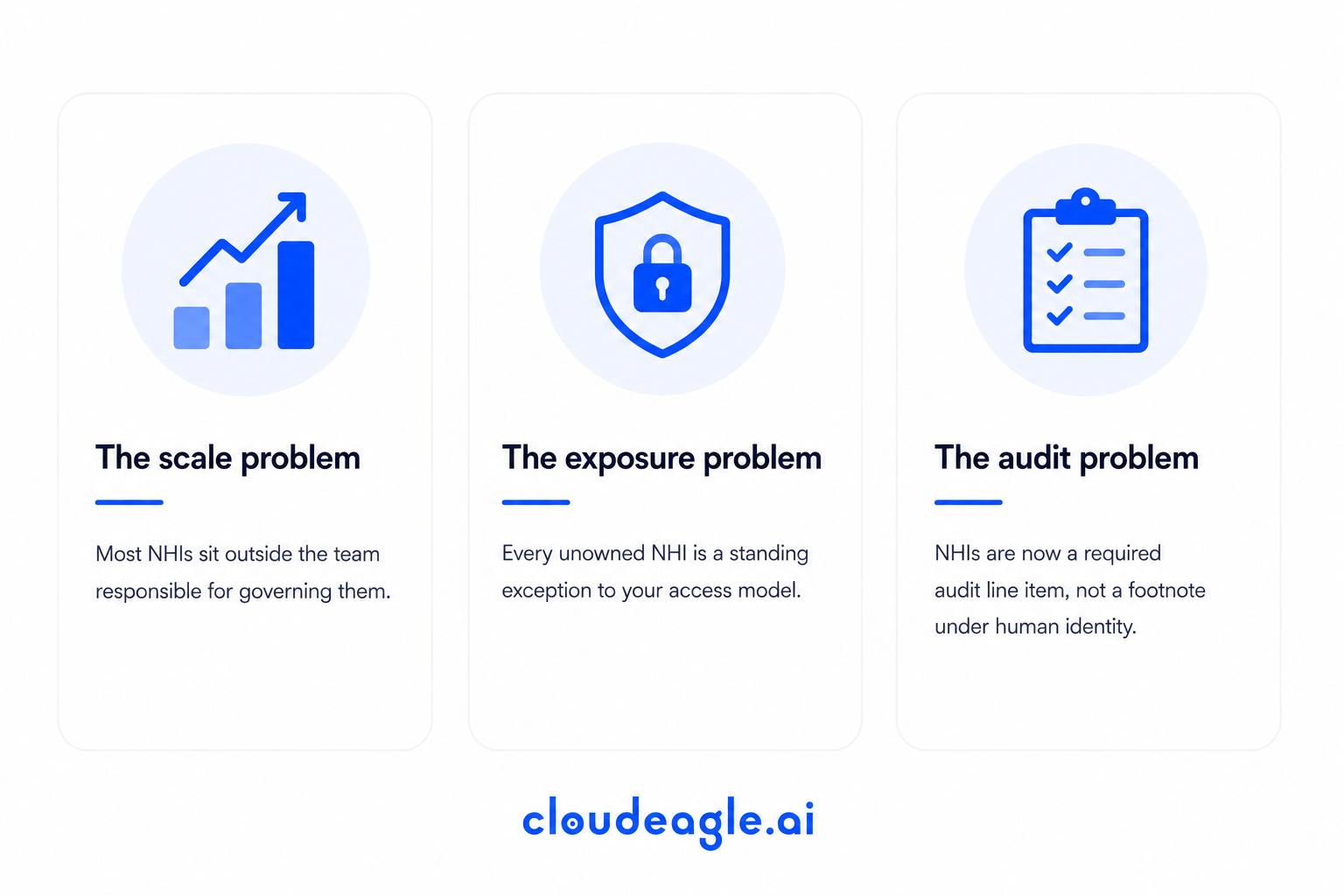
The NHI governance challenge: unmanaged scale, increased access exposure, and growing audit requirements.

→ The scale problem: 

Gartner's cybersecurity trends research, based on a survey of 335 IAM leaders, found that IAM teams are only responsible for 44% of an organization's machine identities. 

The majority of NHIs in a typical enterprise sit outside the team whose job is supposedly to govern them.

→ The exposure problem: 

Every unowned NHI is a standing exception to your access model. At ten, that's a rounding error. At ten thousand, it's a structural gap, and it's exactly the kind of gap adversaries look for when mapping lateral movement paths. 

Gartner has gone further, predicting that 25% of breaches will vector through agent-based attack surfaces due to poor machine identities and a lack of context-aware policy controls by 2028.

→ The audit problem: 

SOC 2, ISO 27001, and emerging AI governance frameworks now expect NHIs to be governed with the same rigor as human accounts: who owns it, what it can access, when it was last reviewed. 

Machine identity governance is becoming its own audit line item, not a footnote under human identity lifecycle management. "We govern human identities, NHIs are different" doesn't hold up as an audit answer anymore.

The six differences above don't make NHI governance impossible. They make it impossible to do with tools that were designed for people.

44% of Machine Identities Have No Accountable Owner

Close the gaps before auditors find them.
Download Checklist

3. What Governing Non-Human Identities Actually Requires

Governing NHIs well means replacing every human-centric assumption with one built for machine identities. 

Machine identity governance and human identity governance solve different problems, and treating them as one program is where most gaps start.

a) Discovery that doesn't depend on login events: 

NHIs don't authenticate through your identity provider the way people do, so finding them means looking at API traffic, OAuth registries, code repositories, and integration platforms instead of SSO logs.

b) Ownership assigned on purpose, never inferred: 

Every NHI needs an accountable owner responsible for certifying it still needs to exist, keeping its credentials current, and initiating decommissioning when its purpose ends.

c) Lifecycle tied to use case, not to an HR event: 

NHI identity lifecycle management has to start at creation. 

When the project that created an NHI ends, the NHI should retire with it, which means documenting its purpose, expected lifespan, and connected systems the moment it's created.

d) Scheduled, proactive review instead of reactive cleanup: 

Without an offboarding trigger, NHIs need to surface automatically on a review cadence, especially ownerless identities and ones connected to decommissioned systems.

e) Credential lifecycle policy replacing session-based thinking: 

Rotation schedules, expiry windows, and scope restrictions have to do the job that session expiry does for human logins, since static credentials don't reset on their own.

Teams operationalizing this at scale need a platform built to assign ownership, surface ownerless identities, and run review workflows for machine identities specifically, not one adapted from a human IGA model after the fact. 

This is the same discipline behind closing identity drift in human access, applied to identities that never had an HR record to drift from in the first place.

4. How CloudEagle.ai Helps You Govern Non-Human Identities

CloudEagle.ai gives every discovered non-human identity two things human-centric tools can't: a deliberate otner and a review path that doesn't depend on an HR event.
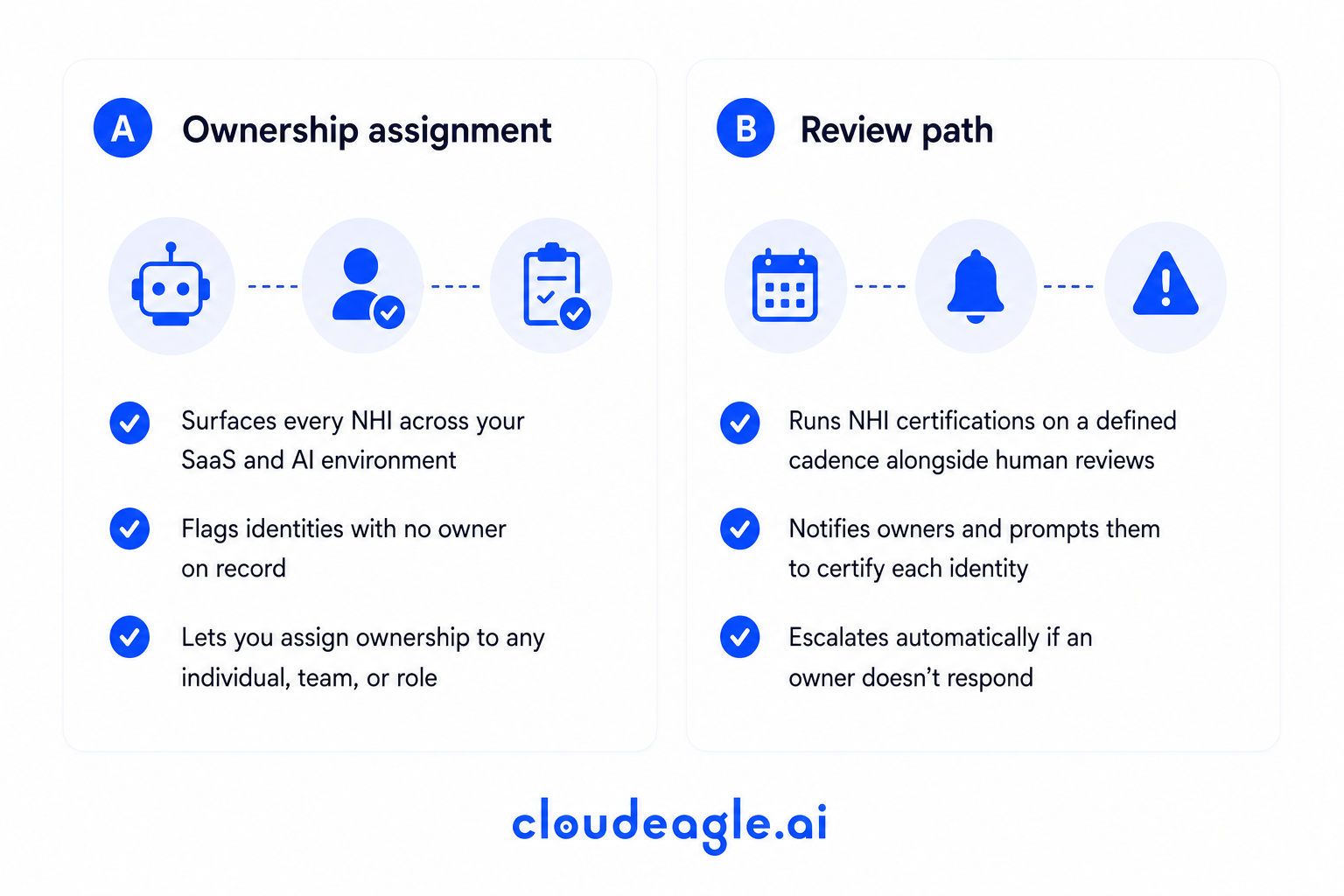
CloudEagle.ai’s NHI governance workflow: discover every non-human identity, assign accountable owners, run recurring certifications, notify reviewers, and escalate overdue reviews automatically.

a) Ownership assignment

Most NHIs are created outside IT's visibility and never assigned an owner.

How CloudEagle helps:

  • Surfaces every NHI across your SaaS and AI environment, including ones created outside IT's visibility
  • Flags identities with no owner on record instead of letting them sit unnoticed
  • Lets you assign ownership to any individual, team, or role
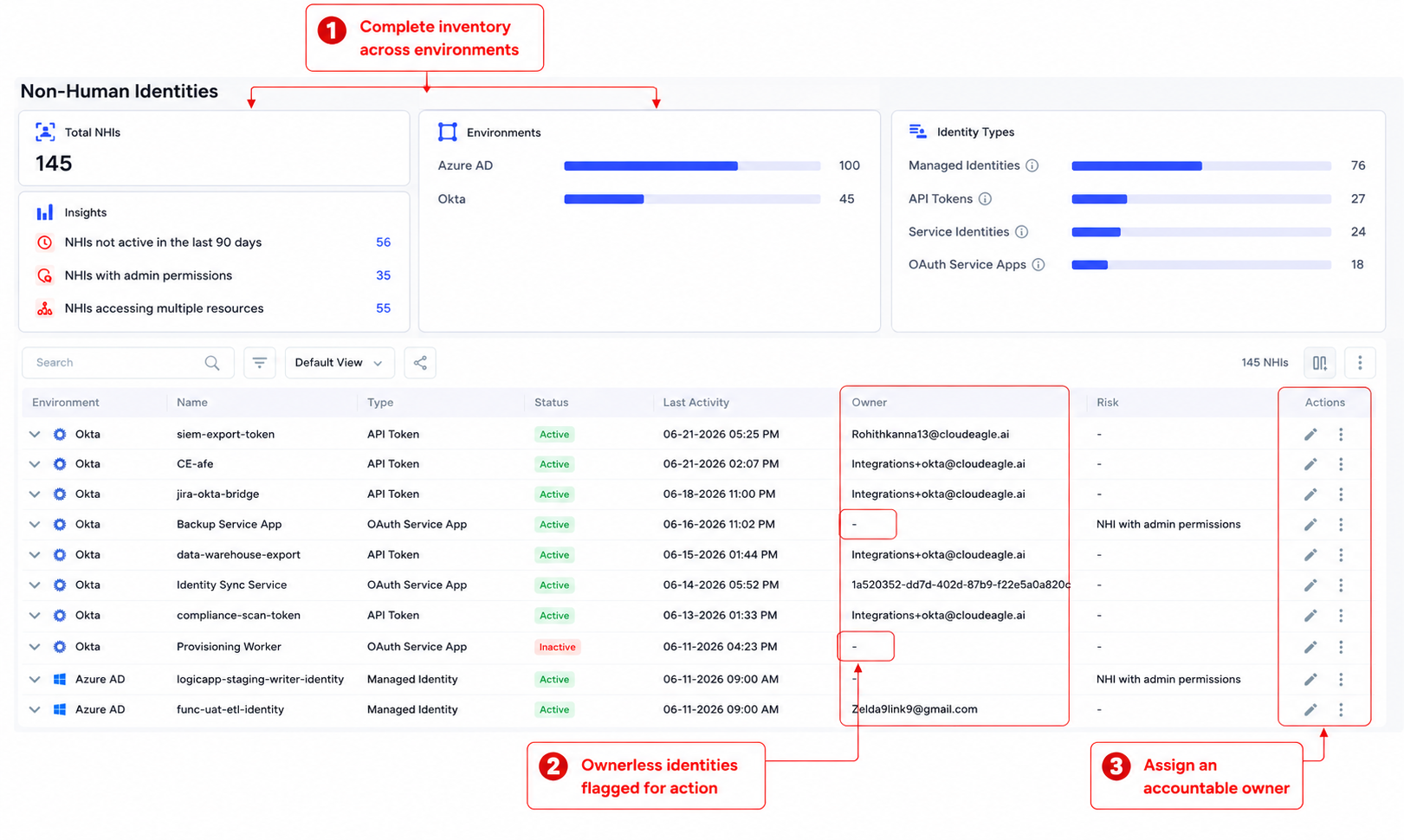
Non-human identity inventory across Azure AD and Okta, highlighting inactive, privileged, multi-resource, and ownerless identities so teams can assign accountability.

Once assigned, that owner is accountable for certification and decommissioning decisions going forward, so ownerless NHIs stop accumulating in the first place.

b) Review path

Without an HR trigger, NHI reviews happen inconsistently or not at all.

How CloudEagle helps:

  • Runs NHI certifications on a defined cadence alongside human access reviews
  • Notifies owners and prompts them to certify each identity
  • Escalates automatically if an owner doesn't respond
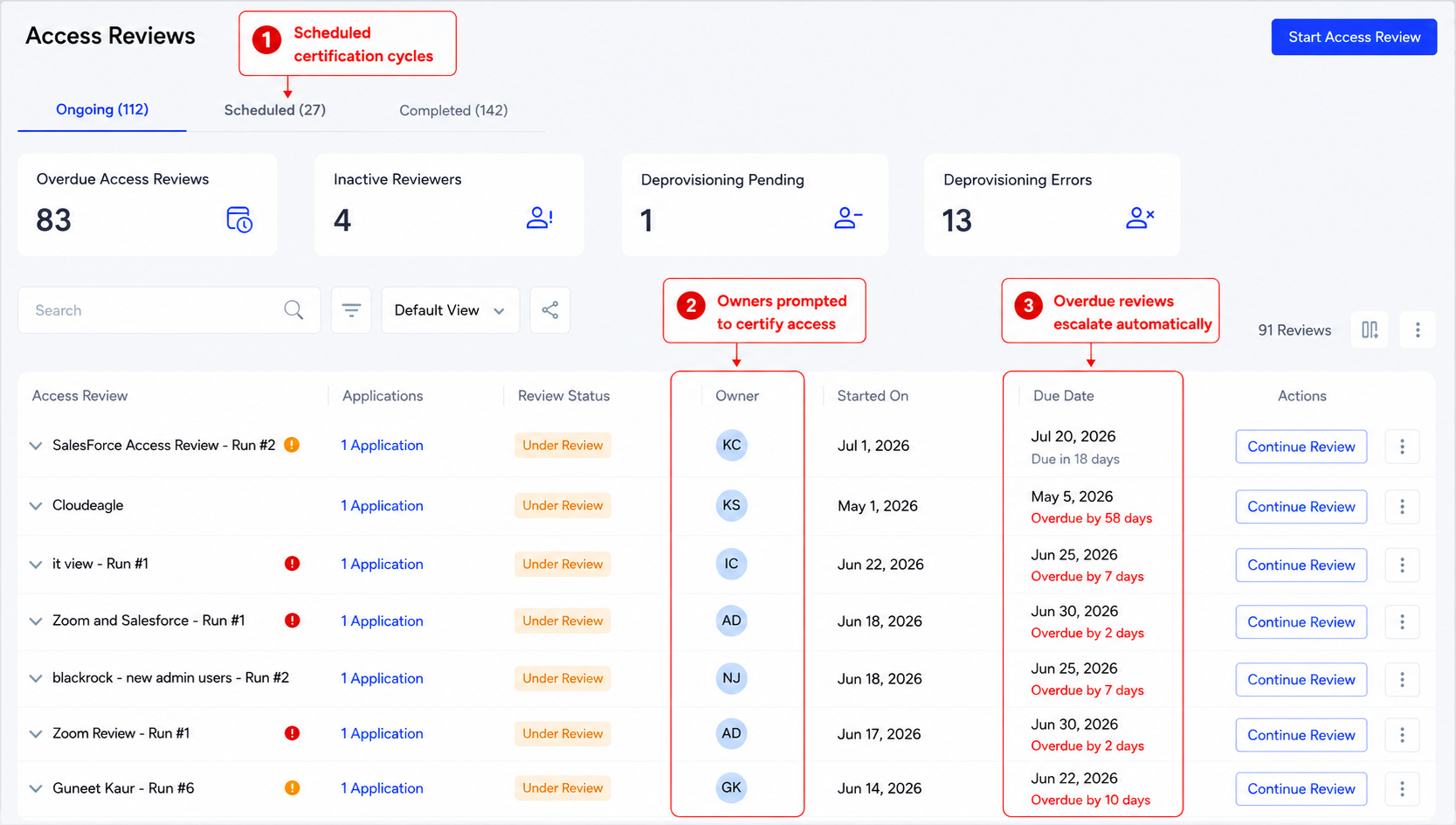
Access Reviews dashboard showing scheduled certification cycles, assigned owners, review due dates, and automatic escalation for overdue access reviews.

The result is the same workflow rigor human IGA applies to managers, now adapted for machine identity ownership, on the same AI governance foundation CloudEagle.ai uses to track token usage and tool sprawl.

The structural differences between NHIs and human identities don't require a completely new governance philosophy. They require a platform that accounts for those differences instead of ignoring them.

5. FAQs

1. What is a non-human identity (NHI)? 

An NHI is any identity accessing systems without a human directly operating it, including API keys, service accounts, OAuth tokens, and AI agents.

2. Why can't traditional IGA tools govern NHIs? 

They're built around HR events and manager approvals. NHIs have neither, so certifications stall and offboarding never triggers.

3. Who should own a non-human identity? 

A specific person, team, or role assigned deliberately at creation, accountable for certifying the identity and deciding when to decommission it.

4. How often should NHIs be reviewed? 

On the same defined cadence as human access reviews, with ownerless or orphaned NHIs surfaced automatically rather than found during an incident.

5. What happens to an NHI when the person who created it leaves? 

Nothing, by default. It keeps running with the same access unless ownership was assigned in advance and transfers on departure.

NHIs aren't ungovernable. Non-human identities just need a governance model built for them, not retrofitted from one that wasn't.

See how CloudEagle.ai assigns ownership and review paths to non-human identities: book a demo.

Advertisement for a SaaS Subscription Tracking Template with a call-to-action button to download and a partial graphic of a tablet showing charts.Banner promoting a SaaS Agreement Checklist to streamline SaaS management and avoid budget waste with a call-to-action button labeled Download checklist.Blue banner with text 'The Ultimate Employee Offboarding Checklist!' and a black button labeled 'Download checklist' alongside partial views of checklist documents from cloudeagle.ai.Digital ad for download checklist titled 'The Ultimate Checklist for IT Leaders to Optimize SaaS Operations' by cloudeagle.ai, showing checklist pages.Slack Buyer's Guide offer with text 'Unlock insider insights to get the best deal on Slack!' and a button labeled 'Get Your Copy', accompanied by a preview of the guide featuring Slack's logo.Monday Pricing Guide by cloudeagle.ai offering exclusive pricing secrets to maximize investment with a call-to-action button labeled Get Your Copy and an image of the guide's cover.Blue banner for Canva Pricing Guide by cloudeagle.ai offering a guide to Canva costs, features, and alternatives with a call-to-action button saying Get Your Copy.Blue banner with white text reading 'Little-Known Negotiation Hacks to Get the Best Deal on Slack' and a white button labeled 'Get Your Copy'.Blue banner with text 'Little-Known Negotiation Hacks to Get the Best Deal on Monday.com' and a white button labeled 'Get Your Copy'.Blue banner with text 'Little-Known Negotiation Hacks to Get the Best Deal on Canva' and a white button labeled 'Get Your Copy'.Banner with text 'Slack Buyer's Guide' and a 'Download Now' button next to images of a guide titled 'Slack Buyer’s Guide: Features, Pricing & Best Practices'.Digital cover of Monday Pricing Guide with a button labeled Get Your Copy on a blue background.Canva Pricing Guide cover with a button labeled Get Your Copy on a blue gradient background.

Enter your email to
unlock the report

Oops! Something went wrong while submitting the form.
License Count
Benchmark
Per User/Per Year

Enter your email to
unlock the report

Oops! Something went wrong while submitting the form.
License Count
Benchmark
Per User/Per Year

Enter your email to
unlock the report

Oops! Something went wrong while submitting the form.
Notion Plus
License Count
Benchmark
Per User/Per Year
100-500
$67.20 - $78.72
500-1000
$59.52 - $72.00
1000+
$51.84 - $57.60
Canva Pro
License Count
Benchmark
Per User/Per Year
100-500
$74.33-$88.71
500-1000
$64.74-$80.32
1000+
$55.14-$62.34

Enter your email to
unlock the report

Oops! Something went wrong while submitting the form.

Enter your email to
unlock the report

Oops! Something went wrong while submitting the form.
Zoom Business
License Count
Benchmark
Per User/Per Year
100-500
$216.00 - $264.00
500-1000
$180.00 - $216.00
1000+
$156.00 - $180.00

Enter your email to
unlock the report

Oops! Something went wrong while submitting the form.

Get the Right Security Platform To Secure Your Cloud Infrastructure

Please enter a business email
Thank you!
The 2023 SaaS report has been sent to your email. Check your promotional or spam folder.
Oops! Something went wrong while submitting the form.

Access full report

Please enter a business email
Thank you!
The 2023 SaaS report has been sent to your email. Check your promotional or spam folder.
Oops! Something went wrong while submitting the form.

An IAM team extends its access review program to service accounts and API keys and immediately hits a wall. 

There's no manager to notify. HRIS record to pull, or offboarding event to trigger deprovisioning. The joiner-mover-leaver model that works cleanly for people produces nothing useful for machine identities.

That's not a gap in execution. It's a mismatch in design. 

Human IGA was built around a lifecycle anchored to employment: someone joins, moves roles, eventually leaves. Non-human identities have none of those anchors. They're created for a purpose, and most IGA platforms were never built with that distinction in mind.

Here are six ways governing non-human identities is different from governing people, why those differences compound as NHI counts grow, and what governing non-human identities actually requires instead of a borrowed human framework.

TL;DR

  • Non-human identity (NHI) governance breaks in six specific places where human-centric IGA models don't translate: ownership, offboarding triggers, discovery, access reviews, behavioral baselines, and lifecycle continuity
  • At scale, each unowned non-human identity becomes a standing exception, and Gartner survey data shows IAM teams are directly responsible for less than half of their organization's machine identities
  • Fixing NHI governance requires discovery that doesn't depend on logins, ownership assigned deliberately, and lifecycle policy tied to use case rather than HR events
  • CloudEagle.ai assigns ownership to every discovered non-human identity and runs certifications on the same review cadence as human identities

1. 6 Ways Governing Non-Human Identities Is Different From Governing People

Every one of these differences comes down to the same root cause: non-human identity governance was retrofitted from a model built for people, and people are not machines.

Six reasons traditional access governance fails for non-human identities: no manager, no HR record, limited visibility, unclear reviewers, atypical behavior, and identities that outlive their creators.

1. NHIs have no manager

  • Human IGA: every identity has a manager who certifies access, approves changes, and triggers offboarding
  • NHI reality: the identity has a creator, who may have left the company, and no ongoing accountable party unless one is explicitly assigned
  • What breaks: access certifications route to no one, so they get skipped, rubber-stamped, or dumped in a generic IT queue

Ownership has to be assigned on purpose. It doesn't emerge from an org chart the way a manager relationship does.

No Manager. No Review. No Owner. That's Your NHI Problem.

Find every ungoverned identity right now.
Download Checklist

2. NHIs have no HR record, so lifecycle events never fire

  • Human IGA: offboarding triggers an HR event, a termination date, and a status change in the HRIS
  • NHI reality: there is no equivalent event. NHIs don't get terminated; they just stop being used, or keep running long after the project that created them has ended
  • What breaks: deprovisioning becomes manual, so it happens inconsistently or not at all

An IT leader at a mid-market insurance company described piloting Microsoft Copilot with a hundred licensed users. 

Within weeks, employees had spun up dozens of personal and workflow agents connecting to SharePoint and internal files, none of it provisioned through IT, none of it inventoried. His words: he wanted to claw that visibility back and get human eyes on what those agents could touch.

If that story sounds familiar, the pattern is bigger than Copilot pilots. The CIO's AI Governance Checklist for 2026 walks through the exact questions to ask before agent sprawl outruns your inventory.

3. NHIs proliferate without IT ever seeing them

  • Human IGA: provisioning goes through a defined process with a record of who approved it
  • NHI reality: a developer adds an API key to a script in five minutes; an analyst connects Zapier to Salesforce with an OAuth token, none of it touching a provisioning workflow
  • What breaks: the inventory IT maintains simply doesn't include most of what exists

An IT director at a travel technology company put it plainly: developers had open access to download AI tools, and each tool arrived with its own API keys and credentials nobody had inventoried. 

When usage data stopped matching invoices, there was no clean way to trace which shared key was driving which cost.

4. Traditional access reviews don't know who to ask

  • Human IGA: a review route to a manager who has context on whether their report still needs access
  • NHI reality: there is no one to route to. The creator may have left, and the original purpose may no longer apply
  • What breaks: reviews either get skipped or rubber-stamped by someone with zero context on what the identity actually does

A security lead at a software company solved part of this by embedding usernames inside API tokens, a manual workaround for attribution. It works until that person leaves the company. 

The token doesn't get revoked through any standard offboarding workflow because the username is metadata, not a lifecycle trigger.

5. NHI behavior doesn't match human behavioral baselines

  • Human IGA: anomaly detection learns typical hours, typical apps, and typical data volume for a person
  • NHI reality: an AI agent calling APIs at 3 a.m. or a service account running a job every fifteen minutes is routine, not suspicious
  • What breaks: detection either drowns in false positives or gets tuned to ignore NHI activity entirely, creating a blind spot

A compliance manager in the pharmaceutical industry flagged this directly: AI agents accessing regulated systems without appearing in any access review is a finding that auditors will eventually surface themselves, in an environment where SOC 2 and HIPAA both assume every access event is traceable.

6. NHIs can outlive the person who created them indefinitely

  • Human IGA: a person's access ends when they leave, full stop
  • NHI reality: the account they created inherits no successor, no owner, and no review cadence
  • What breaks: the identity becomes an orphan holding whatever permissions it had on the day it was built, indefinitely, unless someone explicitly intervenes

2. Why These Differences Become a Bigger Problem at Scale

Each of these six gaps is manageable in isolation. 

The problem is that most enterprises aren't managing one NHI at a time; they're managing thousands, and the count keeps growing faster than any manual process can track.

The NHI governance challenge: unmanaged scale, increased access exposure, and growing audit requirements.

→ The scale problem: 

Gartner's cybersecurity trends research, based on a survey of 335 IAM leaders, found that IAM teams are only responsible for 44% of an organization's machine identities. 

The majority of NHIs in a typical enterprise sit outside the team whose job is supposedly to govern them.

→ The exposure problem: 

Every unowned NHI is a standing exception to your access model. At ten, that's a rounding error. At ten thousand, it's a structural gap, and it's exactly the kind of gap adversaries look for when mapping lateral movement paths. 

Gartner has gone further, predicting that 25% of breaches will vector through agent-based attack surfaces due to poor machine identities and a lack of context-aware policy controls by 2028.

→ The audit problem: 

SOC 2, ISO 27001, and emerging AI governance frameworks now expect NHIs to be governed with the same rigor as human accounts: who owns it, what it can access, when it was last reviewed. 

Machine identity governance is becoming its own audit line item, not a footnote under human identity lifecycle management. "We govern human identities, NHIs are different" doesn't hold up as an audit answer anymore.

The six differences above don't make NHI governance impossible. They make it impossible to do with tools that were designed for people.

44% of Machine Identities Have No Accountable Owner

Close the gaps before auditors find them.
Download Checklist

3. What Governing Non-Human Identities Actually Requires

Governing NHIs well means replacing every human-centric assumption with one built for machine identities. 

Machine identity governance and human identity governance solve different problems, and treating them as one program is where most gaps start.

a) Discovery that doesn't depend on login events: 

NHIs don't authenticate through your identity provider the way people do, so finding them means looking at API traffic, OAuth registries, code repositories, and integration platforms instead of SSO logs.

b) Ownership assigned on purpose, never inferred: 

Every NHI needs an accountable owner responsible for certifying it still needs to exist, keeping its credentials current, and initiating decommissioning when its purpose ends.

c) Lifecycle tied to use case, not to an HR event: 

NHI identity lifecycle management has to start at creation. 

When the project that created an NHI ends, the NHI should retire with it, which means documenting its purpose, expected lifespan, and connected systems the moment it's created.

d) Scheduled, proactive review instead of reactive cleanup: 

Without an offboarding trigger, NHIs need to surface automatically on a review cadence, especially ownerless identities and ones connected to decommissioned systems.

e) Credential lifecycle policy replacing session-based thinking: 

Rotation schedules, expiry windows, and scope restrictions have to do the job that session expiry does for human logins, since static credentials don't reset on their own.

Teams operationalizing this at scale need a platform built to assign ownership, surface ownerless identities, and run review workflows for machine identities specifically, not one adapted from a human IGA model after the fact. 

This is the same discipline behind closing identity drift in human access, applied to identities that never had an HR record to drift from in the first place.

4. How CloudEagle.ai Helps You Govern Non-Human Identities

CloudEagle.ai gives every discovered non-human identity two things human-centric tools can't: a deliberate otner and a review path that doesn't depend on an HR event.

CloudEagle.ai’s NHI governance workflow: discover every non-human identity, assign accountable owners, run recurring certifications, notify reviewers, and escalate overdue reviews automatically.

a) Ownership assignment

Most NHIs are created outside IT's visibility and never assigned an owner.

How CloudEagle helps:

  • Surfaces every NHI across your SaaS and AI environment, including ones created outside IT's visibility
  • Flags identities with no owner on record instead of letting them sit unnoticed
  • Lets you assign ownership to any individual, team, or role

Non-human identity inventory across Azure AD and Okta, highlighting inactive, privileged, multi-resource, and ownerless identities so teams can assign accountability.

Once assigned, that owner is accountable for certification and decommissioning decisions going forward, so ownerless NHIs stop accumulating in the first place.

b) Review path

Without an HR trigger, NHI reviews happen inconsistently or not at all.

How CloudEagle helps:

  • Runs NHI certifications on a defined cadence alongside human access reviews
  • Notifies owners and prompts them to certify each identity
  • Escalates automatically if an owner doesn't respond

Access Reviews dashboard showing scheduled certification cycles, assigned owners, review due dates, and automatic escalation for overdue access reviews.

The result is the same workflow rigor human IGA applies to managers, now adapted for machine identity ownership, on the same AI governance foundation CloudEagle.ai uses to track token usage and tool sprawl.

The structural differences between NHIs and human identities don't require a completely new governance philosophy. They require a platform that accounts for those differences instead of ignoring them.

5. FAQs

1. What is a non-human identity (NHI)? 

An NHI is any identity accessing systems without a human directly operating it, including API keys, service accounts, OAuth tokens, and AI agents.

2. Why can't traditional IGA tools govern NHIs? 

They're built around HR events and manager approvals. NHIs have neither, so certifications stall and offboarding never triggers.

3. Who should own a non-human identity? 

A specific person, team, or role assigned deliberately at creation, accountable for certifying the identity and deciding when to decommission it.

4. How often should NHIs be reviewed? 

On the same defined cadence as human access reviews, with ownerless or orphaned NHIs surfaced automatically rather than found during an incident.

5. What happens to an NHI when the person who created it leaves? 

Nothing, by default. It keeps running with the same access unless ownership was assigned in advance and transfers on departure.

NHIs aren't ungovernable. Non-human identities just need a governance model built for them, not retrofitted from one that wasn't.

See how CloudEagle.ai assigns ownership and review paths to non-human identities: book a demo.

CloudEagle.ai recognized in the 2025 Gartner® Magic Quadrant™ for SaaS Management Platforms
Download now
gartner chart
5x
Faster employee
onboarding
80%
Reduction in time for
user access reviews
30k
Workflows
automated
$15Bn
Analyzed in
contract spend
$2Bn
Saved in
SaaS spend

Streamline SaaS governance and save 10-30%

Book a Demo with Expert
CTA image