
%201.svg)


HIPAA Compliance Checklist for 2025

Most teams use Reco to understand which number of AI agents in their environment, who owns them, what they can access, and their risk factors.. If that's the primary problem you're solving, Reco does that well.
But in 2026, most security and IT teams are also trying to govern AI tools, manage access reviews, control SaaS spend, and automate identity lifecycle. OAuth visibility is important, but it's only one piece of the puzzle.
That’s why you need broader platforms. CloudEagle.ai combines SaaS security, identity governance, AI governance, and spend management in a single platform. Instead of four tools, one platform can answer all the questions.
In this article, we'll look at seven Reco alternatives that go beyond OAuth risk management and help organizations govern their broader SaaS and AI environment.
What Reco Does Well (And Where Most Teams Outgrow It)
Reco helps security teams understand which third-party applications have access to company data. Its strengths lie in SaaS-to-SaaS OAuth discovery, identity risk analysis, and identifying shadow IT.
For organizations asking, "What external applications are connected to our Google Workspace or Microsoft 365 environment?" Reco provides a strong answer.
The challenge is that most SaaS environments don't stop at OAuth risk.
As enterprises grow, security teams get pulled into access reviews. IT teams are asked to automate provisioning and deprovisioning. Procurement wants visibility into SaaS spend. Finance wants renewal data.
And AI adoption introduces an entirely new governance layer around shadow AI, model usage, and data exposure.
- License Optimization Becomes Important
- SaaS Spend Requires Active Management
- Access Reviews Need Automation
- Identity Lifecycle Processes Must Scale
- AI Governance Becomes Part of the Security Conversation
If your only question is "what third-party apps are connected to our Google Workspace," Reco answers it. If your question is "what is our entire SaaS and AI posture, and what is it costing us," you need a broader platform.

How Did We Choose the Reco Alternatives?
For this list, we've included platforms we genuinely respect for specific use cases. Some focus heavily on SaaS security and compliance. Others are stronger in identity governance or SaaS management.
The list is presented in alphabetical order. CloudEagle.ai appears first because of that, not because we ranked it above the others. We'll let the capabilities speak for themselves.
Top 7 Reco Alternatives to Choose in 2026
1. CloudEagle.ai
CloudEagle.ai is the only alternative on this list that pairs AI governance and SaaS security with SaaS management and procurement in a single platform.
Where most tools on this list, including Reco, solve for AI and SaaS security in isolation, CloudEagle.ai governs applications, AI tools, and identities together, humans and non-human identities alike, so entitlements, usage, and lifecycle events stay connected instead of living in separate systems.
What does CloudEagle.ai do differently from Reco?
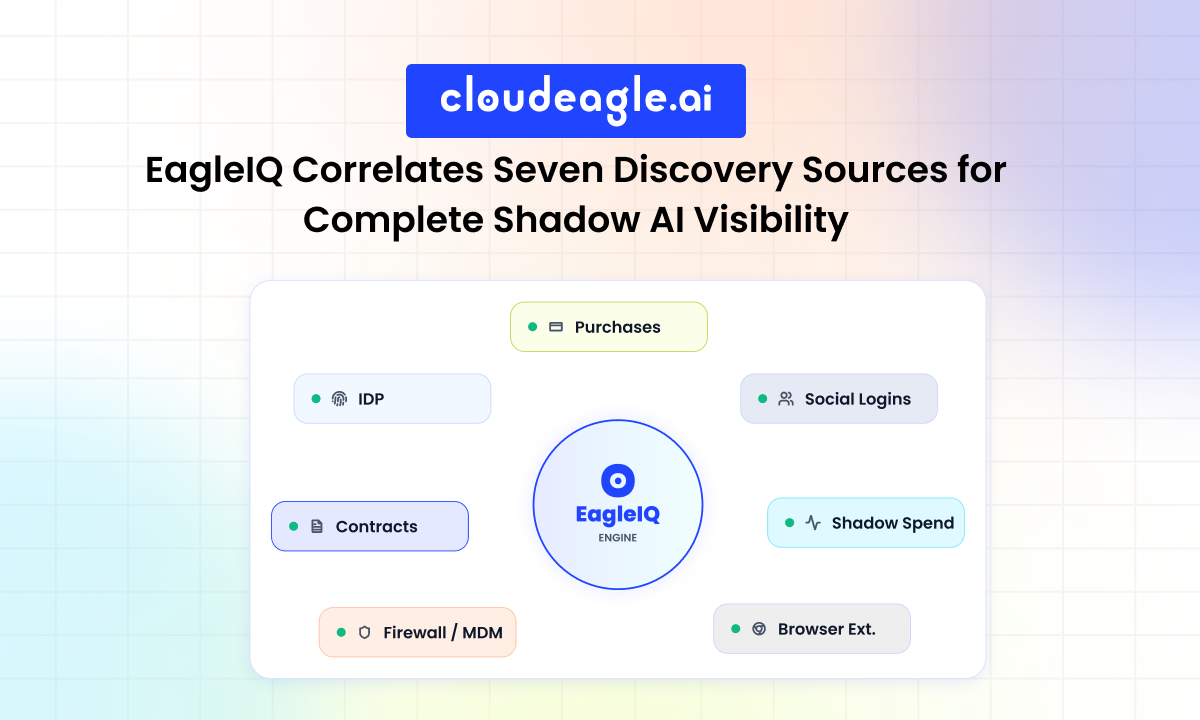
CloudEagle.ai leads with AI usage control and AI policy enforcement rather than discovery alone. It builds a real-time inventory of every AI tool in use. That inventory comes from combining SSO, browser extensions, firewall logs, and finance data.
From there, it actively blocks sensitive data from reaching unsanctioned AI tools in real time, rather than only flagging the exposure after it's already happened.
What has CloudEagle.ai's AI governance delivered for real customers?
At Iterative Health, CloudEagle.ai governed 500+ AI apps, cut AI approval time by 60%, and reached 100% audited AI access, replacing manual, after-the-fact reviews with policy-based controls enforced at the point of use.
"Once AI adoption accelerated across teams, visibility alone wasn't enough. We needed clear rules around who could use AI tools, under what conditions, and how those decisions were enforced and reviewed. CloudEagle helped us move from ad-hoc approvals to structured, defensible AI governance."
— Aditya Khosla, CTO, Iterative Health
It's built for mid-market and enterprise security teams that need shadow AI discovery, identity governance, and SaaS security posture management to work as one system rather than three point tools stitched together.
Key Features:
AI Usage Control: Real-time inventory of every AI tool in use, built by combining SSO, browser extensions, firewall logs, and finance data, surfacing duplicate copilots, underutilized AI licenses, and orphaned accounts before they turn into renewal or usage-based billing surprises.
AI Policy Enforcement: Goes beyond visibility to active remediation, monitors and blocks sensitive data (PII, source code, financial data) from being shared with AI tools in real time, and redirects users to an approved alternative the moment they attempt to open an unsanctioned one.
AI Token Consumption Tracking: Per-user, per-model token consumption across Claude, Cursor, ChatGPT, and Gemini with run-rate forecasting.
Shadow AI and Shadow IT Discovery: Four-layer shadow AI and shadow IT detection across browser, network, endpoint, and finance, including personal AI accounts on sanctioned domains.
GenAI Risk Scores: Every AI tool and vendor scored for GenAI risk via Netskope's Cloud Confidence Index, covering data residency, training data use, and security posture.
Non-Human Identity Management: Service accounts, API keys, and AI agents tracked with the same ownership, lifecycle, and access-review discipline applied to human identities.
Continuous Security Posture Management: Application-level compliance tracked against frameworks like NIST 800, pulling MFA/SSO federation signals directly from Okta and Entra, replacing manual point-in-time audits with one live dashboard.
Continuous Access Reviews: Automated reviewer assignment, high-risk and ex-employee flagging, and audit-ready evidence attached automatically, cutting review cycles from months to days.
License Management and Harvesting: Feature-level dormancy detection with configurable thresholds and automated reclaim workflows.
SaaS Spend Intelligence and Procurement Workflows: The one area Reco doesn't cover, contract metadata extraction, renewal alerts, and price benchmarking, alongside the security stack.
CloudEagle MCP Server: Query SaaS, AI, and identity data in natural language directly from inside Claude or any MCP-compatible AI tool.
Strengths:
4.7/5 on G2 from verified reviews. Reviewers consistently highlight breadth of coverage, automation, and ease of use. The strongest option on this list for teams that want security posture, identity governance, and spend visibility in one place rather than stitched from separate tools.
Limitations:
Feature depth can feel overwhelming during initial setup. Better suited for mid-market and enterprise teams managing 50+ applications than smaller environments.
Pricing:
CloudEagle.ai is priced by module rather than a flat per-seat rate, AI Governance, Security & Compliance, Identity Governance, Optimization, and Procurement can be licensed separately or together, scaled to company size.
For teams evaluating this specifically as a Reco alternative, that matters: you can start with just the AI Governance and Security & Compliance modules if shadow AI discovery and posture management are the immediate need, without paying for the SaaS spend or procurement tooling Reco doesn't offer in the first place.
Reco Finds The Problem. Then What?


2. Grip Security
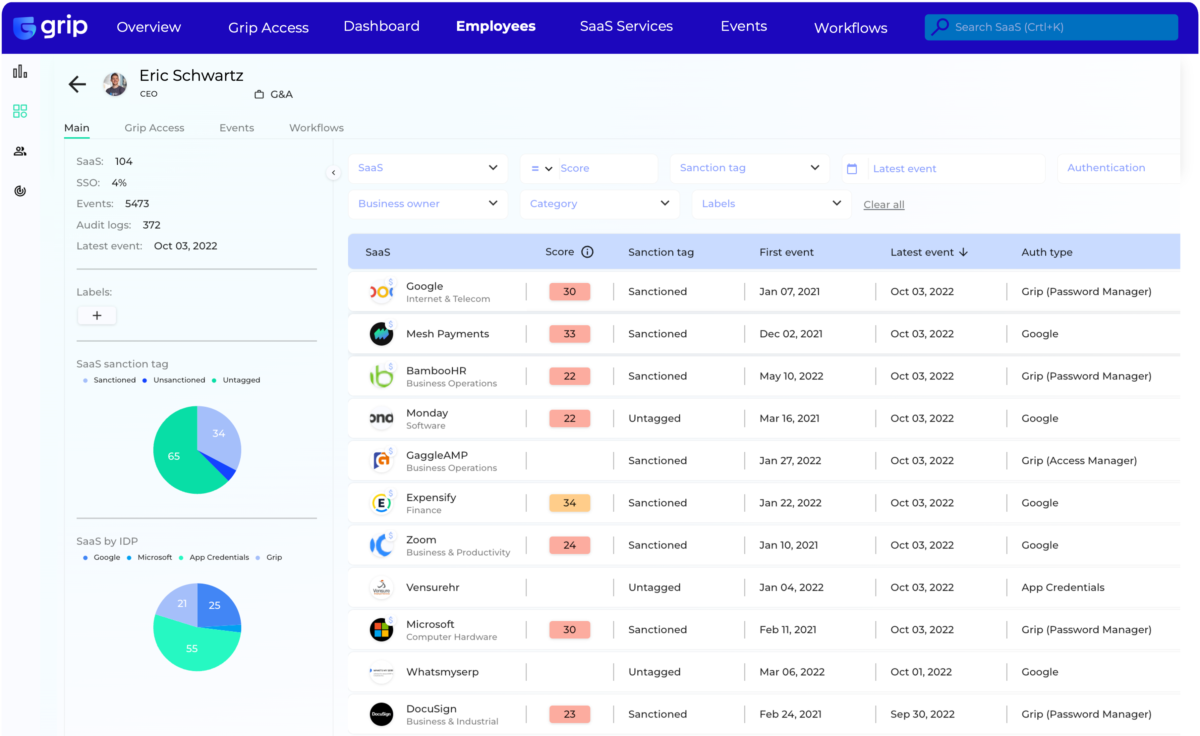
Grip, another Reco competitor, consolidates SSPM, SSCP, and ITDR into a single platform, enabling security teams to eliminate risk, enforce least privilege, simplify audits, and uncover unused or redundant licenses.
It takes an endpoint-centric approach, the Grip client becomes the access layer for SaaS, providing visibility and control without agents, inline redirections, or performance degradation typical of CASB solutions.
Key Features:
- SaaS and Shadow AI Discovery: Discovers every app including shadow IT and shadow AI without SSO dependence or network changes.
- SSPM and ITDR: Continuous posture management combined with identity threat detection and response in one platform.
- OAuth and Third-Party App Risk: Maps all OAuth connections, third-party collaborators, and activity events across the SaaS estate.
- Data Loss Prevention: Granular data access control policies to reduce overexposure and exfiltration risk.
- Automated Remediation Workflows: Security workflows for access orchestration and remediation without agents or inline redirections.
Strengths:
Grip operates without agents, inline redirections, or performance degradation typical of CASB solutions, making deployment straightforward. Strong fit for security teams focused on SSPM, ITDR, and identity-centric risk.
Limitations:
Grip is purpose-built for security use cases. It doesn't cover SaaS spend management, procurement workflows, or identity lifecycle automation at the depth broader platforms provide.
Pricing:
Custom pricing based on number of users and selected capabilities. Pricing follows an annual per-user model.
3. Lumos
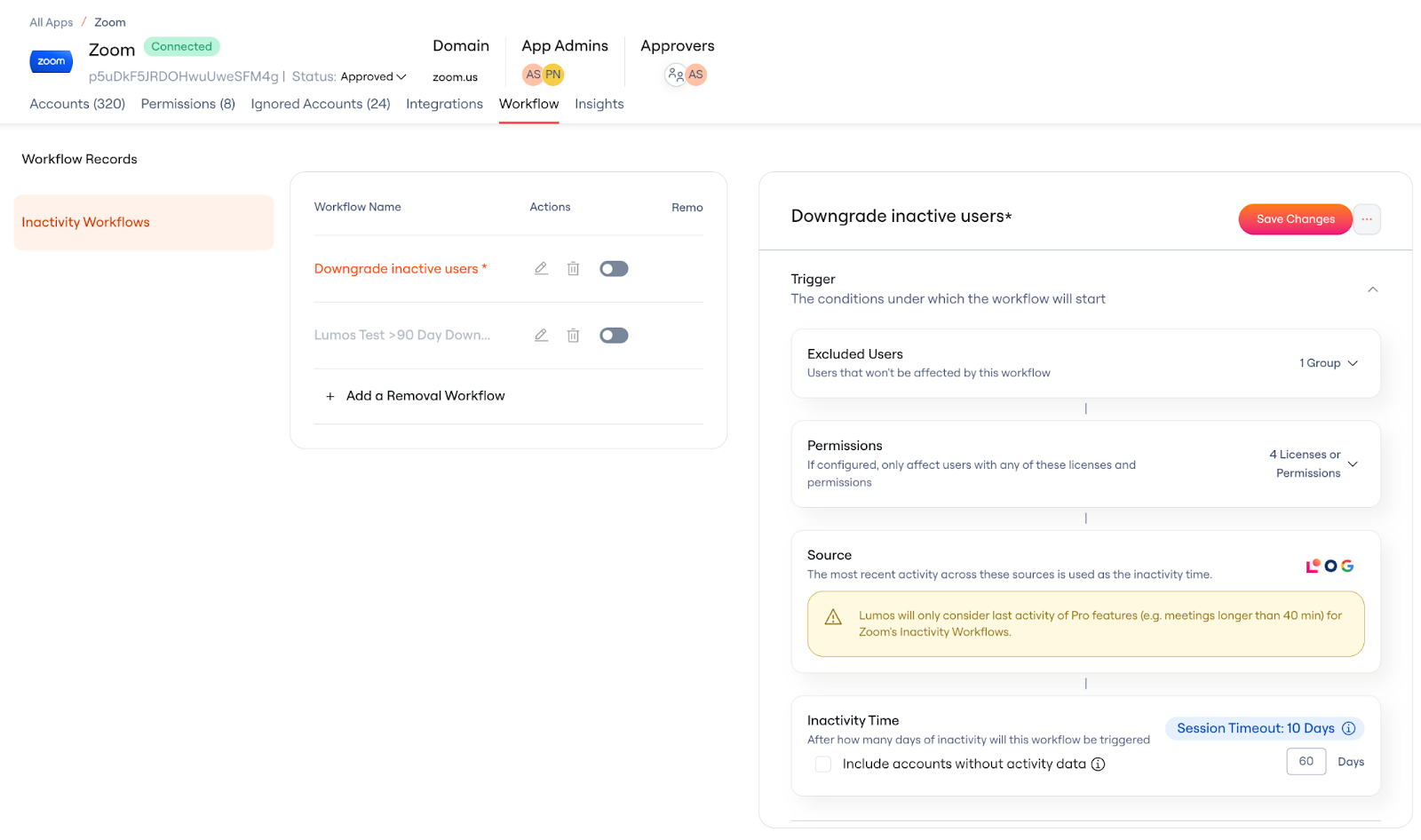
Lumos is an autonomous identity platform that governs access for every human, machine, and AI in the enterprise.
It combines identity governance, privileged access management, and SaaS management in one platform. It’s for organizations that want AI-driven identity governance without the complexity of legacy IGA platforms.
Key Features
- AI-Powered Delta Access Reviews: Reviews focus only on changes since the last cycle, reducing review fatigue while maintaining compliance with SOX, HIPAA, and GDPR.
- JML Lifecycle Automation: Joiners get what they need on day one, movers don't accumulate excess access, and leavers are fully offboarded with licenses reclaimed automatically.
- Non-Human Identity Governance: Agents discover every machine identity, assign owners, decommission dormant accounts, and right-size overscoped service accounts.
- Self-Service App Store: Employees request access through Slack, an IT system, or MCP, provisioned just-in-time against policy with no standing privileges.
- SaaS License Optimization: Identifies unused or underutilized licenses and automates reclamation, delivering cost savings and preventing SaaS sprawl.
Strengths:
Reviewers consistently praise Lumos for its clean UI, automated provisioning, and time-saving access review workflows. The AI-agent approach handles routine certifications autonomously and escalates only ambiguous cases.
Limitations:
Integration support for niche, legacy, and custom applications is limited. Lumos also doesn't cover SaaS spend management, procurement workflows, or AI governance at the depth of broader platforms.
Pricing:
Book a demo with the sales team.
4. Nudge Security
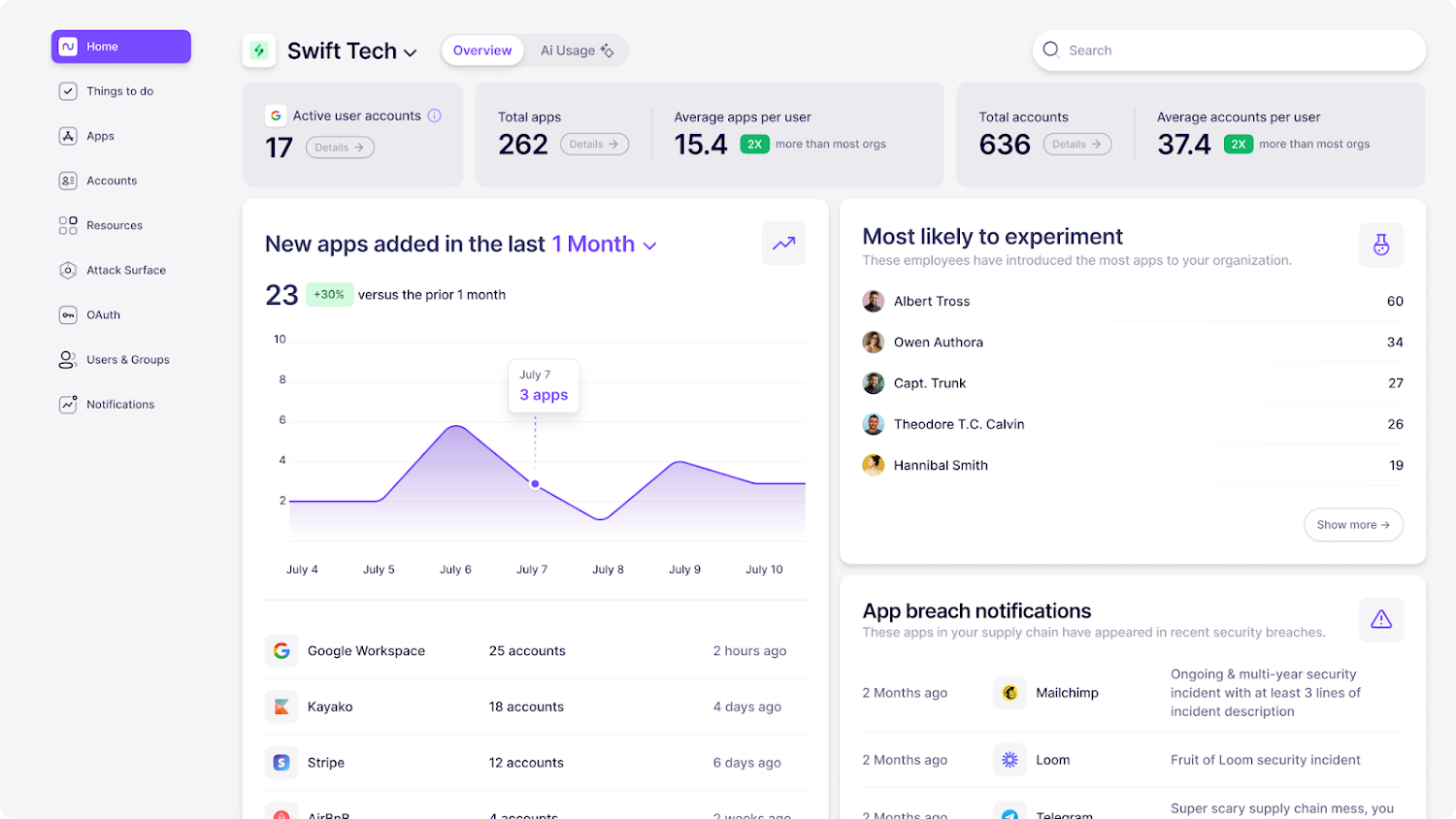
Nudge Security, closest Reco alternative after CloudEagle.ai uses a patented, agentless discovery approach that requires no browser plugins, agents, network proxies, or changes to employee behavior.
Rather than blocking unsanctioned tools, it guides employees toward secure choices through automated behavioral nudges via Slack, email, or browser.
Key Features
- Agentless SaaS and AI Discovery: Discovers every SaaS and AI account without proxies, agents, or network changes.
- Behavioral Nudges: Automatically engages employees via Slack, email, or browser when new tools are detected.
- SaaS Supply Chain Risk: Maps app-to-app integrations, OAuth grants, and API tokens, and alerts teams when a third- or fourth-party breach puts the organization at risk.
- Shadow AI Detection: Detects sensitive data shared with AI chatbots through file uploads and copy-paste activities.
- SaaS Spend and Redundancy Visibility: Surfaces redundant and shadow SaaS spend and upcoming renewal dates without mining expense reports or credit card statements.
Strengths:
Users consistently praise Nudge Security's visibility, ease of deployment, and user-friendly interface. The agentless architecture and Day One visibility make it one of the fastest platforms to deploy on this list.
Limitations:
Nudge Security is designed around SaaS security and behavioral governance rather than identity lifecycle automation or procurement workflows. Some users note that the frequency of automated nudges can lead to alert fatigue.
Pricing:
All-in-One Pricing: $5/user/month (150 - 2500 accounts)
5. Obsidian Security
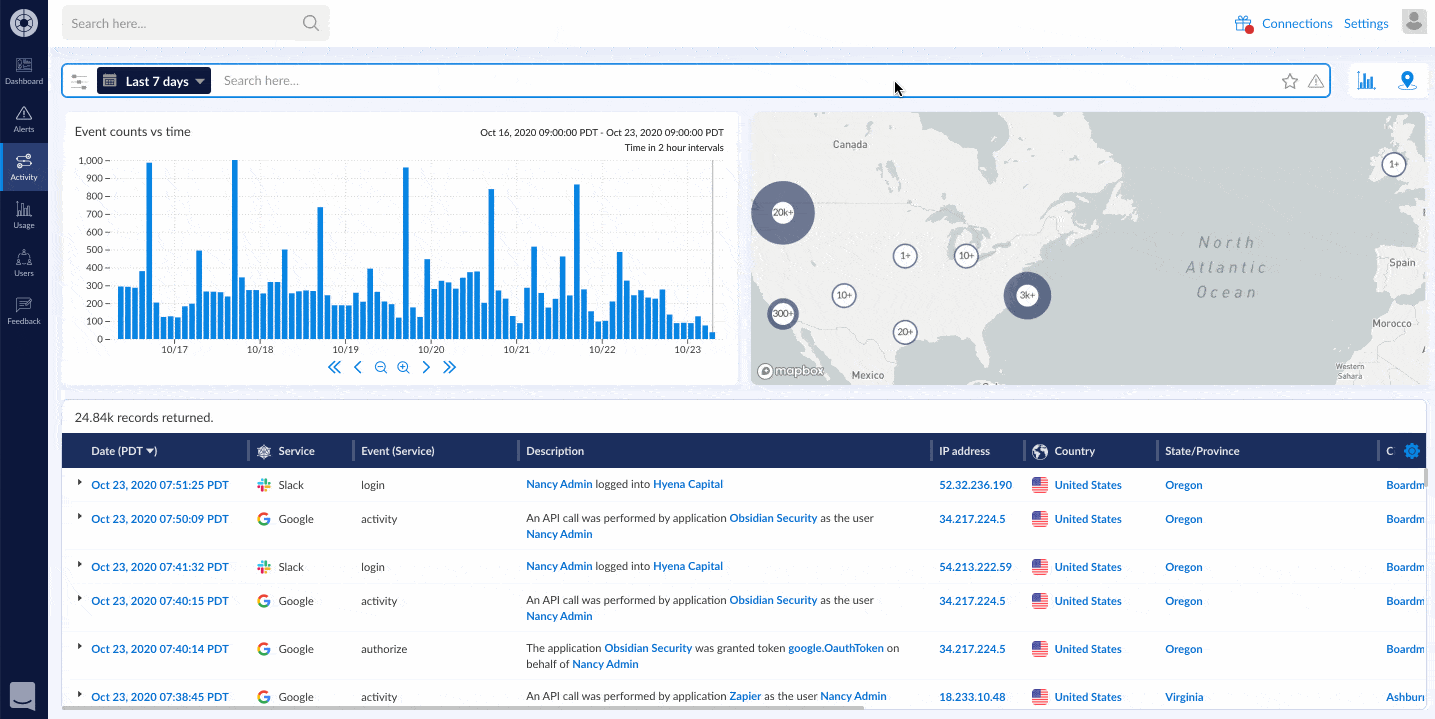
Obsidian Security combines SSPM, ITDR, and AI Threat and Risk Management in a platform built around a Knowledge Graph that correlates identity, activity, and threat data.
It is agentless and API-based for enterprise deployments, with a browser extension option for mid-market organizations. The platform claims to reduce over-permissioning by 90%.
Key Features:
- SaaS Security Posture Management: Handles configuration drift remediation, automated compliance checks, and malicious integration identification.
- Identity Threat Detection and Response: Behavioral analytics and anomaly detection that identifies account compromise, insider threats, and credential misuse across the SaaS estate.
- AI Threat and Risk Management: Discovers shadow AI tools, enforces GenAI usage policies, and monitors sensitive data shared with AI applications through browser-level visibility.
- Knowledge Graph Correlation: Correlates agent privileges with behavioral patterns, flagging excessive permissions and activity deviating from established baselines.
- Supply Chain Defense: Monitors third-party integrations and alerts teams when connected SaaS providers experience breaches affecting the organization.
Strengths:
The Knowledge Graph approach to correlating identity and activity data is a genuine differentiator for security operations teams needing deep SaaS threat intelligence.
Limitations:
Integration options are limited to key SaaS applications. Shadow AI discovery is limited to Chrome browser. Obsidian doesn't cover SaaS spend management, identity lifecycle automation, or procurement.
Pricing:
- Free Plan: Supports up to 1,000 users
- Foundation & Advanced: Get a customized quote.
6. Zluri
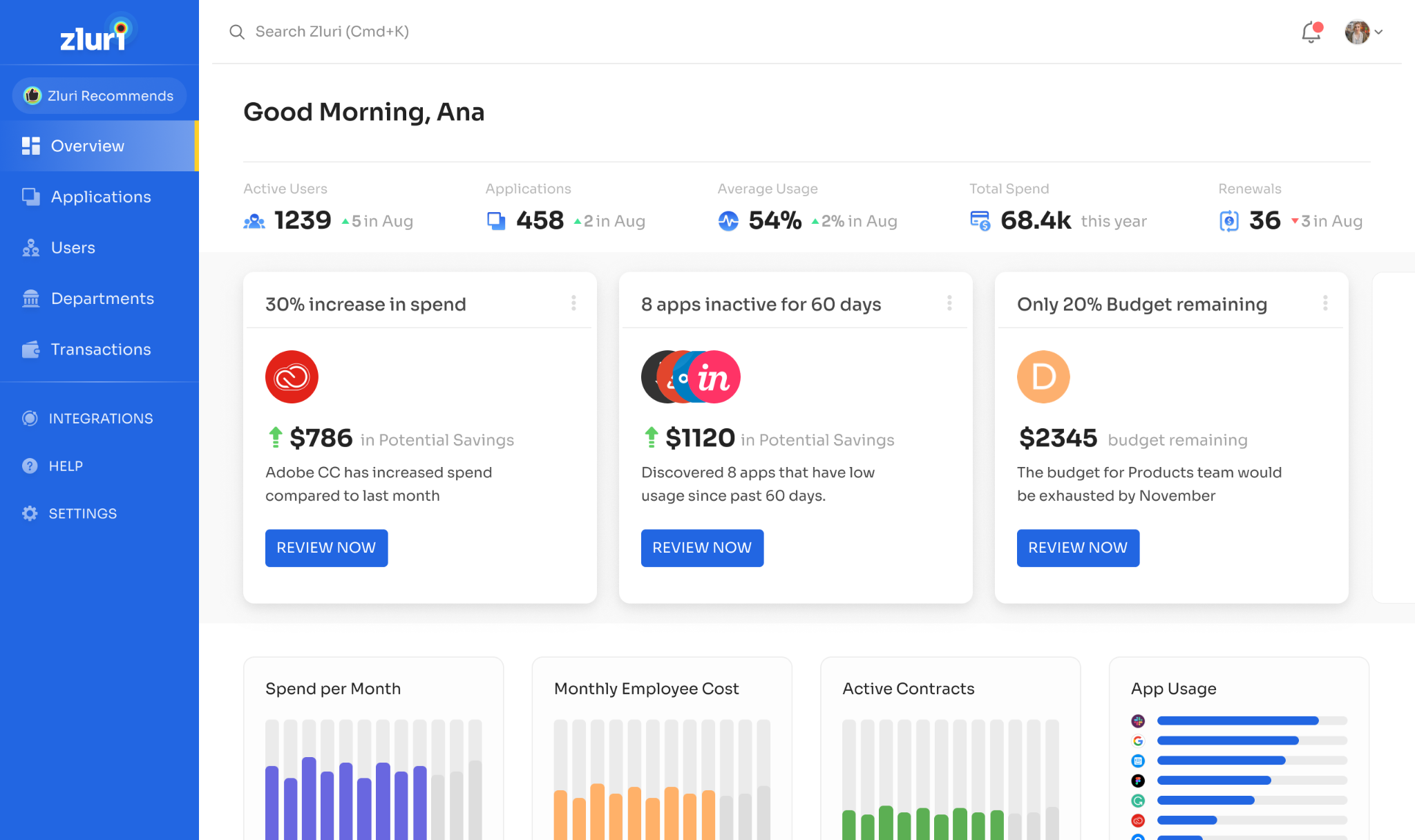
Zluri is a next-gen Identity Governance and Administration platform that enables IT and security teams to discover identities and applications, streamline access management, and automate access reviews.
Built around IRIS, a real-time identity intelligence system, it connects and contextualizes every identity signal across the enterprise, spanning SaaS management, IGA, and shadow AI governance.
Key Features:
- SaaS and Shadow AI Discovery: Discovers 239K+ apps with auto-classification, continuously detecting unauthorized SaaS and AI applications as they appear.
- Identity Governance and Access Reviews: Automates access reviews and certifications for SOX, HIPAA, and SOC 2 compliance.
- JML Lifecycle Automation: Automatically provisions and deprovisions access across applications based on HR system events, with inactive user tracking at 30, 60, and 90-day thresholds.
- License Optimization: Inactive user tracking, optimization reports, and spend analytics identify unused licenses, duplicate subscriptions, and renewal opportunities.
- Contract and Renewal Management: Tracks pricing, analyzes contract terms, and surfaces renewal dates across the SaaS stack.
Strengths:
Zluri provides centralized visibility such as application usage, inactive users, service accounts, spend, and contracts in one place without spreadsheet reconciliation.
Limitations:
Some integrations allow full user management while others only support removal, creating inconsistency. Initial setup and integration with multiple tools can be time-consuming.
Pricing:
Book a personalized demo with the sales team.
7. Zylo
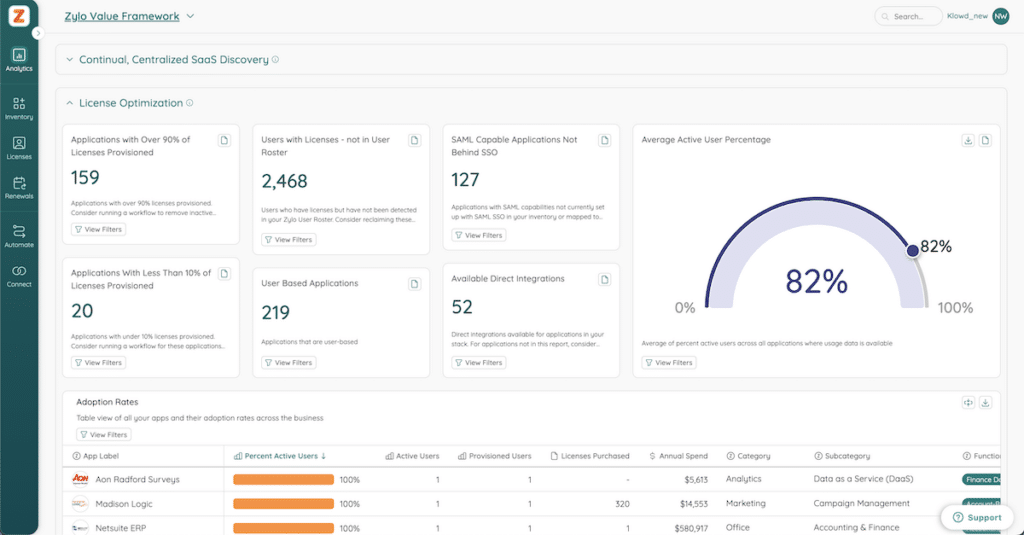
Zylo is the enterprise leader in SaaS Management, with more than 40 million SaaS licenses and $40 billion in SaaS spend under management.
Its focus is financial: SaaS discovery, license optimization, renewal management, and spend intelligence for IT, Procurement, and FinOps teams.
Key Features
- Multi-Source SaaS Discovery: Uses financial data, SSO, and expense systems to uncover all software spend, including shadow IT and hidden PCard purchases.
- License Optimization: Tracks utilization at scale, identifies inactive licenses, and surfaces consolidation opportunities across overlapping tools.
- AI Consumption Cost Management: Monitors AI API costs against commitments, forecasts consumption, and manages spend across OpenAI, Anthropic, and data platforms alongside traditional SaaS.
- Renewal Management and Peer Benchmarking: Centralizes contract management and renewal schedules with peer benchmark data to support vendor negotiations.
- Professional Services: Dedicated SaaS negotiation support backed by $40B+ in spend data.
Strengths:
Zylo's procurement and FinOps teams benchmarking leverage that purpose-built security platforms can't match. The April 2026 AI Consumption Cost Management launch extends that strength into usage-based AI spend.
Limitations:
Zylo is not a security or identity governance platform. It doesn't cover OAuth risk, access reviews, identity lifecycle automation, or shadow AI detection at the depth of security-focused tools on this list.
Pricing:
Book a demo with the sales team.
Which Reco alternative should you choose?
The right choice depends on where the governance gap actually sits.
A tool that's strongest on security posture alone, or one that leads on identity lifecycle or SaaS discovery specifically, is the faster fit for a narrow gap.
For a combined gap, AI usage governed, policy enforced at the point of use, non-human identities tracked, and spend still visible, CloudEagle.ai keeps a shadow AI finding, an access review, and a renewal conversation on the same platform instead of three separate dashboards.
Book a demo scoped to the modules that match the actual gap, not the full suite by default.
FAQs
1. What's the main difference between CloudEagle.ai and Reco?
Reco focuses on SaaS security monitoring: threat detection and data exposure. CloudEagle.ai governs AI usage, policy enforcement, non-human identities, and SaaS spend alongside security posture. The choice usually comes down to whether you need stronger security monitoring or broader AI governance.
2. Does CloudEagle.ai's AI policy enforcement block risky activity, or just flag it?
It blocks sensitive data from reaching unsanctioned AI tools in real time, not just after the fact. When someone opens an unapproved AI tool, CloudEagle.ai can redirect them to a sanctioned alternative on the spot.
3. Can CloudEagle.ai and Reco be used together?
Yes. Some teams run CloudEagle.ai for AI governance and spend, while keeping Reco for deep SaaS security monitoring. The two overlap in shadow IT discovery, so most teams pick one as primary rather than running both in full.
4. How is CloudEagle.ai's pricing different from Reco's?
CloudEagle.ai is priced by module, so a team can license just AI Governance and Security & Compliance. Neither platform publishes flat rates; both require a demo to get a quote scoped to your needs.
5. Does CloudEagle.ai govern AI agents the same way it governs employees?
Yes. Service accounts, API keys, and AI agents get the same ownership and access-review treatment as human employees, which matters since most machine identities never go through formal review.
Finding Risk Doesn't Reduce It


.avif)


.avif)
.avif)




.png)





.png)
.avif)
.avif)
.avif)


