.avif)
%201.svg)


HIPAA Compliance Checklist for 2025

Think about the last time a team signed up for a new SaaS tool. A quick card payment, a fast trial signup, or a small team purchase that never reached finance or IT.
This is how duplicate subscriptions usually begin. Small decisions are made in isolation, scattered across cards, trials, and department budgets. Over time, they add up and inflate SaaS spend without anyone noticing.
The real challenge is visibility. Finance sees charges, IT sees app usage, procurement sees renewals, and none of these views connect end to end.
This article explains why duplicates slip through, what the current process misses, and how CloudEagle.ai helps you find and eliminate overlapping SaaS subscriptions before they grow into unnecessary spend.
How Companies Try to Find Duplicate SaaS Subscriptions Today?
Most teams try to manage duplicate SaaS subscriptions using a mix of finance data, SSO logs, app dashboards, and spreadsheets. The process looks organized on paper, but breaks down in practice because every system holds a different piece of information.
Instead of a unified view, companies end up stitching together partial insights from finance, IT, procurement, and individual departments.
Below is what the current state actually looks like today:
This is the operating reality for most organizations today. It’s manual, fragmented, and dependent on humans catching patterns that the systems themselves do not surface.
How CloudEagle.ai Helps Identify and Eliminate Duplicate SaaS Subscriptions?
The tools that prevent duplicate subscriptions see every purchase, including tools bought outside SSO, and act on an overlap before the next renewal. CloudEagle.ai, an AI-powered SaaS Management, AI Governance, and SaaS Security platform, does this by joining finance, identity, usage, contract and browser data in one workflow.
Here is how to find duplicate SaaS subscriptions and eliminate them with CloudEagle.ai, step by step.
A. Discover Every App, Including Those Purchased Outside IT
Duplicates hide where IT rarely looks: a team lead's corporate card, an expense report, a free trial that quietly converted.
CloudEagle.ai builds the full app list from several sources at once. EagleIQ, its context graph, correlates SSO, HRIS, finance and expense data, browser activity and contracts across 500+ direct integrations. SaaS subscriptions purchased outside of IT show up next to the ones procurement signed, and AI tools are included, so a second ChatGPT workspace or an orphaned AI subscription on someone's card surfaces too.
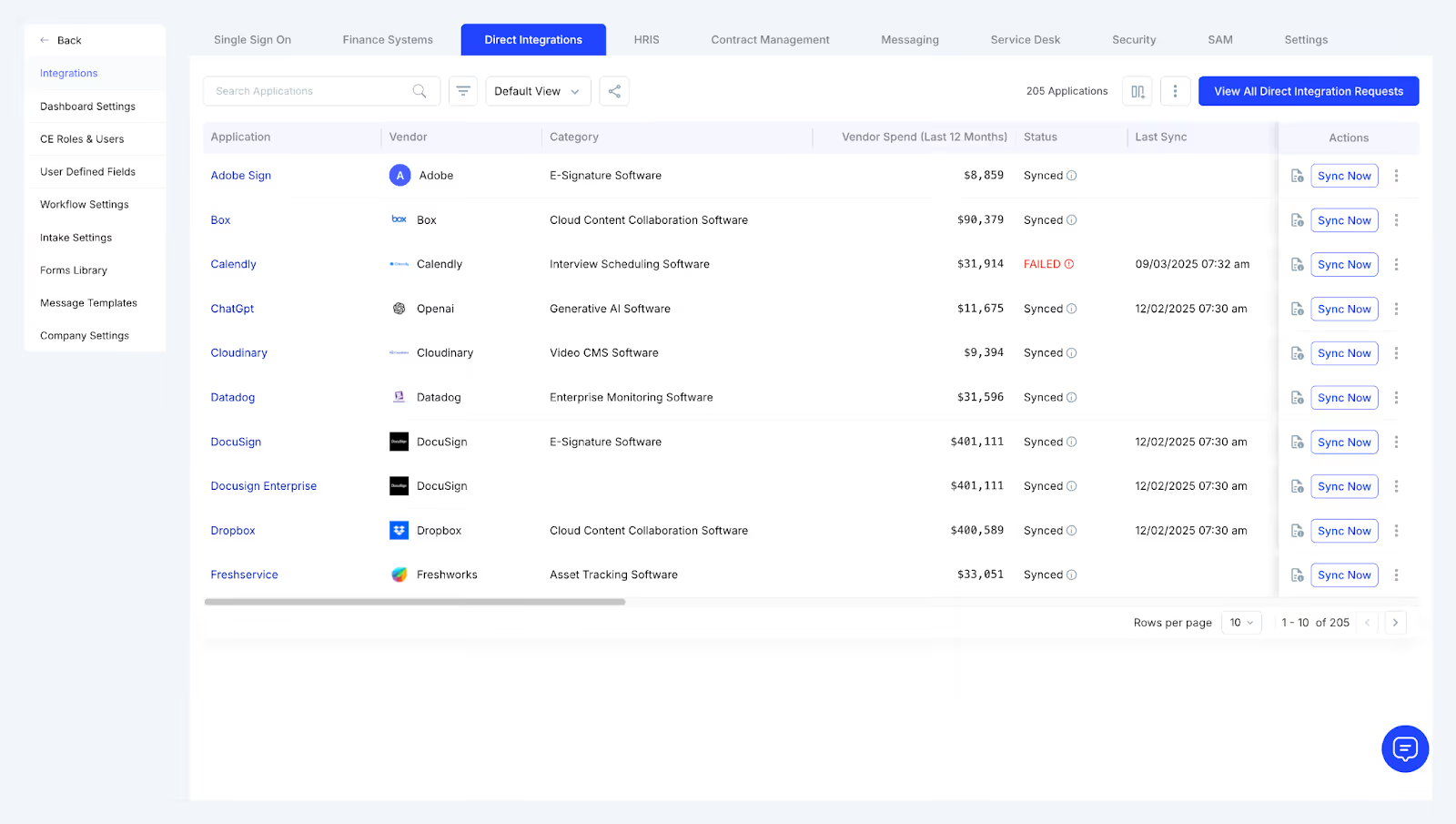
You start with one inventory instead of five partial ones. Next comes spotting which apps overlap.
B. Group Apps by Function to Expose Overlap
Raw data rarely labels anything a duplicate. The same vendor shows up as "Adobe," "Adobe Inc" and "Acrobat Pro," and two teams can pay for different tools that do the same job.
CloudEagle.ai normalizes vendor names across every source and groups apps into functional categories such as project management, CRM, design and AI assistants. In the application rationalization view, Asana and Trello sit side by side, and so do three copilots bought by three departments.
Overlap alone does not prove waste, so the next step is checking who actually uses each app.
C. Confirm True Duplicates With Usage, Spend and Access Data
Two tools in one category might both be needed. A duplicate is only confirmed when spend, usage and access data agree.
CloudEagle.ai correlates who has access through SSO and HRIS, who actually uses the app through app-level APIs (down to features and roles), what each subscription costs, and which contracts exist for the same vendor. That exposes multiple subscriptions for the same tool, teams paying separately for identical apps, and the specific users holding licenses in two redundant tools.
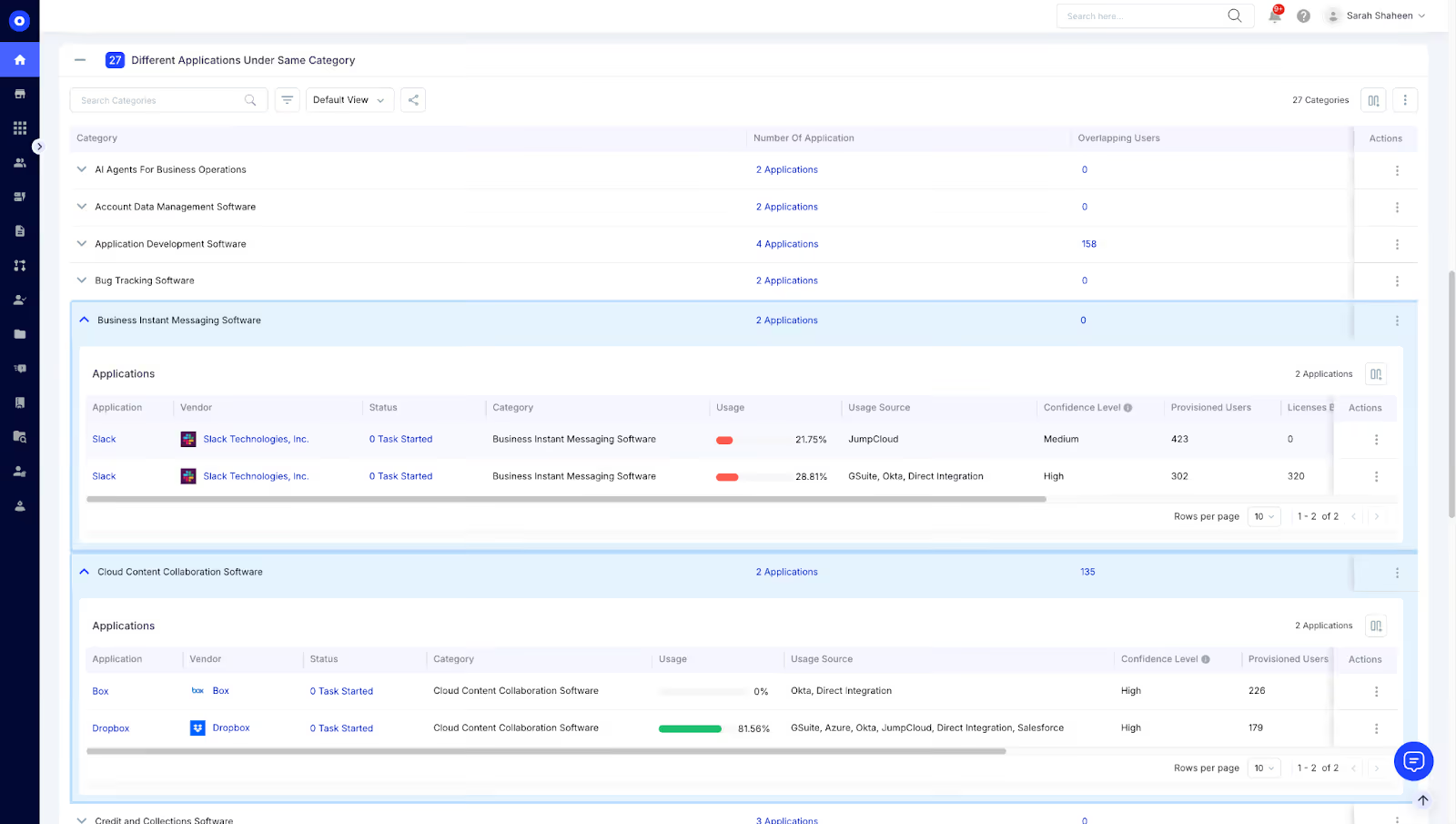
You get a named list of apps, users and dollars. Then the focus shifts to stopping new ones.
D. Catch New Duplicates the Day They Appear
A one-time cleanup does not keep the stack clean. New card charges and trial conversions keep adding duplicates between audits.
CloudEagle.ai monitors continuously and flags a new subscription when it overlaps something you already pay for. Alerts reach IT, finance and app owners in Slack or email, and trials converting to paid plans are flagged before the first full invoice.
When an employee requests a tool the company already owns, the self-service app catalog routes them to the existing license instead of a new purchase.
For duplicates already on the books, the next move is getting licenses back.
E. Reclaim Duplicate Licenses Through Approval Workflows
Every confirmed duplicate leaves licenses behind: users assigned to two tools in the same category, inactive seats, or plans pitched higher than the work needs.
CloudEagle.ai turns these into automated license reclamation workflows. It messages the user, follows up, and routes each downgrade, removal or reassignment through an approval step, so no license is cut without sign-off. Deprovisioning, access revocation or an ITSM ticket can be triggered from the same screen.
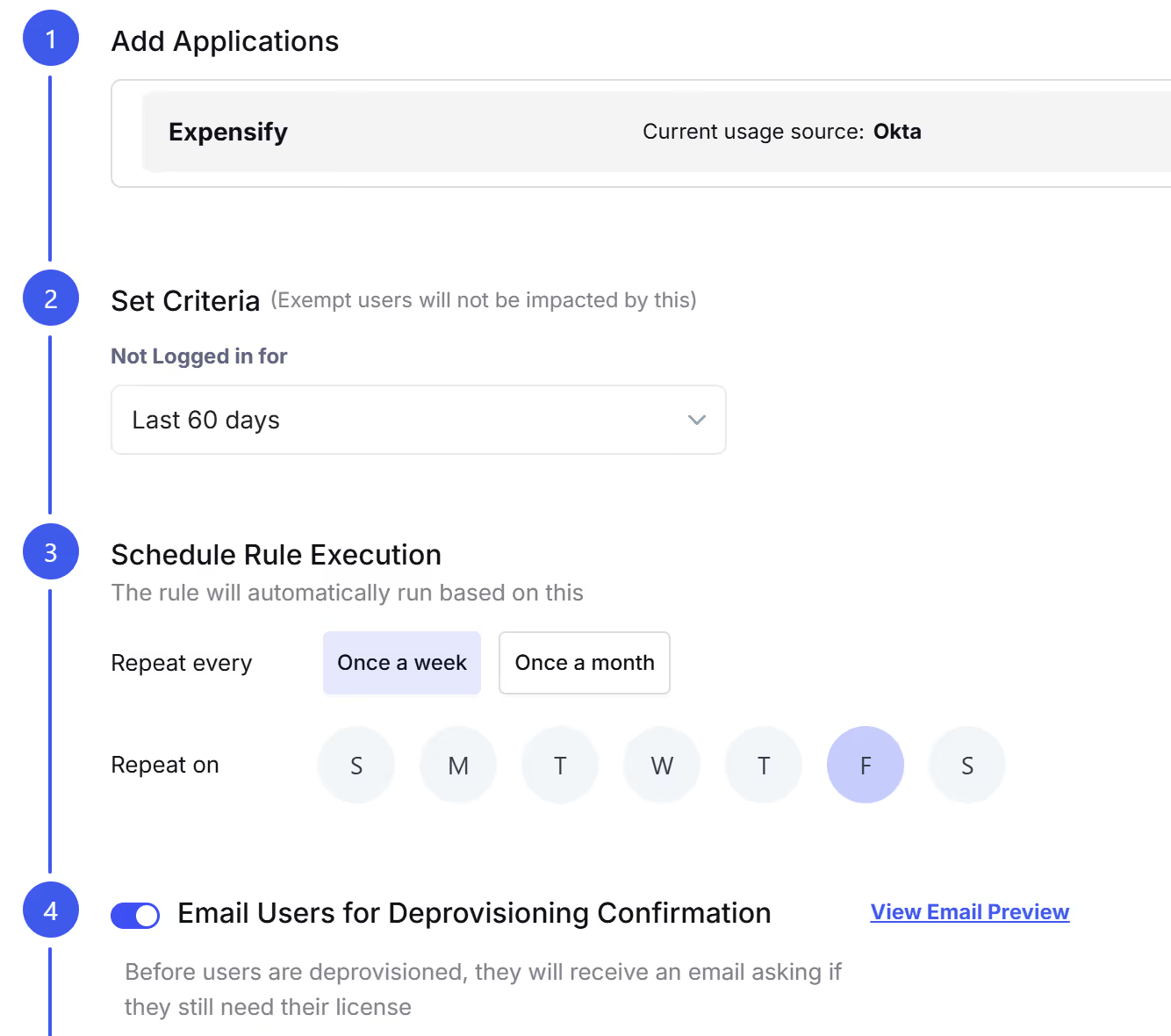
Seats come back without IT chasing anyone. What remains is the contract.
F. Consolidate Contracts Before the Renewal Locks In
Licenses can be reclaimed any day, but overlapping contracts are fixed at renewal. Miss that window and the duplicate rolls over for another year.
The renewal calendar in CloudEagle.ai lines up every contract for the same vendor or category with its renewal date, so procurement can co-term agreements, merge them, or let the redundant one lapse. Price benchmarking, which needs no contract upload, shows what similar companies pay before you negotiate the contract you keep.
RingCentral saved more than $250K by consolidating the duplicate apps CloudEagle.ai surfaced this way.
“We didn't have centralized visibility to identify apps with overlapping functionalities. CloudEagle provided a comprehensive view of our SaaS portfolio. The tool we had no central view of our SaaS portfolio, so duplicate tools with overlapping functionality were invisible until CloudEagle surfaced them. Once we could see which apps were redundant and who had access to them, the consolidation decision was straightforward.”
- Eric Silver, AVP, Head of Procurement, RingCentral
The result is a smaller stack, fewer contracts, and duplicates that stay gone.
What Goes Wrong When Duplicate SaaS Goes Unnoticed?
SaaS ownership has become increasingly distributed as teams adopt tools independently to move faster.
That flexibility helps execution, but it also introduces a blind spot: duplicate subscriptions that quietly drain budgets and increase risk. Most organizations don’t see the problem until it shows up in a renewal, a credit card audit, or a budget review.
Duplicate SaaS isn’t just a financial nuisance. It creates operational friction, weakens governance, and undermines the ability to manage spend strategically.
Most companies don’t see:
- How many versions of the same app are different teams paying for
- Whether licenses across plans are being used
- What tools were purchased independently on credit cards or as free trials
- Whether the spend mapped to those tools was ever reviewed, approved, or consolidated
And the current process doesn’t support:
- Consistent visibility into all SaaS contracts and renewal cycles
- Proactive detection of shadow purchases before they convert into paid plans
- Reliable license cleanup when employees leave or switch teams
- Centralized decision-making that prevents overlapping contracts across the organization
As a result, spending grows without clear justification. Duplicate apps sit on different cards and budgets. Free trials turn into recurring charges that no one notices for months.
IT teams spend hours reconciling SSO logs with finance data, yet still can’t clearly identify who owns which tool or whether two subscriptions are actually duplicates.
By the time these issues surface, organizations have already missed negotiation windows, overpaid for redundant tools, and locked themselves into unnecessary contracts. This is why duplicate SaaS subscriptions quickly become one of the most persistent sources of wasted spend across modern SaaS environments.
Stop Letting Duplicate Tools Drain Your Budget
Duplicate SaaS spend adds up quickly, and now you know where it comes from, why current methods miss it, and how organizations lose value without realizing it.
If you want continuous clarity instead of quarterly cleanup, CloudEagle.ai gives you the visibility and automation to catch duplicate subscriptions early and keep your SaaS stack efficient year-round.
FAQs
1. Which tools prevent duplicate SaaS subscriptions, not just find them?
Tools that pair discovery with action: multi-source data to spot overlaps, plus alerts, request routing and reclamation workflows to stop new ones. CloudEagle.ai covers both.
2. Which platforms detect unused or duplicate SaaS accounts automatically, beyond SSO?
SSO only sees federated apps, so card purchases and converted trials stay hidden. CloudEagle.ai correlates SSO with finance, browser and app-level usage data across 500+ integrations.
3. How do I identify SaaS subscriptions purchased outside of IT?
Start with spend. Card, expense and AP data reveal tools that never touched SSO, and CloudEagle.ai adds browser discovery so they land in the same inventory as approved apps.
4. How do you reduce redundant SaaS subscriptions across teams without disrupting them?
Confirm usage first. Keep the tool most people use, move the rest onto it, and consolidate contracts at renewal, with approvals so app owners weigh in.
5. Is automated SaaS license reclamation safe for duplicate licenses?
Yes. CloudEagle.ai automates outreach and follow-ups, and every downgrade or removal goes through an approval workflow first.


.avif)


.avif)
.avif)




.png)




.avif)
.avif)
.avif)


