

%201.svg)


HIPAA Compliance Checklist for 2025

81% of organizations have no visibility into the AI tools their employees are actively using. That is not a gap in awareness. That is a governance failure waiting to become a breach.
CISOs in 2026 are facing two distinct security challenges simultaneously: AI-powered attacks are becoming increasingly sophisticated by the month, and employees are deploying AI tools faster than any security review process can keep pace with.
The best AI security tools address both. Most only address one. This guide helps you distinguish between them.
TL;DR
- AI security tools fall into two categories: AI for Security (threat detection, SOC automation) and Security for AI (shadow AI discovery, governance, compliance)
- Most enterprises invest heavily in Category 1 and almost nothing in Category 2, where the real ungoverned risk lives
- 81% of organizations lack visibility into AI usage across their environments, per Cycode's 2026 report
- CISOs need tools that cover both threat detection and AI governance, not just one side of the equation
- CloudEagle.ai is the only tool on this list built specifically to govern enterprise AI adoption end-to-end
1. What Are AI Security Tools? The Two Categories CISOs Need to Know
Before evaluating any tool, it helps to understand what type of problem it actually solves. Most vendors blur this line deliberately.
Category 1: AI for Security
These tools make your security operations faster and smarter using machine learning:
- AI-powered threat detection and behavioral anomaly detection
- SOC automation and alert triage
- AI-driven threat intelligence and incident response
- Endpoint, network, and cloud monitoring
Category 2: Security for AI
These tools govern the AI itself, not just protect against external threats:
- Shadow AI discovery across sanctioned and unsanctioned apps
- AI usage monitoring and policy enforcement at the point of behavior
- LLM data leakage prevention
- AI compliance tracking against GDPR, EU AI Act, SOC 2
- AI vendor risk management and spend governance
Most competitors cover Category 1 well. Almost none address Category 2 with real depth. This guide covers both.

2. Why CISOs Must Prioritize AI Security Tools Now
The pressure is coming from multiple directions simultaneously.
The bottom line: AI has expanded the attack surface faster than traditional controls can adapt. AI cybersecurity tools that only address the perimeter are already behind.
Before evaluating tools, it helps to understand what shadow AI actually looks like inside an enterprise and how it creates compliance exposure that most security teams are not tracking.
📖 Worth a Read: Shadow AI is already inside your organization, including inside tools IT has already approved. Here is how enterprises are discovering and governing it before it becomes a compliance problem. 👉 Shadow AI in Financial Services: How Finance Teams Are Introducing Unseen Risk
3. How We Evaluated These AI Security Tools
Every tool was assessed against criteria that matter for real enterprise security programs:
4. 7 Best AI Security Tools for CISOs in 2026
1. CloudEagle.ai
CloudEagle.ai is an AI-powered AI governance, SaaS management and SaaS security platform that gives enterprises a unified command center to discover, secure, govern, and optimize both human and non-human identities across their entire SaaS and AI ecosystem.
Enterprises can govern AI usage, identify the teams and users consuming most AI tokens, enabling end-to-end AI usage control.
You can also configure safe usage policies to ensure that users don't use unsanctioned AI tools nor upload sensitive data into LLMs, ensuring an organization stays secure in the era of AI.
Discover Shadow AI Across the Enterprise
Most tools see what is connected to SSO. CloudEagle sees everything else, too.
It discovers every AI tool in use by correlating browser signals, Zscaler logs, CrowdStrike data, and finance integrations against SaaSMap, its proprietary AI app inventory built specifically for enterprise AI discovery.
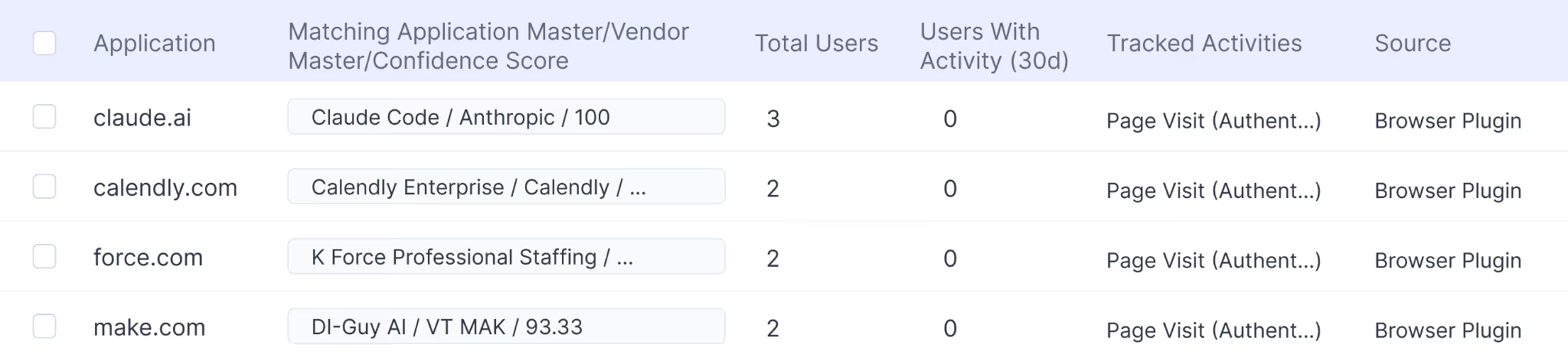
- Surfaces AI tools accessed through personal accounts, not just corporate SSO
- Identifies AI features activating silently inside already-approved SaaS products
- Shows adoption by team, department, and user, not just a list of app names
- Flags which tools are sanctioned, which are unreviewed, and which need immediate action
Control AI Usage in Real Time
Quarterly policy reviews do not stop data from leaving. Real-time enforcement does.
When an employee tries to access an unapproved AI tool, CloudEagle steps in at the moment of behavior. A flash page educates them on your safe AI usage policy and redirects them to the approved alternative, before any data is shared.
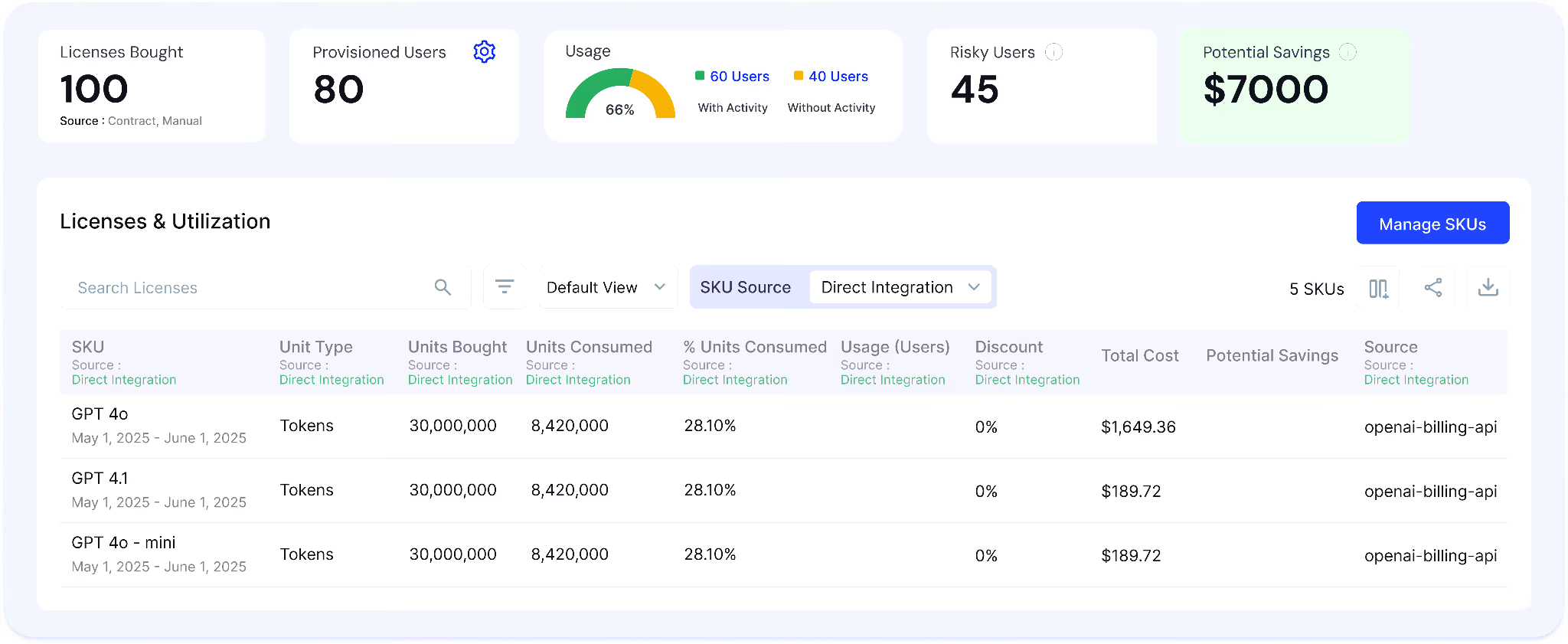
- Redirects users from unapproved AI tools to approved alternatives using real-time flash pages
- Maintains a centralized list of approved AI tools aligned to security policies
- Enforces AI usage policies across all users without disrupting productivity
- Ensures AI usage is continuously monitored, not periodically reviewed
Reduce AI Risk and Maintain Compliance
Not all shadow AI carries equal risk. CloudEagle classifies every discovered AI tool by risk level using security profiles powered by a native Netskope integration.

- Assigns risk scores to every AI tool using security profiles and external integrations
- Tracks sensitive data flowing into external AI tools
- Maintains audit-ready logs of every AI access event
- Surfaces compliance gaps across GDPR, CCPA, EU AI Act, and SOC 2
Orphaned Account and API Token Detection
Former employees retaining AI tool access is one of the most overlooked governance gaps. CloudEagle surfaces it automatically.
- Identifies orphaned accounts belonging to departed employees still accessing AI tool
- Detects active API tokens connected to AI systems that were never formally reviewed
- Flags non-human identities, including service accounts and bots, with AI tool access
- Continuous monitoring so new shadow AI usage surfaces immediately, not at the next audit
Your AI Footprint Is Bigger Than You Think.


2. CrowdStrike Falcon
CrowdStrike uses AI and behavioral analysis to detect threats across endpoints, cloud workloads, and identities in real time. Its Threat Graph processes trillions of security events weekly to surface attack patterns that signature-based tools miss.
Key features:
- AI-driven behavioral endpoint detection and response
- Threat intelligence correlation across the CrowdStrike customer base
- Identity threat protection and privileged access monitoring
- Cloud workload security and container protection
Limitations:
- Expensive at enterprise scale
- Primarily focused on threat detection, not AI governance or shadow AI discovery
Pricing: Starts at approximately $15/endpoint/month for Falcon Go. Enterprise plans vary based on the modules selected.
3. Darktrace
Darktrace uses unsupervised machine learning to build a behavioral baseline for every user, device, and system. It detects deviations in real time without relying on signatures or known threat patterns.
Key features:
- Self-learning AI that adapts to your specific environment
- Autonomous response capabilities that contain threats without human intervention
- Email security with AI-powered phishing and impersonation detection
- OT and IoT security coverage
Limitations:
- High false positive rate during the initial learning period
- Limited visibility into AI tool usage and shadow AI
Pricing: Custom pricing based on organization size and deployment scope. Typically starts around $30,000/year for smaller deployments.
4. Palo Alto Cortex XSIAM
Cortex XSIAM combines SIEM, SOAR, EDR, and threat intelligence into one AI-powered platform. It uses machine learning to correlate alerts, prioritize threats, and automate response playbooks.
Key features:
- Unified AI-driven alert correlation across the entire security stack
- Automated threat response and playbook execution
- Identity analytics and behavioral threat detection
- Cloud and endpoint coverage in a single platform
Limitations:
- Complex implementation, especially in hybrid environments
- High cost, particularly for smaller security teams
- Not designed to govern AI tool usage or detect internal shadow AI
Pricing: Custom enterprise pricing. Typically starts at $100,000+ annually for enterprise deployments.
5. Microsoft Security Copilot
Security Copilot uses GPT-4 combined with Microsoft's threat intelligence to help security analysts investigate incidents, summarize alerts, and generate response guidance in natural language.
Key features:
- Natural language interface for security investigation and triage
- Integration with Microsoft Sentinel, Defender, Entra, and Purview
- Automated incident summary and remediation guidance
- Threat intelligence synthesis from Microsoft's global signal network
Limitations:
- Deep Microsoft ecosystem dependency, limited value outside that stack
- Does not address shadow AI governance or internal AI tool usage policies
Pricing: $4/security compute unit (SCU) per hour. Minimum 1 SCU provisioned. Costs vary significantly based on usage volume.
6. Lakera Guard
Lakera Guard sits as a protection layer between users and LLM applications, detecting and blocking adversarial inputs in real time. It maintains an extensive database of prompt injection techniques and jailbreak patterns.
Key features:
- Real-time prompt injection and jailbreak detection
- Sensitive data leakage prevention at the LLM input and output layer
- Policy enforcement for LLM-based applications
- Integration with major LLM providers and APIs
Limitations:
- Focused on applications being built with LLMs, not on governing employee usage of existing AI tools like ChatGPT or Copilot
- Limited enterprise-wide AI governance capabilities
Pricing: Free tier available for development use. Paid plans start at $500/month. Enterprise pricing on request.
7. HiddenLayer
HiddenLayer focuses on protecting machine learning models from threats like model inversion, data poisoning, and adversarial inputs. It monitors model behavior continuously without requiring access to training data or source code.
Key features:
- ML model behavioral monitoring and anomaly detection
- Protection against adversarial attacks and model evasion
- Supply chain risk detection for third-party AI models
- Compliance reporting for AI model governance\
Limitations:
- Narrow use case focused on ML model protection
- Limited relevance for organizations primarily consuming commercial AI tools rather than building their own
Pricing: Custom pricing based on the number of models monitored and deployment scope. Contact HiddenLayer for quotes.
5. AI Security Risks CISOs Cannot Ignore in 2026
These are the risks that traditional security controls were not designed to catch:
Before the next board presentation, it helps to understand how AI governance is increasingly becoming a board-level requirement, not just a security team concern.
📖 Worth a Read: AI governance is now showing up in M&A due diligence, board reporting, and regulatory inquiries. Here is how organizations are building defensible governance programs before auditors ask for evidence. 👉 AI Governance During M&A: What Enterprises Should Focus On
6. AI Governance vs Traditional Security: What Actually Changes
Traditional security was built around perimeters, applications, and known threats. AI security requires a different model entirely.
The most important shift: traditional security assumes you know what tools are in your environment. AI security starts from the assumption that you probably do not.
7. How to Build an AI Security Strategy in 2026
A practical approach that works regardless of organization size:
Step 1: Discover AI usage across your environment
- Pull from SSO logs, browser signals, expense reports, and firewall data
- Do not rely on self-reporting. Most shadow AI never appears in IT-sanctioned inventories
Step 2: Classify AI tools by data sensitivity and regulatory risk
- A tool accessing customer PII is a different category from a writing assistant for internal emails
- Build a risk classification before deciding what to govern and what to allow
Step 3: Define an AI acceptable use policy that leadership owns
- Finance, legal, engineering leads, and the CTO need to own this alongside security
- A policy IT wrote, and nobody in the business read, is not a control
Step 4: Enforce AI usage at the point of behavior
- Real-time redirection is more effective than retroactive policy enforcement
- Build enforcement into the workflow, not after it
Step 5: Integrate AI monitoring into your security operations
- AI tool activity should flow into your SIEM alongside other security signals
- An employee pasting sensitive data into an unapproved LLM is a security event
Step 6: Establish a vendor AI risk review process
- Every SaaS vendor in your stack has added or is adding AI features
- That needs to trigger a security and data processing review, the same way a new vendor acquisition would
Final Thoughts
The best AI security tools in 2026 fall into two categories, and most security programs only cover one of them.
AI cybersecurity tools like CrowdStrike, Darktrace, and Cortex XSIAM are genuinely strong at detecting external threats and automating SOC operations. That capability belongs in your stack.
But the AI risk most organizations are underestimating is internal. Shadow AI tools, ungoverned LLM usage, unsanctioned copilots, and AI features activating silently inside approved SaaS products are creating data exposure, compliance gaps, and audit liabilities that threat detection tools were never built to catch.
CloudEagle.ai closes that gap. It gives CISOs real-time visibility into every AI security software risk that lives inside the organization, enforces policies at the point of behavior, and delivers the defensible AI governance that regulators, boards, and auditors are now demanding.
Book a demo with CloudEagle.ai and see what your full AI footprint actually looks like.
Frequently Asked Questions
1. What are AI security tools?
AI security tools help organizations reduce risk across both cybersecurity operations and enterprise AI adoption. Some use AI to detect threats, automate incident response, and improve SOC workflows. Others focus on AI governance, helping teams discover shadow AI, control usage, prevent sensitive data exposure, and maintain compliance.
2. How do AI cybersecurity tools detect threats?
AI cybersecurity tools learn normal behavior across users, devices, and systems, then flag unusual activity that may indicate threats like privilege escalation, lateral movement, or insider risk. Unlike traditional rule-based tools, they can detect unknown attack patterns and reduce false positives through behavioral analysis.
3. What are AI governance tools?
AI governance tools help enterprises control how AI tools are adopted and used across the organization. They provide visibility into sanctioned and shadow AI, enforce usage policies, monitor sensitive data shared with external AI platforms, manage vendor risk, and generate audit-ready compliance records.
4. How can organizations manage AI risk effectively?
Effective AI risk management starts with visibility. Discover all AI tools in use, classify them by data sensitivity and regulatory risk, define and enforce acceptable use policies, integrate AI monitoring into security operations, and establish continuous governance rather than periodic audits.
5. How do you secure machine learning models?
Securing ML models requires addressing threats specific to AI systems, including adversarial inputs, model inversion attacks, and data poisoning. Tools like HiddenLayer focus on ML model security through behavioral monitoring and attack detection.
Your AI Footprint Is Bigger Than You Think.


.avif)


.avif)
.avif)




.png)




.png)

.avif)
.avif)
.avif)


