AI Governance

Responsible AI in Practice: Turning Principles Into Controls

Share via:
Written by:
CloudEagle.ai Team
Reviewed by
Nidhi Jain
Last Updated:
September 25, 2026
blog-cms-banner-bg
Little-Known Negotiation Hacks to Get the Best Deal on Slack
cta-bg-blogDownload Your Copy

HIPAA Compliance Checklist for 2025

Download PDF

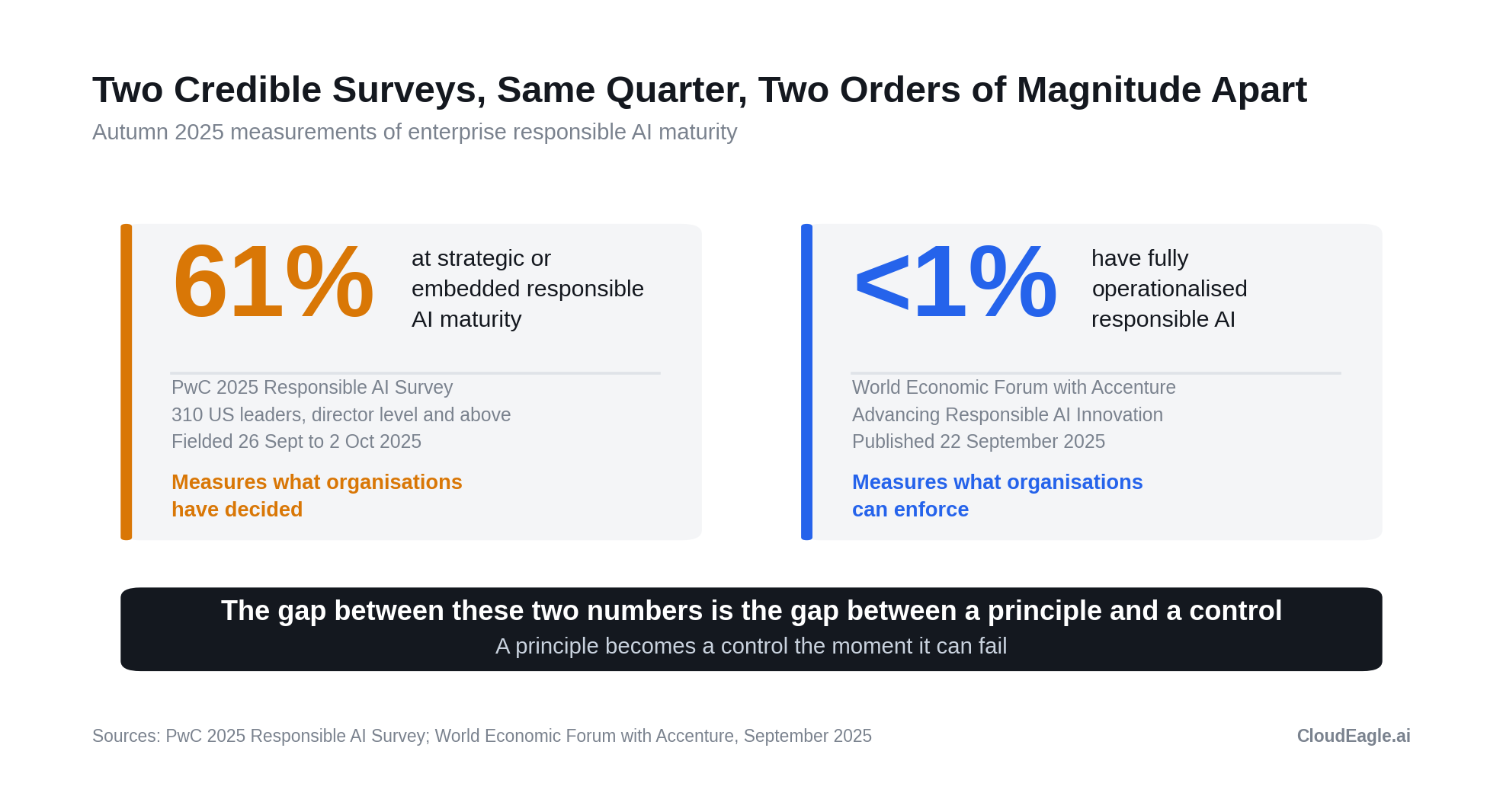
In autumn 2025, two credible organisations measured how far enterprises had got with responsible AI, and their answers differ by two orders of magnitude.

The World Economic Forum, with Accenture, published its responsible AI playbook on 22 September 2025 and found that fewer than 1% of organisations had fully operationalised responsible AI in a comprehensive and anticipatory manner.

Four days later, PwC began fielding its 2025 Responsible AI Survey across 310 US business leaders at director level and above, and found 61% at the strategic or embedded stage.

Neither is wrong. One measured what organisations have decided; the other measured what they can enforce. That distance has a precise name, and a one-line test separates the two: a principle becomes a control the moment it can fail.

‍

1. What Is the Difference Between a Responsible AI Principle and a Control?

A responsible AI framework is the set of principles an organisation commits to. A responsible AI control is a specific, testable requirement with an owner, a trigger, an artefact and a failure mode. Responsible AI governance is the machinery that runs the controls and reports when they fail.

The practical consequence is blunt: if nobody can fail your responsible AI policy, nobody is following it either.

‍

Every AI Tool Doesn't Go Through IT

Learn how to uncover them.
Discover Hidden AI

‍

2. Why Do Two Credible Responsible AI Surveys Disagree So Sharply?
‍

‍

Because they measured different objects. PwC asked leaders to place their organisation on a four-stage maturity ladder, which captures intent, published policy and self-perception. The World Economic Forum assessed whether responsible AI was operationalised comprehensively and anticipatorily, which captures enforceable controls.

An organisation can honestly answer “embedded” on the first question while failing the second. Publishing a framework, naming an ethics committee and running annual training all feel like embedding, and none of them can fail.

‍

3. Why the Principles-to-Practice Gap Is Seven Years Old

This was diagnosed in 2019. Jobin, Ienca and Vayena analysed 84 AI ethics guidelines for Nature Machine Intelligence and found convergence on five principles — transparency, justice and fairness, non-maleficence, responsibility and privacy, alongside substantive divergence in how those principles should be interpreted and implemented.

The same journal that year carried Brent Mittelstadt’s “Principles alone cannot guarantee ethical AI”, which counted at least 84 public-private initiatives producing high-level principle statements and argued that AI lacks the professional norms, translation methods and accountability mechanisms that make principlism work in medicine.

Seven years later, most of what ranks for “responsible AI framework” is principle number eighty-five. The convergence is finished; the conversion has barely started, which is the argument we made in why AI governance can’t be an afterthought.

‍

4. How Do You Turn a Responsible AI Principle Into a Control?
‍

‍

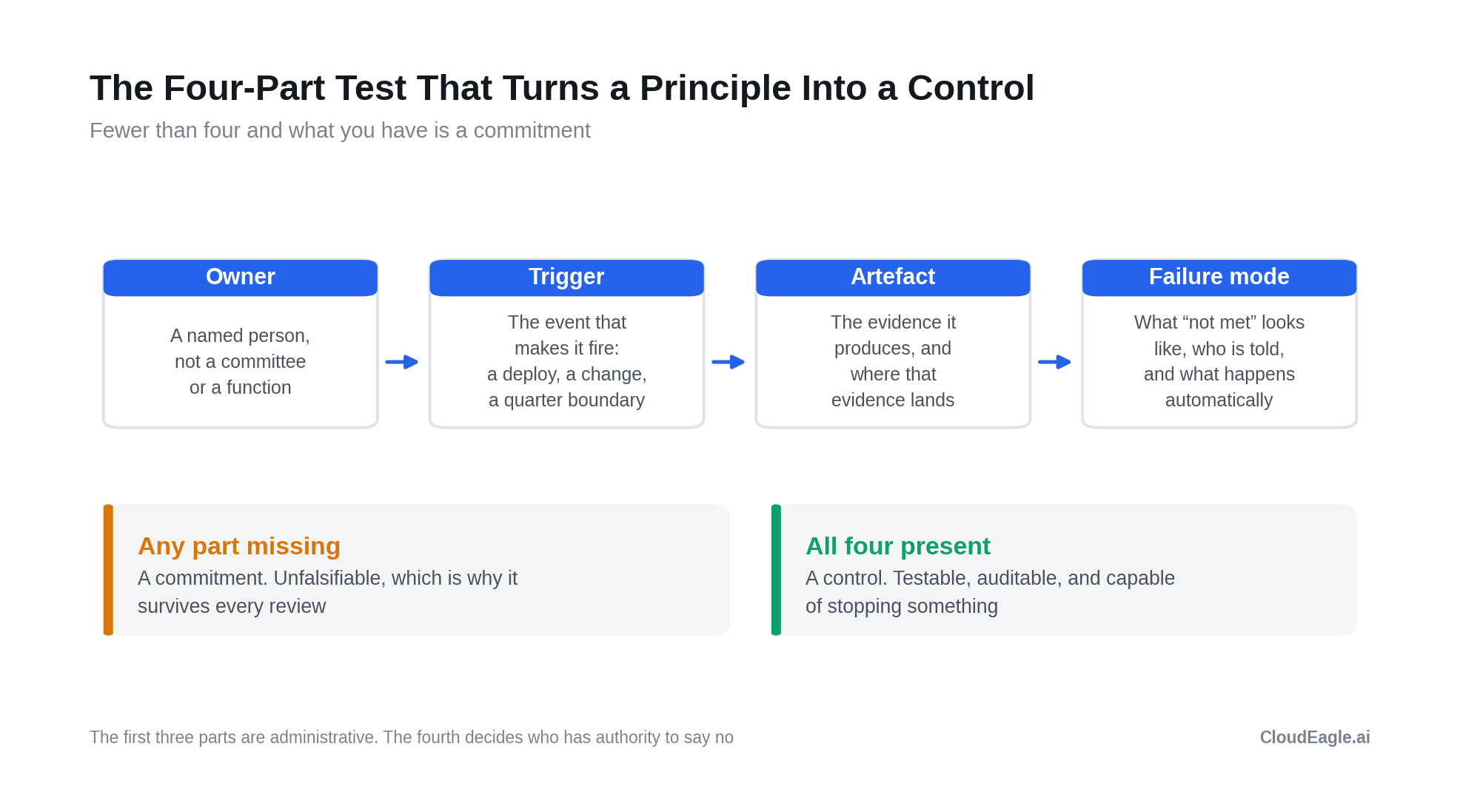
Give it four parts. Fewer than four and you have a commitment.

  • An owner: a named person rather than a committee or a function, because committees deliberate and people get asked why something failed
  • A trigger: the event that makes it fire — a deployment, a model change, a new integration, a data-source change, a quarter boundary
  • An artefact: the evidence produced when it runs and the place that evidence lands, because a control with no output cannot be audited
  • A failure mode: what “not met” looks like, who is told, and what happens automatically

Test any line in your current policy against those four. Most fail on the last two. “We are committed to fairness in our AI systems” has none of them, which is why it survives every review.

‍

5. Three Responsible AI Principles Converted Into Controls

‍

Principle as written The same thing as a control
We are committed to fairness Before any model affecting hiring, credit or pricing goes live, the model owner runs disparate-impact testing across defined groups and files the results in the model register; deployment is blocked automatically until the file exists
We believe in transparency Every AI system in the register carries a current model or system card, refreshed on any material change; systems without one are flagged in the monthly governance report and their owner is named
Humans remain in the loop Any AI system able to take an action rather than produce text has a defined override and a kill switch, tested quarterly, with the test result attached to the access review

‍

The conversion exposes something uncomfortable: a principle you cannot convert is usually a principle you have not decided. “Fairness” only becomes actionable once someone has picked the groups, the metric and the threshold.

‍

6. Why the Failure Mode Is the Part Everyone Omits

The first three parts are administrative. The fourth is political.

A failure mode means someone has agreed in advance that a launch can be stopped, and accepted that they will be the person who stopped it. That is a real cost, paid by a real person, usually in a quarter where the launch matters.

Programmes that skip it are not being lazy; they are avoiding a conversation about who has authority to say no. That conversation is what responsible AI governance actually is, and it is why decision rights come before controls rather than after them.

‍

Shadow AI Grows One App At A Time

Stop it before it spreads.
Explore The Guide

‍

7. What Happens When Two Converted Controls Collide

Conversion surfaces conflicts that principle lists hide, because two aspirations can coexist on a page while two controls cannot both pass.

  • Transparency against privacy: publishing enough about a model’s behaviour to make it explainable can expose training-data characteristics you committed to protect
  • Fairness against accuracy: equalising outcomes across groups usually costs predictive performance, and someone has to say how much is acceptable
  • Human oversight against speed: a meaningful review step is a latency budget, and the business case for the system often assumed there was not one

None of these has a universal answer, but each has an owner. Naming the person who arbitrates them is worth more than another principle asserting that both matter, which is the job an AI governance committee with defined decision rights exists to do.

‍

8. Which Responsible AI Control Catalogue Should You Use?

You are not short of controls. The catalogues already exist and cost nothing, so pick on the basis of what you will eventually have to show someone.

‍

Catalogue What it carries Take it if
ISO/IEC 42001:2023
Annex A
38 controls across AI policy, internal organisation, resources, impact assessment, life cycle, data and third-party relationships Certification is anywhere on your two-year horizon, since what you write now becomes the Statement of Applicability you present later (implementation checklist)
AI Life Cycle Core Principles control set,
Stanford CodeX
48 controls classified by domain and by function: preventive, detective, directive, corrective, compensating and external benchmarking Agents are already in your environment, because it carries agent-specific controls the management-system standards have not caught up to
NIST AI RMF Govern, Map, Measure and Manage — the structure the others hang from You need connective vocabulary engineering teams already recognise (implementation checklist)

‍

The Stanford set is worth opening for the naming alone. Its controls include Agent Kill Switch, Rate and Scope Limiter, Rollback and Quarantine, and Supply Chain Vetting. Those are not ethics statements; they either exist in your environment or they do not.

Take one as your source of truth and map the others to it; running two in parallel doubles the evidence work and halves the chance either is maintained. What no catalogue supplies is owners, triggers and consequences.

‍

9. Where Do Responsible AI Controls Actually Run?

A control needs a surface to act on, and this is where most responsible AI programmes quietly stall.

A. Why Agentic AI Turns This Into an Enforcement Problem

Deloitte’s State of AI in the Enterprise 2026, surveying 3,235 IT and business leaders across 24 countries, found 74% expect to be using AI agents at least moderately by 2027, against only 21% with a mature governance model for agentic AI.

That matters more than a normal adoption gap, because a documented principle is harmless against an agent. Agents act rather than draft, so responsible AI stops being a documentation problem and becomes an enforcement problem on a two-year clock — a gap the major frameworks have not yet closed for autonomous agents.

The incident numbers say it is already open. Gravitee’s State of AI Agent Security 2026, surveying more than 900 respondents, found 88% of organisations had a confirmed or suspected AI agent security incident in the past year, while 82% of executives were confident existing policy protected them and only 14.4% had full security approval for the agents they were running.

B. The Four Surfaces a Responsible AI Control Can Act On

‍

Surface What it does for a control
Discovery Tells you which systems the control applies to; every other surface depends on it
Policy enforcement at the point of use Stops an action rather than recording that it was discouraged (how enforcement works)
Non-human identity governance Gives agents and service accounts an owner and a revocation path (governing agent identities)
Access reviews The recurring trigger most controls can attach to without inventing a new process (bringing NHIs into reviews)

‍

The first is not optional. Every control in every catalogue on this page assumes you can name the AI systems it applies to.

Netskope’s Cloud and Threat Report, January 2026, found the average organisation using eight distinct generative AI applications and the top 1% using eighty-nine, with only half enforcing data protection policies for generative AI. IBM’s 2025 Cost of a Data Breach research puts the consequence plainly: 97% of breached organisations that had an AI-related security incident lacked proper AI access controls, and 63% of the 600 breached organisations studied had no AI governance policy at all.

‍

10. How CloudEagle.ai Supplies the Enforcement Surface

CloudEagle.ai’s AI governance platform discovers AI applications, agents and MCP servers by correlating single sign-on, finance, firewall and browser signals, then risk-scores what it finds so controls attach to the systems that warrant them first. EagleIQ correlates seven discovery sources to catch the tools that never reached procurement, including the ones SSO and CASB logs miss.

Policy enforcement then happens at the point of use rather than in a document, and non-human identities sit in the same lifecycle and review cycle as human ones. That turns “humans remain in the loop” from a sentence into something with a revocation path, and produces the auditable AI inventory and audit evidence a governance review actually runs on.

‍

‍

11. How Do You Convert Principles Into Controls in Six Weeks?

This is conversion work on documents you already have, so treat it as a short project, not a transformation.

  1. Inventory: discover every AI application, agent and model integration actually in use, and accept that the list will be longer than procurement’s
  2. Pick a catalogue: ISO/IEC 42001 Annex A if certification is on the horizon, the 48-control lifecycle set if you want agent-specific controls sooner
  3. Run your top ten principles through the four-part test, in writing, in one workshop
  4. Assign an owner to every surviving control — a name, not a team; anything that cannot find an owner in a week is not a control your organisation intends to run
  5. Wire the triggers into processes you already have: deployment gates, access reviews, quarterly risk reporting, since new processes are where governance programmes go to die
  6. Report failures, not adoption; a governance report showing zero failures is reporting that nothing is being tested

Step six decides whether any of this holds. A control set that never fails is indistinguishable from a control set nobody runs, which is also what an AI governance audit is designed to expose.

‍

12. What Should You Ask in Your Next AI Governance Review?

Take these in instead of a maturity score.

  1. Pick any line in our responsible AI policy at random: who owns it, what makes it fire, what does it produce, and what happens when it is not met?
  2. When did a responsible AI control last fail, and what did the failure trigger?
  3. How many AI systems does each control currently apply to, and how confident are we in that number?
  4. Which of our controls can stop an action, and which can only record that one happened?
  5. If an auditor asked for evidence that our fairness commitment was enforced last quarter, what file would we send?

If question five produces a policy document rather than a test result, you have commitments. Our AI usage policy template and the guide to enforcing an acceptable use policy cover the conversion from one to the other.

13. Concusion

Both figures are honest, and the same organisation can sit inside both. Which one describes you is not settled by how good your principles are; it is settled by whether anything in them can fail, in front of a named person, on a schedule, producing a file.

The principles work is finished. It was finished in 2019, across 84 documents, and the industry has been reprinting the results ever since. What remains is conversion, and it is a smaller job than the frameworks make it look.

‍

14. FAQs

1. Can't you apply responsible AI controls without knowing every AI system in use?

CloudEagle.ai makes discovery the first control, because every other control depends on it. It finds AI applications, agents, and MCP servers by correlating SSO, finance, firewall, and browser signals, then risk-scores each one so controls attach to the systems that need them first.

2. Doesn't a written AI policy only record violations after they happen?

CloudEagle.ai turns the policy into a control that can stop an action. Policy enforcement runs at the point of use, in the browser, instead of in a document. That gives your responsible AI programme a real failure mode, not just a record that someone was discouraged.

3. Don't AI agents slip past "humans remain in the loop" commitments?

CloudEagle.ai gives every agent and service account an owner and a revocation path. Non-human identities sit in the same lifecycle and review cycle as human ones, so human oversight becomes something your team can actually exercise, not a sentence in a policy.

4. Doesn't every new responsible AI control need a new process to trigger it?

With CloudEagle.ai, controls attach to a process you already run. Access reviews become the recurring trigger for checking AI tools, agents, and non-human identities, so you add controls without building new workflows that nobody maintains.

5. Isn't it hard to prove a responsible AI control actually ran?

CloudEagle.ai produces the artefact auditors ask for. It maintains an auditable inventory of AI tools and agents, plus access review records and audit evidence in one place, so when a reviewer asks what file proves enforcement, you have one to send.

‍

Advertisement for a SaaS Subscription Tracking Template with a call-to-action button to download and a partial graphic of a tablet showing charts.Banner promoting a SaaS Agreement Checklist to streamline SaaS management and avoid budget waste with a call-to-action button labeled Download checklist.Blue banner with text 'The Ultimate Employee Offboarding Checklist!' and a black button labeled 'Download checklist' alongside partial views of checklist documents from cloudeagle.ai.Digital ad for download checklist titled 'The Ultimate Checklist for IT Leaders to Optimize SaaS Operations' by cloudeagle.ai, showing checklist pages.Slack Buyer's Guide offer with text 'Unlock insider insights to get the best deal on Slack!' and a button labeled 'Get Your Copy', accompanied by a preview of the guide featuring Slack's logo.Monday Pricing Guide by cloudeagle.ai offering exclusive pricing secrets to maximize investment with a call-to-action button labeled Get Your Copy and an image of the guide's cover.Blue banner for Canva Pricing Guide by cloudeagle.ai offering a guide to Canva costs, features, and alternatives with a call-to-action button saying Get Your Copy.Blue banner with white text reading 'Little-Known Negotiation Hacks to Get the Best Deal on Slack' and a white button labeled 'Get Your Copy'.Blue banner with text 'Little-Known Negotiation Hacks to Get the Best Deal on Monday.com' and a white button labeled 'Get Your Copy'.Blue banner with text 'Little-Known Negotiation Hacks to Get the Best Deal on Canva' and a white button labeled 'Get Your Copy'.Banner with text 'Slack Buyer's Guide' and a 'Download Now' button next to images of a guide titled 'Slack Buyer’s Guide: Features, Pricing & Best Practices'.Digital cover of Monday Pricing Guide with a button labeled Get Your Copy on a blue background.Canva Pricing Guide cover with a button labeled Get Your Copy on a blue gradient background.

Enter your email to
unlock the report

Oops! Something went wrong while submitting the form.
License Count
Benchmark
Per User/Per Year

Enter your email to
unlock the report

Oops! Something went wrong while submitting the form.
License Count
Benchmark
Per User/Per Year

Enter your email to
unlock the report

Oops! Something went wrong while submitting the form.
Notion Plus
License Count
Benchmark
Per User/Per Year
100-500
$67.20 - $78.72
500-1000
$59.52 - $72.00
1000+
$51.84 - $57.60
Canva Pro
License Count
Benchmark
Per User/Per Year
100-500
$74.33-$88.71
500-1000
$64.74-$80.32
1000+
$55.14-$62.34

Enter your email to
unlock the report

Oops! Something went wrong while submitting the form.

Enter your email to
unlock the report

Oops! Something went wrong while submitting the form.
Zoom Business
License Count
Benchmark
Per User/Per Year
100-500
$216.00 - $264.00
500-1000
$180.00 - $216.00
1000+
$156.00 - $180.00

Enter your email to
unlock the report

Oops! Something went wrong while submitting the form.

Get the Right Security Platform To Secure Your Cloud Infrastructure

Please enter a business email
Thank you!
The 2023 SaaS report has been sent to your email. Check your promotional or spam folder.
Oops! Something went wrong while submitting the form.

Access full report

Please enter a business email
Thank you!
The 2023 SaaS report has been sent to your email. Check your promotional or spam folder.
Oops! Something went wrong while submitting the form.
  • Two credible surveys of the same quarter in 2025 put responsible AI maturity at 61% and under 1%; the gap between them is the gap between a principle and a control
  • A principle becomes a control when it has an owner, a trigger, an artefact and a failure mode; fewer than four and it is a value statement
  • The control catalogues already exist and are free, so what most organisations are short of is owners and triggers, not controls
  • Agentic AI turns responsible AI from a documentation problem into an enforcement problem, on a two-year clock
  • Every control assumes you can name the AI systems it applies to, which makes discovery the first control rather than a prerequisite to it

‍

In autumn 2025, two credible organisations measured how far enterprises had got with responsible AI, and their answers differ by two orders of magnitude.

The World Economic Forum, with Accenture, published its responsible AI playbook on 22 September 2025 and found that fewer than 1% of organisations had fully operationalised responsible AI in a comprehensive and anticipatory manner.

Four days later, PwC began fielding its 2025 Responsible AI Survey across 310 US business leaders at director level and above, and found 61% at the strategic or embedded stage.

Neither is wrong. One measured what organisations have decided; the other measured what they can enforce. That distance has a precise name, and a one-line test separates the two: a principle becomes a control the moment it can fail.

‍

1. What Is the Difference Between a Responsible AI Principle and a Control?

A responsible AI framework is the set of principles an organisation commits to. A responsible AI control is a specific, testable requirement with an owner, a trigger, an artefact and a failure mode. Responsible AI governance is the machinery that runs the controls and reports when they fail.

The practical consequence is blunt: if nobody can fail your responsible AI policy, nobody is following it either.

‍

Every AI Tool Doesn't Go Through IT

Learn how to uncover them.
Discover Hidden AI

‍

2. Why Do Two Credible Responsible AI Surveys Disagree So Sharply?

‍

‍

Because they measured different objects. PwC asked leaders to place their organisation on a four-stage maturity ladder, which captures intent, published policy and self-perception. The World Economic Forum assessed whether responsible AI was operationalised comprehensively and anticipatorily, which captures enforceable controls.

An organisation can honestly answer “embedded” on the first question while failing the second. Publishing a framework, naming an ethics committee and running annual training all feel like embedding, and none of them can fail.

‍

3. Why the Principles-to-Practice Gap Is Seven Years Old

This was diagnosed in 2019. Jobin, Ienca and Vayena analysed 84 AI ethics guidelines for Nature Machine Intelligence and found convergence on five principles — transparency, justice and fairness, non-maleficence, responsibility and privacy, alongside substantive divergence in how those principles should be interpreted and implemented.

The same journal that year carried Brent Mittelstadt’s “Principles alone cannot guarantee ethical AI”, which counted at least 84 public-private initiatives producing high-level principle statements and argued that AI lacks the professional norms, translation methods and accountability mechanisms that make principlism work in medicine.

Seven years later, most of what ranks for “responsible AI framework” is principle number eighty-five. The convergence is finished; the conversion has barely started, which is the argument we made in why AI governance can’t be an afterthought.

‍

4. How Do You Turn a Responsible AI Principle Into a Control?

‍

‍

Give it four parts. Fewer than four and you have a commitment.

  • An owner: a named person rather than a committee or a function, because committees deliberate and people get asked why something failed
  • A trigger: the event that makes it fire — a deployment, a model change, a new integration, a data-source change, a quarter boundary
  • An artefact: the evidence produced when it runs and the place that evidence lands, because a control with no output cannot be audited
  • A failure mode: what “not met” looks like, who is told, and what happens automatically

Test any line in your current policy against those four. Most fail on the last two. “We are committed to fairness in our AI systems” has none of them, which is why it survives every review.

‍

5. Three Responsible AI Principles Converted Into Controls

‍

Principle as written The same thing as a control
We are committed to fairness Before any model affecting hiring, credit or pricing goes live, the model owner runs disparate-impact testing across defined groups and files the results in the model register; deployment is blocked automatically until the file exists
We believe in transparency Every AI system in the register carries a current model or system card, refreshed on any material change; systems without one are flagged in the monthly governance report and their owner is named
Humans remain in the loop Any AI system able to take an action rather than produce text has a defined override and a kill switch, tested quarterly, with the test result attached to the access review

‍

The conversion exposes something uncomfortable: a principle you cannot convert is usually a principle you have not decided. “Fairness” only becomes actionable once someone has picked the groups, the metric and the threshold.

‍

6. Why the Failure Mode Is the Part Everyone Omits

The first three parts are administrative. The fourth is political.

A failure mode means someone has agreed in advance that a launch can be stopped, and accepted that they will be the person who stopped it. That is a real cost, paid by a real person, usually in a quarter where the launch matters.

Programmes that skip it are not being lazy; they are avoiding a conversation about who has authority to say no. That conversation is what responsible AI governance actually is, and it is why decision rights come before controls rather than after them.

‍

Shadow AI Grows One App At A Time

Stop it before it spreads.
Explore The Guide

‍

7. What Happens When Two Converted Controls Collide

Conversion surfaces conflicts that principle lists hide, because two aspirations can coexist on a page while two controls cannot both pass.

  • Transparency against privacy: publishing enough about a model’s behaviour to make it explainable can expose training-data characteristics you committed to protect
  • Fairness against accuracy: equalising outcomes across groups usually costs predictive performance, and someone has to say how much is acceptable
  • Human oversight against speed: a meaningful review step is a latency budget, and the business case for the system often assumed there was not one

None of these has a universal answer, but each has an owner. Naming the person who arbitrates them is worth more than another principle asserting that both matter, which is the job an AI governance committee with defined decision rights exists to do.

‍

8. Which Responsible AI Control Catalogue Should You Use?

You are not short of controls. The catalogues already exist and cost nothing, so pick on the basis of what you will eventually have to show someone.

‍

Catalogue What it carries Take it if
ISO/IEC 42001:2023
Annex A
38 controls across AI policy, internal organisation, resources, impact assessment, life cycle, data and third-party relationships Certification is anywhere on your two-year horizon, since what you write now becomes the Statement of Applicability you present later (implementation checklist)
AI Life Cycle Core Principles control set,
Stanford CodeX
48 controls classified by domain and by function: preventive, detective, directive, corrective, compensating and external benchmarking Agents are already in your environment, because it carries agent-specific controls the management-system standards have not caught up to
NIST AI RMF Govern, Map, Measure and Manage — the structure the others hang from You need connective vocabulary engineering teams already recognise (implementation checklist)

‍

The Stanford set is worth opening for the naming alone. Its controls include Agent Kill Switch, Rate and Scope Limiter, Rollback and Quarantine, and Supply Chain Vetting. Those are not ethics statements; they either exist in your environment or they do not.

Take one as your source of truth and map the others to it; running two in parallel doubles the evidence work and halves the chance either is maintained. What no catalogue supplies is owners, triggers and consequences.

‍

9. Where Do Responsible AI Controls Actually Run?

A control needs a surface to act on, and this is where most responsible AI programmes quietly stall.

A. Why Agentic AI Turns This Into an Enforcement Problem

Deloitte’s State of AI in the Enterprise 2026, surveying 3,235 IT and business leaders across 24 countries, found 74% expect to be using AI agents at least moderately by 2027, against only 21% with a mature governance model for agentic AI.

That matters more than a normal adoption gap, because a documented principle is harmless against an agent. Agents act rather than draft, so responsible AI stops being a documentation problem and becomes an enforcement problem on a two-year clock — a gap the major frameworks have not yet closed for autonomous agents.

The incident numbers say it is already open. Gravitee’s State of AI Agent Security 2026, surveying more than 900 respondents, found 88% of organisations had a confirmed or suspected AI agent security incident in the past year, while 82% of executives were confident existing policy protected them and only 14.4% had full security approval for the agents they were running.

B. The Four Surfaces a Responsible AI Control Can Act On

‍

Surface What it does for a control
Discovery Tells you which systems the control applies to; every other surface depends on it
Policy enforcement at the point of use Stops an action rather than recording that it was discouraged (how enforcement works)
Non-human identity governance Gives agents and service accounts an owner and a revocation path (governing agent identities)
Access reviews The recurring trigger most controls can attach to without inventing a new process (bringing NHIs into reviews)

‍

The first is not optional. Every control in every catalogue on this page assumes you can name the AI systems it applies to.

Netskope’s Cloud and Threat Report, January 2026, found the average organisation using eight distinct generative AI applications and the top 1% using eighty-nine, with only half enforcing data protection policies for generative AI. IBM’s 2025 Cost of a Data Breach research puts the consequence plainly: 97% of breached organisations that had an AI-related security incident lacked proper AI access controls, and 63% of the 600 breached organisations studied had no AI governance policy at all.

‍

10. How CloudEagle.ai Supplies the Enforcement Surface

CloudEagle.ai’s AI governance platform discovers AI applications, agents and MCP servers by correlating single sign-on, finance, firewall and browser signals, then risk-scores what it finds so controls attach to the systems that warrant them first. EagleIQ correlates seven discovery sources to catch the tools that never reached procurement, including the ones SSO and CASB logs miss.

Policy enforcement then happens at the point of use rather than in a document, and non-human identities sit in the same lifecycle and review cycle as human ones. That turns “humans remain in the loop” from a sentence into something with a revocation path, and produces the auditable AI inventory and audit evidence a governance review actually runs on.

‍

‍

11. How Do You Convert Principles Into Controls in Six Weeks?

This is conversion work on documents you already have, so treat it as a short project, not a transformation.

  1. Inventory: discover every AI application, agent and model integration actually in use, and accept that the list will be longer than procurement’s
  2. Pick a catalogue: ISO/IEC 42001 Annex A if certification is on the horizon, the 48-control lifecycle set if you want agent-specific controls sooner
  3. Run your top ten principles through the four-part test, in writing, in one workshop
  4. Assign an owner to every surviving control — a name, not a team; anything that cannot find an owner in a week is not a control your organisation intends to run
  5. Wire the triggers into processes you already have: deployment gates, access reviews, quarterly risk reporting, since new processes are where governance programmes go to die
  6. Report failures, not adoption; a governance report showing zero failures is reporting that nothing is being tested

Step six decides whether any of this holds. A control set that never fails is indistinguishable from a control set nobody runs, which is also what an AI governance audit is designed to expose.

‍

12. What Should You Ask in Your Next AI Governance Review?

Take these in instead of a maturity score.

  1. Pick any line in our responsible AI policy at random: who owns it, what makes it fire, what does it produce, and what happens when it is not met?
  2. When did a responsible AI control last fail, and what did the failure trigger?
  3. How many AI systems does each control currently apply to, and how confident are we in that number?
  4. Which of our controls can stop an action, and which can only record that one happened?
  5. If an auditor asked for evidence that our fairness commitment was enforced last quarter, what file would we send?

If question five produces a policy document rather than a test result, you have commitments. Our AI usage policy template and the guide to enforcing an acceptable use policy cover the conversion from one to the other.

13. Concusion

Both figures are honest, and the same organisation can sit inside both. Which one describes you is not settled by how good your principles are; it is settled by whether anything in them can fail, in front of a named person, on a schedule, producing a file.

The principles work is finished. It was finished in 2019, across 84 documents, and the industry has been reprinting the results ever since. What remains is conversion, and it is a smaller job than the frameworks make it look.

‍

14. FAQs

1. Can't you apply responsible AI controls without knowing every AI system in use?

CloudEagle.ai makes discovery the first control, because every other control depends on it. It finds AI applications, agents, and MCP servers by correlating SSO, finance, firewall, and browser signals, then risk-scores each one so controls attach to the systems that need them first.

2. Doesn't a written AI policy only record violations after they happen?

CloudEagle.ai turns the policy into a control that can stop an action. Policy enforcement runs at the point of use, in the browser, instead of in a document. That gives your responsible AI programme a real failure mode, not just a record that someone was discouraged.

3. Don't AI agents slip past "humans remain in the loop" commitments?

CloudEagle.ai gives every agent and service account an owner and a revocation path. Non-human identities sit in the same lifecycle and review cycle as human ones, so human oversight becomes something your team can actually exercise, not a sentence in a policy.

4. Doesn't every new responsible AI control need a new process to trigger it?

With CloudEagle.ai, controls attach to a process you already run. Access reviews become the recurring trigger for checking AI tools, agents, and non-human identities, so you add controls without building new workflows that nobody maintains.

5. Isn't it hard to prove a responsible AI control actually ran?

CloudEagle.ai produces the artefact auditors ask for. It maintains an auditable inventory of AI tools and agents, plus access review records and audit evidence in one place, so when a reviewer asks what file proves enforcement, you have one to send.

‍

CloudEagle.ai recognized in the 2025 Gartner® Magic Quadrant™ for SaaS Management Platforms
Download now
gartner chart
5x
Faster employee
onboarding
80%
Reduction in time for
user access reviews
30k
Workflows
automated
$15Bn
Analyzed in
contract spend
$2Bn
Saved in
SaaS spend

Streamline SaaS governance and save 10-30%

Book a Demo with Expert
CTA image