%201.svg)


HIPAA Compliance Checklist for 2025

An engineer signs up for a coding assistant with a personal email. A marketer expenses a writing tool on a corporate card. A sales rep logs into a note-taking AI through a Google account. Security pulls the IDP report for the quarterly review, and none of the three show up on it.
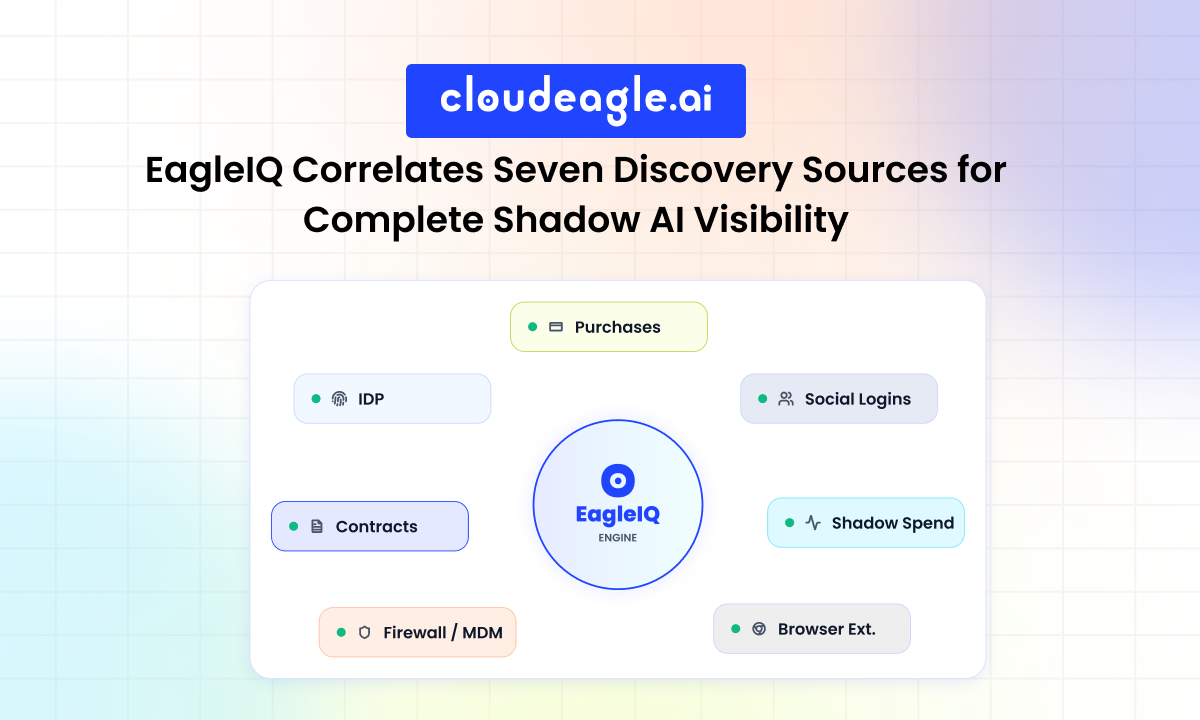
As of today, that report has to include all three. CloudEagle.ai's EagleIQ, formerly SaaSMap, renamed earlier this year as its scope grew from tracking SaaS alone to mapping identity, spend, and AI together, now correlates seven independent discovery layers, from the identity provider to browser-extension session data, into one confirmed inventory of every AI tool actually running inside the enterprise.
Why the IDP Report Was Always Going to Miss This
Security and IT teams have treated the identity provider as their source of truth for years, and for approved SaaS, that mostly worked. AI tools broke it. An assistant signed up for with a personal email never touches SSO. A subscription expensed on a corporate card never generates a login event. A tool joined through a Google or Microsoft social login shows up nowhere the IDP looks.
The scale of the miss is large. Sixty-nine percent of cybersecurity leaders now say they have evidence, or suspect, that employees are using public generative AI at work, according to Gartner. For a team that reports its AI footprint as one confident number every quarter, that stat should sting a little.
Single-source detection compounds the problem:
- An IDP log confirms a login, not what someone signed up for on their own
- A firewall log confirms a session, not who owns it
- A contract line item confirms one SKU, not the dozen a single vendor can quietly add to an existing deal
- An expense report confirms a charge, not which team is actually using the tool
Each source, read alone, is a fragment, and most security teams already have all four sitting in different systems with nobody assigned to cross-reference them weekly. Adding an eighth log to check would not fix that. Reading all seven at once would, which is the actual engineering problem CloudEagle.ai set out to solve.

The Seven Layers EagleIQ Correlates
Instead of picking one system of record and trusting it, EagleIQ pulls from seven and reconciles them against each other:
- IDP: every app provisioned through single sign-on
- Contract metadata: what was formally purchased, and every SKU buried inside a larger vendor agreement
- Firewall logs and MDM: network and device-level activity across the environment
- Approved purchases: subscriptions bought through sanctioned procurement channels
- Social-login signups: tools joined with a personal or work email through a third-party identity provider
- Shadow purchases: subscriptions expensed outside the normal procurement process
- Browser-extension sessions: the layer that catches what none of the other six can: a session that never touched SSO and was never expensed anywhere
"Six of our seven layers read data companies already have. Your IDP, your contract metadata, your expense records, your firewall logs. We are not asking anyone to install something new to get that picture," said Nidhi Jain, CEO of CloudEagle.ai. "The seventh is different. Our browser extension catches the session that never touched an approved app in the first place, the one nobody logged into with SSO and nobody expensed. That is where shadow AI actually lives, and it is the one layer none of the other six can see on their own."
The seventh layer is doing work the other six structurally cannot. An IDP, an ERP, and a firewall all generate a record somewhere by design. A session with no login and no expense line has nowhere else to show up until a browser extension catches it in the moment it happens.
What Changes for the Teams Chasing Shadow AI
A single correlated inventory changes the day-to-day for every team that currently treats shadow AI as a separate fire to put out:
- Security stops investigating every unfamiliar session on its own: Every app EagleIQ detects is automatically risk-scored, so the team knows what to escalate before opening a single ticket.
- IT applies the same process to AI tools it already runs for the rest of the SaaS stack: Apps discovered through social logins or shadow purchases are matched back to the employees using them, so provisioning and deprovisioning happen through the normal workflow instead of a manual chase.
- Compliance stops scrambling across five systems when an audit lands: When a board member or auditor asks how many AI tools are in use and who approved them, the answer is a single report instead of a research project.
EagleIQ reads the systems already in place, so there is nothing new for IT to install or maintain. It sits on top of the stack and does the correlation work that used to fall on whoever pulled the IDP report and hoped it was current.
The Session Nobody Logged Into Finally Counts
Every enterprise already has an IDP, a NetSuite, a firewall, an expense system. The session someone never logged into is the one that has never had a place to land on that list, until now.
EagleIQ gives security and IT one starting point instead of seven, so nothing gets missed just because it never touched an approved system in the first place.
FAQs
1. What is EagleIQ by CloudEagle.ai?
A capability that correlates seven discovery layers into one confirmed inventory of every AI tool running across the enterprise, approved or not.
2. What are the seven discovery layers?
IDP, contract metadata, firewall logs and MDM, approved purchases, social-login signups, shadow purchases, and browser-extension sessions.
3. How is this different from just checking IDP or SSO logs?
The IDP only shows apps provisioned through single sign-on. EagleIQ also catches tools signed up with personal emails or expensed outside procurement.
4. Does EagleIQ require installing new software across the company?
No. Six of the seven layers read data from systems already in place. Only the browser-extension layer adds new coverage, for sessions no other source can see.
5. Who uses the output of EagleIQ?
Security uses the risk scores to prioritize investigations, IT uses it for provisioning and deprovisioning, and Compliance uses it to answer audit questions in one report.
See what EagleIQ surfaces in your own environment. Book a demo
See Every AI Tool Your IDP Has Never Reported




.avif)


.avif)
.avif)




.png)




.png)
.avif)
.avif)
.avif)


