AI Governance

AI Usage Policy Template: What to Include (and What Most Companies Get Wrong)

Share via:
Written by:
CloudEagle.ai Team
Reviewed by
Nidhi Jain
Last Updated:
September 9, 2026
blog-cms-banner-bg
Little-Known Negotiation Hacks to Get the Best Deal on Slack
cta-bg-blogDownload Your Copy

HIPAA Compliance Checklist for 2025

Download PDF

An AI usage policy is a governing document that defines which AI tools employees and systems may use, what data may enter them, who approves new ones, and what happens when the rules are broken. Almost every enterprise has one by now. Far fewer have one that matches the AI actually running inside their stack.

That mismatch is the expensive part. IBM's 2025 Cost of a Data Breach report found that 97% of organizations hit by an AI-related breach lacked proper AI access controls and that shadow AI added $670,000 to the average breach.

Read that wording again. Access controls, not policy language. The document was rarely the missing piece.

So this is not another list of clauses to paste into Confluence. It is the four structural mistakes that make most AI usage policy templates unenforceable the day they are signed, and the template that survives them.

What An AI Usage Policy Is, And What It Is Not

An AI usage policy sets the boundaries for AI use across an organization: approved tools, permitted data classes, approval paths for new tools, disclosure requirements for AI-assisted output, and consequences for violations. 

It differs from an AI ethics charter, which states principles; the policy states rules, and every rule names an owner.

A policy is only as strong as the system that can detect a breach of it. That single test separates a governing document from a compliance artifact.

The Four Things Most AI Usage Policy Templates Get Wrong

Mistake 1: The Policy Governs Apps, While The Risk Sits In Features And Agents

Nearly every template on the internet is organized around named tools. Approved: ChatGPT Enterprise, Microsoft Copilot, Gemini. Prohibited: everything else.

That structure was reasonable when AI meant a website an employee logged into. It no longer describes the surface. Zylo's 2026 SaaS Management Index found that 77% of IT leaders discovered AI features running somewhere in their stack without IT's awareness.

Those features arrived through software the company already bought, already vetted, and already approved. No one signed up for anything. A vendor shipped a release note.

The same index puts the average organization at seven generative AI apps, with AI applications in the portfolio up 181% year over year. A named-tool allowlist cannot keep pace with a number moving that fast, and it says nothing at all about the AI your existing vendors switched on last quarter.

What to do instead: scope the policy to AI capability, not AI brand. Define it as any system that generates, summarizes, classifies, or acts on company data using a model, whether it arrives as a standalone app, a feature inside an approved tool, an agent, or an MCP server.

Mistake 2: Every AI Tool Gets The Same Rulebook

The second failure is uniformity. Templates apply one approval workflow and one set of controls to a spell-checker and to an agent with write access to production.

Gartner named this directly in May 2026. Shiva Varma, Senior Director Analyst, put it as: "Enterprises are treating AI agent governance as binary, either locked down or fully trusted, and that is the root cause of failure."

The cost is measurable in both directions. Over-restrict a low-risk tool and teams route around IT; under-restrict an autonomous one and you find the gap after the incident. Gartner predicts that by 2027, 40% of enterprises will demote or decommission autonomous AI agents because of governance gaps discovered only in production.

What to do instead: tier the policy. The tiering table further down does this on two axes, autonomy and data sensitivity, which is the pairing that actually predicts blast radius.

Mistake 3: Non-Human Identities Sit Outside The Scope

Read most AI usage policies closely and you find they govern employees. The subject of every sentence is a person.

Meanwhile the Cloud Security Alliance's 2026 research puts non-human identities at roughly 45 for every human identity in the enterprise. Every integration, automation, and agent spins up another one: a service account, an API key, a token.

Agentic AI accelerates this, because an agent can create its own credentials to do its job. GitGuardian's 2026 analysis found AI-service secrets exposed in public commits surged 81% year over year, to 1.275 million credentials.

There is a telling ratio underneath all of this. On PyPI in May 2026, agent frameworks had been downloaded 483 million times; guardrail and security packages, 5.8 million. Eighty-three to one, and widening from 59 to one in January.

Building is outpacing governing by roughly two orders of magnitude, and the policy usually has nothing to say about it.

What to do instead: make non-human identities in-scope by name. Every AI agent, service account, API key, and MCP server needs a registered owner, a defined permission set, an expiry, and inclusion in access reviews.

Mistake 4: No Clause Names The Control That Enforces It

The deepest problem is structural, and it explains the other three.

Policy clauses are written as prose obligations: employees must not enter confidential data into unapproved AI tools. Nobody writes the next line, which is the one that matters: who sees it happen, through what signal, and what fires automatically.

An unenforceable clause is worse than a missing one. It creates documented awareness of a risk with no evidence of mitigation, which is precisely the position no CISO wants to defend to an auditor or a regulator.

What to do instead: give every clause three attributes before it ships, an owner, a detection signal, and an automated action. If a clause cannot carry all three, it is a principle, and it belongs in the ethics charter instead.

Is Your AI Policy Enforceable?

Find the gaps between your AI rules and actual controls.
Download Checklist

The AI Usage Policy Template: Ten Sections, Each With Its Control

Use this as the skeleton. The third column is the part most templates omit, and the part that determines whether the policy is real.

Section The Question It Must Answer The Control That Proves It
1. Scope and definitions What counts as AI here, including embedded features, agents, and MCP servers? Continuous discovery across IdP, finance, browser, and network signals
2. Approved tool register Which tools are sanctioned, at what tier, and who owns each? A live inventory, not a wiki page; risk score attached to every entry
3. Data classification rules Which data classes may enter which tier of tool? Content inspection at the point of submission
4. Access and provisioning Who gets access, at what privilege, for how long? Role-based provisioning with time-bound access by default
5. Non-human identity governance Who owns each agent, service account, and API key? NHI inventory with owner, permissions, and expiry
6. Approval and intake How does an employee request a new AI tool, and how fast is the answer? Self-service catalog with routed approvals in Slack or ITSM
7. Spend and consumption Who owns token and consumption costs before the invoice? Token usage tracking by app, team, and user, with thresholds
8. Output disclosure When must AI involvement be disclosed, internally and to customers? Documented in workflow, not left to individual judgment
9. Monitoring and review How often is the register reviewed, and by whom? Scheduled access reviews covering human and non-human identities
10. Offboarding What happens to AI access, tokens, and agent credentials when someone leaves? Automated deprovisioning across all AI tools, including those outside the IdP

Four of these deserve expansion, because they are where policies most often go thin.

Section 3, Data Classification

Do not write a single prohibited list. Write a matrix that pairs your existing data classes, public, internal, confidential, regulated, with tool tiers. Most organizations already have the classes; the AI policy simply inherits them rather than inventing a parallel scheme.

Section 5, Non-Human Identity Governance

Require an accountable human owner for every non-human identity at the moment of creation. An agent without a named owner is standing access with nobody to revoke it.

Section 7, Spend And Consumption

Consumption pricing makes cost a governance issue, not a finance one. Zylo found 78% of IT leaders hit unexpected charges tied to consumption or AI features, against an average of $1.2 million a year in AI-native spend, which is why token governance belongs in the policy rather than the budget review.

Section 10, Offboarding

Standard offboarding runs through the IdP. AI tools frequently do not, particularly free tiers signed up for with a work email. Write the clause to cover deprovisioning outside the identity provider, or accept that it covers very little.

Your AI Policy Needs Controls

Build enforceable rules for AI access, identities, data, and spend.
Download Checklist

Tier The Policy: Autonomy Against Data Sensitivity

Gartner's four autonomy levels, observe, advise, act with approval, act autonomously, become genuinely useful once crossed with data sensitivity. The result tells you where to spend governance effort.

AI usage policy matrix showing four autonomy levels: Observe, Advise, Act with approval, and Act autonomously, mapped against public or internal data and confidential or regulated data, with governance requirements increasing from Tier 1 to Tier

Two rules make the matrix work. Tier is assigned at intake and re-evaluated when either axis changes, and any tool that moves up a tier loses its access until it is re-approved at the new one.

Five Questions That Tell You If Your Policy Is Enforceable

Run the existing policy through these before rewriting a word of it. They pair well with the broader CIO AI governance checklist if a board conversation is coming.

  1. Can you produce, today, a list of every AI tool, agent, and MCP server in use, including the ones inside tools you already own?
  2. For any clause restricting data, can you name the system that would detect a violation within an hour?
  3. Can you name the owner of every AI agent and service account operating in your environment?
  4. When someone left last month, was their AI access revoked everywhere, including tools outside your identity provider?
  5. Could you hand an auditor evidence of enforcement, not just the signed document?

A 'no' to question one makes the other four unanswerable. Discovery is the precondition; everything else is downstream of knowing what exists.

How AI Governance Requirements Are Changing Between 2026 and 2028

Regulatory timelines have shifted enough in 2026 that many policies are calibrated to dates that no longer apply. The full picture across jurisdictions sits in this breakdown of AI governance regulations for 2026; the short version follows.

EU AI Act Deadlines Have Moved

The EU AI Act's transparency obligations under Article 50, covering disclosure of AI-generated content, apply from 2 August 2026. Under the Omnibus political agreement of 6 May 2026, obligations for stand-alone high-risk systems under Annex III moved to 2 December 2027, and embedded high-risk systems under Annex I to 2 August 2028. The AI literacy obligation has been in force since February 2025.

Colorado Replaces Its AI Act With New Requirements

In the United States, Colorado repealed its AI Act before it took effect and replaced it with SB 26-189, the Automated Decision-Making Technology Act, effective 1 January 2027. It drops the discrimination-focused duties in favor of transparency ones: consumer notice, a plain-language explanation within 30 days of an adverse automated decision, three-year record retention, and a trained human reviewer who can override.

The Deadlines Are Moving, But the Evidence Requirements Remain

The practical read for a policy owner: the deadlines moved, the direction did not. Every one of these regimes requires you to prove what your systems did and who reviewed it, which is an evidence problem before it is a legal one, and one an AI compliance checklist will close faster than a policy rewrite.

How CloudEagle.ai Helps Enforce AI Governance Policies 

CloudEagle.ai closes the gap between the policy document and the control surface it needs.

Its AI governance platform discovers AI apps, agents, and MCP servers by correlating SSO, finance, firewall, browser, and MDM signals, so the register reflects what is running rather than what was requested. Detected tools are risk-scored, so security prioritizes rather than treating every unsanctioned app as equal.

From there, enforcement is automatic: sensitive content shared with AI tools can be monitored or blocked, users attempting an unsanctioned tool can be redirected to an approved one, token consumption is tracked by app, team, and user, and non-human identities are governed with the same lifecycle controls as employees, including offboarding for tools that sit outside the IdP.

Onboarding takes about 30 minutes across 500+ integrations, which matters mainly because it means the policy and the control can ship in the same quarter.

Frequently Asked Questions

What should an AI usage policy include at minimum? 

Ten sections: scope and definitions, an approved tool register, data classification rules, access and provisioning, non-human identity governance, an approval and intake path, spend and consumption ownership, output disclosure, monitoring and review, and offboarding. Each clause should name an owner, a detection signal, and an automated action.

How is an AI acceptable use policy different from a general acceptable use policy? 

A general AUP governs how employees use company systems. An AI acceptable use policy adds two things a traditional AUP has no concept of: data that leaves the perimeter through a model prompt, and non-human identities that act on their own after creation. The practical difference shows up at the enforcement layer.

How often should an employee AI usage policy be reviewed? 

Quarterly, at minimum, and on any change to the tool register or tiering axes. With AI applications in the average portfolio up 181% year over year, an annual review cycle means the policy describes a stack that stopped existing three quarters ago.

Does CloudEagle.ai enforce AI usage policies, or only report on them? 

Both. It discovers and risk-scores AI apps, agents, and MCP servers, then enforces policy at the point of use by monitoring or blocking sensitive data shared with AI tools and redirecting users to approved alternatives.

Can CloudEagle.ai govern AI agents and service accounts, not just employee access? 

Yes. Non-human identities, including service accounts, API keys, and AI agents, are tracked in one place with current status, owner, and attached permissions, and are included in access reviews and automated deprovisioning alongside human identities.

Advertisement for a SaaS Subscription Tracking Template with a call-to-action button to download and a partial graphic of a tablet showing charts.Banner promoting a SaaS Agreement Checklist to streamline SaaS management and avoid budget waste with a call-to-action button labeled Download checklist.Blue banner with text 'The Ultimate Employee Offboarding Checklist!' and a black button labeled 'Download checklist' alongside partial views of checklist documents from cloudeagle.ai.Digital ad for download checklist titled 'The Ultimate Checklist for IT Leaders to Optimize SaaS Operations' by cloudeagle.ai, showing checklist pages.Slack Buyer's Guide offer with text 'Unlock insider insights to get the best deal on Slack!' and a button labeled 'Get Your Copy', accompanied by a preview of the guide featuring Slack's logo.Monday Pricing Guide by cloudeagle.ai offering exclusive pricing secrets to maximize investment with a call-to-action button labeled Get Your Copy and an image of the guide's cover.Blue banner for Canva Pricing Guide by cloudeagle.ai offering a guide to Canva costs, features, and alternatives with a call-to-action button saying Get Your Copy.Blue banner with white text reading 'Little-Known Negotiation Hacks to Get the Best Deal on Slack' and a white button labeled 'Get Your Copy'.Blue banner with text 'Little-Known Negotiation Hacks to Get the Best Deal on Monday.com' and a white button labeled 'Get Your Copy'.Blue banner with text 'Little-Known Negotiation Hacks to Get the Best Deal on Canva' and a white button labeled 'Get Your Copy'.Banner with text 'Slack Buyer's Guide' and a 'Download Now' button next to images of a guide titled 'Slack Buyer’s Guide: Features, Pricing & Best Practices'.Digital cover of Monday Pricing Guide with a button labeled Get Your Copy on a blue background.Canva Pricing Guide cover with a button labeled Get Your Copy on a blue gradient background.

Enter your email to
unlock the report

Oops! Something went wrong while submitting the form.
License Count
Benchmark
Per User/Per Year

Enter your email to
unlock the report

Oops! Something went wrong while submitting the form.
License Count
Benchmark
Per User/Per Year

Enter your email to
unlock the report

Oops! Something went wrong while submitting the form.
Notion Plus
License Count
Benchmark
Per User/Per Year
100-500
$67.20 - $78.72
500-1000
$59.52 - $72.00
1000+
$51.84 - $57.60
Canva Pro
License Count
Benchmark
Per User/Per Year
100-500
$74.33-$88.71
500-1000
$64.74-$80.32
1000+
$55.14-$62.34

Enter your email to
unlock the report

Oops! Something went wrong while submitting the form.

Enter your email to
unlock the report

Oops! Something went wrong while submitting the form.
Zoom Business
License Count
Benchmark
Per User/Per Year
100-500
$216.00 - $264.00
500-1000
$180.00 - $216.00
1000+
$156.00 - $180.00

Enter your email to
unlock the report

Oops! Something went wrong while submitting the form.

Get the Right Security Platform To Secure Your Cloud Infrastructure

Please enter a business email
Thank you!
The 2023 SaaS report has been sent to your email. Check your promotional or spam folder.
Oops! Something went wrong while submitting the form.

Access full report

Please enter a business email
Thank you!
The 2023 SaaS report has been sent to your email. Check your promotional or spam folder.
Oops! Something went wrong while submitting the form.

An AI usage policy is a governing document that defines which AI tools employees and systems may use, what data may enter them, who approves new ones, and what happens when the rules are broken. Almost every enterprise has one by now. Far fewer have one that matches the AI actually running inside their stack.

That mismatch is the expensive part. IBM's 2025 Cost of a Data Breach report found that 97% of organizations hit by an AI-related breach lacked proper AI access controls and that shadow AI added $670,000 to the average breach.

Read that wording again. Access controls, not policy language. The document was rarely the missing piece.

So this is not another list of clauses to paste into Confluence. It is the four structural mistakes that make most AI usage policy templates unenforceable the day they are signed, and the template that survives them.

What An AI Usage Policy Is, And What It Is Not

An AI usage policy sets the boundaries for AI use across an organization: approved tools, permitted data classes, approval paths for new tools, disclosure requirements for AI-assisted output, and consequences for violations. 

It differs from an AI ethics charter, which states principles; the policy states rules, and every rule names an owner.

A policy is only as strong as the system that can detect a breach of it. That single test separates a governing document from a compliance artifact.

The Four Things Most AI Usage Policy Templates Get Wrong

Mistake 1: The Policy Governs Apps, While The Risk Sits In Features And Agents

Nearly every template on the internet is organized around named tools. Approved: ChatGPT Enterprise, Microsoft Copilot, Gemini. Prohibited: everything else.

That structure was reasonable when AI meant a website an employee logged into. It no longer describes the surface. Zylo's 2026 SaaS Management Index found that 77% of IT leaders discovered AI features running somewhere in their stack without IT's awareness.

Those features arrived through software the company already bought, already vetted, and already approved. No one signed up for anything. A vendor shipped a release note.

The same index puts the average organization at seven generative AI apps, with AI applications in the portfolio up 181% year over year. A named-tool allowlist cannot keep pace with a number moving that fast, and it says nothing at all about the AI your existing vendors switched on last quarter.

What to do instead: scope the policy to AI capability, not AI brand. Define it as any system that generates, summarizes, classifies, or acts on company data using a model, whether it arrives as a standalone app, a feature inside an approved tool, an agent, or an MCP server.

Mistake 2: Every AI Tool Gets The Same Rulebook

The second failure is uniformity. Templates apply one approval workflow and one set of controls to a spell-checker and to an agent with write access to production.

Gartner named this directly in May 2026. Shiva Varma, Senior Director Analyst, put it as: "Enterprises are treating AI agent governance as binary, either locked down or fully trusted, and that is the root cause of failure."

The cost is measurable in both directions. Over-restrict a low-risk tool and teams route around IT; under-restrict an autonomous one and you find the gap after the incident. Gartner predicts that by 2027, 40% of enterprises will demote or decommission autonomous AI agents because of governance gaps discovered only in production.

What to do instead: tier the policy. The tiering table further down does this on two axes, autonomy and data sensitivity, which is the pairing that actually predicts blast radius.

Mistake 3: Non-Human Identities Sit Outside The Scope

Read most AI usage policies closely and you find they govern employees. The subject of every sentence is a person.

Meanwhile the Cloud Security Alliance's 2026 research puts non-human identities at roughly 45 for every human identity in the enterprise. Every integration, automation, and agent spins up another one: a service account, an API key, a token.

Agentic AI accelerates this, because an agent can create its own credentials to do its job. GitGuardian's 2026 analysis found AI-service secrets exposed in public commits surged 81% year over year, to 1.275 million credentials.

There is a telling ratio underneath all of this. On PyPI in May 2026, agent frameworks had been downloaded 483 million times; guardrail and security packages, 5.8 million. Eighty-three to one, and widening from 59 to one in January.

Building is outpacing governing by roughly two orders of magnitude, and the policy usually has nothing to say about it.

What to do instead: make non-human identities in-scope by name. Every AI agent, service account, API key, and MCP server needs a registered owner, a defined permission set, an expiry, and inclusion in access reviews.

Mistake 4: No Clause Names The Control That Enforces It

The deepest problem is structural, and it explains the other three.

Policy clauses are written as prose obligations: employees must not enter confidential data into unapproved AI tools. Nobody writes the next line, which is the one that matters: who sees it happen, through what signal, and what fires automatically.

An unenforceable clause is worse than a missing one. It creates documented awareness of a risk with no evidence of mitigation, which is precisely the position no CISO wants to defend to an auditor or a regulator.

What to do instead: give every clause three attributes before it ships, an owner, a detection signal, and an automated action. If a clause cannot carry all three, it is a principle, and it belongs in the ethics charter instead.

Is Your AI Policy Enforceable?

Find the gaps between your AI rules and actual controls.
Download Checklist

The AI Usage Policy Template: Ten Sections, Each With Its Control

Use this as the skeleton. The third column is the part most templates omit, and the part that determines whether the policy is real.

Section The Question It Must Answer The Control That Proves It
1. Scope and definitions What counts as AI here, including embedded features, agents, and MCP servers? Continuous discovery across IdP, finance, browser, and network signals
2. Approved tool register Which tools are sanctioned, at what tier, and who owns each? A live inventory, not a wiki page; risk score attached to every entry
3. Data classification rules Which data classes may enter which tier of tool? Content inspection at the point of submission
4. Access and provisioning Who gets access, at what privilege, for how long? Role-based provisioning with time-bound access by default
5. Non-human identity governance Who owns each agent, service account, and API key? NHI inventory with owner, permissions, and expiry
6. Approval and intake How does an employee request a new AI tool, and how fast is the answer? Self-service catalog with routed approvals in Slack or ITSM
7. Spend and consumption Who owns token and consumption costs before the invoice? Token usage tracking by app, team, and user, with thresholds
8. Output disclosure When must AI involvement be disclosed, internally and to customers? Documented in workflow, not left to individual judgment
9. Monitoring and review How often is the register reviewed, and by whom? Scheduled access reviews covering human and non-human identities
10. Offboarding What happens to AI access, tokens, and agent credentials when someone leaves? Automated deprovisioning across all AI tools, including those outside the IdP

Four of these deserve expansion, because they are where policies most often go thin.

Section 3, Data Classification

Do not write a single prohibited list. Write a matrix that pairs your existing data classes, public, internal, confidential, regulated, with tool tiers. Most organizations already have the classes; the AI policy simply inherits them rather than inventing a parallel scheme.

Section 5, Non-Human Identity Governance

Require an accountable human owner for every non-human identity at the moment of creation. An agent without a named owner is standing access with nobody to revoke it.

Section 7, Spend And Consumption

Consumption pricing makes cost a governance issue, not a finance one. Zylo found 78% of IT leaders hit unexpected charges tied to consumption or AI features, against an average of $1.2 million a year in AI-native spend, which is why token governance belongs in the policy rather than the budget review.

Section 10, Offboarding

Standard offboarding runs through the IdP. AI tools frequently do not, particularly free tiers signed up for with a work email. Write the clause to cover deprovisioning outside the identity provider, or accept that it covers very little.

Your AI Policy Needs Controls

Build enforceable rules for AI access, identities, data, and spend.
Download Checklist

Tier The Policy: Autonomy Against Data Sensitivity

Gartner's four autonomy levels, observe, advise, act with approval, act autonomously, become genuinely useful once crossed with data sensitivity. The result tells you where to spend governance effort.

AI usage policy matrix showing four autonomy levels: Observe, Advise, Act with approval, and Act autonomously, mapped against public or internal data and confidential or regulated data, with governance requirements increasing from Tier 1 to Tier

Two rules make the matrix work. Tier is assigned at intake and re-evaluated when either axis changes, and any tool that moves up a tier loses its access until it is re-approved at the new one.

Five Questions That Tell You If Your Policy Is Enforceable

Run the existing policy through these before rewriting a word of it. They pair well with the broader CIO AI governance checklist if a board conversation is coming.

  1. Can you produce, today, a list of every AI tool, agent, and MCP server in use, including the ones inside tools you already own?
  2. For any clause restricting data, can you name the system that would detect a violation within an hour?
  3. Can you name the owner of every AI agent and service account operating in your environment?
  4. When someone left last month, was their AI access revoked everywhere, including tools outside your identity provider?
  5. Could you hand an auditor evidence of enforcement, not just the signed document?

A 'no' to question one makes the other four unanswerable. Discovery is the precondition; everything else is downstream of knowing what exists.

How AI Governance Requirements Are Changing Between 2026 and 2028

Regulatory timelines have shifted enough in 2026 that many policies are calibrated to dates that no longer apply. The full picture across jurisdictions sits in this breakdown of AI governance regulations for 2026; the short version follows.

EU AI Act Deadlines Have Moved

The EU AI Act's transparency obligations under Article 50, covering disclosure of AI-generated content, apply from 2 August 2026. Under the Omnibus political agreement of 6 May 2026, obligations for stand-alone high-risk systems under Annex III moved to 2 December 2027, and embedded high-risk systems under Annex I to 2 August 2028. The AI literacy obligation has been in force since February 2025.

Colorado Replaces Its AI Act With New Requirements

In the United States, Colorado repealed its AI Act before it took effect and replaced it with SB 26-189, the Automated Decision-Making Technology Act, effective 1 January 2027. It drops the discrimination-focused duties in favor of transparency ones: consumer notice, a plain-language explanation within 30 days of an adverse automated decision, three-year record retention, and a trained human reviewer who can override.

The Deadlines Are Moving, But the Evidence Requirements Remain

The practical read for a policy owner: the deadlines moved, the direction did not. Every one of these regimes requires you to prove what your systems did and who reviewed it, which is an evidence problem before it is a legal one, and one an AI compliance checklist will close faster than a policy rewrite.

How CloudEagle.ai Helps Enforce AI Governance Policies 

CloudEagle.ai closes the gap between the policy document and the control surface it needs.

Its AI governance platform discovers AI apps, agents, and MCP servers by correlating SSO, finance, firewall, browser, and MDM signals, so the register reflects what is running rather than what was requested. Detected tools are risk-scored, so security prioritizes rather than treating every unsanctioned app as equal.

From there, enforcement is automatic: sensitive content shared with AI tools can be monitored or blocked, users attempting an unsanctioned tool can be redirected to an approved one, token consumption is tracked by app, team, and user, and non-human identities are governed with the same lifecycle controls as employees, including offboarding for tools that sit outside the IdP.

Onboarding takes about 30 minutes across 500+ integrations, which matters mainly because it means the policy and the control can ship in the same quarter.

Frequently Asked Questions

What should an AI usage policy include at minimum? 

Ten sections: scope and definitions, an approved tool register, data classification rules, access and provisioning, non-human identity governance, an approval and intake path, spend and consumption ownership, output disclosure, monitoring and review, and offboarding. Each clause should name an owner, a detection signal, and an automated action.

How is an AI acceptable use policy different from a general acceptable use policy? 

A general AUP governs how employees use company systems. An AI acceptable use policy adds two things a traditional AUP has no concept of: data that leaves the perimeter through a model prompt, and non-human identities that act on their own after creation. The practical difference shows up at the enforcement layer.

How often should an employee AI usage policy be reviewed? 

Quarterly, at minimum, and on any change to the tool register or tiering axes. With AI applications in the average portfolio up 181% year over year, an annual review cycle means the policy describes a stack that stopped existing three quarters ago.

Does CloudEagle.ai enforce AI usage policies, or only report on them? 

Both. It discovers and risk-scores AI apps, agents, and MCP servers, then enforces policy at the point of use by monitoring or blocking sensitive data shared with AI tools and redirecting users to approved alternatives.

Can CloudEagle.ai govern AI agents and service accounts, not just employee access? 

Yes. Non-human identities, including service accounts, API keys, and AI agents, are tracked in one place with current status, owner, and attached permissions, and are included in access reviews and automated deprovisioning alongside human identities.

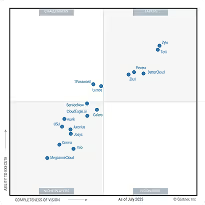
CloudEagle.ai recognized in the 2025 Gartner® Magic Quadrant™ for SaaS Management Platforms
Download now
gartner chart
5x
Faster employee
onboarding
80%
Reduction in time for
user access reviews
30k
Workflows
automated
$15Bn
Analyzed in
contract spend
$2Bn
Saved in
SaaS spend

Streamline SaaS governance and save 10-30%

Book a Demo with Expert
CTA image