AI Governance

What Is AI Policy Enforcement? A 2026 Guide for CIO

Share via:
Written by:
CloudEagle.ai Team
Reviewed by
Nidhi Jain
Last Updated:
August 26, 2026
blog-cms-banner-bg
Little-Known Negotiation Hacks to Get the Best Deal on Slack
cta-bg-blogDownload Your Copy

HIPAA Compliance Checklist for 2025

Download PDF

AI policy enforcement is the set of technical controls that apply an organization's written AI policy in real time, at the point where employees use AI tools.

It governs which AI apps people can access, what data they can send, and what gets logged for audit.

As of August 2, 2026, the EU AI Act's high-risk obligations require that evidence. A policy document alone cannot produce it.

TL;DR

  • Enforcement makes an AI policy binding rather than advisory; it runs in three layers, namely discovery, real-time control, and automatic logging.
  • 49% of employees use AI tools without employer approval, and 58% of them are on free consumer tiers (BlackFog, January 2026).
  • AI gateways govern the APIs your engineers build against, not the tools employees open in a browser, so a gateway will never surface shadow AI.
  • Your IdP is one discovery signal, not the inventory; personal-email signups, free tiers, and embedded AI features all sit outside it.
  • Audit evidence has to be captured as it happens, because no logging regime can be applied retroactively.

1. What Is AI Policy Enforcement?

Enforcement is what makes a policy binding instead of advisory. Three things have to be true for it to work:

  1. You can see every AI tool in use, including the ones that never touched your IdP.
  2. You can act on what you see, warning, redirecting, or blocking before data leaves.
  3. Every action is logged with enough context to satisfy an auditor.

Miss any one of these and you have monitoring, not enforcement.

Security Gaps Don't Announce Themselves

Find them first.
See The Checklist

2. AI Policy Enforcement vs. AI Governance

The two terms get used interchangeably. They produce entirely different artifacts:

AI governance AI policy enforcement
Produces Decisions Events
Looks like Approved tool list, risk taxonomy, escalation path, named owners Blocked submission, redirect, approved exception, log entry
Cadence Monthly committee Continuous, per interaction
Answers What should we allow? What actually happened?

If your AI program has decisions but no events, nothing is being enforced.

Still building the decision layer? Start with our AI governance policies and controls guide.

3. Where The Policy-Behavior Gap Actually Sits Now

The old gap was compliance. Employees knew the policy and worked around it anyway, and the controls in this article largely solve that.

The gap that matters in 2026 is worse: your policy governs a choice most employees no longer make.

AI stopped being a destination. It arrived inside tools you already approved and paid for.

A summarizer in the meeting platform. A copilot in the productivity suite. A drafting assistant in the CRM.

Nobody signed up. Nobody clicked accept. Procurement never saw a request, because there was nothing to buy.

Then agents made it structural. Most non-human identities are now AI agents rather than service accounts, and an agent provisions its own credentials, runs on a schedule, and touches data at 3 a.m.

No human is in the session. There is no employee to educate and no browser tab to intercept.

So the question has moved. It is no longer "did the employee comply?" It is "did anyone decide at all?"

A policy written against named tools cannot answer that, because the surface it governs arrived unnamed.

4. Why AI Policy Enforcement Matters For CIOs And CAIOs

Because you will be asked to prove it, not describe it.

Boards, auditors, and enterprise customers have stopped accepting "we have an AI policy" as an answer.

They want to know which tools are in use, who has access, what data flows into them, and what happens when someone steps outside the rules.

Every one of those is an enforcement question, and our CIO's AI governance checklist covers the ten a board is most likely to ask.

Shadow AI Doesn't Need Permission

Just one signup.
Learn More

5. The Cost Of Shadow AI Left Unenforced

A shadow SaaS app leaves you a license you're paying for. Shadow AI does that, and it accepts whatever an employee types into it.

Source code. Customer PII. Pricing models. Board decks.

Left unenforced, four costs compound:

Cost What it looks like
Data exposure with no record Sensitive content leaves through a channel you don't log, so you can't scope the incident afterward
Orphaned access after offboarding Personal-email accounts and standing API tokens survive the exit checklist, and offboarding does not stop the AI agents an employee created
Duplicate, unmanaged spend Four teams buy four copilots, none through procurement, all on usage-based billing
Audit findings you can't remediate A control that wasn't running in Q1 cannot be made to have been running in Q1

The last one turns a governance problem into a regulatory one.

6. Why A Governance Committee Is Not Enough

Committees decide which tools are approved, who owns risk, and what the escalation path looks like. Our guide to building an AI governance committee covers that work.

But a committee meets monthly and employees adopt AI daily. That gap between clocks is where risk accumulates.

Approving one tool and rejecting another changes nothing, unless something enforces the decision in the browser the next morning.

Committees decide; enforcement executes. Most organizations have only the first.

7. How AI Policy Enforcement Works

Each layer depends on the one before it. You can't control a tool you never discovered, and you can't log a decision that was never made.
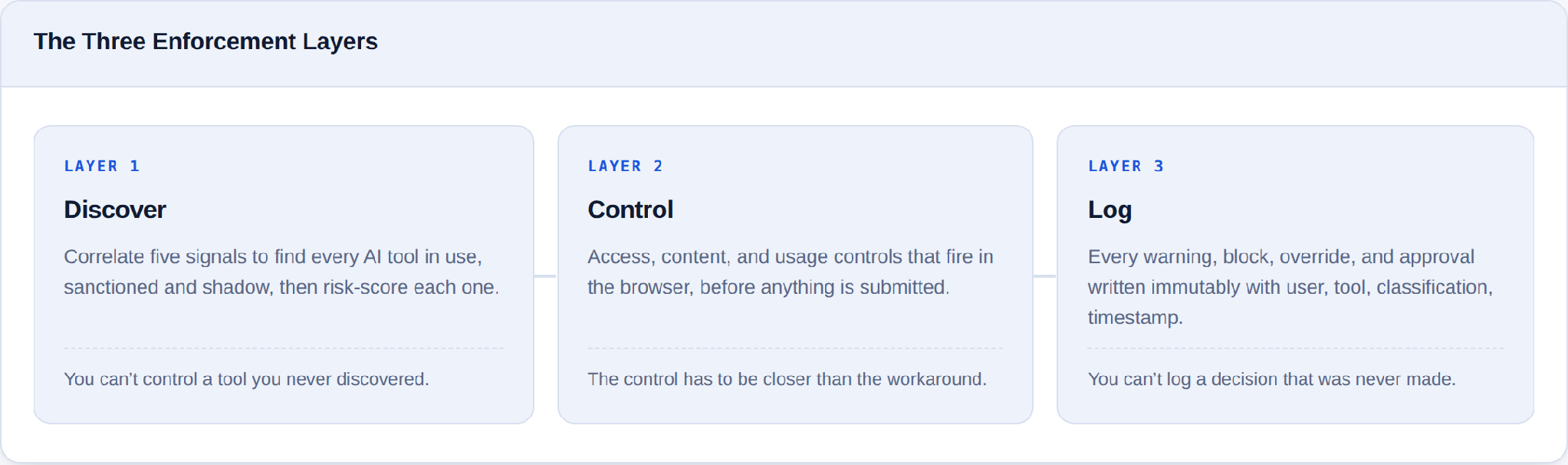
Layer 1: Discovering Every AI Tool In Use

Your identity provider only shows you the tools already under management.

It says nothing about the tool an engineer signed up for with a personal email, the copilot bundled into a suite you own, or the MCP server someone stood up last week.

Real discovery correlates five signals:

Signal source What it reveals
Browser extension AI tools accessed through personal accounts, outside SSO
SSO and IdP logs Sanctioned, federated AI apps and who has access
Finance and card spend AI tools bought on corporate cards, never routed through IT
Firewall and network logs Traffic to AI domains from managed devices
Contract and vendor data AI features bundled into existing SaaS agreements

CloudEagle.ai correlates all five, then risk-scores every tool it finds against a maintained AI inventory.

Without risk scoring you get a list of 200 tools and no defensible way to pick the three that matter. See our shadow AI discovery tool.

Layer 2: Controlling Access, Content, And Usage In Real Time

Discovery gives you a list; enforcement acts on it, in the browser, before anything is submitted.

Control Governs What the user sees
Access Which AI tools a user or department can open An in-browser warning with two options, request approval or switch to the sanctioned alternative
Content What data can be entered, in any tool PII, credentials, financial records, and PHI caught in the input field and blocked before submission
Usage Who holds licenses and what they consume Token spend tracked like any other metered utility

Access

Which AI tools a user or department can open

An in-browser warning with two options, request approval or switch to the sanctioned alternative

Content

What data can be entered, in any tool

PII, credentials, financial records, and PHI caught in the input field and blocked before submission

Usage

Who holds licenses and what they consume

Token spend tracked like any other metered utility

Content control is what separates enforcement from monitoring. Monitoring tells you the customer list was pasted into a chatbot. Enforcement stops the paste.

Sensitive information disclosure sits in the OWASP Top 10 for LLM applications for exactly this reason. The design principle across all three: the control has to be closer to the employee than the workaround is.

For the clause-by-clause version, see how to enforce an AI acceptable use policy. For the spend side, see AI usage policies and guardrails.

Layer 3: Logging Every Decision For Audit-Ready Evidence

Every warning, block, override, and approval gets written to an immutable log with the user, the tool, the data classification, and the timestamp.

This is not a reporting nice-to-have.

Under the EU AI Act, Article 12 requires automatic logging for traceability across the AI system lifecycle. Annex III high-risk obligations became enforceable on August 2, 2026.

Penalties reach EUR 35 million or 7% of global annual turnover, above GDPR's 4% ceiling.

Two other frameworks say the same thing in different language, and our AI compliance checklist maps all three side by side:

  • ISO/IEC 42001 requires operational controls and documented evidence for an AI management system.
  • NIST AI RMF is voluntary, but enterprise customers increasingly write it into contracts.

An auditor asking what happened in Q1 needs Q1's logs. You either wrote them or you didn't.

8. Extending Enforcement To AI Agents And Non-Human Identities

Most enforcement stops at a human in a browser, which covers less of your AI surface every quarter.

Every integration spins up a non-human identity. Connecting an app generates a token; standing up an agent creates a service account.

An orphaned non-human identity is a bot with standing access and no accountable owner.

It doesn't read your policy, it doesn't get offboarded, and it won't appear in a browser-based control.

Enforcement has to reach machine identities with the same lifecycle discipline you apply to employees:

  • A live inventory of every service account, API key, and agent
  • A named owner for each
  • Visibility into the permissions and resources it's tied to
  • The ability to revoke standing access when it goes unowned

Access reviews that cover people but not agents leave the faster-growing half of the problem ungoverned.

9. AI Policy Enforcement vs. AI Gateway Enforcement

Both terms get used interchangeably; they solve different halves of the problem.

Control Governs What the user sees
Access Which AI tools a user or department can open An in-browser warning with two options, request approval or switch to the sanctioned alternative
Content What data can be entered, in any tool PII, credentials, financial records, and PHI caught in the input field and blocked before submission
Usage Who holds licenses and what they consume Token spend tracked like any other metered utility

Path B never touches the gateway, which is why gateway logs show a clean environment that isn't.

A gateway enforces policy only on traffic configured to route through it. Shadow AI is, by definition, traffic that was not.

A gateway governs the APIs your engineers build against. Browser-layer enforcement governs the ChatGPT tab an employee opened with a personal email.

Mature programs run both, because neither covers the other's surface.

See how CloudEagle.ai enforces AI policy at the browser layer. Explore AI policy enforcement →

10. AI Policy Enforcement Examples

Policy language is abstract; enforcement is not.

Scenario What the policy says What enforcement does
A finance analyst pastes next quarter's revenue forecast into a free AI tool "Do not share confidential financial data with unapproved AI tools" Content control catches the financial pattern in the input field and blocks submission, logged with user, tool, and classification
An engineer signs up for an AI code assistant with a personal email "All AI tools require security review before use" Browser-layer discovery detects the tool outside SSO; the user sees the approved alternative and a one-click exception request
An HR manager uploads performance reviews to a transcription feature bundled into a licensed SaaS app "Employee records may not be processed by third-party AI" Discovery surfaces the embedded feature through contract data; access control restricts it by department and PII is blocked

The policy clause is identical in all three. Only the mechanism changes, based on where the behavior happens.

11. Best Practices For Implementing AI Policy Enforcement

A. Run Discovery Before Writing Rules

Give it two to four weeks before you write a single rule.

The output is usually several times more AI tools than IT expected, concentrated in a few departments, with two or three carrying most of the risk.

Write rules against that, not against assumption.

B. Enforce At The Point Of Behavior

A weekly report showing 40 employees used unapproved AI tools is a record of 40 failures.

Put the control in the browser: warnings, in-field blocking, redirects at navigation.

Anything downstream of the paste is incident response, and it costs far more to run.

C. Redirect Instead Of Block

This decides whether your program survives its first quarter.

A hard block with no alternative teaches employees that governance is an obstacle. They move to personal devices, where you have no visibility at all.

You've traded a governed risk for an invisible one.

Show them the approved tool instead, and let them request an exception in a click. See how CAIOs scale AI adoption without creating chaos.

D. Build The Audit Trail Before The Auditor Asks

Capture five things automatically:

  • The AI inventory, with owners and risk scores
  • The policy version in effect on any given date
  • Every access decision
  • Every content block
  • Every override, with its approver

For SOC 2, add provisioning records, evidence of deprovisioning at offboarding, and proof that monitoring ran continuously.

Benchling risk-scored 287 SaaS tools for GenAI exposure to build exactly this baseline.

12. Two Mistakes That Undo Enforcement

A. Treating A Policy Document As A Control

The tell: ask what happens, technically, when someone violates the policy.

If the answer involves a person noticing and escalating, you have a document. If the action is blocked and logged, you have a control.

Auditors have learned to ask this. So have enterprise customers running vendor security reviews.

B. Assuming SSO Visibility Means Full Coverage

This one is dangerous because it produces confident wrong answers rather than obvious gaps.

A clean SSO report showing twelve governed AI apps feels like an inventory. It is a list of what was already governed.

Teams present that number as coverage, and it isn't.

The test: can you name a single AI tool in your org that your IdP doesn't know about? If not, you haven't looked with anything except your IdP.

13. Turning Your AI Policy Into A Control

The organizations scaling AI safely aren't the ones with the strictest policies. They're the ones whose policies actually run.

CloudEagle.ai delivers all three layers in one place.

Discovery surfaces every sanctioned and shadow AI tool. Enforcement warns, redirects, or blocks before sensitive data reaches an unapproved model.

Every decision is logged and audit-ready from day one, across human and non-human identities alike.

See how AI policy enforcement in the browser works, or explore the full AI governance platform.

13. FAQs

Is AI policy enforcement the same as AI governance?

No. Enforcement is one component of governance, and the two produce different artifacts. Governance produces decisions: an approved tool list, a risk taxonomy, an escalation path, a named owner. Enforcement produces events: a blocked submission, a redirect, an approved exception, a log entry. If your AI program has decisions but no events, nothing is being enforced.

Who owns AI policy enforcement, the CIO or the CAIO?

The CAIO or AI governance lead defines what gets enforced: approved tools, restricted data classifications, and the exception path. The CIO's org owns how, since the controls run through browser extensions, identity systems, and endpoints IT already manages. Where no CAIO exists, both fall to the Office of the CIO. The failure mode to avoid is a committee that defines policy with no technical owner accountable for making it real.

Does AI policy enforcement slow down AI adoption?

It depends on whether enforcement offers a path forward or just a wall. Two metrics tell you which one you built: time from access request to approval, and the share of AI usage happening on sanctioned tools. Well-designed enforcement moves both in the right direction, and gives leadership the confidence to widen access.

What regulations require demonstrable AI policy enforcement?

The EU AI Act is the most direct. Article 12 requires automatic logging, and Annex III high-risk obligations became enforceable on August 2, 2026, with penalties up to EUR 35 million or 7% of global turnover.

Three others apply:

  • ISO/IEC 42001 requires operational controls and documented evidence for AI management systems.
  • NIST AI RMF is voluntary, but increasingly written into enterprise contracts.
  • SOC 2, GDPR, HIPAA, and CCPA apply wherever regulated data reaches an AI tool.

All of them require evidence, not assertions.

Does CloudEagle.ai enforce AI policy without replacing our existing security stack?

Yes. Enforcement runs at the browser layer and integrates bi-directionally with existing IdP, ITSM, and security tooling. Discovery correlates signals from Okta or Entra, finance systems, firewall logs, and contract data alongside CloudEagle.ai's browser extension. Onboarding takes about 30 minutes, and policies can be scoped by user, team, or data classification.

Advertisement for a SaaS Subscription Tracking Template with a call-to-action button to download and a partial graphic of a tablet showing charts.Banner promoting a SaaS Agreement Checklist to streamline SaaS management and avoid budget waste with a call-to-action button labeled Download checklist.Blue banner with text 'The Ultimate Employee Offboarding Checklist!' and a black button labeled 'Download checklist' alongside partial views of checklist documents from cloudeagle.ai.Digital ad for download checklist titled 'The Ultimate Checklist for IT Leaders to Optimize SaaS Operations' by cloudeagle.ai, showing checklist pages.Slack Buyer's Guide offer with text 'Unlock insider insights to get the best deal on Slack!' and a button labeled 'Get Your Copy', accompanied by a preview of the guide featuring Slack's logo.Monday Pricing Guide by cloudeagle.ai offering exclusive pricing secrets to maximize investment with a call-to-action button labeled Get Your Copy and an image of the guide's cover.Blue banner for Canva Pricing Guide by cloudeagle.ai offering a guide to Canva costs, features, and alternatives with a call-to-action button saying Get Your Copy.Blue banner with white text reading 'Little-Known Negotiation Hacks to Get the Best Deal on Slack' and a white button labeled 'Get Your Copy'.Blue banner with text 'Little-Known Negotiation Hacks to Get the Best Deal on Monday.com' and a white button labeled 'Get Your Copy'.Blue banner with text 'Little-Known Negotiation Hacks to Get the Best Deal on Canva' and a white button labeled 'Get Your Copy'.Banner with text 'Slack Buyer's Guide' and a 'Download Now' button next to images of a guide titled 'Slack Buyer’s Guide: Features, Pricing & Best Practices'.Digital cover of Monday Pricing Guide with a button labeled Get Your Copy on a blue background.Canva Pricing Guide cover with a button labeled Get Your Copy on a blue gradient background.

Enter your email to
unlock the report

Oops! Something went wrong while submitting the form.
License Count
Benchmark
Per User/Per Year

Enter your email to
unlock the report

Oops! Something went wrong while submitting the form.
License Count
Benchmark
Per User/Per Year

Enter your email to
unlock the report

Oops! Something went wrong while submitting the form.
Notion Plus
License Count
Benchmark
Per User/Per Year
100-500
$67.20 - $78.72
500-1000
$59.52 - $72.00
1000+
$51.84 - $57.60
Canva Pro
License Count
Benchmark
Per User/Per Year
100-500
$74.33-$88.71
500-1000
$64.74-$80.32
1000+
$55.14-$62.34

Enter your email to
unlock the report

Oops! Something went wrong while submitting the form.

Enter your email to
unlock the report

Oops! Something went wrong while submitting the form.
Zoom Business
License Count
Benchmark
Per User/Per Year
100-500
$216.00 - $264.00
500-1000
$180.00 - $216.00
1000+
$156.00 - $180.00

Enter your email to
unlock the report

Oops! Something went wrong while submitting the form.

Get the Right Security Platform To Secure Your Cloud Infrastructure

Please enter a business email
Thank you!
The 2023 SaaS report has been sent to your email. Check your promotional or spam folder.
Oops! Something went wrong while submitting the form.

Access full report

Please enter a business email
Thank you!
The 2023 SaaS report has been sent to your email. Check your promotional or spam folder.
Oops! Something went wrong while submitting the form.

AI policy enforcement is the set of technical controls that apply an organization's written AI policy in real time, at the point where employees use AI tools.

It governs which AI apps people can access, what data they can send, and what gets logged for audit.

As of August 2, 2026, the EU AI Act's high-risk obligations require that evidence. A policy document alone cannot produce it.

TL;DR

  • Enforcement makes an AI policy binding rather than advisory; it runs in three layers, namely discovery, real-time control, and automatic logging.
  • 49% of employees use AI tools without employer approval, and 58% of them are on free consumer tiers (BlackFog, January 2026).
  • AI gateways govern the APIs your engineers build against, not the tools employees open in a browser, so a gateway will never surface shadow AI.
  • Your IdP is one discovery signal, not the inventory; personal-email signups, free tiers, and embedded AI features all sit outside it.
  • Audit evidence has to be captured as it happens, because no logging regime can be applied retroactively.

1. What Is AI Policy Enforcement?

Enforcement is what makes a policy binding instead of advisory. Three things have to be true for it to work:

  1. You can see every AI tool in use, including the ones that never touched your IdP.
  2. You can act on what you see, warning, redirecting, or blocking before data leaves.
  3. Every action is logged with enough context to satisfy an auditor.

Miss any one of these and you have monitoring, not enforcement.

Security Gaps Don't Announce Themselves

Find them first.
See The Checklist

2. AI Policy Enforcement vs. AI Governance

The two terms get used interchangeably. They produce entirely different artifacts:

AI governance AI policy enforcement
Produces Decisions Events
Looks like Approved tool list, risk taxonomy, escalation path, named owners Blocked submission, redirect, approved exception, log entry
Cadence Monthly committee Continuous, per interaction
Answers What should we allow? What actually happened?

If your AI program has decisions but no events, nothing is being enforced.

Still building the decision layer? Start with our AI governance policies and controls guide.

3. Where The Policy-Behavior Gap Actually Sits Now

The old gap was compliance. Employees knew the policy and worked around it anyway, and the controls in this article largely solve that.

The gap that matters in 2026 is worse: your policy governs a choice most employees no longer make.

AI stopped being a destination. It arrived inside tools you already approved and paid for.

A summarizer in the meeting platform. A copilot in the productivity suite. A drafting assistant in the CRM.

Nobody signed up. Nobody clicked accept. Procurement never saw a request, because there was nothing to buy.

Then agents made it structural. Most non-human identities are now AI agents rather than service accounts, and an agent provisions its own credentials, runs on a schedule, and touches data at 3 a.m.

No human is in the session. There is no employee to educate and no browser tab to intercept.

So the question has moved. It is no longer "did the employee comply?" It is "did anyone decide at all?"

A policy written against named tools cannot answer that, because the surface it governs arrived unnamed.

4. Why AI Policy Enforcement Matters For CIOs And CAIOs

Because you will be asked to prove it, not describe it.

Boards, auditors, and enterprise customers have stopped accepting "we have an AI policy" as an answer.

They want to know which tools are in use, who has access, what data flows into them, and what happens when someone steps outside the rules.

Every one of those is an enforcement question, and our CIO's AI governance checklist covers the ten a board is most likely to ask.

Shadow AI Doesn't Need Permission

Just one signup.
Learn More

5. The Cost Of Shadow AI Left Unenforced

A shadow SaaS app leaves you a license you're paying for. Shadow AI does that, and it accepts whatever an employee types into it.

Source code. Customer PII. Pricing models. Board decks.

Left unenforced, four costs compound:

Cost What it looks like
Data exposure with no record Sensitive content leaves through a channel you don't log, so you can't scope the incident afterward
Orphaned access after offboarding Personal-email accounts and standing API tokens survive the exit checklist, and offboarding does not stop the AI agents an employee created
Duplicate, unmanaged spend Four teams buy four copilots, none through procurement, all on usage-based billing
Audit findings you can't remediate A control that wasn't running in Q1 cannot be made to have been running in Q1

The last one turns a governance problem into a regulatory one.

6. Why A Governance Committee Is Not Enough

Committees decide which tools are approved, who owns risk, and what the escalation path looks like. Our guide to building an AI governance committee covers that work.

But a committee meets monthly and employees adopt AI daily. That gap between clocks is where risk accumulates.

Approving one tool and rejecting another changes nothing, unless something enforces the decision in the browser the next morning.

Committees decide; enforcement executes. Most organizations have only the first.

7. How AI Policy Enforcement Works

Each layer depends on the one before it. You can't control a tool you never discovered, and you can't log a decision that was never made.

Layer 1: Discovering Every AI Tool In Use

Your identity provider only shows you the tools already under management.

It says nothing about the tool an engineer signed up for with a personal email, the copilot bundled into a suite you own, or the MCP server someone stood up last week.

Real discovery correlates five signals:

Signal source What it reveals
Browser extension AI tools accessed through personal accounts, outside SSO
SSO and IdP logs Sanctioned, federated AI apps and who has access
Finance and card spend AI tools bought on corporate cards, never routed through IT
Firewall and network logs Traffic to AI domains from managed devices
Contract and vendor data AI features bundled into existing SaaS agreements

CloudEagle.ai correlates all five, then risk-scores every tool it finds against a maintained AI inventory.

Without risk scoring you get a list of 200 tools and no defensible way to pick the three that matter. See our shadow AI discovery tool.

Layer 2: Controlling Access, Content, And Usage In Real Time

Discovery gives you a list; enforcement acts on it, in the browser, before anything is submitted.

Control Governs What the user sees
Access Which AI tools a user or department can open An in-browser warning with two options, request approval or switch to the sanctioned alternative
Content What data can be entered, in any tool PII, credentials, financial records, and PHI caught in the input field and blocked before submission
Usage Who holds licenses and what they consume Token spend tracked like any other metered utility

Access

Which AI tools a user or department can open

An in-browser warning with two options, request approval or switch to the sanctioned alternative

Content

What data can be entered, in any tool

PII, credentials, financial records, and PHI caught in the input field and blocked before submission

Usage

Who holds licenses and what they consume

Token spend tracked like any other metered utility

Content control is what separates enforcement from monitoring. Monitoring tells you the customer list was pasted into a chatbot. Enforcement stops the paste.

Sensitive information disclosure sits in the OWASP Top 10 for LLM applications for exactly this reason. The design principle across all three: the control has to be closer to the employee than the workaround is.

For the clause-by-clause version, see how to enforce an AI acceptable use policy. For the spend side, see AI usage policies and guardrails.

Layer 3: Logging Every Decision For Audit-Ready Evidence

Every warning, block, override, and approval gets written to an immutable log with the user, the tool, the data classification, and the timestamp.

This is not a reporting nice-to-have.

Under the EU AI Act, Article 12 requires automatic logging for traceability across the AI system lifecycle. Annex III high-risk obligations became enforceable on August 2, 2026.

Penalties reach EUR 35 million or 7% of global annual turnover, above GDPR's 4% ceiling.

Two other frameworks say the same thing in different language, and our AI compliance checklist maps all three side by side:

  • ISO/IEC 42001 requires operational controls and documented evidence for an AI management system.
  • NIST AI RMF is voluntary, but enterprise customers increasingly write it into contracts.

An auditor asking what happened in Q1 needs Q1's logs. You either wrote them or you didn't.

8. Extending Enforcement To AI Agents And Non-Human Identities

Most enforcement stops at a human in a browser, which covers less of your AI surface every quarter.

Every integration spins up a non-human identity. Connecting an app generates a token; standing up an agent creates a service account.

An orphaned non-human identity is a bot with standing access and no accountable owner.

It doesn't read your policy, it doesn't get offboarded, and it won't appear in a browser-based control.

Enforcement has to reach machine identities with the same lifecycle discipline you apply to employees:

  • A live inventory of every service account, API key, and agent
  • A named owner for each
  • Visibility into the permissions and resources it's tied to
  • The ability to revoke standing access when it goes unowned

Access reviews that cover people but not agents leave the faster-growing half of the problem ungoverned.

9. AI Policy Enforcement vs. AI Gateway Enforcement

Both terms get used interchangeably; they solve different halves of the problem.

Control Governs What the user sees
Access Which AI tools a user or department can open An in-browser warning with two options, request approval or switch to the sanctioned alternative
Content What data can be entered, in any tool PII, credentials, financial records, and PHI caught in the input field and blocked before submission
Usage Who holds licenses and what they consume Token spend tracked like any other metered utility

Path B never touches the gateway, which is why gateway logs show a clean environment that isn't.

A gateway enforces policy only on traffic configured to route through it. Shadow AI is, by definition, traffic that was not.

A gateway governs the APIs your engineers build against. Browser-layer enforcement governs the ChatGPT tab an employee opened with a personal email.

Mature programs run both, because neither covers the other's surface.

See how CloudEagle.ai enforces AI policy at the browser layer. Explore AI policy enforcement →

10. AI Policy Enforcement Examples

Policy language is abstract; enforcement is not.

Scenario What the policy says What enforcement does
A finance analyst pastes next quarter's revenue forecast into a free AI tool "Do not share confidential financial data with unapproved AI tools" Content control catches the financial pattern in the input field and blocks submission, logged with user, tool, and classification
An engineer signs up for an AI code assistant with a personal email "All AI tools require security review before use" Browser-layer discovery detects the tool outside SSO; the user sees the approved alternative and a one-click exception request
An HR manager uploads performance reviews to a transcription feature bundled into a licensed SaaS app "Employee records may not be processed by third-party AI" Discovery surfaces the embedded feature through contract data; access control restricts it by department and PII is blocked

The policy clause is identical in all three. Only the mechanism changes, based on where the behavior happens.

11. Best Practices For Implementing AI Policy Enforcement

A. Run Discovery Before Writing Rules

Give it two to four weeks before you write a single rule.

The output is usually several times more AI tools than IT expected, concentrated in a few departments, with two or three carrying most of the risk.

Write rules against that, not against assumption.

B. Enforce At The Point Of Behavior

A weekly report showing 40 employees used unapproved AI tools is a record of 40 failures.

Put the control in the browser: warnings, in-field blocking, redirects at navigation.

Anything downstream of the paste is incident response, and it costs far more to run.

C. Redirect Instead Of Block

This decides whether your program survives its first quarter.

A hard block with no alternative teaches employees that governance is an obstacle. They move to personal devices, where you have no visibility at all.

You've traded a governed risk for an invisible one.

Show them the approved tool instead, and let them request an exception in a click. See how CAIOs scale AI adoption without creating chaos.

D. Build The Audit Trail Before The Auditor Asks

Capture five things automatically:

  • The AI inventory, with owners and risk scores
  • The policy version in effect on any given date
  • Every access decision
  • Every content block
  • Every override, with its approver

For SOC 2, add provisioning records, evidence of deprovisioning at offboarding, and proof that monitoring ran continuously.

Benchling risk-scored 287 SaaS tools for GenAI exposure to build exactly this baseline.

12. Two Mistakes That Undo Enforcement

A. Treating A Policy Document As A Control

The tell: ask what happens, technically, when someone violates the policy.

If the answer involves a person noticing and escalating, you have a document. If the action is blocked and logged, you have a control.

Auditors have learned to ask this. So have enterprise customers running vendor security reviews.

B. Assuming SSO Visibility Means Full Coverage

This one is dangerous because it produces confident wrong answers rather than obvious gaps.

A clean SSO report showing twelve governed AI apps feels like an inventory. It is a list of what was already governed.

Teams present that number as coverage, and it isn't.

The test: can you name a single AI tool in your org that your IdP doesn't know about? If not, you haven't looked with anything except your IdP.

13. Turning Your AI Policy Into A Control

The organizations scaling AI safely aren't the ones with the strictest policies. They're the ones whose policies actually run.

CloudEagle.ai delivers all three layers in one place.

Discovery surfaces every sanctioned and shadow AI tool. Enforcement warns, redirects, or blocks before sensitive data reaches an unapproved model.

Every decision is logged and audit-ready from day one, across human and non-human identities alike.

See how AI policy enforcement in the browser works, or explore the full AI governance platform.

13. FAQs

Is AI policy enforcement the same as AI governance?

No. Enforcement is one component of governance, and the two produce different artifacts. Governance produces decisions: an approved tool list, a risk taxonomy, an escalation path, a named owner. Enforcement produces events: a blocked submission, a redirect, an approved exception, a log entry. If your AI program has decisions but no events, nothing is being enforced.

Who owns AI policy enforcement, the CIO or the CAIO?

The CAIO or AI governance lead defines what gets enforced: approved tools, restricted data classifications, and the exception path. The CIO's org owns how, since the controls run through browser extensions, identity systems, and endpoints IT already manages. Where no CAIO exists, both fall to the Office of the CIO. The failure mode to avoid is a committee that defines policy with no technical owner accountable for making it real.

Does AI policy enforcement slow down AI adoption?

It depends on whether enforcement offers a path forward or just a wall. Two metrics tell you which one you built: time from access request to approval, and the share of AI usage happening on sanctioned tools. Well-designed enforcement moves both in the right direction, and gives leadership the confidence to widen access.

What regulations require demonstrable AI policy enforcement?

The EU AI Act is the most direct. Article 12 requires automatic logging, and Annex III high-risk obligations became enforceable on August 2, 2026, with penalties up to EUR 35 million or 7% of global turnover.

Three others apply:

  • ISO/IEC 42001 requires operational controls and documented evidence for AI management systems.
  • NIST AI RMF is voluntary, but increasingly written into enterprise contracts.
  • SOC 2, GDPR, HIPAA, and CCPA apply wherever regulated data reaches an AI tool.

All of them require evidence, not assertions.

Does CloudEagle.ai enforce AI policy without replacing our existing security stack?

Yes. Enforcement runs at the browser layer and integrates bi-directionally with existing IdP, ITSM, and security tooling. Discovery correlates signals from Okta or Entra, finance systems, firewall logs, and contract data alongside CloudEagle.ai's browser extension. Onboarding takes about 30 minutes, and policies can be scoped by user, team, or data classification.

CloudEagle.ai recognized in the 2025 Gartner® Magic Quadrant™ for SaaS Management Platforms
Download now
gartner chart
5x
Faster employee
onboarding
80%
Reduction in time for
user access reviews
30k
Workflows
automated
$15Bn
Analyzed in
contract spend
$2Bn
Saved in
SaaS spend

Streamline SaaS governance and save 10-30%

Book a Demo with Expert
CTA image