AI Governance

40% of AI Prompts Contain Sensitive Data: What That Means for Teams Using Claude or ChatGPT

Share via:
Written by:
CloudEagle.ai Team
Reviewed by
Nidhi Jain
Last Updated:
September 25, 2026
blog-cms-banner-bg
Little-Known Negotiation Hacks to Get the Best Deal on Slack
cta-bg-blogDownload Your Copy

HIPAA Compliance Checklist for 2025

Download PDF

What almost 40% of AI prompts containing sensitive data means for your team is: almost nothing.

It is 39.7% of AI interactions, which includes pastes and file uploads, not prompts alone.

The interesting part is that a room full of executives can agree on a statistic none of them can reproduce for their own company, and then make budget decisions with it.

We think the 40% conversation is a displacement activity. It lets leadership feel informed about sensitive data risk without ever having to answer the only question that matters, which is what the number is inside their own four walls.

Most enterprises cannot answer it. Not because the tooling is missing, but because AI governance inherited a mental model built for software procurement, and it is the wrong one.

‍

1. What Does the 40% Sensitive-Data Statistic Actually Measure?

Line up the major 2025–26 studies and the same question comes back with answers between roughly 2.6% and 39.7%.

‍

Sensor type What it counts Why the number differs
Endpoint agent Data movements off the device Counts every file and paste, so the figure runs high
Prompt classifier Prompts flagged as sensitive Counts typed text only, so uploads never enter the denominator
Browser tool Uploads through the browser tab Counts one channel, misses desktop apps and APIs
Published range Same question, different architecture 2.6% to 39.7%, a fifteenfold spread

‍

A. The Sensor Determines the Statistic

That spread is not a scandal. Each vendor measured the events its own product can see; an endpoint agent counts data movements, a prompt classifier counts prompts, a browser tool counts uploads.

Which is why every one of these figures is, structurally, a marketing artifact.

Not dishonest, just shaped. A security vendor publishes the number its architecture is good at producing, and that number flatters the architecture.

B. The Useful Version Is Narrower Than the Headline

The useful version of the statistic is narrower than the headline. It does not mean four in ten of your team's AI conversations leak something.

It means that when data physically moves toward an AI tool, it is sensitive roughly four times in ten.

That is a statement about a moment, not a behavior. It points at a control surface.

‍

Every Hidden AI App Creates Hidden Risk

Find them before attackers do.
See How

‍

2. Is Shadow AI the Right Name for What Is Actually Happening?

The phrase implies rogue tools. Unsanctioned software, sneaking in, bypassing procurement.

That is not the pattern shadow AI data shows. The dominant failure is the opposite: a perfectly sanctioned tool, accessed through an account nobody sanctioned.

‍

Tool Personal-account usage How it entered the building
Claude 58.2% A browser tab and somebody’s personal email
Perplexity High Same route, outside any enterprise agreement
ChatGPT Lower Bundled into agreements IT had already signed
Gemini 24.9% Arrived inside Google Workspace

‍

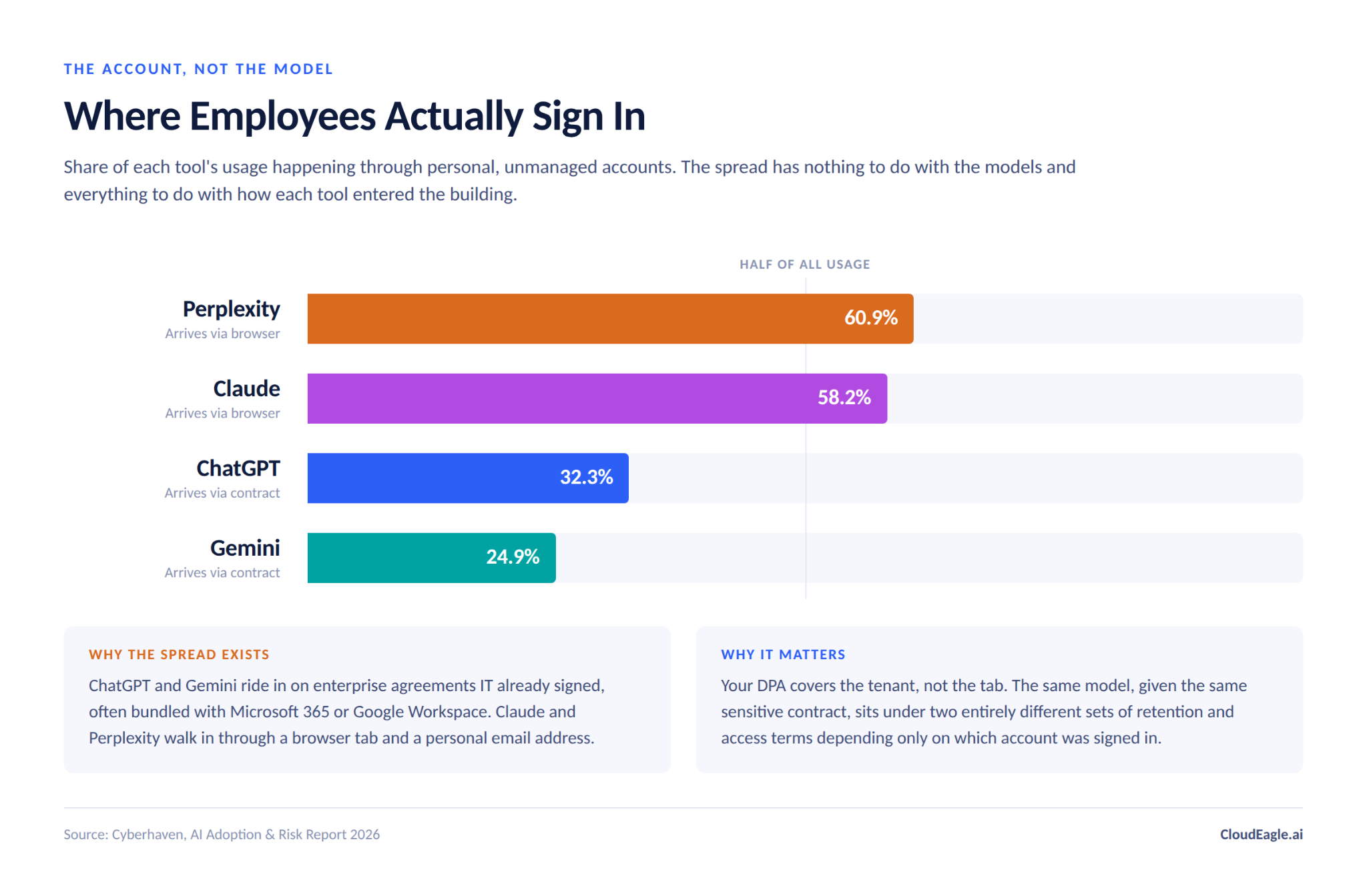
Look at the spread between Claude at 58.2% personal-account usage and Gemini at 24.9%. Nothing about that gap is a statement on either vendor's security posture. It is a statement about how each tool entered the building.

ChatGPT and Gemini arrived inside enterprise agreements IT had already signed, bundled with Microsoft 365 and Google Workspace. Claude and Perplexity arrived the way every genuinely useful tool arrives, through a browser tab and somebody’s personal email.

A. The Risk Is the Credential, Not the Model
‍

‍

‍

So the risk is not the model. It is the credential.

Your DPA covers the tenant, not the tab, and the same model handed the same contract sits under two entirely different sets of terms depending only on who was signed in.

3. Why Doesn’t Blocking GenAI Applications Work?

‍

What the blocking numbers say Figure
Organizations blocking at least one GenAI application 9 in 10
GenAI applications the average organization blocks 10
GenAI tools running at the most AI-forward enterprises 300+
Change in data-policy violations over the same year Doubled
Share of endpoint AI usage from DeepSeek and Qwen models ~50%

‍

Nine out of ten organizations now block at least one GenAI application. The average organization blocks ten of them.

Meanwhile the most AI-forward enterprises are running north of 300 GenAI tools, and adding more every week. Data-policy violations doubled over the same year the blocking got more aggressive.

Ten against three hundred is not a control. It is a gesture with a reporting line, and everyone involved privately knows it.

There is a harder truth underneath. Blocking assumes you can name the thing you are blocking, and the long tail is now moving faster than any naming process.

Cyberhaven puts DeepSeek and Qwen models at half of all endpoint-based AI usage, which is a very different conversation for a regulated business than the one about Claude and ChatGPT that most controls were designed to have.

Blocking fails for the same reason URL filtering failed and USB bans failed: it treats a productivity motive as a compliance defect.

Employees reaching for an unsanctioned AI tool are not attacking you, they are routing around you, and they will keep finding the gap faster than you can close it. Three things work better than a longer blocklist.

A. Risk-Score Before You Block

If you are only going to stop ten tools, they should be the ten that carry real risk, not the ten you had heard of.

Roughly 82% of the hundred most-used GenAI applications now rate medium-to-critical risk, so the selection problem is real and it is not intuitive.

B. Redirect Instead of Denying

Intercepting an attempt to reach an unsanctioned tool and pointing the employee at the approved equivalent preserves the motive that created the shadow tool.

A denial page creates a workaround; a redirect creates a convert.

C. Govern the Transfer, Not the Tool

If the risk concentrates at the moment data moves, then controlling that moment scales across three hundred tools in a way a named list never will.

This is the single highest-leverage shift available to most enterprises right now, and it is the one almost nobody has made.

‍

Your AI Inventory Is Missing More Than You Think

Find every hidden tool.
Catch Hidden AI

‍

4. Why Does Falling Personal-Account Share Look Like Progress?

Here is the number that should worry a CFO more than 40%.
‍

‍

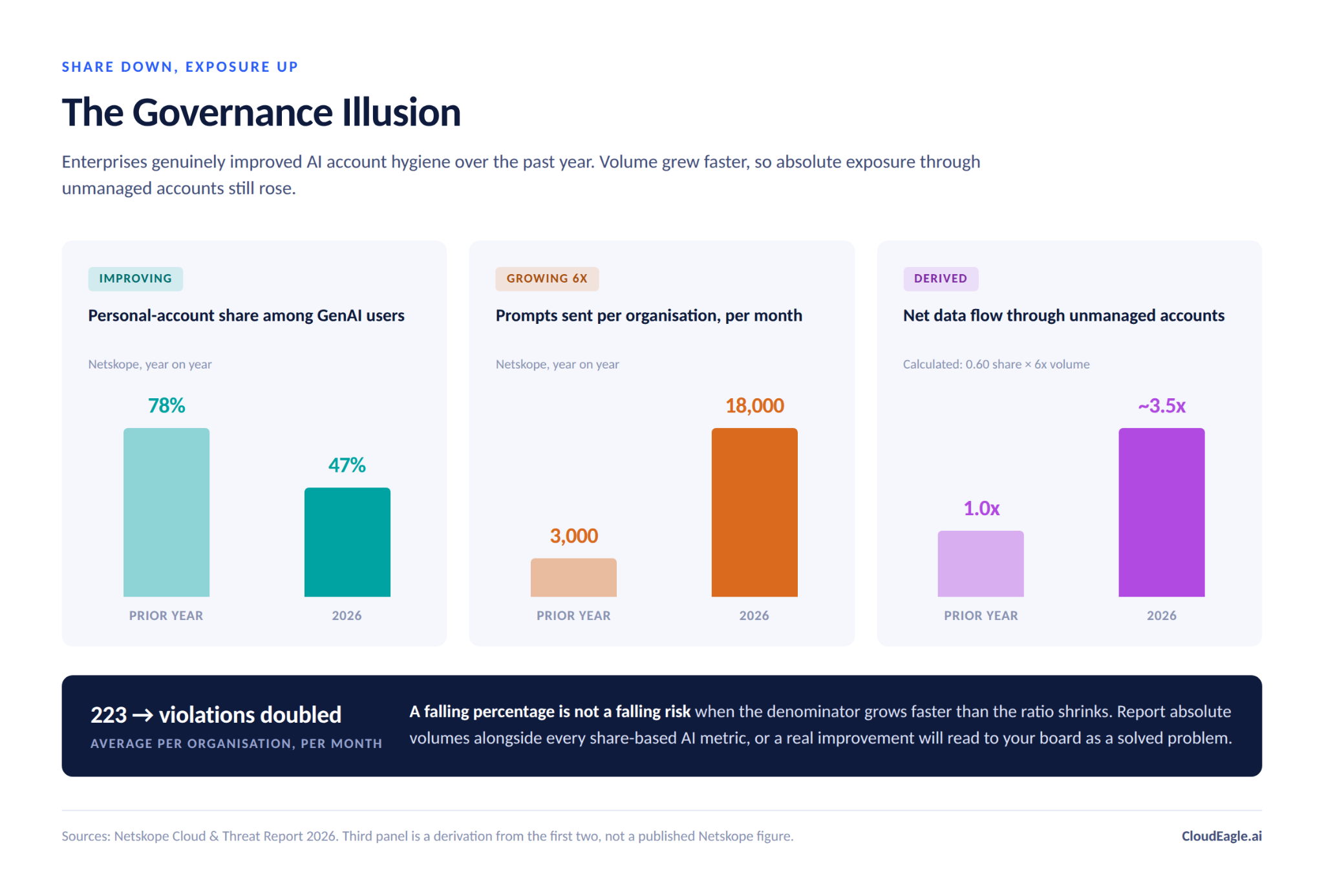
Personal-account usage among GenAI users fell from 78% to 47% year on year. Genuine progress; onboarding people onto sanctioned tenants is working.

Over the same period, prompt volume per organization went from 3,000 to 18,000 a month.

Run those together and the improvement evaporates.

A share that falls to 0.6 of its previous level, against volume that rises sixfold, still produces roughly three and a half times more data flowing through unmanaged accounts than the year before.

The percentage went down. The exposure went up. Both statements are true, and only one of them is going in the board deck.

‍

5. What Happens Next in Enterprise AI Governance?

Pedictions, stated plainly so they can be wrong.

‍

Prediction What changes if it holds
Personal-account share becomes a board metric within a year Reporting shifts from tool count to account hygiene
Enforcement moves from the app layer to the transfer layer Controls stop depending on naming every tool
Non-human identities become the next shadow AI Service accounts and API keys enter the inventory

‍

A. Personal-Account Share Becomes a Board Metric Within a Year

Tool count is already a vanity number; every enterprise has more AI tools than it can name, and the count only goes up.

Account hygiene is the metric that actually moves with intervention, and it survives contact with a board that wants to know whether last quarter’s spend changed anything.

‍B. Enforcement Moves From the App Layer to the Transfer Layer

The app-by-app approach cannot survive a tool count that grows weekly.

The controls that last will sit at the point of data movement and be indifferent to which of three hundred tools is on the other end.

C. Non-Human Identities Become the Next Shadow AI

Every AI integration and agent spins up service accounts and API keys that outlive whoever created them.

They appear in none of the studies quoted in this piece, because nobody was looking for them, which is exactly what shadow AI looked like in 2023.

‍

6. How Do You Produce Your Own Number?

If the published figure swings fifteenfold by measurement method, reproducing it internally is the whole job.

The one that matters most is the first: count your AI applications four separate times.

  1. Count through your IdP.
  2. Count through your browser telemetry.
  3. Count through your firewall.
  4. Count through your finance data.

‍

Count source Number of AI apps found
Identity provider
Browser telemetry
Firewall
Finance and card spend
Highest count minus IdP count = your blind spot

‍

The gap between the highest count and the IdP count is your blind spot, expressed as a number you can actually put on a slide.

That gap is also the honest version of the 40% statistic. It is the only figure in this entire conversation that describes you.

‍

7. What Does Getting This Wrong Actually Cost?

IBM found that among organizations that suffered an AI-related security incident, 97% turned out to have no proper access controls on the AI layer. Not fewer controls. None, once somebody finally looked.

That is not a correlation to reason about. It is a description of what AI governance maturity looks like in practice, which is to say it mostly does not exist yet, and the organizations discovering this are discovering it during an incident.

‍

‍

8. Conclusion

The 40% figure did something genuinely useful. It got AI data exposure onto agendas that had spent two years ignoring it, and no amount of methodological pedantry should take that away from it.

What it cannot do is tell you where you stand, because it was never measuring you. It was measuring 222 other companies through one vendor’s sensor, and the version of that number produced by a different sensor is fifteen times smaller.

The teams that get the next two years right will not be the ones citing the best statistic. They will be the ones who stopped governing tools and started governing accounts and transfers, and who can produce their own number, from their own stack, on demand, and watch it move.

Everyone else will still be quoting 40% while their real figure does whatever it likes.

‍

9. FAQs

1. Can't CloudEagle.ai only see the AI tools that go through your identity provider?

No. CloudEagle.ai counts AI tools the way this post recommends: through your identity provider, browser telemetry, firewall, and finance data, all correlated. It surfaces the AI apps that never touched your IdP, which is exactly the blind spot a single source misses.

2. Doesn't CloudEagle.ai miss approved AI tools used on personal accounts?

CloudEagle.ai governs accounts, not just apps, so it catches the most common exposure route: a sanctioned tool like Claude used through a personal login. It separates corporate from personal sessions, so your team can see which usage falls outside your enterprise agreement and DPA.

3. Won't CloudEagle.ai just add another blocklist that employees route around?

CloudEagle.ai redirects instead of denying. When an employee reaches for an unsanctioned AI tool, it points them to the approved equivalent, which keeps the productivity motive intact. It also risk-scores every tool first, so any blocking you do targets real risk instead of familiar names.

4. Isn't CloudEagle.ai's inventory limited to apps and not the API keys that AI agents create?

CloudEagle.ai includes non-human identities in the same inventory. Service accounts and API keys created by AI integrations and agents are discovered alongside apps and user accounts, so the next wave of shadow AI is visible before it outlives the people who created it.

5. Doesn't it take months to get your own sensitive-data number with CloudEagle.ai?

CloudEagle.ai onboarding takes about thirty minutes. From there it surfaces every AI app, agent, account, and non-human identity in your environment, so you can measure your own exposure instead of quoting an industry average that describes someone else.

‍

Advertisement for a SaaS Subscription Tracking Template with a call-to-action button to download and a partial graphic of a tablet showing charts.Banner promoting a SaaS Agreement Checklist to streamline SaaS management and avoid budget waste with a call-to-action button labeled Download checklist.Blue banner with text 'The Ultimate Employee Offboarding Checklist!' and a black button labeled 'Download checklist' alongside partial views of checklist documents from cloudeagle.ai.Digital ad for download checklist titled 'The Ultimate Checklist for IT Leaders to Optimize SaaS Operations' by cloudeagle.ai, showing checklist pages.Slack Buyer's Guide offer with text 'Unlock insider insights to get the best deal on Slack!' and a button labeled 'Get Your Copy', accompanied by a preview of the guide featuring Slack's logo.Monday Pricing Guide by cloudeagle.ai offering exclusive pricing secrets to maximize investment with a call-to-action button labeled Get Your Copy and an image of the guide's cover.Blue banner for Canva Pricing Guide by cloudeagle.ai offering a guide to Canva costs, features, and alternatives with a call-to-action button saying Get Your Copy.Blue banner with white text reading 'Little-Known Negotiation Hacks to Get the Best Deal on Slack' and a white button labeled 'Get Your Copy'.Blue banner with text 'Little-Known Negotiation Hacks to Get the Best Deal on Monday.com' and a white button labeled 'Get Your Copy'.Blue banner with text 'Little-Known Negotiation Hacks to Get the Best Deal on Canva' and a white button labeled 'Get Your Copy'.Banner with text 'Slack Buyer's Guide' and a 'Download Now' button next to images of a guide titled 'Slack Buyer’s Guide: Features, Pricing & Best Practices'.Digital cover of Monday Pricing Guide with a button labeled Get Your Copy on a blue background.Canva Pricing Guide cover with a button labeled Get Your Copy on a blue gradient background.

Enter your email to
unlock the report

Oops! Something went wrong while submitting the form.
License Count
Benchmark
Per User/Per Year

Enter your email to
unlock the report

Oops! Something went wrong while submitting the form.
License Count
Benchmark
Per User/Per Year

Enter your email to
unlock the report

Oops! Something went wrong while submitting the form.
Notion Plus
License Count
Benchmark
Per User/Per Year
100-500
$67.20 - $78.72
500-1000
$59.52 - $72.00
1000+
$51.84 - $57.60
Canva Pro
License Count
Benchmark
Per User/Per Year
100-500
$74.33-$88.71
500-1000
$64.74-$80.32
1000+
$55.14-$62.34

Enter your email to
unlock the report

Oops! Something went wrong while submitting the form.

Enter your email to
unlock the report

Oops! Something went wrong while submitting the form.
Zoom Business
License Count
Benchmark
Per User/Per Year
100-500
$216.00 - $264.00
500-1000
$180.00 - $216.00
1000+
$156.00 - $180.00

Enter your email to
unlock the report

Oops! Something went wrong while submitting the form.

Get the Right Security Platform To Secure Your Cloud Infrastructure

Please enter a business email
Thank you!
The 2023 SaaS report has been sent to your email. Check your promotional or spam folder.
Oops! Something went wrong while submitting the form.

Access full report

Please enter a business email
Thank you!
The 2023 SaaS report has been sent to your email. Check your promotional or spam folder.
Oops! Something went wrong while submitting the form.
  • The widely cited "40% of AI prompts contain sensitive data" statistic varies dramatically based on how vendors measure AI activity, making organization-specific visibility far more important than industry averages.
  • The biggest AI governance risk is often personal accounts using approved AI tools—not the AI models themselves or traditional shadow AI.
  • Blocking AI tools alone doesn't scale; organizations should prioritize risk-based controls, redirects to approved tools, and governing data transfers instead.
  • Effective AI governance requires measuring your own environment by combining identity, browser, firewall, and finance data to uncover hidden AI usage and blind spots.
  • CloudEagle.ai helps enterprises discover every AI app, account, agent, and non-human identity, enabling governance based on real organizational data rather than industry benchmarks
  • ‍

    What almost 40% of AI prompts containing sensitive data means for your team is: almost nothing.

    It is 39.7% of AI interactions, which includes pastes and file uploads, not prompts alone.

    The interesting part is that a room full of executives can agree on a statistic none of them can reproduce for their own company, and then make budget decisions with it.

    We think the 40% conversation is a displacement activity. It lets leadership feel informed about sensitive data risk without ever having to answer the only question that matters, which is what the number is inside their own four walls.

    Most enterprises cannot answer it. Not because the tooling is missing, but because AI governance inherited a mental model built for software procurement, and it is the wrong one.

    ‍

    1. What Does the 40% Sensitive-Data Statistic Actually Measure?

    Line up the major 2025–26 studies and the same question comes back with answers between roughly 2.6% and 39.7%.

    ‍

    Sensor type What it counts Why the number differs
    Endpoint agent Data movements off the device Counts every file and paste, so the figure runs high
    Prompt classifier Prompts flagged as sensitive Counts typed text only, so uploads never enter the denominator
    Browser tool Uploads through the browser tab Counts one channel, misses desktop apps and APIs
    Published range Same question, different architecture 2.6% to 39.7%, a fifteenfold spread

    ‍

    A. The Sensor Determines the Statistic

    That spread is not a scandal. Each vendor measured the events its own product can see; an endpoint agent counts data movements, a prompt classifier counts prompts, a browser tool counts uploads.

    Which is why every one of these figures is, structurally, a marketing artifact.

    Not dishonest, just shaped. A security vendor publishes the number its architecture is good at producing, and that number flatters the architecture.

    B. The Useful Version Is Narrower Than the Headline

    The useful version of the statistic is narrower than the headline. It does not mean four in ten of your team's AI conversations leak something.

    It means that when data physically moves toward an AI tool, it is sensitive roughly four times in ten.

    That is a statement about a moment, not a behavior. It points at a control surface.

    ‍

    Every Hidden AI App Creates Hidden Risk

    Find them before attackers do.
    See How

    ‍

    2. Is Shadow AI the Right Name for What Is Actually Happening?

    The phrase implies rogue tools. Unsanctioned software, sneaking in, bypassing procurement.

    That is not the pattern shadow AI data shows. The dominant failure is the opposite: a perfectly sanctioned tool, accessed through an account nobody sanctioned.

    ‍

    Tool Personal-account usage How it entered the building
    Claude 58.2% A browser tab and somebody’s personal email
    Perplexity High Same route, outside any enterprise agreement
    ChatGPT Lower Bundled into agreements IT had already signed
    Gemini 24.9% Arrived inside Google Workspace

    ‍

    Look at the spread between Claude at 58.2% personal-account usage and Gemini at 24.9%. Nothing about that gap is a statement on either vendor's security posture. It is a statement about how each tool entered the building.

    ChatGPT and Gemini arrived inside enterprise agreements IT had already signed, bundled with Microsoft 365 and Google Workspace. Claude and Perplexity arrived the way every genuinely useful tool arrives, through a browser tab and somebody’s personal email.

    A. The Risk Is the Credential, Not the Model

    ‍

    ‍

    ‍

    So the risk is not the model. It is the credential.

    Your DPA covers the tenant, not the tab, and the same model handed the same contract sits under two entirely different sets of terms depending only on who was signed in.

    3. Why Doesn’t Blocking GenAI Applications Work?

    ‍

    What the blocking numbers say Figure
    Organizations blocking at least one GenAI application 9 in 10
    GenAI applications the average organization blocks 10
    GenAI tools running at the most AI-forward enterprises 300+
    Change in data-policy violations over the same year Doubled
    Share of endpoint AI usage from DeepSeek and Qwen models ~50%

    ‍

    Nine out of ten organizations now block at least one GenAI application. The average organization blocks ten of them.

    Meanwhile the most AI-forward enterprises are running north of 300 GenAI tools, and adding more every week. Data-policy violations doubled over the same year the blocking got more aggressive.

    Ten against three hundred is not a control. It is a gesture with a reporting line, and everyone involved privately knows it.

    There is a harder truth underneath. Blocking assumes you can name the thing you are blocking, and the long tail is now moving faster than any naming process.

    Cyberhaven puts DeepSeek and Qwen models at half of all endpoint-based AI usage, which is a very different conversation for a regulated business than the one about Claude and ChatGPT that most controls were designed to have.

    Blocking fails for the same reason URL filtering failed and USB bans failed: it treats a productivity motive as a compliance defect.

    Employees reaching for an unsanctioned AI tool are not attacking you, they are routing around you, and they will keep finding the gap faster than you can close it. Three things work better than a longer blocklist.

    A. Risk-Score Before You Block

    If you are only going to stop ten tools, they should be the ten that carry real risk, not the ten you had heard of.

    Roughly 82% of the hundred most-used GenAI applications now rate medium-to-critical risk, so the selection problem is real and it is not intuitive.

    B. Redirect Instead of Denying

    Intercepting an attempt to reach an unsanctioned tool and pointing the employee at the approved equivalent preserves the motive that created the shadow tool.

    A denial page creates a workaround; a redirect creates a convert.

    C. Govern the Transfer, Not the Tool

    If the risk concentrates at the moment data moves, then controlling that moment scales across three hundred tools in a way a named list never will.

    This is the single highest-leverage shift available to most enterprises right now, and it is the one almost nobody has made.

    ‍

    Your AI Inventory Is Missing More Than You Think

    Find every hidden tool.
    Catch Hidden AI

    ‍

    4. Why Does Falling Personal-Account Share Look Like Progress?

    Here is the number that should worry a CFO more than 40%.

    ‍

    ‍

    Personal-account usage among GenAI users fell from 78% to 47% year on year. Genuine progress; onboarding people onto sanctioned tenants is working.

    Over the same period, prompt volume per organization went from 3,000 to 18,000 a month.

    Run those together and the improvement evaporates.

    A share that falls to 0.6 of its previous level, against volume that rises sixfold, still produces roughly three and a half times more data flowing through unmanaged accounts than the year before.

    The percentage went down. The exposure went up. Both statements are true, and only one of them is going in the board deck.

    ‍

    5. What Happens Next in Enterprise AI Governance?

    Pedictions, stated plainly so they can be wrong.

    ‍

    Prediction What changes if it holds
    Personal-account share becomes a board metric within a year Reporting shifts from tool count to account hygiene
    Enforcement moves from the app layer to the transfer layer Controls stop depending on naming every tool
    Non-human identities become the next shadow AI Service accounts and API keys enter the inventory

    ‍

    A. Personal-Account Share Becomes a Board Metric Within a Year

    Tool count is already a vanity number; every enterprise has more AI tools than it can name, and the count only goes up.

    Account hygiene is the metric that actually moves with intervention, and it survives contact with a board that wants to know whether last quarter’s spend changed anything.

    ‍B. Enforcement Moves From the App Layer to the Transfer Layer

    The app-by-app approach cannot survive a tool count that grows weekly.

    The controls that last will sit at the point of data movement and be indifferent to which of three hundred tools is on the other end.

    C. Non-Human Identities Become the Next Shadow AI

    Every AI integration and agent spins up service accounts and API keys that outlive whoever created them.

    They appear in none of the studies quoted in this piece, because nobody was looking for them, which is exactly what shadow AI looked like in 2023.

    ‍

    6. How Do You Produce Your Own Number?

    If the published figure swings fifteenfold by measurement method, reproducing it internally is the whole job.

    The one that matters most is the first: count your AI applications four separate times.

    1. Count through your IdP.
    2. Count through your browser telemetry.
    3. Count through your firewall.
    4. Count through your finance data.

    ‍

    Count source Number of AI apps found
    Identity provider
    Browser telemetry
    Firewall
    Finance and card spend
    Highest count minus IdP count = your blind spot

    ‍

    The gap between the highest count and the IdP count is your blind spot, expressed as a number you can actually put on a slide.

    That gap is also the honest version of the 40% statistic. It is the only figure in this entire conversation that describes you.

    ‍

    7. What Does Getting This Wrong Actually Cost?

    IBM found that among organizations that suffered an AI-related security incident, 97% turned out to have no proper access controls on the AI layer. Not fewer controls. None, once somebody finally looked.

    That is not a correlation to reason about. It is a description of what AI governance maturity looks like in practice, which is to say it mostly does not exist yet, and the organizations discovering this are discovering it during an incident.

    ‍

    ‍

    8. Conclusion

    The 40% figure did something genuinely useful. It got AI data exposure onto agendas that had spent two years ignoring it, and no amount of methodological pedantry should take that away from it.

    What it cannot do is tell you where you stand, because it was never measuring you. It was measuring 222 other companies through one vendor’s sensor, and the version of that number produced by a different sensor is fifteen times smaller.

    The teams that get the next two years right will not be the ones citing the best statistic. They will be the ones who stopped governing tools and started governing accounts and transfers, and who can produce their own number, from their own stack, on demand, and watch it move.

    Everyone else will still be quoting 40% while their real figure does whatever it likes.

    ‍

    9. FAQs

    1. Can't CloudEagle.ai only see the AI tools that go through your identity provider?

    No. CloudEagle.ai counts AI tools the way this post recommends: through your identity provider, browser telemetry, firewall, and finance data, all correlated. It surfaces the AI apps that never touched your IdP, which is exactly the blind spot a single source misses.

    2. Doesn't CloudEagle.ai miss approved AI tools used on personal accounts?

    CloudEagle.ai governs accounts, not just apps, so it catches the most common exposure route: a sanctioned tool like Claude used through a personal login. It separates corporate from personal sessions, so your team can see which usage falls outside your enterprise agreement and DPA.

    3. Won't CloudEagle.ai just add another blocklist that employees route around?

    CloudEagle.ai redirects instead of denying. When an employee reaches for an unsanctioned AI tool, it points them to the approved equivalent, which keeps the productivity motive intact. It also risk-scores every tool first, so any blocking you do targets real risk instead of familiar names.

    4. Isn't CloudEagle.ai's inventory limited to apps and not the API keys that AI agents create?

    CloudEagle.ai includes non-human identities in the same inventory. Service accounts and API keys created by AI integrations and agents are discovered alongside apps and user accounts, so the next wave of shadow AI is visible before it outlives the people who created it.

    5. Doesn't it take months to get your own sensitive-data number with CloudEagle.ai?

    CloudEagle.ai onboarding takes about thirty minutes. From there it surfaces every AI app, agent, account, and non-human identity in your environment, so you can measure your own exposure instead of quoting an industry average that describes someone else.

    ‍

    CloudEagle.ai recognized in the 2025 Gartner® Magic Quadrant™ for SaaS Management Platforms
    Download now
    gartner chart
    5x
    Faster employee
    onboarding
    80%
    Reduction in time for
    user access reviews
    30k
    Workflows
    automated
    $15Bn
    Analyzed in
    contract spend
    $2Bn
    Saved in
    SaaS spend

    Streamline SaaS governance and save 10-30%

    Book a Demo with Expert
    CTA image