Which AI Contract Clauses Decide Whether Your Data Trains Someone Else's Model

Share via:
blog-cms-banner-bg
Little-Known Negotiation Hacks to Get the Best Deal on Slack
cta-bg-blogDownload Your Copy

HIPAA Compliance Checklist for 2025

Download PDF

A legal team reviews an AI vendor renewal. The pricing looks right. The features haven't changed. The auto-renewal notice came in on time. Nobody reads page 11, where the data usage clause quietly changed from "we will not use your data to train models" to "we may use aggregated and anonymized data to improve our services." 

The contract renews, and the new clause takes effect.

This isn't unusual. During AI vendor renewals, procurement teams often focus on pricing, seats, and deadlines, comparing contracts from memory instead of against the previous version. AI-specific data usage clauses are easy to miss but can have significant legal and security implications.

AI contract review isn't about reading faster. It's about automatically extracting and flagging the clauses that determine how vendors can use your data before the renewal is finalized.

TL;DR

  • AI vendor contracts contain specific clauses that govern whether your prompts, outputs, and data can be used for model training, and they vary significantly between vendors and between contract versions at renewal
  • These clauses are routinely buried in DPAs, acceptable use policies, and service agreements that procurement teams do not have time to read line by line under renewal deadlines
  • The most dangerous clause is the aggregation and anonymization carve-out, which vendors use to justify training on de-identified versions of your data while maintaining a training opt-out elsewhere in the agreement
  • CloudEagle.ai centralizes all SaaS contracts, extracts key metadata automatically including AI-specific data usage clauses, and flags policy deviations before the renewal window closes
  • The result: every AI contract renewal enters negotiation with a clear picture of what the vendor can and cannot do with your data

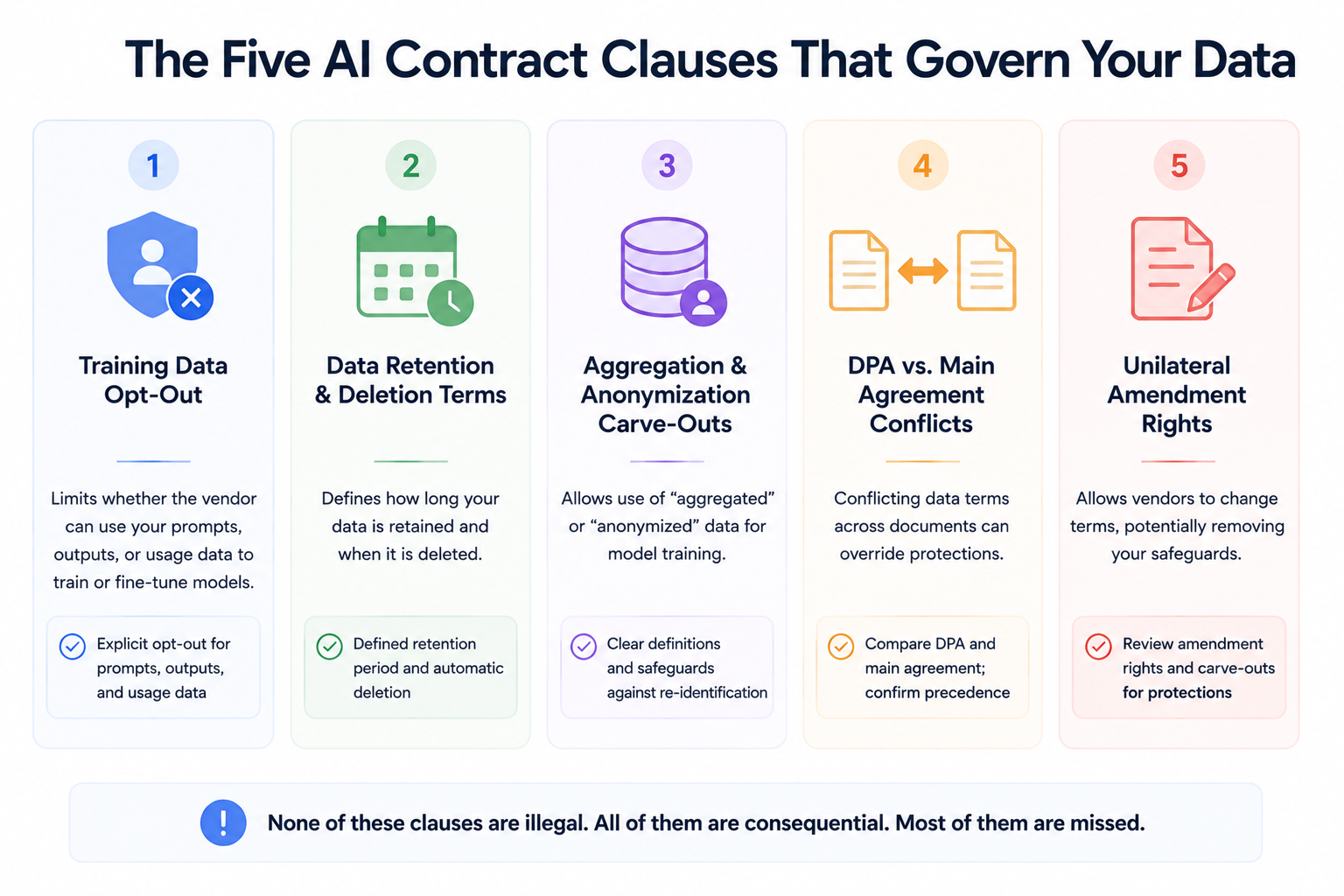
1. The Five AI Contract Clauses That Govern Your Data

AI vendors may use different language, but the same five contract clauses consistently determine customer data rights. Understanding what each clause does makes it easier to evaluate vendor risk and negotiate stronger protections.
Clause 1: Training Data Opt-Out

This is the clause most procurement teams think they have covered. It defines whether the vendor can use your inputs, outputs, or usage data to train or fine-tune their models.

The risk is not the absence of the clause. It is the quality of the language. Look for explicit opt-out language that specifically covers prompts, outputs, and usage data. "We take security seriously" is not an opt-out. "We will not use your data to train or fine-tune our models" is. 

The difference between those two sentences is the difference between protected and unprotected data.

Review checklist:

  • Explicit prohibition on model training using customer data
  • Coverage for prompts, outputs, and usage data
  • No vague or marketing-oriented language

Clause 2: Data Retention and Deletion Terms

The opt-out clause tells you what the vendor will do with your data while they have it. The retention clause tells you how long they have it.

Some vendors retain prompts and outputs indefinitely unless you explicitly instruct otherwise. Some retain data for 30 days. Some retain flagged content for up to seven years. The retention period determines the window during which your data is accessible, reviewable, and subject to legal process, regardless of what the training clause says.

Review checklist:

  • Defined retention period for prompts and outputs
  • Automatic deletion after contract termination
  • Clear deletion and data export process

Clause 3: Aggregation and Anonymization Carve-Outs

This is the most consequential and most misunderstood clause in AI contracts.

Vendors often include an explicit training opt-out in one part of the agreement, then exclude "aggregated and anonymized data" from the scope of that opt-out. The practical effect: the vendor can de-identify a version of your data and use it for model training while technically honoring the opt-out you negotiated.

Whether that de-identification adequately protects your data depends on the specifics of your data, the quality of the anonymization process, and whether re-identification is possible from the resulting dataset. Most contracts do not address any of those questions.

Review checklist:

  • How "aggregated" and "anonymized" data are defined
  • Whether anonymized data can be used for model improvement
  • Any safeguards against re-identification

Clause 4: DPA vs. Main Agreement Conflicts

AI vendors frequently structure their agreements so that data usage restrictions appear in the main service agreement while the actual legal terms governing data processing appear in a separate Data Processing Addendum (DPA). When the two documents conflict, the DPA typically governs.

This creates a specific failure mode: procurement reviews the main agreement, sees the training opt-out, and assumes it is sufficient. The DPA contains more permissive language for specific processing activities. The conflict is never spotted because the two documents were never compared directly.

Review checklist:

  • Compare the DPA against the main agreement
  • Resolve conflicting data processing terms
  • Confirm which document takes legal precedence

Clause 5: Unilateral Amendment Rights

Many AI vendor contracts include the right to update terms with 30 days' notice. A training data opt-out you negotiated today can be removed at the next renewal cycle without renegotiation, provided the vendor gives adequate notice.

This clause is the mechanism by which every other protection can be unwound. If the training opt-out is not explicitly carved out from unilateral amendment rights, it is not a durable protection. It is a protection that holds until the vendor decides it should not.

Review checklist:

  • Vendor's right to modify terms
  • Notice period for contract changes
  • Whether negotiated protections are exempt from future amendments

None of these clauses are illegal. All of them are consequential. Most of them are missed.

3. How CloudEagle's AI Contract Review Surfaces These Clauses Before You Sign

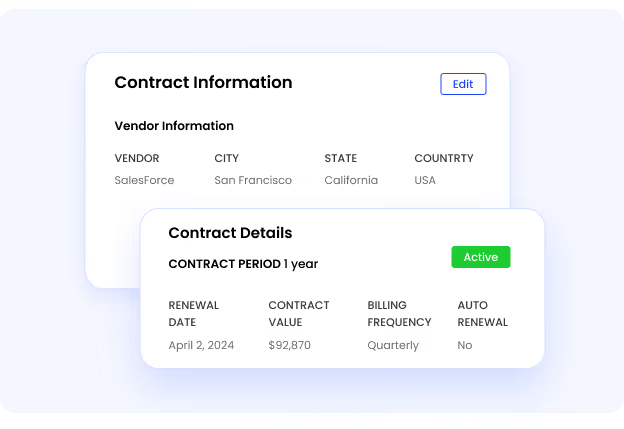
CloudEagle.ai centralizes AI contracts in one searchable repository and uses AI-powered metadata extraction to identify AI-specific contractual terms, compare renewal drafts against previous versions, and flag deviations from your procurement and AI governance policies before the agreement is approved.
Training Data Rights

Whether a vendor can use your prompts, inputs, outputs, or uploaded files for model training should never be left to interpretation.

How it helps

  • Identifies clauses governing model training and AI data usage
  • Flags whether training-data opt-outs are contractual, account-level, or require customer action
  • Compares renewal drafts with previous agreements to detect changes in training rights
  • Surfaces weakened data protection terms before contracts are signed

"CloudEagle was the right choice for us. AI-powered metadata extraction pulled key contract details into a centralized repository, auto-built our renewal calendar, and sent alerts ahead of time, so we're always prepared and never chasing inboxes." Troy Otilio, CEO, Aira

Data Usage and Retention

Many AI vendors reserve rights to retain, aggregate, or de-identify customer data under specific conditions.

How it helps

  • Flags aggregation, anonymization, and data retention clauses automatically
  • Highlights provisions affecting customer data, PII, financial data, and regulated information
  • Detects changes to data processing obligations between contract versions
  • Surfaces clauses that may conflict with internal data governance policies

Contract Consistency Checks

AI data usage commitments are often split across multiple legal documents, making inconsistencies easy to miss during manual review.
How it helps

  • Compares data usage language across the MSA, DPA, and other supporting agreements
  • Flags conflicting or more permissive data processing terms
  • Identifies missing or inconsistent privacy commitments
  • Surfaces contracts requiring legal or security review

Policy and Renewal Governance

AI contract terms evolve frequently, and important changes often appear during renewals rather than initial negotiations.
How it helps

  • Compares contracts against predefined procurement and AI governance policies
  • Flags deviations in data usage, security, liability, and compliance requirements
  • Tracks renewal windows and amendment notices that require action
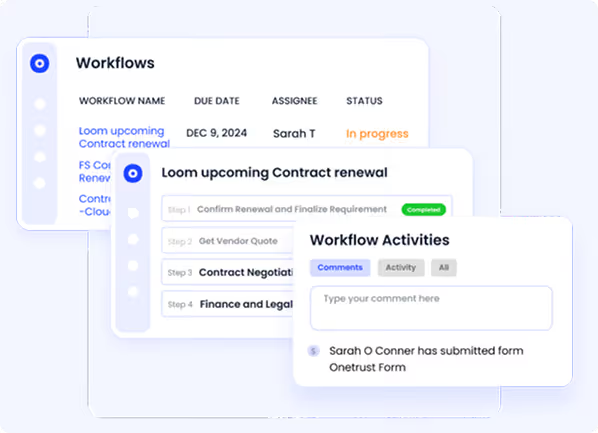
  • Generates renewal alerts so policy exceptions are addressed before contracts renew automatically

This structure is technically accurate, stays focused on the blog's topic (AI contract clauses), and positions CloudEagle.ai as an AI contract governance platform rather than simply a clause extraction tool.

4. How the Major AI Vendors Handle Training Data by Default

Vendor defaults shift frequently. Verify against each vendor's current DPA before any contract decision. These positions are accurate as of July 2026:

  • OpenAI: Enterprise and API customers are not trained on by default under OpenAI's enterprise terms. Consumer ChatGPT Free, Plus, and Pro plans train on conversations by default unless the user opts out. If your teams are using both enterprise and personal accounts, the distinction matters significantly.
  • Microsoft Copilot for M365: Microsoft 365 Copilot is contractually excluded from training under the Microsoft Products and Services Data Protection Addendum: customer data is not used to train foundation models. Note that Microsoft added Anthropic as a default subprocessor for M365 Copilot in January 2026, with separate data retention terms for Anthropic's processing. EU and UK tenants have Anthropic disabled by default.
  • Google Gemini: Google Gemini Enterprise does not train on business data, with processing within Google Cloud's data residency framework. Consumer Gemini plans train on conversations by default with activity enabled. Google Workspace enterprise accounts are treated differently from consumer accounts under the same Google credentials.
  • Anthropic Claude: Claude for Work, Education, Government, and the API are not trained on by default. Consumer plans including Free, Pro, and Max train by default as of August 2025 following a policy change.
  • GitHub Copilot: Business and Enterprise tiers are exempt from training data collection. Free, Pro, and Pro+ users have interaction data used for training by default as of April 2026 following a policy change. Proprietary code on personal Copilot accounts is high risk under the current policy.
  • Third-party AI tools: The highest risk category. Tools built on top of foundation models often have their own data usage terms that are separate from the underlying model provider's terms and may be significantly more permissive. A tool built on Claude's API and sold through a third-party vendor is governed by that vendor's terms, not Anthropic's, unless the contract explicitly states otherwise.

📖 Worth a Read 👉 How CloudEagle.ai's AI Contract Review Tool Keeps Every SaaS Renewal Inside Your Policy

5. What Changes at Renewal and Why It's the Highest-Risk Moment

Missed renewal deadlines lead to auto-renewals at unfavorable terms, and procurement teams often lack visibility into contract terms across multiple vendors. For AI contracts specifically, the renewal is the moment vendors update data usage terms most frequently, because it is when procurement is focused on price and seat count and least likely to review the DPA for changes.

Three things should trigger a full data usage clause review at any AI vendor renewal:

  • Any change to the DPA, even if described as a minor update
  • Any update to the acceptable use policy referenced in the main contract
  • Any change to the vendor's privacy policy effective date

CloudEagle.ai sends automated reminders before contract renewals and provides version-by-version comparison of data usage language, so the team knows what changed between the current contract and the renewal draft before the opt-out window closes.

6. Building a Data Usage Clause Review Into Your AI Procurement Process

Most AI procurement processes treat data usage clause review as an optional legal add-on rather than a mandatory step. The consequence is that it gets skipped under deadline pressure, which is exactly when it matters most.

Three process changes that close the gap:

  • Add AI data usage clause review as a mandatory step in the renewal workflow, not a discretionary legal review
  • Maintain a vendor-by-vendor record of opt-out status and the date it was last verified, not just the date the contract was signed
  • Set calendar alerts for unilateral amendment windows so the team has time to respond before a changed clause takes effect

CloudEagle.ai automates contract review by assigning clause review tasks to predefined owners with deadlines. If a task isn't completed on time, it automatically escalates, ensuring data usage clauses are reviewed before renewal instead of being missed under deadline pressure.

Conclusion

The clause that decides whether your data trains someone else's model is in every AI contract you have signed. 

Whether it protects you depends on whether someone read it carefully enough to catch the aggregation carve-out, the DPA conflict, and the unilateral amendment right that can remove the protection you negotiated at any subsequent renewal.

CloudEagle.ai makes sure you know what that clause says before you sign the next one. AI-powered metadata extraction surfaces every data usage clause, flags version changes between contract cycles, and connects every flag to an assigned action with a deadline before the renewal window closes.

See CloudEagle's AI Contract Review in Action → Book a Demo

Frequently Asked Questions

1. What AI contract clauses determine whether my data is used for training?
Five clauses matter most: training data opt-out, data retention, aggregation and anonymization carve-outs, DPA vs. main agreement conflicts, and unilateral amendment rights. Together, they determine how vendors can use, retain, and change the terms governing your data.

2. Do enterprise AI contracts protect my data from training by default?
Most enterprise AI plans do, but consumer plans often do not. Always verify the vendor's contract and DPA, as third-party AI tools may have different data usage policies than the underlying AI model provider.

3. What is an aggregation and anonymization carve-out in an AI contract?
It is a clause allowing vendors to use aggregated or anonymized versions of customer data, even when training on identifiable data is prohibited. This is one of the most commonly overlooked provisions in AI contracts.

4. How often do AI vendors change their data usage terms?
AI vendors update data usage terms regularly, often during renewals or product updates. Even minor wording changes can affect customer data rights, making contract comparison essential before every renewal.

5. What should I do if a vendor changes their training data terms?
Compare the new agreement with the previous version, review the DPA for conflicting language, and negotiate changes before renewing if the updated terms don't meet your security, privacy, or compliance requirements.

Advertisement for a SaaS Subscription Tracking Template with a call-to-action button to download and a partial graphic of a tablet showing charts.Banner promoting a SaaS Agreement Checklist to streamline SaaS management and avoid budget waste with a call-to-action button labeled Download checklist.Blue banner with text 'The Ultimate Employee Offboarding Checklist!' and a black button labeled 'Download checklist' alongside partial views of checklist documents from cloudeagle.ai.Digital ad for download checklist titled 'The Ultimate Checklist for IT Leaders to Optimize SaaS Operations' by cloudeagle.ai, showing checklist pages.Slack Buyer's Guide offer with text 'Unlock insider insights to get the best deal on Slack!' and a button labeled 'Get Your Copy', accompanied by a preview of the guide featuring Slack's logo.Monday Pricing Guide by cloudeagle.ai offering exclusive pricing secrets to maximize investment with a call-to-action button labeled Get Your Copy and an image of the guide's cover.Blue banner for Canva Pricing Guide by cloudeagle.ai offering a guide to Canva costs, features, and alternatives with a call-to-action button saying Get Your Copy.Blue banner with white text reading 'Little-Known Negotiation Hacks to Get the Best Deal on Slack' and a white button labeled 'Get Your Copy'.Blue banner with text 'Little-Known Negotiation Hacks to Get the Best Deal on Monday.com' and a white button labeled 'Get Your Copy'.Blue banner with text 'Little-Known Negotiation Hacks to Get the Best Deal on Canva' and a white button labeled 'Get Your Copy'.Banner with text 'Slack Buyer's Guide' and a 'Download Now' button next to images of a guide titled 'Slack Buyer’s Guide: Features, Pricing & Best Practices'.Digital cover of Monday Pricing Guide with a button labeled Get Your Copy on a blue background.Canva Pricing Guide cover with a button labeled Get Your Copy on a blue gradient background.

Enter your email to
unlock the report

Oops! Something went wrong while submitting the form.
License Count
Benchmark
Per User/Per Year

Enter your email to
unlock the report

Oops! Something went wrong while submitting the form.
License Count
Benchmark
Per User/Per Year

Enter your email to
unlock the report

Oops! Something went wrong while submitting the form.
Notion Plus
License Count
Benchmark
Per User/Per Year
100-500
$67.20 - $78.72
500-1000
$59.52 - $72.00
1000+
$51.84 - $57.60
Canva Pro
License Count
Benchmark
Per User/Per Year
100-500
$74.33-$88.71
500-1000
$64.74-$80.32
1000+
$55.14-$62.34

Enter your email to
unlock the report

Oops! Something went wrong while submitting the form.

Enter your email to
unlock the report

Oops! Something went wrong while submitting the form.
Zoom Business
License Count
Benchmark
Per User/Per Year
100-500
$216.00 - $264.00
500-1000
$180.00 - $216.00
1000+
$156.00 - $180.00

Enter your email to
unlock the report

Oops! Something went wrong while submitting the form.

Get the Right Security Platform To Secure Your Cloud Infrastructure

Please enter a business email
Thank you!
The 2023 SaaS report has been sent to your email. Check your promotional or spam folder.
Oops! Something went wrong while submitting the form.

Access full report

Please enter a business email
Thank you!
The 2023 SaaS report has been sent to your email. Check your promotional or spam folder.
Oops! Something went wrong while submitting the form.

A legal team reviews an AI vendor renewal. The pricing looks right. The features haven't changed. The auto-renewal notice came in on time. Nobody reads page 11, where the data usage clause quietly changed from "we will not use your data to train models" to "we may use aggregated and anonymized data to improve our services." 

The contract renews, and the new clause takes effect.

This isn't unusual. During AI vendor renewals, procurement teams often focus on pricing, seats, and deadlines, comparing contracts from memory instead of against the previous version. AI-specific data usage clauses are easy to miss but can have significant legal and security implications.

AI contract review isn't about reading faster. It's about automatically extracting and flagging the clauses that determine how vendors can use your data before the renewal is finalized.

TL;DR

  • AI vendor contracts contain specific clauses that govern whether your prompts, outputs, and data can be used for model training, and they vary significantly between vendors and between contract versions at renewal
  • These clauses are routinely buried in DPAs, acceptable use policies, and service agreements that procurement teams do not have time to read line by line under renewal deadlines
  • The most dangerous clause is the aggregation and anonymization carve-out, which vendors use to justify training on de-identified versions of your data while maintaining a training opt-out elsewhere in the agreement
  • CloudEagle.ai centralizes all SaaS contracts, extracts key metadata automatically including AI-specific data usage clauses, and flags policy deviations before the renewal window closes
  • The result: every AI contract renewal enters negotiation with a clear picture of what the vendor can and cannot do with your data

1. The Five AI Contract Clauses That Govern Your Data

AI vendors may use different language, but the same five contract clauses consistently determine customer data rights. Understanding what each clause does makes it easier to evaluate vendor risk and negotiate stronger protections.

Clause 1: Training Data Opt-Out

This is the clause most procurement teams think they have covered. It defines whether the vendor can use your inputs, outputs, or usage data to train or fine-tune their models.

The risk is not the absence of the clause. It is the quality of the language. Look for explicit opt-out language that specifically covers prompts, outputs, and usage data. "We take security seriously" is not an opt-out. "We will not use your data to train or fine-tune our models" is. 

The difference between those two sentences is the difference between protected and unprotected data.

Review checklist:

  • Explicit prohibition on model training using customer data
  • Coverage for prompts, outputs, and usage data
  • No vague or marketing-oriented language

Clause 2: Data Retention and Deletion Terms

The opt-out clause tells you what the vendor will do with your data while they have it. The retention clause tells you how long they have it.

Some vendors retain prompts and outputs indefinitely unless you explicitly instruct otherwise. Some retain data for 30 days. Some retain flagged content for up to seven years. The retention period determines the window during which your data is accessible, reviewable, and subject to legal process, regardless of what the training clause says.

Review checklist:

  • Defined retention period for prompts and outputs
  • Automatic deletion after contract termination
  • Clear deletion and data export process

Clause 3: Aggregation and Anonymization Carve-Outs

This is the most consequential and most misunderstood clause in AI contracts.

Vendors often include an explicit training opt-out in one part of the agreement, then exclude "aggregated and anonymized data" from the scope of that opt-out. The practical effect: the vendor can de-identify a version of your data and use it for model training while technically honoring the opt-out you negotiated.

Whether that de-identification adequately protects your data depends on the specifics of your data, the quality of the anonymization process, and whether re-identification is possible from the resulting dataset. Most contracts do not address any of those questions.

Review checklist:

  • How "aggregated" and "anonymized" data are defined
  • Whether anonymized data can be used for model improvement
  • Any safeguards against re-identification

Clause 4: DPA vs. Main Agreement Conflicts

AI vendors frequently structure their agreements so that data usage restrictions appear in the main service agreement while the actual legal terms governing data processing appear in a separate Data Processing Addendum (DPA). When the two documents conflict, the DPA typically governs.

This creates a specific failure mode: procurement reviews the main agreement, sees the training opt-out, and assumes it is sufficient. The DPA contains more permissive language for specific processing activities. The conflict is never spotted because the two documents were never compared directly.

Review checklist:

  • Compare the DPA against the main agreement
  • Resolve conflicting data processing terms
  • Confirm which document takes legal precedence

Clause 5: Unilateral Amendment Rights

Many AI vendor contracts include the right to update terms with 30 days' notice. A training data opt-out you negotiated today can be removed at the next renewal cycle without renegotiation, provided the vendor gives adequate notice.

This clause is the mechanism by which every other protection can be unwound. If the training opt-out is not explicitly carved out from unilateral amendment rights, it is not a durable protection. It is a protection that holds until the vendor decides it should not.

Review checklist:

  • Vendor's right to modify terms
  • Notice period for contract changes
  • Whether negotiated protections are exempt from future amendments

None of these clauses are illegal. All of them are consequential. Most of them are missed.

3. How CloudEagle's AI Contract Review Surfaces These Clauses Before You Sign

CloudEagle.ai centralizes AI contracts in one searchable repository and uses AI-powered metadata extraction to identify AI-specific contractual terms, compare renewal drafts against previous versions, and flag deviations from your procurement and AI governance policies before the agreement is approved.

Training Data Rights

Whether a vendor can use your prompts, inputs, outputs, or uploaded files for model training should never be left to interpretation.

How it helps

  • Identifies clauses governing model training and AI data usage
  • Flags whether training-data opt-outs are contractual, account-level, or require customer action
  • Compares renewal drafts with previous agreements to detect changes in training rights
  • Surfaces weakened data protection terms before contracts are signed

"CloudEagle was the right choice for us. AI-powered metadata extraction pulled key contract details into a centralized repository, auto-built our renewal calendar, and sent alerts ahead of time, so we're always prepared and never chasing inboxes." Troy Otilio, CEO, Aira

Data Usage and Retention

Many AI vendors reserve rights to retain, aggregate, or de-identify customer data under specific conditions.

How it helps

  • Flags aggregation, anonymization, and data retention clauses automatically
  • Highlights provisions affecting customer data, PII, financial data, and regulated information
  • Detects changes to data processing obligations between contract versions
  • Surfaces clauses that may conflict with internal data governance policies

Contract Consistency Checks

AI data usage commitments are often split across multiple legal documents, making inconsistencies easy to miss during manual review.

How it helps

  • Compares data usage language across the MSA, DPA, and other supporting agreements
  • Flags conflicting or more permissive data processing terms
  • Identifies missing or inconsistent privacy commitments
  • Surfaces contracts requiring legal or security review

Policy and Renewal Governance

AI contract terms evolve frequently, and important changes often appear during renewals rather than initial negotiations.

How it helps

  • Compares contracts against predefined procurement and AI governance policies
  • Flags deviations in data usage, security, liability, and compliance requirements
  • Tracks renewal windows and amendment notices that require action
  • Generates renewal alerts so policy exceptions are addressed before contracts renew automatically

This structure is technically accurate, stays focused on the blog's topic (AI contract clauses), and positions CloudEagle.ai as an AI contract governance platform rather than simply a clause extraction tool.

4. How the Major AI Vendors Handle Training Data by Default

Vendor defaults shift frequently. Verify against each vendor's current DPA before any contract decision. These positions are accurate as of July 2026:

  • OpenAI: Enterprise and API customers are not trained on by default under OpenAI's enterprise terms. Consumer ChatGPT Free, Plus, and Pro plans train on conversations by default unless the user opts out. If your teams are using both enterprise and personal accounts, the distinction matters significantly.
  • Microsoft Copilot for M365: Microsoft 365 Copilot is contractually excluded from training under the Microsoft Products and Services Data Protection Addendum: customer data is not used to train foundation models. Note that Microsoft added Anthropic as a default subprocessor for M365 Copilot in January 2026, with separate data retention terms for Anthropic's processing. EU and UK tenants have Anthropic disabled by default.
  • Google Gemini: Google Gemini Enterprise does not train on business data, with processing within Google Cloud's data residency framework. Consumer Gemini plans train on conversations by default with activity enabled. Google Workspace enterprise accounts are treated differently from consumer accounts under the same Google credentials.
  • Anthropic Claude: Claude for Work, Education, Government, and the API are not trained on by default. Consumer plans including Free, Pro, and Max train by default as of August 2025 following a policy change.
  • GitHub Copilot: Business and Enterprise tiers are exempt from training data collection. Free, Pro, and Pro+ users have interaction data used for training by default as of April 2026 following a policy change. Proprietary code on personal Copilot accounts is high risk under the current policy.
  • Third-party AI tools: The highest risk category. Tools built on top of foundation models often have their own data usage terms that are separate from the underlying model provider's terms and may be significantly more permissive. A tool built on Claude's API and sold through a third-party vendor is governed by that vendor's terms, not Anthropic's, unless the contract explicitly states otherwise.

📖 Worth a Read 👉 How CloudEagle.ai's AI Contract Review Tool Keeps Every SaaS Renewal Inside Your Policy

5. What Changes at Renewal and Why It's the Highest-Risk Moment

Missed renewal deadlines lead to auto-renewals at unfavorable terms, and procurement teams often lack visibility into contract terms across multiple vendors. For AI contracts specifically, the renewal is the moment vendors update data usage terms most frequently, because it is when procurement is focused on price and seat count and least likely to review the DPA for changes.

Three things should trigger a full data usage clause review at any AI vendor renewal:

  • Any change to the DPA, even if described as a minor update
  • Any update to the acceptable use policy referenced in the main contract
  • Any change to the vendor's privacy policy effective date

CloudEagle.ai sends automated reminders before contract renewals and provides version-by-version comparison of data usage language, so the team knows what changed between the current contract and the renewal draft before the opt-out window closes.

6. Building a Data Usage Clause Review Into Your AI Procurement Process

Most AI procurement processes treat data usage clause review as an optional legal add-on rather than a mandatory step. The consequence is that it gets skipped under deadline pressure, which is exactly when it matters most.

Three process changes that close the gap:

  • Add AI data usage clause review as a mandatory step in the renewal workflow, not a discretionary legal review
  • Maintain a vendor-by-vendor record of opt-out status and the date it was last verified, not just the date the contract was signed
  • Set calendar alerts for unilateral amendment windows so the team has time to respond before a changed clause takes effect

CloudEagle.ai automates contract review by assigning clause review tasks to predefined owners with deadlines. If a task isn't completed on time, it automatically escalates, ensuring data usage clauses are reviewed before renewal instead of being missed under deadline pressure.

Conclusion

The clause that decides whether your data trains someone else's model is in every AI contract you have signed. 

Whether it protects you depends on whether someone read it carefully enough to catch the aggregation carve-out, the DPA conflict, and the unilateral amendment right that can remove the protection you negotiated at any subsequent renewal.

CloudEagle.ai makes sure you know what that clause says before you sign the next one. AI-powered metadata extraction surfaces every data usage clause, flags version changes between contract cycles, and connects every flag to an assigned action with a deadline before the renewal window closes.

See CloudEagle's AI Contract Review in Action → Book a Demo

Frequently Asked Questions

1. What AI contract clauses determine whether my data is used for training?
Five clauses matter most: training data opt-out, data retention, aggregation and anonymization carve-outs, DPA vs. main agreement conflicts, and unilateral amendment rights. Together, they determine how vendors can use, retain, and change the terms governing your data.

2. Do enterprise AI contracts protect my data from training by default?
Most enterprise AI plans do, but consumer plans often do not. Always verify the vendor's contract and DPA, as third-party AI tools may have different data usage policies than the underlying AI model provider.

3. What is an aggregation and anonymization carve-out in an AI contract?
It is a clause allowing vendors to use aggregated or anonymized versions of customer data, even when training on identifiable data is prohibited. This is one of the most commonly overlooked provisions in AI contracts.

4. How often do AI vendors change their data usage terms?
AI vendors update data usage terms regularly, often during renewals or product updates. Even minor wording changes can affect customer data rights, making contract comparison essential before every renewal.

5. What should I do if a vendor changes their training data terms?
Compare the new agreement with the previous version, review the DPA for conflicting language, and negotiate changes before renewing if the updated terms don't meet your security, privacy, or compliance requirements.

CloudEagle.ai recognized in the 2025 Gartner® Magic Quadrant™ for SaaS Management Platforms
Download now
gartner chart
5x
Faster employee
onboarding
80%
Reduction in time for
user access reviews
30k
Workflows
automated
$15Bn
Analyzed in
contract spend
$2Bn
Saved in
SaaS spend

Streamline SaaS governance and save 10-30%

Book a Demo with Expert
CTA image