You need to enable JavaScript in order to use the AI chatbot tool powered by ChatBot

How to Centralize Your SaaS Contracts and Streamline Renewals

Share via:
blog-cms-banner-bg
Little-Known Negotiation Hacks to Get the Best Deal on Slack
cta-bg-blogDownload Your Copy

How to Centralize Your SaaS Contracts and Streamline Renewals

HIPAA Compliance Checklist for 2025

Download PDF

Most organizations think SaaS spend gets out of control because of bad purchasing decisions. That’s not true. The real problem starts when contracts are scattered across inboxes, shared drives, and spreadsheets, making it nearly impossible to track renewals or ownership.

If you want to centralize SaaS contracts and streamline renewals, you need more than visibility. You need a system that connects your SaaS contracts, renewal management workflows, and ownership structure into one place. Without that, renewal decisions become reactive, deadlines get missed, and vendors dictate pricing.

In this guide, you’ll learn how to centralize your SaaS contracts, eliminate renewal chaos, and build a SaaS renewal management process that actually gives your team control over spend, timelines, and negotiations. 

TL;DR

  • Organizations handle an average of 247 SaaS renewals per year, but only 30% say they have an effective renewal process in place
  • Decentralized SaaS contracts spread across email, shared drives, and department spreadsheets mean most renewal decisions happen reactively, not proactively
  • SaaS contract centralization requires more than a file repository. It requires ownership, metadata, automated alerts, and a review workflow tied to actual usage data
  • The biggest renewal mistakes are all preventable: auto-renewing without usage reviews, missing opt-out windows, and accepting vendor-set pricing without benchmarking
  • CloudEagle.ai automates contract discovery, renewal tracking, and stakeholder alerts so your team makes decisions ahead of renewals, not after them

1. The Real Cost of Contract Sprawl: Why Decentralized SaaS Contracts Always Lose

You do not have a SaaS contracts problem. You have a visibility problem.

Most organizations are not losing money because they signed bad agreements. They are losing money because nobody knows where the contracts live, when they renew, or what was actually agreed to twelve months ago.

If you want to centralize your SaaS contracts and streamline renewals, the first step is to understand how they became scattered in the first place.

How SaaS Contracts Spread Across Email, Shared Drives, and Spreadsheets

Here is how it typically happens:

  • Procurement closes a deal. The signed PDF goes to whoever was on the email thread
  • Legal stores a copy somewhere in their shared drive
  • Finance logs a line item in a spreadsheet
  • The department head saves their own version locally

Nobody has the same information. Nobody knows the opt-out window. And when renewal comes around, the first person to notice is whoever receives the auto-renewal invoice.

40% of organizations track renewal dates manually on a calendar or spreadsheet, per BetterCloud research. That is nearly half of all enterprises managing their biggest software cost cycle with the same tool they use to schedule meetings.

The Average Enterprise Handles 247 SaaS Renewals Per Year, and Most Teams Miss the Window

247 renewals per year is roughly one every business day. Each one has:

  • Its own renewal date
  • Its own opt-out notice window
  • Its own pricing terms
  • Its own stakeholder who may or may not be paying attention

79% of IT leaders encountered price increases at SaaS renewal in the past 12 months. Most of those increases went unchallenged because the renewal arrived faster than the team could respond.

You cannot negotiate what you did not know was coming.

Before building your process, it helps to understand what an ideal SaaS contract looks like and which clauses matter most throughout the year.

📖 Worth a Read: Most teams only think about SaaS contracts at signing and renewal. Here is why the clauses in between matter just as much and what a working governance program actually looks like. 👉 The Ideal SaaS Contract: What It Includes and How to Govern It

2. What SaaS Contract Centralization Actually Means

Centralization is not moving all your PDFs into one folder. That solves the storage problem, not the governance problem.

A Single Source of Truth for SaaS Contracts, Renewal Dates, Ownership, and Spend

A true central repository is a live system. Every SaaS contract should have:

  • Vendor name and contract tier
  • Start date, end date, and opt-out notice deadline
  • Annual contract value and seat count
  • Named owner across IT, Finance, or Legal
  • Auto-renewal status and last usage review date

All of it is searchable. All of it is current. All of it is accessible when a renewal decision needs to be made.

When someone asks "when does our Workday contract renew and who owns it," the answer should take ten seconds, not two days.

The Difference Between a Contract Repository and a Contract Governance Program

A repository is where SaaS contracts live. A governance program is what you do with them.

The governance layer is what most organizations skip:

  • Ownership assignments for every contract
  • Renewal alert cadences at 120, 90, 60, and 30 days
  • Pre-renewal usage reviews tied to actual seat data
  • Escalation workflows that surface the right decision to the right person at the right time

Without the governance layer, even a well-organized repository becomes a passive file system nobody checks until a vendor sends an invoice.

3. How to Centralize Your SaaS Contracts: A Step-by-Step Process

1. Audit Your Current SaaS Stack and Collect Every Active Contract

Start with a complete list of every SaaS tool your organization is paying for. Cross-reference:

  • Your finance system and expense reports
  • Corporate card statements
  • IT asset inventory

For every tool, locate the signed agreement. You will almost certainly find contracts nobody knew existed:

  • Department-level tools purchased outside IT
  • Legacy tools are still auto-renewing after the team stopped using them
  • Duplicate tools solving the same problem for different teams

2. Choose a Centralized Contract Repository With Metadata Tagging and Search

The repository needs to be more than a shared drive. You need:

  • Structured metadata tagging for every contract
  • Search by renewal date, vendor, and owner
  • Ownership assignment directly within the system

Every SaaS contract must be findable. Every key data point must be extractable without opening the document.

3. Standardize the Data You Capture for Each Contract

Every contract in your repository should have the same core fields:

Field Why it matters
Vendor name Basic identification
Contract start date Tracks the relationship age
Contract end date Renewal planning anchor
Opt-out notice deadline The most important date most teams miss
Annual contract value Budget visibility
Seat count and tier Right-sizing decisions
Named owner Accountability
Auto-renewal status Risk flag
Last usage review date Renewal readiness

Consistency matters here. If some SaaS contracts have opt-out windows documented and others do not, your process breaks down the moment a deadline passes.

4. Assign a Named Owner to Every Contract

Every SaaS contract needs one person responsible for:

  • Monitoring the contract throughout the year
  • Surfacing renewal decisions before the deadline
  • Making sure the right stakeholders are involved on time

Shared ownership is no ownership. The owner does not have to be the same person for every contract:

  • Engineering tools can sit with the IT lead
  • Marketing tools can sit with the CMO's team
  • Finance tools can sit with the CFO's office

The requirement is that every contract has exactly one named person accountable for it.

5. Set Automated Alerts at 120, 90, 60, and 30 Days Before Each Renewal

Manual calendar reminders fail. People leave organizations. Inboxes get buried. Reminders get dismissed.

Automated alerts are the only reliable way to ensure nobody misses a renewal window. The cadence matters:

  • 120 days: First visibility. The owner knows the renewal is coming
  • 90 days: Usage review triggered. Is the tool being used? Should it renew?
  • 60 days: Decision point. Renew, renegotiate, or cancel
  • 30 days: Action window. Notice sent to vendor if canceling, negotiation finalized if renewing

If you are making renewal decisions at 30 days, you are already behind.

6. Build a Review Workflow That Triggers 90 Days Out

The 90-day alert should automatically kick off a lightweight review:

  • Pull usage data for the tool
  • Identify seat utilization against provisioned count
  • Check whether the tool is still solving the problem it was purchased for
  • Bring the decision to relevant stakeholders with enough time to act

It does not need to be complex. It needs to be consistent. Same questions, same data, same stakeholders, every time.

Are You Walking Into Your Next SaaS Renewal Without Real Usage Data?

This checklist covers the SaaS management best practices your team needs before every renewal decision
Get the SaaS Management Best Practices Guide

4. How to Streamline SaaS Renewal Management Once Contracts Are Centralized

Centralization gives you visibility. What you do with that visibility at renewal time determines whether it actually saves money.

Run Usage Reviews Before Every Renewal to Eliminate Unused Licenses

The most consistent source of SaaS waste is renewing seat counts based on last year's purchase, not last year's actual usage.

44% of SaaS licenses go unused or underutilized, costing organizations an estimated $18 billion annually.

Before any renewal, pull actual utilization data:

  • How many provisioned seats are actively being used?
  • How many users logged in at least once in the past 30 days?
  • Are entire departments sitting on licenses they never open?

Usage data gives you two things:

  • A defensible case for reducing seat count at renewal
  • Negotiation leverage because you are showing the vendor exactly what you consumed

Benchmark Vendor Pricing Before Every Significant Renewal

SaaS vendors raise prices. 79% of IT leaders saw increases at their last renewal. Most passed through unchallenged because teams had no market data to push back with.

Before any significant renewal, run a pricing benchmark:

  • What are comparable organizations paying for the same tool?
  • What has the vendor charged customers who negotiated vs. those who accepted default terms?

Benchmark data shifts the conversation from "should we accept the increase" to "what does the market actually support?"

Create a Renewal Playbook With Go, Renegotiate, or Cancel Criteria

SaaS renewal management should not be an ad hoc decision for every tool. Define clear criteria:

  • Go: Usage is at or above 80% of provisioned seats, the tool is core to a defined workflow, and pricing is within market benchmarks.
  • Renegotiate: Usage is between 50% and 80%, pricing has increased without proportional value improvement, or benchmarks suggest room to negotiate.
  • Cancel: Usage is below 50%, a redundant tool exists in the stack, or the use case has been absorbed by another platform.

Consistent criteria mean consistent decisions. They also make it easier to communicate outcomes to Finance and leadership because the logic is documented.

The negotiation side of SaaS renewals is where most teams leave money on the table. This conversation covers how finance leaders approach vendor negotiations.

🎙️ Podcast: Optimizing SaaS Spend Management: Strategies from a Finance Director. How finance teams approach renewal negotiations and what leverage actually looks like in practice. 👉 Listen now

5. The Biggest SaaS Renewal Management Mistakes Organizations Keep Making

  • Auto-renewing without a usage review
    Organizations renew contracts without validating actual usage, leading to unnecessary spend on underutilized or unused tools.
  • Missing opt-out windows due to a lack of ownership
    Without a clear contract owner, critical notice periods are missed, forcing automatic renewals and eliminating negotiation opportunities.
  • Renewing at vendor-set prices without benchmarking
    Teams accept renewal quotes without market comparison, resulting in higher costs and lost savings potential.
  • Letting shadow IT contracts live outside the system
    Contracts purchased outside IT remain untracked, bypass governance, and quietly auto-renew, increasing overall SaaS spend.

Your SaaS Renewal Calendar Has Gaps You Do Not Know About

This guide covers how to optimize SaaS spend across your entire stack, including the shadow IT contracts that never make it into your renewal process.
Get the SaaS Spend Optimization Guide

6. How CloudEagle.ai Centralizes SaaS Contracts and Automates Renewals?

Manual contract tracking breaks once your SaaS stack grows. CloudEagle.ai brings contracts, ownership, and renewals into one system so every decision happens with visibility and enough lead time.

Centralized contract repository built from automated discovery

Instead of chasing contracts across systems, CloudEagle automatically builds your source of truth.

  • Pulls contracts from financial systems, SSO, and expense data
  • Extracts renewal dates, opt-out windows, contract value, and ownership
  • Creates a live, searchable repository of your entire SaaS stack
  • Includes shadow IT, not just manually tracked tools

Automated renewal alerts tied to every contract

Renewals stop being surprises when alerts are built into the system.

  • Sends alerts at key intervals before renewal deadlines
  • Tracks opt-out windows so they are never missed
  • Gives teams enough time to review and act
  • Eliminates last-minute, reactive renewals

Stakeholder routing and ownership-driven workflows

Every contract has an owner, and every decision reaches the right people.

  • Routes renewal decisions to the correct contract owner
  • Involves IT, Finance, and Legal automatically
  • Removes confusion around accountability
  • Ensures faster, coordinated decision-making

Centralized renewal calendar with forward visibility

You get a clear view of what is coming, not just what has already renewed.
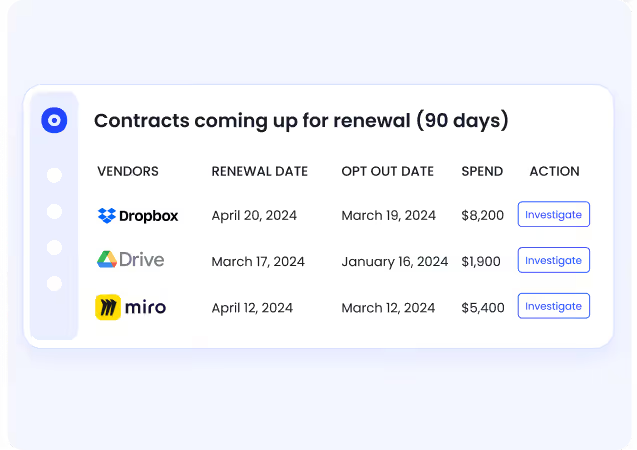
  • Shows all upcoming renewals in one place
  • Helps teams plan budgets and prioritize decisions
  • Aligns stakeholders on upcoming actions
  • Turns renewals into a predictable workflow

Usage insights surfaced at the right decision window

Decisions are backed by data, not assumptions.

  • Surface usage data during the 90-day renewal window
  • Highlights unused or underutilized licenses
  • Connects usage with contract terms
  • Supports smarter renew, renegotiate, or cancel decisions

7. What Your SaaS Renewal Process Should Look Like 6 Months From Now

Six months from now, your renewal process should not feel like a fire drill.

Here is what a working state looks like:

  • Every active SaaS contract is in a single repository with complete metadata
  • Every contract has a named owner who received an alert 120 days before renewal
  • The 90-day review triggered a usage pull and a decision recommendation
  • The 60-day mark was when the decision was finalized, not scrambled over
  • The vendor conversation happened with benchmark data in hand, not gut feel
  • Every outcome was documented and fed back into the contract system

A Must Read: How to Prepare for SaaS Renewals 90 Days in Advance

Conclusion

Most organizations do not lose control of their software spend all at once. It happens one missed renewal at a time, one ungoverned contract at a time, one auto-renewal nobody caught in time.

The fix is not complicated. It is consistent. Build the repository, assign the owners, set the alerts, run the reviews, and make every renewal a decision rather than a default.

CloudEagle.ai gives your team the infrastructure to run this process at scale, so no renewal catches you off guard, and no contract gets lost in someone's inbox.

Frequently Asked Questions

  1. What does it mean to centralize SaaS contracts?
    Bringing all SaaS contracts into one system with key details like renewal dates, ownership, and cost, so teams have a single source of truth.
  2. Why is SaaS contract centralization important?
    It prevents missed renewals, reduces wasted spend, and ensures every contract is reviewed before it renews.
  3. What is SaaS renewal management?
    The process of tracking and reviewing contracts before renewal, using alerts, usage data, and benchmarks to decide whether to renew, renegotiate, or cancel.
  4. How often should SaaS contracts be reviewed?
    At least 90 days before renewal, with additional reviews for high-value or frequently used tools.
  5. How does CloudEagle.ai help?
    It automatically centralizes contracts, tracks renewals, assigns ownership, and surfaces usage data for better decisions.
  6. What is the biggest SaaS renewal mistake?
    Auto-renewing without a usage review, leading to unnecessary spend on unused tools.

Advertisement for a SaaS Subscription Tracking Template with a call-to-action button to download and a partial graphic of a tablet showing charts.Banner promoting a SaaS Agreement Checklist to streamline SaaS management and avoid budget waste with a call-to-action button labeled Download checklist.Blue banner with text 'The Ultimate Employee Offboarding Checklist!' and a black button labeled 'Download checklist' alongside partial views of checklist documents from cloudeagle.ai.Digital ad for download checklist titled 'The Ultimate Checklist for IT Leaders to Optimize SaaS Operations' by cloudeagle.ai, showing checklist pages.Slack Buyer's Guide offer with text 'Unlock insider insights to get the best deal on Slack!' and a button labeled 'Get Your Copy', accompanied by a preview of the guide featuring Slack's logo.Monday Pricing Guide by cloudeagle.ai offering exclusive pricing secrets to maximize investment with a call-to-action button labeled Get Your Copy and an image of the guide's cover.Blue banner for Canva Pricing Guide by cloudeagle.ai offering a guide to Canva costs, features, and alternatives with a call-to-action button saying Get Your Copy.Blue banner with white text reading 'Little-Known Negotiation Hacks to Get the Best Deal on Slack' and a white button labeled 'Get Your Copy'.Blue banner with text 'Little-Known Negotiation Hacks to Get the Best Deal on Monday.com' and a white button labeled 'Get Your Copy'.Blue banner with text 'Little-Known Negotiation Hacks to Get the Best Deal on Canva' and a white button labeled 'Get Your Copy'.Banner with text 'Slack Buyer's Guide' and a 'Download Now' button next to images of a guide titled 'Slack Buyer’s Guide: Features, Pricing & Best Practices'.Digital cover of Monday Pricing Guide with a button labeled Get Your Copy on a blue background.Canva Pricing Guide cover with a button labeled Get Your Copy on a blue gradient background.

Enter your email to
unlock the report

Oops! Something went wrong while submitting the form.
License Count
Benchmark
Per User/Per Year

Enter your email to
unlock the report

Oops! Something went wrong while submitting the form.
License Count
Benchmark
Per User/Per Year

Enter your email to
unlock the report

Oops! Something went wrong while submitting the form.
Notion Plus
License Count
Benchmark
Per User/Per Year
100-500
$67.20 - $78.72
500-1000
$59.52 - $72.00
1000+
$51.84 - $57.60
Canva Pro
License Count
Benchmark
Per User/Per Year
100-500
$74.33-$88.71
500-1000
$64.74-$80.32
1000+
$55.14-$62.34

Enter your email to
unlock the report

Oops! Something went wrong while submitting the form.

Enter your email to
unlock the report

Oops! Something went wrong while submitting the form.
Zoom Business
License Count
Benchmark
Per User/Per Year
100-500
$216.00 - $264.00
500-1000
$180.00 - $216.00
1000+
$156.00 - $180.00

Enter your email to
unlock the report

Oops! Something went wrong while submitting the form.

Get the Right Security Platform To Secure Your Cloud Infrastructure

Please enter a business email
Thank you!
The 2023 SaaS report has been sent to your email. Check your promotional or spam folder.
Oops! Something went wrong while submitting the form.

Access full report

Please enter a business email
Thank you!
The 2023 SaaS report has been sent to your email. Check your promotional or spam folder.
Oops! Something went wrong while submitting the form.

Most organizations think SaaS spend gets out of control because of bad purchasing decisions. That’s not true. The real problem starts when contracts are scattered across inboxes, shared drives, and spreadsheets, making it nearly impossible to track renewals or ownership.

If you want to centralize SaaS contracts and streamline renewals, you need more than visibility. You need a system that connects your SaaS contracts, renewal management workflows, and ownership structure into one place. Without that, renewal decisions become reactive, deadlines get missed, and vendors dictate pricing.

In this guide, you’ll learn how to centralize your SaaS contracts, eliminate renewal chaos, and build a SaaS renewal management process that actually gives your team control over spend, timelines, and negotiations. 

TL;DR

  • Organizations handle an average of 247 SaaS renewals per year, but only 30% say they have an effective renewal process in place
  • Decentralized SaaS contracts spread across email, shared drives, and department spreadsheets mean most renewal decisions happen reactively, not proactively
  • SaaS contract centralization requires more than a file repository. It requires ownership, metadata, automated alerts, and a review workflow tied to actual usage data
  • The biggest renewal mistakes are all preventable: auto-renewing without usage reviews, missing opt-out windows, and accepting vendor-set pricing without benchmarking
  • CloudEagle.ai automates contract discovery, renewal tracking, and stakeholder alerts so your team makes decisions ahead of renewals, not after them

1. The Real Cost of Contract Sprawl: Why Decentralized SaaS Contracts Always Lose

You do not have a SaaS contracts problem. You have a visibility problem.

Most organizations are not losing money because they signed bad agreements. They are losing money because nobody knows where the contracts live, when they renew, or what was actually agreed to twelve months ago.

If you want to centralize your SaaS contracts and streamline renewals, the first step is to understand how they became scattered in the first place.

How SaaS Contracts Spread Across Email, Shared Drives, and Spreadsheets

Here is how it typically happens:

  • Procurement closes a deal. The signed PDF goes to whoever was on the email thread
  • Legal stores a copy somewhere in their shared drive
  • Finance logs a line item in a spreadsheet
  • The department head saves their own version locally

Nobody has the same information. Nobody knows the opt-out window. And when renewal comes around, the first person to notice is whoever receives the auto-renewal invoice.

40% of organizations track renewal dates manually on a calendar or spreadsheet, per BetterCloud research. That is nearly half of all enterprises managing their biggest software cost cycle with the same tool they use to schedule meetings.

The Average Enterprise Handles 247 SaaS Renewals Per Year, and Most Teams Miss the Window

247 renewals per year is roughly one every business day. Each one has:

  • Its own renewal date
  • Its own opt-out notice window
  • Its own pricing terms
  • Its own stakeholder who may or may not be paying attention

79% of IT leaders encountered price increases at SaaS renewal in the past 12 months. Most of those increases went unchallenged because the renewal arrived faster than the team could respond.

You cannot negotiate what you did not know was coming.

Before building your process, it helps to understand what an ideal SaaS contract looks like and which clauses matter most throughout the year.

📖 Worth a Read: Most teams only think about SaaS contracts at signing and renewal. Here is why the clauses in between matter just as much and what a working governance program actually looks like. 👉 The Ideal SaaS Contract: What It Includes and How to Govern It

2. What SaaS Contract Centralization Actually Means

Centralization is not moving all your PDFs into one folder. That solves the storage problem, not the governance problem.

A Single Source of Truth for SaaS Contracts, Renewal Dates, Ownership, and Spend

A true central repository is a live system. Every SaaS contract should have:

  • Vendor name and contract tier
  • Start date, end date, and opt-out notice deadline
  • Annual contract value and seat count
  • Named owner across IT, Finance, or Legal
  • Auto-renewal status and last usage review date

All of it is searchable. All of it is current. All of it is accessible when a renewal decision needs to be made.

When someone asks "when does our Workday contract renew and who owns it," the answer should take ten seconds, not two days.

The Difference Between a Contract Repository and a Contract Governance Program

A repository is where SaaS contracts live. A governance program is what you do with them.

The governance layer is what most organizations skip:

  • Ownership assignments for every contract
  • Renewal alert cadences at 120, 90, 60, and 30 days
  • Pre-renewal usage reviews tied to actual seat data
  • Escalation workflows that surface the right decision to the right person at the right time

Without the governance layer, even a well-organized repository becomes a passive file system nobody checks until a vendor sends an invoice.

3. How to Centralize Your SaaS Contracts: A Step-by-Step Process

1. Audit Your Current SaaS Stack and Collect Every Active Contract

Start with a complete list of every SaaS tool your organization is paying for. Cross-reference:

  • Your finance system and expense reports
  • Corporate card statements
  • IT asset inventory

For every tool, locate the signed agreement. You will almost certainly find contracts nobody knew existed:

  • Department-level tools purchased outside IT
  • Legacy tools are still auto-renewing after the team stopped using them
  • Duplicate tools solving the same problem for different teams

2. Choose a Centralized Contract Repository With Metadata Tagging and Search

The repository needs to be more than a shared drive. You need:

  • Structured metadata tagging for every contract
  • Search by renewal date, vendor, and owner
  • Ownership assignment directly within the system

Every SaaS contract must be findable. Every key data point must be extractable without opening the document.

3. Standardize the Data You Capture for Each Contract

Every contract in your repository should have the same core fields:

Field Why it matters
Vendor name Basic identification
Contract start date Tracks the relationship age
Contract end date Renewal planning anchor
Opt-out notice deadline The most important date most teams miss
Annual contract value Budget visibility
Seat count and tier Right-sizing decisions
Named owner Accountability
Auto-renewal status Risk flag
Last usage review date Renewal readiness

Consistency matters here. If some SaaS contracts have opt-out windows documented and others do not, your process breaks down the moment a deadline passes.

4. Assign a Named Owner to Every Contract

Every SaaS contract needs one person responsible for:

  • Monitoring the contract throughout the year
  • Surfacing renewal decisions before the deadline
  • Making sure the right stakeholders are involved on time

Shared ownership is no ownership. The owner does not have to be the same person for every contract:

  • Engineering tools can sit with the IT lead
  • Marketing tools can sit with the CMO's team
  • Finance tools can sit with the CFO's office

The requirement is that every contract has exactly one named person accountable for it.

5. Set Automated Alerts at 120, 90, 60, and 30 Days Before Each Renewal

Manual calendar reminders fail. People leave organizations. Inboxes get buried. Reminders get dismissed.

Automated alerts are the only reliable way to ensure nobody misses a renewal window. The cadence matters:

  • 120 days: First visibility. The owner knows the renewal is coming
  • 90 days: Usage review triggered. Is the tool being used? Should it renew?
  • 60 days: Decision point. Renew, renegotiate, or cancel
  • 30 days: Action window. Notice sent to vendor if canceling, negotiation finalized if renewing

If you are making renewal decisions at 30 days, you are already behind.

6. Build a Review Workflow That Triggers 90 Days Out

The 90-day alert should automatically kick off a lightweight review:

  • Pull usage data for the tool
  • Identify seat utilization against provisioned count
  • Check whether the tool is still solving the problem it was purchased for
  • Bring the decision to relevant stakeholders with enough time to act

It does not need to be complex. It needs to be consistent. Same questions, same data, same stakeholders, every time.

Are You Walking Into Your Next SaaS Renewal Without Real Usage Data?

This checklist covers the SaaS management best practices your team needs before every renewal decision
Get the SaaS Management Best Practices Guide

4. How to Streamline SaaS Renewal Management Once Contracts Are Centralized

Centralization gives you visibility. What you do with that visibility at renewal time determines whether it actually saves money.

Run Usage Reviews Before Every Renewal to Eliminate Unused Licenses

The most consistent source of SaaS waste is renewing seat counts based on last year's purchase, not last year's actual usage.

44% of SaaS licenses go unused or underutilized, costing organizations an estimated $18 billion annually.

Before any renewal, pull actual utilization data:

  • How many provisioned seats are actively being used?
  • How many users logged in at least once in the past 30 days?
  • Are entire departments sitting on licenses they never open?

Usage data gives you two things:

  • A defensible case for reducing seat count at renewal
  • Negotiation leverage because you are showing the vendor exactly what you consumed

Benchmark Vendor Pricing Before Every Significant Renewal

SaaS vendors raise prices. 79% of IT leaders saw increases at their last renewal. Most passed through unchallenged because teams had no market data to push back with.

Before any significant renewal, run a pricing benchmark:

  • What are comparable organizations paying for the same tool?
  • What has the vendor charged customers who negotiated vs. those who accepted default terms?

Benchmark data shifts the conversation from "should we accept the increase" to "what does the market actually support?"

Create a Renewal Playbook With Go, Renegotiate, or Cancel Criteria

SaaS renewal management should not be an ad hoc decision for every tool. Define clear criteria:

  • Go: Usage is at or above 80% of provisioned seats, the tool is core to a defined workflow, and pricing is within market benchmarks.
  • Renegotiate: Usage is between 50% and 80%, pricing has increased without proportional value improvement, or benchmarks suggest room to negotiate.
  • Cancel: Usage is below 50%, a redundant tool exists in the stack, or the use case has been absorbed by another platform.

Consistent criteria mean consistent decisions. They also make it easier to communicate outcomes to Finance and leadership because the logic is documented.

The negotiation side of SaaS renewals is where most teams leave money on the table. This conversation covers how finance leaders approach vendor negotiations.

🎙️ Podcast: Optimizing SaaS Spend Management: Strategies from a Finance Director. How finance teams approach renewal negotiations and what leverage actually looks like in practice. 👉 Listen now

5. The Biggest SaaS Renewal Management Mistakes Organizations Keep Making

  • Auto-renewing without a usage review
    Organizations renew contracts without validating actual usage, leading to unnecessary spend on underutilized or unused tools.
  • Missing opt-out windows due to a lack of ownership
    Without a clear contract owner, critical notice periods are missed, forcing automatic renewals and eliminating negotiation opportunities.
  • Renewing at vendor-set prices without benchmarking
    Teams accept renewal quotes without market comparison, resulting in higher costs and lost savings potential.
  • Letting shadow IT contracts live outside the system
    Contracts purchased outside IT remain untracked, bypass governance, and quietly auto-renew, increasing overall SaaS spend.

Your SaaS Renewal Calendar Has Gaps You Do Not Know About

This guide covers how to optimize SaaS spend across your entire stack, including the shadow IT contracts that never make it into your renewal process.
Get the SaaS Spend Optimization Guide

6. How CloudEagle.ai Centralizes SaaS Contracts and Automates Renewals?

Manual contract tracking breaks once your SaaS stack grows. CloudEagle.ai brings contracts, ownership, and renewals into one system so every decision happens with visibility and enough lead time.

Centralized contract repository built from automated discovery

Instead of chasing contracts across systems, CloudEagle automatically builds your source of truth.

  • Pulls contracts from financial systems, SSO, and expense data
  • Extracts renewal dates, opt-out windows, contract value, and ownership
  • Creates a live, searchable repository of your entire SaaS stack
  • Includes shadow IT, not just manually tracked tools

Automated renewal alerts tied to every contract

Renewals stop being surprises when alerts are built into the system.

  • Sends alerts at key intervals before renewal deadlines
  • Tracks opt-out windows so they are never missed
  • Gives teams enough time to review and act
  • Eliminates last-minute, reactive renewals

Stakeholder routing and ownership-driven workflows

Every contract has an owner, and every decision reaches the right people.

  • Routes renewal decisions to the correct contract owner
  • Involves IT, Finance, and Legal automatically
  • Removes confusion around accountability
  • Ensures faster, coordinated decision-making

Centralized renewal calendar with forward visibility

You get a clear view of what is coming, not just what has already renewed.

  • Shows all upcoming renewals in one place
  • Helps teams plan budgets and prioritize decisions
  • Aligns stakeholders on upcoming actions
  • Turns renewals into a predictable workflow

Usage insights surfaced at the right decision window

Decisions are backed by data, not assumptions.

  • Surface usage data during the 90-day renewal window
  • Highlights unused or underutilized licenses
  • Connects usage with contract terms
  • Supports smarter renew, renegotiate, or cancel decisions

7. What Your SaaS Renewal Process Should Look Like 6 Months From Now

Six months from now, your renewal process should not feel like a fire drill.

Here is what a working state looks like:

  • Every active SaaS contract is in a single repository with complete metadata
  • Every contract has a named owner who received an alert 120 days before renewal
  • The 90-day review triggered a usage pull and a decision recommendation
  • The 60-day mark was when the decision was finalized, not scrambled over
  • The vendor conversation happened with benchmark data in hand, not gut feel
  • Every outcome was documented and fed back into the contract system

A Must Read: How to Prepare for SaaS Renewals 90 Days in Advance

Conclusion

Most organizations do not lose control of their software spend all at once. It happens one missed renewal at a time, one ungoverned contract at a time, one auto-renewal nobody caught in time.

The fix is not complicated. It is consistent. Build the repository, assign the owners, set the alerts, run the reviews, and make every renewal a decision rather than a default.

CloudEagle.ai gives your team the infrastructure to run this process at scale, so no renewal catches you off guard, and no contract gets lost in someone's inbox.

Frequently Asked Questions

  1. What does it mean to centralize SaaS contracts?
    Bringing all SaaS contracts into one system with key details like renewal dates, ownership, and cost, so teams have a single source of truth.
  2. Why is SaaS contract centralization important?
    It prevents missed renewals, reduces wasted spend, and ensures every contract is reviewed before it renews.
  3. What is SaaS renewal management?
    The process of tracking and reviewing contracts before renewal, using alerts, usage data, and benchmarks to decide whether to renew, renegotiate, or cancel.
  4. How often should SaaS contracts be reviewed?
    At least 90 days before renewal, with additional reviews for high-value or frequently used tools.
  5. How does CloudEagle.ai help?
    It automatically centralizes contracts, tracks renewals, assigns ownership, and surfaces usage data for better decisions.
  6. What is the biggest SaaS renewal mistake?
    Auto-renewing without a usage review, leading to unnecessary spend on unused tools.

CloudEagle.ai recognized in the 2025 Gartner® Magic Quadrant™ for SaaS Management Platforms
Download now
gartner chart
5x
Faster employee
onboarding
80%
Reduction in time for
user access reviews
30k
Workflows
automated
$15Bn
Analyzed in
contract spend
$2Bn
Saved in
SaaS spend

Streamline SaaS governance and save 10-30%

Book a Demo with Expert
CTA image
One platform to Manage
all SaaS Products
Learn More