You need to enable JavaScript in order to use the AI chatbot tool powered by ChatBot

How SaaS License Waste Quietly Erodes Margins and Slows Growth?

Share via:
blog-cms-banner-bg
Little-Known Negotiation Hacks to Get the Best Deal on Slack
cta-bg-blogDownload Your Copy

HIPAA Compliance Checklist for 2025

Download PDF

License Management Best Practices

Learn how enterprises identify unused licenses, reclaim wasted seats, and protect margins through disciplined license management.

Download Guide
CTA Thumbnail

You’ve heard executives complain about rising SaaS bills. But what if the problem isn’t just cost per seat? What if the real money drain is something almost nobody sees, silent, systemic, and deeply embedded in enterprise operations?

That’s SaaS license waste in action: licenses sitting idle, unused features still paid for, contracts auto-renewing for tools no one uses, and spending inefficiencies that bleed your margins slowly but steadily.

Consider this: 53% of SaaS licenses go unused, costing organizations about $21M a year in wasted spend, and that figure is growing year-over-year.

In this blog, you’ll learn why SaaS license waste is more than a ledger entry, how it undermines performance, and what forward-thinking organizations are doing to stop the erosion.

TL;DR 

  • SaaS license waste is a hidden but persistent driver of margin erosion across enterprises
  • Paying for unused and low usage licenses creates ongoing SaaS cost leakage
  • Compounding renewals amplify SaaS spend inefficiency year after year
  • License waste reduces flexibility, slows growth, and weakens overall SaaS margins
  • Continuous governance, not one-time audits, is the only sustainable way to eliminate SaaS waste

Optimize SaaS Spend with Proven Tactics

Discover practical tactics enterprises use to reduce SaaS waste, improve utilization, and support long-term growth.

Read the Guide
CTA Thumbnail

1. Why SaaS License Waste Is a Margin Problem, Not Just an IT Issue?

People often think of SaaS waste as “tech overhead.” But in reality, it shows up in every department’s P&L,  the CFO sees it, the CEO complains about forecasting variance, and the board asks why margins aren’t improving despite lean operations.

Here’s the truth: SaaS spend inefficiency isn’t usually visible on the surface because it doesn’t look like a glaring expense; it’s hidden in the licenses that are paid for but never used.

A staggering 30–35% of SaaS spend disappears into unused licenses before anyone realizes.
That means almost one-third of your SaaS budget isn’t delivering value, and it keeps renewing year after year if you don’t intervene.

When you can’t see license waste, you can’t fix it. And when you can’t fix it, it eats away at margins over time.

Read our case study to see how Rec Room reduced SaaS costs by reclaiming unused licenses with CloudEagle.ai.

2. How License Waste Directly Impacts Enterprise Margins?

License waste is not an abstract accounting issue; it hits margins in measurable ways. Let’s break down how that works.

A. Paying for licenses that deliver zero value

Organizations routinely pay for SaaS licenses that nobody is using. In some environments, up to 73% of provisioned users never utilize their assigned software licenses.

What does that feel like in real terms?

  • You pay annual fees for dormant accounts
  • Vendors auto-bill at contract renewal
  • Finance teams only see “expense,” not “usage value.”

When you’re paying for seats that deliver no ROI, your gross margin shrinks, budgets tighten, and investment dollars get diverted from growth to upkeep.

This is classic SaaS waste,  and it doesn’t show up until someone actually looks at usage data.

FinOps Best Practices for SaaS Cost Control

Learn how FinOps teams align finance and IT to control SaaS costs and improve financial accountability.

Get FinOps Guide
CTA Thumbnail

B. Compounding waste across multi-year contracts

Auto-renewals are convenient. But they also lock in inefficiencies long before teams realize licenses aren’t being used.

It’s not unusual for enterprises to renew contracts worth tens of millions of dollars without ever reconciling the last year’s usage metrics.

It’s like paying full rent for an office that half of your people haven’t used in months.

Because SaaS contracts often have price increases built in, compounding waste can add another 5–15% to your total spend annually, and that ultimately erodes your margin even further.

C. Budget locked into tools instead of growth initiatives

Every dollar tied up in unproductive licenses is a dollar not invested in innovation, hiring, R&D, or strategic scaling.

For example:

  • Marketing is stuck with unused automation tools
  • Sales are paying for expensive CRM seats that are under-utilized
  • IT is locked into duplicate analytics tools

A wasted SaaS dollar isn’t just a sunk cost; it’s a missed opportunity.

And missed opportunities show up directly in corporate growth metrics.

3. How License Waste Slows Down Business Growth?

Lost margins are one thing. But license waste also harms how you scale and innovate.

A. Reduced flexibility to invest in new tools

Strategy meetings often start with this question: “Where can we invest next quarter?”

But if 30% of your SaaS budget is eaten by waste, that’s 30% less flexibility to adopt emerging technologies that could drive growth.

When license spend inefficiency dominates, organizations delay strategic tool purchases, slow digital transformation, and under-invest in competitive capabilities.

That translates into slower product launches, reduced agility, and a measurable competitive disadvantage.

B. Slower scaling due to inefficient spend allocation

Scaling means reallocating resources toward high-value projects, not burning them on unused subscriptions.

When your SaaS budget is bloated with waste, lines of business are forced to:

  • Compete internally for funding
  • Delay crucial hires
  • Limit experimentation due to budget uncertainty

This misalignment slows down organizational scaling, not because you lack vision, but because your spending is misallocated.

C. Poor visibility into SaaS ROI across teams

Most enterprises lack real-time visibility into which SaaS investments are actually generating value.

That’s partly why license waste persists:

  • Finance sees invoices, not utilization
  • IT sees usage, not spend impact
  • Business leaders see outcomes, not spending efficiency

This fragmented view means nobody owns SaaS ROI end-to-end, and waste remains invisible until it’s too late.

4. Why License Waste Remains Invisible in Most Enterprises?

If license waste is so costly, why doesn’t everyone fix it? Here are the common reasons:

A. Usage data is siloed or unavailable

Many SaaS tools don’t integrate usage data into central reporting, so finance teams never see how licenses are actually used.

Even when data exists, it’s often locked behind dashboards that aren’t connected to spend metrics, meaning decision-makers lack actionable insights.

Without usage visibility, it’s impossible to separate productive spend from waste.

B. No clear accountability after procurement

Purchase decisions often trail through expense reports and corporate cards, without linkage to long-term governance.

Once a tool is approved:

  • Ownership evaporates
  • Renewals proceed automatically
  • No one tracks adoption or cost impact

This lack of accountability lets SaaS license waste thrive.

C. Renewals prioritized over optimization

Renewal season becomes tactical, “just get the contract signed”, instead of strategic.

That leads to:

  • Spending on unused seats
  • Missed downgrade opportunities
  • Contracts rolling over with no usage review

Renewal cycles then amplify SaaS waste instead of correcting it.

5. Why Does Eliminating SaaS License Waste Require Continuous Governance?

Eliminating SaaS license waste requires continuous governance because usage, roles, and costs constantly change. Without automated oversight, unused and underutilized licenses quickly accumulate.

A. Usage-based license management

Stop paying for seats that haven’t logged in in 30+ days. License assignment should be driven by real usage data, not headcount assumptions.

Strategic usage governance includes:

  • Tracking feature-level adoption
  • Flagging inactive accounts automatically
  • Aligning licences to active workflows

This reduces waste directly and strengthens ROI.

B. Role-aligned access and entitlements

Not everyone needs premium access. Many organizations realise too late that they’ve been paying for expensive tiers that users never utilize.

Role-aligned entitlements mean:

  • Users get only what they actually need
  • License tiers reflect job function, not title
  • Access is regularly reviewed against performance

This keeps SaaS spend efficient and aligned with business outcomes.

C. Optimization is built into renewal and budgeting cycles

True governance happens before the contract is signed.

Savvy companies:

  • Review utilization 60–120 days before renewal
  • Right-size license counts and tiers
  • Allocate budget based on performance, not defaults

Embedding optimization into budgeting cycles stops waste long before it impacts margins.

6. How CloudEagle.ai Helps Eliminate SaaS License Waste

CloudEagle.ai is redefining how companies manage and optimize their SaaS ecosystems. 

With over $3.5B in spend analyzed and $250M+ in customer savings delivered, CloudEagle’s AI-powered platform is built to do one thing exceptionally well: eliminate SaaS waste while improving governance, security, and ROI.

A. Full-Stack Visibility: Know What You Own

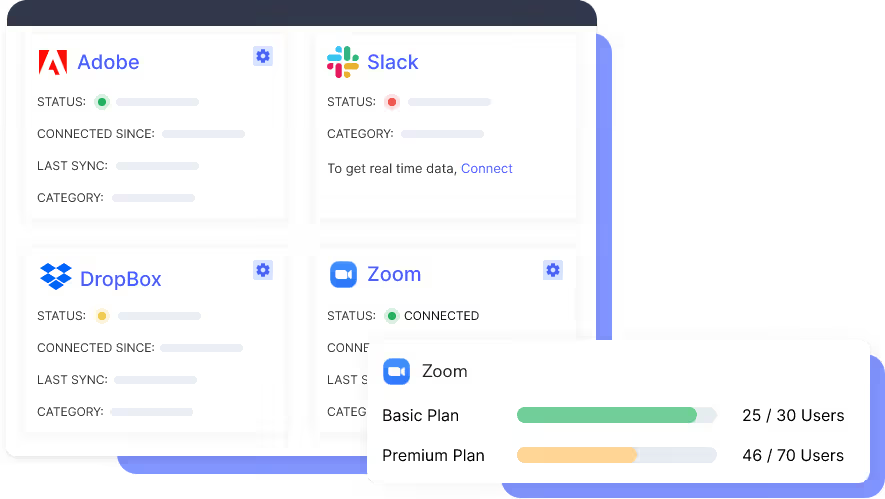
CloudEagle integrates with 500+ SaaS tools, including identity providers, finance systems, and direct app connectors. It continuously syncs:

  • What licenses were purchased
  • Who is using them
  • What features are being used (and which are not)
  • Where waste is happening (e.g., duplicate apps, unused seats)

This real-time data helps IT and procurement teams make faster, more informed decisions.

B. Automated License Harvesting: Reclaim and Reuse

License harvesting is where savings start. CloudEagle:

  • Detects users who haven’t logged in or used their licensed features
  • Sends automated emails or Slack messages to confirm inactivity
  • Deprovisions or downgrades users (via Okta, Microsoft AD, etc.)
  • Reclaims those licenses for reuse

This process reduces SaaS costs instantly and is proven to recover thousands in recurring waste.

C. App Rationalization: Eliminate Redundancy

Overlapping tools like Zoom vs. Webex, Asana vs. Trello, or Slack vs. Teams often co-exist unknowingly. CloudEagle’s AI:
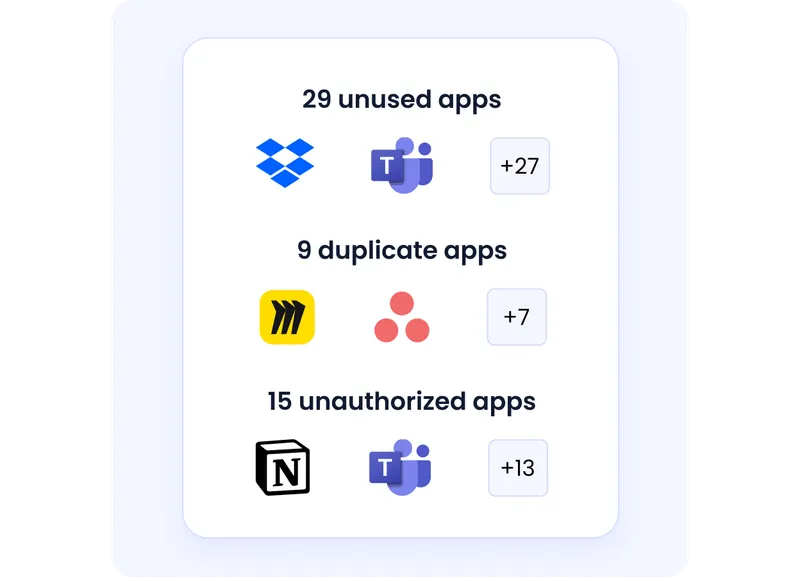
  • Identifies functionally similar apps
  • Flags users with access to both
  • Recommends app rationalization paths
  • Enables direct remediation (deprovision, consolidate, notify users)

It’s like having an AI-powered analyst continuously optimizing your stack.

D. Spend Optimization: The Power of Usage Insights + Renewal Intelligence

CloudEagle doesn't stop at detection, it enables better SaaS buying and renewal decisions by giving procurement teams:
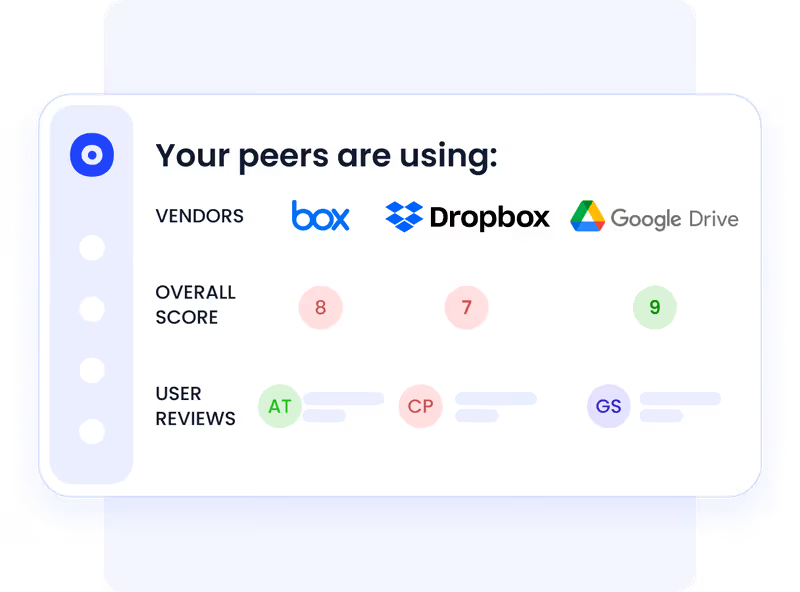
  • Feature-level usage: Not just login data, but which SKUs and modules are being used
  • Benchmarking: Know what others pay for the same tools
  • Contract intelligence: AI-extracted renewal dates, SKUs, opt-outs, and license tiers
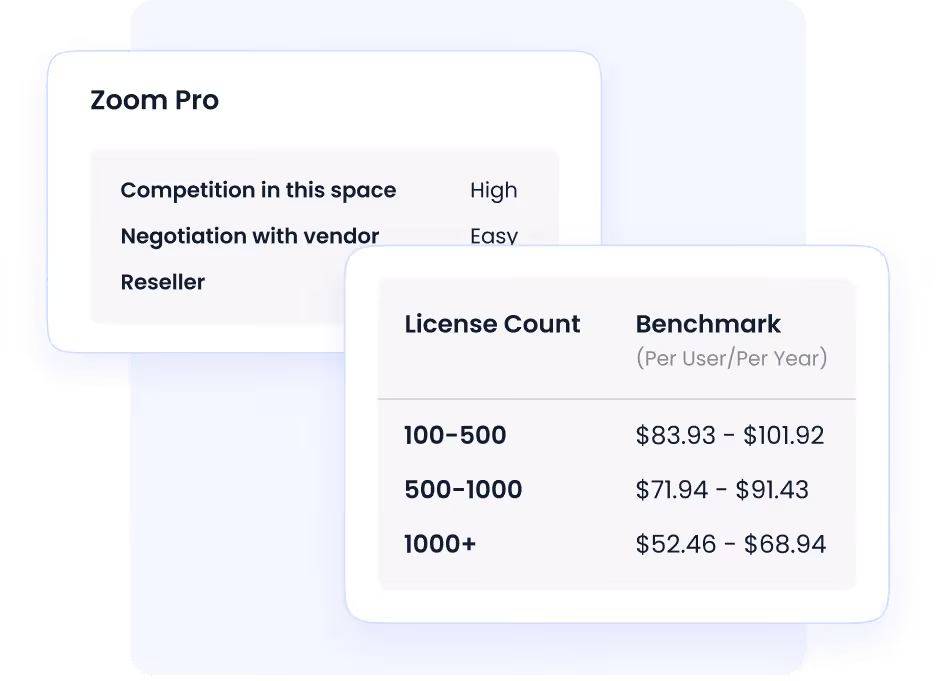
Before your next renewal, CloudEagle can show:

  • Whether you should renew or reduce licenses
  • What SKUs are overkill
  • If there’s a better pricing tier available

This transforms renewals from a reactive process into a strategic advantage.

E. Eliminating Shadow IT: From Visibility to Enforcement

With up to 60% of SaaS spend now happening outside of IT's purview, CloudEagle uses login data, browser telemetry, and card transaction verification to detect shadow IT.
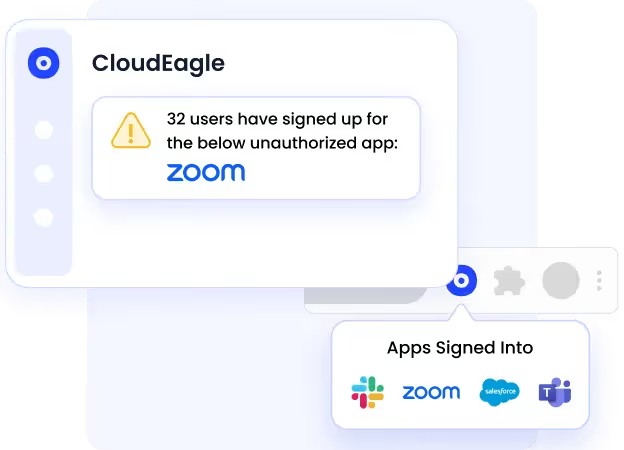
  • Free tools employees are using
  • AI tools (like ChatGPT or DeepSeek) bare ypassing security controls
  • Unauthorised apps with overlapping functionality

Admins get real-time alerts, scorecards, and can enforce policies or notify users, all from one dashboard.

F. License Waste Is Optional Now

With CloudEagle.ai, license waste is no longer a necessary evil. It's a fixable problem with immediate ROI.
Benefits at a glance:

  • Save 10–30% of SaaS spend in year one
  • Automate license cleanup and user access workflows
  • Strengthen security and compliance posture
  • Simplify procurement and renewals
  • Reduce IT workload and manual audits

SaaS sprawl is growing, but your budget doesn’t have to. CloudEagle gives you the visibility, intelligence, and automation to take back control.

Conclusion

SaaS license waste doesn’t announce itself loudly.
It builds quietly through unused seats, misaligned access, and contracts that renew without scrutiny, slowly eroding SaaS margins and creating long-term SaaS cost leakage.

As SaaS portfolios scale, license waste becomes harder to spot but more expensive to ignore.
Without clear usage visibility and accountability, SaaS spend inefficiency compounds, locking budgets into tools instead of funding growth, innovation, and strategic initiatives.

CloudEagle.ai helps enterprises eliminate SaaS license waste by bringing together usage intelligence, automation, and renewal governance into a single operating model. 

Book a free demo to see how CloudEagle.ai helps you eliminate SaaS license waste before it erodes margins and slows growth.

FAQ

  1. What is a SaaS licence?
    A SaaS licence is a subscription right to use a cloud-based software product for a defined period. It governs access, usage terms, and entitlements under the vendor’s subscription agreement.
  2. What are the disadvantages of SaaS?
    While SaaS offers flexibility and scalability, disadvantages include recurring costs, subscription inflation, license waste, dependency on internet connectivity, and potential data control concerns.
  3. What is SaaS license management?
    SaaS license management refers to governing how software subscriptions are provisioned, monitored, and optimized to ensure efficient use and cost-effective allocation of licenses.
  4. What is the difference between license maintenance and SaaS?
    License maintenance refers to support and updates for on-premises software, often with annual fees, while SaaS provides access to software hosted by the vendor on a subscription model, including updates and infrastructure.
  5. What is the rule of 40 for SaaS?
    The rule of 40 is a benchmark suggesting that a SaaS company’s revenue growth rate plus profit margin should equal at least 40%, a combined measure of growth and efficiency.

Advertisement for a SaaS Subscription Tracking Template with a call-to-action button to download and a partial graphic of a tablet showing charts.Banner promoting a SaaS Agreement Checklist to streamline SaaS management and avoid budget waste with a call-to-action button labeled Download checklist.Blue banner with text 'The Ultimate Employee Offboarding Checklist!' and a black button labeled 'Download checklist' alongside partial views of checklist documents from cloudeagle.ai.Digital ad for download checklist titled 'The Ultimate Checklist for IT Leaders to Optimize SaaS Operations' by cloudeagle.ai, showing checklist pages.Slack Buyer's Guide offer with text 'Unlock insider insights to get the best deal on Slack!' and a button labeled 'Get Your Copy', accompanied by a preview of the guide featuring Slack's logo.Monday Pricing Guide by cloudeagle.ai offering exclusive pricing secrets to maximize investment with a call-to-action button labeled Get Your Copy and an image of the guide's cover.Blue banner for Canva Pricing Guide by cloudeagle.ai offering a guide to Canva costs, features, and alternatives with a call-to-action button saying Get Your Copy.Blue banner with white text reading 'Little-Known Negotiation Hacks to Get the Best Deal on Slack' and a white button labeled 'Get Your Copy'.Blue banner with text 'Little-Known Negotiation Hacks to Get the Best Deal on Monday.com' and a white button labeled 'Get Your Copy'.Blue banner with text 'Little-Known Negotiation Hacks to Get the Best Deal on Canva' and a white button labeled 'Get Your Copy'.Banner with text 'Slack Buyer's Guide' and a 'Download Now' button next to images of a guide titled 'Slack Buyer’s Guide: Features, Pricing & Best Practices'.Digital cover of Monday Pricing Guide with a button labeled Get Your Copy on a blue background.Canva Pricing Guide cover with a button labeled Get Your Copy on a blue gradient background.

Enter your email to
unlock the report

Oops! Something went wrong while submitting the form.
License Count
Benchmark
Per User/Per Year

Enter your email to
unlock the report

Oops! Something went wrong while submitting the form.
License Count
Benchmark
Per User/Per Year

Enter your email to
unlock the report

Oops! Something went wrong while submitting the form.
Notion Plus
License Count
Benchmark
Per User/Per Year
100-500
$67.20 - $78.72
500-1000
$59.52 - $72.00
1000+
$51.84 - $57.60
Canva Pro
License Count
Benchmark
Per User/Per Year
100-500
$74.33-$88.71
500-1000
$64.74-$80.32
1000+
$55.14-$62.34

Enter your email to
unlock the report

Oops! Something went wrong while submitting the form.

Enter your email to
unlock the report

Oops! Something went wrong while submitting the form.
Zoom Business
License Count
Benchmark
Per User/Per Year
100-500
$216.00 - $264.00
500-1000
$180.00 - $216.00
1000+
$156.00 - $180.00

Enter your email to
unlock the report

Oops! Something went wrong while submitting the form.

Get the Right Security Platform To Secure Your Cloud Infrastructure

Please enter a business email
Thank you!
The 2023 SaaS report has been sent to your email. Check your promotional or spam folder.
Oops! Something went wrong while submitting the form.

Access full report

Please enter a business email
Thank you!
The 2023 SaaS report has been sent to your email. Check your promotional or spam folder.
Oops! Something went wrong while submitting the form.

License Management Best Practices

Learn how enterprises identify unused licenses, reclaim wasted seats, and protect margins through disciplined license management.

Download Guide
CTA Thumbnail

You’ve heard executives complain about rising SaaS bills. But what if the problem isn’t just cost per seat? What if the real money drain is something almost nobody sees, silent, systemic, and deeply embedded in enterprise operations?

That’s SaaS license waste in action: licenses sitting idle, unused features still paid for, contracts auto-renewing for tools no one uses, and spending inefficiencies that bleed your margins slowly but steadily.

Consider this: 53% of SaaS licenses go unused, costing organizations about $21M a year in wasted spend, and that figure is growing year-over-year.

In this blog, you’ll learn why SaaS license waste is more than a ledger entry, how it undermines performance, and what forward-thinking organizations are doing to stop the erosion.

TL;DR 

  • SaaS license waste is a hidden but persistent driver of margin erosion across enterprises
  • Paying for unused and low usage licenses creates ongoing SaaS cost leakage
  • Compounding renewals amplify SaaS spend inefficiency year after year
  • License waste reduces flexibility, slows growth, and weakens overall SaaS margins
  • Continuous governance, not one-time audits, is the only sustainable way to eliminate SaaS waste

Optimize SaaS Spend with Proven Tactics

Discover practical tactics enterprises use to reduce SaaS waste, improve utilization, and support long-term growth.

Read the Guide
CTA Thumbnail

1. Why SaaS License Waste Is a Margin Problem, Not Just an IT Issue?

People often think of SaaS waste as “tech overhead.” But in reality, it shows up in every department’s P&L,  the CFO sees it, the CEO complains about forecasting variance, and the board asks why margins aren’t improving despite lean operations.

Here’s the truth: SaaS spend inefficiency isn’t usually visible on the surface because it doesn’t look like a glaring expense; it’s hidden in the licenses that are paid for but never used.

A staggering 30–35% of SaaS spend disappears into unused licenses before anyone realizes.
That means almost one-third of your SaaS budget isn’t delivering value, and it keeps renewing year after year if you don’t intervene.

When you can’t see license waste, you can’t fix it. And when you can’t fix it, it eats away at margins over time.

Read our case study to see how Rec Room reduced SaaS costs by reclaiming unused licenses with CloudEagle.ai.

2. How License Waste Directly Impacts Enterprise Margins?

License waste is not an abstract accounting issue; it hits margins in measurable ways. Let’s break down how that works.

A. Paying for licenses that deliver zero value

Organizations routinely pay for SaaS licenses that nobody is using. In some environments, up to 73% of provisioned users never utilize their assigned software licenses.

What does that feel like in real terms?

  • You pay annual fees for dormant accounts
  • Vendors auto-bill at contract renewal
  • Finance teams only see “expense,” not “usage value.”

When you’re paying for seats that deliver no ROI, your gross margin shrinks, budgets tighten, and investment dollars get diverted from growth to upkeep.

This is classic SaaS waste,  and it doesn’t show up until someone actually looks at usage data.

FinOps Best Practices for SaaS Cost Control

Learn how FinOps teams align finance and IT to control SaaS costs and improve financial accountability.

Get FinOps Guide
CTA Thumbnail

B. Compounding waste across multi-year contracts

Auto-renewals are convenient. But they also lock in inefficiencies long before teams realize licenses aren’t being used.

It’s not unusual for enterprises to renew contracts worth tens of millions of dollars without ever reconciling the last year’s usage metrics.

It’s like paying full rent for an office that half of your people haven’t used in months.

Because SaaS contracts often have price increases built in, compounding waste can add another 5–15% to your total spend annually, and that ultimately erodes your margin even further.

C. Budget locked into tools instead of growth initiatives

Every dollar tied up in unproductive licenses is a dollar not invested in innovation, hiring, R&D, or strategic scaling.

For example:

  • Marketing is stuck with unused automation tools
  • Sales are paying for expensive CRM seats that are under-utilized
  • IT is locked into duplicate analytics tools

A wasted SaaS dollar isn’t just a sunk cost; it’s a missed opportunity.

And missed opportunities show up directly in corporate growth metrics.

3. How License Waste Slows Down Business Growth?

Lost margins are one thing. But license waste also harms how you scale and innovate.

A. Reduced flexibility to invest in new tools

Strategy meetings often start with this question: “Where can we invest next quarter?”

But if 30% of your SaaS budget is eaten by waste, that’s 30% less flexibility to adopt emerging technologies that could drive growth.

When license spend inefficiency dominates, organizations delay strategic tool purchases, slow digital transformation, and under-invest in competitive capabilities.

That translates into slower product launches, reduced agility, and a measurable competitive disadvantage.

B. Slower scaling due to inefficient spend allocation

Scaling means reallocating resources toward high-value projects, not burning them on unused subscriptions.

When your SaaS budget is bloated with waste, lines of business are forced to:

  • Compete internally for funding
  • Delay crucial hires
  • Limit experimentation due to budget uncertainty

This misalignment slows down organizational scaling, not because you lack vision, but because your spending is misallocated.

C. Poor visibility into SaaS ROI across teams

Most enterprises lack real-time visibility into which SaaS investments are actually generating value.

That’s partly why license waste persists:

  • Finance sees invoices, not utilization
  • IT sees usage, not spend impact
  • Business leaders see outcomes, not spending efficiency

This fragmented view means nobody owns SaaS ROI end-to-end, and waste remains invisible until it’s too late.

4. Why License Waste Remains Invisible in Most Enterprises?

If license waste is so costly, why doesn’t everyone fix it? Here are the common reasons:

A. Usage data is siloed or unavailable

Many SaaS tools don’t integrate usage data into central reporting, so finance teams never see how licenses are actually used.

Even when data exists, it’s often locked behind dashboards that aren’t connected to spend metrics, meaning decision-makers lack actionable insights.

Without usage visibility, it’s impossible to separate productive spend from waste.

B. No clear accountability after procurement

Purchase decisions often trail through expense reports and corporate cards, without linkage to long-term governance.

Once a tool is approved:

  • Ownership evaporates
  • Renewals proceed automatically
  • No one tracks adoption or cost impact

This lack of accountability lets SaaS license waste thrive.

C. Renewals prioritized over optimization

Renewal season becomes tactical, “just get the contract signed”, instead of strategic.

That leads to:

  • Spending on unused seats
  • Missed downgrade opportunities
  • Contracts rolling over with no usage review

Renewal cycles then amplify SaaS waste instead of correcting it.

5. Why Does Eliminating SaaS License Waste Require Continuous Governance?

Eliminating SaaS license waste requires continuous governance because usage, roles, and costs constantly change. Without automated oversight, unused and underutilized licenses quickly accumulate.

A. Usage-based license management

Stop paying for seats that haven’t logged in in 30+ days. License assignment should be driven by real usage data, not headcount assumptions.

Strategic usage governance includes:

  • Tracking feature-level adoption
  • Flagging inactive accounts automatically
  • Aligning licences to active workflows

This reduces waste directly and strengthens ROI.

B. Role-aligned access and entitlements

Not everyone needs premium access. Many organizations realise too late that they’ve been paying for expensive tiers that users never utilize.

Role-aligned entitlements mean:

  • Users get only what they actually need
  • License tiers reflect job function, not title
  • Access is regularly reviewed against performance

This keeps SaaS spend efficient and aligned with business outcomes.

C. Optimization is built into renewal and budgeting cycles

True governance happens before the contract is signed.

Savvy companies:

  • Review utilization 60–120 days before renewal
  • Right-size license counts and tiers
  • Allocate budget based on performance, not defaults

Embedding optimization into budgeting cycles stops waste long before it impacts margins.

6. How CloudEagle.ai Helps Eliminate SaaS License Waste

CloudEagle.ai is redefining how companies manage and optimize their SaaS ecosystems. 

With over $3.5B in spend analyzed and $250M+ in customer savings delivered, CloudEagle’s AI-powered platform is built to do one thing exceptionally well: eliminate SaaS waste while improving governance, security, and ROI.

A. Full-Stack Visibility: Know What You Own

CloudEagle integrates with 500+ SaaS tools, including identity providers, finance systems, and direct app connectors. It continuously syncs:

  • What licenses were purchased
  • Who is using them
  • What features are being used (and which are not)
  • Where waste is happening (e.g., duplicate apps, unused seats)

This real-time data helps IT and procurement teams make faster, more informed decisions.

B. Automated License Harvesting: Reclaim and Reuse

License harvesting is where savings start. CloudEagle:

  • Detects users who haven’t logged in or used their licensed features
  • Sends automated emails or Slack messages to confirm inactivity
  • Deprovisions or downgrades users (via Okta, Microsoft AD, etc.)
  • Reclaims those licenses for reuse

This process reduces SaaS costs instantly and is proven to recover thousands in recurring waste.

C. App Rationalization: Eliminate Redundancy

Overlapping tools like Zoom vs. Webex, Asana vs. Trello, or Slack vs. Teams often co-exist unknowingly. CloudEagle’s AI:

  • Identifies functionally similar apps
  • Flags users with access to both
  • Recommends app rationalization paths
  • Enables direct remediation (deprovision, consolidate, notify users)

It’s like having an AI-powered analyst continuously optimizing your stack.

D. Spend Optimization: The Power of Usage Insights + Renewal Intelligence

CloudEagle doesn't stop at detection, it enables better SaaS buying and renewal decisions by giving procurement teams:

  • Feature-level usage: Not just login data, but which SKUs and modules are being used
  • Benchmarking: Know what others pay for the same tools
  • Contract intelligence: AI-extracted renewal dates, SKUs, opt-outs, and license tiers

Before your next renewal, CloudEagle can show:

  • Whether you should renew or reduce licenses
  • What SKUs are overkill
  • If there’s a better pricing tier available

This transforms renewals from a reactive process into a strategic advantage.

E. Eliminating Shadow IT: From Visibility to Enforcement

With up to 60% of SaaS spend now happening outside of IT's purview, CloudEagle uses login data, browser telemetry, and card transaction verification to detect shadow IT.

  • Free tools employees are using
  • AI tools (like ChatGPT or DeepSeek) bare ypassing security controls
  • Unauthorised apps with overlapping functionality

Admins get real-time alerts, scorecards, and can enforce policies or notify users, all from one dashboard.

F. License Waste Is Optional Now

With CloudEagle.ai, license waste is no longer a necessary evil. It's a fixable problem with immediate ROI.

Benefits at a glance:

  • Save 10–30% of SaaS spend in year one
  • Automate license cleanup and user access workflows
  • Strengthen security and compliance posture
  • Simplify procurement and renewals
  • Reduce IT workload and manual audits

SaaS sprawl is growing, but your budget doesn’t have to. CloudEagle gives you the visibility, intelligence, and automation to take back control.

Conclusion

SaaS license waste doesn’t announce itself loudly.
It builds quietly through unused seats, misaligned access, and contracts that renew without scrutiny, slowly eroding SaaS margins and creating long-term SaaS cost leakage.

As SaaS portfolios scale, license waste becomes harder to spot but more expensive to ignore.
Without clear usage visibility and accountability, SaaS spend inefficiency compounds, locking budgets into tools instead of funding growth, innovation, and strategic initiatives.

CloudEagle.ai helps enterprises eliminate SaaS license waste by bringing together usage intelligence, automation, and renewal governance into a single operating model. 

Book a free demo to see how CloudEagle.ai helps you eliminate SaaS license waste before it erodes margins and slows growth.

FAQ

  1. What is a SaaS licence?
    A SaaS licence is a subscription right to use a cloud-based software product for a defined period. It governs access, usage terms, and entitlements under the vendor’s subscription agreement.
  2. What are the disadvantages of SaaS?
    While SaaS offers flexibility and scalability, disadvantages include recurring costs, subscription inflation, license waste, dependency on internet connectivity, and potential data control concerns.
  3. What is SaaS license management?
    SaaS license management refers to governing how software subscriptions are provisioned, monitored, and optimized to ensure efficient use and cost-effective allocation of licenses.
  4. What is the difference between license maintenance and SaaS?
    License maintenance refers to support and updates for on-premises software, often with annual fees, while SaaS provides access to software hosted by the vendor on a subscription model, including updates and infrastructure.
  5. What is the rule of 40 for SaaS?
    The rule of 40 is a benchmark suggesting that a SaaS company’s revenue growth rate plus profit margin should equal at least 40%, a combined measure of growth and efficiency.

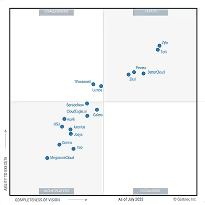
CloudEagle.ai recognized in the 2025 Gartner® Magic Quadrant™ for SaaS Management Platforms
Download now
gartner chart
5x
Faster employee
onboarding
80%
Reduction in time for
user access reviews
30k
Workflows
automated
$15Bn
Analyzed in
contract spend
$2Bn
Saved in
SaaS spend

Recognized as an Industry leader for our AI

CloudEagle.ai is Recognized in the 2024 Gartner® Magic Quadrant™ for SaaS Management Platforms

Recognition highlights CloudEagle’s innovation and leadership in the rapidly evolving SaaS management and procurement space.
Read More
Gartner Magic Quadrant for SaaS Management Platforms showing a chart divided into Challengers and Leaders quadrants with various companies plotted as dots.

CloudEagle.ai Recognized in the GigaOm Radar for SaaS Management Platforms

CloudEagle named a Leader and Outperformer in GigaOm Radar Report, validating its impact in the SaaS management platform landscape.
Read More
gigaom

Everest Group Positions CloudEagle.ai as a Trailblazer in SaaS Management Platforms

CloudEagle recognized as a Trailblazer by Everest Group, showcasing its rapid growth and innovation in SaaS spend and operations management.
Read More
qks

CloudEagle.ai is Recognized in the 2024 Gartner® Magic Quadrant™ for SaaS Management Platforms

Recognition highlights CloudEagle’s innovation and leadership in the rapidly evolving SaaS management and procurement space.
Read More
gartner

Streamline SaaS governance and save 10-30%

Book a Demo with Expert
CTA image
One platform to Manage
all SaaS Products
Learn More