You need to enable JavaScript in order to use the AI chatbot tool powered by ChatBot

The Ideal SaaS Contract: What It Includes and How to Govern It

Share via:
blog-cms-banner-bg
Little-Known Negotiation Hacks to Get the Best Deal on Slack
cta-bg-blogDownload Your Copy

HIPAA Compliance Checklist for 2025

Download PDF

Most SaaS contracts look fine on paper. Clean clauses, standard terms, nothing alarming at first glance. But the real risk shows up later, in renewal traps, vague usage rights, and zero visibility into what you actually agreed to.

That is where the idea of an Ideal SaaS Contract starts to matter. Not just a legal document, but a structured agreement that protects your costs, your data, and your flexibility as you scale.

In this guide, you will break down what a strong SaaS Contract actually looks like, the core elements that define an Ideal SaaS Contract, and how to build a practical approach to SaaS Contract Governance

Along the way, we will also cover key SaaS Agreement Best Practices so you are not just signing contracts, but managing them with intent.

TL;DR

  • Most organizations sign SaaS contracts without reviewing the clauses that matter most, auto-renewal windows, pricing escalation caps, and liability limits, and end up paying for it at renewal
  • An ideal SaaS contract covers license scope, SLA commitments, data security obligations, exit provisions, and pricing controls with specific, enforceable terms
  • Clauses most teams skip but should negotiate include feature deprecation rights, liability caps tied to data breach scenarios, and change management notification terms
  • A working governance process needs centralized contract storage, assigned ownership, automated renewal alerts, and a pre-renewal usage review, not just a signature file
  • CloudEagle.ai automates the contract visibility and renewal alert process so nothing falls through the cracks between signing and renewal

1. Why Most Organizations Sign SaaS Contracts Without Actually Reading Them?

Procurement moves fast. A business unit wants a tool, legal reviews it once, and someone signs. Most SaaS Contracts are not ignored on purpose. They just get lost in speed.

A team needs a tool. Procurement pushes it through. Legal reviews it once. Someone signs. And the contract disappears into a shared drive until renewal shows up unexpectedly.

That is the reality for most organizations. And it is exactly how you end up overpaying, stuck with unused tools, or scrambling to fix things too late.

The hidden clauses that cost companies millions at renewal time

The biggest risks in a SaaS Contract are rarely obvious at signing. They show up later, when you have no leverage left.

  • Auto-renewal clauses
    Many contracts require 30 to 90 days' notice before renewal. Miss that window, and you are locked in for another year, even if the tool is no longer critical.
  • Pricing escalation clauses
    Vendors often include annual price increases of 5 to 10%. At scale, this quietly inflates costs without any renegotiation.
  • Usage and licensing ambiguity
    Vague terms around seats or usage tiers can lead to unexpected overage charges later.

These are exactly the gaps that strong SaaS Agreement Best Practices aim to catch early.

Why is legal involved at signing but not throughout the year

Legal plays a key role when the Ideal SaaS Contract is signed. After that, involvement typically declines.

But SaaS agreements are not static. They include ongoing commitments like:

Without continuous tracking, these obligations are easy to miss until something breaks.

This is where SaaS Contract Governance becomes critical. It ensures contracts are actively managed, not just stored.

Most teams manage SaaS contracts in spreadsheets or shared drives. This guide covers how that breaks down and what a better process looks like.

📖 Worth a Read: Managing SaaS agreements manually creates gaps that compound at every renewal. Here is what a structured approach to SaaS contract governance actually looks like in practice. 👉 Ensuring Compliance in SaaS Contracts

2. What an Ideal SaaS Contract Actually Looks Like?

An Ideal SaaS Contract is not just about signing safely. It is about staying in control after the deal is done.

Scope of license and usage rights: who can use it and under what conditions

This is one of the most critical parts of any SaaS Contract, and one of the most overlooked.

Your contract should clearly define:

  • Who can use the software
    Employees, contractors, affiliates, or third parties
  • Type of licensing model
    Named users vs concurrent users
  • Usage boundaries
    Geographic limits, department-level access, or use-case restrictions
  • What counts as a violation
    So you are not unknowingly breaching terms

The risk with vague language is simple. If your contract says “employees” but your workflows include contractors, you could be non-compliant without realizing it.

This is where following SaaS Agreement Best Practices makes a real difference. Clarity upfront prevents disputes later.

SLA and uptime commitments: what 99.9% really means in practice

99.9% uptime sounds solid until you calculate that it allows for 8.7 hours of downtime per year. That may or may not be acceptable depending on how critical the tool is to your operations.

The ideal contract specifies:

  • Exactly how uptime is measured and by whom
  • What constitutes a qualifying outage for SLA credit purposes
  • What is the remedy when SLA commitments are missed (service credits are standard, but the amounts matter)
  • Termination rights if the vendor fails to meet SLA thresholds over a defined period, such as three consecutive months below 98%

Data security obligations, breach notification, and the Data Processing Addendum (DPA)

This is the section where weak language creates the most risk. Push for specifics on all of the following:

Clause What to insist on
Breach notification 48 hours or less from vendor discovery. Not "promptly"
Encryption AES-256 at rest, TLS 1.2 or higher in transit. Named standards, not vague references
Subprocessor changes 30-day advance notice with right to object
Audit rights Your right to request security audit reports or SOC 2 Type II at least annually
DPA A signed Data Processing Addendum that meets GDPR Article 28 requirements if you handle EU data

Auto-renewal clauses and opt-out windows: the terms most teams miss

Auto-renewal is where even a well-negotiated SaaS Contract can quietly work against you.

To stay in control, your Ideal SaaS Contract should include:

  • A clear opt-out window
    60 to 90 days is common. Make sure it aligns with your internal planning cycles so you can actually act on it.
  • Defined notification process
    Some vendors require formal written notice, not just an email. If the contract says registered mail, that is what counts.
  • Explicit renewal terms
    Avoid vague auto-renewals that lock you in without visibility on pricing or terms.

Pricing escalation caps, overage policies, and audit rights

This is where long-term cost control and accountability come into play in SaaS Contract Governance.

Here is what to lock down:

  • Pricing escalation caps
    Tie increases to CPI or cap them at 3 to 5%. Anything uncapped gives vendors too much control over future pricing.
  • Clear overage policies
    Define exactly what triggers extra charges and how they are calculated. Avoid vague terms like “excessive use.”
  • Audit rights
    You should be able to verify vendor compliance, whether it is usage data, billing accuracy, or security commitments.

Termination, data return, and exit provisions

Every SaaS contract should include:

  • Your right to terminate for cause if the vendor materially breaches the agreement
  • A defined data return window after termination, typically 30 days in a standard format, you can actually use
  • Deletion confirmation from the vendor after data return
  • No data hostage clauses that make data export contingent on payment of exit fees

Data return is often the most contentious part of an exit. Negotiate it clearly at signing, not when you are trying to leave.

Does Your SaaS Agreement Actually Protect You?

This checklist covers the clauses most teams miss and the terms worth pushing back on before you sign anything.
Get the SaaS Agreement Checklist

3. The Clauses Competitors Rarely Negotiate, But You Should

Most teams treat a SaaS Contract as a pricing exercise. That is exactly why these clauses get missed and why they create problems later.

An Ideal SaaS Contract accounts for change, risk, and accountability upfront, not after something breaks.

  • Feature deprecation rights
    SaaS vendors regularly remove or change features. Without protection, you could be stuck paying for a tool that no longer meets your needs. Your contract should require advance notice for major changes and give you the right to exit if a critical feature is deprecated. This is increasingly important with fast-changing AI features.
  • Liability caps and indemnification
    Standard contracts cap vendor liability at 12 months of fees, which rarely reflects real risk. A stronger approach is to increase caps for scenarios like data breaches or confidentiality violations, ensuring the vendor shares meaningful accountability when things go wrong.
  • Change management terms
    Most SaaS Contracts do not define how product updates are communicated. That leaves your team reacting to unexpected changes. The contract should require advance notice of significant updates, so you have time to test, train, and adapt without disruption.

4. How to Build a SaaS Contract Governance Process?

Signing a good contract is step one. Governing it through its entire lifecycle is where most organizations fall short.

What this looks like in practice

  • Centralize contracts with structured metadata
    Store every contract in one system with clear fields like vendor name, renewal date, opt-out deadline, value, and owner. If you are digging through emails before renewal, governance is already broken.
  • Assign clear ownership across teams
    Every SaaS Contract needs a single accountable owner. Not a shared alias. Someone responsible for tracking usage, performance, and renewal decisions.
  • Set proactive renewal checkpoints
    Use a 90-60-30 day alert system. At 90 days, you review usage, at 60 days you decide, and at 30 days you act. Anything later reduces your leverage.

What to evaluate before every renewal

Instead of auto-renewing, pressure-test the contract:

  • Is actual usage aligned with what you are paying for?
  • Has the vendor consistently met SLA commitments?
  • Were there any security, compliance, or performance issues?

This is where SaaS Agreement Best Practices shift renewals from reactive to intentional.

How to make governance scalable

  • Track SLA performance continuously
    Do not wait until renewal to assess vendor performance. Log downtime, support delays, and incidents as they happen so you have evidence when it matters.
  • Build a contract playbook
    Define your standard positions for key clauses like pricing caps, renewal terms, liability, and data handling. This makes every new Ideal SaaS Contract faster to negotiate and more consistent.

Your SaaS Renewal Is Coming. Here Is What to Review Before You Sign Again.

This checklist walks through the usage data, SLA performance, and contract terms your team should review before any SaaS renewal decision.
Get the SaaS Management Best Practices Guide

5. How CloudEagle.ai Helps You Govern SaaS Contracts at Scale?

Manual contract governance works at small scale. It breaks down when you are managing 50, 100, or 300 SaaS vendors with different renewal dates, notice windows, and compliance obligations.

Centralized Contract Intelligence

CloudEagle creates a single source of truth with AI-powered extraction and structured visibility across all contracts

  • Centralized repository for all SaaS Contracts
  • Auto-extraction of renewal dates, notice periods, pricing, SKUs
  • Dynamic renewal calendar with complete visibility

This is the foundation of an Ideal SaaS Contract environment where nothing is buried or missed.

Automated Renewal Governance

CloudEagle embeds governance directly into the renewal process, removing last-minute decision-making

  • Automated alerts aligned to notice windows
  • Built-in approval workflows across IT, Finance, and Procurement
  • Renewal tracking with clear ownership and timelines

This ensures renewals follow a structured process aligned with SaaS Agreement Best Practices.

Data-Driven Contract Decisions

CloudEagle connects contract data with real usage and spend insights so decisions are based on facts, not assumptions.

  • Correlates contract terms with license utilization and spend
  • Identifies underused licenses and redundant tools
  • Surfaces optimization opportunities before renewal

This shifts renewals from reactive approvals to informed, strategic decisions.

Benchmarking and Negotiation Intelligence

CloudEagle strengthens your negotiation position with market context and pricing insights

  • Benchmark pricing across vendors and SKUs
  • Highlight overpriced contracts and optimization gaps
  • Provide procurement-backed negotiation insights

This ensures every SaaS Contract is evaluated against real market standards, not just vendor quotes.

End-to-End Procurement Workflows

CloudEagle connects contract governance with procurement execution, eliminating fragmentation.

This creates consistency across how contracts are requested, approved, and governed.

Final Thoughts

A SaaS contract is not a formality. It is the document that determines what you pay, what protection you have when things go wrong, and how cleanly you can exit if the vendor relationship stops working.

Most organizations sign contracts quickly and govern them poorly. The ideal SaaS contract covers usage rights, SLA commitments, security obligations, pricing controls, and exit provisions with specific, enforceable terms. 

SaaS contract governance requires centralized storage, clear ownership, automated renewal alerts, and pre-renewal usage reviews. Done consistently, it turns contracts from a passive document pile into active leverage at every renewal negotiation.

CloudEagle.ai automates the visibility and alerting layer that makes this possible at scale.

Frequently Asked Questions 

1. What is a SaaS contract?
A SaaS contract is a legal agreement that defines how cloud software is accessed, used, and billed.

2. What does SaaS stand for?
SaaS stands for Software as a Service, meaning software delivered over the internet.

3. What is the difference between SLA and a SaaS agreement?
An SLA defines service performance, while a SaaS agreement covers the overall terms of use.

4. What is the difference between MSA and a SaaS agreement?
An MSA sets general legal terms, while a SaaS agreement governs a specific software service.

5. What are the 4 types of contracts?
The four types are fixed-price, time and materials, cost-reimbursable, and unit-based contracts.

Advertisement for a SaaS Subscription Tracking Template with a call-to-action button to download and a partial graphic of a tablet showing charts.Banner promoting a SaaS Agreement Checklist to streamline SaaS management and avoid budget waste with a call-to-action button labeled Download checklist.Blue banner with text 'The Ultimate Employee Offboarding Checklist!' and a black button labeled 'Download checklist' alongside partial views of checklist documents from cloudeagle.ai.Digital ad for download checklist titled 'The Ultimate Checklist for IT Leaders to Optimize SaaS Operations' by cloudeagle.ai, showing checklist pages.Slack Buyer's Guide offer with text 'Unlock insider insights to get the best deal on Slack!' and a button labeled 'Get Your Copy', accompanied by a preview of the guide featuring Slack's logo.Monday Pricing Guide by cloudeagle.ai offering exclusive pricing secrets to maximize investment with a call-to-action button labeled Get Your Copy and an image of the guide's cover.Blue banner for Canva Pricing Guide by cloudeagle.ai offering a guide to Canva costs, features, and alternatives with a call-to-action button saying Get Your Copy.Blue banner with white text reading 'Little-Known Negotiation Hacks to Get the Best Deal on Slack' and a white button labeled 'Get Your Copy'.Blue banner with text 'Little-Known Negotiation Hacks to Get the Best Deal on Monday.com' and a white button labeled 'Get Your Copy'.Blue banner with text 'Little-Known Negotiation Hacks to Get the Best Deal on Canva' and a white button labeled 'Get Your Copy'.Banner with text 'Slack Buyer's Guide' and a 'Download Now' button next to images of a guide titled 'Slack Buyer’s Guide: Features, Pricing & Best Practices'.Digital cover of Monday Pricing Guide with a button labeled Get Your Copy on a blue background.Canva Pricing Guide cover with a button labeled Get Your Copy on a blue gradient background.

Enter your email to
unlock the report

Oops! Something went wrong while submitting the form.
License Count
Benchmark
Per User/Per Year

Enter your email to
unlock the report

Oops! Something went wrong while submitting the form.
License Count
Benchmark
Per User/Per Year

Enter your email to
unlock the report

Oops! Something went wrong while submitting the form.
Notion Plus
License Count
Benchmark
Per User/Per Year
100-500
$67.20 - $78.72
500-1000
$59.52 - $72.00
1000+
$51.84 - $57.60
Canva Pro
License Count
Benchmark
Per User/Per Year
100-500
$74.33-$88.71
500-1000
$64.74-$80.32
1000+
$55.14-$62.34

Enter your email to
unlock the report

Oops! Something went wrong while submitting the form.

Enter your email to
unlock the report

Oops! Something went wrong while submitting the form.
Zoom Business
License Count
Benchmark
Per User/Per Year
100-500
$216.00 - $264.00
500-1000
$180.00 - $216.00
1000+
$156.00 - $180.00

Enter your email to
unlock the report

Oops! Something went wrong while submitting the form.

Get the Right Security Platform To Secure Your Cloud Infrastructure

Please enter a business email
Thank you!
The 2023 SaaS report has been sent to your email. Check your promotional or spam folder.
Oops! Something went wrong while submitting the form.

Access full report

Please enter a business email
Thank you!
The 2023 SaaS report has been sent to your email. Check your promotional or spam folder.
Oops! Something went wrong while submitting the form.

Most SaaS contracts look fine on paper. Clean clauses, standard terms, nothing alarming at first glance. But the real risk shows up later, in renewal traps, vague usage rights, and zero visibility into what you actually agreed to.

That is where the idea of an Ideal SaaS Contract starts to matter. Not just a legal document, but a structured agreement that protects your costs, your data, and your flexibility as you scale.

In this guide, you will break down what a strong SaaS Contract actually looks like, the core elements that define an Ideal SaaS Contract, and how to build a practical approach to SaaS Contract Governance

Along the way, we will also cover key SaaS Agreement Best Practices so you are not just signing contracts, but managing them with intent.

TL;DR

  • Most organizations sign SaaS contracts without reviewing the clauses that matter most, auto-renewal windows, pricing escalation caps, and liability limits, and end up paying for it at renewal
  • An ideal SaaS contract covers license scope, SLA commitments, data security obligations, exit provisions, and pricing controls with specific, enforceable terms
  • Clauses most teams skip but should negotiate include feature deprecation rights, liability caps tied to data breach scenarios, and change management notification terms
  • A working governance process needs centralized contract storage, assigned ownership, automated renewal alerts, and a pre-renewal usage review, not just a signature file
  • CloudEagle.ai automates the contract visibility and renewal alert process so nothing falls through the cracks between signing and renewal

1. Why Most Organizations Sign SaaS Contracts Without Actually Reading Them?

Procurement moves fast. A business unit wants a tool, legal reviews it once, and someone signs. Most SaaS Contracts are not ignored on purpose. They just get lost in speed.

A team needs a tool. Procurement pushes it through. Legal reviews it once. Someone signs. And the contract disappears into a shared drive until renewal shows up unexpectedly.

That is the reality for most organizations. And it is exactly how you end up overpaying, stuck with unused tools, or scrambling to fix things too late.

The hidden clauses that cost companies millions at renewal time

The biggest risks in a SaaS Contract are rarely obvious at signing. They show up later, when you have no leverage left.

  • Auto-renewal clauses
    Many contracts require 30 to 90 days' notice before renewal. Miss that window, and you are locked in for another year, even if the tool is no longer critical.
  • Pricing escalation clauses
    Vendors often include annual price increases of 5 to 10%. At scale, this quietly inflates costs without any renegotiation.
  • Usage and licensing ambiguity
    Vague terms around seats or usage tiers can lead to unexpected overage charges later.

These are exactly the gaps that strong SaaS Agreement Best Practices aim to catch early.

Why is legal involved at signing but not throughout the year

Legal plays a key role when the Ideal SaaS Contract is signed. After that, involvement typically declines.

But SaaS agreements are not static. They include ongoing commitments like:

Without continuous tracking, these obligations are easy to miss until something breaks.

This is where SaaS Contract Governance becomes critical. It ensures contracts are actively managed, not just stored.

Most teams manage SaaS contracts in spreadsheets or shared drives. This guide covers how that breaks down and what a better process looks like.

📖 Worth a Read: Managing SaaS agreements manually creates gaps that compound at every renewal. Here is what a structured approach to SaaS contract governance actually looks like in practice. 👉 Ensuring Compliance in SaaS Contracts

2. What an Ideal SaaS Contract Actually Looks Like?

An Ideal SaaS Contract is not just about signing safely. It is about staying in control after the deal is done.

Scope of license and usage rights: who can use it and under what conditions

This is one of the most critical parts of any SaaS Contract, and one of the most overlooked.

Your contract should clearly define:

  • Who can use the software
    Employees, contractors, affiliates, or third parties
  • Type of licensing model
    Named users vs concurrent users
  • Usage boundaries
    Geographic limits, department-level access, or use-case restrictions
  • What counts as a violation
    So you are not unknowingly breaching terms

The risk with vague language is simple. If your contract says “employees” but your workflows include contractors, you could be non-compliant without realizing it.

This is where following SaaS Agreement Best Practices makes a real difference. Clarity upfront prevents disputes later.

SLA and uptime commitments: what 99.9% really means in practice

99.9% uptime sounds solid until you calculate that it allows for 8.7 hours of downtime per year. That may or may not be acceptable depending on how critical the tool is to your operations.

The ideal contract specifies:

  • Exactly how uptime is measured and by whom
  • What constitutes a qualifying outage for SLA credit purposes
  • What is the remedy when SLA commitments are missed (service credits are standard, but the amounts matter)
  • Termination rights if the vendor fails to meet SLA thresholds over a defined period, such as three consecutive months below 98%

Data security obligations, breach notification, and the Data Processing Addendum (DPA)

This is the section where weak language creates the most risk. Push for specifics on all of the following:

Clause What to insist on
Breach notification 48 hours or less from vendor discovery. Not "promptly"
Encryption AES-256 at rest, TLS 1.2 or higher in transit. Named standards, not vague references
Subprocessor changes 30-day advance notice with right to object
Audit rights Your right to request security audit reports or SOC 2 Type II at least annually
DPA A signed Data Processing Addendum that meets GDPR Article 28 requirements if you handle EU data

Auto-renewal clauses and opt-out windows: the terms most teams miss

Auto-renewal is where even a well-negotiated SaaS Contract can quietly work against you.

To stay in control, your Ideal SaaS Contract should include:

  • A clear opt-out window
    60 to 90 days is common. Make sure it aligns with your internal planning cycles so you can actually act on it.
  • Defined notification process
    Some vendors require formal written notice, not just an email. If the contract says registered mail, that is what counts.
  • Explicit renewal terms
    Avoid vague auto-renewals that lock you in without visibility on pricing or terms.

Pricing escalation caps, overage policies, and audit rights

This is where long-term cost control and accountability come into play in SaaS Contract Governance.

Here is what to lock down:

  • Pricing escalation caps
    Tie increases to CPI or cap them at 3 to 5%. Anything uncapped gives vendors too much control over future pricing.
  • Clear overage policies
    Define exactly what triggers extra charges and how they are calculated. Avoid vague terms like “excessive use.”
  • Audit rights
    You should be able to verify vendor compliance, whether it is usage data, billing accuracy, or security commitments.

Termination, data return, and exit provisions

Every SaaS contract should include:

  • Your right to terminate for cause if the vendor materially breaches the agreement
  • A defined data return window after termination, typically 30 days in a standard format, you can actually use
  • Deletion confirmation from the vendor after data return
  • No data hostage clauses that make data export contingent on payment of exit fees

Data return is often the most contentious part of an exit. Negotiate it clearly at signing, not when you are trying to leave.

Does Your SaaS Agreement Actually Protect You?

This checklist covers the clauses most teams miss and the terms worth pushing back on before you sign anything.
Get the SaaS Agreement Checklist

3. The Clauses Competitors Rarely Negotiate, But You Should

Most teams treat a SaaS Contract as a pricing exercise. That is exactly why these clauses get missed and why they create problems later.

An Ideal SaaS Contract accounts for change, risk, and accountability upfront, not after something breaks.

  • Feature deprecation rights
    SaaS vendors regularly remove or change features. Without protection, you could be stuck paying for a tool that no longer meets your needs. Your contract should require advance notice for major changes and give you the right to exit if a critical feature is deprecated. This is increasingly important with fast-changing AI features.
  • Liability caps and indemnification
    Standard contracts cap vendor liability at 12 months of fees, which rarely reflects real risk. A stronger approach is to increase caps for scenarios like data breaches or confidentiality violations, ensuring the vendor shares meaningful accountability when things go wrong.
  • Change management terms
    Most SaaS Contracts do not define how product updates are communicated. That leaves your team reacting to unexpected changes. The contract should require advance notice of significant updates, so you have time to test, train, and adapt without disruption.

4. How to Build a SaaS Contract Governance Process?

Signing a good contract is step one. Governing it through its entire lifecycle is where most organizations fall short.

What this looks like in practice

  • Centralize contracts with structured metadata
    Store every contract in one system with clear fields like vendor name, renewal date, opt-out deadline, value, and owner. If you are digging through emails before renewal, governance is already broken.
  • Assign clear ownership across teams
    Every SaaS Contract needs a single accountable owner. Not a shared alias. Someone responsible for tracking usage, performance, and renewal decisions.
  • Set proactive renewal checkpoints
    Use a 90-60-30 day alert system. At 90 days, you review usage, at 60 days you decide, and at 30 days you act. Anything later reduces your leverage.

What to evaluate before every renewal

Instead of auto-renewing, pressure-test the contract:

  • Is actual usage aligned with what you are paying for?
  • Has the vendor consistently met SLA commitments?
  • Were there any security, compliance, or performance issues?

This is where SaaS Agreement Best Practices shift renewals from reactive to intentional.

How to make governance scalable

  • Track SLA performance continuously
    Do not wait until renewal to assess vendor performance. Log downtime, support delays, and incidents as they happen so you have evidence when it matters.
  • Build a contract playbook
    Define your standard positions for key clauses like pricing caps, renewal terms, liability, and data handling. This makes every new Ideal SaaS Contract faster to negotiate and more consistent.

Your SaaS Renewal Is Coming. Here Is What to Review Before You Sign Again.

This checklist walks through the usage data, SLA performance, and contract terms your team should review before any SaaS renewal decision.
Get the SaaS Management Best Practices Guide

5. How CloudEagle.ai Helps You Govern SaaS Contracts at Scale?

Manual contract governance works at small scale. It breaks down when you are managing 50, 100, or 300 SaaS vendors with different renewal dates, notice windows, and compliance obligations.

Centralized Contract Intelligence

CloudEagle creates a single source of truth with AI-powered extraction and structured visibility across all contracts

  • Centralized repository for all SaaS Contracts
  • Auto-extraction of renewal dates, notice periods, pricing, SKUs
  • Dynamic renewal calendar with complete visibility

This is the foundation of an Ideal SaaS Contract environment where nothing is buried or missed.

Automated Renewal Governance

CloudEagle embeds governance directly into the renewal process, removing last-minute decision-making

  • Automated alerts aligned to notice windows
  • Built-in approval workflows across IT, Finance, and Procurement
  • Renewal tracking with clear ownership and timelines

This ensures renewals follow a structured process aligned with SaaS Agreement Best Practices.

Data-Driven Contract Decisions

CloudEagle connects contract data with real usage and spend insights so decisions are based on facts, not assumptions.

  • Correlates contract terms with license utilization and spend
  • Identifies underused licenses and redundant tools
  • Surfaces optimization opportunities before renewal

This shifts renewals from reactive approvals to informed, strategic decisions.

Benchmarking and Negotiation Intelligence

CloudEagle strengthens your negotiation position with market context and pricing insights

  • Benchmark pricing across vendors and SKUs
  • Highlight overpriced contracts and optimization gaps
  • Provide procurement-backed negotiation insights

This ensures every SaaS Contract is evaluated against real market standards, not just vendor quotes.

End-to-End Procurement Workflows

CloudEagle connects contract governance with procurement execution, eliminating fragmentation.

This creates consistency across how contracts are requested, approved, and governed.

Final Thoughts

A SaaS contract is not a formality. It is the document that determines what you pay, what protection you have when things go wrong, and how cleanly you can exit if the vendor relationship stops working.

Most organizations sign contracts quickly and govern them poorly. The ideal SaaS contract covers usage rights, SLA commitments, security obligations, pricing controls, and exit provisions with specific, enforceable terms. 

SaaS contract governance requires centralized storage, clear ownership, automated renewal alerts, and pre-renewal usage reviews. Done consistently, it turns contracts from a passive document pile into active leverage at every renewal negotiation.

CloudEagle.ai automates the visibility and alerting layer that makes this possible at scale.

Frequently Asked Questions 

1. What is a SaaS contract?
A SaaS contract is a legal agreement that defines how cloud software is accessed, used, and billed.

2. What does SaaS stand for?
SaaS stands for Software as a Service, meaning software delivered over the internet.

3. What is the difference between SLA and a SaaS agreement?
An SLA defines service performance, while a SaaS agreement covers the overall terms of use.

4. What is the difference between MSA and a SaaS agreement?
An MSA sets general legal terms, while a SaaS agreement governs a specific software service.

5. What are the 4 types of contracts?
The four types are fixed-price, time and materials, cost-reimbursable, and unit-based contracts.

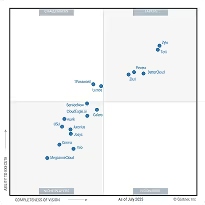
CloudEagle.ai recognized in the 2025 Gartner® Magic Quadrant™ for SaaS Management Platforms
Download now
gartner chart
5x
Faster employee
onboarding
80%
Reduction in time for
user access reviews
30k
Workflows
automated
$15Bn
Analyzed in
contract spend
$2Bn
Saved in
SaaS spend

Streamline SaaS governance and save 10-30%

Book a Demo with Expert
CTA image
One platform to Manage
all SaaS Products
Learn More