
%201.svg)


HIPAA Compliance Checklist for 2025

TL;DR
- GitHub Copilot pricing looks like a per-seat line on your bill. Since June 2026 it is also a usage meter and an access surface.
- The real cost sits below the sticker price. Copilot Enterprise needs GitHub Enterprise Cloud beneath it, code review runs two meters at once, and credit overage sits on top of every seat.
- The bigger exposure is access. Agents and service accounts now consume Copilot against your repositories, and personal Copilot sits outside SSO entirely.
- List price and what companies actually pay are different numbers. Bundling and term length move the rate more than anything else.
- CloudEagle.ai governs Copilot access, identity, and spend from one view, before the bill or the audit forces the question.
On June 1, 2026, GitHub moved every Copilot plan to usage-based billing. The seat became a meter.
Around the same time, agents and automated workflows started consuming Copilot on their own. The seat also became an identity.
That is why GitHub Copilot pricing is no longer a question engineering answers alone.
This guide covers what the plans cost, what the meter does to that number, and how to govern GitHub Copilot pricing at scale once the tool is already in every editor and every pipeline.
Why GitHub Copilot Pricing Gets Harder to Govern at Scale
The plans themselves are simple. What sits underneath them is not.
The Seat Price Is the Smallest Part of the Bill
GitHub sells Copilot on per-seat plans. Current list pricing:
List prices from GitHub's Copilot plans page. Enterprise requires GitHub Enterprise Cloud underneath it.
One distinction shapes everything that follows. Code completions and next edit suggestions stay unlimited on paid plans and never consume credits.
Chat, agent mode, code review, the Copilot CLI, and the cloud agent all do consume credits. The features developers reach for when the work gets hard are the ones that meter.
Every Plan Became a Usage Meter in June 2026
GitHub replaced premium requests with GitHub AI Credits on June 1, 2026. Usage is now calculated on token consumption, including input, output, and cached tokens.
Each plan includes a monthly credit allowance:
When the allowance runs out, additional usage bills at $0.01 per credit at the per-token rate for whichever model was called.
Two consequences matter for anyone holding the budget.
- Overage is a policy decision, not an accident. On Business and Enterprise, admins set usage limits and decide whether paid usage beyond the allowance is allowed at all. If it is not, Copilot pauses until the next cycle. If it is, usage bills at the per-token rate, with alerts at 75, 90, and 100 percent of budget.
- Model choice drives the burn. Reasoning-heavy models consume credits several times faster than ordinary chat, so the same prompt can cost very different amounts depending on where it was routed.
The practical problem is that those admin controls only help if someone owns them.
Two developers on identical seats can produce very different bills, and nothing in the seat price tells you which is which.
The Real Cost Sits Below the Sticker Price
The $39 Copilot Enterprise line is the one that surprises people most often.
Copilot Enterprise requires GitHub Enterprise Cloud beneath it, at $21 per user per month. What you actually pay:
Either way the jump is steep, and most teams never use the knowledge bases and custom models that justify it.
Two more meters run alongside it.
- Code review bills twice. Copilot Code Review consumes GitHub Actions minutes in addition to AI Credits, so review-heavy teams pay on two meters for the same activity.
- Actions scales quietly. In one case tracked in CloudEagle.ai buyer's guide research, a team scaling CI went from $200 to $4,000 a month before caching and parallelization brought it back to $1,200.
- Security scanning is priced separately, and per committer. What used to be sold as Advanced Security now splits into Secret Protection at around $19 and Code Security at around $30, each billed per active committer per month rather than per seat. That difference in billing unit catches teams out when they budget it like a license.
Put those together and the pattern is clear. You are billed on three meters:
- The seats you provisioned.
- The credits your teams burned.
- The compute your pipelines consumed.
Only the first of those three appears on the pricing page.
There is a second pattern underneath the first, and it is easier to miss.
- Agents and service accounts now consume Copilot against your repositories without a person in the loop.
- Personal Copilot subscriptions sit entirely outside SSO.
- Seats granted for one project keep working long after the project ends.
This is where the cost question turns into a security one.
IBM's Cost of a Data Breach research found that one in five organizations experienced a breach linked to shadow AI:
- Up to $670,000 added to the average breach cost.
- 97 percent of organizations reporting an AI-related breach lacked proper AI access controls.
The bill is the symptom you notice. The access is the thing you did not.

How CloudEagle.ai Governs GitHub Copilot Across Your Enterprise
Copilot rarely sits in one place. There are the sanctioned Business and Enterprise seats, the personal accounts nobody registered, and the agents and tokens calling Copilot on their own schedule.
CloudEagle.ai works in that order. It discovers every place Copilot runs, governs who and what can reach it, then gets the spend under control.
Each lever below works on its own. Run together, they compound.
Surface Shadow Copilot
Developers adopt Copilot faster than procurement approves it. A personal Pro subscription on a corporate card never reaches an intake form, and your identity provider never sees it.
CloudEagle.ai builds the inventory from finance and expense data, browser signals, and direct integrations, not from SSO alone.
That surfaces the accounts an identity-only view misses, including access through IDE plugins and browser extensions.
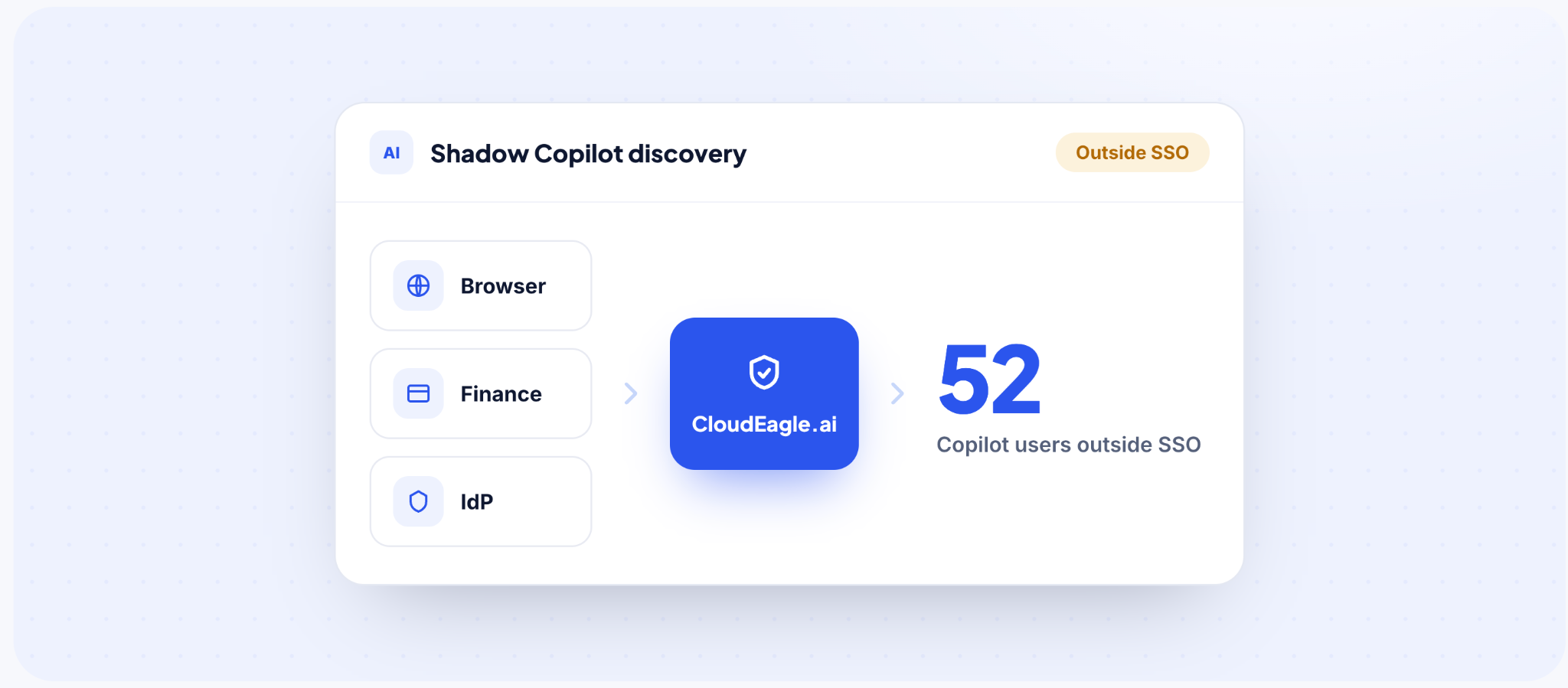
The cost of that is untracked spend. The risk is larger.
Copilot Business and Enterprise sit under different data terms than the individual plans.
GitHub states plainly that it does not use Business or Enterprise data to train its models. That is precisely the protection a personal account outside your agreement does not carry.
So shadow Copilot is a data question before it is a budget question, and you cannot answer it for accounts you have not found.
Once the usage is visible, CloudEagle.ai brings it onto governed corporate access and monitors sensitive data sharing with external AI vendors, so the same rules apply everywhere Copilot runs.
The same approach extends across the rest of your stack when you discover shadow AI wherever it appears.
Govern Who and What Has Copilot Access
Copilot access follows the same drift as every other tool. Someone joins a project, gets a seat, moves teams, and keeps it.
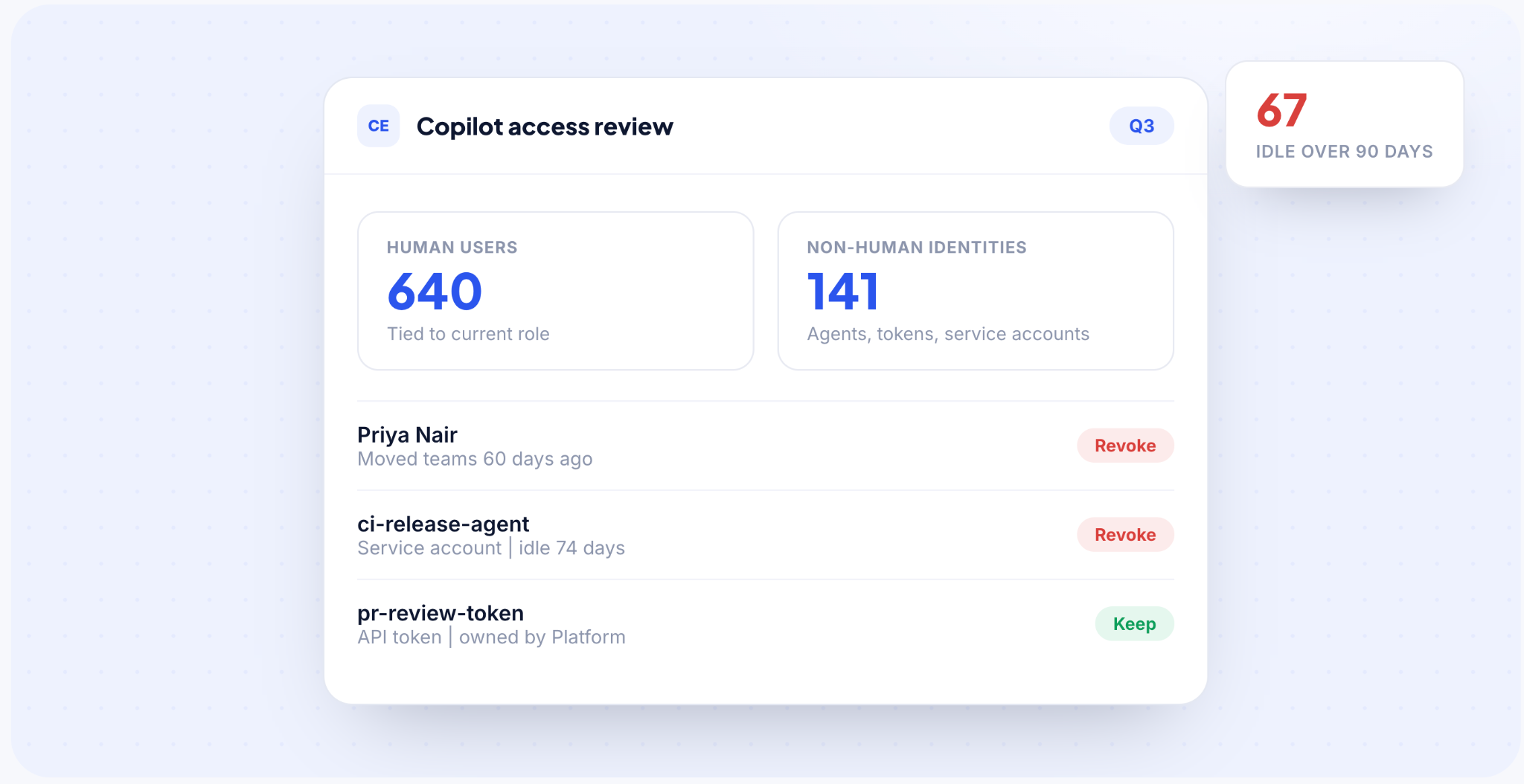
CloudEagle.ai runs access reviews that tie Copilot access to current role, with offboarding that removes it on schedule rather than on memory.
That does two things at once: it turns stale access into a reclaimed seat, and it closes standing privilege into your repositories.
The harder half is the access that was never human.
Agents, service accounts, and API tokens that consume Copilot are identities in their own right. They get provisioned for an integration, they hold privilege, and they are almost never reviewed.
Karthik Swarnam, Chief Security and Trust Officer at Armorcode, put it this way after bringing them under governance:
“As our identity environment expanded, governing non-human identities became just as important as managing human access. CloudEagle.ai gave us visibility into service accounts, API tokens, and AI agents, helping increase NHI visibility, remediate unmanaged identities, and reduce overprivileges, helping us govern NHI, the same way we did for people.”
Armorcode moved non-human identity visibility from 40 percent to 95 percent and remediated 480 unmanaged identities, bringing them under the same governance model as their human users.
Most teams have not started this, and Copilot's agent features keep adding to the pile.
Non-human identity governance now sits inside SaaS management rather than beside it, so it runs through the same identity governance workflows you already use for people.
Right-Size Licenses by Real Usage
Copilot rollouts are usually sized on headcount, then never resized on usage. That gap between GitHub Copilot pricing on paper and what you actually spend is where most of the waste lives.
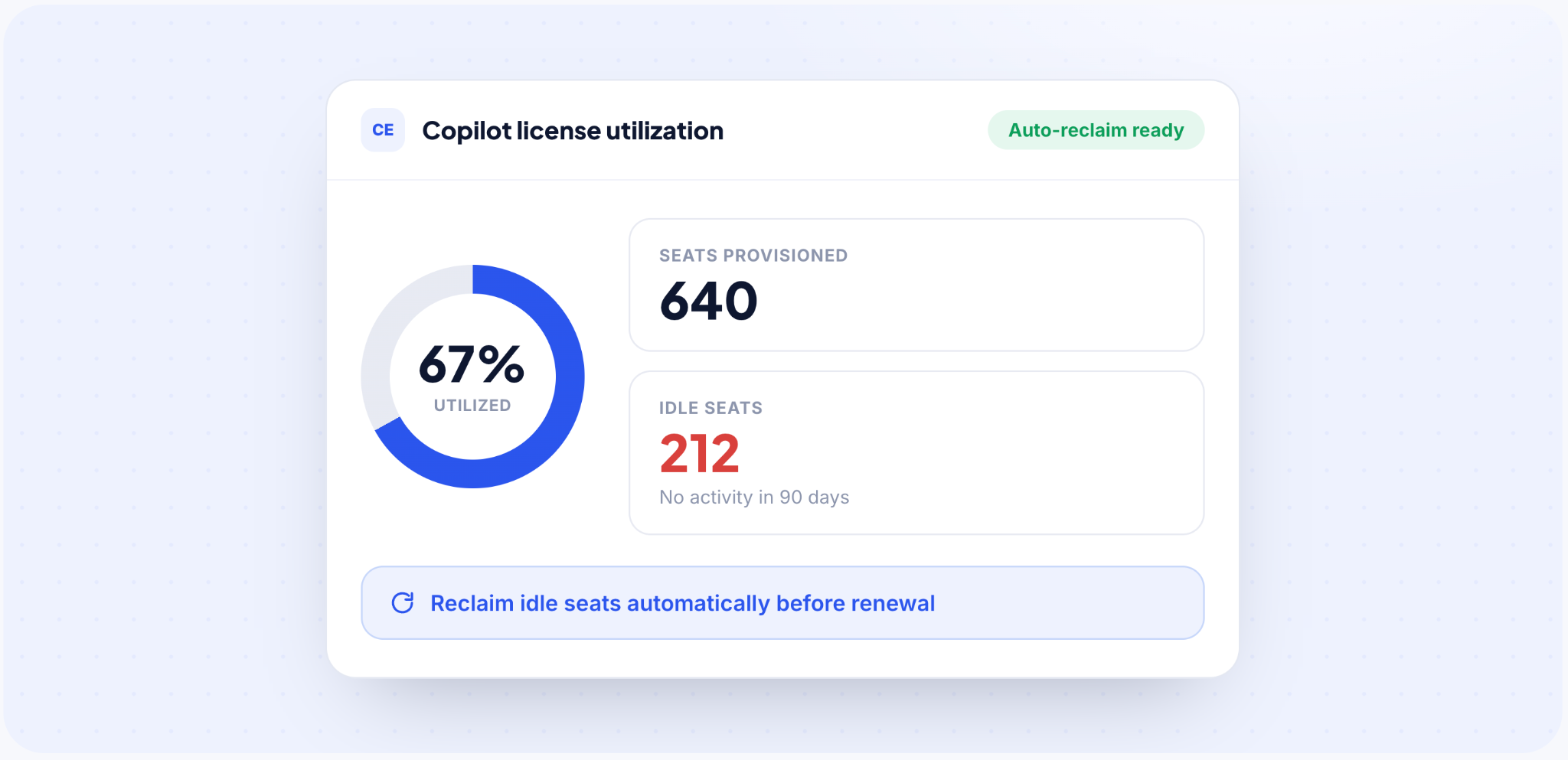
- Reclaim idle seats. At $19 to $60 per user per month, a dormant Copilot seat is expensive to leave alone.
- Size from evidence, not headcount. One team that piloted Copilot Business across a quarter of its developers found real adoption landed near 60 percent, not the 100 percent the rollout assumed. Licensing only the active users saved $87,000 a year.
- Match the tier to the work. Enterprise seats that never touch knowledge bases or custom models belong on Business. Individual plans held alongside an org seat are duplicate spend.
Daren Thayne, Chief Technology Officer and EVP of Product at Domo, described what that visibility changed across their AI rollout:
“34% of licenses had no activity in 90 days. We lacked this visibility. That single view changed every conversation we had about our AI program, internally and with our vendors.”
CloudEagle.ai tracks this continuously and flags it between renewal cycles, so the cleanup happens while it still changes the invoice.
Attribute Copilot Spend and Usage by Team
A single GitHub invoice tells you the total. It does not tell you which team, project, or workflow drove it.
CloudEagle.ai closes that gap:
- Attributes spend to the team, department, or cost center responsible.
- Checks it against the budget you set and flags usage-based billing surprises as they build, not after they land.
- Surfaces over-provisioning per user and per model, which turns a credit-burn number into a decision about a seat.
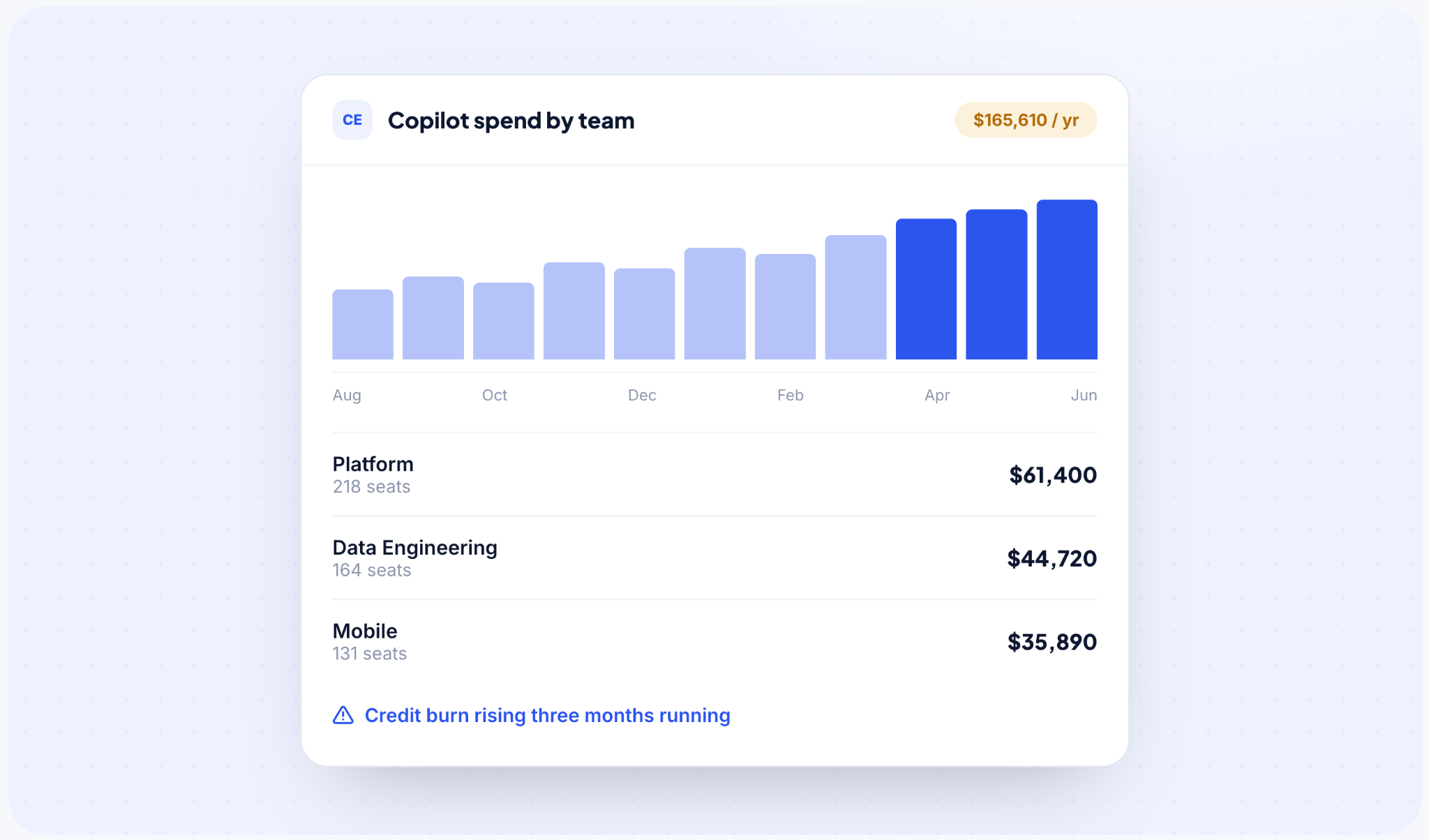
That view already covers the rest of your AI stack, so Copilot sits next to everything else you are paying for instead of in its own console.
Teams use it to track AI usage and spend in one place rather than reconciling vendor portals by hand.
Every Copilot Seat Is Now A Meter And An Identity


Walk Into Renewals with Usage and Benchmark Data
Renewal is where all of this converts into money, and renewal management is only as good as the usage data behind it.
Walk in without usage data and you are arguing against the vendor's number with nothing behind you.
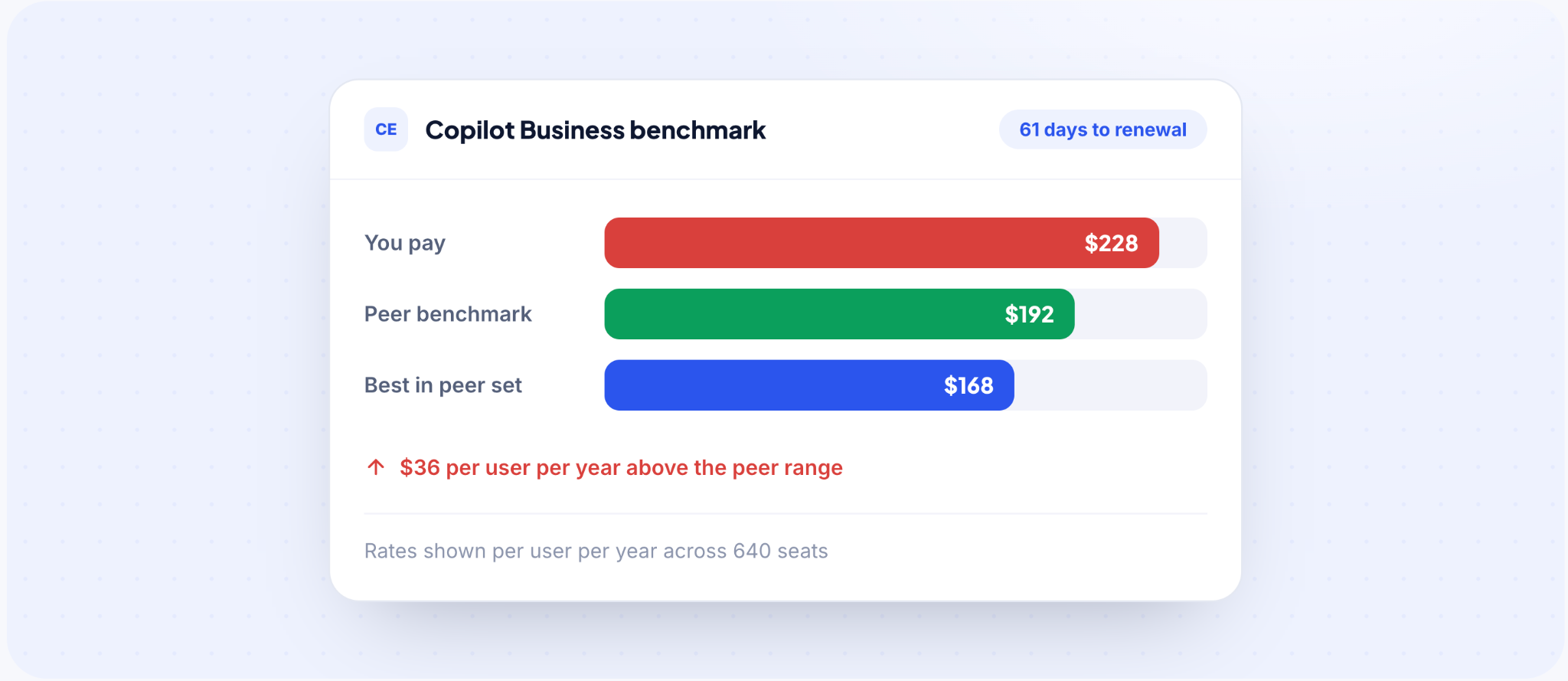
Walk in with utilization by team, the seats nobody opened, and peer benchmark pricing, and both the seat count and the rate move.
Where CloudEagle.ai Stops
Worth stating plainly, because AI coding tools invite the assumption.
- What CloudEagle.ai governs: the tool, the access, the identities, and the data policy around Copilot.
- What it does not do: scan your source code or read what Copilot writes.
What Companies Actually Pay for GitHub Copilot
List price is where GitHub opens, not where enterprises land. The real GitHub Copilot cost an enterprise carries depends on volume, term length, and what else sits in the agreement.
Real Rates Land Well Below List
From CloudEagle.ai benchmark and community deal data, negotiated Copilot rates cluster like this:
These reflect benchmark and community deal data as of the most recent renewals tracked, so treat them as a starting range rather than a quote.
Bundling and Term Length Move the Rate Most
Not every lever is worth the same. In order of what actually shifts the number:
Every one of those levers runs on knowing your real usage.
You cannot argue a seat count down without knowing which seats sit idle, and you cannot size a credit allowance while personal-account Copilot stays invisible.
Best Practices to Reduce GitHub Copilot Credit Spend
Contract terms fix the rate. They do not fix the burn. These are the practices that change what a team spends day to day under the new model.
- Route work to the cheapest capable model. Model choice is the biggest single driver of credit consumption. Reserve deep-reasoning models for work that genuinely needs them and let ordinary chat run somewhere cheaper.
- Lean on code completions. They stay unlimited on paid plans and never touch credits, so the highest-volume work in the editor costs nothing extra. Many teams do not realize this and route it through chat instead.
- Keep agent runs scoped. Agentic sessions consume tokens far faster than interactive chat. An unbounded agent loop is where a month's allowance disappears in an afternoon.
- Watch the pooled balance, not just the seat. Business and Enterprise draw from a shared organizational pool, so one heavy team can spend another team's headroom without either noticing until the pool is gone.
CloudEagle.ai is what keeps these true as teams and projects change, by attributing the spend and surfacing the surprises while there is still time to act.
Bring Copilot Spend and Access Under One View
Choosing the plan was always the easy decision.
The hard part is seeing every seat, every credit, every agent, and every account that reaches your code, then acting before the invoice or the audit forces the question.
That is the layer CloudEagle.ai puts over your Copilot usage, and over every other AI tool your teams have already adopted.
If you want the wider picture first, start with how AI governance works across the stack, or see how one security team brought service accounts, API tokens, and AI agents under the same governance as their people.
When you are ready to see it against your own Copilot footprint, book a demo and we will walk through your seats, your credit burn, and who has access.
Govern The Access, Not The Code


.avif)


.avif)
.avif)




.png)






.avif)
.avif)
.avif)


