You need to enable JavaScript in order to use the AI chatbot tool powered by ChatBot

How CAIOs Can Scale AI Adoption Without Creating Chaos

Share via:
blog-cms-banner-bg
Little-Known Negotiation Hacks to Get the Best Deal on Slack
cta-bg-blogDownload Your Copy

HIPAA Compliance Checklist for 2025

Download PDF

AI is moving fast. Most organizations are moving faster than they're ready for.

New tools get approved in one department. Duplicate workflows pop up in another. Nobody's sure which models are being used, what data they're touching, or whether any of it connects to actual business goals.

That's the CAIO's problem to solve. 

The pressure to "adopt AI" is real. But adoption without structure leads to SaaS sprawl, wasted spend, and risk nobody accounted for. CAIOs who scale AI responsibly will become some of the most valuable executives in their organizations.

Here's how to do it right.

TL;DR

  • AI adoption without governance creates sprawl, compliance gaps, and budget bleed.
  • CAIOs must own the full lifecycle: strategy, access, accountability, and measurement.
  • Cross-functional alignment with CFOs and CISOs turns AI from a department experiment to a company capability.
  • Visibility into spend, usage, and outcomes separates strategic AI leaders from reactive ones.
  • CloudEagle.ai gives CAIOs the operational layer to make AI governance executable, instead of planning.

1. Why Scaling AI Is Harder Than Adopting It

Getting a team to try an AI tool is easy. Getting an entire organization to use AI well is a different challenge entirely.

"Many organizations are moving quickly to deploy AI, but governance maturity often lags as adoption scales. The opaque nature of many AI systems makes it difficult to trace decisions, identify bias, and establish clear accountability." 
~ Jean-Matthieu Schertzer, Chief AI Officer, Eagle Eye Group (CIO.com)

Most companies hit the same wall. Early AI wins in one department create pressure to expand. Leadership wants results everywhere, fast. So:

  • Tools get deployed before governance is in place
  • Training gets skipped to hit timelines
  • Nobody builds the infrastructure to measure what's actually working
  • Shadow AI usage grows outside of any IT visibility

The result: "AI sprawl" dozens of tools with overlapping functions, inconsistent outputs, and zero central visibility.

The numbers back this up. According to a 2024 McKinsey report, only 21% of companies that have adopted AI at scale report strong governance frameworks. A separate Forrester study found 38% of IT leaders cite governance and security as the biggest barrier to scaling AI.

The organizations winning with AI aren't the fastest movers. They're the ones building systems that let everyone move fast without breaking things.

2. The Traps That Derail AI Scaling

Most AI scaling failures trace back to a few repeating patterns.

A. Tool Proliferation Without Oversight

When departments can procure their own AI tools, they do.

Marketing adopts one writing assistant, sales adopts another, and product uses a third. Before long, you have 15 tools doing overlapping jobs, each with its own:

  • Data access and permissions
  • Pricing model and renewal timeline
  • Security posture and compliance requirements
  • Owner (or lack of one)

Nobody planned for that. And now someone has to clean it up. This is shadow AI in its most common form, not rogue actors, just teams moving fast with no guardrails.

B. Adoption Without Accountability

Buying licenses is not the same as driving adoption.

Too many AI rollouts get measured by seats purchased, not outcomes delivered. When accountability sits with IT or procurement instead of the CAIO, there's no one:

  • Driving consistent usage across the org
  • Tracking whether the tool is delivering ROI
  • Making the call when it's time to cut something that isn't working

C. Speed Over Structure

Fast deployments without change management lead to one outcome: tools that get paid for but are never used.

A Gartner survey found that 41% of employees say they don't use AI tools provided by their company because they weren't trained on them properly.

Deployment speed means nothing if the tools don't get used.

D. No Cross-Functional Alignment

CAIOs often run the AI roadmap independently from the rest of the C-suite. That creates friction everywhere:

  • Tools that finance hasn't approved
  • Deployments that security hasn't reviewed
  • Initiatives that ops teams don't have the bandwidth to support

Scaling AI is cross-functional. Treating it as a technology project is how you get stuck.

Signs your AI scaling has a chaos problem: 

Symptom What it signals
Multiple teams using different tools for the same job No centralized intake or approval process
Finance asking where AI budget is going Spend not tied to outcomes or owners
Security flagging AI tools during audits Tools deployed before review
Low tool adoption despite high license spend Training and change management skipped
CISO saying no to AI requests by default No shared governance framework with security

AI Sprawl Doesn't Announce Itself. Until It's Too Late.

Use this checklist to find every ungoverned AI tool before it finds you.
Download Checklist

3. The CAIO's Framework for Scaling Without Chaos

Here's what separates CAIOs who scale effectively from those who spend all their time firefighting.

A. Build Governance Before You Build Scale

Governance sounds like bureaucracy. It isn't. It's the infrastructure that makes speed sustainable.

A practical AI governance framework needs four things:

  1. A clear approval process for new tools
  2. Defined ownership for each deployment
  3. Data access standards that connect to your security posture
  4. A way to measure whether tools are actually delivering value

Without that foundation, every new tool you add increases your risk exposure and your operational complexity.

Pro tip: Start with an inventory. Document the tools already in use, who owns them, what data they access, and what outcomes they're supposed to drive. That baseline is the foundation for everything else.

B. Tie Every AI Initiative to a Business Outcome

The fastest way to lose executive support: usage metrics that don't connect to business results.

CAIOs need to speak about outcomes, not adoption rates. Here's what that shift looks like:

Instead of this Say this
"800 active AI users across the org" "AI workflows cut proposal time 35%, saving 1,200 sales hours last quarter."
"AI tools in 6 departments" "AI in customer support cut handle time 22%, protecting $1.8M in annual capacity"
"3 LLM pilots running" "Content automation reduced agency spend by $400K this year"

When every initiative has an owner and a measurable outcome, it's harder to deprioritize in budget conversations.

C. Create an AI Center of Excellence, Not a Bottleneck

The goal isn't to control every deployment. That breeds resentment and slows teams down.

Think of the AI CoE as the team that provides the rails, not the team that drives the train. In practice, that means:

  • Creating reusable prompt libraries and workflow templates
  • Running internal training that meets people where they are
  • Building an intake process fast enough that teams don't route around it
  • Tracking cross-functional wins so learnings get shared

Done right, a CoE accelerates adoption. It doesn't slow it down.

D. Own the Access and Risk Layer

Every AI tool that touches company data is a potential risk vector.

Overprivileged access, shadow AI deployments, and unreviewed third-party integrations all create exposure that most organizations don't discover until something goes wrong. 

According to CloudEagle's research, 60% of enterprise AI and SaaS applications operate entirely outside IT visibility.

CAIOs who take ownership of this layer, in close partnership with the CISO, become significantly more valuable to the business. The practical steps:

  • Require a security review as part of the AI tool approval process
  • Audit what data each tool accesses and whether that access matches the use case
  • Build a regular review cadence with the CISO so nothing falls through the cracks

E. Make Visibility a Competitive Advantage

The best CAIOs have real-time visibility into their AI ecosystem. That means:

  • What tools are running across the organization
  • What each one costs and who owns it
  • Who's actually using them and how often
  • What outcomes they're delivering against their stated goals

Without visibility, you're guessing. With it, you're leading.

4. Cross-Functional Alignment: The Partnerships CAIOs Can't Skip

AI scaling doesn't happen in a vacuum. Three relationships matter most.

CAIO + CFO

Finance funds AI at scale when they understand what they're getting.

The CAIO's job: translate AI investments into financial outcomes: cost avoidance, revenue impact, capacity unlocked. That requires:

  • Bringing the CFO into the planning process early
  • Sharing a view of AI spend that connects to outcomes
  • Flagging underperforming tools before they become budget debates
  • Showing up with data, not just projections

That's how you build the kind of trust that gets you more investment, not less.

CAIO + CISO

Security concerns kill more AI initiatives than bad technology does.

CAIOs who build a working CISO relationship before deployments happen move faster. Build toward:

  • A shared framework for evaluating AI tools from a security standpoint
  • Agreed-upon data classification standards for AI use cases
  • Security review is built into the intake process as a step
"AI innovation is advancing faster than most enterprises can formalize controls, forcing teams to scale technology and governance simultaneously."
~ Jean-Matthieu Schertzer, Chief AI Officer, Eagle Eye Group (CIO.com)

When security and AI strategy are aligned, the answer to most deployment requests becomes "here's how" instead of "no."

CAIO + Business Leaders

The most overlooked alignment: the people whose teams will actually use the tools.

Department heads need to feel ownership over AI adoption. It shouldn’t be like something is being done to them. Involve them in tool selection. Make them accountable for outcomes. Celebrate wins and attribute them to the teams that drove them.

That's how you build an AI culture, not just an AI program.

5. How CloudEagle.ai Helps CAIOs Scale AI Without Creating Chaos

Every framework in the previous section depends on one thing: visibility. 

You can't govern what you can't see. You can't measure outcomes for tools you've lost track of. You can't have a credible CFO conversation without real spend data.

That's the gap CloudEagle fills for CAIOs by acting as the operating layer that makes the whole AI governance strategy executable.

A. Get a Complete Inventory of Every AI Tool in Your Stack

Most CAIOs discover their AI sprawl problem through a finance audit or a security incident. By then, it's costly to fix.

CloudEagle.ai surfaces every AI and SaaS tool in use across the organization, including tools that bypassed IT or procurement. 
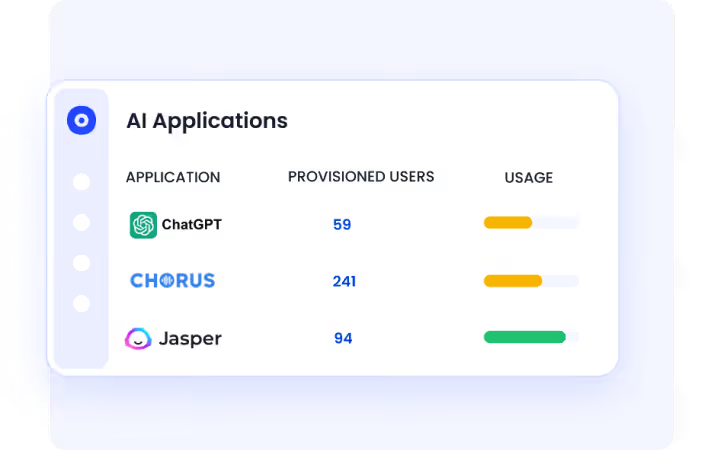
CAIO AI adoption tool showing AI applications dashboard with provisioned users and usage tracking for ChatGPT, Chorus, and Jasper.

Using signals from SSO logs, browser activity, spend data, and security integrations, it builds a continuously updated inventory through its proprietary SaaSMap.

That means:

  • No more unknown shadow AI deployments operating outside visibility
  • Clear view of which tools overlap in functionality (and where budget is being wasted)
  • A single source of truth CAIOs can bring to C-suite conversations with confidence

Instead of defending a position, you're presenting facts.

"Once AI adoption accelerated across teams, visibility alone wasn't enough. We needed clear rules around who could use AI tools, under what conditions, and how those decisions were enforced and reviewed. CloudEagle helped us move from ad-hoc approvals to structured, defensible AI governance." 
~ Aditya Khosla, CTO, Iterative Health

Iterative Health used CloudEagle to surface 200+ AI tools adopted without formal review, govern access by role and data sensitivity, and get 100% of AI usage audit-ready. 

Read the case study →

B. Connect AI Spend to Outcomes Instead of Receipts

CFOs don't want a list of AI subscriptions. They want to understand value.

CloudEagle shows utilization alongside spend. 

CAIOs can walk into budget conversations with data like: "We're spending $60K annually on this tool, but only 28% of licensed users are active."

That shifts the conversation completely. You're not justifying budget; you're optimizing it.

Pro tip: Use CloudEagle's usage data to identify tools to cut or renegotiate before renewal season. Catching the waste before it hits the books is one of the fastest ways to earn CFO credibility.
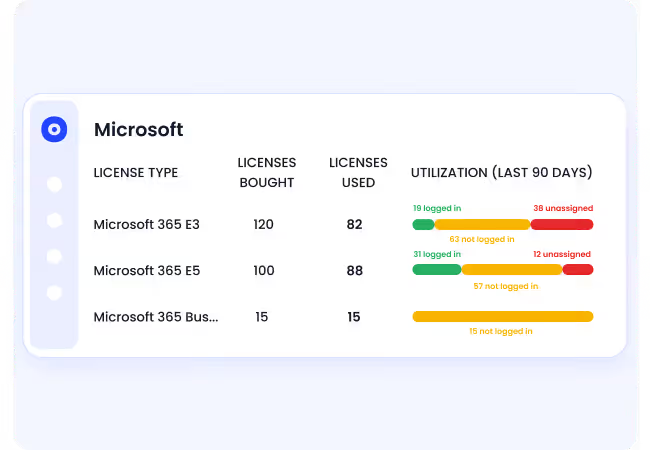
CAIO AI governance tool showing Microsoft license utilization dashboard with bought vs used licenses and 90-day login activity for Microsoft 365 E3, E5, and Business plans.

C. Reduce AI Risk With Role-Based Access Controls

Overprivileged access is one of the most common and least visible AI risks in any organization.

When an employee moves roles, gets promoted, or leaves, their AI tool access rarely updates. Access accumulates, and the people with the most permissions are often the least active users.

CloudEagle.ai lets CAIOs audit and control AI tool access by role. 

For high-sensitivity tools, it also supports Just-in-Time (JIT) access, where users request access when needed, for as long as needed, and it expires automatically.
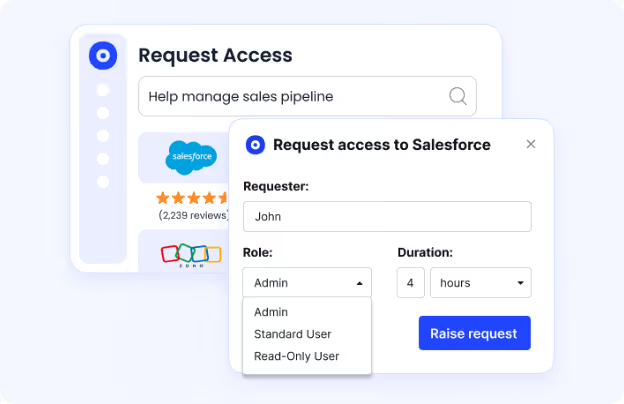
CAIO AI adoption platform showing access request workflow for Salesforce with role selection including Admin, Standard User, and Read-Only User, and configurable access duration.

The result: "We've reduced persistent admin access across our core AI tools by 60%, without slowing down any team."

D. Never Get Caught Off Guard by a Renewal

A surprise renewal request is one of the fastest ways to lose CFO confidence.

CloudEagle.ai sends 30/60/90-day renewal alerts with usage data already attached. CAIOs can see which tools deserve renewal, which should be renegotiated, and which have cheaper overlapping alternatives already in the stack.
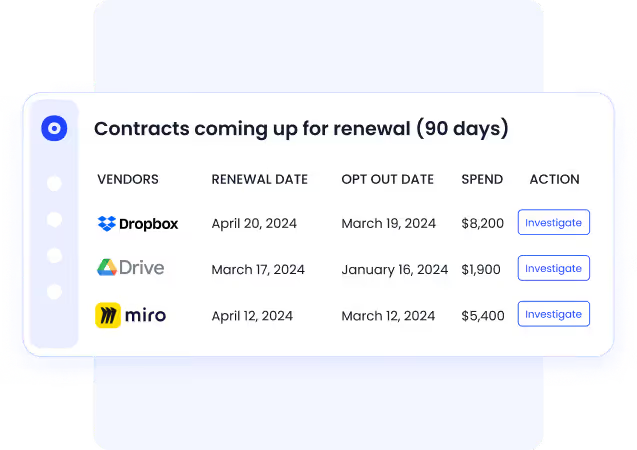
CAIO SaaS governance tool showing contracts coming up for renewal within 90 days including Dropbox, Google Drive, and Miro with opt-out dates and spend amounts.

That predictability earns trust and removes one of the biggest friction points between AI leadership and finance.

E. Build the Audit-Ready Evidence Your Board Will Eventually Ask For

AI governance is becoming a board-level question. Investors, regulators, and auditors are asking: 

"How do you know what AI your organization is using, who has access, and what data it's touching?"

CloudEagle maintains an automated, continuously updated audit trail: access logs, approval histories, usage records, and deprovisioning evidence, all in one place. 
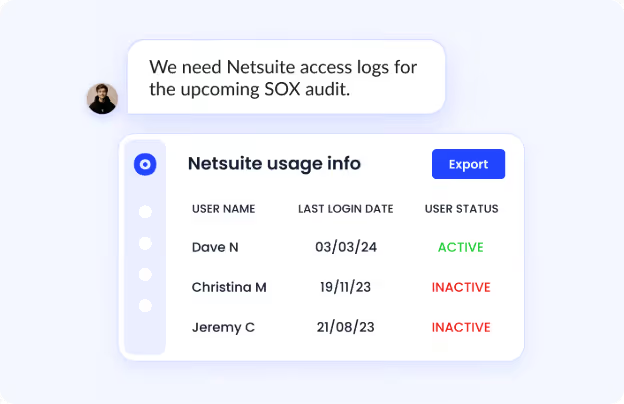
CAIO AI adoption platform showing Netsuite usage info with last login dates and active or inactive status for users, with an Export button for SOX audit reporting.

When that question comes, the answer is already ready.

6. Actionable Checklist: How CAIOs Can Scale Without Creating Chaos

Use this as a recurring audit, not a one-time exercise.

☑  Inventory What You Have: Know every AI tool in the organization: what it does, who owns it, what data it accesses, and what it costs. 

If you can't answer those questions, start there.

☑  Define Ownership for Every Deployment. Every tool needs a business owner who is accountable for adoption and outcomes. No owner means no accountability, and usage drifts.

☑  Connect Initiatives to Financial Metrics: For every active AI initiative, identify the business outcome it supports and the metric that proves it. 

Review those metrics quarterly with business owners and finance.

☑  Build a Fast-Lane Approval Process: Governance fails when it's too slow. 

Create a lightweight intake process that covers security, data access, budget, and ownership in under two weeks for standard deployments. 

Reserve deeper review for high-risk use cases.

☑  Review the Tool Stack for Redundancy: AI sprawl is expensive. Run a quarterly portfolio review looking for:

  • Overlapping capabilities across tools
  • Low or declining utilization
  • Orphaned deployments with no active owner
  • Tools where the cost no longer matches the value

☑   Report to the C-Suite in Business Terms: Your quarterly AI update should lead with business outcomes, instead of usage stats. What did AI initiatives deliver? What's the cost-per-outcome trend? What's the plan for next quarter?

Step One Is Knowing What's Already Running.

Find every hidden AI tool your teams adopted without telling IT.
Download Checklist

7. The Shift: From AI Evangelist to AI Operator

The first wave of CAIOs got hired to generate excitement about AI and run proof-of-concept projects. That job is largely done.

The next wave of AI leaders will be operators. People who can build the infrastructure, governance, and measurement systems that turn AI experiments into organizational capabilities.

That requires a different mindset:

  • Less focus on what's new, more focus on what's working
  • Less enthusiasm for the next tool, more rigor around whether the current ones are delivering
  • Less reporting on activity, more accountability for outcomes

CAIOs who make that shift will scale AI effectively. They'll have the data to defend their budgets, the relationships to move fast cross-functionally, and the track record to earn increasing investment.

Those who don't will spend the next few years explaining why their organization has 40 AI tools and nothing to show for it.

8. FAQs

1. What's the biggest mistake CAIOs make when scaling AI? 

Prioritizing speed over governance. More tools in an unmanaged ecosystem amplify risk and cost; it doesn't accelerate value. Build the governance layer first, then scale.

2. How should CAIOs measure AI success? 

Connect every initiative to a business outcome with a financial proxy: time saved, cost avoided, revenue protected, or capacity unlocked. Usage metrics and adoption rates are inputs, not outcomes.

3. How do CAIOs get buy-in from skeptical CFOs? 

Lead with outcomes, instead of activity reports. Speak in terms CFOs care about: ROI, cost avoidance, forecast variance, and bring them into planning early, not just at budget time.

4. What's the right structure for an AI Center of Excellence? 

Small and embedded. The CoE's job is to provide standards, tools, and training that make adoption easier, not gate every deployment. A fast intake process beats a thorough one that teams route around.

5. How does CloudEagle.ai help CAIOs specifically? 

Complete visibility into every AI and SaaS tool in use, spend tied to utilization, access risk managed, and renewals made predictable. The operational layer that makes AI governance executable.

Related reads:

-> How CISOs Can Prevent Overprivileged Access & Insider Threats
-> 10 Best AI Governance Platforms in 2026
-> How to Manage Shadow AI and Shadow IT

Advertisement for a SaaS Subscription Tracking Template with a call-to-action button to download and a partial graphic of a tablet showing charts.Banner promoting a SaaS Agreement Checklist to streamline SaaS management and avoid budget waste with a call-to-action button labeled Download checklist.Blue banner with text 'The Ultimate Employee Offboarding Checklist!' and a black button labeled 'Download checklist' alongside partial views of checklist documents from cloudeagle.ai.Digital ad for download checklist titled 'The Ultimate Checklist for IT Leaders to Optimize SaaS Operations' by cloudeagle.ai, showing checklist pages.Slack Buyer's Guide offer with text 'Unlock insider insights to get the best deal on Slack!' and a button labeled 'Get Your Copy', accompanied by a preview of the guide featuring Slack's logo.Monday Pricing Guide by cloudeagle.ai offering exclusive pricing secrets to maximize investment with a call-to-action button labeled Get Your Copy and an image of the guide's cover.Blue banner for Canva Pricing Guide by cloudeagle.ai offering a guide to Canva costs, features, and alternatives with a call-to-action button saying Get Your Copy.Blue banner with white text reading 'Little-Known Negotiation Hacks to Get the Best Deal on Slack' and a white button labeled 'Get Your Copy'.Blue banner with text 'Little-Known Negotiation Hacks to Get the Best Deal on Monday.com' and a white button labeled 'Get Your Copy'.Blue banner with text 'Little-Known Negotiation Hacks to Get the Best Deal on Canva' and a white button labeled 'Get Your Copy'.Banner with text 'Slack Buyer's Guide' and a 'Download Now' button next to images of a guide titled 'Slack Buyer’s Guide: Features, Pricing & Best Practices'.Digital cover of Monday Pricing Guide with a button labeled Get Your Copy on a blue background.Canva Pricing Guide cover with a button labeled Get Your Copy on a blue gradient background.

Enter your email to
unlock the report

Oops! Something went wrong while submitting the form.
License Count
Benchmark
Per User/Per Year

Enter your email to
unlock the report

Oops! Something went wrong while submitting the form.
License Count
Benchmark
Per User/Per Year

Enter your email to
unlock the report

Oops! Something went wrong while submitting the form.
Notion Plus
License Count
Benchmark
Per User/Per Year
100-500
$67.20 - $78.72
500-1000
$59.52 - $72.00
1000+
$51.84 - $57.60
Canva Pro
License Count
Benchmark
Per User/Per Year
100-500
$74.33-$88.71
500-1000
$64.74-$80.32
1000+
$55.14-$62.34

Enter your email to
unlock the report

Oops! Something went wrong while submitting the form.

Enter your email to
unlock the report

Oops! Something went wrong while submitting the form.
Zoom Business
License Count
Benchmark
Per User/Per Year
100-500
$216.00 - $264.00
500-1000
$180.00 - $216.00
1000+
$156.00 - $180.00

Enter your email to
unlock the report

Oops! Something went wrong while submitting the form.

Get the Right Security Platform To Secure Your Cloud Infrastructure

Please enter a business email
Thank you!
The 2023 SaaS report has been sent to your email. Check your promotional or spam folder.
Oops! Something went wrong while submitting the form.

Access full report

Please enter a business email
Thank you!
The 2023 SaaS report has been sent to your email. Check your promotional or spam folder.
Oops! Something went wrong while submitting the form.

AI is moving fast. Most organizations are moving faster than they're ready for.

New tools get approved in one department. Duplicate workflows pop up in another. Nobody's sure which models are being used, what data they're touching, or whether any of it connects to actual business goals.

That's the CAIO's problem to solve. 

The pressure to "adopt AI" is real. But adoption without structure leads to SaaS sprawl, wasted spend, and risk nobody accounted for. CAIOs who scale AI responsibly will become some of the most valuable executives in their organizations.

Here's how to do it right.

TL;DR

  • AI adoption without governance creates sprawl, compliance gaps, and budget bleed.
  • CAIOs must own the full lifecycle: strategy, access, accountability, and measurement.
  • Cross-functional alignment with CFOs and CISOs turns AI from a department experiment to a company capability.
  • Visibility into spend, usage, and outcomes separates strategic AI leaders from reactive ones.
  • CloudEagle.ai gives CAIOs the operational layer to make AI governance executable, instead of planning.

1. Why Scaling AI Is Harder Than Adopting It

Getting a team to try an AI tool is easy. Getting an entire organization to use AI well is a different challenge entirely.

"Many organizations are moving quickly to deploy AI, but governance maturity often lags as adoption scales. The opaque nature of many AI systems makes it difficult to trace decisions, identify bias, and establish clear accountability." 
~ Jean-Matthieu Schertzer, Chief AI Officer, Eagle Eye Group (CIO.com)

Most companies hit the same wall. Early AI wins in one department create pressure to expand. Leadership wants results everywhere, fast. So:

  • Tools get deployed before governance is in place
  • Training gets skipped to hit timelines
  • Nobody builds the infrastructure to measure what's actually working
  • Shadow AI usage grows outside of any IT visibility

The result: "AI sprawl" dozens of tools with overlapping functions, inconsistent outputs, and zero central visibility.

The numbers back this up. According to a 2024 McKinsey report, only 21% of companies that have adopted AI at scale report strong governance frameworks. A separate Forrester study found 38% of IT leaders cite governance and security as the biggest barrier to scaling AI.

The organizations winning with AI aren't the fastest movers. They're the ones building systems that let everyone move fast without breaking things.

2. The Traps That Derail AI Scaling

Most AI scaling failures trace back to a few repeating patterns.

A. Tool Proliferation Without Oversight

When departments can procure their own AI tools, they do.

Marketing adopts one writing assistant, sales adopts another, and product uses a third. Before long, you have 15 tools doing overlapping jobs, each with its own:

  • Data access and permissions
  • Pricing model and renewal timeline
  • Security posture and compliance requirements
  • Owner (or lack of one)

Nobody planned for that. And now someone has to clean it up. This is shadow AI in its most common form, not rogue actors, just teams moving fast with no guardrails.

B. Adoption Without Accountability

Buying licenses is not the same as driving adoption.

Too many AI rollouts get measured by seats purchased, not outcomes delivered. When accountability sits with IT or procurement instead of the CAIO, there's no one:

  • Driving consistent usage across the org
  • Tracking whether the tool is delivering ROI
  • Making the call when it's time to cut something that isn't working

C. Speed Over Structure

Fast deployments without change management lead to one outcome: tools that get paid for but are never used.

A Gartner survey found that 41% of employees say they don't use AI tools provided by their company because they weren't trained on them properly.

Deployment speed means nothing if the tools don't get used.

D. No Cross-Functional Alignment

CAIOs often run the AI roadmap independently from the rest of the C-suite. That creates friction everywhere:

  • Tools that finance hasn't approved
  • Deployments that security hasn't reviewed
  • Initiatives that ops teams don't have the bandwidth to support

Scaling AI is cross-functional. Treating it as a technology project is how you get stuck.

Signs your AI scaling has a chaos problem: 

Symptom What it signals
Multiple teams using different tools for the same job No centralized intake or approval process
Finance asking where AI budget is going Spend not tied to outcomes or owners
Security flagging AI tools during audits Tools deployed before review
Low tool adoption despite high license spend Training and change management skipped
CISO saying no to AI requests by default No shared governance framework with security

AI Sprawl Doesn't Announce Itself. Until It's Too Late.

Use this checklist to find every ungoverned AI tool before it finds you.
Download Checklist

3. The CAIO's Framework for Scaling Without Chaos

Here's what separates CAIOs who scale effectively from those who spend all their time firefighting.

A. Build Governance Before You Build Scale

Governance sounds like bureaucracy. It isn't. It's the infrastructure that makes speed sustainable.

A practical AI governance framework needs four things:

  1. A clear approval process for new tools
  2. Defined ownership for each deployment
  3. Data access standards that connect to your security posture
  4. A way to measure whether tools are actually delivering value

Without that foundation, every new tool you add increases your risk exposure and your operational complexity.

Pro tip: Start with an inventory. Document the tools already in use, who owns them, what data they access, and what outcomes they're supposed to drive. That baseline is the foundation for everything else.

B. Tie Every AI Initiative to a Business Outcome

The fastest way to lose executive support: usage metrics that don't connect to business results.

CAIOs need to speak about outcomes, not adoption rates. Here's what that shift looks like:

Instead of this Say this
"800 active AI users across the org" "AI workflows cut proposal time 35%, saving 1,200 sales hours last quarter."
"AI tools in 6 departments" "AI in customer support cut handle time 22%, protecting $1.8M in annual capacity"
"3 LLM pilots running" "Content automation reduced agency spend by $400K this year"

When every initiative has an owner and a measurable outcome, it's harder to deprioritize in budget conversations.

C. Create an AI Center of Excellence, Not a Bottleneck

The goal isn't to control every deployment. That breeds resentment and slows teams down.

Think of the AI CoE as the team that provides the rails, not the team that drives the train. In practice, that means:

  • Creating reusable prompt libraries and workflow templates
  • Running internal training that meets people where they are
  • Building an intake process fast enough that teams don't route around it
  • Tracking cross-functional wins so learnings get shared

Done right, a CoE accelerates adoption. It doesn't slow it down.

D. Own the Access and Risk Layer

Every AI tool that touches company data is a potential risk vector.

Overprivileged access, shadow AI deployments, and unreviewed third-party integrations all create exposure that most organizations don't discover until something goes wrong. 

According to CloudEagle's research, 60% of enterprise AI and SaaS applications operate entirely outside IT visibility.

CAIOs who take ownership of this layer, in close partnership with the CISO, become significantly more valuable to the business. The practical steps:

  • Require a security review as part of the AI tool approval process
  • Audit what data each tool accesses and whether that access matches the use case
  • Build a regular review cadence with the CISO so nothing falls through the cracks

E. Make Visibility a Competitive Advantage

The best CAIOs have real-time visibility into their AI ecosystem. That means:

  • What tools are running across the organization
  • What each one costs and who owns it
  • Who's actually using them and how often
  • What outcomes they're delivering against their stated goals

Without visibility, you're guessing. With it, you're leading.

4. Cross-Functional Alignment: The Partnerships CAIOs Can't Skip

AI scaling doesn't happen in a vacuum. Three relationships matter most.

CAIO + CFO

Finance funds AI at scale when they understand what they're getting.

The CAIO's job: translate AI investments into financial outcomes: cost avoidance, revenue impact, capacity unlocked. That requires:

  • Bringing the CFO into the planning process early
  • Sharing a view of AI spend that connects to outcomes
  • Flagging underperforming tools before they become budget debates
  • Showing up with data, not just projections

That's how you build the kind of trust that gets you more investment, not less.

CAIO + CISO

Security concerns kill more AI initiatives than bad technology does.

CAIOs who build a working CISO relationship before deployments happen move faster. Build toward:

  • A shared framework for evaluating AI tools from a security standpoint
  • Agreed-upon data classification standards for AI use cases
  • Security review is built into the intake process as a step
"AI innovation is advancing faster than most enterprises can formalize controls, forcing teams to scale technology and governance simultaneously."
~ Jean-Matthieu Schertzer, Chief AI Officer, Eagle Eye Group (CIO.com)

When security and AI strategy are aligned, the answer to most deployment requests becomes "here's how" instead of "no."

CAIO + Business Leaders

The most overlooked alignment: the people whose teams will actually use the tools.

Department heads need to feel ownership over AI adoption. It shouldn’t be like something is being done to them. Involve them in tool selection. Make them accountable for outcomes. Celebrate wins and attribute them to the teams that drove them.

That's how you build an AI culture, not just an AI program.

5. How CloudEagle.ai Helps CAIOs Scale AI Without Creating Chaos

Every framework in the previous section depends on one thing: visibility. 

You can't govern what you can't see. You can't measure outcomes for tools you've lost track of. You can't have a credible CFO conversation without real spend data.

That's the gap CloudEagle fills for CAIOs by acting as the operating layer that makes the whole AI governance strategy executable.

A. Get a Complete Inventory of Every AI Tool in Your Stack

Most CAIOs discover their AI sprawl problem through a finance audit or a security incident. By then, it's costly to fix.

CloudEagle.ai surfaces every AI and SaaS tool in use across the organization, including tools that bypassed IT or procurement. 

CAIO AI adoption tool showing AI applications dashboard with provisioned users and usage tracking for ChatGPT, Chorus, and Jasper.

Using signals from SSO logs, browser activity, spend data, and security integrations, it builds a continuously updated inventory through its proprietary SaaSMap.

That means:

  • No more unknown shadow AI deployments operating outside visibility
  • Clear view of which tools overlap in functionality (and where budget is being wasted)
  • A single source of truth CAIOs can bring to C-suite conversations with confidence

Instead of defending a position, you're presenting facts.

"Once AI adoption accelerated across teams, visibility alone wasn't enough. We needed clear rules around who could use AI tools, under what conditions, and how those decisions were enforced and reviewed. CloudEagle helped us move from ad-hoc approvals to structured, defensible AI governance." 
~ Aditya Khosla, CTO, Iterative Health

Iterative Health used CloudEagle to surface 200+ AI tools adopted without formal review, govern access by role and data sensitivity, and get 100% of AI usage audit-ready. 

Read the case study →

B. Connect AI Spend to Outcomes Instead of Receipts

CFOs don't want a list of AI subscriptions. They want to understand value.

CloudEagle shows utilization alongside spend. 

CAIOs can walk into budget conversations with data like: "We're spending $60K annually on this tool, but only 28% of licensed users are active."

That shifts the conversation completely. You're not justifying budget; you're optimizing it.

Pro tip: Use CloudEagle's usage data to identify tools to cut or renegotiate before renewal season. Catching the waste before it hits the books is one of the fastest ways to earn CFO credibility.

CAIO AI governance tool showing Microsoft license utilization dashboard with bought vs used licenses and 90-day login activity for Microsoft 365 E3, E5, and Business plans.

C. Reduce AI Risk With Role-Based Access Controls

Overprivileged access is one of the most common and least visible AI risks in any organization.

When an employee moves roles, gets promoted, or leaves, their AI tool access rarely updates. Access accumulates, and the people with the most permissions are often the least active users.

CloudEagle.ai lets CAIOs audit and control AI tool access by role. 

For high-sensitivity tools, it also supports Just-in-Time (JIT) access, where users request access when needed, for as long as needed, and it expires automatically.

CAIO AI adoption platform showing access request workflow for Salesforce with role selection including Admin, Standard User, and Read-Only User, and configurable access duration.

The result: "We've reduced persistent admin access across our core AI tools by 60%, without slowing down any team."

D. Never Get Caught Off Guard by a Renewal

A surprise renewal request is one of the fastest ways to lose CFO confidence.

CloudEagle.ai sends 30/60/90-day renewal alerts with usage data already attached. CAIOs can see which tools deserve renewal, which should be renegotiated, and which have cheaper overlapping alternatives already in the stack.

CAIO SaaS governance tool showing contracts coming up for renewal within 90 days including Dropbox, Google Drive, and Miro with opt-out dates and spend amounts.

That predictability earns trust and removes one of the biggest friction points between AI leadership and finance.

E. Build the Audit-Ready Evidence Your Board Will Eventually Ask For

AI governance is becoming a board-level question. Investors, regulators, and auditors are asking: 

"How do you know what AI your organization is using, who has access, and what data it's touching?"

CloudEagle maintains an automated, continuously updated audit trail: access logs, approval histories, usage records, and deprovisioning evidence, all in one place. 

CAIO AI adoption platform showing Netsuite usage info with last login dates and active or inactive status for users, with an Export button for SOX audit reporting.

When that question comes, the answer is already ready.

6. Actionable Checklist: How CAIOs Can Scale Without Creating Chaos

Use this as a recurring audit, not a one-time exercise.

☑  Inventory What You Have: Know every AI tool in the organization: what it does, who owns it, what data it accesses, and what it costs. 

If you can't answer those questions, start there.

☑  Define Ownership for Every Deployment. Every tool needs a business owner who is accountable for adoption and outcomes. No owner means no accountability, and usage drifts.

☑  Connect Initiatives to Financial Metrics: For every active AI initiative, identify the business outcome it supports and the metric that proves it. 

Review those metrics quarterly with business owners and finance.

☑  Build a Fast-Lane Approval Process: Governance fails when it's too slow. 

Create a lightweight intake process that covers security, data access, budget, and ownership in under two weeks for standard deployments. 

Reserve deeper review for high-risk use cases.

☑  Review the Tool Stack for Redundancy: AI sprawl is expensive. Run a quarterly portfolio review looking for:

  • Overlapping capabilities across tools
  • Low or declining utilization
  • Orphaned deployments with no active owner
  • Tools where the cost no longer matches the value

☑   Report to the C-Suite in Business Terms: Your quarterly AI update should lead with business outcomes, instead of usage stats. What did AI initiatives deliver? What's the cost-per-outcome trend? What's the plan for next quarter?

Step One Is Knowing What's Already Running.

Find every hidden AI tool your teams adopted without telling IT.
Download Checklist

7. The Shift: From AI Evangelist to AI Operator

The first wave of CAIOs got hired to generate excitement about AI and run proof-of-concept projects. That job is largely done.

The next wave of AI leaders will be operators. People who can build the infrastructure, governance, and measurement systems that turn AI experiments into organizational capabilities.

That requires a different mindset:

  • Less focus on what's new, more focus on what's working
  • Less enthusiasm for the next tool, more rigor around whether the current ones are delivering
  • Less reporting on activity, more accountability for outcomes

CAIOs who make that shift will scale AI effectively. They'll have the data to defend their budgets, the relationships to move fast cross-functionally, and the track record to earn increasing investment.

Those who don't will spend the next few years explaining why their organization has 40 AI tools and nothing to show for it.

8. FAQs

1. What's the biggest mistake CAIOs make when scaling AI? 

Prioritizing speed over governance. More tools in an unmanaged ecosystem amplify risk and cost; it doesn't accelerate value. Build the governance layer first, then scale.

2. How should CAIOs measure AI success? 

Connect every initiative to a business outcome with a financial proxy: time saved, cost avoided, revenue protected, or capacity unlocked. Usage metrics and adoption rates are inputs, not outcomes.

3. How do CAIOs get buy-in from skeptical CFOs? 

Lead with outcomes, instead of activity reports. Speak in terms CFOs care about: ROI, cost avoidance, forecast variance, and bring them into planning early, not just at budget time.

4. What's the right structure for an AI Center of Excellence? 

Small and embedded. The CoE's job is to provide standards, tools, and training that make adoption easier, not gate every deployment. A fast intake process beats a thorough one that teams route around.

5. How does CloudEagle.ai help CAIOs specifically? 

Complete visibility into every AI and SaaS tool in use, spend tied to utilization, access risk managed, and renewals made predictable. The operational layer that makes AI governance executable.

Related reads:

-> How CISOs Can Prevent Overprivileged Access & Insider Threats
-> 10 Best AI Governance Platforms in 2026
-> How to Manage Shadow AI and Shadow IT

Recognized as an Industry leader for our AI

CloudEagle.ai is Recognized in the 2024 Gartner® Magic Quadrant™ for SaaS Management Platforms

Recognition highlights CloudEagle’s innovation and leadership in the rapidly evolving SaaS management and procurement space.
Read More
Gartner Magic Quadrant for SaaS Management Platforms showing a chart divided into Challengers and Leaders quadrants with various companies plotted as dots.

CloudEagle.ai Recognized in the GigaOm Radar for SaaS Management Platforms

CloudEagle named a Leader and Outperformer in GigaOm Radar Report, validating its impact in the SaaS management platform landscape.
Read More
gigaom

Everest Group Positions CloudEagle.ai as a Trailblazer in SaaS Management Platforms

CloudEagle recognized as a Trailblazer by Everest Group, showcasing its rapid growth and innovation in SaaS spend and operations management.
Read More
qks

CloudEagle.ai is Recognized in the 2024 Gartner® Magic Quadrant™ for SaaS Management Platforms

Recognition highlights CloudEagle’s innovation and leadership in the rapidly evolving SaaS management and procurement space.
Read More
gartner
CloudEagle.ai recognized in the 2025 Gartner® Magic Quadrant™ for SaaS Management Platforms
Download now
gartner chart
5x
Faster employee
onboarding
80%
Reduction in time for
user access reviews
30k
Workflows
automated
$15Bn
Analyzed in
contract spend
$2Bn
Saved in
SaaS spend

Streamline SaaS governance and save 10-30%

Book a Demo with Expert
CTA image
One platform to Manage
all SaaS Products
Learn More