
%201.svg)


HIPAA Compliance Checklist for 2025

AI isn’t “coming”, it’s already everywhere.
Marketing teams are prompting ChatGPT for campaign ideas. Finance is analyzing forecasts using AI copilots. Engineers rely on autonomous coding assistants. HR uses AI to screen resumes.
And here’s the truth nobody really says out loud: AI adoption inside enterprises is happening faster than organizations can govern it.
Shadow AI tools slip into workflows. Sensitive data gets pasted into public models. Compliance teams race to interpret new laws like the EU AI Act. Effective AI governance is about giving your organization the clarity, guardrails, policies, and visibility required to use AI safely, without slowing teams down. Discover how AI governance software automates these controls at enterprise scale.
In this guide, we break down the real benefits of AI governance, why it matters today, and how organizations can implement it without friction.
TL;DR
- AI governance ensures safe, responsible AI use without killing innovation.
- It protects your organization from data leaks, shadow AI, compliance failures, and model risks.
- You gain full visibility into how every team and employee is using AI.
- Governance improves trust across customers, regulators, and internal teams.
- It cuts risk costs while boosting operational efficiency and innovation velocity.
1. What Are the Benefits of Effective AI Governance?
AI is moving faster than internal controls, and that gap keeps widening. Here’s why governance has become a non-negotiable priority:
A. Rapid Adoption of GenAI Across Teams
Every team is experimenting with AI. Most of this experimentation is decentralized, unmonitored, and inconsistent. Without governance, organizations can't ensure safe or appropriate use.
B. Shadow AI Is Exploding
Employees are using AI tools without approval, often unintentionally. All it takes is one unvetted browser extension or free AI tool to expose confidential data.
C. Regulatory Pressure Is Rising
Laws like the EU AI Act, NIST AI RMF, and upcoming global standards require:
- Documentation
- Risk assessments
- Usage policies
- Monitoring
- Vendor AI disclosures
Governance ensures you're always audit-ready.
D. Higher Risk of Data Exposure and Bias
AI tools learn from the data they receive. Without proper controls:
- Sensitive data can leak
- Outputs may become biased or inaccurate
- Models can hallucinate in high-risk scenarios
E. Enterprise Dependence on AI Is Growing
AI is now embedded in SaaS platforms (Salesforce Einstein, HubSpot AI, Notion AI, CloudEagle.ai EagleEye). As reliance grows, governance ensures these features are used responsibly.
2. What are the Core Benefits of Implementing AI Governance?
The core benefits of AI governance are building trust, ensuring ethical & responsible use, mitigating significant risks (bias, privacy, legal), boosting efficiency & reliability, and driving sustainable innovation, ultimately helping organizations navigate complex regulations while gaining a competitive edge and ensuring AI aligns with human values and business goals.
Let’s break down the biggest and most practical benefits organizations experience. Understanding where your organization sits on an AI governance maturity model helps identify which benefits are achievable first.
A. Reduces Risk and Enhances Security
Effective AI governance acts like a security shield around your AI usage.
It helps you:
- Prevent confidential or regulated data exposure - Clear rules define what data can and cannot be fed into AI systems.
- Minimize misuse or hallucination-based decisions - Employees know where to trust AI and where human review is required.
- Reduce security incidents caused by unvetted AI tools - Governance ensures all AI apps undergo proper risk evaluation. Use an AI compliance checklist to ensure you're covering all required controls across SOC 2, GDPR, and regulatory frameworks.
- Support secure access management - Role-based permissions and controlled access prevent accidental misuse.
Bottom line: AI becomes safer, predictable, and less prone to unexpected risk.
B. Improves Compliance and Regulatory Readiness
Compliance frameworks are expanding rapidly. AI governance keeps you ahead of them, not scrambling behind them.
It ensures:
- Alignment with frameworks - NIST AI RMF, ISO standards, EU AI Act classifications.
- Reduced audit risk - Because everything, from usage logs to vendor risk scores is already documented.
- Standardized approvals, documentation, and controls - Governance transforms compliance from manual and reactive to automated and proactive.
- Repeatable, scalable compliance processes - No more reinventing policy for each new AI tool.
C. Increases Visibility Across AI Usage
Most organizations don’t actually know how many AI tools they use. That’s the problem governance solves immediately.
You gain:
- A centralized AI inventory - Every GenAI app, model, and embedded AI feature is visible in one place.
- Shadow AI detection - Governance tools flag unapproved usage or rogue experimentation.
- Team-level and user-level behavior insights - See who’s using AI, how often, and for what purpose.
- Better decision-making for tool selection - Identify duplicate tools, redundant purchases, and usage patterns.
Visibility is the foundation of safe, cost-efficient AI adoption.
D. Strengthens Data Governance and Privacy
AI governance ensures data flows responsibly across the organization.
It establishes:
- Rules for what data models can ingest - No more pasting customer records into public AI tools.
- Customer trust through stronger safeguards - Clients feel secure knowing your AI processes are compliant.
- Data retention and model output review - AI-generated content is evaluated before consumption.
- Reduced sensitive data misuse - Governance ensures proper redaction, anonymization, and oversight.
E. Builds Organizational Trust & Accountability
AI governance creates clarity across the enterprise.
It provides:
- Clear rules and responsibilities for employees - Everyone understands how AI should be used.
- Transparency for customers and partners - Enterprises can demonstrate responsible AI usage with confidence.
- Ethical and responsible AI adoption - Bias and unfair decisions are minimized.
- Cross-functional ownership - CIO, CISO, Legal, and business units collaborate under one framework.
Governance builds trust, and trust accelerates adoption.
F. Improves Operational Efficiency
AI governance doesn’t slow you down. It removes friction across workflows.
It helps organizations:
- Eliminate duplicate tools and reduce cost waste - No more multiple teams purchasing the same AI assistant.
- Create standard, reusable workflows - For approvals, onboarding, and risk review.
- Speed up tool onboarding while staying compliant - Governance ensures teams aren’t blocked by unnecessary delays.
- Prevent policy creation chaos - One governance framework applies to all AI apps.
G. Enables Responsible Innovation
The goal of AI governance isn’t restriction, it’s empowerment.
It helps organizations:
- Encourage safe experimentation - Teams can innovate confidently within defined guardrails.
- Adopt approved AI tools more quickly - Because every new tool follows a structured evaluation.
- Scale AI adoption across business functions - From marketing to finance to engineering.
- Move from “AI chaos” to “controlled acceleration” - A stable framework makes innovation more sustainable.
3. How CloudEagle.ai Helps You Realize These Benefits
CloudEagle.ai enables enterprises to shift from reactive oversight to proactive, intelligence-driven AI governance. Instead of scattered tools and manual reviews, CloudEagle centralizes visibility, automates compliance, and enforces policy guardrails, allowing you to adopt AI confidently and safely at scale.
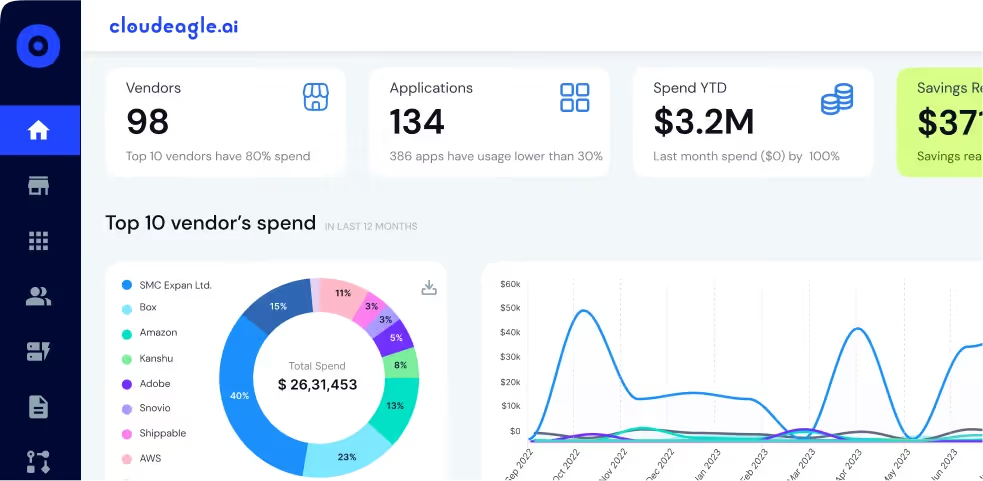
A. Shadow AI Detection
Shadow AI is the biggest blind spot for IT and security teams, and CloudEagle.ai solves it at the source. The platform automatically identifies unapproved AI tools, embedded GenAI features inside existing SaaS apps, and browser plugins that traditional monitoring fails to catch.
From AI writing assistants hidden in productivity tools to sales intelligence plugins installed in browsers, CloudEagle.ai brings everything into a unified view. Each tool is assigned a dynamic risk score based on access levels, data exposure, and compliance posture, so you immediately know where the real risks are.
B. Policy Enforcement
CloudEagle.ai lets you create and enforce AI usage policies that match your security, compliance, and industry requirements.
These are not passive documents, they are active controls. The platform applies your policies in real time, triggering automated approvals, routing risky actions for review, or blocking unsafe behavior entirely.
Whether someone is uploading sensitive data into a chatbot or experimenting with a new AI tool, CloudEagle ensures every action aligns with the rules you set.
C. Vendor Compliance & Risk Scoring
CloudEagle.ai embeds AI-specific compliance and risk assessments directly into your procurement workflow. It evaluates vendors for SOC2, GDPR, ISO, and other frameworks, while automatically extracting contract and security details from uploaded documents.
Instead of manually checking every vendor claim, teams get instant insights, centralized security data, and clear risk scores, making procurement both faster and safer.
D. Continuous Monitoring & Alerts
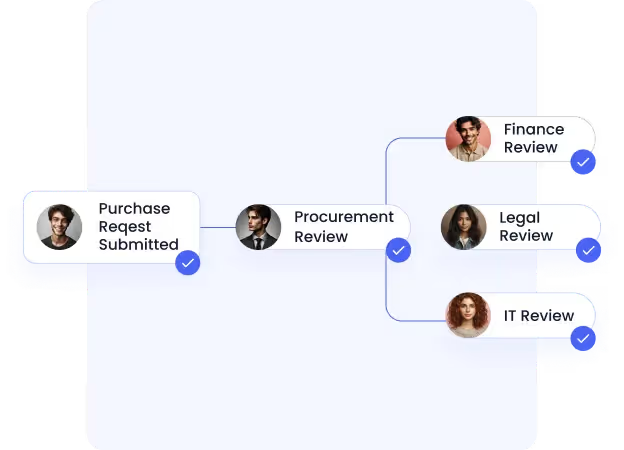
CloudEagle.ai continuously tracks how employees interact with AI tools, giving IT and security teams user-level visibility and accountability.
The moment an out-of-policy or high-risk action occurs like uploading sensitive files into ChatGPT or accessing unapproved AI apps, CloudEagle triggers immediate alerts. Automated responses can follow instantly, including revoking access, sending Slack notifications, or creating ITSM tickets.
It’s 24/7 governance that never sleeps.
E. Governance That Saves You Money
CloudEagle.ai doesn’t just strengthen governance, it optimizes spend. By combining AI governance with SaaS management and procurement automation, organizations eliminate tool duplication, reclaim unused licenses, and prevent redundant AI purchases.
Customers typically reduce SaaS costs by 10–30%, cut compliance preparation time by 80%, and move from occasional access reviews to continuous, automated governance, all powered through a single platform.
4. Conclusion
Effective AI governance isn’t just a best practice, it’s the backbone of safe, compliant, and scalable AI adoption. When organizations put governance first, they gain clarity, reduce risk, and create an environment where innovation can thrive with confidence.
Understanding where governance and security diverge helps teams invest in the controls that provide the most business value.
CloudEagle.ai makes this transformation seamless by giving you full visibility into AI usage, automatically detecting Shadow AI, enforcing access controls, and monitoring model activity in real time. With built-in compliance, automated approvals, and deep integrations across your SaaS and identity stack, CloudEagle turns AI governance into a streamlined, automated system you can rely on.
Frequently Asked Questions
1. Why is AI governance important for modern organizations?
Because AI adoption is growing faster than organizational controls. Governance protects against shadow AI, data exposure, compliance risk, and misuse.
2. How does AI governance reduce security and compliance risk?
By defining what data can be used, controlling access, enforcing policies, and monitoring all AI activity. It ensures all AI tools and models operate within safe boundaries.
3. Can AI governance slow down innovation?
Not when done right. Modern governance accelerates innovation by providing approved tools, guardrails, and workflows that prevent delays and uncertainty.
4. What tools help implement effective AI governance?
Platforms like CloudEagle.ai help with shadow AI detection, vendor risk scoring, policy enforcement, real-time monitoring, and AI compliance automation.


.avif)


.avif)
.avif)




.png)





.avif)
.avif)
.avif)


