You need to enable JavaScript in order to use the AI chatbot tool powered by ChatBot

AI Governance vs AI Security: What’s the Difference & Why It Matters

Share via:
blog-cms-banner-bg
Little-Known Negotiation Hacks to Get the Best Deal on Slack
cta-bg-blogDownload Your Copy

HIPAA Compliance Checklist for 2025

Download PDF

IAM Risk Guide

Explore key identity and access risks that impact AI governance, compliance alignment, and secure tool adoption across teams.

Download Guide
CTA Thumbnail

AI is being embedded everywhere, from productivity copilots inside Microsoft 365 to predictive assistants in Salesforce and automated analytics in Google Workspace. 

Many leadership teams mistakenly assume that deploying AI securely means they are governing it, or that implementing governance frameworks automatically makes their environment secure. 

Neither assumption is true.

Research from Gartner shows that while 91% of enterprises plan to scale AI usage, more than 70% lack governance maturity, meaning they cannot track where AI is used, who controls it, or what risks it creates. 

This guide clarifies the distinction, explains why both are essential, analyzes the consequences of neglecting either, and outlines best practices for managing AI safely at enterprise scale.

TL;DR 

  • AI governance and AI security are different: governance manages usage and accountability, while security protects systems, data, and access.
  • Enterprises need both to prevent Shadow AI, unmanaged spending, and audit or compliance risk.
  • Without clear oversight, organizations struggle with visibility, ownership gaps, and uncontrolled access to embedded AI tools.
  • Best practices include cross-department AI ownership, automation-driven approvals, and measurable outcome tracking.
  • CloudEagle.ai accelerates AI maturity by giving enterprises visibility into AI usage, spend, renewals, and access ownership, turning governance into measurable control.

1. What Is AI Governance?

AI governance refers to the structures, decision processes, controls, and operational models that determine how AI is adopted, monitored, approved, and measured within an organization. 

It is concerned with accountability, who owns risk, who approves access, how usage is evaluated, and whether business outcomes justify investment.

Governance ensures leadership visibility into:

  • Where AI is being used
  • Which systems contain embedded AI functionality
  • What teams benefit from deployment
  • How access is granted, monitored, and audited

Modern AI governance also includes ethical considerations, fairness, legal compliance, and alignment with standards such as ISO/IEC 42001 or the EU AI Act.

McKinsey’s enterprise AI survey notes that companies with clear governance functions realize three times higher ROI because AI adoption becomes intentional rather than reactive experimentation.

What Is Identity & Access Management

Learn IAM foundations, policy controls, access models, and governance frameworks necessary for safe AI adoption.

Read IAM Guide
CTA Thumbnail

2. What Is AI Security?

AI security is the technical discipline dedicated to protecting AI models, decision engines, data inputs, and outputs from misuse, leakage, tampering, and exploitation. 

It focuses on safeguarding model integrity, preventing unauthorized access, and defending AI operations from internal and external threats.

Effective AI security incorporates:

  • Identity controls and authentication
  • Data encryption across AI pipelines
  • Monitoring for abuse, manipulation, or prompt attacks
  • Secure infrastructure configurations
  • Integration with cybersecurity and IAM enforcement layers

IBM’s threat research indicates that AI-powered systems are increasingly targeted for input manipulation, model poisoning, and inference exploitation, making AI security a pressing operational need, not a future concern.

3. Key Differences: AI Governance vs AI Security

Although both functions protect organizations, they operate in different dimensions.

a. Oversight vs. Defense

AI governance manages oversight, ownership, policies, and justification for AI access and investment. 

AI security functions as the defense mechanism, preventing misuse, abuse, and unauthorized activity.

Governance determines the rules; security enforces protection when those rules are challenged or violated.

b. Compliance vs. Threat Protection

Governance ensures compliance with laws, ethics, and internal obligations, especially relevant under new regulatory environments such as the EU AI Act. 

Security handles technical risk mitigation, threat detection, and incident defense.

Governance answers “Should we use this AI tool?” while security answers “How do we protect it once we do?”

c. Policy vs. Execution

Governance defines intent, usage conditions, and approval workflow, whereas security performs execution, restriction, and enforcement across systems and endpoints.

Organizations that excel distinguish these roles rather than treating them as interchangeable.

Dimension AI Governance AI Security
Primary Function Sets oversight, ownership, and policies for AI usage and investment Defends AI systems from misuse, abuse, and unauthorized access
Focus Area Compliance, ethics, accountability, regulatory alignment Technical risk mitigation, threat detection, and attack prevention
Guiding Question “Should we use this AI tool, and under what rules?” “How do we protect this AI once deployed?”
Role in Control Flow Defines intent, rules, and approval workflows Enforces, restricts, and responds via controls and monitoring
Outcome Goal Responsible, justified AI adoption Secure, resilient AI operations
Organizational Insight Policy layer Execution layer

4. Why Enterprises Need Both Governance and Security?

Enterprises cannot select one or the other. AI governance is meaningless if there are no technical controls to enforce it, and AI security lacks direction without policy structures guiding usage.

Three realities make both disciplines essential:

a. Rapid AI Adoption and Usage Risk

AI is spreading across apps, workflows, and extensions faster than leaders can approve or assess it. This results in:

  • Fragmented ownership as business units procure AI independently
  • Unreviewed spending with no linkage to outcomes
  • Low visibility into where AI is used or whether it drives value

Governance gives structure to how AI enters the enterprise; security ensures that access, behavior, and data use remain safe and controlled.

b. Protection of Sensitive Enterprise Data

AI systems frequently access privileged information, emails, CRM records, financial data, and intellectual property. Without:

  • Governance, employees misuse tools, or expose sensitive inputs
  • Security, external models, extensions, and agents could leak data

Together, they ensure responsible use and technical safeguards around what AI systems can reach or infer.

c. Regulatory and Audit Pressure

New laws and frameworks (e.g., EU AI Act, ISO 42001) require proof of control, not just technology. Organizations must demonstrate:

  • Why is AI being used?
  • Who approved it?
  • How is accountability assigned?
  • What monitoring and controls exist?

Governance documents intent and ownership; security enforces protection, logging, and evidence capture.

SaaS Management Best Practices

Understand essential governance principles, including visibility, compliance controls, approvals, and lifecycle management for AI tools.

Read Best Practices
CTA Thumbnail

5. What Happens When Enterprises Lack Governance and Security?

Enterprises that neglect governance or security experience significant consequences.

a. Shadow AI Proliferation

Employees adopt tools like ChatGPT, Jasper, or browser AI add-ons without approval, creating invisible risk:

  • IT loses control of where data goes.
  • Sensitive inputs may reach external systems.
  • Governance is bypassed entirely.

Gartner reports that 41% of enterprise AI use occurs outside sanctioned platforms, creating unmanaged risk and cost.

b. No Audit or Tracking Visibility

Executives can’t answer critical questions:

  • Which AI tools are being used?
  • Who approved them?
  • Are they generating measurable value?

This lack of visibility derails forecasting, renewals, budgeting, and strategic decision-making.

c. Increased Internal Risk and Cost

When AI spends, access, and data exposure grow without controls, organizations face rising operational and compliance risk, yet no owners responsible for preventing or correcting it.

  • Auto-renewals go unnoticed
  • Licensing and usage spike unchecked
  • Sensitive data enters ungoverned systems
  • Compliance becomes reactive, and audits turn into friction

6. How CloudEagle.ai Enables AI Governance and Security?

CloudEagle.ai gives IT, Security, and Procurement teams a unified, automated platform to govern and secure every SaaS and AI tool in the organization, approved or unapproved, behind SSO or completely outside it. 

With real-time discovery, automated access governance, and deep usage visibility, CloudEagle.ai helps enterprises eliminate shadow IT, reduce identity risk, strengthen compliance, and modernize governance for the AI era.

a. Unified Visibility Across ALL SaaS & AI Tools (Shadow IT + Shadow AI)

CloudEagle.ai automatically discovers every application employees log into, including AI tools, browser-based apps, free plans, credit-card purchases, and tools not connected to SSO.
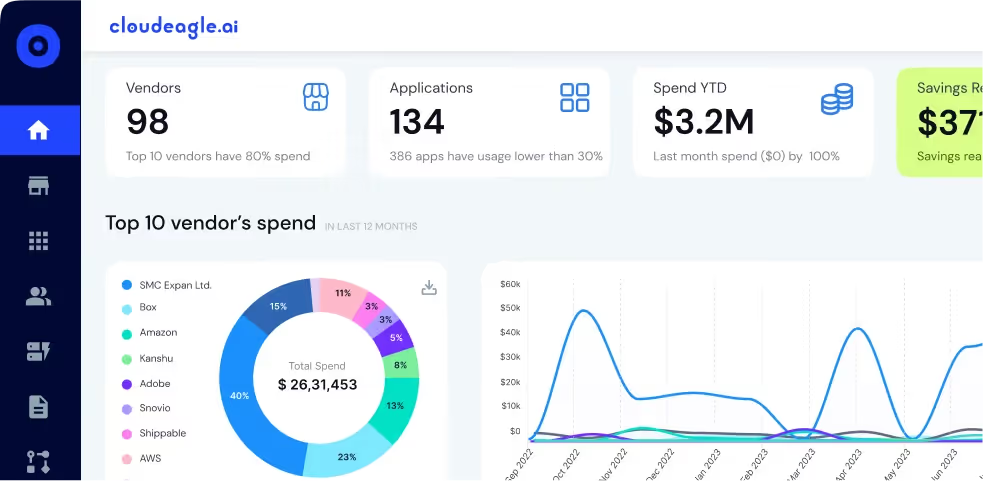
This directly addresses the governance gap highlighted in the IGA Report, where 60% of AI/SaaS tools sit outside IT oversight.

Why this matters:
You cannot enforce AI security policies if you can’t see which tools employees are actually using.

b. Automated Access Governance: Zero-Touch, Continuous, and Role-Aware

CloudEagle.ai enforces governance through:
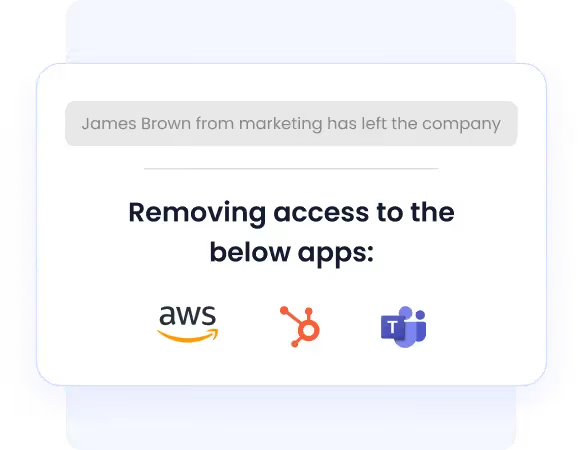
  • Role-based and department-based access provisioning
  • Automated deprovisioning,  even for apps outside Okta/SailPoint
  • Continuous, AI-powered access reviews
  • Time-based access for contractors and temp workers
  • SOC 2-ready audit logs

These capabilities minimize privilege creep and mitigate insider risk, problems that plague 50%+ of organizations according to CloudEagle’s IGA report.

c. AI Security Through Real-Time Detection of High-Risk Tools

CloudEagle.ai flags unapproved AI tools and automatically identifies:
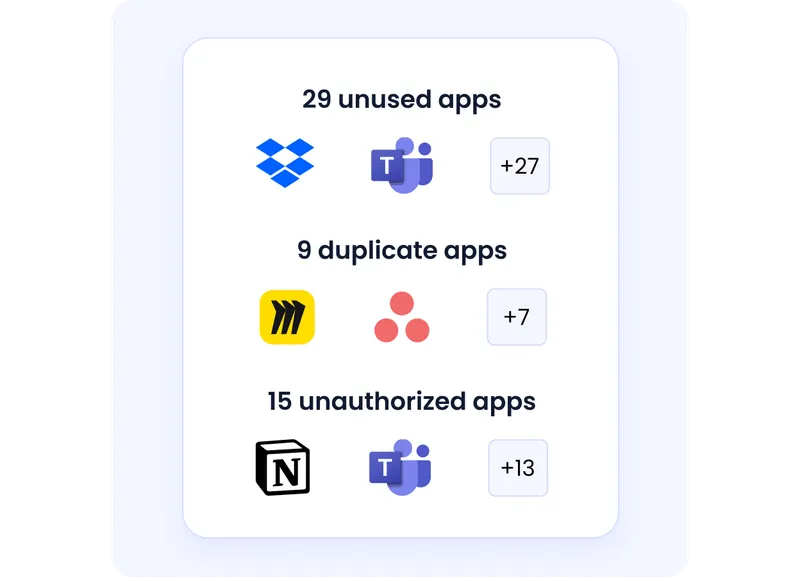
  • Which employees are using them
  • What overlapping or redundant AI tools exist
  • Which apps introduce privacy, data exposure, or compliance risks

No firewall block or IDP control can do this. 

CloudEagle.ai correlates login data + spend signals + browser patterns to expose hidden AI activity.

d. Governance + Security Meets Cost Optimization

Unlike point solutions, CloudEagle.ai connects AI governance with spend analysis:
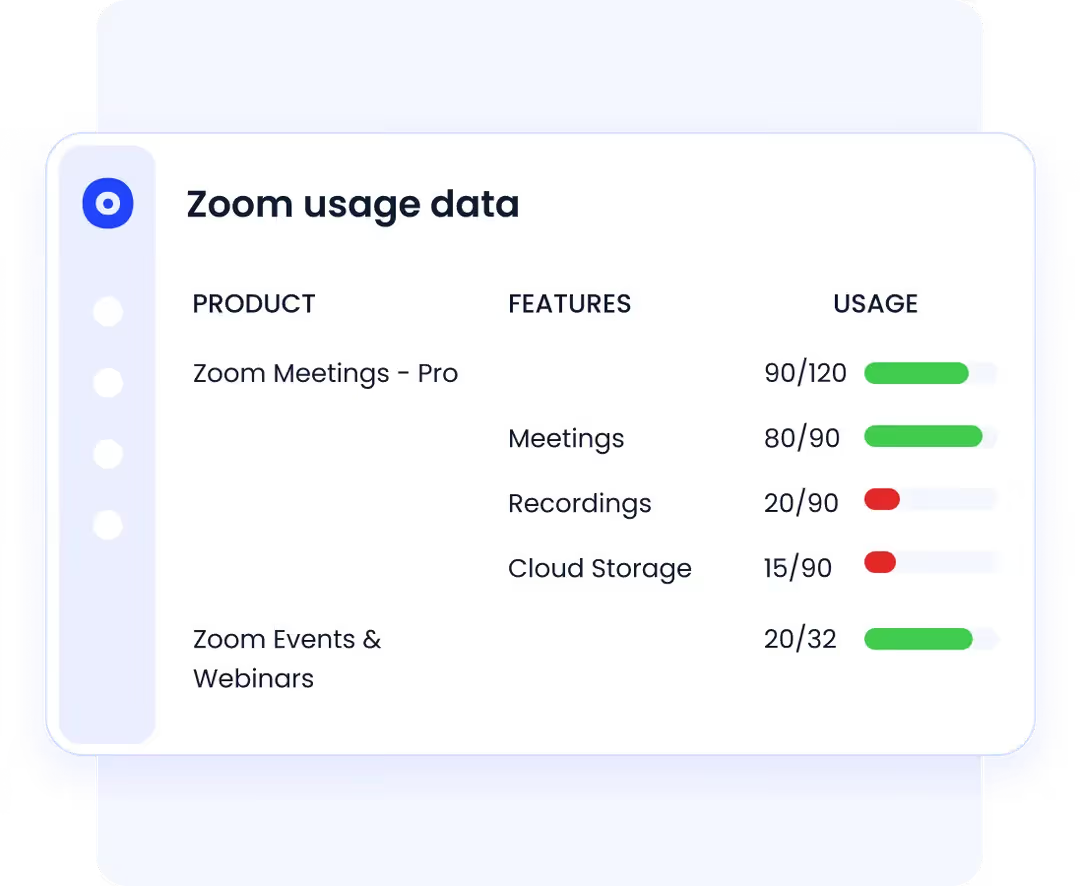
  • Identifies unapproved or duplicated AI tools
  • Eliminates unused or overprivileged licenses
  • Benchmarks AI/SaaS pricing to prevent overspend
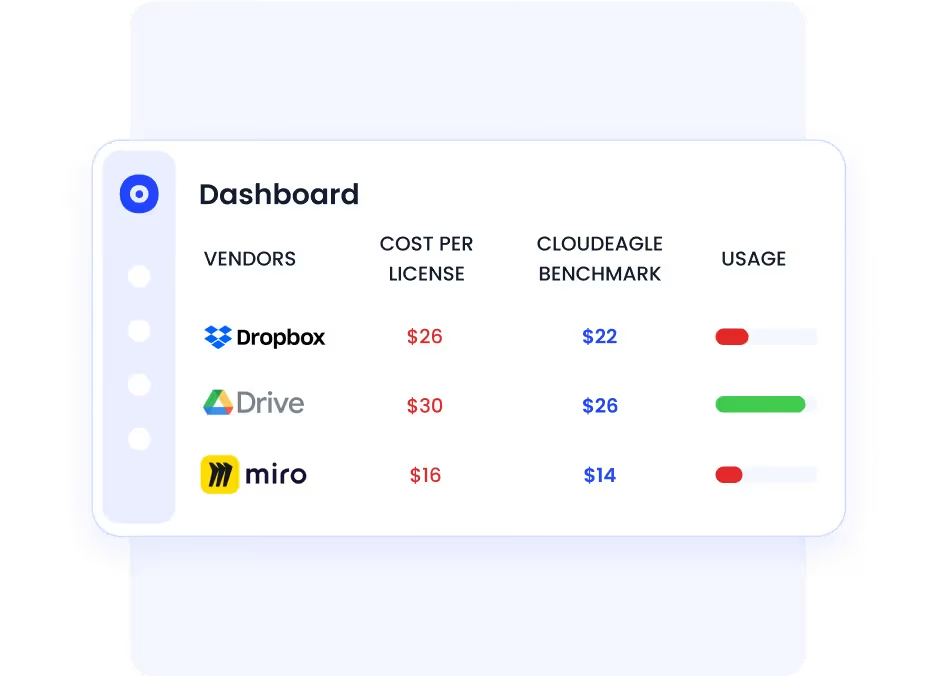
This aligns directly with CloudEagle’s differentiator as not just a governance tool, but a SaaS savings and procurement platform that reduces software spend by 10–30%.

e. A Single Operating System for SaaS & AI Governance

CloudEagle.ai unifies the traditionally disconnected parts of AI governance, discovery, access control, compliance, renewals, and cost optimization into one platform.

This enables IT, Security, Procurement, and Finance teams to work from the same source of truth instead of dozens of spreadsheets, emails, and admin consoles.

Key outcomes:

  • Reduce compliance effort by 80%
  • Eliminate access blind spots (continuous access reviews, automated offboarding)
  • Prevent data leakage from unapproved AI apps
  • Cut SaaS waste and redistribute licenses instantly
  • Strengthen governance and security without adding headcount

7. Conclusion

AI adoption is outpacing governance and security maturity, exposing enterprises to rising costs, compliance gaps, and uncontrolled data risk. 

Governance defines ownership and intent, while security enforces protection; together, they convert AI from experimentation into accountable value.

CloudEagle.ai unifies AI governance and security in one platform, discovering Shadow AI, monitoring usage, enforcing access workflows, and generating audit-ready visibility. It gives enterprises the control, accountability, and measurable value most AI programs lack.

Book a free demo and bring visibility, control, and accountability to your AI ecosystem.

Frequently Asked Questions

1. What is the difference between AI governance and AI security?
Governance manages how AI is adopted and overseen; security protects AI systems and data from misuse, attack, or unauthorized access.

2. How does AI security protect organizational data?
By enforcing authentication, monitoring model interactions, encrypting data, detecting anomalies, and restricting how AI tools process information.

3. What is responsible AI, and how does it relate to governance?
Responsible AI ensures ethical and auditable use of AI; governance operationalizes this through rules, policies, ownership structures, and controls.

4. What risks are associated with enterprise AI adoption?
Shadow AI usage, uncontrolled spending, data leakage, compliance gaps, unmanaged renewals, and untracked decision-making influence.

5. What are the key principles of AI governance? 

AI governance is built on fairness, transparency, accountability, privacy, security, and compliance. These principles ensure AI systems are ethical, explainable, secure, legally compliant, and aligned with business and societal expectations.

Advertisement for a SaaS Subscription Tracking Template with a call-to-action button to download and a partial graphic of a tablet showing charts.Banner promoting a SaaS Agreement Checklist to streamline SaaS management and avoid budget waste with a call-to-action button labeled Download checklist.Blue banner with text 'The Ultimate Employee Offboarding Checklist!' and a black button labeled 'Download checklist' alongside partial views of checklist documents from cloudeagle.ai.Digital ad for download checklist titled 'The Ultimate Checklist for IT Leaders to Optimize SaaS Operations' by cloudeagle.ai, showing checklist pages.Slack Buyer's Guide offer with text 'Unlock insider insights to get the best deal on Slack!' and a button labeled 'Get Your Copy', accompanied by a preview of the guide featuring Slack's logo.Monday Pricing Guide by cloudeagle.ai offering exclusive pricing secrets to maximize investment with a call-to-action button labeled Get Your Copy and an image of the guide's cover.Blue banner for Canva Pricing Guide by cloudeagle.ai offering a guide to Canva costs, features, and alternatives with a call-to-action button saying Get Your Copy.Blue banner with white text reading 'Little-Known Negotiation Hacks to Get the Best Deal on Slack' and a white button labeled 'Get Your Copy'.Blue banner with text 'Little-Known Negotiation Hacks to Get the Best Deal on Monday.com' and a white button labeled 'Get Your Copy'.Blue banner with text 'Little-Known Negotiation Hacks to Get the Best Deal on Canva' and a white button labeled 'Get Your Copy'.Banner with text 'Slack Buyer's Guide' and a 'Download Now' button next to images of a guide titled 'Slack Buyer’s Guide: Features, Pricing & Best Practices'.Digital cover of Monday Pricing Guide with a button labeled Get Your Copy on a blue background.Canva Pricing Guide cover with a button labeled Get Your Copy on a blue gradient background.

Enter your email to
unlock the report

Oops! Something went wrong while submitting the form.
License Count
Benchmark
Per User/Per Year

Enter your email to
unlock the report

Oops! Something went wrong while submitting the form.
License Count
Benchmark
Per User/Per Year

Enter your email to
unlock the report

Oops! Something went wrong while submitting the form.
Notion Plus
License Count
Benchmark
Per User/Per Year
100-500
$67.20 - $78.72
500-1000
$59.52 - $72.00
1000+
$51.84 - $57.60
Canva Pro
License Count
Benchmark
Per User/Per Year
100-500
$74.33-$88.71
500-1000
$64.74-$80.32
1000+
$55.14-$62.34

Enter your email to
unlock the report

Oops! Something went wrong while submitting the form.

Enter your email to
unlock the report

Oops! Something went wrong while submitting the form.
Zoom Business
License Count
Benchmark
Per User/Per Year
100-500
$216.00 - $264.00
500-1000
$180.00 - $216.00
1000+
$156.00 - $180.00

Enter your email to
unlock the report

Oops! Something went wrong while submitting the form.

Get the Right Security Platform To Secure Your Cloud Infrastructure

Please enter a business email
Thank you!
The 2023 SaaS report has been sent to your email. Check your promotional or spam folder.
Oops! Something went wrong while submitting the form.

Access full report

Please enter a business email
Thank you!
The 2023 SaaS report has been sent to your email. Check your promotional or spam folder.
Oops! Something went wrong while submitting the form.

IAM Risk Guide

Explore key identity and access risks that impact AI governance, compliance alignment, and secure tool adoption across teams.

Download Guide
CTA Thumbnail

AI is being embedded everywhere, from productivity copilots inside Microsoft 365 to predictive assistants in Salesforce and automated analytics in Google Workspace. 

Many leadership teams mistakenly assume that deploying AI securely means they are governing it, or that implementing governance frameworks automatically makes their environment secure. 

Neither assumption is true.

Research from Gartner shows that while 91% of enterprises plan to scale AI usage, more than 70% lack governance maturity, meaning they cannot track where AI is used, who controls it, or what risks it creates. 

This guide clarifies the distinction, explains why both are essential, analyzes the consequences of neglecting either, and outlines best practices for managing AI safely at enterprise scale.

TL;DR 

  • AI governance and AI security are different: governance manages usage and accountability, while security protects systems, data, and access.
  • Enterprises need both to prevent Shadow AI, unmanaged spending, and audit or compliance risk.
  • Without clear oversight, organizations struggle with visibility, ownership gaps, and uncontrolled access to embedded AI tools.
  • Best practices include cross-department AI ownership, automation-driven approvals, and measurable outcome tracking.
  • CloudEagle.ai accelerates AI maturity by giving enterprises visibility into AI usage, spend, renewals, and access ownership, turning governance into measurable control.

1. What Is AI Governance?

AI governance refers to the structures, decision processes, controls, and operational models that determine how AI is adopted, monitored, approved, and measured within an organization. 

It is concerned with accountability, who owns risk, who approves access, how usage is evaluated, and whether business outcomes justify investment.

Governance ensures leadership visibility into:

  • Where AI is being used
  • Which systems contain embedded AI functionality
  • What teams benefit from deployment
  • How access is granted, monitored, and audited

Modern AI governance also includes ethical considerations, fairness, legal compliance, and alignment with standards such as ISO/IEC 42001 or the EU AI Act.

McKinsey’s enterprise AI survey notes that companies with clear governance functions realize three times higher ROI because AI adoption becomes intentional rather than reactive experimentation.

What Is Identity & Access Management

Learn IAM foundations, policy controls, access models, and governance frameworks necessary for safe AI adoption.

Read IAM Guide
CTA Thumbnail

2. What Is AI Security?

AI security is the technical discipline dedicated to protecting AI models, decision engines, data inputs, and outputs from misuse, leakage, tampering, and exploitation. 

It focuses on safeguarding model integrity, preventing unauthorized access, and defending AI operations from internal and external threats.

Effective AI security incorporates:

  • Identity controls and authentication
  • Data encryption across AI pipelines
  • Monitoring for abuse, manipulation, or prompt attacks
  • Secure infrastructure configurations
  • Integration with cybersecurity and IAM enforcement layers

IBM’s threat research indicates that AI-powered systems are increasingly targeted for input manipulation, model poisoning, and inference exploitation, making AI security a pressing operational need, not a future concern.

3. Key Differences: AI Governance vs AI Security

Although both functions protect organizations, they operate in different dimensions.

a. Oversight vs. Defense

AI governance manages oversight, ownership, policies, and justification for AI access and investment. 

AI security functions as the defense mechanism, preventing misuse, abuse, and unauthorized activity.

Governance determines the rules; security enforces protection when those rules are challenged or violated.

b. Compliance vs. Threat Protection

Governance ensures compliance with laws, ethics, and internal obligations, especially relevant under new regulatory environments such as the EU AI Act. 

Security handles technical risk mitigation, threat detection, and incident defense.

Governance answers “Should we use this AI tool?” while security answers “How do we protect it once we do?”

c. Policy vs. Execution

Governance defines intent, usage conditions, and approval workflow, whereas security performs execution, restriction, and enforcement across systems and endpoints.

Organizations that excel distinguish these roles rather than treating them as interchangeable.

Dimension AI Governance AI Security
Primary Function Sets oversight, ownership, and policies for AI usage and investment Defends AI systems from misuse, abuse, and unauthorized access
Focus Area Compliance, ethics, accountability, regulatory alignment Technical risk mitigation, threat detection, and attack prevention
Guiding Question “Should we use this AI tool, and under what rules?” “How do we protect this AI once deployed?”
Role in Control Flow Defines intent, rules, and approval workflows Enforces, restricts, and responds via controls and monitoring
Outcome Goal Responsible, justified AI adoption Secure, resilient AI operations
Organizational Insight Policy layer Execution layer

4. Why Enterprises Need Both Governance and Security?

Enterprises cannot select one or the other. AI governance is meaningless if there are no technical controls to enforce it, and AI security lacks direction without policy structures guiding usage.

Three realities make both disciplines essential:

a. Rapid AI Adoption and Usage Risk

AI is spreading across apps, workflows, and extensions faster than leaders can approve or assess it. This results in:

  • Fragmented ownership as business units procure AI independently
  • Unreviewed spending with no linkage to outcomes
  • Low visibility into where AI is used or whether it drives value

Governance gives structure to how AI enters the enterprise; security ensures that access, behavior, and data use remain safe and controlled.

b. Protection of Sensitive Enterprise Data

AI systems frequently access privileged information, emails, CRM records, financial data, and intellectual property. Without:

  • Governance, employees misuse tools, or expose sensitive inputs
  • Security, external models, extensions, and agents could leak data

Together, they ensure responsible use and technical safeguards around what AI systems can reach or infer.

c. Regulatory and Audit Pressure

New laws and frameworks (e.g., EU AI Act, ISO 42001) require proof of control, not just technology. Organizations must demonstrate:

  • Why is AI being used?
  • Who approved it?
  • How is accountability assigned?
  • What monitoring and controls exist?

Governance documents intent and ownership; security enforces protection, logging, and evidence capture.

SaaS Management Best Practices

Understand essential governance principles, including visibility, compliance controls, approvals, and lifecycle management for AI tools.

Read Best Practices
CTA Thumbnail

5. What Happens When Enterprises Lack Governance and Security?

Enterprises that neglect governance or security experience significant consequences.

a. Shadow AI Proliferation

Employees adopt tools like ChatGPT, Jasper, or browser AI add-ons without approval, creating invisible risk:

  • IT loses control of where data goes.
  • Sensitive inputs may reach external systems.
  • Governance is bypassed entirely.

Gartner reports that 41% of enterprise AI use occurs outside sanctioned platforms, creating unmanaged risk and cost.

b. No Audit or Tracking Visibility

Executives can’t answer critical questions:

  • Which AI tools are being used?
  • Who approved them?
  • Are they generating measurable value?

This lack of visibility derails forecasting, renewals, budgeting, and strategic decision-making.

c. Increased Internal Risk and Cost

When AI spends, access, and data exposure grow without controls, organizations face rising operational and compliance risk, yet no owners responsible for preventing or correcting it.

  • Auto-renewals go unnoticed
  • Licensing and usage spike unchecked
  • Sensitive data enters ungoverned systems
  • Compliance becomes reactive, and audits turn into friction

6. How CloudEagle.ai Enables AI Governance and Security?

CloudEagle.ai gives IT, Security, and Procurement teams a unified, automated platform to govern and secure every SaaS and AI tool in the organization, approved or unapproved, behind SSO or completely outside it. 

With real-time discovery, automated access governance, and deep usage visibility, CloudEagle.ai helps enterprises eliminate shadow IT, reduce identity risk, strengthen compliance, and modernize governance for the AI era.

a. Unified Visibility Across ALL SaaS & AI Tools (Shadow IT + Shadow AI)

CloudEagle.ai automatically discovers every application employees log into, including AI tools, browser-based apps, free plans, credit-card purchases, and tools not connected to SSO.

This directly addresses the governance gap highlighted in the IGA Report, where 60% of AI/SaaS tools sit outside IT oversight.

Why this matters:
You cannot enforce AI security policies if you can’t see which tools employees are actually using.

b. Automated Access Governance: Zero-Touch, Continuous, and Role-Aware

CloudEagle.ai enforces governance through:

  • Role-based and department-based access provisioning
  • Automated deprovisioning,  even for apps outside Okta/SailPoint
  • Continuous, AI-powered access reviews
  • Time-based access for contractors and temp workers
  • SOC 2-ready audit logs

These capabilities minimize privilege creep and mitigate insider risk, problems that plague 50%+ of organizations according to CloudEagle’s IGA report.

c. AI Security Through Real-Time Detection of High-Risk Tools

CloudEagle.ai flags unapproved AI tools and automatically identifies:

  • Which employees are using them
  • What overlapping or redundant AI tools exist
  • Which apps introduce privacy, data exposure, or compliance risks

No firewall block or IDP control can do this. 

CloudEagle.ai correlates login data + spend signals + browser patterns to expose hidden AI activity.

d. Governance + Security Meets Cost Optimization

Unlike point solutions, CloudEagle.ai connects AI governance with spend analysis:

  • Identifies unapproved or duplicated AI tools
  • Eliminates unused or overprivileged licenses
  • Benchmarks AI/SaaS pricing to prevent overspend

This aligns directly with CloudEagle’s differentiator as not just a governance tool, but a SaaS savings and procurement platform that reduces software spend by 10–30%.

e. A Single Operating System for SaaS & AI Governance

CloudEagle.ai unifies the traditionally disconnected parts of AI governance, discovery, access control, compliance, renewals, and cost optimization into one platform.

This enables IT, Security, Procurement, and Finance teams to work from the same source of truth instead of dozens of spreadsheets, emails, and admin consoles.

Key outcomes:

  • Reduce compliance effort by 80%
  • Eliminate access blind spots (continuous access reviews, automated offboarding)
  • Prevent data leakage from unapproved AI apps
  • Cut SaaS waste and redistribute licenses instantly
  • Strengthen governance and security without adding headcount

7. Conclusion

AI adoption is outpacing governance and security maturity, exposing enterprises to rising costs, compliance gaps, and uncontrolled data risk. 

Governance defines ownership and intent, while security enforces protection; together, they convert AI from experimentation into accountable value.

CloudEagle.ai unifies AI governance and security in one platform, discovering Shadow AI, monitoring usage, enforcing access workflows, and generating audit-ready visibility. It gives enterprises the control, accountability, and measurable value most AI programs lack.

Book a free demo and bring visibility, control, and accountability to your AI ecosystem.

Frequently Asked Questions

1. What is the difference between AI governance and AI security?
Governance manages how AI is adopted and overseen; security protects AI systems and data from misuse, attack, or unauthorized access.

2. How does AI security protect organizational data?
By enforcing authentication, monitoring model interactions, encrypting data, detecting anomalies, and restricting how AI tools process information.

3. What is responsible AI, and how does it relate to governance?
Responsible AI ensures ethical and auditable use of AI; governance operationalizes this through rules, policies, ownership structures, and controls.

4. What risks are associated with enterprise AI adoption?
Shadow AI usage, uncontrolled spending, data leakage, compliance gaps, unmanaged renewals, and untracked decision-making influence.

5. What are the key principles of AI governance? 

AI governance is built on fairness, transparency, accountability, privacy, security, and compliance. These principles ensure AI systems are ethical, explainable, secure, legally compliant, and aligned with business and societal expectations.

CloudEagle.ai recognized in the 2025 Gartner® Magic Quadrant™ for SaaS Management Platforms
Download now
gartner chart
5x
Faster employee
onboarding
80%
Reduction in time for
user access reviews
30k
Workflows
automated
$15Bn
Analyzed in
contract spend
$2Bn
Saved in
SaaS spend

Recognized as an Industry leader for our AI

CloudEagle.ai is Recognized in the 2024 Gartner® Magic Quadrant™ for SaaS Management Platforms

Recognition highlights CloudEagle’s innovation and leadership in the rapidly evolving SaaS management and procurement space.
Read More
Gartner Magic Quadrant for SaaS Management Platforms showing a chart divided into Challengers and Leaders quadrants with various companies plotted as dots.

CloudEagle.ai Recognized in the GigaOm Radar for SaaS Management Platforms

CloudEagle named a Leader and Outperformer in GigaOm Radar Report, validating its impact in the SaaS management platform landscape.
Read More
gigaom

Everest Group Positions CloudEagle.ai as a Trailblazer in SaaS Management Platforms

CloudEagle recognized as a Trailblazer by Everest Group, showcasing its rapid growth and innovation in SaaS spend and operations management.
Read More
qks

CloudEagle.ai is Recognized in the 2024 Gartner® Magic Quadrant™ for SaaS Management Platforms

Recognition highlights CloudEagle’s innovation and leadership in the rapidly evolving SaaS management and procurement space.
Read More
gartner

Streamline SaaS governance and save 10-30%

Book a Demo with Expert
CTA image
One platform to Manage
all SaaS Products
Learn More